Refresher Biosafety Training for Microbiology Labs
By Dr. Zubair Khalid, DVM, MS, PhD ·
Refresher biosafety training keeps microbiology staff current on the skills that protect them at the bench: risk assessment, personal protective equipment (PPE), spill response, decontamination, waste handling, and exposure management. A well-built refresher does three jobs. It updates staff on the agents, assays, and equipment that changed since the last session. It verifies, by direct observation, that people can still perform critical tasks correctly. It produces dated records that hold up during an institutional biosafety committee (IBC) review or an accreditation inspection.
Run a refresher on a fixed cycle, with an annual interval as the common institutional standard, and again after any trigger event: a spill or exposure, a near miss, a new agent or assay, new equipment, or a revised standard operating procedure (SOP).
Plan on about two hours of hands-on time for a full session with drills, plus one to two hours of self-paced reading or e-learning completed in advance. Elapsed time from scheduling to signed documentation runs two to four weeks in most labs, driven by shift coverage rather than content length. Refresher biosafety training for microbiology labs becomes a repeatable annual task once it is built as a procedure, with the same materials kit, the same measurement tools, and the same documentation every cycle.
Why Microbiology Labs Need Refresher Biosafety Training
Competence decays when it is not practiced. The order of PPE removal, the contact time printed on a disinfectant label, and the correct loading of an autoclave are procedural skills that drift between sessions, and the skills used least often drift fastest. Spill response is the classic example. Many technologists go years without a real spill, so the drill they performed during initial training is the last time they practiced the sequence. Under pressure, unpracticed sequences fail.
Microbiology also adds a moving target that initial training cannot cover. The agent list changes as new organisms and resistance mechanisms arrive. Instrumentation changes workflows, from automated blood culture systems to rapid identification platforms, and each change moves exposure points around the bench. Staff change too, through turnover, student rotations, and cross-training between benches. A refresher session resets skills and content together, before drift becomes an exposure.
Refresher training is an administrative control in the hierarchy of controls, the ranked system of hazard reduction that runs from elimination and substitution, through engineering controls such as the biological safety cabinet (BSC), to administrative rules and finally PPE. Administrative controls only work when people know them and follow them, which makes training the control that keeps the rest of the program honest.
The evidence for hidden gaps among working staff is direct. In a national training effort under the Global Laboratory Leadership Programme (GLLP), a program that treats biosafety and biosecurity as core laboratory leadership competencies, laboratory personnel from human, animal, and environmental health sectors averaged 41% on a biosafety pre-test before structured one-day workshops, and paired pre- and post-training assessments with a paired t-test documented measurable knowledge gain after interactive delivery [1]. Working staff carried significant gaps that only measurement revealed. That finding is the practical case for testing at every refresher rather than assuming competence persists from one year to the next.
What Benchmarking Shows About BSL-2 Training Programs
Biosafety level 2 (BSL-2) is the containment level for work with agents associated with human disease of moderate severity. It combines standard microbiological practices with BSCs for aerosol-generating work, biohazard signage, controlled access, and documented training, and it is the working level for most clinical microbiology laboratories.
A 2025 survey of Biosafety Officers (BSOs), the individuals responsible for institutional biosafety programs, benchmarked how BSL-2 training is actually delivered at institutions of higher learning in the United States [2]. Institutional or IBC policy required BSL-2 training at 88% of institutions, it was optional at 5.6%, and it was not offered at 6.5%. Delivery is mostly on demand, with 60.4% of institutions offering training that way. About a third (34.5%) include an in-person component, and the survey noted that in-person delivery does not automatically mean hands-on practice, since interactive exercises are not always part of the package. Nearly all institutions (96.6%) keep BSL-2 training under three hours. Refresher training specifically is required at 58% of institutions.
Three lessons transfer directly to microbiology biosafety training in clinical settings. First, keep the knowledge core short and modular, because long lectures do not fit how programs actually deliver content and most programs stay under three hours. Second, deliver that core on demand so evening and weekend shift staff can complete it without waiting for a scheduled class. Third, add hands-on drills deliberately, because the benchmarking shows the interactive component is the part most often missing even where in-person sessions exist. Finally, do not assume a refresher requirement exists. Nearly half of the surveyed institutions had none, which means many microbiology staff work under no formal retraining obligation at all, and a lab that wants a current workforce has to build the requirement itself.
The Biosafety Risk Assessment Behind Every Refresher
A biosafety risk assessment is a structured review that identifies the agents handled in the lab, the procedures that can release them, the staff exposed, and the controls that reduce exposure. It is the blueprint for refresher content. Every objective in the session should trace back to a line in the assessment, and the assessment should be re-run before every cycle so the training teaches the current lab rather than the old one.
A workable assessment covers five elements. First, an agent inventory with routes of exposure and any special requirements, such as respiratory protection decisions for aerosol-generating mycobacterial work. Second, a procedure inventory that flags aerosol-generating steps: centrifugation, vortexing, aliquoting, opening blood culture bottles, and spill cleanup. Third, a competency map that records who is trained on what and when each competency expires. Fourth, the control set, from BSCs and sealed centrifuge rotors to SOPs and PPE. Fifth, review triggers that force an update: a new agent, a new instrument, an incident, or the annual date.
The trace from assessment to training is short and concrete. A lab whose assessment lists suspected Brucella cultures should find open-bench manipulation and plate sniffing identified as prohibited practices, and the refresher should test exactly that behavior. A lab whose assessment flags centrifuge breakage as a near-miss source should run a rotor spill drill. If a session objective cannot be traced to an assessment line, it is either filler or the assessment is incomplete, and both problems get fixed before the session.
The assessment must also look beyond living cultures. A review of biosafety in veterinary anatomy education found that preservation method determines risk: formaldehyde fixation prevents microbial growth but carries its own toxicity and carcinogenicity concerns, while saturated saline preserves tissue quality yet does not sterilize, leaving halotolerant organisms viable and staff exposed [3]. The training lesson generalizes. Materials that look inert are not risk free, and chemical and biological hazards often share the same workflow, so the refresher should cover fixatives, preservatives, and preserved specimens alongside cultures.
Safety note: Formaldehyde is toxic and a potential carcinogen. Handle fixed specimens in ventilated spaces, follow the institutional exposure control plan, and keep formaldehyde-specific training and exposure monitoring current for anyone who works with fixed material.
The second example is the precautionary rule taught even in biosafety level 1 (BSL-1) teaching frameworks: unknown means potentially pathogenic [4]. BSL-1 is the basic containment level for well-characterized agents not known to cause disease in healthy adults. The rule scales cleanly to clinical microbiology, where unprocessed environmental samples and unspecified specimens arrive without a workup order. Refresher training should drill the behavior directly: treat unknown material at the containment level of the worst plausible agent until someone with authority reclassifies it.
Materials and Supplies for a Refresher Session
One kit supports the whole cycle. Build it once, check it before each session, and restock it after every drill.
| Item | Working concentration or specification | Purpose in the session | Handling notes |
|---|---|---|---|
| Fresh bleach solution | 1:10 dilution of standard household bleach, about 0.5% sodium hypochlorite, prepared the day of the session | Spill drill and surface decontamination demonstration | Corrosive. Never mix with acids or ammonia. Prepare fresh and discard at the end of the day because hypochlorite loses strength in storage. |
| 70% ethanol or isopropanol | 70% (v/v) in water | Surface wipe-down demonstration and discussion of disinfectant limitations | Flammable. Keep away from ignition sources. Ineffective against spores and unreliable against non-enveloped viruses. |
| Surrogate spill material | Pigmented BSL-1 organism or inert dye approved by the BSO | Simulated spill with no real exposure risk | Never use a clinical isolate for a drill. |
| Spill kit | Absorbent pads, prepared disinfectant, forceps and scoop, sharps container, biohazard bags, spare gloves | Spill response drill | Store the kit at the bench where spills are most likely, not in a storeroom. |
| PPE sets | Fluid-resistant lab coat, nitrile gloves, safety glasses or face shield, shoe covers | Donning and doffing drill with observed sequence | One set per participant plus extras, since doffing practice consumes gloves. |
| Chemical indicator tape | Lead-free autoclave tape | Autoclave loading demonstration | Responds to heat exposure, not to sterility, so say that out loud during the demo. |
| Biological indicator | Geobacillus stearothermophilus spore ampoules or strips, about 100,000 spores per unit, within expiry | Autoclave verification teaching | Incubate per the manufacturer instructions with an unprocessed unit as the positive control. |
| Timer | Stopwatch or phone timer | Contact time drill for disinfectants | Contact times come from the product label, not from habit. |
| Pre-test and post-test | 10 to 15 questions mapped to the session objectives | Knowledge measurement | Use the same questions for both tests and add scenario items to the post-test. |
| Competency checklist | One page per participant per station | Skill verification with defined pass criteria | Sign it during the drill, not afterward from memory. |
| Sign-in and version log | Curriculum version, date, trainer name | Audit trail | Keep it with the training records, not in a personal folder. |
Safety note: Bleach is corrosive and reacts violently with acids and ammonia-containing cleaners, and ethanol and isopropanol are flammable. Keep both away from open flames and hot equipment during the session, and have participants wash hands after handling any surrogate organism.
Refresher Biosafety Training Step by Step
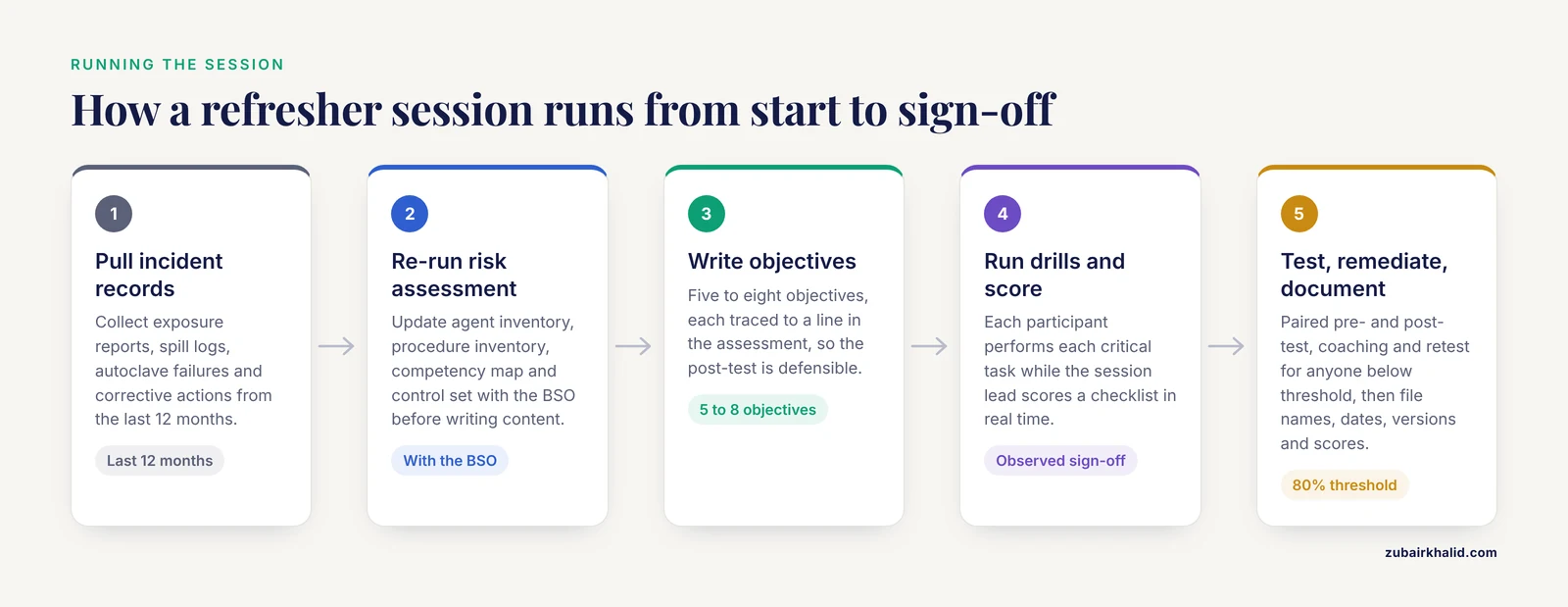
The sequence below assumes one session lead (the BSO or a designated senior technologist), one room with stations, and a group of 6 to 15 participants. Larger groups split into rotations.
- Pull the last 12 months of incident and near-miss records. Collect exposure reports, spill logs, autoclave failures, and corrective actions from the previous cycle. Reason: local events are the highest-value content in any refresher, and staff remember the spill that actually happened in their lab far better than a generic case study.
- Re-run the biosafety risk assessment with the BSO. Update the agent inventory, procedure inventory, competency map, and control set. Reason: training built on last year's assessment teaches last year's lab, and an outdated assessment is itself a finding during an inspection.
- Write five to eight learning objectives. A working example set: select the correct PPE for a named task, respond to a spill using the posted SOP and the label contact time, load and verify an autoclave run with indicators, segregate waste streams correctly, and describe first-response steps after an exposure. Reason: objectives cap the scope, keep the session inside its time budget, and make the post-test defensible because every question maps to a stated objective.
- Choose the delivery format. A workable default is a short on-demand knowledge module completed before the session, followed by one in-person drill day. Reason: on-demand delivery matches how most programs actually run BSL-2 training, and it protects scarce bench time for the hands-on component that benchmarking shows is most often missing [2].
- Build the pre-test. Write 10 to 15 questions directly from the objectives, including one scenario question per planned drill. Reason: a baseline exposes individual gaps before content delivery, so the session lead can target teaching time where the group is weakest instead of re-teaching what everyone already knows.
- Set up hands-on stations. The standard set: spill drill, PPE donning and doffing, waste segregation with look-alike items, autoclave loading with chemical and biological indicators, and a BSC work-practice demonstration covering airflow and the arm movements that break containment. Reason: interactive, engaged delivery is the format associated with knowledge retention in structured biosafety workshops [1], and skills such as doffing order cannot be taught on slides.
- Deliver the knowledge core. Cover the updated risk assessment, agent changes since the last cycle, PPE selection by task, spill response with label contact times, decontamination and waste streams, exposure first response and reporting, and access and security rules. Reason: this list maps one-to-one onto the assessment elements, so nothing in the session is content-free and nothing in the assessment goes untaught.
- Run the drills with observed sign-off. Each participant performs each critical task while the session lead scores a checklist. A pass on the spill drill, for example, requires the correct PPE sequence, the correct contact time read from the actual product label, and correct segregation of the cleanup waste. Reason: observation is the only direct evidence of skill. A written test measures recall, and recall is not performance under time pressure.
- Administer the post-test. Use the same questions as the pre-test plus scenario items that ask participants to apply the objectives. Reason: paired pre- and post-testing is the measurement design used to document knowledge gain in structured biosafety training [1], and it gives the IBC a defensible record of effect rather than attendance alone.
- Remediate and retest. Anyone below the institutional threshold gets one-on-one coaching on the missed objectives and a retest before resuming independent work on the affected tasks. Reason: a refresher that leaves a failed competency unaddressed does not function as a control, it only functions as paperwork.
- Document everything. Record names, dates, curriculum version, test scores, and signed competency checklists in the training file. Reason: the training record is what an IBC or inspector reviews, and an undocumented session carries no weight in a review no matter how well it went.
- Schedule the next cycle and set triggers. Book the annual session and define the events that force an out-of-cycle refresher: a new agent, new equipment, an SOP revision, a spill, an exposure, or a near miss. Reason: time-based refreshers alone can leave a change untaught for up to a year, and trigger-based refreshers close that window.
Practical tips for the session lead
- Open with the lab's own incident data. Ten minutes on the real spill from last March buys more attention than an hour of generic slides.
- Read contact times from the actual product labels during the drill, and have participants do the same. Most wrong contact times come from habit, not from ignorance.
- Keep each station under 15 minutes and rotate in small groups so nobody queues.
- Score checklists in real time at the station. Reconstructed sign-offs are the weakest records in the file.
- Close the session by updating the competency map while everyone is still in the room, so expirations are recorded correctly from the start.
Assessment Controls and Expected Results
A refresher program needs the same discipline a bench assay needs: defined controls, defined readouts, and criteria for judging them. Four controls do the work.
The paired pre- and post-test is the knowledge control. The observed competency checklist is the skill control. The drill performance standards, written before the session, are the applied control. The documentation audit, done after the session, is the record control. Each control answers a different question, and no single one covers the others.
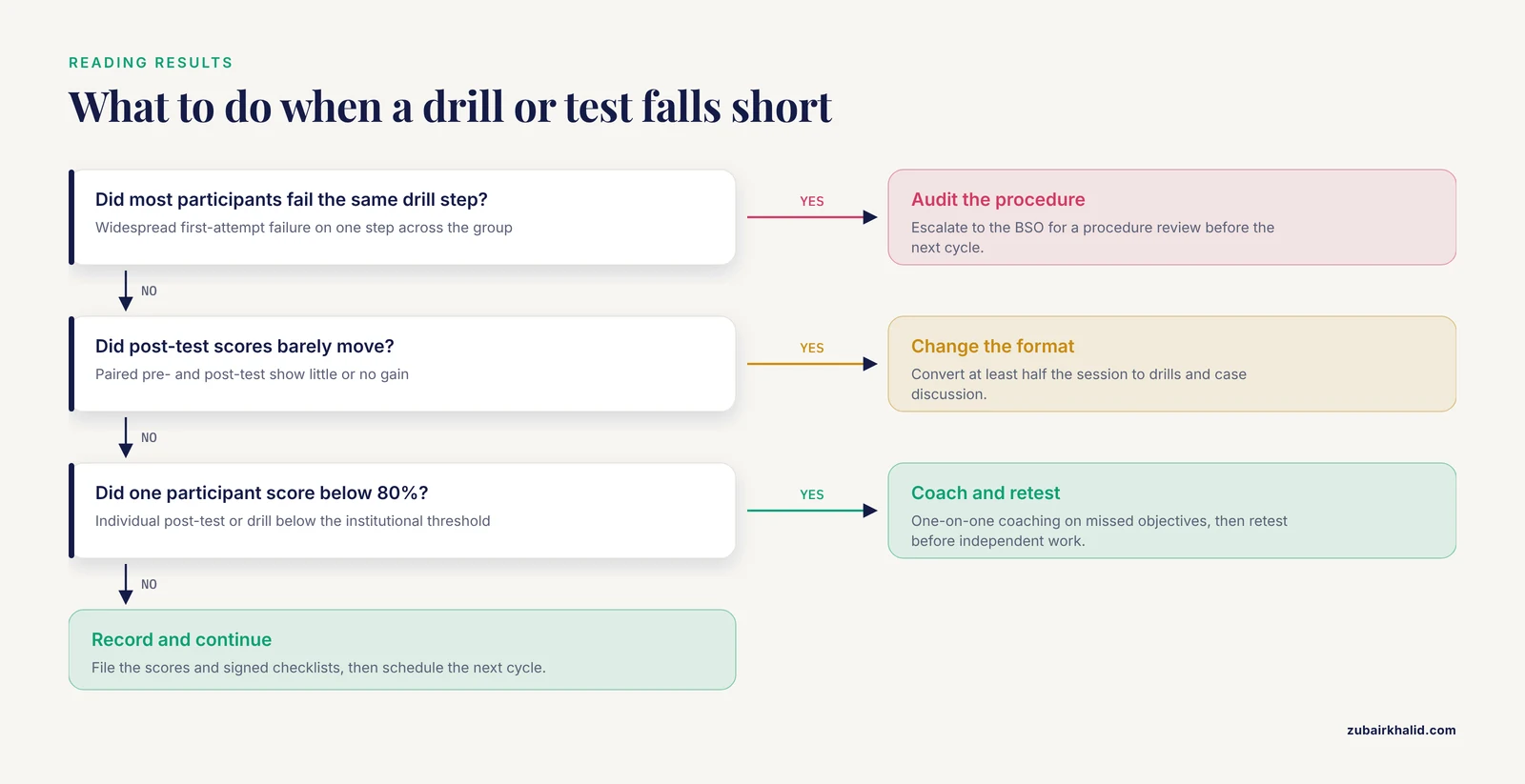
Expected results and how to read them follow a pattern. Post-test gains should concentrate on the session objectives, which tells you the content matched the gaps. Flat post-test scores point to a delivery problem, usually a passive format, rather than to a staff problem. First-attempt passes on drills by most participants indicate current skills. Widespread first-attempt failure on the same step points to an SOP problem rather than a training problem, because a whole group failing one step usually means the step is unclear or the procedure changed without documentation. A short remediation list indicates the targeted content worked. Complete records mean the program survives an audit. If the institutional threshold is 80%, a participant scoring 70% on the post-test goes to remediation on the missed objectives, not to a general warning.
Paired analysis is what turns these observations into evidence. The GLLP workshops used paired pre- and post-assessments specifically to measure knowledge gain rather than satisfaction [1], and the same design scales down to a single lab session without added cost.
Two limits of measurement are worth stating to the group. Test scores capture recall, not attitude or safety culture. Observation captures the drill day, not daily behavior. Both limits are the reason trigger-based refreshers and unannounced spot checks belong in the program alongside the annual session.
Troubleshooting a Refresher Program
| Symptom | Likely cause | Fix |
|---|---|---|
| Post-test scores barely move | Passive lecture format with no interaction | Convert at least half the session to drills and case discussion, the format linked to retention in structured biosafety training |
| Participants pass the test but fail the drills | On-demand theory with no practice | Add an in-person drill day, since in-person components do not guarantee hands-on exercises |
| The session overruns and staff rush | Too many objectives in one block | Split the core into two short modules across two weeks |
| The spill drill uses the wrong contact time | Label not visible at the point of use | Post the contact time on the spill kit and at the bench, then re-test |
| The autoclave station gets skipped for time | No indicators on hand | Stock chemical and biological indicators inside the training kit and check them each cycle |
| Records lack dates, versions, or scores | Paper sign-in sheets only | Move to a log that captures curriculum version, date, trainer, and score per person |
| Attendance drops year over year | Fixed sessions collide with shift coverage | Keep the knowledge core on demand and protect only the drill day |
| Experienced staff treat the session as a formality | Generic content disconnected from their bench | Open with the lab's own incident data and score against the lab's actual SOPs |
| The same competency fails every year | The SOP or the equipment is the problem, not the staff | Escalate to the BSO for a procedure review before the next cycle |
One pattern deserves emphasis. When the same step fails across multiple people and multiple cycles, stop retraining and audit the procedure. Repeated failure at one step is a design signal, and the fix is usually a clearer SOP, better labeling, or an equipment change rather than another lecture.
Program Variations
The default design above flexes into several formats without changing the underlying structure.
On-demand core with drill days. The knowledge module runs online and on demand, and the drill day runs on a fixed calendar. This combination fits shift work and matches how most institutions deliver BSL-2 content while preserving the hands-on element that benchmarking shows is most often absent [2].
Tabletop exercises. For supervisors, safety officers, and emergency-response roles, walk through a scenario on paper: a sharps injury during a spill cleanup, with decisions mapped at each branch. Tabletops test decision-making and reporting chains that bench drills do not reach.
Post-incident refreshers. Within days of a spill or exposure, run a 20 to 30 minute targeted session on the failed step. The event supplies the attention, and the short interval supplies the retention.
New-agent and new-equipment briefings. Out-of-cycle, short, and tied to the specific change. These briefings are the trigger-based layer of the program.
Cross-sector sessions. The GLLP model in Liberia trained personnel from human, animal, and environmental health laboratories together under a One Health approach, which surfaces how specimens, waste, and hazards move between sectors [1]. A hospital lab that receives veterinary or environmental referrals can borrow the format for a joint session with those partners.
BSL-1 teaching and research benches. The frugal-circular framework developed for resource-limited teaching labs shows that BSL-1 content runs on minimal equipment: pressure-cooker sterilization, improvised incubators, documented end-of-session inactivation of all cultures before disposal, and clear biosafety boundaries around organism selection [4]. Clinical labs supporting teaching or research benches can adopt the end-of-session inactivation discipline directly, since the workflow is the same one that keeps a student bench from becoming a reservoir.
Any work above BSL-2 follows institutional program requirements set with the BSO, and those add-on competencies sit outside the general refresher described here.
Records, Retention, and Program Stability
The record set for each cycle is short: roster, curriculum version, objectives, pre- and post-test scores, signed competency checklists, and certificates. Retention length follows institutional policy, and the practical floor is long enough to span accreditation cycles so a surveyor can trace training back through several years. Store records where the IBC or an inspector can retrieve them without a scavenger hunt.
Version control keeps the materials honest. Date every slide deck, handout, and SOP excerpt, and retire old versions from circulation so nobody trains from a stale deck found in a shared drive. When an SOP changes mid-cycle, note the change in the next session's materials so the refresher explains the difference rather than contradicting the bench.
The physical kit has its own stability rules. Bleach solution is prepared fresh on the day of the session and discarded at the end of the day, because diluted hypochlorite loses strength in storage, especially in light and heat. Ethanol and isopropanol live in a flammables cabinet between sessions. Chemical and biological indicators are checked for expiry before every cycle, and the spill kit is resealed and restocked after each drill so the next session starts complete.
Common Mistakes and Limitations
The most common mistakes in biosafety refresher training are predictable, which makes them fixable in advance.
- Treating the refresher as paperwork. Sign-off without engagement produces records that look complete while skills drift underneath them. The record is the output, not the goal.
- Lecture-only delivery. Knowledge without observed practice leaves spill response, doffing order, and autoclave technique unverified, and benchmarking shows this is the default state at many institutions.
- Generic content. A deck borrowed from another institution teaches another institution's risks. Score against local SOPs and local incidents.
- No measurement. Without a pre-test, gaps stay invisible. Without a post-test, the program cannot show effect, and the IBC gets attendance instead of evidence.
- Forgetting non-bench personnel. Phlebotomy, collection, housekeeping, facilities, students, and visiting researchers all need coverage matched to their access, and they are the groups most often left off the roster.
- Ignoring chemical and physical hazards in the same workflow. Fixatives, preservatives, disinfectants, and preserved materials carry their own exposure routes alongside the biological ones, and a biological-only curriculum misses them.
- Letting certifications drift out of sync. Respirator fit testing and any other certified competency should renew on the same calendar as the refresher so records stay aligned and nobody works with an expired fit test beside a current training certificate.
- Relying on the annual session alone. Without trigger-based refreshers, a new agent introduced in January waits until the next annual date for coverage.
- Skipping documentation details. Missing versions, dates, or scores turn a real session into an unauditable one, which is functionally the same as not running it.
One limitation frames the whole guide. The program design above covers structure and process, not agent-specific protocols. Decisions about individual exposures, agent reclassification, respiratory protection, and medical follow-up belong to the BSO and occupational health, who can see the actual bench, the actual agent, and the actual records. Use this guide to build the cycle, and route individual cases to the people accountable for them.
Frequently Asked Questions
How often should microbiology staff complete biosafety refresher training?
Most institutions use an annual cycle, with an additional session whenever a spill, exposure, new agent, new instrument, or SOP revision creates a gap the annual calendar will not cover.
How long should a refresher session run?
Keep the knowledge core short enough to finish in one sitting, roughly one to two hours, and move skills practice into a separate drill block so neither part gets cut for time.
What topics belong in every refresher?
Risk assessment updates, PPE selection and doffing, spill response with label contact times, decontamination and waste segregation, exposure first response, and any SOP that changed since the last session.
Is online training sufficient on its own?
No. Online modules work well as the knowledge core, but spill response, PPE technique, and autoclave practice need observed, hands-on verification before they count as current.
Who must attend refresher training?
Everyone with laboratory access, including students, visiting researchers, phlebotomy and collection staff, housekeeping, and facilities personnel who enter or support the lab.
What records prove that refresher training happened?
A signed competency checklist per participant, pre- and post-test scores, the curriculum version, the session date, and the trainer's name, all filed where an IBC or inspector can retrieve them.
What happens if someone fails the post-test or a drill?
They get one-on-one coaching on the missed objectives and a retest, and they should not resume the affected task independently until they pass.
How do I start a refresher program from scratch?
Start with a biosafety risk assessment, write objectives from its findings, run one short interactive session with hands-on drills, document everything, and set an annual date plus trigger events.
Sources
- Strengthening laboratory biosafety in Liberia during the COVID-19 pandemic: Experience from the Global Laboratory Leadership Programme.
- Biosafety Level 2 Training Programs at Institutions of Higher Learning in the United States.
- Biosafety implications of cadaver preservation methods in veterinary anatomy education.
- Eco-Microbiology: A Frugal-Circular Framework for Biosafe, Low-Cost Practical Microbiology in Secondary Education.