Biosafety Record Keeping Requirements: Step-by-Step Guide
By Dr. Zubair Khalid, DVM, MS, PhD ·

A laboratory that handles pathogenic or genetically modified material must be able to prove, on demand, that it assessed its risks, trained its people, maintained its equipment, and responded to its incidents. Biosafety record keeping is the discipline that produces that proof. A functioning record keeping system converts day-to-day safety work into dated, retrievable, attributable documents that satisfy institutional biosafety committees, accreditation assessors, and regulators, and it gives the laboratory a defensible memory when staff turnover or an incident investigation demands answers.
This guide walks through biosafety record keeping requirements step by step for a microbiology laboratory, from the first written risk assessment through retention and disposal of the records themselves. It applies to clinical microbiology benches, research laboratories, and core facilities that handle biological agents, patient specimens, recombinant organisms, or shipped infectious substances.
When to use this guide. Use it when standing up a new laboratory, preparing for an accreditation or biosafety inspection, inheriting a records system from a predecessor, or rebuilding a system that has drifted into shoeboxes and unshared spreadsheets.
Time commitment. Building a complete record keeping framework for a single laboratory takes roughly 40 to 60 hours of hands-on work spread over 4 to 8 weeks, mostly front-loaded in the inventory and template phases. Sustaining it afterward requires about 4 to 8 hours per month for a mid-sized laboratory, concentrated in monthly logging, quarterly training reconciliation, and an annual document review. The effort falls sharply once templates and responsibilities are in place.
Principle: Why Records Are the Backbone of a Biosafety Program
Biosafety is the set of practices, containment measures, and training that protect laboratory workers, the public, and the environment from exposure to biological hazards. A biosafety program performs four continuous activities: risk assessment, routine surveillance of equipment and practices, training, and incident response. Each of those activities only counts, from a compliance standpoint, if it is documented [1].
The most useful way to think about records comes from the public health logic model that biosafety professionals use to describe their programs. Inputs are staffing and budget. Activities are the risk assessments, surveillance rounds, training sessions, and incident responses the program performs. Outcomes are the reported exposures, injuries, compliance findings, and inspection results that follow. Records are what connect the three. Without captured activity data, a program cannot demonstrate to leadership that prevention is happening, which is a genuine communication problem in a profession where, on a good day, nothing bad happens and there is nothing visible to show for it [1].
Records also carry legal weight that varies with the agent. Work with biological select agents and toxins (BSAT), a US regulatory category of high-consequence pathogens and toxins, requires documented pre-access suitability assessments and ongoing personnel evaluations in addition to the Federal Bureau of Investigation Security Risk Assessment, and those assessments must exist as records that can be produced on request [2]. Facilities working with genetically modified organisms under national biosafety frameworks face parallel obligations, and field experience shows that routine laboratory record keeping is rarely sufficient on its own. When Burkina Faso's first insectary prepared to import transgenic mosquitoes, the team established record keeping beyond routine practice specifically to maintain evidence related to regulatory requirements and the assumptions underlying their risk assessments, because the permitting agency required that evidence [3].
Finally, records protect the laboratory itself. Comparative analyses of national biosafety legal frameworks show that where oversight is decentralized and documentation requirements are inconsistent, compliance becomes variable and gaps emerge that directly affect preparedness for emerging infectious disease work [4]. A laboratory that keeps its own rigorous records is insulated from that variability.
Materials and Tools for Biosafety Record Keeping
You do not need specialized software to start, though digital tools help at scale. The materials table below lists the record categories that form the minimum framework for a microbiology laboratory, the tool that typically houses each one, and who owns it.
| Record category | Core contents | Typical tool or format | Record owner | Review cycle |
|---|---|---|---|---|
| Risk assessments | Agent, procedure, routes of exposure, controls, residual risk, approval date | Risk assessment template, institutional IBC protocol file | Biosafety officer and laboratory supervisor | At protocol initiation and on any process change |
| Training records | Curriculum, dates, trainer, assessment method, competency results | Learning management system or signed training log | Training coordinator | Reconciled quarterly, audited annually |
| Personnel suitability records | Pre-access screening, ongoing evaluation, security risk assessment status | Restricted-access personnel file | Program manager or reliability officer | Ongoing per access level |
| Inventory records | Agent or organism name, source, quantity, location, transfer and disposal dates | Electronic inventory system or controlled register | Laboratory supervisor | Continuous, verified monthly |
| Equipment certification | Biological safety cabinet and autoclave certification dates, repairs, failures | Certification certificates plus equipment log | Facilities or biosafety officer | Annual certification, monthly log entries |
| Incident and exposure reports | Event narrative, root cause, corrective actions, closure date | Incident reporting system | Biosafety officer | Filed within 24 hours, closed and reviewed quarterly |
| Medical surveillance | Immunization status, tuberculin skin test or equivalent screening results, occupational health clearance | Confidential occupational health file, separate from laboratory records | Occupational health service | Per institutional schedule |
| Shipping and transport | Shipper training certificates, packing records, dangerous goods declarations | Shipping binder or digital folder | Designated shipping coordinator | Per shipment, certificates renewed on schedule |
| Equipment maintenance and calibration | Autoclave cycles, incubator and refrigerator temperature logs, centrifuge safety checks | Bench logbooks, digital monitoring systems | Assigned bench staff | Daily to monthly depending on instrument |
| Inspection and audit findings | Findings, responsible parties, corrective actions, closure verification | Audit report file with corrective action tracker | Biosafety officer or quality manager | Semiannual internal audit |
Biosafety Record Keeping Requirements Step by Step
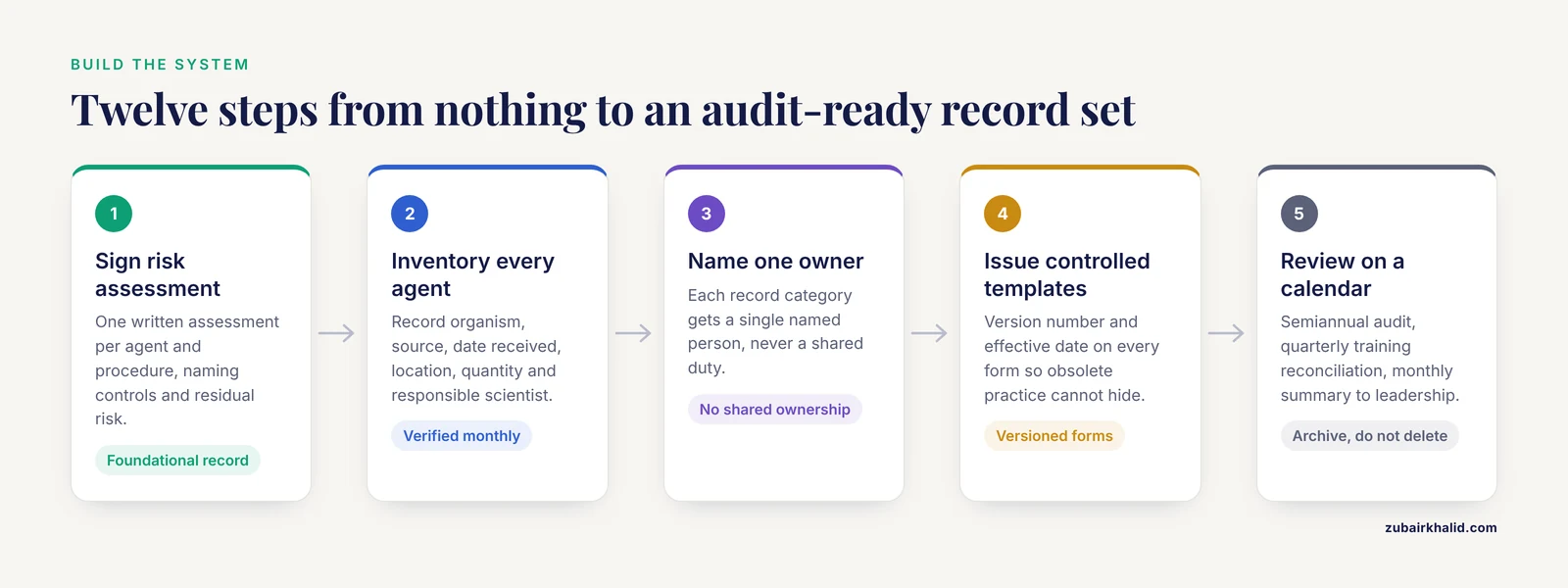
The following twelve steps build the system from nothing. Each step includes the reason it matters, because understanding the reason is what keeps a records system alive after the initial enthusiasm fades.
- Perform and sign a written biosafety risk assessment for every agent-procedure combination in the laboratory. The biosafety risk assessment is the foundational record from which every other record derives. It identifies the agent, the procedural hazards, the routes of exposure, the containment level, and the controls that reduce risk to an acceptable level. Reason: training curricula, personal protective equipment requirements, containment specifications, and inventory controls are all traceable back to this document, and an inspector will ask you to show the chain.
- Inventory every biological agent, cell line, and recombinant construct held by the laboratory. Record the organism, the source, the date received, the location, the quantity, and the responsible scientist. Reason: you cannot write a risk assessment for an agent you have not inventoried, and transfers or disposals that are not recorded leave orphaned stocks that surface during inspections as unaccounted-for material.
- Map every regulatory and institutional requirement that applies to your laboratory. List what your institutional biosafety committee, accreditation body, occupational health service, and shipping regulators each require you to document. Reason: requirements differ by agent and activity, and a written map prevents the most common failure mode, which is discovering an unmet documentation obligation during an inspection rather than before it. Institutions with decentralized or fragmented oversight show variable adherence to compliance standards precisely because no one performed this mapping [4].
- Assign a named owner to each record category. One person, by name, owns each row of the materials table above. Reason: shared ownership is no ownership. When a record lapses, the owner is the person who gets the reminder, and the person who answers for the gap.
- Create controlled templates with version numbers and effective dates. Build a template for the risk assessment, the training log, the incident report, the monthly equipment log, and the audit checklist. Give each a document identifier, a version number, and an effective date. Reason: undated, unversioned forms allow obsolete practices to persist invisibly. A version number lets an auditor confirm that the form in use matches the current approved procedure.
- Establish the training record system before the first new employee arrives. For each person, record the orientation date, the biosafety curriculum completed, the assessment method used, the score or competency determination, and the refresher schedule. Reason: training documentation is the record inspectors check first, and surveys of clinical laboratories show why it cannot be assumed. In a cross-sectional study of laboratory professionals, only 18.5 percent had received biosafety training, and emergency preparedness adherence was similarly low at 34.6 percent, even while day-to-day work habits such as handwashing and mechanical pipette use exceeded 95 percent compliance [5]. Routine practice looks safe on the floor and still fails the documentation test.
- Align training records with a documented needs assessment. Base the curriculum on the hazards identified in step 1, and structure it as a lifecycle: identification of hazards, curriculum development aligned to those hazards, delivery, competency verification, refresher scheduling, and periodic program improvement [6]. Reason: a training log that records attendance without recording competency verification is a weak record, because it shows the session happened but not that the worker can perform safely.
- Set up personnel reliability and access records for restricted work. If your laboratory works with high-consequence agents, document pre-access suitability assessments, ongoing evaluations, and security risk assessment status for every individual with access. Institutions working with biological select agents and toxins have shown that a formal personnel reliability program, built on documented evaluations, both maintains regulatory compliance and actively drives a culture of responsibility among staff [2]. Reason: access records are the only proof that only assessed, authorized people ever entered the containment space.
- Record incidents and near misses within 24 hours, and close them out in writing. Every spill, exposure, sharps injury, containment failure, and near miss gets an entry with the narrative, the root cause, the corrective action, the responsible person, and a closure date. Reason: incomplete incident records are worse than none in an investigation, because they suggest awareness of a hazard followed by inaction.
- Log equipment certification and maintenance against a fixed schedule. Biological safety cabinets are certified annually and after any move. Autoclaves are validated with cycle records. Refrigerators and freezers holding specimens are logged daily or continuously monitored. Reason: equipment records prove the engineering controls named in your risk assessments actually functioned during the period in question.
- Verify shipping and transport documentation for every movement of infectious material. Keep shipper training certificates current, and retain packing records and dangerous goods declarations for each shipment. Reason: transport compliance is chronically underdocumented. In a two-year national assessment of infectious substance shipping in Pakistan, only 1.29 percent of surveyed institutions offered any training in this domain, which means most shippers could not have produced a compliant training record [7].
- Review, archive, and report on a fixed calendar. Run a semiannual internal audit against your own checklist, reconcile training records quarterly, submit a monthly activity summary to your safety committee or leadership, and archive superseded documents rather than deleting them. Reason: a records system that no one reviews decays silently, and a program that never summarizes its activity data loses the ability to show leadership what the program does and what resources it needs [1].
Training and Competency Records for Microbiology Biosafety Training
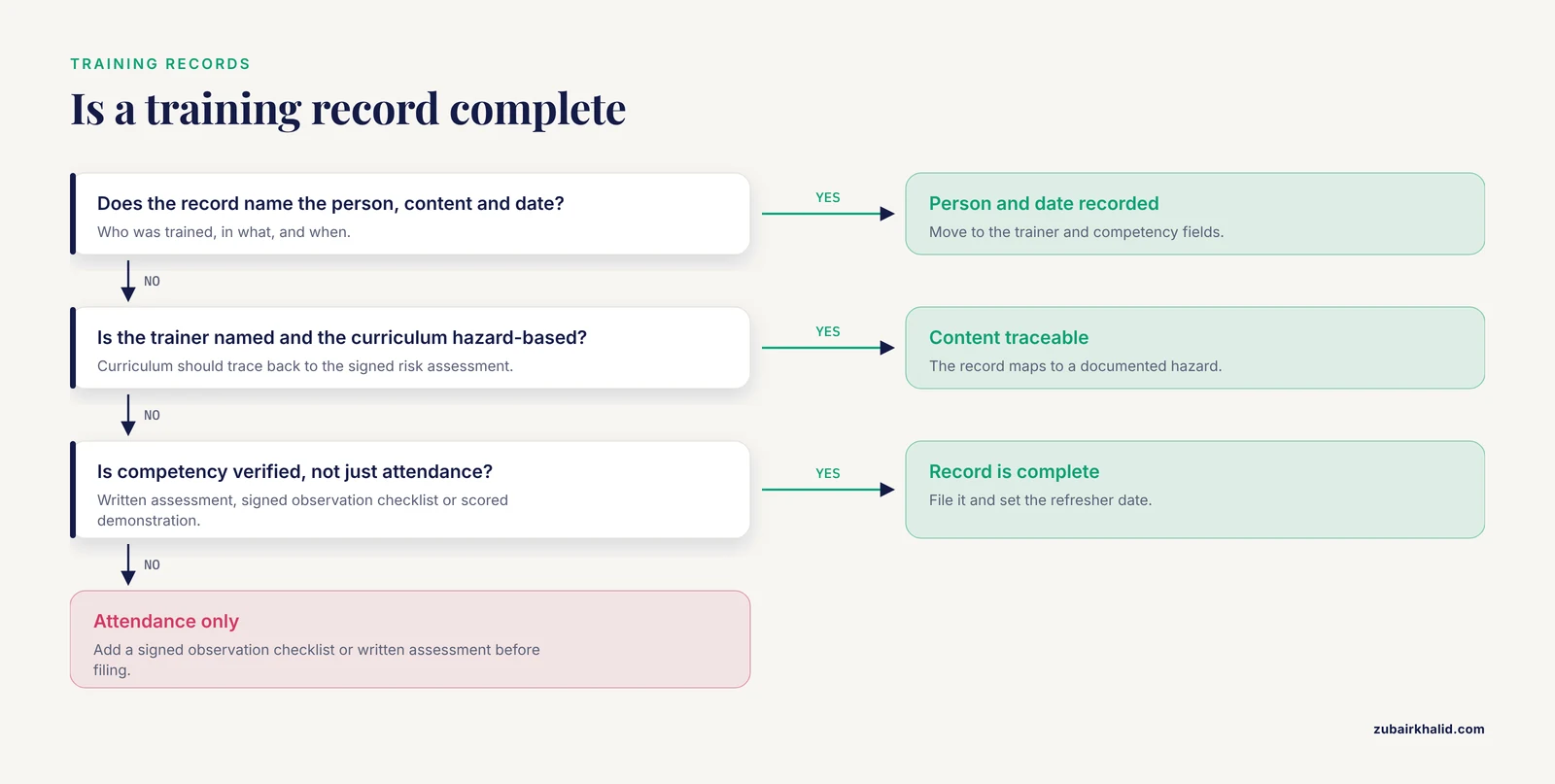
Training records deserve their own treatment because they are the most frequently requested and most frequently deficient record category in microbiology laboratories.
A compliant training record contains five elements: who was trained, in what, when, by whom, and with what verification of competency. Attendance sheets alone do not satisfy the fifth element. Acceptable verification includes a written assessment, a direct observation checklist signed by the trainer, or a practical demonstration scored against defined criteria.
Structure the curriculum from the hazard assessment rather than from a generic list. A formal process for identifying and documenting workplace hazards, then building the training curriculum aligned to those hazards, is the recognized backbone of a sustainable safety training program [6]. For microbiology, the hazard-derived curriculum typically covers standard precautions, biological safety cabinet use, decontamination and spill response, sharps handling, specimen packing and shipping, and agent-specific hazards identified in the risk assessments.
Cross-training strengthens the record base. Biosafety staff in particular encounter hazards well beyond infectious agents, including chemical, radiological, and physical hazards in the same laboratory space. One academic health institution codified this by having a focus group of safety specialists from multiple disciplines develop a list of 50 basic health and safety items that any safety specialist should know, then used that list as the formal basis for cross-training. Staff responded positively and overall compliance with health and safety expectations improved across the institution [8]. The lesson for record keeping is that the knowledge expectations themselves should be written down, versioned, and used as the reference for what each training record must demonstrate.
Where the training obligation is regulator-defined, the record must map to the regulation. Shippers of infectious substances fall under International Air Transport Association dangerous goods rules, and the record requirement is a current, role-specific training certificate that can be shown to a carrier or inspector [7].
Surveillance and Medical Surveillance Records
Two record streams sit partially outside the laboratory but remain biosafety obligations, and both are chronically underdocumented.
Medical surveillance records document immunization status, screening for occupationally relevant infections such as tuberculosis, and clearance for work with specific agents. These records must be held confidentially, typically in the occupational health service rather than the laboratory, with the laboratory retaining only clearance status. The compliance problem is real and measurable. In a large survey of healthcare students in a tuberculosis-endemic setting, the non-compliance rate with the tuberculin skin test exceeded 40 percent even among individuals at higher risk, and unvaccinated individuals were significantly less likely to comply with surveillance, with an odds ratio of 3.33 [9]. The record keeping lesson is that surveillance programs need their own tracked roster, reminder system, and completion log, because relying on individuals to self-present produces precisely this failure rate.
Emergency preparedness and response records document spill kits, eyewash checks, evacuation drills, and exposure response procedures. These were among the weakest documentation areas in the clinical laboratory survey cited above, at 34.6 percent adherence [5], which indicates that laboratories routinely operate with strong daily habits but weak preparedness paper.
Digital Tools and Automation in Biosafety Record Keeping
Paper systems work but do not scale, and digitalization solves three specific record keeping problems: version control, shared access, and automated risk evaluation.
A useful recent example is GMOCU, a free Python-based tool for digital documentation and biological risk assessment of genetic parts and genetically modified organisms. It unifies internal documentation of bioparts, automates biological risk evaluations, maintains a shared up-to-date inventory for team-wide navigation, and exports data into customizable formats suitable for scientific publications and official biosafety documents. The tool was developed precisely because academic researchers otherwise bear inconsistent and redundant documentation regimes and a significant time and labor burden [10]. The design pattern transfers to any microbiology laboratory: one shared inventory, risk evaluations generated from the inventory entries rather than rewritten by hand, and export functions that produce regulator-ready output.
At the program level, digital dashboards solve the visibility problem. Collecting biosafety program activity data monthly and displaying it systematically lets leadership and safety committees grasp the scope of program activities at a glance, which in turn supports the resource requests that keep the program functioning [1].
Digital records carry their own requirements. A compliant electronic system needs access control, audit trails showing who changed what and when, backup, and a defined export format for records that must leave the system. An electronic record that cannot be produced in readable form during an inspection does not count as a record.
Controls: How to Verify Your Records Are Audit-Ready
In record keeping, the control is the audit. Treat your own records the way an external inspector would.
Run a semiannual internal audit using a checklist derived from the materials table above. For each record category, sample three entries and verify four properties: the record exists, it is dated and signed or attributable, it is the current version of the form, and it is retrievable within five minutes. Any entry failing one of the four properties generates a corrective action with a named owner and a closure date.
Add traceability testing to the audit. Pick one stored vial at random and walk its paper trail backward through inventory, risk assessment, approval, and training of the person who last handled it. A laboratory with genuine records can complete this walk in minutes. A laboratory with decorative records cannot.
Know where your institutional review structure sits so records flow to the right committee. Survey data show that Institutional Biosafety Committees most commonly reside under the same administrative unit as animal care and human subjects committees, while biosafety officers more often report through a different unit, and that IBCs typically review biological hazards beyond the minimum required by the NIH Guidelines. Support staffing is thin, with 57 percent of institutions reporting one or more full-time employees dedicated to the IBC, compared to 83 to 86 percent for the other review committees [11]. The practical implication is that your IBC records must be self-explanatory and well organized, because the committee reviewing them likely has less administrative support than any other oversight body on campus.
Expected Results: What a Compliant Records System Looks Like
When the system is working, an inspector's document request is a five-minute exercise rather than a week of scrambling. The observable signs are consistent across laboratories.
Every agent in the freezer has a matching risk assessment and inventory entry. Every person on the roster has a current training record with documented competency, and the quarterly reconciliation shows zero untrained personnel on the bench. Every biological safety cabinet certificate on the wall matches an entry in the equipment log. Every incident in the last year has a closed corrective action. The monthly activity summary exists for every month of the year, and the leadership report shows activities, exposures, and compliance status side by side [1]. Superseded documents live in the archive, not the trash, and no record in the active system is more than one review cycle old.
Troubleshooting Common Record Keeping Failures
| Symptom | Likely cause | Fix |
|---|---|---|
| Training records exist but contain no competency verification | Training treated as attendance rather than assessment | Add a signed observation checklist or written assessment to every training event |
| Inventory lists agents that cannot be found, or bench stocks appear on no list | Transfers and disposals not recorded in real time | Make the inventory entry a required step in the transfer and disposal procedures, verify monthly |
| Risk assessments are years old and no longer match bench practice | No trigger linking process changes to assessment updates | Add an automatic reassessment trigger to the protocol amendment process and to the annual review |
| Incident reports stop at the narrative, with no corrective action | No closure workflow | Add a mandatory closure field with owner and date, review open items quarterly |
| Records scattered across personal drives, bench drawers, and email | No designated system of record | Designate one authoritative location per record category, migrate or archive everything else |
| Certification certificates on the wall do not match equipment logs | Certification treated as a facilities task with no laboratory-side record | Enter every certification date into the laboratory equipment log on receipt |
| Records lost when a staff member departs | Personal ownership without institutional custody | Transfer custody formally at departure, verify during the exit checklist |
| Supervisor cannot produce surveillance compliance status for the team | No tracked roster or reminder system for medical surveillance | Maintain a surveillance roster in coordination with occupational health, with completion dates per person |
Variations by Laboratory Type and Circumstance
The twelve-step framework scales up and down with containment level and agent type, but the record categories that change most are personnel records, inventory granularity, and external reporting.
Small clinical microbiology laboratories. A hospital bench can run the entire framework from a single controlled binder or shared drive with the biosafety officer as the owner of most categories. The critical records are the risk assessments for the specimen types handled, the annual training and competency records, the equipment certification logs, and the exposure incident file.
High-containment and select agent laboratories. Personnel records expand substantially. Pre-access suitability assessments, ongoing evaluations, and security risk assessments become mandatory, documented, and auditable, and the personnel reliability program itself becomes a driver of safety culture rather than a bureaucratic layer [2].
Genetic engineering and transgenic organism work. Inventory and risk assessment records must satisfy the separate biotechnology regulatory framework in addition to institutional requirements, and permits for import or possession become part of the record set. The Burkina Faso transgenic mosquito insectary shows the pattern clearly: adapted biosafety framework, National Biosafety Agency permits on file, and record keeping established beyond routine practice to preserve evidence of regulatory compliance and risk assumptions [3].
Pandemic and surge conditions. Records during a crisis follow a three-way split. Some routine activities are temporarily diminished, some must continue despite shutdowns for safety and compliance purposes, and a third group increases dramatically in volume and novelty. Cataloging which tasks fell into which category during COVID-19, and documenting the adjustments as they were made, produces a template that makes the next surge response faster and better documented [12]. The record keeping rule during any pivot is to document the decision to suspend, continue, or expand each activity at the moment it is made, not in retrospect.
Storage, Retention, and Stability of Records
Records have a storage and stability profile just like reagents, and the same discipline applies.
Active records belong in one designated location per category, with controlled access for personnel and medical records. Backup for electronic systems follows the standard three-copy rule, with at least one copy offsite or in cloud storage, and backup restoration tested annually, because an untested backup is a hope rather than a control.
Retention periods vary by record type and by the regulations binding your institution, so confirm the specific periods with your biosafety officer and legal counsel. As working practice, training records, risk assessments, inventory histories, incident reports, and equipment certification records are retained for several years at minimum, with select agent and high-consequence program records retained longer under their specific regulatory requirements. Archive superseded versions with their effective dates intact, because an auditor may need to know what version of a procedure was in force on the date of an incident.
Destruction follows a documented schedule as well. Dispose of expired records under a written retention policy that records what was destroyed, when, and by whose authorization. A records system with no destruction schedule grows until it becomes unusable, and an unexplained gap where records should exist is more damaging during an investigation than a documented, authorized disposal.
One safety note on the records themselves. Records that contain patient identifiers or agent details are sensitive documents. Store personnel medical records separately from laboratory records with restricted access, and treat any record linking a named individual to an exposure event as confidential.
Tips for Sustaining Biosafety Record Keeping Compliance
The difference between a system that survives five years and one that dies in eight months is almost always workflow design rather than diligence.
Tip 1. Make the record a step in the workflow, not a task after it. The inventory entry happens when the vial arrives, the training record closes when the competency check passes, the incident report files the day of the event. Records generated as byproducts of work persist. Records generated as extra homework do not.
Tip 2. Standardize before you digitalize. Automating a chaotic paper system produces chaotic digital records. Fix the templates and the ownership first, then move the controlled versions into a tool.
Tip 3. Report upward monthly. A one-page monthly summary of activities, incidents, and training keeps leadership engaged and keeps the program visible. This is the practice that lets a biosafety program make the case for resources when, on a good day, nothing bad happens to point to [1].
Tip 4. Write down the knowledge expectations. A codified list of what every safety-trained person must know, like the 50-item list developed at one academic health institution, turns training from a vague obligation into a checkable standard [8].
Tip 5. Schedule the audit before the inspector does. Semiannual self-audits with corrective action tracking convert findings into fixed deficiencies on your own timeline rather than citations on someone else's.
Common Mistakes and Limitations
These are the failures seen most often when biosafety record keeping systems are audited, and each one is avoidable at the design stage.
Recording attendance instead of competency. The most common training record deficiency. A signed sign-in sheet proves presence, not ability, and inspectors read the difference immediately.
Letting risk assessments fossilize. A risk assessment written at protocol inception and never revisited does not describe the laboratory currently operating. Build the reassessment trigger into protocol amendments and the annual review cycle.
Keeping medical surveillance records in the laboratory. Immunization and screening records belong with occupational health. Laboratories that hold them commingled with bench records create both a confidentiality violation and a records management problem. The low observed immunization coverage in clinical laboratory surveys, at 43.2 percent of participants appropriately immunized, shows how easily this stream falls through organizational cracks when no one owns it [5].
Confusing institutional approval with laboratory documentation. An approved IBC protocol is not a substitute for the laboratory's own risk assessment, inventory, and training records. The committee approval and the local records must corroborate each other.
Treating shipping documentation as a one-time certificate. Shipper training has a renewal cycle, and each shipment generates its own packing and declaration records. Only 1.29 percent of institutions in one national survey offered shipping-related training at all, so treat a current shipping training record as a genuine competitive distinction among staff rather than a formality [7].
No closure discipline on corrective actions. An incident report without a closed corrective action is an open liability. Track open items to zero.
Assuming digital means compliant. An electronic system without access control, audit trails, and tested backup fails an inspection as thoroughly as a missing binder.
Limitation. Specific retention periods, forms, and reporting formats are set by your institution's biosafety program, its accreditation body, and the regulations governing your agents, and they differ across institutions and jurisdictions. This guide defines the framework and the record categories. Individual cases, specific agents, and binding retention periods need review by your institution's biosafety officer or a qualified biosafety professional.
Frequently Asked Questions
What records must a microbiology laboratory keep for biosafety compliance?
At minimum, a laboratory must keep documented biosafety risk assessments, agent and biological material inventories, training and competency records, equipment certification and maintenance logs, incident and exposure reports, medical surveillance clearance records, and shipping documentation for any movement of infectious material. Institutions working with regulated agents add personnel suitability and permit records to this baseline.
How long should biosafety records be retained?
Retention periods are set by the regulations and institutional policies that apply to your specific agents and activities, and they differ by record type, with select agent and high-consequence program records generally retained longer than routine training logs. Confirm the binding periods with your biosafety officer and retain superseded document versions in an archive with their effective dates intact.
What is a biosafety risk assessment record and how detailed must it be?
A biosafety risk assessment record documents the agent, the procedure, the exposure routes, the containment level, the controls in place, and the residual risk after controls, with a dated approval. It must be detailed enough that an independent reviewer can reconstruct why the chosen containment and practices are adequate, and it must be reassessed whenever the procedure, agent, or facility changes.
Who is responsible for biosafety record keeping in a laboratory?
The biosafety officer owns the program-level records and the laboratory supervisor owns bench-level records such as inventory and equipment logs, but every record category needs one named individual as its owner. Shared or unassigned ownership is the leading cause of lapsed records.
How do I document microbiology biosafety training correctly?
Record who was trained, in what content, on what date, by which trainer, and how competency was verified, using a written assessment, a signed observation checklist, or a scored practical demonstration. Attendance alone does not satisfy the requirement, and each record should map to the hazard-based curriculum your risk assessments define.
Are digital record keeping systems acceptable for biosafety records?
Yes, provided the system has access control, audit trails, tested backup, and a defined export format so records can be produced in readable form on request. Digital tools can also automate parts of the work, such as generating biological risk evaluations from a shared inventory and exporting regulator-ready documentation.
What happens during a biosafety inspection if records are missing?
Missing records are documented as findings that typically require a written corrective action plan with deadlines, and gaps in training, inventory, or incident records can escalate to restricted activities or loss of approval depending on the severity and the governing framework. A dated, attributable record produced on the spot is the strongest defense a laboratory has.
How often should biosafety records be reviewed and updated?
Review training records quarterly, verify inventories monthly, audit the full record system semiannually, and reassess risk assessments at every protocol change plus at least annually. Summarize program activity monthly so leadership and safety committees see a current picture of the program.
Sources
- Articulating Biosafety Program Activities in the Context of a Simplified Public Health Logic Model.
- Implementation of a personnel reliability program as a facilitator of biosafety and biosecurity culture in BSL-3 and BSL-4 laboratories.
- Preparing an Insectary in Burkina Faso to Support Research in Genetic Technologies for Malaria Control.
- Comparison of Brazilian High- and Maximum-Containment Laboratories Biosafety and Biosecurity Regulations to Legal Frameworks in the United States and Other Countries: Gaps and Opportunities.
- Biosafety Management Practices Among Clinical Laboratory Professionals in Debre Berhan Town Governmental Hospitals, Ethiopia: A Cross-Sectional Study.
- Establishing and Maintaining a Safety Training Program at Scientific Institutions.
- Enhancing Compliance: Tailored Training on IATA Regulations for Shipping Infectious Substances and Biological Specimens for Targeted Cohorts in Pakistan.
- A Means of Codifying Safety Cross-Training Knowledge Expectations for Biosafety Professionals.
- Non-compliance with health surveillance is a matter of Biosafety: a survey of latent tuberculosis infection in a highly endemic setting.
- GMOCU: Digital Documentation, Management, and Biological Risk Assessment of Genetic Parts.
- The Evolving Landscape of Institutional Biosafety Committees and Biosafety Programs: Results from a National Survey on Organizational Structure, Resources, and Practices.
- Pivoting the Biosafety Program in Response to COVID-19: Recommendations of Key Services and Tasks to Consider for the Next Pandemic.