Biosafety Mitigation Strategies: Options Compared
By Dr. Zubair Khalid, DVM, MS, PhD ·
The core difference between biosafety mitigation strategies is when they act. A biosafety risk assessment decides what could go wrong before work begins, while engineering controls, administrative rules, protective equipment, decontamination, and surveillance act on the exposure itself. The rule of thumb for choosing is to size containment to the procedure you will actually perform, not to the agent's name alone, and to layer at least two independent controls so that no single failure exposes a worker, the public, or the environment.
This guide compares the main options side by side, explains where each earns its place, and walks through worked scenarios from clinical, public health, and environmental microbiology. The audience is bench microbiologists, biosafety officers, and diagnostic laboratory managers who must defend containment decisions to an institutional biosafety committee (IBC), the body that reviews and approves work with biological agents.
What Biosafety Mitigation Means in a Microbiology Laboratory
Biosafety is the discipline that protects laboratory workers, the public, and the environment from exposure to biological agents such as bacteria, viruses, fungi, and parasites. Mitigation means any action that lowers the likelihood of an exposure event or the severity of its consequences. A mitigation strategy is a deliberately selected combination of such actions, not a pile of habits accumulated over the years. Its counterpart, biosecurity, protects the agents themselves from theft, loss, or misuse, and the two disciplines share infrastructure but answer different questions.
Three terms anchor every comparison in this article.
- Hazard is the inherent capacity of an agent to cause harm, driven by pathogenicity, transmissibility, infectious dose, and the availability of vaccines or treatment.
- Risk is the probability that an exposure will occur combined with the severity of its outcome. The same agent carries different risks in different procedures.
- Containment is the combination of facility design, equipment, practices, and training that keeps an agent where it belongs.
Risk groups (RG) classify agents by inherent hazard. Biosafety levels (BSL-1 through BSL-4) describe the containment package applied to the work. The two are related but not identical, and confusing them is the most common source of poor containment decisions. A Risk Group 3 agent handled only as a sealed, inactivated extract does not generate the exposure of the same agent grown to high titer, which is why modern frameworks assign containment by procedure rather than by taxonomy [1].
Biosafety Risk Assessment: The Option That Selects All Others
A biosafety risk assessment is a structured process that identifies the hazards in a planned activity, estimates how likely an exposure is and how severe it would be, and selects controls proportionate to that estimate. Every other option in this article is chosen, scaled, or rejected by this process, which is why assessment counts as a mitigation strategy in its own right.
The field has moved away from fixed agent lists. The WHO Laboratory Biosafety Manual, fourth edition (LBM4), requires risk assessments tailored to specific pathogens, specific activities, and the operational setting in which they are performed, a shift that applies to a district hospital laboratory as much as to a maximum-containment facility [2]. Two operational implementations show how the shift works on the bench.
Semi-Quantitative Risk Matrices
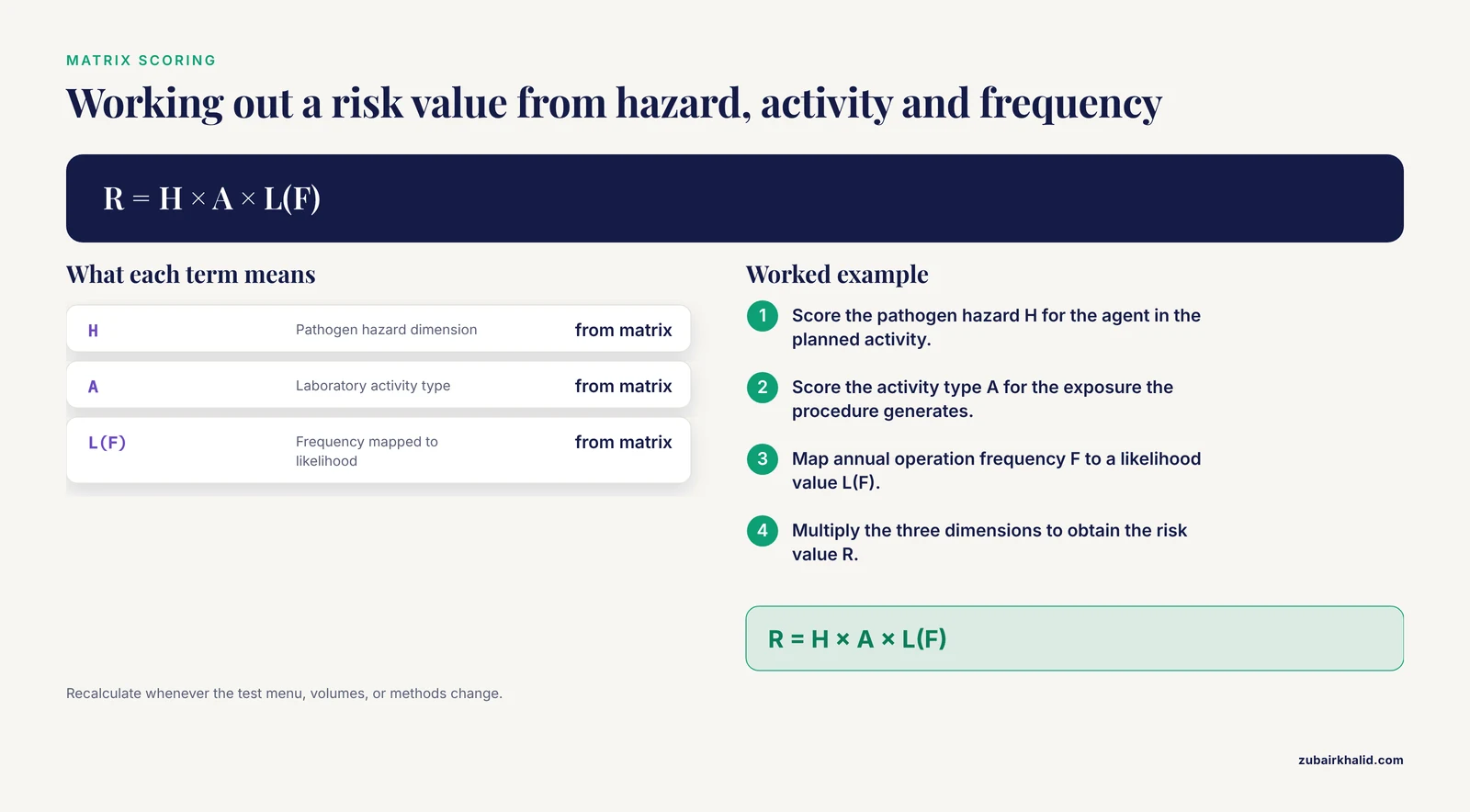
A semi-quantitative matrix converts professional judgment into numbers so that two assessors reach similar conclusions. A validated example from public health laboratories in Beijing uses three dimensions: pathogen hazard (H), laboratory activity type (A), and annual operation frequency (F), combined in the formula R = H × A × L(F), where L(F) maps frequency to the likelihood of an event [3]. The model was verified against real activity data from 16 district-level Centers for Disease Prevention and Control, which performed 130 pathogen tests in 2024, 88% of them involving Category III pathogens under the national hazard classification. Workload intensity varied widely, with only two of the 16 laboratories reporting five or more tests per day in a BSL-2 room, and the matrix flagged one activity as unacceptable, which triggered targeted control measures [3].
The strengths of this approach are reproducibility, auditability, and proportionality. Activities with inactivated and non-infectious materials reached a 100% acceptable-risk rating, the cleanest result in the dataset, which frees supervision and capital for genuinely risky work [3]. The weaknesses are equally concrete: the matrix needs accurate activity and frequency data, and it must be recalculated whenever the test menu, volumes, or methods change.
Procedure-Specific Risk Frameworks
The Procedure-Specific Risk (PSR) framework pushes the same logic further. It is an 8-step operational protocol in which the exposure generated by the procedure, rather than the agent's taxonomy, serves as the primary determinant of containment. The protocol integrates agent risk group classification, procedural exposure characterization, and modulating factors such as staff experience and equipment condition into a biosafety level assignment matrix, supported by a structured assessment template and a freely accessible bilingual digital tool [1]. Its components were derived from ten national and international reference documents, including the WHO LBM4, Biosafety in Microbiological and Biomedical Laboratories (BMBL), 6th edition, and the CDC Biological Risk Assessment guidance of 2024, and the framework reports both content validity and convergent validity evidence [1].
For a working laboratory, the practical value is a defensible paper trail. When an auditor or an IBC member asks why an assay runs at BSL-2 rather than BSL-3, a documented procedure-specific assessment answers with the exposure that assay generates, not with an opinion.
Agent-Based Assessment and Its Limits
Agent characteristics still matter, and they feed the hazard dimension of every assessment. Hendra virus (HeV) and Nipah virus (NiV) are highly pathogenic zoonotic henipaviruses associated with recurrent outbreaks, high case fatality rates, and occupational exposure risks for veterinarians, healthcare workers, and laboratory personnel [2]. Nipah virus adds features that raise concern: an RNA genome replicated without proofreading, which drives genetic diversification, cell entry mediated by glycoprotein binding to ephrin-B2 and ephrin-B3 receptors, and accessory proteins that suppress innate antiviral signaling [4]. Human-to-human transmission remains limited, with basic reproduction numbers generally below unity, although respiratory involvement and healthcare-associated exposure can amplify clusters [4].
Those facts describe the agent. They do not, by themselves, dictate the containment for a given assay. A structured review of henipavirus biosafety evidence concluded that containment decisions must rest on assessments tailored to the pathogen, the activity, and the setting, with particular weight on validated inactivation before material leaves the containment envelope [2]. That is the assessment-first principle in action.
The Hierarchy of Controls: How the Options Are Ordered
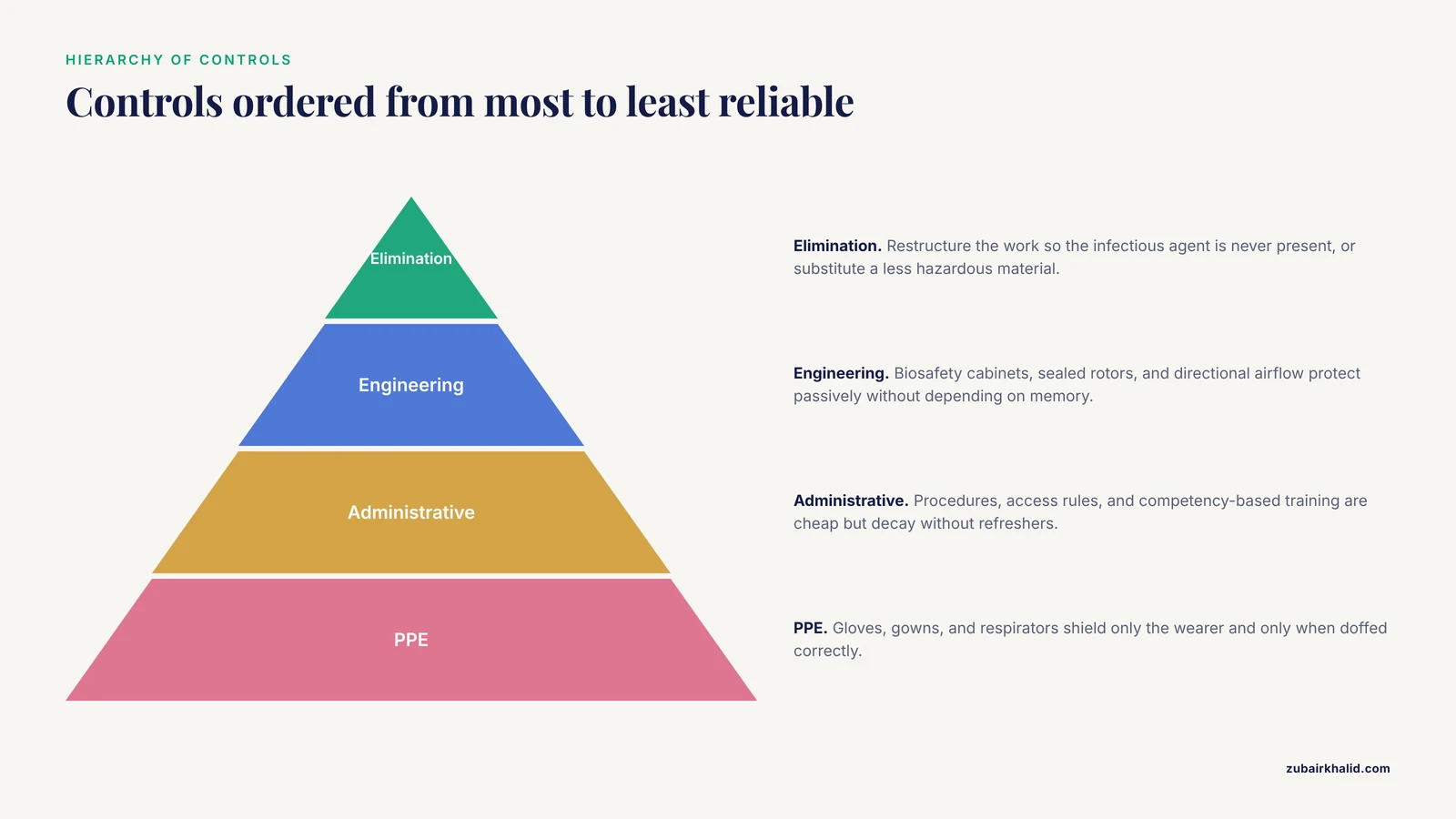
Occupational health organizes mitigation options from most to least reliable, a sequence known as the hierarchy of controls. Elimination and substitution remove or replace the hazard. Engineering controls isolate the worker from the hazard through equipment and facility design. Administrative controls change how people work through procedures, training, and scheduling. Personal protective equipment (PPE) shields the individual worker.
The order reflects failure behavior. Engineering controls protect passively and do not depend on a worker remembering anything during a busy afternoon. Administrative controls are inexpensive but fragile, because they depend on training, attention, and compliance. PPE is indispensable and simultaneously the weakest tier, because it protects only the person wearing it and only when worn correctly. A defensible program uses the highest feasible tier as the backbone and adds the tiers below as redundancy, a design principle called defense in depth.
Biosafety Mitigation Strategies Options: Side-by-Side Comparison
The table compares the eight options on the criteria that decide real choices: what the option controls, where it fits best, and what it costs in money, effort, or fragility.
| Option | What it controls | Best suited for | Key pros | Key cons |
|---|---|---|---|---|
| Structured risk assessment (matrix or procedure-specific) | The decision itself, before work starts | Every new assay, method change, or workload shift | Reproducible, auditable, right-sizes containment, low cost relative to capital controls | Needs accurate activity data, must be updated, judgment-dependent at the margins |
| Elimination and substitution | The hazard at its source | Work that can proceed on inactivated material, fixed samples, extracts, or non-pathogenic surrogates | Removes exposure rather than managing it, lowest supervision burden, lowest risk tier in validated matrices | Not always possible, inactivation must be validated or it gives false security |
| Engineering controls (biosafety cabinets, sealed rotors, directional airflow) | The pathway between agent and worker | Aerosol-generating procedures, high-throughput processing, shared facilities | Passive protection independent of human performance, protects everyone in the room | Capital and certification costs, misuse defeats airflow, maintenance burden |
| Administrative controls and training | Human behavior | All facilities, especially small laboratories with limited capital | Inexpensive, flexible, scales with the risk assessment | Weakest tier alone, decays without refreshers, compliance varies |
| Personal protective equipment | The individual worker | Task-matched add-on at every tier of work | Immediate, visible, adjustable to the task | Protects only the wearer, doffing is a contamination event, comfort limits compliance |
| Decontamination and validated inactivation | The agent after use and in waste streams | Spill response, waste treatment, material leaving containment | Acts at every exit point, makes lower-containment work defensible | Validation burden per agent and matrix, chemical hazards, contact-time discipline |
| Detection and surveillance | The interval between a failure and its discovery | Facilities with environmental release pathways, high-consequence agents, exposure hotspots | Catches failures early, generates data for reassessment, justifies capital with numbers | Cost, sampling bias, culture-based methods underestimate exposure |
| Adaptive governance | Novel risks with thin evidence | Emerging technologies and poorly characterized agents | Flexible, forward-looking, tiered checkpoints act before problems arise | Demands institutional commitment, norms still forming, requires standing expertise |
No single row is sufficient. The best biosafety mitigation strategies draw several rows at once, matched to the exposure profile the risk assessment produced.
Elimination and Substitution: Removing the Hazard Before Managing It
Elimination means restructuring the work so the infectious agent is never present. Substitution means replacing it with something less hazardous. Both act at the source, which makes them the strongest options in the hierarchy.
In diagnostic microbiology the practical forms are consistent: work on fixed smears instead of live cultures when the clinical question allows it, extract nucleic acid and discard the input, use non-pathogenic surrogate organisms for training and equipment qualification, and order commercially prepared inactivated control material instead of propagating stocks in-house. The Beijing matrix validation gives this tier quantitative support, because activities involving inactivated and non-infectious materials earned the cleanest acceptable-risk rating in the dataset [3].
The catch is inactivation itself. Inactivation is any treatment that renders an agent noninfectious while preserving what the downstream assay needs, whether that is antigen, nucleic acid, or morphology. An inactivation step that has not been validated for the specific agent and the specific matrix is a hope, not a control. The henipavirus biosafety review treats validated inactivation and decontamination as a distinct evidence domain that containment decisions must rest on, because incomplete inactivation can move a high-consequence agent into a lower-containment room while it is still infectious [2]. Validation means documented testing, for example spiking the matrix with the agent or a close surrogate, running the intended treatment, and demonstrating loss of infectivity with an appropriate assay, then repeating the exercise whenever the protocol changes.
Pros: elimination and substitution remove exposure rather than manage it, reduce the training and supervision burden, and simplify facility requirements. Cons: many diagnostic questions require viable organisms, validation takes time and money, and substitution can degrade assay performance.
Engineering Controls: Passive Protection That Does Not Depend on Memory
Engineering controls place a physical barrier or airflow regime between the agent and the worker. The centerpiece in most microbiology laboratories is the Class II biosafety cabinet (BSC), a ventilated enclosure in which high-efficiency particulate air (HEPA) filtration and laminar airflow protect the worker, the product, and the environment simultaneously. A HEPA filter removes at least 99.97% of particles at the 0.3 micrometer size that penetrates filters most readily, which is established filtration engineering. Cabinets require annual certification by a qualified technician, and a cabinet that fails certification is a box with a fan until it is repaired.
Other standard engineering controls include sealed centrifuge rotors and safety cups that contain aerosols if a tube breaks, aerosol-resistant pipette tips, splash shields, directional airflow with negative pressure in containment rooms, controlled or interlocked access doors, dedicated hand-wash stations, and pass-through autoclaves that let waste leave the room without traveling through corridors.
The strengths are structural. An engineering control protects the experienced technologist and the new hire identically, on the busiest day of the year, without a single decision on their part. That independence from human behavior is why the hierarchy places engineering above administration and PPE.
The weaknesses are money and misuse. Cabinets and containment ventilation carry capital, certification, and maintenance costs. Misuse can defeat the airflow entirely: fast arm movements, work surfaces loaded so high that the front and rear grilles are blocked, open flames that disturb the air curtain, and sashes or lids left in the wrong position all create exposure inside a functioning cabinet. An engineering control used incorrectly is an administrative control wearing a disguise, which is why equipment training belongs with the equipment.
Administrative Controls and Microbiology Biosafety Training
Administrative controls shape what people do: standard operating procedures, access rules, exposure and spill response plans, medical surveillance, incident reporting, and competency assessment. They are the least expensive tier to install and the most dependent on maintenance.
Microbiology biosafety training is the administrative control that makes the others work. Competency-based training, in which a trainee demonstrates a skill rather than attends a lecture, is the standard expectation for anyone working with human specimens or cultures. Evidence from biosafety education research supports practice-based formats. In a qualitative study of 26 undergraduate nursing students, clinical simulation improved understanding of personal protective equipment use, sharpened risk perception, and helped students integrate theory with practice, while also surfacing the emotional regulation and communication skills that standard precautions demand at the bedside [5]. Students also identified their own technical limitations and the value of teamwork, which are exactly the self-assessments a laboratory wants before a real exposure rather than after one [5].
Simulation translates directly to the bench. A spill drill with a surrogate organism, a mock donning and doffing session scored against a checklist, and a walkthrough of the exposure response plan give trainees the chance to fail safely. The weaknesses of the tier remain: knowledge decays, compliance drifts under production pressure, and a procedure manual nobody opens is furniture. Effective programs tie training to the risk assessment, refresh it when the assessment changes, and verify competency by observation rather than by attendance records.
Personal Protective Equipment: The Last Line, Not the First
PPE is the equipment a worker wears: gloves, fluid-resistant laboratory coats or gowns, eye and face protection, and respirators for aerosol-generating tasks where engineering controls cannot fully capture the hazard. Respiratory protection adds a program around the device, including fit testing, medical clearance, and cartridge management.
PPE earns its place as a task-matched add-on. Glove and gown selection follows the expected splash and contact risk of the specific procedure, and eye protection belongs wherever splashes are plausible. The limits of the tier are structural. PPE protects only the wearer, not colleagues or the environment. Removal is itself a contamination event, which is why doffing sequence is trained and observed. Comfort drives compliance, and a coat worn open or gloves carried into the break room negate the control. Treat PPE as the outermost layer of a layered program, selected by the risk assessment, never as the program's core.
Decontamination, Inactivation, and Waste Treatment
Decontamination reduces or eliminates microbial burden on surfaces, equipment, and waste after work is done. The standard toolkit includes chemical disinfectants matched to the agent class, steam sterilization in an autoclave, and physical containment of waste until treatment.
Chemical disinfection depends on contact time, concentration, and organic load. Alcohol-based surface disinfectants around 70% are standard for bench surfaces, hypochlorite dilutions are standard for spill response in most institutional plans, and gross soil removal precedes disinfection because organic material shields organisms from the active ingredient. Steam sterilization in a gravity or prevacuum autoclave is the default for heat-stable waste, and cycle performance is verified with chemical indicators on every load and biological indicators, typically spore strips of Geobacillus stearothermophilus, on a defined schedule. Spill response follows a standard sequence: cover the spill, contain it with absorbent material, apply disinfectant from the perimeter inward, and hold the full contact time before cleanup.
The henipavirus evidence review frames why this tier demands rigor for high-consequence agents: validated inactivation and decontamination practices form one of the evidence domains on which risk-based containment decisions rest, spanning laboratory diagnostics, occupational exposure, and environmental release [2]. For agents with high case fatality, an unvalidated wipe-down is the difference between a controlled workflow and an uncontrolled release.
Pros: decontamination acts at every exit point from the laboratory, from spill response to final waste, and it is the control that makes lower-containment work on treated material defensible. Cons: every agent-matrix combination needs its own validation, chemical disinfectants carry their own occupational hazards, and contact-time discipline fails quietly when staff are rushed.
Detection and Surveillance: Shortening the Time Between Failure and Response
Every control fails eventually. Detection and surveillance options do not prevent a failure, they shorten the interval between the failure and its discovery, which limits consequences and generates the data that drives reassessment.
Occupational bioaerosol monitoring shows the method. In a cross-sectional assessment at a municipal wastewater treatment plant, investigators sampled airborne bacterial and fungal bioaerosols across ten operational units with a single-stage impactor operated at breathing-zone height of 1.5 meters, collecting 320 air samples over four working days and both major shifts, then estimated non-carcinogenic inhalation risk with hazard quotient (HQ) and hazard index (HI) metrics, where the hazard quotient compares estimated exposure against a reference exposure level [6]. The design captured spatial variability across units and diurnal variability across shifts, the two dimensions that decide where controls are actually needed [6]. The same logic applies inside a laboratory: settle plates reveal gross contamination passively, active air sampling near a centrifuge or a cage-change station tests whether an engineering control is performing, and the results feed directly back into the risk assessment.
Environmental biosurveillance extends the idea beyond the building. In finfish aquaculture, an integrated biosafety framework links water quality, microbial ecology, pathogen surveillance, and antimicrobial resistance, pairing conventional water treatments such as mechanical filtration, biofiltration, ultraviolet disinfection, ozonation, and water exchange with emerging platforms including environmental DNA and environmental RNA monitoring, biosensors, smart sensors, and microfluidic devices that support earlier pathogen detection and more targeted intervention [7]. Environmental DNA (eDNA) is genetic material shed by organisms into water or air, detectable without isolating the organism itself, which turns surveillance from periodic sampling into near-continuous monitoring.
Pros: surveillance catches control failures before they become exposures, quantifies exposure where intuition fails, and justifies capital requests with data. Cons: sampling and culture methods miss organisms that fail to grow, programs cost money and staff time, and data without a pre-agreed action plan is shelf decoration.
Adaptive Governance for Novel and Poorly Characterized Risks
Some hazards arrive before the evidence does. Mirror organisms, hypothetical life forms built with the opposite chirality to natural biology, illustrate the problem: because of their unusual chemistry they might evade immune detection or persist unrecognized in the environment, and current risk assessment and mitigation systems were not built to manage such atypical concerns [8]. The proposed response is adaptive governance, a framework of tiered checkpoints, early warning signals, defined institutional roles, and international coordination that evolves as evidence accumulates, allowing oversight to tighten or relax in step with what is actually known [8].
The same architecture scales down to any laboratory facing an agent with thin data. A tiered checkpoint structure means the work pauses at defined milestones, for example before scale-up, before a new vector is introduced, or before material leaves containment, and the risk assessment is revisited with whatever new evidence exists. Early warning signals are pre-agreed triggers, such as unexpected growth characteristics, unexplained illness among staff, or assay anomalies, that escalate the review. For zoonotic threats that cross human, animal, and environmental boundaries, coordinated biosafety across those systems within a One Health framework is the operating model, and the henipavirus literature treats it as a requirement rather than an aspiration [2].
Pros: adaptive governance lets laboratories work responsibly at the frontier instead of either freezing all work or defaulting to maximum containment. Cons: it demands institutional commitment, standing committees, and tolerance for revisiting decisions, and international norms for genuinely novel technologies remain under construction [8].
Biosafety Mitigation Strategies Pros and Cons: How to Weigh the Trade-Offs
The best biosafety mitigation strategies are not the most expensive ones or the most restrictive ones. They are the ones matched to the exposure the risk assessment actually identified, layered so that independent controls back each other up.
Three trade-offs decide most real choices.
First, passive versus behavioral protection. Engineering controls cost capital but protect regardless of human performance. Administrative controls and PPE cost little up front but borrow against future attention and compliance. A small laboratory that cannot fund containment ventilation compensates with tighter procedure design, substitution, and rigorous training, and it accepts the residual risk on paper rather than by accident.
Second, over-containment versus under-containment. Excess containment wastes money, slows turnaround, and can push staff toward workarounds that create new exposures. Insufficient containment risks infection, release, and regulatory shutdown. A validated matrix or procedure-specific framework exists precisely to find the proportionate point, and the Beijing dataset shows the payoff, with inactivated materials rated at the lowest risk tier while one live-agent activity was flagged unacceptable and recontrolled [3].
Third, prevention versus detection. Prevention options act before an event, detection options act after a failure has begun. Facilities with environmental release pathways, such as those handling high-consequence zoonotic agents, need both, because the henipavirus and Nipah preparedness literature emphasizes surveillance, early detection, and coordinated response alongside containment [2], [4].
A program built on one tier is a program with one failure mode. A program that pairs a current risk assessment with one strong engineering control, a living training program, and a functioning decontamination chain has defense in depth.
Worked Scenarios
Scenario 1: A District Clinical Laboratory Expands Its Respiratory Culture Menu
A district laboratory plans to process respiratory specimens for bacterial culture and expects volumes to triple. The biosafety officer applies a semi-quantitative matrix with the three dimensions of hazard, activity, and frequency [3]. Hazard is moderate for the expected agents. Activity includes high-aerosol steps such as vortexing and plate inoculation. Frequency is the dimension that changed, and the matrix maps rising daily volume to rising likelihood, the same mechanism that separated high-workload from low-workload rooms in the validation dataset [3]. The output is proportionate rather than reflexive: all open manipulation moves into the Class II cabinet, centrifugation is restricted to sealed rotors, and the specimen-receipt area gains a splash barrier. Training shifts from an annual lecture to observed competency for the new workflow. The assessment is scheduled for review whenever weekly volume crosses the next threshold defined in the matrix.
Scenario 2: A Referral Laboratory Is Asked to Test Samples for Henipavirus
A public health network asks a referral laboratory to run molecular assays on samples from a suspected Nipah virus investigation. The agent is highly pathogenic and creates recognized occupational exposure risk for laboratory personnel [2]. An agent-name reflex would demand maximum containment for everything. The risk-based approach required by the LBM4 framework asks instead what exposure the procedure generates [2]. Propagation of live virus sits at the highest containment tier. Molecular detection on material that has passed a validated inactivation step, documented for henipaviruses in that matrix, can be assigned to lower containment because the procedure no longer generates exposure to infectious virus [2]. The laboratory therefore invests in inactivation validation and a chain-of-custody process for material leaving containment, rather than in construction it does not need. The same assessment adds One Health coordination, because the investigation spans human, animal, and environmental teams [2].
Scenario 3: A Facility Chases Recurring Staff Symptoms Near the Centrifuge
Staff report headaches and respiratory irritation near a shared preparation area. Rather than guessing, the facility borrows the bioaerosol assessment method used in wastewater treatment settings: active air sampling at breathing-zone height with a calibrated impactor, repeated across units and across shifts to capture spatial and diurnal variability, with results expressed as hazard quotients against reference exposure levels [6]. Sampling identifies the centrifuge alcove during the morning batch as the peak exposure point. The mitigation follows the hierarchy: sealed rotors replace open-bucket spinning, a dedicated cabinet is installed for tube manipulation, and morning batching is redistributed across shifts. Follow-up sampling confirms the fix, and the data enters the laboratory's risk assessment file as evidence that the control works.
Common Mistakes and Limitations
- Assigning containment by agent name alone. The exposure the procedure generates, not the taxonomy of the agent, is the primary determinant of containment in current frameworks, and procedure-specific assignment is reproducible where name-based assignment is not [1].
- Treating inactivation as automatic. An inactivation step is a control only after it is validated for the specific agent and matrix, and high-consequence agents demand documented evidence before material leaves containment [2].
- Writing the risk assessment once and shelving it. Frequency and workload are risk dimensions in their own right, and rising volumes change the risk value even when the method is unchanged, which is why the validated matrix formula multiplies hazard by activity by frequency [3].
- Leading with PPE. Gloves and respirators are the last line. A program that starts and ends with PPE has no defense when doffing fails.
- Confusing a biosafety cabinet with a clean bench. A clean bench protects the product and blows filtered air toward the worker, the opposite of containment. Placing an infectious agent in a clean bench is a release event.
- Treating training as an event instead of a competency. Attendance at a lecture is not evidence of skill, and simulation-based formats that let trainees practice and self-assess outperform passive formats for PPE technique and risk perception [5].
- Collecting monitoring data without an action plan. Exposure measurements mitigate risk only when they map to specific controls, and the value of sampling designs that capture unit-level and shift-level variability is that they point at the exact place and time to intervene [6].
- Ignoring modulating factors. Staff experience, equipment condition, and concurrent workload change exposure, and frameworks that integrate them into the assignment matrix produce decisions that survive audit [1].
The limits of any written guide are real. Individual containment decisions depend on local facility design, applicable agent lists, and national regulations, and they require review by a qualified biosafety professional together with the institutional biosafety committee. Use this comparison to prepare for that review, not to replace it.
Frequently Asked Questions
What are biosafety mitigation strategies?
They are the selected combinations of actions a laboratory uses to lower the likelihood and severity of exposure to biological agents. The main options are structured risk assessment, elimination and substitution, engineering controls, administrative controls and training, personal protective equipment, decontamination and validated inactivation, detection and surveillance, and adaptive governance for novel risks.
What is the difference between a risk group and a biosafety level?
A risk group classifies an agent by its inherent hazard, such as pathogenicity and transmissibility. A biosafety level describes the containment package of facility, equipment, and practices applied to the work. Current frameworks determine the biosafety level primarily from the exposure the procedure generates, with the risk group as one input rather than the whole answer [1].
Which biosafety mitigation strategies give the best protection for a small clinical laboratory?
Substitution and validated inactivation first, because work with inactivated and non-infectious materials rated at the lowest risk tier in a validated laboratory matrix [3]. Add disciplined cabinet use, observed competency training, and a current biosafety risk assessment, then escalate to capital engineering controls wherever the matrix flags unacceptable risk.
How does a biosafety risk assessment work step by step?
Define the activity, identify the agent hazards, characterize the exposure the procedure generates, evaluate modulating factors such as staff experience and equipment condition, assign controls proportionate to the combined risk, and document the result for review. Semi-quantitative matrices compute a risk value such as R = H × A × L(F) from hazard, activity, and frequency, and procedure-specific frameworks walk the same logic in defined steps [1], [3].
How often should microbiology biosafety training be refreshed?
Whenever the risk assessment changes, after any incident or near miss, and on a recurring schedule set by the institution. Competency is verified by observation, and simulation-based practice improves personal protective equipment technique and risk perception compared with lecture alone [5].
Does every dangerous pathogen require maximum containment?
No. Containment follows the procedure. High-consequence agents such as henipaviruses require maximum containment for propagation, while work on validated inactivated material from the same agents can be assigned to lower containment under a risk-based framework [2].
Sources
- An 8-step procedure-specific risk framework enables reproducible biosafety level assignment beyond agent-based classification.
- Hendra and Nipah viruses: Biosafety evidence for risk-based containment, inactivation practices, and one health preparedness.
- A semi-quantitative risk assessment of pathogenic microorganism laboratories in Beijing's CDCs based on a three-dimensional risk matrix model.
- Nipah virus in the era of global connectivity: molecular evolution, transmission risk, and preparedness strategies.
- Nursing students' perceptions of the use of clinical simulation in biosafety education.
- Inhalation exposure and non-carcinogenic risk assessment of bacterial and fungal bioaerosols among wastewater treatment plants workers.
- Assessment of water prophylaxis and biosafety in finfish aquaculture - current and emerging technologies.
- Mirror Life and the Case for Adaptive Risk Governance.