Biosafety Management Software: Options Compared
By Dr. Zubair Khalid, DVM, MS, PhD ·
Biosafety management software is a digital system that centralizes the documents and records a laboratory biosafety program produces, including biosafety risk assessments, agent inventories, training logs, inspection findings, and incident reports. The rule of thumb for choosing among biosafety management software options is simple: pick the smallest platform that covers your highest-consequence workflow from start to finish, because the evidence from laboratory audits shows that consistent protocol compliance, frequent training, and maintained containment equipment do more to reduce laboratory-associated risk than feature count does [1].
This article is written for people who run biosafety programs in microbiology settings, including clinical diagnostic laboratories, research laboratories, and biopharmaceutical quality-control laboratories. It compares the main categories of software on their own terms, explains the criteria that decide real purchasing choices, and flags the mistakes that sink implementations.
What Biosafety Management Software Actually Does
Before comparing options, define the work the software is meant to manage. A biosafety program, in the standard professional sense, is the organized set of practices that protect laboratory workers, the community, and the environment from exposure to biological materials. Biosafety risk assessment is the structured process of identifying the hazards an agent or procedure presents, evaluating the likelihood and consequences of exposure, and selecting controls at the facility, equipment, and practice levels. Microbiology biosafety training is the documented instruction and competency verification that qualifies staff to work at a given containment level.
A widely used framework describes biosafety programs in terms of inputs, activities, and outcomes, following the public health logic model. The activities include risk assessments, routine surveillance, training, and incident response. The outcomes include reported exposures, injuries, compliance status, finances, and client satisfaction. The authors of that framework emphasize capturing activity data monthly so that leadership and safety committees can grasp the scope of the program's work, because in biosafety the value of prevention is invisible on a good day and must be made visible with data [2]. This framing matters for software selection because it tells you exactly what a system must record: the resources consumed, the activities performed, and the outcomes observed.
A cross-sectional analysis of 214 laboratory biosafety audit records and safety program reports found that biosafety protocol compliance had the strongest association with reduced laboratory-associated risk (F=7.24, p=0.001), followed by staff training frequency (F=6.47, p=0.002) and containment equipment maintenance (F=5.93, p=0.003). The same analysis concluded that digital biosafety management systems and AI-powered risk monitoring significantly reduce laboratory-associated infection and biosecurity risks [1]. Those three statistical findings map directly onto the three software capabilities you should weight most heavily in any comparison: compliance documentation, training tracking, and equipment maintenance records.
Software does not create compliance by itself. A credentialing audit of practitioners submitting nuchal translucency images found that only 4 of 77 providers met the optimal output display standard across all submitted images, showing that even credentialed, experienced clinicians skip required steps when no system forces the issue [3]. The lesson for software selection is that the best platform is the one that puts the required step in front of the user at the moment of work, not buried in a policy binder.
Side-by-Side Comparison of Biosafety Management Software Options
The market does not sell one product called biosafety software. It sells several overlapping categories, and most laboratories assemble a stack. The table below compares the six main options. Vendor names change frequently, so the comparison is by category, which is how a serious buyer should evaluate the field anyway.
| Option category | Core functions | Strengths | Weaknesses | Best fit |
|---|---|---|---|---|
| Dedicated biosafety program platforms | Risk assessments, biological agent and select-agent inventories, protocol registrations, inspection checklists, incident and exposure reporting | Purpose-built workflows match how biosafety officers actually work | Narrow scope, may not cover chemical or radiation safety | Laboratories whose dominant risk is biological |
| Broad environment, health, and safety (EHS) suites with biosafety modules | Biosafety plus chemical hygiene, radiation safety, occupational health, waste manifests in one system | Single vendor, one login, unified dashboards for leadership | Biosafety module can feel generic, deep customization costs time | Large institutions with mixed-hazard portfolios |
| Laboratory information management system (LIMS) safety overlays | Sample-linked biosafety flags, agent-linked risk assessment prompts at accessioning or workflow level | Safety information lives where the work happens | Safety analytics weaker than dedicated tools | Clinical and diagnostic laboratories already committed to a LIMS |
| Training and learning management systems (LMS) | Curriculum assignment, completion tracking, competency verification, audit trails | Directly drives the training-frequency factor shown to reduce risk | Does not manage inventory or risk assessments | Any laboratory, as a companion layer |
| Records and document management systems | Version-controlled policies, standard operating procedures, audit-ready records, retention schedules | Solves the document control problem that underlies audit failures | No workflow automation for risk assessment or incidents | Programs whose main gap is documentation discipline |
| Spreadsheets and homegrown databases | Whatever the builder built, usually inventories and training logs | Free or nearly free, fully tailored, no vendor negotiation | Fragile, no audit trail, key-person risk, poor at scale | Very small programs as a temporary measure |
Read the table with your own audit findings in hand. If your last inspection failed on document version control, the records management row matters more than the incident reporting row. If your exposure reports live in email, the dedicated platform row is your starting point.
The Options Explained on Their Own Terms
Dedicated Biosafety Program Platforms
These systems are built around the biosafety officer's job description. A typical implementation covers biological inventory with container-level tracking, a risk assessment module that walks the user through agent characteristics, procedure hazards, and control selection, an institutional protocol or registration workflow with approvals, scheduled inspections with corrective-action tracking, and incident and exposure reporting with follow-up documentation.
The pros are direct. The workflows mirror the activities that the biosafety logic model identifies as the core of a program: risk assessments, surveillance, training coordination, and incident response [2]. When an auditor asks for the risk assessment for a specific agent in a specific room, the answer is a search, not a filing-cabinet excavation.
The cons are scope. Most dedicated platforms do not manage chemical inventories well, and few integrate deeply with the clinical side of a diagnostic laboratory. In a hospital microbiology laboratory, the biosafety platform can become an island that clinical staff visit once a year for annual training attestation and never otherwise, which defeats the purpose.
Broad EHS Suites with Biosafety Modules
Large institutions often already run an EHS suite for chemical safety, and adding the biosafety module keeps everything under one vendor and one login. The practical advantage shows up at leadership reporting. A single dashboard that displays biological inventory counts, training completion, and inspection status alongside chemical and radiation metrics gives upper management the consolidated view that the logic-model approach recommends for communicating program value [2].
The pros are vendor consolidation and shared user management. The cons are depth. Biosafety workflows inside a general EHS suite are often built to a lowest common denominator, and laboratories with select-agent-level requirements or complex protocol approval chains may find the module rigid. Customization is possible but usually billed as professional services, and heavily customized configurations are harder to upgrade.
LIMS-Integrated Safety Overlays
A LIMS, or laboratory information management system, tracks specimens, tests, and workflows. In a microbiology laboratory, the LIMS knows which specimens arrive suspected of containing which organisms. A safety overlay uses that context to surface biosafety information where the work happens, for example a hazard flag on a specimen record that reminds the bench officer of the required containment practices before the culture is opened.
The pro is context. Software that interrupts the workflow with the right reminder at the right moment addresses the compliance gap described in the credentialing audit, where knowledgeable practitioners still missed required steps because nothing prompted them at the bench [3]. The con is analytics. LIMS vendors build for specimen flow, not for biosafety program management, so risk assessment libraries, inspection scheduling, and exposure follow-up are usually thin or absent. Treat this category as a complement to a dedicated platform, not a replacement.
Training and Learning Management Systems
A LMS assigns curricula, records completions, schedules recertification, and stores competency verification. For microbiology biosafety training, the useful LMS features are role-based assignment (a phlebotomist and a mycology technologist should not receive the same curriculum), due-date escalation, and an audit trail that ties each person to the version of the training they completed.
Training frequency was the second-strongest predictor of reduced laboratory-associated risk in the audit-record analysis, after protocol compliance [1], which justifies spending real selection effort here. Training effectiveness research also shows that the design of the program matters. An evaluation of a distance-learning compliance program for civil servants measured behavior change with a 360-degree questionnaire after training and found average competency scores rising from a range of 7.43 to 8.22 before training to 9.17 to 9.49 after, with respondents confirming that knowledge transferred into workplace behavior [4]. When you evaluate a LMS, ask whether it supports this kind of post-training behavioral evaluation, not just completion percentages. Completion is a weak proxy for competence.
Records and Document Management Systems
Biosafety is a records-intensive discipline. Policies, exposure control plans, risk assessment reports, training certificates, inspection reports, and incident files must be version controlled, retrievable, and retained on schedule. A study of records management compliance at a university campus found deficiencies tied to inadequate training, insufficient resources, and outdated policies, and proposed a structured intervention program to close the gaps [5]. The same failure pattern appears in laboratories: the risk assessment was done, but nobody can find the current version.
Document management systems solve this well. The pros are version control, retention automation, and search. The cons are that they are passive. A document system stores the risk assessment but does not prompt anyone to update it when a new agent arrives, and it does not track the corrective actions an inspection generates. A records weakness documented in another institutional study is instructive: students showed low awareness of waste classification and, regardless of residence type, low awareness in classifying waste, with compliance measured by direct audit of disposed waste rather than by survey [6]. The parallel is exact. Awareness surveys look fine, audits reveal the truth, and your document system must make the audited truth easy to produce.
Spreadsheets and Homegrown Databases
Many programs start here and some should stay here longer than vendors would like. A spreadsheet inventory of a 40-freezer culture collection, maintained by one conscientious scientist with a backup routine, can outperform a poorly implemented platform. The pros are zero licensing cost and complete tailoring. The cons compound with scale: no audit trail, no concurrent editing, no automated escalation, and total dependence on the person who built it. A useful discipline is to write down the exact conditions under which you will migrate. A common trigger set is more than two concurrent editors, more than a few thousand inventory records, or the first time a spreadsheet error causes a missed recertification.
The Criteria That Decide Real Choices
Feature lists in sales decks look similar. These are the criteria that actually separate options, in rough order of consequence.
1. Biosafety risk assessment workflow depth. Can the system walk a user through agent hazard characterization, procedure risk, and control selection, and can it store the assessment as a versioned document linked to the protocol and the location? A platform that only stores a completed PDF is a filing cabinet. The audit evidence gives you the benchmark: protocol compliance showed the strongest association with risk reduction in the reviewed records [1], so the risk assessment module should actively drive compliance, for example by blocking protocol approval until the linked assessment is complete.
2. Inventory accuracy and linkage. For microbiology, the inventory question is whether the system tracks agents at the container level, links containers to risk group and required containment, and supports reconciliation. An inventory that is 90 percent accurate is a liability, because the 10 percent you cannot account for is precisely what an incident investigation or an inspection will ask about.
3. Training tracking that connects to work assignments. The strongest LMS configurations tie training requirements to roles and to specific agents or spaces, so that gaining access to a room or a protocol automatically generates the training requirement. Ask each vendor to demonstrate this linkage, not just a completion report.
4. Inspection and corrective-action closure. Audit findings without tracked corrective actions recur. The pipeline workflow analogy is instructive: a regulator's integrity management audit process incorporated the plan-do-check-act cycle and a risk-based approach to prioritize which operators to audit, using factors such as previous audit results and incident frequency [7]. Your software should do the internal equivalent, prioritizing re-inspection of spaces with prior findings and tracking every corrective action to closure.
5. Reporting to leadership. The monthly activity-reporting model described for biosafety programs exists because program value must be communicated to people who control budgets [2]. Whatever system you choose must produce a one-page monthly summary of activities and outcomes without a analyst spending a day assembling it.
6. AI and automation features, evaluated skeptically. The pharmaceutical program management literature describes AI-based decision support that prioritizes portfolios, automates documentation, tracks changing guidelines, and enables active risk monitoring [8]. The diagnostic laboratory audit analysis likewise credited AI-powered risk monitoring and digital biosafety management systems with reducing laboratory-associated infection and biosecurity risks [1]. These are real capabilities, but they depend on clean underlying data. An AI feature sitting on top of a spreadsheet-quality inventory produces confident nonsense.
7. Integration and access control. The system must integrate with your institutional identity provider, export data in non-proprietary formats, and enforce role-based permissions, because biosafety records contain personal exposure and incident information.
Worked Scenarios
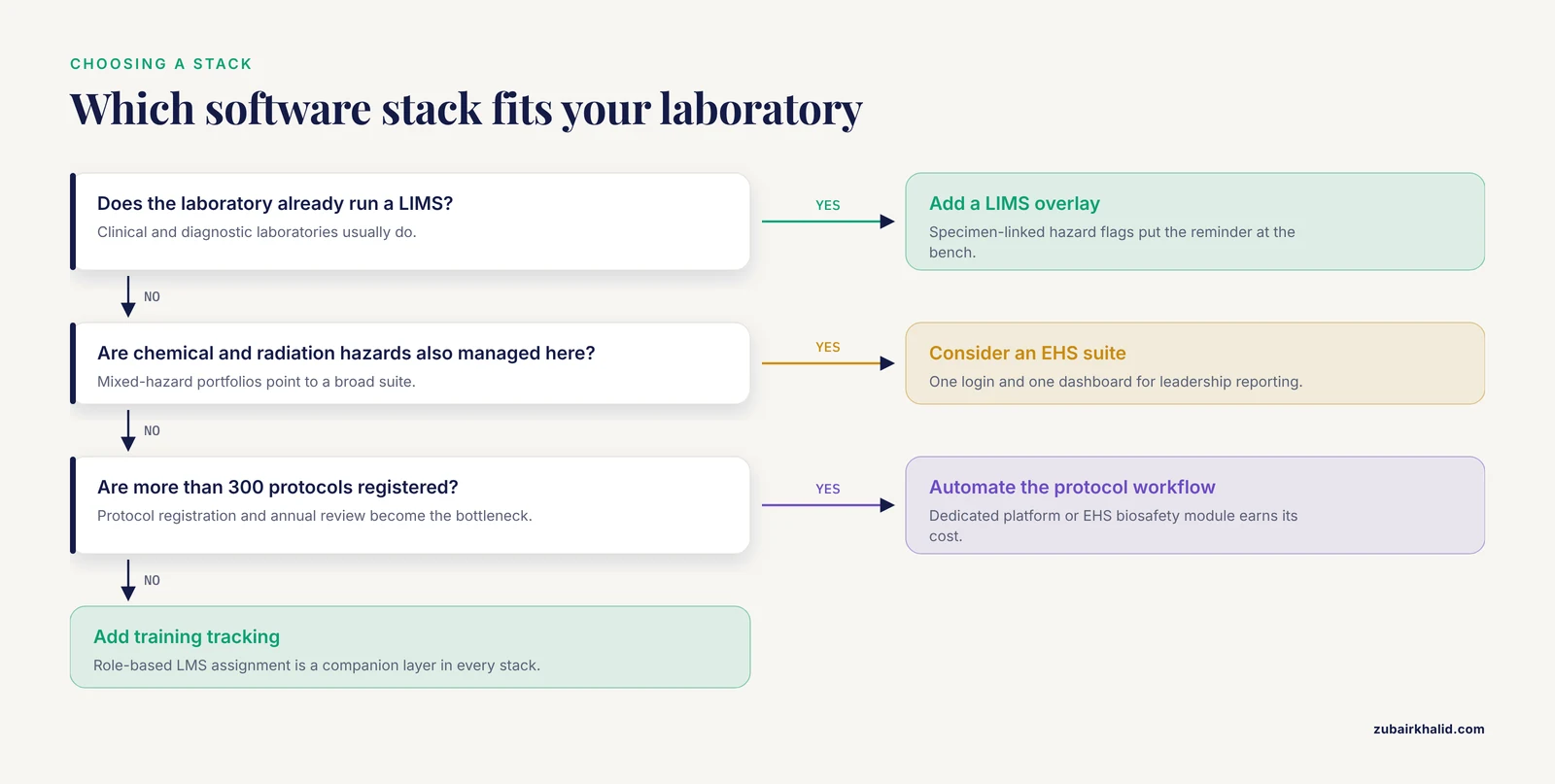
Scenario 1: A hospital clinical microbiology laboratory, 45 staff, BSL-2 with one BSL-3 suite. The dominant risks are specimen handling and the BSL-3 suite. The laboratory already runs a LIMS. The sensible stack is a LIMS safety overlay for specimen-linked hazard flags, plus a modest dedicated biosafety platform for the risk assessments, BSL-3 suite inspection checklists, and exposure follow-up, plus role-based LMS assignment for microbiology biosafety training. A full EHS suite would be overkill because chemical hazards in a microbiology laboratory are limited and already managed by the hospital's existing program.
Scenario 2: A university research program, 300 registered protocols across BSL-1, BSL-2, and BSL-2 with select-agent overlap. The dominant workload is protocol registration, annual review, and inspection logistics. A dedicated biosafety platform or the biosafety module of an existing EHS suite earns its cost here, because the protocol workflow automation is the bottleneck. The university context also brings the records management risk documented in the campus compliance study, where inadequate training, insufficient resources, and outdated policies drove deficiencies [5], so a document management layer with version control and retention schedules should be part of the selection.
Scenario 3: A biopharmaceutical quality-control laboratory under regulatory inspection pressure. The dominant need is audit-ready documentation and risk analytics. Here the AI capabilities described in the pharmaceutical program management literature are most relevant, including documentation automation, monitoring of changing guidelines, and data-driven risk management [8]. The stack leans toward a validated EHS suite with strong document control, with the acceptance criterion being that any record an inspector requests can be produced with its full version history in minutes.
Evidence on What Moves the Needle
Summarizing the citable evidence in one place, three findings should shape your purchase decision.
First, in the analysis of 214 laboratory biosafety audit records, the ranked predictors of reduced laboratory-associated risk were protocol compliance, then staff training frequency, then containment equipment maintenance [1]. Software should therefore be selected for how well it enforces those three things daily, not for breadth of ancillary features.
Second, biosafety program data is most useful when collected systematically and displayed monthly in an inputs, activities, and outcomes format that leadership can absorb [2]. Reporting capability is a selection criterion with direct operational payoff, because it is how a biosafety officer converts program activity into sustained budget support.
Third, systems and programs must flex under disruption. During the COVID-19 pandemic, the biosafety program at one academic health center found its tasks fell into three categories: those temporarily diminished, those that had to continue for safety or compliance purposes, and those that increased dramatically in volume and novelty [9]. A rigid system that cannot absorb a sudden shift in task mix, such as a surge of diagnostic testing under a new pathogen, becomes a liability at exactly the moment the program is under the most strain. Ask vendors how their inspection scheduling and training assignment handles a surge.
The professional literature continues to treat biosafety program management at national and international levels as an evolving discipline with its own dedicated venues [10], which is a reminder that your software configuration is never finished. Plan for annual review of workflows, not a one-time implementation.
Implementation Without Wasted Budget
The failure mode for biosafety software is rarely technical. It is organizational. A study of a government digital program found that change management practices, specifically leadership, communication strategies, and stakeholder engagement, had a significant positive relationship with budget compliance, with an adjusted R-squared of 0.432 (F=86.833, p=0.000) [11]. Translated to a laboratory, this means the budget for your software survives only if leadership stays aligned, communication is clear, and the people who will use the system are engaged from the start.
Three practical steps follow. Assign a visible executive sponsor before purchase. Involve two or three bench technologists in the selection demos, and record their objections in writing. Build the first-month communication plan, including who announces go-live and how questions get answered, before the contract is signed. A platform that bench staff experience as something done to them will collect dust regardless of its feature set.
Common Mistakes and Limitations
Buying breadth instead of depth. A suite with twenty modules and shallow biosafety workflows loses to a narrow platform that enforces risk assessment completion. Match the tool to the ranked risk factors, not the demo.
Treating the inventory as complete after the initial load. Inventories decay from the day they are finished. Schedule reconciliation the way you schedule equipment maintenance, which the audit evidence identifies as a top-three risk factor [1].
Assuming software produces compliance. The credentialing audit showing that only 4 of 77 practitioners met the optimal standard on all submitted images, regardless of professional background or training level [3], and the waste audit showing very low compliance despite institutional programs [6] both demonstrate that compliance is a behavior, not a database. Software helps by inserting prompts at the moment of work, but someone must still verify behavior directly.
Confusing training completion with training effectiveness. Completion percentages measure attendance. The distance-learning evaluation cited above measured actual behavior change after training and found meaningful gains [4]. Configure your LMS and program review to ask whether practices changed, using observation or competency assessment, not just whether modules were opened.
Ignoring the maintenance record module. Containment equipment maintenance reached statistical significance as a risk reducer in the audit analysis [1], yet maintenance tracking is the feature most often left in the old spreadsheet. Move it into the system during implementation, not later.
A limitation to state plainly. No software category comparison replaces judgment about your own facility's hazards, staffing, and regulatory obligations, and individual exposure incidents or outbreak situations need assessment by a qualified biosafety professional and, where relevant, occupational medicine input.
Frequently Asked Questions
What does biosafety management software actually do?
It centralizes and automates the records and workflows of a laboratory biosafety program, including biosafety risk assessments, biological inventories, training logs, inspection scheduling, corrective-action tracking, and incident reporting, so that program activity and compliance status can be shown to leadership and auditors on demand [2].
What is the best biosafety management software for a microbiology laboratory?
There is no single best product, because the right choice depends on which workflow is your biggest risk. A clinical microbiology laboratory usually does best with a LIMS safety overlay plus a modest dedicated platform for risk assessments and inspections, while a large research program benefits from a dedicated platform or a full EHS suite with a strong biosafety module [1].
Can biosafety software replace a biosafety officer?
No. The software records and enforces the decisions a qualified biosafety professional makes, and the evidence shows that human factors such as protocol compliance behavior and training frequency drive risk reduction, with the software serving as the tracking and prompting layer [1].
How does software support microbiology biosafety training?
A learning management system assigns role-based curricula, schedules recertification, and stores competency records tied to specific agents or spaces, and the audit evidence ranks training frequency as the second-strongest predictor of reduced laboratory-associated risk, after protocol compliance [1].
Do we need AI features in biosafety management software?
Only after your underlying data is clean. AI-powered risk monitoring and automated documentation are credited with reducing laboratory-associated risks in the diagnostic laboratory literature, and AI decision support is well described in regulated pharmaceutical program management, but both depend on accurate inventory, training, and inspection data as their foundation [8] [1].
What is the biggest mistake laboratories make when adopting biosafety software?
Skipping change management. Evidence from a large digital program shows that leadership, communication, and stakeholder engagement significantly predict whether a technology budget delivers, which means bench-level engagement and an executive sponsor matter as much as the software you choose [11].
Sources
- Biosafety and Biosecurity in Diagnostic Laboratories: Strengthening Risk Management, Containment Strategies, and Global Regulatory Compliance
- Articulating Biosafety Program Activities in the Context of a Simplified Public Health Logic Model
- Do clinical practitioners seeking credentialing for nuchal translucency measurement demonstrate compliance with biosafety recommendations? Experience of the Nuchal Translucency Quality Review Program.
- Optimizing Civil Servant Performance Management through Internal Compliance Distance Learning Program
- Records Management Compliance of Cagayan State University, Sanchez Mira Campus, Philippines: Basis on Intervention Program
- Awareness and Compliance on Waste Segregation: Implication to a Waste Management Program in a University
- Compliance Oversight of Operators’ Integrity Management Program for Pipelines: A Risk Based Evaluation Approach Incorporating Safety Culture
- Artificial Intelligence and Program Management in the Pharmaceutical Industry: Streamlining Decision-Making, Clinical Trials, Regulatory Compliance, Commercialization, and Risk Management
- Pivoting the Biosafety Program in Response to COVID-19: Recommendations of Key Services and Tasks to Consider for the Next Pandemic
- Introduction to Applied Biosafety’s Special Issue on Risk Minimization Strategies: National and International Biosafety Program Management
- The Effect of Change Management Practices on the Budget Compliance for Projects: The Case Study of Digital Ambassadors Program