How to Write an Incident Report for a Biosafety Emergency: A Template
By Dr. Zubair Khalid, DVM, MS, PhD ·
By the end of this guide you will be able to write a complete biosafety incident report for a laboratory exposure, spill, release, or near miss, using a fixed template that survives review. You will also be able to score the event against your biosafety risk assessment, write a root cause statement that names a fixable system failure, and close the report with verified corrective actions.
Have these on hand before you start:
- your institutional exposure response plan and spill procedure
- the agent risk group list that applies to your laboratory
- occupational health contact numbers, including after-hours coverage
- PPE inventory records for the shift involved
- the SOP version that was in force at the time
- a copy of the template below, printed or open in your electronic reporting system
Biosafety is the discipline of protecting staff, the public, and the environment from exposure to biological agents through containment, work practices, protective equipment, and facility design. An incident report is the written record of any unplanned event that breached or threatened that protection. Reviews of biosafety practice during the COVID-19 pandemic concluded that safe operation depends on layered, risk-based measures matched to the specific exposure context and activity, from specimen collection through laboratory processing [1]. The report you write is the raw material that makes those layers evidence-based rather than assumed.
What Counts as a Biosafety Emergency
A biosafety emergency is any event that could expose a person to a biological agent within minutes to hours unless someone acts. The event classes below all belong in a report.
Percutaneous exposure, meaning through the skin. Needlestick and lancet injuries, broken glass, and animal bites or scratches. In veterinary diagnostic laboratories, bites and scratches are a standard event class with their own first aid and follow-up pathway.
Mucous membrane exposure. A splash to the eye, nose, or mouth.
Contact with non-intact skin. Hangnails, cuts, abrasions, eczema, and chapped skin that liquid culture or specimen material touched.
Aerosol events without a visible spill. A centrifuge tube failure, a blender or vortex leak, a dropped culture, or a cabinet failure mid-procedure. No liquid on the floor does not mean no exposure risk.
Spills outside primary containment. Material released on an open bench or the floor rather than inside a biosafety cabinet or isolator.
Release from the laboratory. Material left the intended containment through a waste stream, an airflow failure, or an item removed without decontamination.
Loss, theft, or unauthorized access to agents, specimens, or stocks.
Equipment failure with exposure potential. A biosafety cabinet alarm during work, an autoclave cycle failure for infectious waste, a seal failure on a rotor.
Near misses. A barrier failed and no one was exposed. Report these. A near miss is the least expensive evidence a program ever collects, and it predicts where the next real exposure will happen.
High-consequence agent events. Any event involving risk group 3 or 4 agents, or an unknown agent from a specimen with serious disease potential.
Reviews of high-consequence zoonotic pathogens note that occupational exposure risk reaches veterinarians and animal handlers alongside healthcare workers and laboratory personnel, which is why exposure registers in animal-linked settings include non-laboratory staff [2]. When in doubt, report. Over-reporting costs minutes. Under-reporting leaves an exposure out of the register and a clinician without information.
Why the Report Follows a Risk-Based Format
A biosafety risk assessment is the written evaluation of what could go wrong with a specific agent in a specific activity, how likely that is, how severe it would be, and which controls reduce it. The fourth edition of the WHO Laboratory Biosafety Manual (LBM4) replaced one-size-fits-all containment rules with risk assessments tailored to the specific pathogen, the specific activity, and the operational setting [2]. Incident reports are where the evidence for those assessments comes from. Each completed report records what failed, which controls were in place, what the exposure route was, and whether the controls matched the assessed risk.
The format also serves three readers at once. The occupational health clinician needs the exposure facts and clock times. The biosafety officer needs the control failure and the contributing factors. The biosafety committee needs to know whether the risk assessment itself needs revision. A report written for only one of these readers gets sent back.
Program-level reviews outside routine clinical microbiology reach the same conclusion about planning. A scoping review of corneal xenotransplantation standards lists a biosafety incident and response plan among the pillars a program needs before it can be considered safe, alongside pathogen surveillance, biosecure storage, and bioexclusion monitoring [3]. The plan is only as good as the reports that feed it.
The Biosafety Incident Report Template: Format at a Glance
The format below uses a fixed field order, A through L, so a reviewer can find any fact in seconds and so two reports from different shifts are comparable. Copy it into your biosafety manual, your electronic reporting system, or a word processor form. It is a free biosafety incident report template, and adapting it to institutional policy is expected.
Table 1 summarizes what each section captures and the rejection reason reviewers most often write in that section.
| Section | What it captures | Most common rejection reason |
|---|---|---|
| A. Classification | Event type, date, 24-hour time, location and biosafety level | Clock time missing |
| B. People | Affected staff, report writer, supervisor notification | Roles not stated |
| C. Agent and material | Organism, risk group, form, quantity, identification status | "Unknown agent" with no identification status |
| D. Activity | Procedure, equipment, SOP version, approved scope | No SOP reference |
| E. Exposure and controls | Route, body site, itemized PPE, engineering controls | "Full PPE" without items |
| F. Immediate actions | First aid, spill control, disinfectant and contact time | Contact time missing |
| G. Medical follow-up | Evaluation time, outcome, prophylaxis, follow-up plan | No follow-up plan |
| H. Notifications | Names, dates, times, methods | Missing public health step |
| I. Investigation | Sequence, contributing factors, root cause, addenda | "Human error" as root cause |
| J. Risk update | Scores before and after corrective actions | Old assessment copied |
| K. Corrective actions | Action, owner, due date, verification | No owner or date |
| L. Closure | Verification, sign-off, distribution | No sign-off |
Here is the full template:
BIOSAFETY INCIDENT REPORT
Report ID: YYYY-NNN (assigned by the biosafety office)
Status: DRAFT / SUBMITTED / UNDER INVESTIGATION / CLOSED

SECTION A. EVENT CLASSIFICATION
  A1. Type (select all that apply):
      [ ] Percutaneous exposure (sharps, bite, scratch)
      [ ] Mucous membrane exposure (splash)
      [ ] Contact with non-intact skin
      [ ] Aerosol event without visible spill
      [ ] Spill inside primary containment (cabinet, isolator)
      [ ] Spill outside primary containment (open bench, floor)
      [ ] Release from the laboratory
      [ ] Loss, theft, or unauthorized access
      [ ] Equipment failure with exposure potential
      [ ] Near miss (no exposure)
  A2. Date of incident: ____        A3. Time, 24 h: ____
  A4. Date and time discovered, if different: ____
  A5. Location: building, room, biosafety level: ____

SECTION B. PEOPLE
  B1. Affected person(s): name, role, contact: ____
  B2. Report completed by: name, role, date and time: ____
  B3. Supervisor notified: name, date and time, method: ____

SECTION C. AGENT AND MATERIAL
  C1. Organism and strain, if known: ____
  C2. Risk group (RG1 to RG4) and assigned biosafety level: ____
  C3. Material form: specimen / culture / stock / freeze-dried / tissue
  C4. Approximate quantity or volume: ____
  C5. Concentration, if known: ____
  C6. Identification status: presumptive / confirmed / pending
      Method used for identification: ____

SECTION D. ACTIVITY AT THE TIME
  D1. Procedure being performed: ____
  D2. Equipment in use: ____
  D3. SOP reference and version: ____
  D4. Activity within approved scope (IBC permit or equivalent): Y / N

SECTION E. EXPOSURE AND CONTROLS
  E1. Route (select all): percutaneous / mucous membrane / non-intact skin /
      inhalation / ingestion / none confirmed
  E2. Body site(s): ____
  E3. Duration of contact, if applicable: ____
  E4. PPE in use, item by item: ____
  E5. Engineering controls: cabinet class, certification date, in or out of use
  E6. Deviations from SOP, with reason: ____

SECTION F. IMMEDIATE ACTIONS (chronological, with clock times)
  F1. First aid: action, start time, duration: ____
  F2. Spill control: cover, contain, evacuate, settle period used: ____
  F3. Disinfectant: product, dilution, contact time per label, applied by: ____
  F4. Cleanup verification: ____
  F5. Equipment removed from service: Y / N, tag or work order number: ____

SECTION G. MEDICAL FOLLOW-UP
  G1. Occupational health or emergency service contacted: date and time: ____
  G2. Assessment outcome, treatment or prophylaxis given: ____
  G3. Baseline testing ordered: ____
  G4. Follow-up schedule: ____

SECTION H. NOTIFICATIONS (name, role, date and time, method)
  H1. Biosafety officer: ____
  H2. Laboratory director: ____
  H3. Institutional biosafety committee, if required: ____
  H4. Public health authority, if reportable: ____
  H5. Animal care or veterinary officer, if animal facility: ____

SECTION I. INVESTIGATION
  I1. Sequence of events, numbered, with times: ____
  I2. Contributing factors: equipment / procedure / training / communication /
      workload / design: ____
  I3. Root cause statement, one sentence, system-level: ____
  I4. Repeat of a previously reported issue: Y / N, prior report ID: ____
  I5. Addenda: date and content of each update after initial submission: ____

SECTION J. RISK ASSESSMENT UPDATE
  J1. Likelihood before corrective actions (1 to 5): ____
  J2. Severity before corrective actions (1 to 5): ____
  J3. Score and band before: ____ x ____ = ____
  J4. Likelihood and severity after corrective actions: ____
  J5. Score and band after: ____ x ____ = ____

SECTION K. CORRECTIVE ACTIONS (one row per action)
  Action | Owner | Due date | Verification method

SECTION L. CLOSURE
  L1. Verification that all actions completed: ____
  L2. Biosafety officer sign-off, name and date: ____
  L3. Distribution list: ____

ATTACHMENTS: photographs, equipment service records, SOP version, training
records, agent data sheet, medical clearance to return to work
For laboratories with an electronic reporting system, the same record maps to a structured format:
{
  "report_id": "2026-014",
  "status": "UNDER_INVESTIGATION",
  "event": {
    "type": "spill_outside_containment",
    "date": "2026-03-12",
    "time_24h": "10:15",
    "location": "Room 118, BSL-2"
  },
  "agent": {
    "organism": "unknown at filing",
    "risk_group": "handled as RG3",
    "identification_status": "presumptive"
  },
  "exposure": {
    "route": ["none_confirmed"],
    "potential_route": ["inhalation", "non-intact skin"]
  },
  "risk_score": {
    "before": {"likelihood": 2, "severity": 4, "score": 8, "band": "moderate"},
    "after": {"likelihood": 1, "severity": 4, "score": 4, "band": "low"}
  }
}
Biosafety Incident Report Template Example: A Completed Spill Report
The example below is a completed report for a realistic event in a clinical microbiology laboratory. A technologist subcultured a positive blood culture bottle on the open bench. The syringe detached from the bottle and broth spilled. The Gram stain showed Gram-negative coccobacilli, and the organism was not yet identified at the time of the spill. Three days later, identification by matrix-assisted laser desorption and ionization time-of-flight mass spectrometry (MALDI-TOF MS) returned Brucella melitensis, a risk group 3 agent and a nationally notifiable cause of brucellosis. The report therefore needed a dated addendum, an expanded exposure register, and a public health notification.
BIOSAFETY INCIDENT REPORT
Report ID: 2026-014                Status: UNDER INVESTIGATION

A. EVENT CLASSIFICATION
   Type: Spill outside primary containment, exposure none confirmed
   Date: 2026-03-12    Time: 10:15    Discovered: same moment
   Location: Main Hospital, Microbiology, Room 118, BSL-2

B. PEOPLE
   Affected: J. Alvarez, medical laboratory scientist
   Report by: J. Alvarez, 2026-03-12, 14:05
   Supervisor notified: T. Okafor, 2026-03-12, 10:22, in person

C. AGENT AND MATERIAL
   Organism: unknown at filing. Gram stain of blood culture broth showed
   Gram-negative coccobacilli. Patient history: fever, recent travel to a
   region where Brucella is endemic.
   Risk group: handled as RG3 pending identification
   Form and quantity: blood culture broth, approx. 0.5 mL spilled
   Identification status: PRESUMPTIVE
   ADDENDUM 2026-03-15: MALDI-TOF MS identified Brucella melitensis.
   Status changed to CONFIRMED, RG3.

D. ACTIVITY
   Procedure: subculture of positive blood culture bottle to agar plates
   Equipment: needle and 10 mL syringe with a reused luer fitting
   SOP: SOP-MIC-014, version 3
   Within approved scope: Y

E. EXPOSURE AND CONTROLS
   Route: none confirmed. Potential routes: inhalation (aerosol) and
   contact with non-intact skin (hangnail, right thumb)
   PPE: nitrile exam gloves, fluid-resistant lab coat, safety glasses
   Engineering controls: work performed on open bench, not in cabinet
   Deviation: subculture performed outside the biosafety cabinet. The SOP
   does not require cabinet use for this step.

F. IMMEDIATE ACTIONS
   10:17 Spill covered with absorbent pads
   10:20 Bench wiped with a 70 percent alcohol wipe, then hospital-grade
         disinfectant applied for the contact time stated on the label
   10:25 Hands washed, gloves changed, hangnail covered with dressing
   10:30 Room ventilation left running, bench area kept clear

G. MEDICAL FOLLOW-UP
   11:05 Occupational health evaluated J. Alvarez. No mucous membrane
   contact confirmed. Baseline blood draw sent. Work unrestricted.
   ADDENDUM 2026-03-15: After the identification update, occupational
   health classified J. Alvarez and K. Deng (cleaned the bench) as
   exposures. Prophylaxis prescribed for both by the physician.

H. NOTIFICATIONS
   Biosafety officer M. Reyes, 2026-03-12, 10:40, phone
   Laboratory director S. Patel, 2026-03-12, 10:45, in person
   Public health authority, 2026-03-15, after confirmation of a
   nationally notifiable disease, by M. Reyes

I. INVESTIGATION
   Sequence and 5 whys: attached worksheet
   Contributing factors: no pre-use equipment check, shared supply bin,
   no bench alert tied to travel history, open-bench subculture
   Root cause: SOP-MIC-014 v3 has no pre-use equipment check and does not
   route febrile travel specimens to enhanced containment practices
   Repeat of prior issue: N

J. RISK ASSESSMENT UPDATE
   Before: likelihood 2 x severity 4 = 8, moderate
   After:  likelihood 1 x severity 4 = 4, low

K. CORRECTIVE ACTIONS
   1. Revise SOP-MIC-014 to require a pre-use check of luer fittings and
      cabinet subculture with splash guard. S. Patel, due 2026-04-01,
      verified by biosafety officer review of version 4.
   2. Add a febrile-travel bench alert at accession. R. Chen, due
      2026-04-15, verified by a test entry in the LIS.
   3. Retrain all staff on Brucella handling with competency assessment.
      M. Reyes, due 2026-04-30, verified by assessment records.
   4. Withdraw needle-and-syringe subculture from routine use. T. Okafor,
      due 2026-03-25, verified by supply audit.

L. CLOSURE
   Pending verification of actions 1 to 4. Sign-off: ______
Step-by-Step Walkthrough: From Scene to Sign-Off
- Deliver care and contain the hazard first. Writing starts after care is underway and the hazard is controlled. First aid follows the route of exposure. Wash percutaneous wounds with soap and running water and do not scrub. Flush mucous membrane exposures at an eyewash or tap for the full standard cycle, typically 15 minutes. Wash non-intact skin contact and cover it with a dressing. Do not apply disinfectants to skin.
- Notify while you act. Call the supervisor and the biosafety officer in parallel, not one after the other. For high-consequence agents, the biosafety officer starts the notification chain that may include public health authorities.
- Open a draft the same shift. Memory of clock times degrades within hours. If you cannot finish the report, capture the timeline and the exposure facts first and finish the rest later.
- Assign the report ID. Use a YYYY-NNN number assigned by the biosafety office. Never reuse numbers, because duplicates break trend analysis and closure tracking.
- Classify the event. Section A describes the failure, not the outcome. A spill with no confirmed exposure is still a spill.
- Fix the timeline with anchors. Use instrument logs, badge access records, phone call times, and specimen labels. Write 24-hour times. When a time is estimated, write "estimated" and state the basis.
- Itemize PPE and controls. Section E. List each item of protective equipment. Record any deviation from the SOP and the reason for it. Note the biosafety cabinet class and its last certification date if a cabinet was involved.
- Log immediate actions with times and durations. Section F. Record the disinfectant product, dilution, and contact time as stated on the label, and who applied it. For aerosol events, record the settle period used before re-entry, commonly 30 minutes in standard spill procedures.
- Record medical follow-up and notifications. Sections G and H. Every notification gets a name, a date, a time, and a method.
- Reconstruct the sequence and run the 5 whys. Section I. Ask why repeatedly until the answer is a system feature you can change:
Step 1. Why did broth spill onto the open bench?
        The syringe detached from the blood culture bottle during subculture.
Step 2. Why did the syringe detach?
        The needle was twisted onto a luer fitting reused past its rated
        seatings, and it no longer locked.
Step 3. Why was a worn fitting in service?
        Subculture supplies are drawn from a shared bin with no inspection.
Step 4. Why is there no inspection step?
        SOP-MIC-014 version 3 does not list a pre-use equipment check.
Step 5. Why does the SOP omit the check?
        The SOP predates the shared-bin practice introduced in 2024.

ROOT CAUSE STATEMENT (output):
A worn luer fitting detached during subculture because SOP-MIC-014 v3 has
no pre-use equipment check and supplies are drawn from an uninspected
shared bin.- Score the risk before and after. Section J. Use a 5 by 5 matrix. Multiply likelihood by severity, then assign a band. One common banding is 1 to 4 low, 5 to 9 moderate, 10 to 15 high, 16 to 25 critical. Adapt the bands to your institutional matrix:
LIKELIHOOD (1-5): 2   (uncommon event, has occurred in comparable labs)
SEVERITY    (1-5): 4   (RG3 agent, treatable infection, aerosol potential)
SCORE = 2 x 4 = 8     (band: moderate, 5-9)

After corrective actions:
LIKELIHOOD: 1 x SEVERITY: 4 = 4 (band: low, 1-4)- Write corrective actions and close. Sections K and L. Each action gets one named owner, one calendar due date, and a verification method. Closure requires biosafety officer sign-off before distribution outside the laboratory.
Field Guidance for the Sections That Get Rejected
Agent and Identification Status
Record what was known at the time and what changed later. If identification is presumptive, write "presumptive" and name the method. Identification can change the risk profile after the fact. A synthesis of 39 published cases of invasive Weissella confusa infection documented frequent misidentification, because the organism shares phenotypic features with other lactic acid bacteria and is intrinsically resistant to vancomycin, and definitive identification required MALDI-TOF MS, 16S rRNA sequencing, or whole-genome sequencing [4]. The practical rule is simple. When an identification update changes the risk group, add a dated addendum to the report, re-review the exposure register, and add anyone with a plausible route.
PPE and Engineering Controls
"Full PPE" is not a field value. List each item, note glove size where tearing or fit matters, and record deviations from the SOP with the reason. For engineering controls, record the cabinet class, the last certification date, and whether the work happened inside or outside the cabinet. In the example above, the open-bench subculture was a deviation only in the sense that the SOP permitted it, and the report says exactly that, which is what allowed the corrective action to change the SOP rather than blame the technologist.
Root Cause Statements
A root cause statement names a system factor, not a person. "Technologist error" cannot be corrected, redesigned, or verified. The output of the 5 whys in the walkthrough is correct because it names an SOP gap and a supply practice, both of which have owners and due dates in Section K.
Risk Scores Before and After
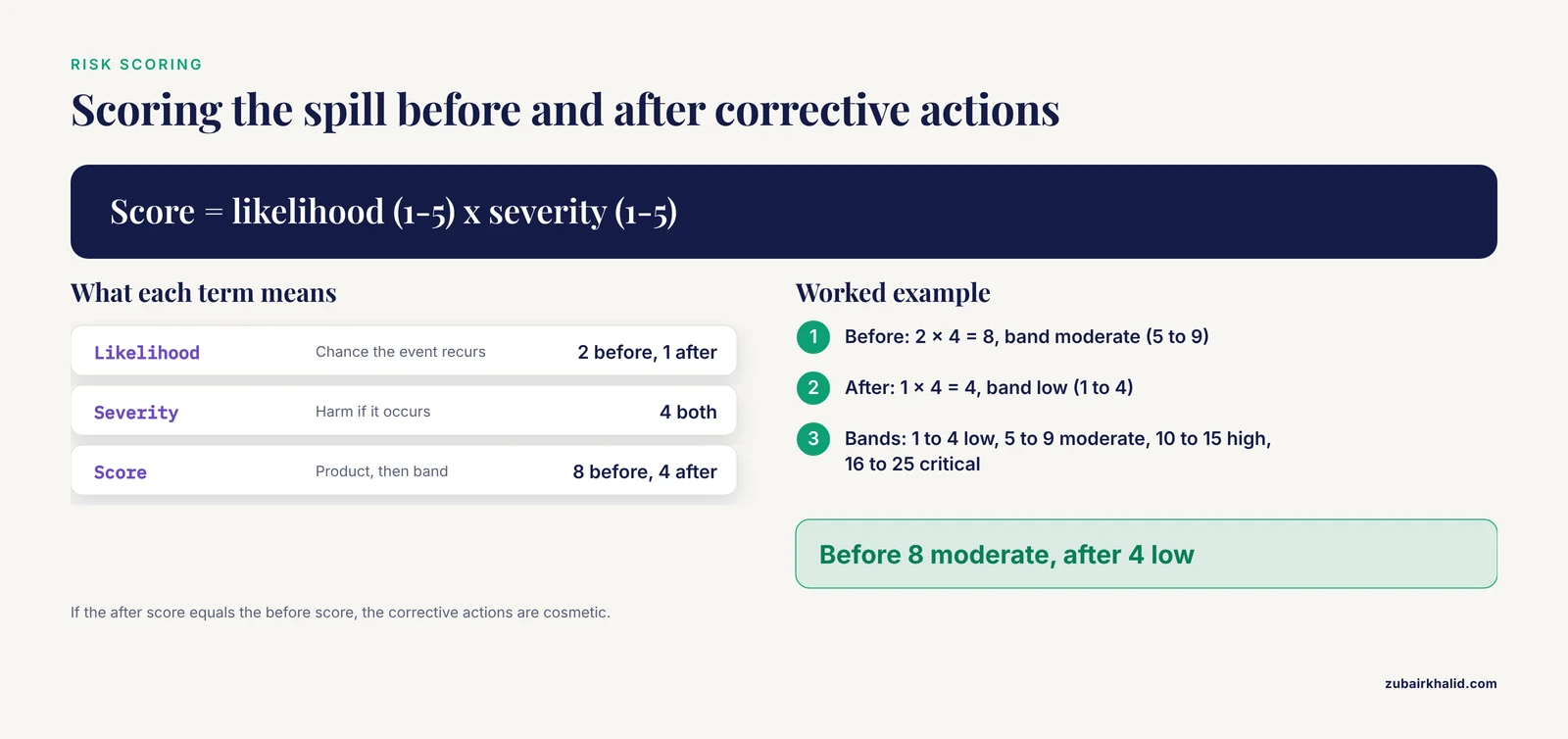
The before score documents the risk that produced the event. The after score documents the risk your corrective actions are claiming to reduce. Both belong in the report, because the gap between them is the documented benefit of the work. If the after score equals the before score, your corrective actions are cosmetic and the report should say so.
Exposure Routes and Immediate Actions
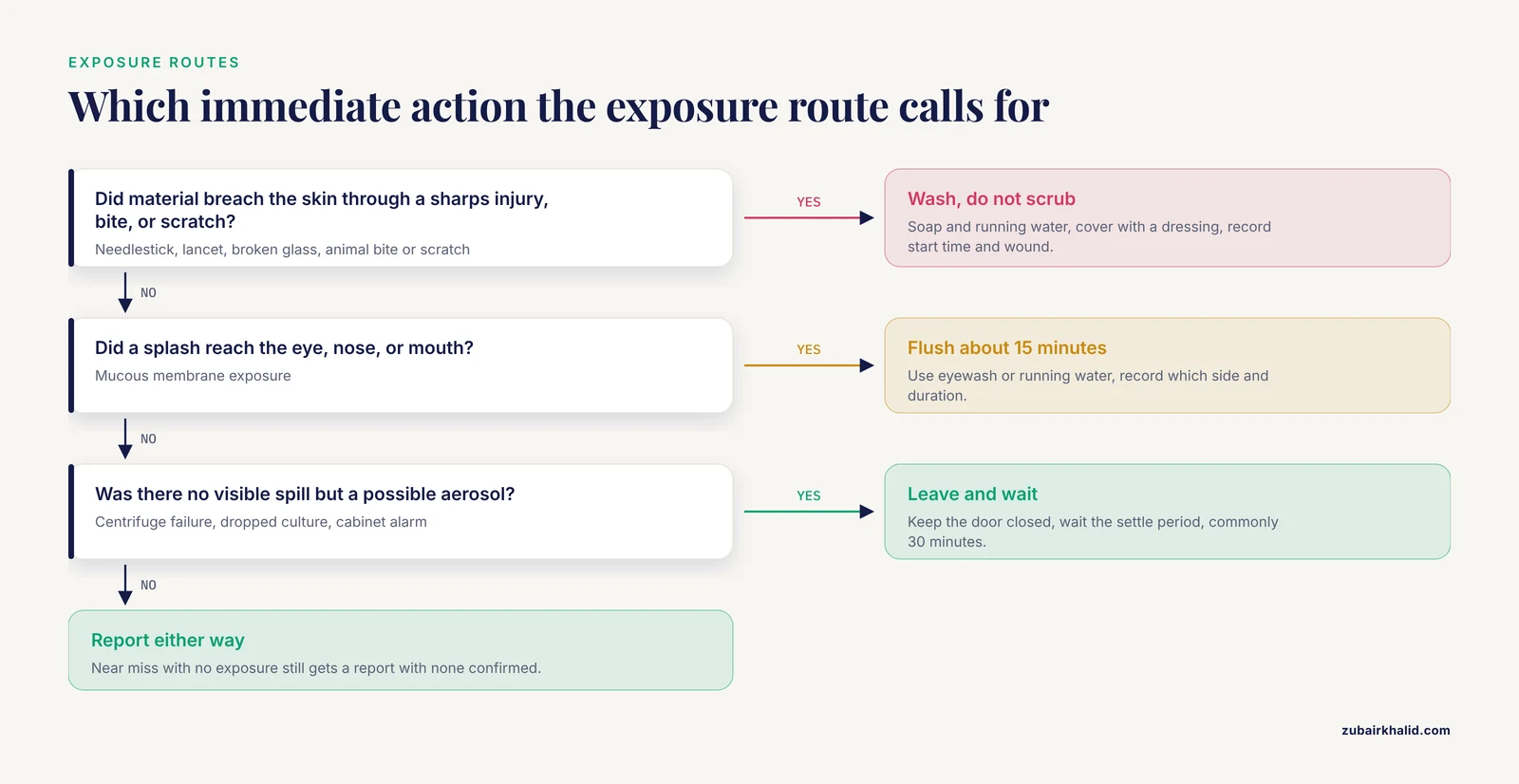
Table 2 pairs each exposure route with the immediate action and the facts the report must capture.
| Route | Immediate action | What to document |
|---|---|---|
| Percutaneous (sharps, bite, scratch) | Wash with soap and running water, do not scrub, cover with a dressing | Start time, duration, wound description |
| Mucous membrane (eye, nose, mouth) | Flush at an eyewash or running water, typically 15 minutes | Start time, duration, which eye or side |
| Non-intact skin | Wash, then cover as an open wound | Skin condition before exposure, such as hangnail or eczema |
| Inhalation (aerosol event) | Leave the room, keep the door closed, wait the settle period in your spill procedure, commonly 30 minutes | Time the room was cleared, settle duration, who authorized re-entry |
| Ingestion | Do not induce vomiting, go to occupational health or the emergency department | Substance, approximate amount, time |
| None confirmed (near miss) | No first aid needed, still report | Why exposure was ruled out |
Common Errors With Exact Reviewer Messages and Fixes
Biosafety reviewers and electronic systems return reports with short messages. These are the ones that appear most often, with the cause and the fix.
- "Time of incident not recorded." Writers record the date but not the clock time. Fix: use 24-hour time, and write "estimated" with a basis when the exact minute is unknown.
- "Agent field incomplete: provide organism and risk group, or state unknown with identification status." "Bacterial culture" is not an agent. Fix: organism and strain when known, material form, approximate quantity, and the identification status.
- "PPE documented as 'full PPE'. Specify items." Shorthand fails the clinician reading the report. Fix: list each item and note any deviation from the SOP.
- "Root cause 'human error' rejected. Identify the system factor." The analysis stopped at the person. Fix: continue the 5 whys until the answer is a policy, tool, or design feature.
- "Corrective action has no owner or due date." Actions written as intentions cannot be verified. Fix: one named owner and one calendar date per action, plus a verification method.
- "Duplicate report ID 2026-014 already exists." Manual numbering without a register. Fix: have the biosafety office assign IDs and never reuse a number.
- "Timeline gap between 10:15 and 13:40." An unrecorded interval weakens the exposure window for occupational health. Fix: anchor times to instrument logs, badge records, or call logs, and state the basis for each anchor.
- "Report closed without biosafety officer sign-off." Distribution before review. Fix: route for sign-off before anyone outside the laboratory receives a copy.
How to Verify the Report Is Complete and Correct
Run these checks before you distribute a report.
The stranger test. Hand the report to a competent colleague who was not present. They should be able to state what happened, to whom, when, where, what was done, and who was told, without asking you a single question. If they cannot, a field is thin.
Completeness against the template. Every section A through L has an entry, and "not applicable" is written explicitly where a section does not apply rather than left blank.
Notifications. Every recipient has a name, a date, a time, and a method.
Corrective actions. Every action has an owner, a due date, and a verification method.
Risk scores. Before and after values are present, and the after values reflect the corrective actions actually written in Section K.
Attachments. Photographs, equipment service records, the SOP version, and training records for the staff involved are attached or referenced by file name.
Program-level metrics make the check continuous rather than per-report. Time from event to draft report, time from draft to closure, and the repeat rate for the same root cause are the three numbers most programs track. The value of defined indicators and external checks was visible during the 2024 Marburg virus disease outbreak, when Rwanda's National Reference Laboratory scored 98 percent on the WHO viral hemorrhagic fever laboratory assessment tool, with every component at 100 percent except quality of the laboratory system at 89 percent, the gap being missing external quality assessment, and turnaround time from sample reception to result release fell from 24 hours to 7 hours [5]. An external check found the one gap the internal team could not see.
Common Mistakes and Limitations
Writing the report as a blame document. Reports used for discipline teach staff to write less. Keep personnel actions in a separate human resources channel and keep the report factual.
Vague times. "That morning" and "shortly after" cannot anchor an exposure window. Use clock times and flag estimates.
Copying the old risk assessment. Section J asks for the scores after corrective actions, not a restatement of the assessment written before the event.
Omitting negative findings. "No mucous membrane contact occurred" and "gloves remained intact" are findings. State what did not happen, because it narrows the exposure route for the clinician.
Drafting days later. An unfinished draft from the same shift beats a polished report from the following week.
Missing the addendum. When identification changes, the report is not finished. Add the dated addendum, expand the exposure register, and re-notify.
Treating closure as the end. The report exists to change the system. Unverified corrective actions are the most common reason the same root cause reappears.
Limitation. This template is a documentation and communication tool. Medical decisions after an exposure belong to occupational health clinicians, and in veterinary diagnostic settings to the designated occupational health provider or facility veterinarian. Adapt the template to your institutional policy and to any additional requirements that apply to the agents your laboratory handles.
After the Report: Corrective Actions, Training, and Program Review
Track actions to verified completion. Name the verification method in the report, for example "SOP-MIC-014 version 4 reviewed by biosafety officer on date." An action without verification is a wish.
Make training specific. Corrective actions often end in retraining, and microbiology biosafety training works when it ends in a competency assessment with return demonstration rather than a signature sheet. The distinction showed at scale during Rwanda's 2024 Marburg outbreak, where rapid workforce mobilization and training were credited among the pillars behind a case fatality rate of 23 percent, against 60 to 100 percent reported in prior outbreaks in the region, alongside early detection and rapid expansion of molecular testing [6]. Trained, rehearsed staff are a measurable input, not a slogan.
Review trends quarterly. Sort reports by root cause and by event type. Two reports with the same root cause from different shifts is a design problem, not a staffing problem.
Drill the template once a year. Run a tabletop scenario and have staff complete the template against the clock. Gaps in the drill become edits to the template.
Keep the template where the event happens. A printed copy inside the biosafety manual and an electronic form in the reporting system both work. After an event, staff reach for what is closest.
Incident documentation is also a service-level control. Biosafety programs protect healthcare workers and maintain reliable diagnostic pathways and service continuity, which is why a documentation failure in the laboratory becomes a patient-care failure downstream [1].
Frequently Asked Questions
What is a biosafety incident report template?
A fixed-format document with fields for the event type, people involved, agent, exposure route, PPE, immediate actions, medical follow-up, notifications, root cause, and corrective actions. It standardizes how a laboratory documents exposures, spills, releases, and near misses so reports are comparable and reviewable.
What do I do first, treat the person or write the report?
Deliver first aid and contain the hazard first, and notify the supervisor and biosafety officer in parallel. Start the draft the same shift, while times and details are still exact.
Who receives the completed report?
At minimum the supervisor, the biosafety officer, and occupational health. Depending on the event and your policy, the institutional biosafety committee, laboratory director, public health authorities, and animal care staff also receive it.
How fast must an incident be reported?
Same shift is the working standard in most programs, with high-consequence agent events reported immediately by phone. Your institutional policy sets the binding deadline, so confirm it before you need it.
Does a near miss need a report?
Yes. A near miss means a barrier failed without anyone being exposed, and it is the least expensive evidence a biosafety program can collect. The same template applies, with "none confirmed" in the exposure section.
What if the organism identification changes after the report is filed?
Add a dated addendum, re-review the exposure register to include anyone with a plausible route, and notify occupational health and the biosafety officer. Identification changes can move an agent into a higher risk group and change medical follow-up.
How does the report connect to the biosafety risk assessment?
The report supplies the failure evidence the risk assessment needs, which is what the risk-based approach in the WHO Laboratory Biosafety Manual fourth edition requires, controls matched to assessed risk for the specific pathogen, activity, and setting [2]. The before-and-after risk scores in the report document that match.
Where can I get a free biosafety incident report template?
The template in this article is free to copy and adapt. Check with your biosafety officer first, because many institutions already maintain a required form in their biosafety manual, and that version will carry the correct notification chain.
Sources
- Strengthening patient safety through biosafety and infection prevention measures during COVID-19: a policy and practice review.
- Hendra and Nipah viruses: Biosafety evidence for risk-based containment, inactivation practices, and one health preparedness.
- Reframing Technology and Ethics in Corneal Xenotransplantation: A Scoping Review of Standards and Safety in Ophthalmology.
- Weissella Confusa Infections and Strain-Level Biosafety: Clinical Evidence and Intrinsic Vancomycin Resistance.
- Rwanda's National Reference Laboratory Operational Capacity during the 2024 Marburg Virus Disease Outbreak Response.
- Rwanda's lessons for strengthening Africa's response to current Marburg virus disease outbreaks.