Biosafety Incident Documentation: What to Record
By Dr. Zubair Khalid, DVM, MS, PhD ·

Biosafety incident documentation is the written record of every unplanned event in a microbiology laboratory that could have exposed a person, a sample, or the environment to infectious material. A complete record captures who was involved, what organism and procedure were involved, what containment failed or held, what immediate response steps were taken, and what corrective actions follow. The finished record serves three purposes at once. It protects the exposed worker by creating a medical timeline. It protects the laboratory by showing regulators, accreditors, and insurers that the event was recognized, reported, and corrected. And it protects everyone who comes after, because the incident, its contributing factors, and its fixes feed directly into the next round of biosafety risk assessment and training.
This guide is written for the bench microbiologist, the laboratory supervisor, and the biosafety officer. It tells you exactly which data fields to record, in what order, with what level of detail. It then walks through a documentation audit, step by step, so you can verify that your own records would survive scrutiny.
When to use this guide. Use it at the moment of any incident, including spills inside and outside a biosafety cabinet, sharps injuries, splashes to mucous membranes, bites and scratches from research animals, releases of aerosolized material, failures of primary or secondary containment, loss or mislabeling of infectious samples, and near misses in which no exposure occurred but the potential was real. Use the audit portion on a scheduled basis, typically annually or after any significant event, to test whether your documentation system actually works.
Time required. The initial report of a straightforward incident, such as a small spill fully contained inside a certified biosafety cabinet, takes 30 to 60 minutes of hands-on documentation time, ideally completed within the first working day. A sharps injury or an exposure involving a high-consequence agent requires 2 to 4 hours of documentation spread over the first week, because it includes notification records, medical evaluation entries, and a written root cause analysis. Elapsed time from incident to closed record ranges from a few days for a contained spill to several months for an exposure requiring longitudinal medical follow-up.
Principle
An incident record is evidence, and evidence has one defining property: it must be captured at the time it happens, by the people who were there, in a form that cannot be quietly edited later. Memory degrades within hours. A spill described "from recollection" three weeks after the fact will omit the concentration of the culture, the volume released, the disinfectant actually used, and the exact cabinet in which it occurred, and those omissions are precisely the details that determine whether the response was adequate.
The underlying principle is traceability. Every incident record must let an independent reader reconstruct the event, the response, and the fix without asking anyone a question. The record must also connect forward in time. An exposure entry written today is the baseline against which any serial serology or clinical monitoring is compared weeks or months later. Long-term follow-up programs built after outbreaks show this clearly. The PREMAV cohort study launched after the 2024 Marburg virus disease outbreak in Rwanda enrolls survivors and contacts for serial sampling of blood, urine, semen, and other specimens over 24 months after recovery, and it depends on initial exposure and clinical records that were captured during the acute response [1]. A laboratory exposure record works the same way on a smaller scale. If the baseline entry is thin, the follow-up is blind.
Documentation also drives system-level learning. Rwanda's response to its first Marburg virus disease outbreak achieved a case fatality rate of 23%, far below the 83% reported in the Democratic Republic of the Congo, 90% in Angola, 60% in Uganda, and 100% in Tanzania, and the response depended on pillars that each generated records: infection prevention and control measures, rapid expansion of molecular testing, early triage and active case finding, and rapid workforce mobilization [2]. The same architecture applies inside a single laboratory. Every documented incident is a data point that sharpens infection prevention and control measures, justifies training requests, and identifies which containment equipment or work practices need repair.
Finally, documentation converts an individual event into institutional memory. Personnel turnover is constant in microbiology laboratories. A well-kept incident file means the lesson survives the departure of the people who learned it.
Materials and Supplies
Documentation is mostly a paper and software exercise, but several physical items appear in the record itself and must be logged accurately.
| Item | Specification or working detail | Purpose in the record |
|---|---|---|
| Incident report form or LIMS module | Standardized template with fixed fields (see core data set below) | Ensures no field is skipped and allows year-over-year comparison |
| Pen with permanent ink or locked electronic entry | No pencil, no erasable fields | Preserves record integrity for audit |
| Exposure and sharps injury log | Separate running log maintained by occupational health or the biosafety officer | Required for bloodborne pathogen compliance in US laboratories |
| Disinfectant use log entry | Record the agent, dilution, and preparation date, for example fresh 1:10 dilution of household bleach (approximately 500 to 600 ppm available chlorine from a 5.25% to 6.15% sodium hypochlorite product) prepared daily, or 70% ethanol for surface wipe-down | Confirms the decontamination step was valid, since expired or wrong-strength disinfectant is a common contributing factor |
| Spill kit inventory check | Absorbent material, disinfectant, forceps for broken glass, autoclavable waste bags | Records whether the kit performed as intended, which feeds restocking decisions |
| Camera or phone for photographs | Timestamped images of the spill, the damaged container, or the failed equipment | Anchors the narrative and resolves later disputes about equipment condition |
| Training and vaccination records | Current biosafety training certificates and, for bloodborne exposures, hepatitis B vaccination and antibody status | Establishes whether the exposed person was trained and protected, which shapes both the risk assessment and the medical follow-up |
| Notification contact sheet | Supervisor, biosafety officer, occupational health, institutional biosafety committee, and public health contacts with after-hours numbers | Proves notifications were made and documents when they were made |
Safety note. Never photograph an active spill or exposure scene before the affected person has received first aid and the area has been made safe. Documentation never outranks response. Decontaminate first, then photograph.
What to Record: The Core Data Set
Every incident record, regardless of type, must contain the following fields. Treat this as a checklist you complete in order.
Identification and timing
Record a unique report number, the date and clock time of the incident itself, the date and time the incident was discovered, and the date and time it was reported to the supervisor or biosafety officer. The gap between occurrence and discovery is itself diagnostic. A splash discovered at the end of a shift suggests PPE was not inspected, while a spill discovered the next morning suggests the area was not checked before staff left.
People
Record the full name, role, and job title of everyone directly involved, everyone who responded, and everyone who witnessed the event. Note each involved person's biosafety training date and status, and for exposures involving human material, their hepatitis B vaccination status and antibody titer if known. Do not editorialize about fault in this section. Record facts only.
Agent and material
Name the organism and strain if known, its risk group and the biosafety level (BSL, the containment level of the laboratory where the event occurred, ranging from BSL-1 for agents not known to consistently cause disease in healthy adults to BSL-3 for agents that can cause serious or potentially lethal disease by inhalation), the type of material (culture, plate, broth, clinical specimen, frozen stock), the approximate quantity and concentration if known, and the container involved (glass tube, petri dish, cryovial, bag). If the agent is unknown at the time of writing, record "unknown, pending identification" and note when identification results are expected.
Incident classification
Classify the event in fixed vocabulary so records can be counted and compared: exposure (percutaneous, mucous membrane, non-intact skin, inhalation), spill (contained, partially contained, released outside containment), equipment failure (biosafety cabinet, centrifuge, autoclave, sealable rotor), animal incident (bite, scratch, splash from a cage), loss or theft of material, shipment or packaging failure, and near miss. Near misses, meaning events in which containment or practice failed but no one was exposed, are documented with the same rigor as actual exposures because they are free lessons.
Narrative description
Write a chronological narrative in plain declarative sentences: what the person was doing, what failed, what was released, and where it went. Include the work being performed (for example, vortexing a 5 mL broth culture of Salmonella enterica outside the biosafety cabinet), the protective equipment worn at the time, and any deviation from the standard operating procedure. Photographs, referenced by file name, attach here.
Immediate response
Record exactly what was done and when, to the minute where first aid is concerned. For a mucocutaneous splash, record the time eyewash or irrigation began and its duration. Standard practice is a minimum 15-minute flush at an eyewash station. For a sharps injury, record the time of washing with soap and water, the reporting time, and the time of occupational health contact. For a spill, record the time the area was covered with absorbent material, the disinfectant applied, the dilution and contact time, and the time the area was declared decontaminated and reopened.
Safety note. Spill response for an aerosol-generating event includes clearing the room and allowing aerosols to settle, a period commonly set at 30 minutes for most BSL-2 work, before re-entry in protective clothing. Record the actual interval used, because it is a checkable fact.
Risk assessment and contributing factors
Document the initial biosafety risk assessment performed on the spot: likelihood that exposure occurred, the consequence if the agent had been infectious, and the factors that contributed. Contributing factors typically fall into five categories: procedure design (the task was inherently aerosol-generating), equipment (a cabinet was down for certification), PPE (wrong gloves, no face protection), training (the task was performed by a new employee), and human factors (rushing, interruptions, end-of-shift timing). Name the category, not the person.
Notifications
Record each notification as a dated entry: who was notified, by what channel, at what time, and what instructions came back. Standard notifications for an exposure include the supervisor, the biosafety officer, and occupational health. Depending on the agent and the institution, notifications may extend to the institutional biosafety committee, facility management, animal care staff, and public health authorities.
Corrective actions and root cause
Record the immediate corrective actions taken (equipment removed from service, procedure suspended, retraining scheduled) and, once the investigation is complete, the root cause analysis. A root cause analysis asks why the event happened at each level until the answer is a system property rather than a person's mistake. "The technician was careless" is not a root cause. "The mouth-pipetting-adjacent task of transferring culture from a flask had no dedicated safe transfer tool available at the workstation, so the technician improvised" is.
Follow-up and closure
Record the follow-up plan with dates: medical evaluation appointments, serial serology or testing intervals, and the person responsible for each item. Close the record only when every corrective action is verified as implemented and signed off by the biosafety officer and the supervisor. An unclosed record is an open hazard.
Step-by-Step Documentation Procedure
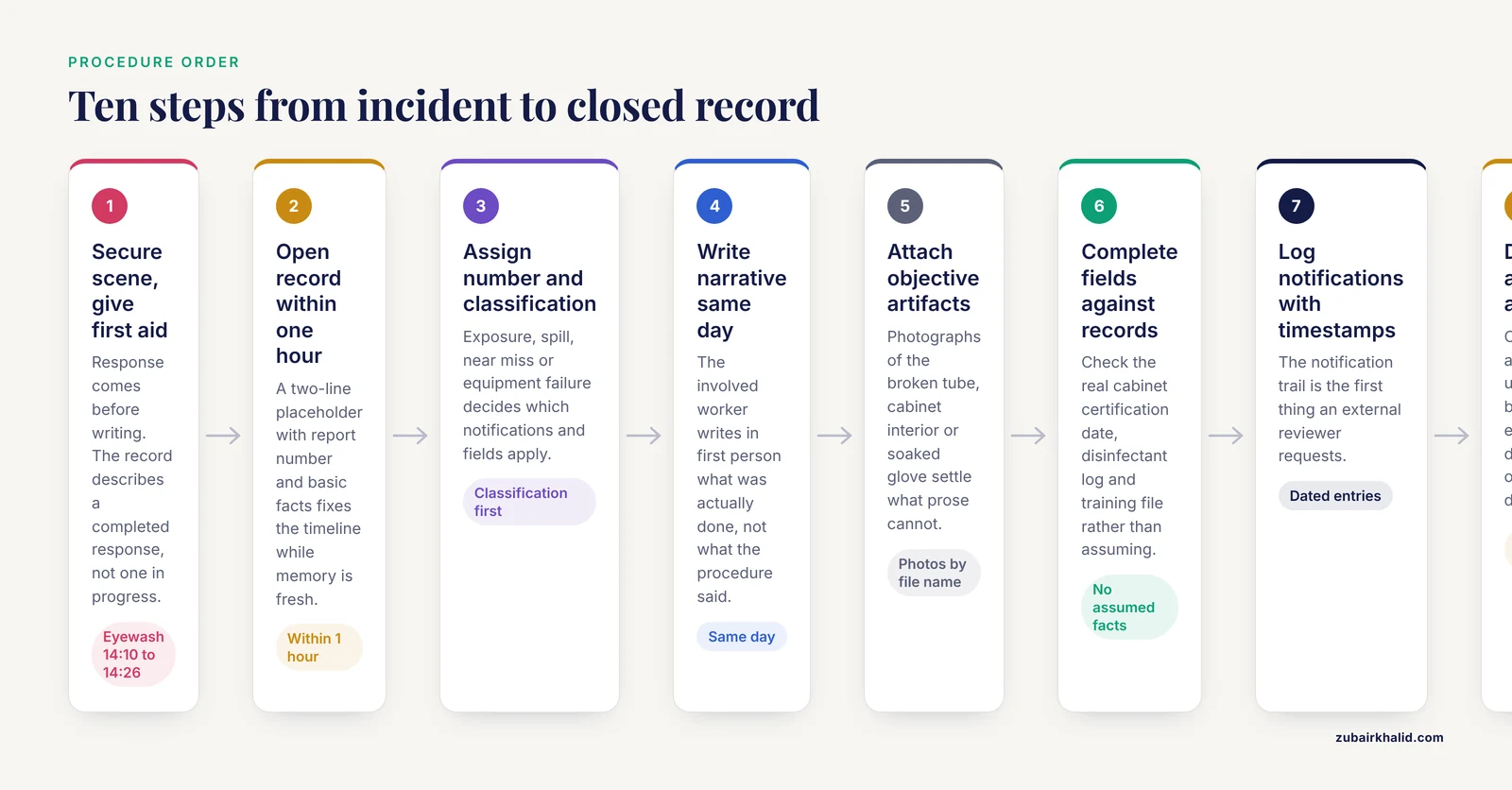
Follow this sequence for any incident. The reason for each step is stated so the sequence survives stress.
- Secure the scene and deliver first aid before writing anything. Reason: the record must describe a completed response, not an in-progress one, and the exposed person's welfare comes first. An eyewash started at 14:10 and stopped at 14:26 goes in the record as a completed fact.
- Open a record within one hour of the event. Reason: the first hour is when witnesses, volumes, and times are still accurate. Even a two-line placeholder entry with the report number and the basic facts establishes the timeline, and you complete the detail afterward.
- Assign the report number and classification immediately. Reason: classification (exposure, spill, near miss, equipment failure) determines which notifications are mandatory and which form fields apply. Misclassification discovered later is far harder to correct than misclassification corrected now.
- Write the narrative the same day, in first person where the involved worker is the source. Reason: the worker's direct account, captured while the memory is fresh, is the most accurate description of what was actually done rather than what the procedure said should be done.
- Photograph or attach objective artifacts. Reason: photographs of the broken tube, the cabinet interior, or the soaked glove settle details that prose cannot.
- Complete the agent, containment, and PPE fields against records, not memory. Reason: check the actual cabinet certification date, the actual disinfectant log, and the actual training file. Assumed facts are the most common source of audit findings.
- Record all notifications with timestamps. Reason: the notification trail is the first thing any external reviewer requests, and gaps in it are treated as gaps in the response.
- Draft the risk assessment and corrective actions within 72 hours. Reason: corrective actions lose urgency and budget with every passing day, and an incident without an assigned owner and due date is an incident that will recur.
- Track follow-up medical entries on the same timeline as the record. Reason: exposure follow-up, such as serial testing after a bloodborne exposure, is meaningful only if the baseline entry states exactly what was sampled and when.
- Close the record with two signatures and a review date. Reason: closure by a single person allows errors of omission, and a scheduled review date (for example, six months out) verifies that corrective actions held.
Running a Biosafety Incident Documentation Audit
A biosafety incident documentation audit is a structured review of your incident records to verify completeness, timeliness, accuracy, and follow-through. Run it annually at minimum, and after any high-consequence event.
Audit, step by step
- Define the audit scope and pull the denominator. List every incident expected in the review period, then pull every record actually filed. The difference between the two numbers is your first finding, because unreported incidents are the most serious documentation failure. Cross-check the record file against the sharps injury log, the occupational health visit log, the equipment service log, and the autoclave cycle records, since events often appear in one of those logs but not in the incident file.
- Score every record against the core data set. Build a simple scorecard from the eleven core sections above and mark each record complete, partially complete, or missing for each section. A record missing the disinfectant details of a spill, or the notification times of an exposure, scores as partially complete.
- Measure timeliness. For each record, calculate the interval from incident to initial entry and from incident to closure. Flag any record opened more than one working day after the event or left unclosed beyond the institutional target.
- Trace corrective actions to verification. Pick each corrective action and follow it to physical evidence: the retrained employee's updated training record, the replaced centrifuge rotor's service invoice, the revised standard operating procedure with its approval date. A corrective action without evidence is an intention, not an action.
- Review the risk assessment linkage. Confirm that each incident's contributing factors were actually folded into the next revision of the biosafety risk assessment, and that any procedure identified as high risk gained a control (engineering change, revised procedure, or added PPE).
- Interview a sample of involved staff. Ask two or three people involved in past incidents whether the record matches their recollection and whether the corrective actions reached their bench. Discrepancies between the paper trail and bench reality are the most valuable findings an audit produces.
- Report findings with owners and dates. Close the audit with a short written report listing each gap, the person responsible for fixing it, and the due date. File the report with the incident records so the next auditor can verify closure.
Practical audit tips
- Audit a random sample if record volume is high, but always include every exposure record and every high-consequence agent record, because those carry the highest stakes.
- Compare vocabulary across records. If the same spill is described as "contained" in one record and "minor release" in another, your classification definitions need tightening before your counts mean anything.
- Check that photographs are actually attached and openable. Electronic records with broken image links fail audits routinely.
- Review trends, not just individual records. Three spills of the same agent in one quarter at one workstation is a procedure problem, and the audit is where that pattern becomes visible.
- Verify that near misses are being reported at all. A laboratory that files zero near misses in a year almost certainly has an underreporting culture, not a perfect safety record.
Controls: Verifying Your Documentation System
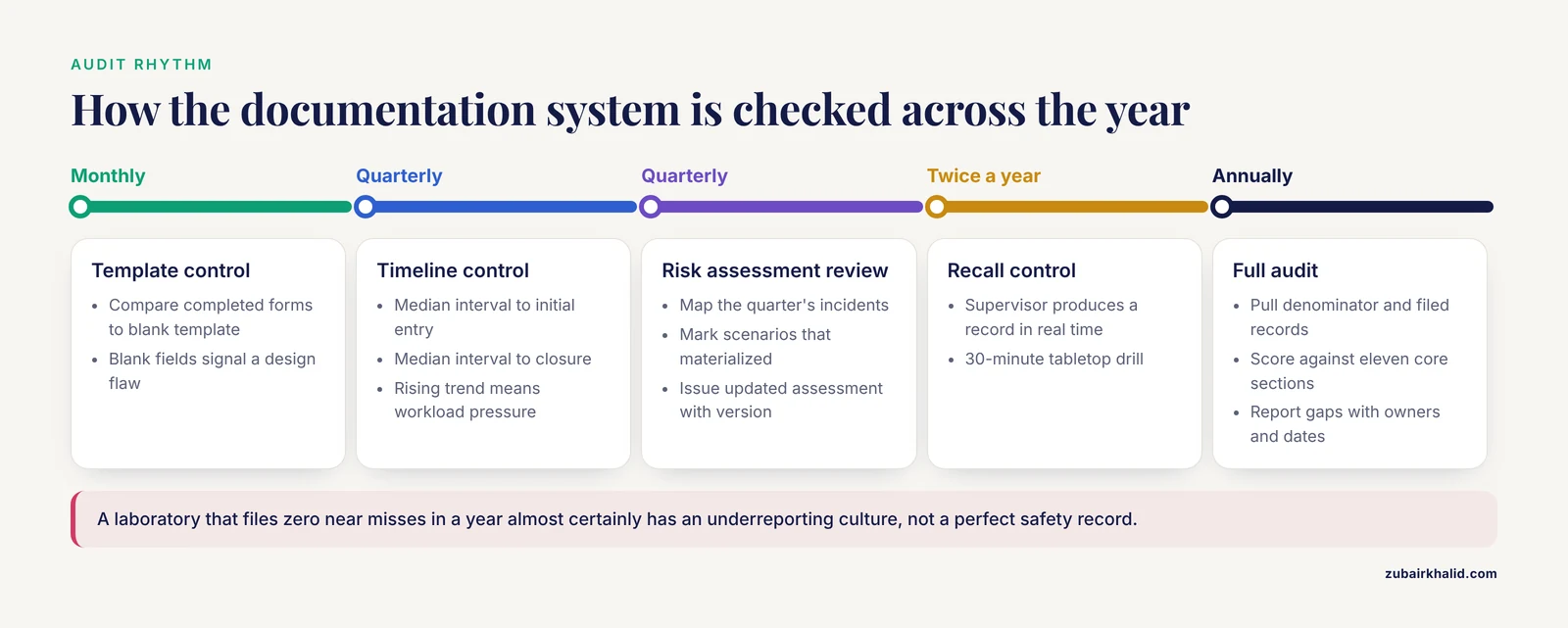
In analytical terms, the audit is your quality control, but the documentation system itself needs positive controls that run continuously. Use these three.
The template control. If records are handwritten on free-form paper, compare a sample of completed forms against the blank template monthly. Any field that staff leave blank consistently is a design flaw in the template, not a discipline problem in the staff. Redesign the field or move it to a forced-entry electronic field.
The timeline control. Each quarter, compute the median interval from incident to initial entry and from incident to closure. A rising trend signals workload pressure, staff turnover, or a supervisor bottleneck, all of which are fixable if caught by the metric.
The recall control. Twice a year, run a tabletop exercise: give a supervisor a hypothetical incident and ask them to produce a record in real time using your actual forms and contact sheet. Gaps that appear in a 30-minute drill are the same gaps that will appear during a real 2 a.m. exposure, and they cost nothing to find now.
Expected Results and How to Read Them
A functioning documentation system produces records that share four properties.
Complete. Every core data set field is filled or explicitly marked "not applicable" with a reason. A blank field is indistinguishable from an unknown, and an unknown is indistinguishable from negligence.
Timely. Initial entries appear within one working day, investigations close within the institutional target, and the timestamps within each record are internally consistent. A record in which first aid is logged before the incident time, or in which the disinfectant is recorded as applied before the spill was discovered, tells an auditor the entry was written from memory after the fact.
Traceable. Every claim in the record traces to an artifact: a signed training sheet, a service log, a photograph, an email notification. An independent reader should be able to reconstruct the event from the file alone.
Actionable. Each record ends in closed corrective actions and a visible edit to the biosafety risk assessment or the training plan. If you read ten consecutive records and find no changes to procedures, equipment, or training anywhere downstream, the documentation is producing paper rather than safety.
When you read your own records, look for the recurrence signature: the same agent, the same procedure, or the same workstation appearing across multiple entries. Individual events are noise. Recurrence is signal.
Troubleshooting
| Symptom in the record | Likely cause | Fix |
|---|---|---|
| Initial entry made days or weeks after the incident | No requirement to open a record immediately, or forms stored where staff cannot reach them | Mandate a same-day placeholder entry, put blank forms and the contact sheet inside the spill kit and at each workstation, and add electronic reporting from any phone |
| Narrative vague on volumes, concentrations, and times | Record written from memory, or the person documenting was not the person involved | Require the involved worker to write or dictate the narrative on the day of the event, and require contemporaneous time-stamped notes during response |
| Disinfectant details missing or wrong | Disinfectant use is not logged routinely, so spill entries cannot cite a real log | Maintain a dated disinfectant preparation log at each prep area and require the log entry number in every spill record |
| Notifications section empty or untimestamped | Notifications made verbally and never confirmed in writing | Require a written confirmation, even a one-line email, for every notification and file it with the record |
| Corrective actions listed but never verified | No owner and no due date assigned, or no closure signature required | Assign each action a named owner, a due date, and a verification method, and block record closure until all are signed off |
| Near misses never reported | Reporting culture problem, often because staff fear blame | Separate near miss reporting from disciplinary processes explicitly in policy, and praise near miss reports publicly in staff meetings |
| Same incident type recurs despite documentation | Records are not feeding the biosafety risk assessment or the training program | Build a quarterly review step in which the biosafety officer maps incident data onto the risk assessment and updates the microbiology biosafety training schedule accordingly |
| Electronic records can be edited silently after the fact | System lacks version control or audit trail | Use a system with a locked audit trail, or move closed paper records to a signed, dated, tamper-evident file |
Variations by Incident Type
Spills of infectious material
Spill records emphasize the physical facts: agent, volume, concentration, location (inside a biosafety cabinet, on an open bench, on the floor, in a centrifuge), the disinfectant and dilution used, the contact time, the cleanup personnel and their PPE, and the settling time allowed before re-entry. For a centrifuge release, also record the rotor type, whether sealed buckets or safety cups were in use, and whether the rotor was opened inside or outside the cabinet. For a spill of a high-consequence agent such as a filovirus handled under enhanced containment, the record should also capture notification of institutional emergency response, because such events are not managed by bench staff alone. The value of rigorous spill records at outbreak scale is well illustrated by the 2024 Marburg virus disease response in Rwanda, where innovative infection prevention and control measures were identified as one of the pillars behind the unusually low case fatality rate of 23% [2]. Those measures are only as strong as their written record, because infection prevention and control improvements are justified, refined, and audited through documentation.
Percutaneous exposures and sharps injuries
These records carry the highest medical and legal stakes. Record the device involved (hollow-bore needle, scalpel, glass), whether the device was visibly bloody, the depth and location of the injury, the source material if known, the first aid given and its timing, and the occupational health evaluation with its date. The exposure log entry, kept separately as required for bloodborne pathogen compliance, must contain the same device details. Follow-up entries record each serologic or clinical checkpoint on its scheduled date.
Mucocutaneous and inhalational exposures
For splashes, record the flush duration and the flush device used. For suspected inhalational exposures, record the procedure generating the aerosol, the room and cabinet in which it occurred, the time spent in the room after the event, and any respiratory symptoms reported on the day. Both record types feed the same follow-up architecture as percutaneous exposures.
Equipment failure
Record the equipment identifier, the certification and service history, the failure mode observed (loss of cabinet airflow alarm, cracked rotor, autoclave cycle failure), the material inside the equipment at the time, and the disposition of that material. Equipment that failed once and was returned to service without a documented repair or revalidation is a classic audit finding.
Loss, theft, or shipment failure
Record the inventory details of the missing or damaged material, the last verified location, the packaging and labeling used, and every notification made, because these events can require regulatory reporting with short deadlines.
Near misses
Record the same core data set minus the medical follow-up section. Pay particular attention to the contributing factors, because a near miss is the cheapest opportunity you will ever get to fix a flaw before it causes an exposure.
Record Storage, Security, and Retention
Store incident records in a controlled location, physical or electronic, with access limited to the biosafety officer, laboratory management, occupational health, and reviewers with a documented need. Electronic systems must have an audit trail showing who edited what and when. Paper records, once closed, belong in a signed and dated file that is not accessible for casual correction.
Retention periods follow two rules. First, retain records at least as long as the applicable regulatory minimum. In US laboratories handling human blood or other potentially infectious materials, the sharps injury log is kept for five years, and medical records related to exposures are retained for the duration of employment plus the statutory period under the bloodborne pathogens standard. Second, when institutional policy or an approved research protocol demands longer retention, the longer period governs. The PREMAV longitudinal study in Rwanda, which follows Marburg survivors and contacts with serial sampling over 24 months post-recovery, illustrates why long retention matters: follow-up analyses years after an event are only possible if the baseline records survive [1]. Set a retention schedule in writing, name the person responsible for it, and include record retention as an audit checkpoint.
Linking Documentation to the Biosafety Risk Assessment
The biosafety risk assessment, the formal evaluation of what agents you work with, what can go wrong, how likely it is, and how you control it, is the engine that makes incident documentation useful rather than archival. The linkage runs in one direction only if you build it deliberately.
When an incident closes, three questions move from the record into the risk assessment. First, did the assessment foresee this event? If not, the hazard inventory or the scenario list is incomplete. Second, did the controls in place fail, or were they absent? A failure of an existing control triggers reevaluation of that control's selection and maintenance. Third, does the residual risk now exceed the acceptable threshold for the procedure, which would require either additional controls or a change in how and where the work is done?
Conduct this linkage as a scheduled quarterly review rather than waiting for annual reassessment. Map the quarter's incidents against the current risk assessment, mark every scenario that materialized, and issue an updated assessment with a version number and date. This closes the loop that turns a single worker's bad afternoon into a permanent improvement in how the whole laboratory operates.
Linking Documentation to Microbiology Biosafety Training
Incident records and near miss reports are the most persuasive training material a laboratory owns, because every entry describes a failure that happened to real people using the laboratory's own procedures. Use them in three ways.
Targeted retraining. When a record identifies a training gap, schedule the affected person's retraining and record both the gap and the completion in the record itself. An unverified "retrain the staff" action is an audit finding waiting to happen.
Case-based teaching. Sanitized incident narratives, with names removed, make powerful case studies in onboarding and annual refresher training. Presenting a real spill from your own centrifuge teaches more than any generic slide, and it signals that reporting is expected and used constructively.
Curriculum revision. A quarterly review of incident themes should directly shape the microbiology biosafety training calendar. A cluster of spill records points to hands-on spill response drills. A cluster of near misses involving new employees points to a supervision period after onboarding. Document these decisions, because the next audit will ask how the incident data changed the training.
Common Mistakes and Limitations
These are the specific errors that most often damage incident documentation, drawn from what audits repeatedly find.
Writing the narrative from memory days later. Detail loss begins within hours. Record times, volumes, and actions contemporaneously, even if the polished narrative comes later.
Documenting blame instead of facts. Records that name a careless employee chill future reporting and contribute nothing to prevention. Every field should answer what, when, where, and how much. The contributing factors section names system categories, never people.
Treating near misses as optional. Near miss documentation is where the greatest preventive value lives, and skipping it guarantees that the same flaw is documented later at the cost of an actual exposure.
Incomplete notification trails. Verbal notifications that were never confirmed in writing are unverifiable and, in an audit, indistinguishable from notifications that never happened. Confirm every notification in writing and file the confirmation.
Closing records without verified corrective actions. A corrective action is closed when someone has confirmed the fix exists, with evidence. Sign-offs without evidence are the most common reason the same incident recurs.
Leaving the disinfectant question unanswered. A spill record that does not state which disinfectant, at what dilution, with what contact time, cannot demonstrate that decontamination was effective. Freshly prepared 1:10 household bleach and 70% ethanol are standard surface disinfectants, but they are not interchangeable, and the record must say which was used.
Failing to link records forward. An exposure record without follow-up dates, or a spill record never fed into the risk assessment, is documentation without function.
Ignoring record security. Incident records contain medical information. Storing them in an open shared folder violates both privacy obligations and the trust that makes staff willing to report in the first place.
Expecting documentation to substitute for prevention. A complete record of a preventable injury is still a preventable injury. Documentation supports the safety system. It does not replace functioning containment, valid training, or a real risk assessment.
A limitation to state once. This guide describes documentation standards and standard response practice for microbiology laboratories. Every actual exposure or injury requires individual medical evaluation by occupational health or a clinician, and this article does not replace that evaluation or any institution-specific policy.
Frequently Asked Questions
What counts as a biosafety incident in a microbiology laboratory?
Any unplanned event with the potential to expose people, samples, or the environment to infectious material. This includes spills, sharps injuries, splashes, aerosol releases, equipment failures, animal bites and scratches, lost or mislabeled samples, and near misses in which no one was actually exposed.
How soon after an incident must the documentation be started?
Start the record within one hour and complete the initial entry within one working day. Early capture preserves the exact times, volumes, and actions that degrade fastest from memory, and the initial timestamp is itself an audit checkpoint.
Who is responsible for writing the incident report?
The person directly involved writes the narrative, because they hold the most accurate account of what was actually done. The supervisor and the biosafety officer complete the risk assessment, corrective actions, and closure sections.
What is a near miss and should it be documented?
A near miss is an event in which a control or a practice failed but no exposure occurred, such as dropping a sealed plate that did not break. Document it with the same core data set as an actual incident, minus medical follow-up, because it reveals the same flaw without the injury.
What must be recorded after a sharps injury?
Record the device type, whether it was visibly bloody, the depth and location of the wound, the source material, the timing of first aid and reporting, and the occupational health evaluation. The same device details go into the separate sharps injury log required for bloodborne pathogen compliance.
How long must biosafety incident records be kept?
Follow the applicable regulatory minimum as your floor, which for the sharps injury log in US laboratories is five years, and let institutional policy or an approved research protocol set a longer period when it applies. Keep the retention schedule in writing and assign someone to enforce it.
How does incident documentation connect to the biosafety risk assessment?
Each closed incident supplies three inputs: whether the risk assessment foresaw the event, whether existing controls failed, and whether residual risk now exceeds the acceptable threshold. A quarterly mapping of incident data onto the risk assessment keeps the assessment current instead of annual and stale.
What should be recorded for a spill of infectious material?
Record the agent, volume, and concentration, the exact location and containment level, the disinfectant with its dilution and contact time, the cleanup personnel and their PPE, the aerosol settling interval before re-entry, and the disposal route for contaminated waste.