How to Assess Biosafety Competency in Microbiology Lab Staff
By Dr. Zubair Khalid, DVM, MS, PhD ·
A biosafety competency assessment is a structured, documented evaluation that verifies a microbiology staff member can actually perform the safe behaviors their job requires, not merely that they attended a lecture. It combines direct observation at the bench, scenario-based problem solving, knowledge testing, and review of the individual's own risk assessment and documentation. This article gives you a complete, bench-level procedure for building and running such an assessment, including scoring, expected results, troubleshooting, and the mistakes that most often invalidate the process.
Use this method when onboarding new technologists, requalifying staff annually, clearing staff for work at a higher containment level, reintegrating staff after a long absence or an exposure incident, or auditing a laboratory before accreditation or inspection. A full assessment cycle takes roughly 4 to 6 hours of direct assessor time per staff member, spread over 2 to 4 weeks of elapsed time when you include document review, scheduled observation sessions, remediation, and sign-off. External quality assessment programs show why this rigor matters. In the first international external quality assessment of molecular Rift Valley fever virus detection, only 64% of analyses returned optimal results and 21% returned partially correct results across 30 expert laboratories testing a 14-sample panel [1]. Even expert staff drift without structured verification, and biosafety behavior drifts the same way technical accuracy does.
Principle of Competency Assessment
Competency is demonstrated performance under realistic conditions, judged against predefined criteria. Training produces knowledge. Assessment verifies that knowledge converts into correct behavior when the staff member is unsupervised, rushed, or surprised. The assessment principle rests on three pillars.
First, the assessment must sample real work. Watching a technologist streak a plate, open a biosafety cabinet correctly, respond to a simulated spill, and fill out a specimen rejection log tells you far more than any written test. Second, the assessment must be criterion based. Each observable behavior gets a written standard, such as "gloves removed last, using the Beardsley-style glove-in-glove technique, without touching the outer glove surface to bare skin." Third, the assessment must be repeatable. Two assessors watching the same performance should reach the same conclusion, which requires written rubrics rather than impressions.
Multi-component evaluation is the norm across laboratory medicine. External quality assessment schemes for molecular diagnostics use blinded panels of unknowns and predefined acceptable responses to compare laboratories against a standard [1]. The same logic applies to biosafety: construct a panel of observable tasks, judge against fixed criteria, and document the result. Structured scoring instruments also improve fairness. In surgical training research, a short structured questionnaire on a 5-point Likert scale paired with a System Usability Scale-style calculation produced a quantified usability score of 71.43 for a new training model [2]. Borrow that structure for biosafety: a short, fixed-item observation rubric with a defined numeric scale converts impressions into data you can track over time.
Build the Assessment on a Current Biosafety Risk Assessment
A biosafety risk assessment identifies the specific hazards in your laboratory and the controls that mitigate them. Competency assessment then verifies that each staff member can execute those controls. Without a current risk assessment, you end up testing generic habits instead of the behaviors that keep your specific staff safe with your specific agents.
Your laboratory risk assessment should list, at minimum:
- Each agent handled, its risk group, and the routes of exposure that matter for the procedures performed (aerosol-generating steps, sharps use, animal contact)
- Each containment level in use and the practices that define it
- Equipment-specific hazards, such as centrifuge rotor failure, sharps injuries during subculture, and exposure during specimen aliquoting
- Decontamination requirements, including validated inactivation and disinfection procedures
- Waste streams and their treatment before disposal
- Incident and exposure response procedures
Risk assessment must be agent and procedure specific, because protective conclusions do not transfer across organisms. Heat inactivation research on risk group 3 bacteria illustrates this clearly. Heating at 56 °C for 5 minutes was the minimum condition that inactivated Orientia tsutsugamushi, Rickettsia typhi, Rickettsia conorii, and Rickettsia honei, yet the reduction behavior differed by species, and a clear inverse relationship between incubation time and log10 reduction appeared for O. tsutsugamushi and R. typhi but not for R. conorii and R. honei [3]. A staff member who assumes one validated cycle covers every organism has not absorbed the risk assessment. Your competency assessment should therefore ask staff to locate the validated inactivation parameters for the specific agent on their bench and explain why they cannot extrapolate to an unvalidated agent.
Written protocols themselves must be stable and complete before you assess anyone against them. A stepwise protocol development approach, in which each parameter is optimized and then verified across repeated runs, produces procedures that staff can actually follow reproducibly [4]. If your biosafety SOPs are vague, competency assessment will fail everyone for the wrong reason. Fix the document first.
Materials and Reagents
| Item | Specification or working concentration | Purpose |
|---|---|---|
| Laboratory biosafety manual and SOPs | Current, version controlled | Reference standard for all observed tasks |
| Risk assessment documents | Current, signed by the biosafety officer | Defines the behaviors to be assessed |
| Competency rubric | Fixed-item checklist, 3- or 5-point scale per item | Converts observation into scoreable data |
| Direct observation log | Dated, signed sheets per staff member | Documents each observed session |
| 70% ethanol (v/v in water) | Ready to use | Routine BSC surface disinfection during observation [5] |
| Peracetic acid (PAA) contact wipe or solution | Used per product labeling, tested at 5 min contact in the cited work [5] | Sporicidal disinfectant competency exercise |
| Benzalkonium chloride with corrosion inhibitor (BKC + I) | Used per product labeling, tested at 5 min contact in the cited work [5] | Quaternary disinfectant competency exercise |
| Simulated spill kit | Absorbent material, disinfectant, sharps container, biohazard bag, mock inoculum (noninfectious colored buffer) | Scenario testing without live hazard |
| Biological indicator ampoules (Geobacillus stearothermophilus spores) | Per manufacturer instructions | Verifies autoclave competency and cycle monitoring knowledge |
| Chemical indicators | Per manufacturer instructions | Load-level sterilization monitoring exercise |
| Noninfectious proficiency-like unknowns | Inactivated material or nonhazardous surrogates | Tests specimen handling, labeling, and algorithm decisions |
| PPE full set | Laboratory coat, gloves, eye protection, respirator if required | Donning and doffing observation |
| Spore strip or hard-surface carrier test materials | Optional, for advanced disinfectant validation exercises | Quantitative check of disinfection technique [5] |
Safety note. Peracetic acid is corrosive and a strong oxidizer. Handle concentrated stock in a fume hood or biosafety cabinet with chemical splash goggles and nitrile gloves. Ethanol is flammable. Keep ignition sources away and never spray ethanol near an open flame. Any live agent used in assessment scenarios must be approved in advance by the biosafety officer, and noninfectious surrogates are strongly preferred for all simulated spills and contamination exercises.
Step-by-Step Biosafety Competency Assessment Procedure
The following sequence is a biosafety competency assessment step by step from program design through final sign-off. Each step lists the reason it matters.
- Assemble the assessment team. Select at least two assessors: the laboratory supervisor or biosafety officer plus a senior technologist who performs the work daily. Reason: Two assessors reduce individual bias and allow one assessor to observe without interrupting.
- Inventory the tasks and map them to the risk assessment. List every biosafety-critical task the role performs: specimen receipt, PPE selection, BSC work, centrifugation, plate reading and subculture, spill response, waste decontamination, incident reporting, and documentation. Reason: The risk assessment defines which failures would actually cause exposure, so the task list must come from it, not from a generic template.
- Write a criterion-based rubric for each task. For each task, define 5 to 10 observable behaviors and the standard each must meet. Use a fixed scale, for example 0 (not performed), 1 (performed with prompting), 2 (performed correctly and independently). Reason: Fixed criteria make the assessment repeatable and defensible, and they show the staff member exactly what competent looks like before the observation begins.
- Review the staff member's prior training records. Check dates of microbiology biosafety training, containment level authorizations, and any previous assessment scores. Reason: Prior records set the starting scope. A newly hired technologist needs the full battery, while an experienced technologist due for annual requalification may only need high-risk tasks plus anything that has changed since the last assessment.
- Assess knowledge first, in writing and orally. Give a short written test covering risk groups, routes of exposure, the location and content of relevant SOPs, decontamination parameters, and incident reporting pathways. Follow with a 15 to 20 minute oral scenario discussion. Reason: Knowledge gaps are cheap to fix before you spend observation time, and the oral scenario tests whether the person can reason, not just recall.
- Verify the staff member can locate and interpret documents. Ask them to retrieve the SOP for a named task, the spill response plan, and the current risk assessment for their bench, and to state one key control from each. Reason: In an incident, staff reach for documents under pressure. An employee who cannot find the spill plan in under a minute does not have working competency.
- Observe routine work directly at the bench. Schedule at least two observation sessions on different days, 30 to 45 minutes each, covering specimen receipt through waste disposal. The assessor records each rubric item silently and does not intervene unless an immediate exposure hazard develops. Reason: Habitual behavior only appears during real work. A single observation session captures a good day, not a stable practice pattern.
- Run the biosafety cabinet and disinfection exercise. Observe the staff member preparing the BSC for work, verifying airflow indicators, arranging materials to preserve the airfoil and minimize arm disruption, and performing surface disinfection between activities. Include a changeover between two mock "cell products" or specimen sets using the laboratory's standard disinfectant. Reason: BSC work is the highest-frequency aerosol barrier in a diagnostic microbiology laboratory, and disinfection between changeovers is the main cross-contamination control. Disinfectant performance is not interchangeable. In a hard-surface carrier test against Bacillus subtilis endospores, benzalkonium chloride with corrosion inhibitor achieved a 2.02 plus or minus 0.21 log10 reduction and peracetic acid achieved a 3.00 plus or minus 0.46 log10 reduction after 5 minutes of contact, while the mechanical action of wiping contributed additional removal [5]. A competent staff member knows which product their SOP requires, respects the contact time, and wipes rather than relying on spray alone.
- Run the decontamination and inactivation exercise. Ask the staff member to state or demonstrate the validated inactivation method for the agents on their bench, including temperature, time, and any pre-treatment, and to explain why the parameters cannot be extrapolated to a new agent without validation. Reason: Organism-specific responses make extrapolation dangerous. The 56 °C, 5 minute minimum effective condition demonstrated for O. tsutsugamushi and three Rickettsia species was established experimentally, and species-to-species variation in reduction behavior was documented in the same work [3]. Competent staff cite the validated parameters for their own agents and flag unvalidated steps.
- Run the simulated spill scenario without warning. At a scheduled but unannounced moment, place a mock spill (colored noninfectious buffer) in the work area and observe the full response: alerting others, covering and containing, applying disinfectant with adequate contact time, mechanical cleanup from the perimeter inward, proper collection of broken glass with tongs or a dustpan rather than hands, PPE removal, hand hygiene, and incident documentation. Reason: Spill response is a chained behavior under stress. Staff who recite the plan flawlessly on paper frequently skip containment or touch broken glass directly under observation. Never use a live agent for this exercise.
- Observe waste handling and autoclave practices. Watch sharps disposal, biohazard bag closure and labeling, autoclave loading, cycle selection, use of biological indicators and chemical indicators, and record keeping. Reason: Waste streams are where individual shortcuts affect the whole building. Autoclave monitoring knowledge also verifies that the staff member can detect a failed cycle, which is a documented expectation in standard laboratory practice.
- Assess risk assessment reasoning. Present a novel scenario, for example a new specimen type or a request to process material outside the current SOP, and ask the staff member to walk through the risk assessment logic: identify hazards, evaluate likelihood and consequence, select controls, and identify when to stop and escalate. Reason: Real laboratories change constantly. Competency includes knowing that new work requires new assessment rather than improvisation. The precautionary rule used in teaching laboratories, "unknown = potentially pathogenic," is a sound habit to test for whenever material of unknown origin arrives [6].
- Score all components against the rubric and hold a feedback session. Combine written, oral, and observed scores. Review every item scored 0 or 1 with the staff member, agree on remediation, and set a date for reassessment of failed items only. Both assessors sign the record. Reason: Immediate specific feedback converts assessment into training. Partial reassessment respects the staff member's time while still closing the gap.
- Document, retain, and schedule requalification. File the rubric, observation logs, test papers, corrective actions, and sign-off in the individual's training record. Set the next assessment date. Reason: Regulators and accreditors evaluate records, not memories. A dated, signed record also protects the laboratory and the employee if an exposure later occurs.
Total hands-on time per staff member: approximately 4 to 6 assessor hours. Total elapsed time: 2 to 4 weeks including scheduling, remediation, and reassessment of failed items.
Controls, Expected Results, and How to Read Them
Control elements
A valid competency assessment needs the same discipline a diagnostic assay needs.
- Positive control: A senior technologist known to perform the task correctly should be able to score 2 on every rubric item. If your best performer fails your rubric, the rubric is wrong, not the performer.
- Negative control (pilot): Run the rubric once against the SOP as written, before assessing anyone, to confirm every item is observable and unambiguous.
- Inter-assessor control: Have both assessors independently score one observation session per cycle. Divergence of more than one scale point on any item signals a vague criterion that needs rewriting.
- Temporal control: Spread observations across at least two different days. A single-session assessment has no way to distinguish habit from a good day.
Expected results and how to read them
In a well-run program, most experienced staff score 2 (independent and correct) on routine items, with scattered 1s (needs prompting) on infrequent tasks such as formal spill response or biological indicator use. That pattern is expected and does not indicate a failed assessment. Read the results this way:
- Any 0 on a high-consequence item, such as sharps handling, BSC airflow verification, or spill containment, is an immediate remediation item, and the staff member should not perform that task independently until reassessed.
- Multiple 1s across unrelated items in one staff member usually indicate stale training rather than individual failure. Schedule a refresher session and reassess in full.
- The same item scored 1 by several staff members indicates an SOP or training defect, not an individual one. Fix the document or the training, then reassess.
- Score trajectories matter more than single scores. An employee whose prompted items shrink cycle over cycle is maturing. A flat pattern across two cycles means the training method, not the person, needs review.
Benchmark data from external quality assessment support tolerance for imperfection with follow-up. In the international Rift Valley fever molecular EQA, 64% of analyses were optimal and 21% partially correct, even among expert laboratories [1]. The program value came from identifying and correcting the partial results, not from expecting perfection on the first pass.
Troubleshooting the Assessment Itself
| Symptom | Likely cause | Fix |
|---|---|---|
| Staff perform perfectly during observation but informal practice differs | Observation is announced and watched, so behavior is staged | Add one unannounced element per cycle, such as the simulated spill, and rotate assessors |
| Two assessors score the same performance differently | Vague rubric items or assessor drift | Rewrite the item as a binary observable behavior, then recalibrate both assessors on a joint session |
| Everyone fails the same written item | The SOP is ambiguous or the training missed the topic | Correct the SOP or training material and void that item for the cycle |
| Staff report the assessment feels punitive | Results feed discipline rather than improvement | Keep scores in the training record, separate from HR discipline, and state this policy in writing |
| Observation sessions keep getting canceled | Assessor workload not protected | Block assessment time on the assessor's schedule in advance and treat it as a fixed commitment |
| Simulated spill produces casual responses because staff recognize the mock material | The surrogate is obviously fake (bright dye, water) | Improve realism with a plausible looking noninfectious surrogate and brief staff only that drills will occur at some point in the cycle |
| High scorers still had a near-miss incident | Assessment sampled routine tasks but missed the specific failure mode | Add the incident's failure mode to the rubric and to the next risk assessment revision |
| New staff fail items the rubric assumes they know | Rubric written for experienced staff only | Maintain two rubric tiers, onboarding and requalification, with different expectations documented |
Variations for Different Staff and Settings
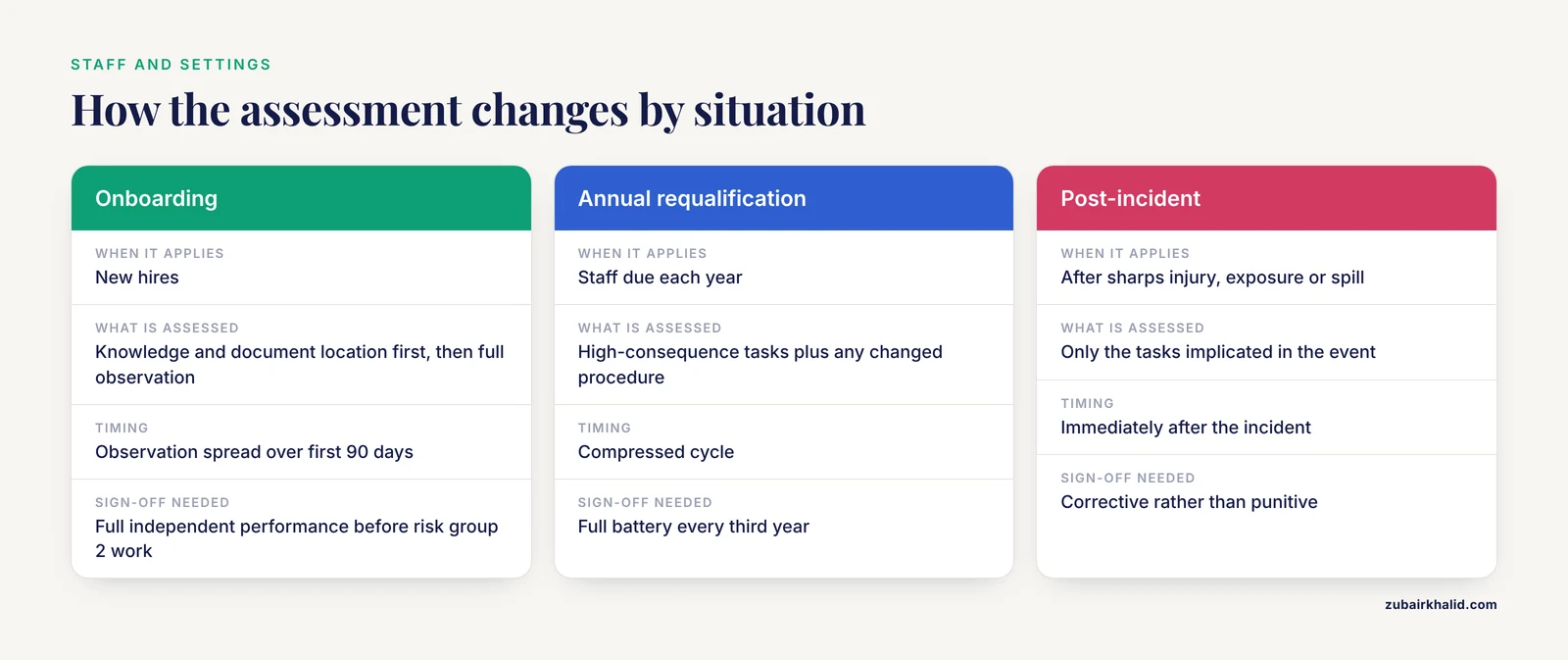
Onboarding assessment. For new hires, front-load the knowledge and document-location components in week one, then spread direct observation over the first 90 days. Require full independent performance sign-off before the person works unsupervised with risk group 2 material.
Annual requalification. Compress the cycle. Assess only high-consequence tasks (BSC practice, sharps, spill response, waste) plus any procedure changed since the last cycle. Reserve the full battery for every third year or after any significant incident.
Post-incident assessment. After a sharps injury, exposure, or spill with real material, assess only the tasks implicated in the event, using the incident report as the rubric source. This keeps the exercise corrective rather than punitive and closes the specific gap quickly.
Higher containment transitions. Staff moving to higher containment work need the full battery plus scenario assessments for containment-specific procedures. For respiratory and other hazards introduced at higher levels, add equipment donning and doffing verification and a written check that the person can state the inactivation requirements for the specific agents involved, since validated parameters are agent specific [3].
Teaching and outreach laboratories. Where staff or students work only at BSL 1 with defined, food-associated organisms, use a simplified rubric built around the core behaviors: hand washing, no mouth pipetting, sealed transport, disinfection of work surfaces, and an end-of-session inactivation workflow before disposal [6]. The teaching setting also demonstrates a useful program principle. Teacher and staff confidence is a documented limiting factor for safe practice, and checklists plus written implementation guides raise it [6]. Give your assessors the same support.
Facility and materials handling contexts. Some laboratories handle fixed materials whose own preservation or preparation method determines the biosafety controls. In veterinary anatomy education, the choice of preservation method changes occupational exposure risk and regulatory obligations, because some widely used preservation approaches do not sterilize the material and may permit persistence of halotolerant microorganisms [7]. If your staff handle preserved or pre-processed biological material, include a rubric item verifying they know which controls the material's preparation history actually guarantees and which it does not.
New product or process introduction. When a laboratory introduces a new process, assess a small cohort first using a structured short instrument, exactly as surgical training research evaluated a new 3D-printed training model with a 7-item questionnaire and a System Usability Scale-style derived score [2]. A brief structured tool deployed early catches usability problems in the new process before they become embedded bad habits across the whole staff.
Records, Reassessment Intervals, and Stability of the Program
Treat the competency program the way you treat reagent lot qualification, with defined stability and expiry.
- Retain completed assessments for the full period required by your accreditor, commonly aligned with employment plus several years. Confirm the interval with your institution's record retention policy.
- Reassess annually at minimum for staff working with risk group 2 or higher material, and immediately after any SOP revision, new agent introduction, equipment replacement, or reportable incident.
- Version control the rubrics themselves. Each scored record should reference the rubric version used, so that trends remain interpretable across years.
- Review the whole program yearly. The biotechnology literature repeatedly identifies incomplete biosafety assessment as a systemic weakness rather than an individual failing, a pattern documented even in structured scoping reviews of applied biological work [8]. Your yearly program review should ask whether any hazard in the current risk assessment lacks a corresponding rubric item.
- Stability check for the program itself: if assessment results remain uniformly perfect for two consecutive cycles across all staff, the instrument has likely become insensitive. Add one harder scenario item, such as a concurrently simulated equipment failure during specimen processing, to restore discrimination.
Biosafety Competency Assessment Tips
- Pair every observed task with a "why" question during feedback. A technologist who can explain why contact time matters retains the behavior better than one who was merely corrected.
- Keep rubric items binary wherever possible. "Removed gloves last without touching inner surfaces" is scoreable. "Handled PPE well" is not.
- Use the risk assessment as the live index of what to assess. When the risk assessment changes, the rubric changes with it.
- Let staff self-assess against the rubric before the observation session. Self-assessment followed by comparison against assessor scores is one of the fastest calibration tools available and costs nothing.
- Rotate scenario details between cycles. A staff member who has seen the same mock spill twice is demonstrating memory, not competency.
- Keep the written test short and diagnostic. Twenty well-written questions that map to your SOPs outperform a hundred generic bank questions.
- For resource-limited laboratories, adapt rather than omit. The frugal laboratory framework shows that rigorous biosafety teaching and assessment are achievable with low-cost equipment and clear written boundaries, provided inactivation and waste workflows are defined and followed every session [6].
- Close every cycle with a one-page program summary for the biosafety committee: items most frequently scored 1, corrective actions taken, and rubric changes made. This turns individual assessments into institutional learning.
Common Mistakes and Limitations
These are the biosafety competency assessment common mistakes seen most often in practice.
- Confusing attendance with competency. A training attendance log proves exposure to content, not performance. Only direct observation or validated simulation demonstrates competency.
- Assessing against a generic checklist instead of the local risk assessment. The behaviors that matter are the ones your agents, equipment, and procedures create. A generic template will both over-test harmless habits and miss your real failure modes.
- Announcing every observation. Announced-only observation measures performance anxiety and courtesy, not habit. Include at least one unannounced element per cycle.
- Single assessor, single session. One observer on one day produces an unrepeatable verdict. Use two assessors and at least two sessions.
- Treating a failed item as an individual defect without checking the system. When several staff miss the same item, the cause is usually an ambiguous SOP, missing equipment, or a training gap. Investigate the system before the person.
- Assuming decontamination knowledge transfers across agents. The species-specific behavior of heat inactivation demonstrated for Orientia and Rickettsia species shows that validated parameters cannot be extrapolated casually [3]. Verify that staff know which parameters are validated in your laboratory and which are not.
- Relying on spray-only disinfection. Mechanical wiping is part of effective surface decontamination, and different disinfectants achieve materially different log10 reductions against the same spore challenge [5]. Assess the full technique, including contact time and wiping action.
- Never testing judgment, only procedure. Staff who can execute a checklist but cannot recognize that a new specimen type requires a fresh risk assessment will eventually improvise unsafely. Always include at least one novel scenario item.
- Letting records lapse. An assessment program with missing or undated records fails accreditation review and provides no legal or scientific protection after an incident.
- Over-relying on written tests. Written instruments measure recall. They are one component of the battery, never the whole.
Limitations. Competency assessment verifies performance at a point in time under observed conditions. It cannot guarantee behavior during every future contingency, and it does not replace a functioning institutional biosafety program, current SOPs, or functioning equipment. Individual cases, particularly after incidents, require review by the biosafety officer and, where human exposure occurred, occupational health input.
Frequently Asked Questions
How often should biosafety competency be assessed in a microbiology laboratory?
Assess at hire, annually for staff working with risk group 2 or higher agents, and after any SOP change, new agent, equipment replacement, or reportable incident. High-consequence tasks should be requalified yearly, with the full battery every third year if your program is stable.
What is the difference between biosafety training and biosafety competency assessment?
Training delivers knowledge and skills. Competency assessment verifies, through direct observation and testing against written criteria, that the individual can perform the required behaviors independently and correctly. Attendance at a training session is not evidence of competency.
Who should perform the biosafety competency assessment?
Two people should share the role: the laboratory supervisor or biosafety officer and a senior technologist who performs the tasks daily. Two assessors reduce bias, allow uninterrupted observation, and make the result defensible.
What happens when a staff member fails part of the assessment?
Review every failed item in a feedback session, agree on specific remediation, restrict independent performance of any high-consequence failed task until reassessment, and reassess only the failed items on a set date. Repeated failure across cycles signals a training or SOP problem, not just an individual one.
Can a written test replace direct observation for biosafety competency?
No. A written test measures recall and belongs in the battery as one component. Biosafety behaviors such as BSC work practice, sharps handling, spill containment, and PPE doffing can only be verified by watching them or by validated simulation.
How does biosafety risk assessment connect to competency assessment?
The risk assessment defines the hazards and controls specific to your laboratory, and the competency rubric verifies that each staff member can execute those controls. When the risk assessment changes, the rubric must change with it in the same cycle.
How do you assess competency for high-containment work without creating exposure risk?
Use the full knowledge and document-location battery, observe donning and doffing, and run scenario and tabletop exercises for containment-specific events. Never introduce live high-consequence agents into simulated spills or drills. Inactivation knowledge can be tested verbally by requiring the staff member to state the validated parameters for the specific agents and explain why extrapolation is unacceptable.
What documentation should be retained after a competency assessment?
Retain the completed rubric with its version number, dated observation logs, written and oral test results, corrective action plans, reassessment records, and the signed final sign-off. Both assessors and the staff member should sign the record, and it belongs in the individual's training file.
Sources
- International external quality assessment of molecular detection of Rift Valley fever virus.
- Development and educational evaluation of patient-specific 3D-printed breast phantoms for oncoplastic surgical training.
- Optimization of heat inactivation protocols for Orientia and Rickettsia species.
- A step-by-step approach to establishing an efficient genetic transformation protocol for Chlorella vulgaris using electroporation.
- Effect of disinfectants and manual wiping for processing the cell product changeover in a biosafety cabinet.
- Eco-Microbiology: A Frugal-Circular Framework for Biosafe, Low-Cost Practical Microbiology in Secondary Education.
- Biosafety implications of cadaver preservation methods in veterinary anatomy education.
- From Spore Biology to System Performance: Strain-Resolved Mechanisms, Biosafety and Translational Readiness of Bacillus Probiotics in Aquaculture.