Biological Waste Disposal Regulations
By Dr. Zubair Khalid, DVM, MS, PhD ·
Biological waste disposal regulations are the federal rules that govern how laboratories, hospitals, and animal facilities collect, decontaminate, package, transport, and discard materials contaminated with infectious agents or human blood. In the United States the framework rests on three agencies, with the Occupational Safety and Health Administration (OSHA) protecting the worker during handling, the Environmental Protection Agency (EPA) protecting the environment at the point of release, and the Department of Transportation (DOT) controlling packaging and transport between the two.
The framework matters because biological waste is a legal responsibility from the moment it is generated until it is destroyed or discharged, and that responsibility does not end when a hauler drives away. A bag of contaminated culture plates is regulated waste under OSHA's Bloodborne Pathogens Standard while it sits at the bench, a DOT-classified shipment when it leaves the dock, and a state-regulated treated residue at the landfill. Facilities that manage the stream well report lower disposal costs, lower operating costs, reduced liability, increased worker safety, and a cleaner environment, outcomes documented in the infectious waste management and laboratory design literature [1]. Facilities that manage it poorly face civil penalties, failed inspections, and occupational exposures that good microbiology cannot undo.
What Biological Waste Disposal Regulations OSHA EPA DOT Mean
Students often search for a single federal statute and find none, because the phrase describes a division of labor rather than one law. The biological waste disposal regulations OSHA EPA DOT framework, explained simply, assigns each agency a different stage of the waste stream. Here is what each one controls and where the boundaries sit.
OSHA: The Worker-Facing Layer
OSHA's Bloodborne Pathogens Standard, 29 CFR Part 1910.1030, anchors most laboratory waste practice. The standard defines regulated waste as liquid or semi-liquid blood or other potentially infectious materials (OPIM), items caked with dried blood or OPIM that could release it during handling, contaminated sharps, and pathological or microbiological wastes containing blood or OPIM. OPIM is itself a defined list. It includes cerebrospinal, synovial, pleural, pericardial, peritoneal, and amniotic fluids, semen and vaginal secretions, and any unfixed tissue or organ from a human or experimental animal infected with HIV or hepatitis B virus. Ordinary urine, feces, and saliva are not OPIM unless they are visibly contaminated with blood.
For waste handling, the standard requires containers that are closable, puncture resistant, leakproof on the sides and bottom, and labeled with the fluorescent orange or orange-red biohazard label. Sharps containers must be easily accessible where sharps are used, maintained upright, replaced routinely, and never allowed to overfill. Employers must maintain a written exposure control plan and train employees with occupational exposure at assignment and annually afterward. One interpretation point causes constant confusion. OSHA dictates how waste is contained, labeled, and handled, not how it is destroyed. The standard does not mandate autoclaving, incineration, or any specific technology, it requires safe handling and disposal according to the standard and other applicable rules.
EPA: The Environment-Facing Layer
EPA's role is narrower than many students expect. Medical waste is not a federally listed hazardous waste under the Resource Conservation and Recovery Act (RCRA) unless it is mixed with chemical waste that carries a listed or characteristic hazard. After the Medical Waste Tracking Act of 1988 ran as a limited demonstration program that ended in the early 1990s, primary authority over medical waste treatment and disposal shifted to the states, and most state programs now define their own waste categories, approved treatment technologies, and tracking paperwork.
EPA still controls three things a laboratory feels directly. Emissions from hospital, medical, and infectious waste incinerators are federally limited under the Clean Air Act. Discharge of treated liquid waste into a sanitary sewer falls under Clean Water Act pretreatment standards, enforced locally by the publicly owned treatment works that receive the discharge. Any chemical disinfectant marketed with pathogen inactivation claims must be registered with EPA, which is why bottle labels carry registration numbers and precise use directions. Mixed waste, meaning radioactive, chemical, and biological hazards combined in one container, generally triggers the strictest applicable rule for each hazard present.
DOT: The Transport-Facing Layer
The DOT Hazardous Materials Regulations, 49 CFR Parts 171 through 180, take over the moment waste leaves the site. Infectious substances fall under Division 6.2. Category A is an infectious substance capable of causing permanent disability or life-threatening or fatal disease in otherwise healthy humans or animals on exposure, assigned UN 2814 when infectious to humans and UN 2900 when infectious to animals only. Category B covers infectious substances that do not meet the Category A criteria, assigned UN 3373. Waste shipped for disposal is classified as regulated medical waste, UN 3291.
All of these materials travel in triple packaging, meaning a leakproof primary receptacle inside a leakproof secondary packaging with absorbent material between the two, all inside a rigid outer container bearing the required UN marking and hazard communication. Waste that has been decontaminated so that it no longer contains an infectious substance falls outside Division 6.2. Anyone who classifies, packs, marks, labels, or signs shipping papers for these materials must hold function-specific training, refreshed at least every three years.
Interpreting Which Rule Applies at Each Step
The cleanest way to understand the framework is to follow one object through its life. Take a sealed bag of used blood culture bottles. At the bench, OSHA rules apply, so the bag must be closable, leakproof, labeled, and stored upright. When the bag goes into a shipping container for a licensed hauler, DOT rules apply, with UN 3291 classification, packaging, marking, and shipping papers signed by a trained employee. At the treatment plant, state medical waste rules plus federal incinerator and sewer limits apply to the residue and emissions. The same physical object changes regulatory identity three times, and a compliant facility documents each handoff. That matching exercise, step by step, is the practical work of biological waste disposal regulations OSHA EPA DOT interpretation.
Key Terms and the Terms They Get Confused With
| Term | Who defines it | What it covers | What it is confused with |
|---|---|---|---|
| Regulated waste | OSHA, 29 CFR 1910.1030 | Liquid or semi-liquid blood or OPIM, items caked with dried blood, contaminated sharps, pathological or microbiological waste containing blood or OPIM | Often misused as a synonym for all biohazardous waste |
| Other potentially infectious materials (OPIM) | OSHA | A defined list of body fluids plus unfixed tissue from humans or experimental animals infected with HIV or hepatitis B virus | Often assumed to include every body fluid, which it does not |
| Category A infectious substance | DOT, 49 CFR 173.134 | Agents capable of permanent disability or life-threatening or fatal disease on exposure, UN 2814 or UN 2900 | Confused with any dangerous pathogen, it is a transport severity class |
| Category B infectious substance | DOT | Infectious substances not meeting Category A criteria, UN 3373 | Confused with non-hazardous material, it remains fully regulated |
| Regulated medical waste | DOT, UN 3291 | Medical and clinical waste shipped for disposal | Confused with state medical waste definitions, which vary |
| RCRA hazardous waste | EPA | Chemical waste with listed or characteristic hazards | Confused with medical waste, which is not RCRA hazardous unless mixed |
These distinctions have practical consequences. A used examination glove with no visible blood is not OSHA regulated waste, yet many facilities still discard it as biohazardous waste under institutional policy, which is allowed but more expensive. A closed vial of patient serum is both OSHA regulated waste and a DOT Category B shipment if it contains a pathogen. A vial of a Category A agent is a far more demanding shipment than a routine specimen even though both may sit in the same type of refrigerator. Classification is not one decision, it is one decision per agency per object.
From Bench to Final Disposal, Step by Step
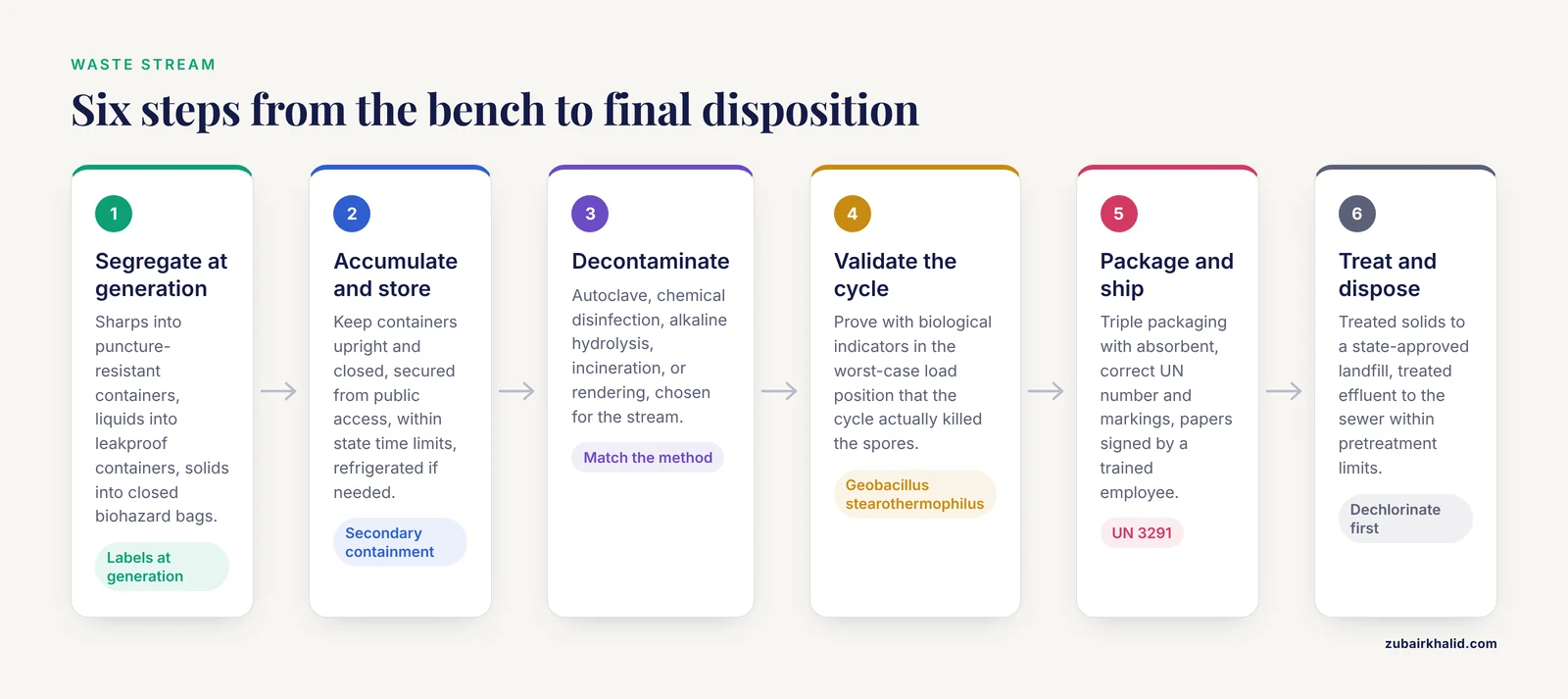
Step 1: Segregation at the Point of Generation
Segregation starts the moment waste is created. Sharps, meaning needles, lancets, broken glass, and scalpel blades, go directly into a puncture-resistant sharps container at the workstation. Free liquids, such as aspirated cultures or blood bank overflow, go into leakproof, break-resistant containers with secondary containment. Solid items such as agar plates, pipettes, gloves, and transfer devices go into biohazard bags that are closed before transport. Labels go on at generation, not at the loading dock. Segregation decisions are an output of the facility's biosafety risk assessment, described below, because the treatment route a stream will take determines how it must be sorted at the bench.
Step 2: Accumulation and On-Site Storage
Containers stay upright, closed when not in use, and inside secondary containment where liquids are involved. Accumulation areas are secured against public access, kept within the time limits the state program sets, and refrigerated where the stream requires it, a common practice for animal carcasses awaiting transport. Storage is also a biosecurity checkpoint, since waste holding areas concentrate infectious material in one room and deserve the same access control as any culture room.
Step 3: Decontamination
Decontamination is treatment that removes or destroys infectious agents so the material no longer poses an infection risk. The main technologies are steam sterilization in an autoclave, chemical disinfection with agents such as sodium hypochlorite, alkaline hydrolysis in tissue digesters, incineration, and rendering, the industrial heat processing of animal byproducts described in World Health Organization hygiene guidance for animal materials [2].
For biomanufacturing waste at biosafety levels 1 and 2, thermal inactivation is described as the most reliable and sustainable method for both liquid and solid waste, with small liquid volumes sterilized in validated autoclave programs and large volumes treated in continuous-flow heat systems designed for complete inactivation and energy efficiency [3]. Chemical inactivation serves as the alternative for heat-resistant toxins such as saxitoxin or palytoxin, using sodium hypochlorite or sodium hydroxide with reaction parameters set to the task and validated pH adjustment afterward so the treated stream is safe for the environment [3]. Alkaline hydrolysis offers a different route for animal work, where a tissue dissolver in an animal biosafety level 3 facility completely digested infectious carcasses into a non-infectious liquid effluent that could be disposed of directly to the sanitary sewer [4].
Step 4: Validation, the Step That Separates Compliance From Assumption
A biological indicator is a preparation of highly resistant bacterial endospores, typically Geobacillus stearothermophilus, placed into a load and cultured afterward to confirm the cycle killed them. Validation means proving, with indicators placed in the worst-case position of the worst-case load, that the chosen cycle, concentration, or holding time actually works.
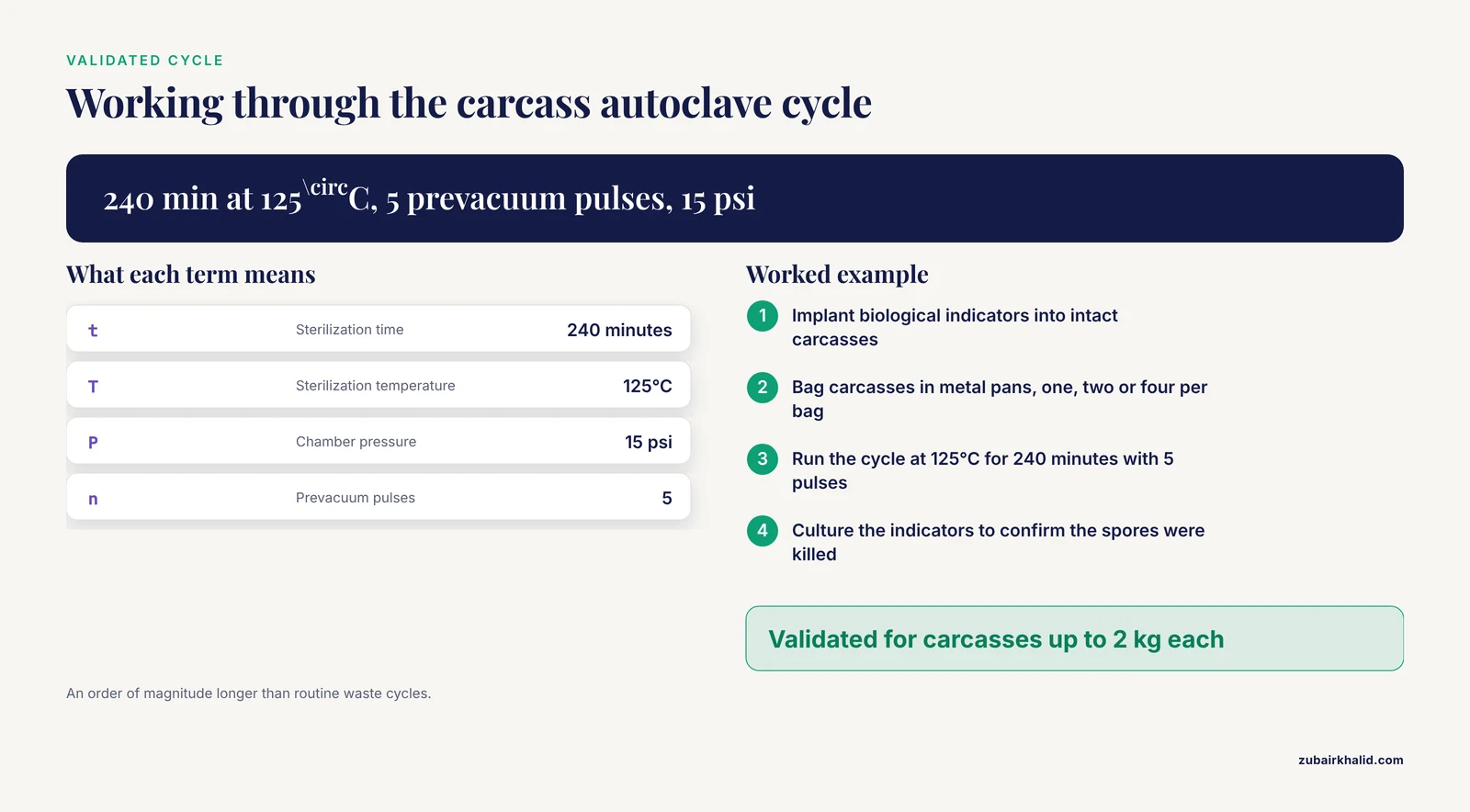
Animal carcasses show why this matters. Carcasses differ in composition from other solid waste, and prior testing showed that cycle parameters proven on general biohazardous waste did not ensure sterilization of ferret carcasses. Researchers implanted biological indicators into intact carcasses, placed them in biohazard bags inside metal pans, and tested loads of one, two, or four carcasses per bag. The validated cycle for carcasses up to 2 kg each required 240 minutes of sterilization at 125°C with five prevacuum pulses and a chamber pressure of 15 psi, an order of magnitude longer than routine waste cycles [5].
Equipment claims need the same scrutiny. A commercial alkaline hydrolysis tissue dissolver inactivated high concentrations of chemically resistant bacterial spores at the manufacturer's recommended cycle parameters, and halving the cycle time still inactivated all spores, although a small amount of tissue remained undigested. Because dissolver design and tissue load vary between facilities, the authors recommend that each facility run its own verification experiments before relying on the equipment [4].
Chemical systems demand matrix-specific testing. A bleach-based effluent decontamination system (EDS), purchased as an interim replacement for a failed unit, was validated for biosafety level 3 and 4 effluent. Laboratory studies first showed effective inactivation of more than one million (10^6) Bacillus spores at a free chlorine concentration of at least 5,700 parts per million with a 2-hour contact time, tested in complex matrices containing fetal bovine serum, humic acid, and animal room sanitation effluent. Translation to the installed system used laboratory-prepared spore packets and commercial biological indicators, and surfaced practical issues including the bleach product source, dechlorination before discharge, and disposal of the treated waste [6].
Liquid waste can sometimes be managed by holding rather than active treatment. In one study, liquid waste from a viral total nucleic acid extraction kit, containing guanidinium chloride, isopropanol, and ethanol, was spiked with bacteriophage MS2, a bacterial virus used as a surrogate for infectious viruses. Inactivation followed a one-phase exponential decay, with a predicted 6-log10 reduction, meaning 99.9999 percent infectivity loss, at an average of 2.41 hours and a 95 percent confidence interval of 1.34 to 4.05 hours. Only the 24-hour holding point significantly exceeded the 6-log10 threshold, so the authors recommend a 24-hour hold as a conservative and practical standard before disposal [7].
Step 5: Packaging and Shipping
Once waste is decontaminated, or if untreated waste must ship to a permitted treatment facility, DOT rules govern the box. Triple packaging is assembled with absorbent material, the outer container carries the correct UN number and hazard markings, and the shipment moves with shipping papers and emergency response information signed by a trained employee. Overpacks, meaning an additional outer box placed over a damaged or leaking package, follow their own marking rules. Facilities keep shipping records because the paperwork is the proof that the generator met its duties.
Step 6: Treatment Facility and Final Disposition
Treated solids go to a landfill approved by the state program. Treated effluent goes to the sanitary sewer within local pretreatment limits, with dechlorination before discharge where chemical systems are used [6]. Incinerator emissions are controlled under federal standards. Rendering plants processing animal materials must prevent cross-contamination from raw to decontaminated product and protect their own personnel, and under the WHO guidance high-risk animal materials should at minimum be sterilized or burnt, while low-risk materials may be autoclaved or cooked so that proteins and fat can be safely reused [2].
A Note on Veterinary Clinics and Animal Facilities
The same three-layer framework applies to veterinary practice. Vaccine needles and scalpel blades are OSHA sharps, biopsy tissue and carcasses from known or suspected infectious cases are regulated or state-defined medical waste, and any shipment of diagnostic specimens or tissues to a reference laboratory is a DOT shipment. Animal facilities that work with livestock at high containment face the largest version of the problem, because in agricultural biosafety level 3Ag and 4Ag facilities the animal room itself serves as primary containment and the waste stream includes bedding, feed, water, and manure from loose-housed animals rather than caged waste [8].
Biosafety Risk Assessment: The Engine Behind Every Disposal Decision
A biosafety risk assessment is the structured evaluation of an agent's hazard, the procedures that manipulate it, the volumes and concentrations involved, and the routes of exposure, used to select containment level, work practices, and waste treatment stringency. The framework used across United States laboratories comes from Biosafety in Microbiological and Biomedical Laboratories (BMBL), published by the Centers for Disease Control and Prevention and the National Institutes of Health.
Risk assessment determines the disposal plan in concrete ways. A biosafety level 1 or 2 biomanufacturing facility can rely on validated thermal inactivation with leakproof collection, the approach recommended for that sector [3]. Work with prions sits at the opposite end, because recognition that prion disease agents and other high-consequence pathogens require safe handling and thorough destruction during terminal decontamination has driven new biosafety guidelines and dedicated technologies [9]. Increased concern about biologically derived toxins and hazardous chemicals has likewise prompted a new categorization of facility containment based on risk assessment [9], and heat-stable toxins such as saxitoxin and palytoxin must be chemically rather than thermally inactivated [3].
The risk assessment also sets validation stringency. A level 2 laboratory discarding routine cultures may rely on a standard validated autoclave cycle with periodic biological indicator monitoring. A facility handling spore-forming agents or prion-contaminated carcasses needs purpose-built destruction, longer cycles, or dedicated chemical treatment, and must prove effectiveness on its own loads. In agricultural high containment, the equipment list itself reflects the assessment, spanning autoclaves, effluent decontamination systems, incinerators, high-temperature renderers, alkaline tissue digester systems, high-efficiency particulate air filtration of supply and exhaust air, gas decontamination systems, and laundry facilities, refined over a decade of facility operation [8].
Microbiology Biosafety Training: The Human Control
Regulators treat training as an engineering control for human error. OSHA requires bloodborne pathogens training at assignment and annually, covering modes of transmission, the exposure control plan, protective equipment, and waste handling. DOT requires function-specific hazmat training, refreshed at least every three years, for anyone who classifies, packages, marks, labels, or documents shipments. Institutions layer on SOP training before independent work, covering the specific autoclave, the specific effluent system, and the specific forms.
The evidence that training changes behavior is direct. In a survey of 208 clinical laboratory workers, 68 percent had laboratory safety training and more than 80 percent followed guidelines for medical waste disposal and spill decontamination, yet 67 percent reported recapping needles after blood withdrawal and 24.2 percent ate, drank, or chewed gum in the laboratory, and these unsafe behaviors were statistically associated with lack of safety training and with three years or less of experience [10]. The pattern generalizes, waste handling errors cluster where training is thin, which is why an inspector reads training records as a leading indicator of compliance rather than as paperwork.
How Compliance Is Tested in Practice
Internal testing runs continuously. Autoclave cycles are monitored with biological indicators on a set frequency and with chemical indicators and temperature and pressure charts on every run, load configurations are logged so a failed indicator can be traced to a specific load, effluent systems are checked for free chlorine concentration and contact time, and holding times for liquid waste are logged. External testing comes from accreditation walkthroughs, state medical waste program audits, DOT packaging and shipping paper checks, and OSHA container and label inspections.
The organizing document is the written infectious waste management plan, which specifies collection, sterilization, and disposal procedures together with the relevant engineering controls for the containment laboratory [1]. Inspectors typically start with the plan, then trace a single waste stream from generation through final disposition, asking at each step for the training record, the validation record, and the tracking document. A facility that can produce all three for any stream it generates passes the test that matters.
Common Mistakes and Limitations
- Using one validated cycle for every load. Cycle parameters proven on loose solid waste can fail on intact tissue, so dense loads such as carcasses need their own developed and validated cycle [5].
- Trusting a chemical method in organic-rich waste. Organic material such as serum can demand far higher disinfectant concentrations than clean-water testing suggests, so concentration and contact time must be validated in the actual matrix [6].
- Picking a liquid holding time from an average. The interval that reliably clears a safety threshold can be several times longer than the average inactivation time, so holding periods should be demonstrated rather than estimated [7].
- Treating manufacturer parameters as validation. Commercial equipment arrives with recommended settings, but design and load composition vary between facilities, so each site runs its own verification before relying on the machine [4].
- Confusing decontamination with detoxification. Treated does not mean chemically harmless, and pH adjustment and residual chemistry after sodium hypochlorite or sodium hydroxide treatment must be validated before discharge [3].
- Over-classifying waste. Placing every item into the regulated medical waste stream looks safe and inflates cost without improving safety, and a well-built plan is specifically associated with lower disposal and operating costs [1].
- Recapping needles or overfilling sharps containers. Recapping remains one of the most frequently reported unsafe behaviors in clinical laboratory surveys and tracks with thin training [10].
- Assuming federal rules are the whole rulebook. State medical waste programs, local sewer pretreatment limits, and institutional policy add requirements on top of OSHA, EPA, and DOT, and the strictest applicable rule governs.
- Misclassifying shipments. Sending a Category A culture as Category B, or shipping untreated infectious waste without UN 3291 packaging and papers, creates both a safety incident and an enforcement problem.
A limitation worth stating once. Rules vary by state and locality, and validation is facility specific, so individual disposal decisions, especially for unusual agents, large animal carcasses, or mixed chemical and biological hazards, belong with the institutional biosafety officer. For veterinary clinics and animal owners arranging disposal of animal remains, the attending veterinarian should confirm the plan for the species and agents involved.
Quick Review
- OSHA contains and labels the waste, EPA controls the release, DOT controls packaging and transport.
- OSHA regulated waste is a narrow definition, not a synonym for all biohazardous waste.
- Category A ships as UN 2814 or UN 2900, Category B as UN 3373, disposal waste as UN 3291, all in triple packaging.
- Decontamination must be validated on the actual load, dense or organic-rich waste needs its own cycle, concentration, or hold time.
- Biological indicators and surrogate organisms such as MS2 phage are how facilities prove inactivation rather than assume it.
- Training is a regulatory control, OSHA annually and DOT every three years.
- The written infectious waste management plan is the first document an inspector requests.
Frequently Asked Questions
What does biological waste disposal regulations OSHA EPA DOT mean?
It describes the three federal rule sets that govern biological waste in sequence. OSHA protects workers during collection and handling, EPA controls environmental release and treatment standards, and DOT regulates classification, packaging, and transport of infectious substances and regulated medical waste.
Can autoclaved biological waste go in the regular trash?
Yes, when decontamination is validated and documented and the material no longer meets the definition of regulated waste or an infectious substance. State rules still apply, so confirm what your state program requires for treatment records and landfill disposal.
What is the difference between Category A and Category B infectious substances?
Category A substances are capable of causing permanent disability or life-threatening or fatal disease in otherwise healthy humans or animals on exposure, and ship as UN 2814 or UN 2900. Category B covers infectious substances that do not meet that severity bar, and ships as UN 3373.
How long should liquid biohazardous waste sit before it can be discarded?
Long enough for validated inactivation under the actual chemistry and organic load of the waste, demonstrated with a surrogate organism rather than assumed. A conservative holding period beats an optimistic average.
Does OSHA require every biohazardous item to be autoclaved?
No. OSHA requires regulated waste to be contained, labeled, and disposed of according to the Bloodborne Pathogens Standard, but it does not mandate a destruction technology. Treatment method follows state rules and the facility's validated plan.
Who is responsible if a medical waste shipment leaks in transit?
The generator remains responsible for correct classification, packaging, marking, and shipping papers under DOT rules, while the transporter and treatment facility carry their own duties. Liability can reach the generator even with a contracted hauler, which is why documentation matters.
Sources
- Infectious waste management and laboratory design criteria.
- [[The hygienic disposal and rendering of dead animals and animal waste].](https://pubmed.ncbi.nlm.nih.gov/3750305/)
- Toolbox for Bio Safety Manufacturing Waste Treatment.
- Decontamination and digestion of infectious animal waste using a tissue dissolver in an animal biosafety level 3 facility.
- Validating Autoclave Cycles for Carcass Disposal in Animal Biosafety Level 2/3 Containment Laboratories.
- Biological Validation of a Chemical Effluent Decontamination System.
- Evaluating viral inactivation in the liquid waste stream from a viral total nucleic acid extraction kit for safe disposal.
- Challenges and Solutions With Agricultural Animal High Containment Waste Disposal.
- What's hot in animal biosafety?
- Assessment of biosafety measures in clinical laboratories of Al-Madinah city, Saudi Arabia.