Biological Exposure Reporting Needlestick Splash: Step-by-Step Guide
By Dr. Zubair Khalid, DVM, MS, PhD ·
A needlestick or splash exposure triggers a fixed sequence: immediate first aid, prompt notification, structured risk assessment, source testing, post-exposure prophylaxis (PEP) when indicated, baseline serology, and a written report that feeds prevention. PEP means preventive medication given after an exposure to stop an infection from establishing. This guide walks through biological exposure reporting for needlestick and splash injuries step by step, written for the bench technologist, nurse, phlebotomist, student, and physician who has just been exposed and needs an order of operations.
Use this procedure for any percutaneous injury (a needle or sharp that breaches the skin) or mucocutaneous splash (blood, body fluid, or infectious culture contacting the eyes, nose, mouth, or non-intact skin). It also covers laboratory incidents such as a spill or centrifuge leak that produces a splash or aerosol outside containment.
Timing drives the whole workflow. Hands-on first aid takes one to five minutes. Notification and occupational health evaluation should fit inside the first hour. Standard practice targets the start of HIV PEP within two hours of the exposure. Baseline bloods are drawn the same day. Serologic follow-up for bloodborne viruses runs six months, and specialized programs after filovirus exposures monitor people for up to 24 months.
Done correctly, the sequence delivers three things. The exposed worker gets the best available chance of preventing infection. The institution gets a documented occupational record that supports care and compensation. The aggregate data reveal the devices, tasks, and shift patterns that prevention programs can fix.
Principle: Why First Aid and Reporting Work
Three bloodborne viruses dominate the risk after patient-derived exposures: hepatitis B virus (HBV), hepatitis C virus (HCV), and human immunodeficiency virus (HIV). HBV transmits far more efficiently through percutaneous exposure than HIV, which is why the worker's vaccination and antibody status drive the HBV response. HCV has no vaccine and no approved prophylaxis, so its management rests on early detection of infection. HIV has potent PEP that works only when started early.
An exposure becomes useful the moment it is reported. A tertiary care hospital in southern India analyzed five years of post-exposure reports and found 189 healthcare workers with reported splash, sharp, and needlestick injuries. Needle prick accounted for 86.2 percent of exposures, splash of fluids for 7.4 percent, and nursing staff for 44.4 percent of reporters [1]. That profile is exactly what a prevention program needs, and it exists only because people filled out the form.
The gap between being exposed and being managed is the real threat. Among nurses at an Ethiopian general hospital, 61.6 percent reported occupational exposure to HIV risk, with blood splash (40.5 percent) and needlestick injury (37.8 percent) as the two leading exposure types [2]. Exposure systems only work at full participation.
The formal term for the percutaneous category is percutaneous exposure incident (PEI), any injury in which a contaminated sharp breaches the skin. In a prospective study at a newly founded tertiary hospital in Athens, 60 needlestick injuries, 11 sharp injuries, and 2 splashes were reported among 71 nurses and 2 cleaning staff, with serologic testing for HBV, HCV, and HIV performed on all injured employees and on source patients when known [3]. That study shows the two halves of a working system, complete reporting and paired testing of both parties.
Materials and Reagents
Keep these items reachable at every bench, phlebotomy cart, and nurses station. Most are standard stock, the rest come from occupational health.
| Item | Working concentration or specification | Purpose | Notes |
|---|---|---|---|
| Plain soap and running water | Any liquid soap | First aid for percutaneous exposure | Wash the wound, do not scrub |
| Sterile 0.9% sodium chloride | 0.9% w/v sodium chloride in water | Eye and mucosal irrigation | Single-use bottles or the eyewash station |
| Eyewash station | Plumbed or gravity-fed, continuous flow | Immediate eye irrigation | Test flow weekly, keep the path to it clear |
| 70% isopropyl alcohol | 70% v/v in water | Skin antisepsis after washing | Apply after the soap wash, not instead of it |
| 10% povidone-iodine | 10% w/v solution, 1% available iodine | Alternative skin antiseptic | Use where alcohol is unsuitable |
| Sterile gauze and dressing | Sterile, single use | Wound coverage | Apply after antisepsis |
| Puncture-resistant sharps container | Meets institutional sharps standard | Disposal of the injuring device | Never recap, bend, or break the needle |
| PPE for source handling | Gloves, fluid-resistant gown, eye protection | Drawing and handling source samples | Prevents a second exposure during workup |
| Exposure incident report form | Institutional template, paper or electronic | Documentation | Complete before the shift ends |
| Occupational health contact card | Daytime number and after-hours line | Rapid notification | Post at every bench and nurses station |
| Laboratory requisitions | HBsAg, anti-HBs, anti-HCV, HIV-1/2 Ag/Ab combination assay | Source and baseline serology | Order baseline for the worker and source testing when the source is known |
| Hepatitis B immune globulin (HBIG) | 250 IU anti-HBs, intramuscular | Passive prophylaxis for workers without adequate titers | Stocked by occupational health or pharmacy [3] |
| Antiretroviral PEP starter pack | Three-drug regimen per institutional protocol | HIV post-exposure prophylaxis | Start within two hours when indicated, 28-day course |
| Serum aliquot tubes | Labeled cryovials, 2 mL | Baseline serum storage | Freeze at -20°C or below for later comparison |
Safety note. The device that injured you is still a hazard. Lift it with tongs or forceps, or use the one-handed scoop technique if you must handle it, and drop it into the sharps container. Never recap it. If blood or fluid is on the floor, contain it with absorbent material and disinfect before the workup continues.
Biological Exposure Reporting for Needlestick and Splash: Step-by-Step Procedure
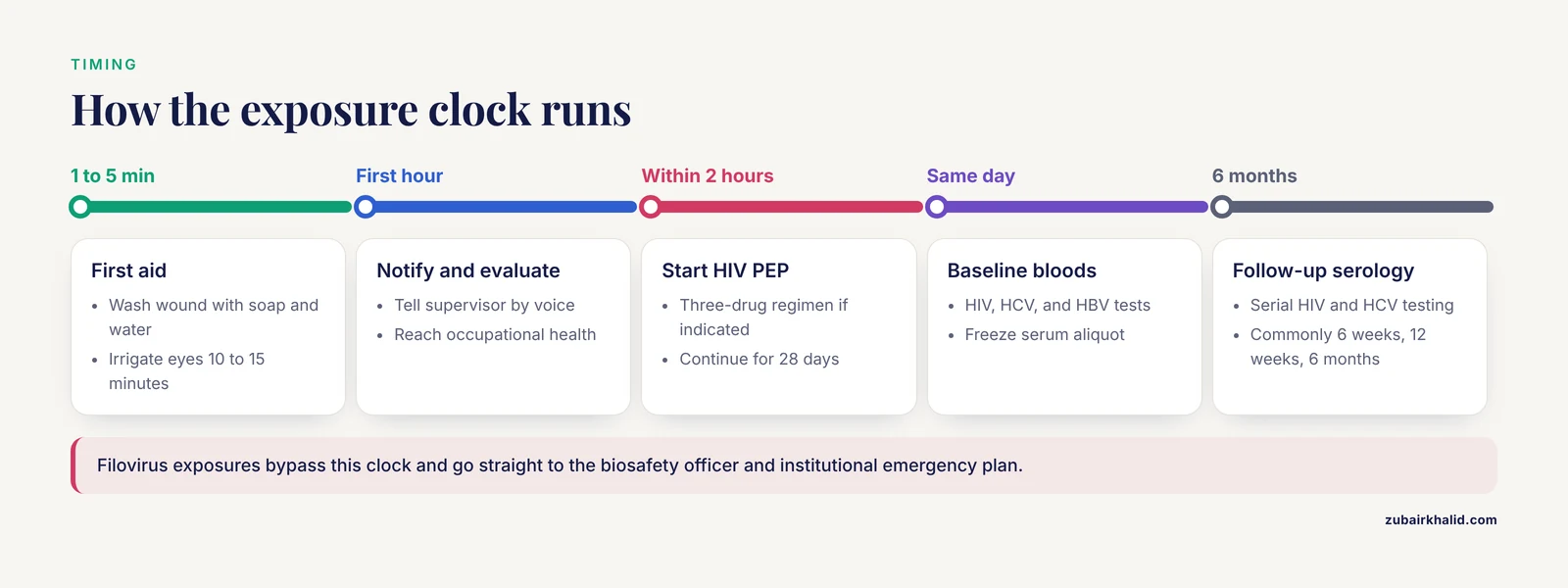
Step 1. Perform first aid within seconds of the exposure. For a needlestick or sharp injury, wash the wound with plain soap and running water, then apply 70% alcohol or 10% povidone-iodine and cover with sterile gauze. Do not squeeze the wound, do not scrub, and do not suck the wound. For a splash to the eyes, nose, or mouth, go to the eyewash station and irrigate with 0.9% saline or clean water for a full 10 to 15 minutes, removing contact lenses as soon as flushing starts. For a splash on non-intact skin (a cut, abrasion, or dermatitis), wash thoroughly and manage it like a percutaneous exposure. Reason: Washing and irrigation physically remove inoculum from the wound surface and mucosa. Squeezing or sucking traumatizes tissue and can press contaminated material deeper. Bleach and undiluted antiseptics damage mucosa and are not first aid.
Step 2. Contain the hazard. Place the injuring needle or blade in a puncture-resistant sharps container using tongs or the one-handed scoop technique. Do not recap. If the exposure came from a spill, cordon the area and start disinfection per the spill protocol after first aid is done. Reason: The device caused one injury and should not cause a second. Leaving the device unrecapped in the container also lets occupational health record the device type, because a hollow-bore needle carrying visible blood ranks higher in risk than a solid suture needle scratch.
Step 3. Notify your supervisor immediately, by voice. Say the words "I had an exposure" with the time and location. Do not send a message and wait for a reply. Reason: Verbal notification starts the institutional exposure protocol, arranges coverage for your tasks, and starts the PEP clock. Minutes matter for HIV PEP.
Step 4. Proceed to occupational health, ideally within the hour. During business hours go to employee health. After hours, follow the institutional route, usually the emergency department, and call the posted after-hours line while you walk. Reason: Standard practice targets HIV PEP initiation within two hours of exposure, and the evaluation, consent, blood draws, and dispensing all take time. Exposures cluster at the start and end of shifts, which is exactly when coverage is thinnest, so know the after-hours route before you need it [4].
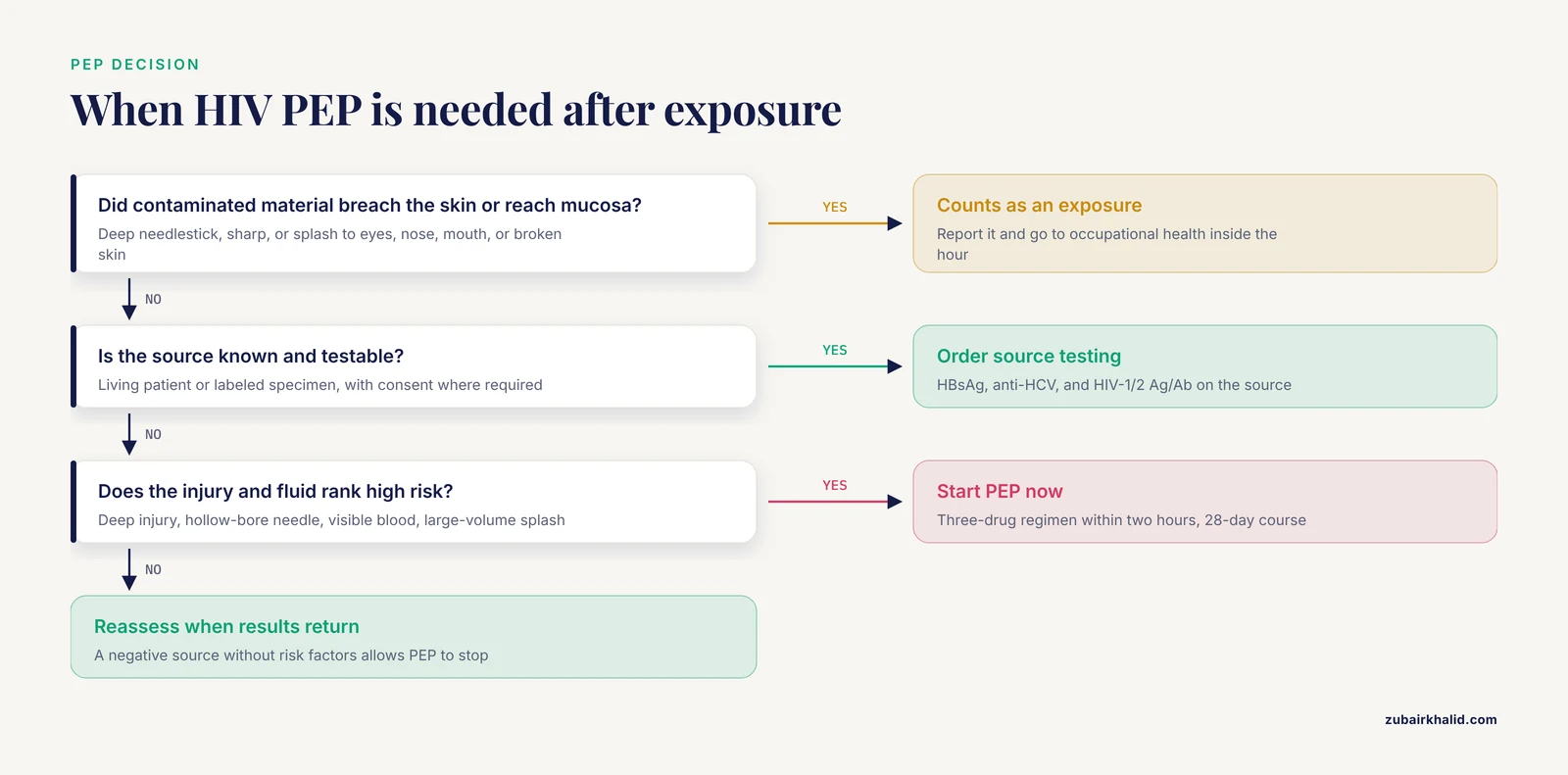
Step 5. Give a precise exposure history. Report the type (needlestick, sharp, splash), clock time, location, task, device details (gauge, hollow bore or solid, visible blood), depth, fluid type (blood, bloody fluid, culture, other body fluid), duration of contact, PPE worn, and first aid performed. Reason: These variables drive the risk estimate and the PEP decision. A deep injury with a hollow-bore needle carrying visible blood sits at the top of the risk hierarchy, a scratch from a solid needle through a glove sits near the bottom.
Step 6. Arrange source testing. If the source is a known patient or a labeled specimen, occupational health orders HBsAg, anti-HCV, and HIV-1/2 Ag/Ab combination testing on the source, with the patient's consent where a living patient is involved. The Athens cohort performed serologic studies for HBV, HCV, and HIV on all injured employees and on source patients when known [3]. Reason: Source results are the strongest single input to the PEP decision. A known HBsAg-positive source with an inadequately vaccinated worker triggers HBIG, and a known HIV-positive source with a significant exposure triggers antiretroviral PEP.
Step 7. Draw baseline bloods on the exposed worker. Order HIV-1/2 Ag/Ab, anti-HCV, and HBsAg with anti-HBs to document immunity. Add liver function tests if antiretrovirals are planned. Aliquot the baseline serum and freeze it at -20°C or below. Reason: Baseline results document the worker's pre-exposure status, guide HBV management, and give the laboratory a stored reference for comparison if any follow-up test turns reactive.
Step 8. Start PEP when the assessment indicates it. For HIV, occupational health starts a three-drug antiretroviral regimen as soon as the exposure qualifies, ideally within two hours, and continues it for 28 days while source results return. For HBV, an unvaccinated worker, or a vaccinated worker whose anti-HBs titer is inadequate, receives HBIG. In the Athens cohort, non-vaccinated or serologically non-responder staff received high-titer immunoglobulin, 250 IU anti-HBs intramuscularly, together with vaccination [3]. Reason: PEP works by blocking replication before infection establishes. Passive anti-HBs antibody neutralizes virus immediately while active vaccination ramps up. Waiting for source results to come back before starting an indicated regimen forfeits the window. Safety note: Antiretroviral PEP causes nausea, fatigue, and headache in many recipients. Occupational health manages adverse effects rather than letting them end the course.
Step 9. Complete the written exposure report before the shift ends. Record date, time, location, task, device, fluid, PPE, first aid, source information, tests ordered, PEP given, and the signatures of worker and supervisor. Reason: The report creates the administrative and legal record that links any future seroconversion to the occupational event. It is also the raw data for prevention, because hospitals that mined years of these reports could profile exactly which injuries dominated and which departments needed intervention [1].
Step 10. Complete follow-up serology. Attend every scheduled visit. Bloodborne virus follow-up typically uses serial HIV and HCV testing over six months, with intervals set by the assays in use, commonly around six weeks, twelve weeks, and six months. HBV testing follows vaccination and titer status. Reason: Antigen and antibody timelines mean a single early test cannot rule out infection. Serial testing detects seroconversion (the appearance of detectable antibodies) or confirms clearance.
Step 11. Close the loop on source results. When source results return, occupational health adjusts the plan. A positive source result extends or modifies PEP and follow-up. A negative result in a source without risk factors allows PEP to be stopped and follow-up shortened. Reason: PEP drugs carry real toxicity. Stopping them when the source is negative protects the worker from unnecessary adverse effects.
Step 12. Participate in the root-cause review. Within days, the unit reviews the event, device design, workload, technique, and PPE, and updates the exposure control plan or training. Reason: Individual reports become prevention only when aggregated and acted on. A reporting system that collects forms without closing the loop prevents nothing.
Practical Tips for the First Ten Minutes
- Memorize the eyewash station nearest your bench before you need it.
- Keep the occupational health number on your badge, not in a drawer.
- Say the exposure out loud to a colleague so a second person tracks the time.
- Note the exact clock time of the exposure, because the PEP clock runs from that minute.
- If you are alone on nights, call the after-hours line while irrigating. Do not finish the task first.
Biosafety Risk Assessment After the Exposure
A biosafety risk assessment is a structured estimate of what agent was involved, how much inoculum reached what tissue, and what the consequence would be if infection established. Occupational health runs it at the first visit. The laboratory director or biosafety officer runs it again for culture exposures and agent-specific incidents.
The assessment answers three questions.
- What agent? Patient-derived material points to HBV, HCV, and HIV. Laboratory cultures point to the organism itself, which can be far more hazardous than any bloodborne virus.
- What route and depth? The hierarchy runs from deep percutaneous injury, to superficial scratch, to splash on mucosa, to contact with non-intact skin, to contact with intact skin. Intact skin contact with blood is not a meaningful bloodborne exposure, though staff report it when unsure.
- What inoculum? Visible blood on the device, a hollow-bore needle, a large-volume splash, and prolonged contact all raise the inoculum estimate.
Two studies show how these variables become numbers. In a prospective study of surgeons at a Zambian district hospital, the estimated chance of HIV transmission per parenteral incident was 0.46 percent, and the authors computed cumulative career risk as 1-(1-fp)^ny, where f is population seroprevalence, p the per-incident transmission probability, n the number of parenteral exposures per year, and y the years of exposure [5]. A survey across nine hospitals in the Mwanza region of Tanzania, published in the World Health Organization's bulletin, found the average health worker reported five prick and nine splash incidents per year, with an estimated annual occupational HIV risk of 0.27 percent overall and 0.7 percent for surgeons without special protective measures [6]. The arithmetic explains why exposure frequency and PPE discipline matter as much as any single event.
Timing patterns add a system dimension. A review of 411 biological exposures over 30 months at a university emergency department found more people exposed between 9:00 AM and 11:00 AM, but the exposure rate per worker or per procedure did not vary by time of day. Exposures clustered in the first hour of the shift and at shift end [4]. The practical reading is that absolute exposure counts follow workload, while the shift-boundary clustering points to rushed handoffs and task completion pressure as modifiable risks.
If the exposure involves a filovirus (Marburg or Ebola) or another high-consequence agent from a culture or specimen, the routine workflow is not enough. Escalate immediately to the biosafety officer and the institutional emergency plan. Rwanda's 2024 Marburg outbreak response, built on rapid molecular testing, infection prevention and control measures, and early triage, achieved a case-fatality rate of 23 percent, against 83 percent in the Democratic Republic of the Congo, 90 percent in Angola, 60 percent in Uganda, and 100 percent in Tanzania in earlier outbreaks [7]. Outcome depends on system speed as much as on individual first aid.
Controls and Expected Results
In a bench protocol, controls verify the assay. In an exposure protocol, controls verify the process. Treat the following checks as the run controls for the event, and verify each before you leave the building.
- First aid performed and timed, documented on the report.
- Injuring device in the sharps container, device type recorded.
- Supervisor notified, name and time recorded.
- Source sample collected and received by the laboratory, or the source documented as unknown with a justification.
- Baseline bloods drawn and the aliquot frozen.
- PEP start time recorded on the medication record when PEP is given.
- Report signed by both worker and supervisor.
Expected results follow a predictable pattern. Source testing on modern platforms typically returns HIV Ag/Ab and HBsAg results within hours to a day, and anti-HCV on a similar schedule. Baseline results in the exposed worker are usually non-reactive for HIV and HCV. An anti-HBs titer at or above 10 mIU/mL indicates adequate immunity to HBV, and lower titers classify the worker for HBIG under standard practice. Follow-up testing in the overwhelming majority of reported exposures ends with a complete set of negative results and a closed file.
How to read deviations. A reactive follow-up screen after a non-reactive baseline triggers immediate confirmatory testing and linkage to care, and the frozen baseline aliquot helps distinguish occupational seroconversion from pre-existing infection. A complete exposure file contains first aid documentation, a risk assessment, source results or an unknown-source justification, baseline and follow-up dates, the PEP record, and a root-cause note. Any missing element is a finding for the annual review.
Troubleshooting
| Symptom | Likely cause | Fix |
|---|---|---|
| Source patient unknown, sharps discarded in regular trash | Waste segregation failure | Search per policy with infection control, treat the source as unknown, risk-stratify by setting seroprevalence, extend HIV and HCV follow-up |
| Source refuses testing | Consent requirements, fear of consequences | Document the refusal, base the risk estimate on clinical clues and local prevalence, continue PEP if the assessment supports it |
| PEP not started within two hours | After-hours exposure, unclear escalation route | Use the emergency department route immediately, a late start still beats no start, then file the delay as a system finding |
| Worker refuses baseline blood draw | Fear of job consequences | Explain that the baseline protects the worker, results stay in the confidential medical record, not the personnel file |
| Eye irritation persists after irrigation | Retained contact lens, chemical component in the splash | Repeat irrigation, refer for ophthalmologic evaluation the same day |
| Follow-up visits missed | Scheduling friction, stigma | Occupational health sends reminders and schedules around shifts, missed visits are chased by phone |
| Exposure involves a high-consequence culture | Routine workflow mismatch | Escalate to the biosafety officer and institutional emergency plan immediately, do not wait for routine occupational health hours |
| Report form incomplete days later | No protected time, unclear ownership | Supervisor countersigns and completes the form with the worker, make the report part of shift close-out |
Variations in Exposure Type and Setting
Laboratory spills and aerosols
A spill of a bacterial or viral culture outside the biosafety cabinet (BSC, the ventilated enclosure that protects the worker from aerosols) counts as a biological exposure when droplets or aerosols reached the face, or when contaminated material contacted skin. Report it through the same system. First aid is irrigation and washing, the risk assessment is agent-specific, and cleanup follows the spill protocol with an appropriate disinfectant and contact time. Safety note: never lean over a spill, and never use a vacuum cleaner on biological material.
Tuberculosis exposures
Aerosolized Mycobacterium tuberculosis from a spill, a failed centrifuge seal, or open-door sonication is managed differently from bloodborne exposures. There is no serologic follow-up, the response is symptom screening plus preventive treatment. Current preventive regimens require at least three months of drug exposure, and shorter one-month schedules of isoniazid plus rifapentine given three times weekly are under evaluation in cluster-randomized trials [8]. Any laboratory tuberculosis exposure goes to occupational health for tuberculin skin testing or interferon-gamma release assay on the appropriate schedule.
High-consequence virus exposures
Exposures involving filovirus cultures or specimens from suspected viral hemorrhagic fever patients bypass routine PEP logic. There is no bloodborne-style prophylaxis to give, so the response is immediate escalation, isolation per the institutional plan, and specialized monitoring. Survivor follow-up after the Rwanda Marburg outbreak samples blood, urine, and semen serially over 24 months to track viral persistence in body fluids [9]. A laboratory worker with a filovirus exposure enters an analogous monitoring pathway defined by the institution and public health authorities.
Trainees and support staff
Students report through both the school and the hospital, and both records must match. Cleaning and waste-handling staff are exposed too, the Athens prospective study included two cleaning staff among the injured alongside 71 nurses [3]. Their reporting route must be as short as the clinicians' route.
Documentation, Records, and Specimen Stability
The exposure report is a confidential medical record, kept separate from the personnel file and retained under the institutional retention policy. Baseline serum aliquots remain stable frozen at -20°C or below, which preserves the option of retrospective testing if any follow-up result is unexpected. Source patient results and worker results are protected medical information, shared only with staff who need them for management.
Aggregate review turns individual reports into prevention. De-identified exposure data should be reviewed at least annually by infection control, occupational health, and laboratory leadership. The southern India hospital mined five years of post-exposure reports to build exactly this kind of prevention profile [1]. The Athens group ran their surveillance alongside a vaccination program and educational activities, pairing data collection with active intervention [3].
Microbiology Biosafety Training and Exposure Prevention
Annual microbiology biosafety training is the backbone of exposure prevention for everyone who touches specimens. The core curriculum covers routes of exposure, first aid, reporting, spill response, and PPE donning and doffing, with hands-on spill drills rather than slide-only sessions.
PPE discipline deserves specific attention because the gap is documented. In the Ethiopian survey, 35.1 percent of nurses reported not using personal protective equipment [2]. Training that ends with a signed attendance sheet but no observed PPE practice has not closed that gap.
Engineering controls remove the hazard before behavior has to be perfect. Needleless systems, safety-engineered sharps, sharps containers at the point of use, and enforced no-recap policy prevent the dominant injury type at its source. Hepatitis B vaccination with documented anti-HBs response for all at-risk staff identifies non-responders in advance, so HBIG is not a scramble after an exposure [3].
Shift timing belongs in the prevention plan too. Because exposures cluster in the first hour and at the end of shifts, handoff periods deserve safety huddles and protected task completion [4]. Finally, treat the biosafety risk assessment as a living document, with agent-specific procedures, BSC use verification, sealed centrifuge rotors or safety cups, and scheduled spill drills.
Common Mistakes and Limitations
These are the errors that show up repeatedly in exposure files and the published profiles of exposure systems.
- Delaying first aid to find a supervisor first. First aid takes minutes, the supervisor comes next.
- Squeezing, sucking, or scrubbing the wound. All three drive inoculum deeper or damage tissue.
- Putting bleach or undiluted antiseptic on skin or mucosa. Bleach belongs on surfaces at the dilution in the spill protocol, never on tissue.
- Not reporting "minor" exposures. A scratch through an intact glove with a contaminated sharp is reportable. Underreporting is the dominant failure of exposure systems, and the Ethiopian data showing high exposure prevalence alongside low prophylaxis utilization illustrate the gap between being exposed and being managed [2].
- Waiting for source results before starting an indicated HIV regimen. The two-hour target exists because the drug window closes fast.
- Skipping baseline bloods. Without a baseline, a reactive follow-up test cannot be interpreted.
- Not documenting PPE worn. The detail drives the risk assessment and any later compensation claim.
- Treating splash exposures as trivial. A splash to the eye delivers real mucosal inoculum and is managed with the same rigor as a needlestick.
- Missing follow-up visits. Seroconversion discovered late is seroconversion discovered by someone else.
- Running a culture or high-consequence agent exposure through the routine bloodborne workflow by default. Agent-specific escalation exists for a reason.
Limitations. Individual exposures differ in agent, inoculum, host immunity, and source status, so the PEP decision and the follow-up schedule belong to the occupational health clinician who examines the worker. This guide supplies the standard workflow, the institution's exposure control plan and its clinicians supply the judgment.
Frequently Asked Questions
How quickly must I report a needlestick or splash exposure?
Immediately. Wash and irrigate within minutes, tell your supervisor at once, and be at occupational health inside the hour. If HIV PEP is indicated, standard practice targets starting it within two hours of the exposure.
What counts as a reportable biological exposure?
Any percutaneous injury from a contaminated sharp, any splash of blood or infectious material onto eyes, nose, mouth, or broken skin, and laboratory incidents such as spills or aerosol releases outside containment. Contact with intact skin alone is not a bloodborne exposure, but report it if you are unsure.
Should I squeeze blood out of a needlestick wound?
No. Wash with soap and running water, then apply an antiseptic. Squeezing traumatizes tissue and can drive contaminated material deeper.
What happens if the source patient tests positive?
Occupational health adjusts management the same day. An HIV-positive source with a significant exposure confirms the PEP decision, an HBsAg-positive source triggers HBIG for workers without adequate titers, and follow-up is extended accordingly.
Do I need HIV PEP after every needlestick?
No. PEP is a risk-based decision that weighs the source's status, the type and depth of injury, and the fluid involved. Occupational health makes the call at the first visit.
How long does follow-up last after a bloodborne exposure?
Typically six months of serial testing for HIV and hepatitis C, with exact intervals set by the assays in use and the source results. HBV follow-up depends on your vaccination and titer status.
Can I keep working during follow-up?
In most cases, yes. Work restrictions apply mainly to specific situations, such as certain high-consequence agent exposures or tasks that would re-expose a healing wound.
What if the exposure involves Marburg or another hemorrhagic fever virus?
Escalate immediately. Call the biosafety officer and follow the institutional emergency plan rather than waiting for routine occupational health hours. Management is agent-specific and includes isolation and specialized monitoring instead of standard PEP.
Sources
- Profile of Splash, Sharp and Needle-Stick Injuries Among Healthcare Workers in a Tertiary Care Hospital in Southern India.
- Prevalence of occupational exposure to HIV and utilization of HIV post-exposure prophylaxis among health staff at Bule Hora General Hospital, Bule Hora, Ethiopia.
- Percutaneous exposure incidents of the health care personnel in a newly founded tertiary hospital: a prospective study.
- Effect of time of day and duration into shift on hazardous exposures to biological fluids.
- A prospective study on the risk of exposure to HIV during surgery in Zambia.
- Occupational exposure to the risk of HIV infection among health care workers in Mwanza Region, United Republic of Tanzania.
- Rwanda's lessons for strengthening Africa's response to current Marburg virus disease outbreaks.
- A Novel Therapy With a One-Month Ultrashort Regimen to Halt Progression From Latent Infection to Active Tuberculosis Among Close Contacts (The TB-YOUTH Study): Protocol for a Cluster Randomized Controlled Trial.
- Marburg virus persistence and clinical complications among recovered persons in Rwanda: a longitudinal study protocol.