Autoclave Validation for Biological Waste
By Dr. Zubair Khalid, DVM, MS, PhD ·
Autoclave validation for biological waste proves, with physical data and biological indicators, that a specific steam sterilization cycle inactivates the infectious agents in the specific waste your facility actually generates. A cycle that sterilizes a half-empty chamber of folded gowns can fail badly when it faces a tightly packed bag of wet linens, a solidified liquid container, or an animal carcass. Validation closes that gap before real contaminated waste depends on it.
This guide walks through the full validation workflow step by step: defining waste streams, designing the cycle, placing biological indicators and data loggers in worst-case positions, running the challenge cycles, reading the results, and documenting the validated state. Expect several days to a few weeks of elapsed time depending on the number of waste streams and cycles tested, with hands-on bench time of roughly 4 to 8 hours per validation day plus incubation and data review. The approach applies to research, clinical diagnostic, animal facility, and biomanufacturing settings that treat biohazardous waste by steam before release from containment.
What Validation Achieves and When It Is Required
Validation answers one question with data: does this cycle, on this autoclave, with this load configuration, kill the most heat-resistant organism you accept as your inactivation target, every time it runs? A survey of 122 research universities found that 90 percent used autoclave sterilization for waste treatment but only 52 percent used a biological indicator to validate the process [1]. That gap between operating an autoclave and proving it works is where failed cycles, positive biological indicators, and release of untreated waste occur.
Validate whenever any of the following applies:
- A new autoclave is commissioned or an existing one is relocated or substantially repaired.
- You introduce a new waste stream, such as carcasses, solidified liquids, or high-consequence patient waste.
- You change cycle parameters, packaging, bag size, or load density.
- Factory default cycles are the only cycles in use. Studies in BSL-3 and Category A waste settings repeatedly showed factory settings are inadequate for dense or complex waste loads [2][3].
- A routine biological indicator fails and you must reestablish a validated cycle.
Routine monitoring (a biological indicator run at a set frequency, for example weekly or per load for critical waste) is not the same as validation. Validation is the intensive one-time-or-on-change study that establishes the cycle. Monitoring then confirms the validated state continues to hold.
Principle of Steam Sterilization Validation
Moist heat under pressure kills microorganisms by denaturing proteins and nucleic acids. The reference challenge organism is Geobacillus stearothermophilus (formerly Bacillus stearothermophilus) spores, suspended on carrier strips or inside self-contained biological indicators (BIs). A BI is a sealed vial or strip containing a defined population of these spores, typically 10^5 to 10^6 per carrier, plus a growth medium system that turns positive if any spore survives. A validated waste cycle must kill every spore on every BI placed in worst-case locations, which demonstrates a sterilization margin well beyond what typical vegetative pathogens require.
Validation rests on two evidence streams that must agree:
- Physical data. Direct measurements of temperature and, where possible, pressure at defined points inside the load, usually recorded by calibrated data loggers buried in the waste. Chamber gauges and the autoclave's own probe readings do not tell you what the center of a dense bag or a carcass actually reached. In one validation study of Category A clinical waste, reliance on autoclave chamber readings overestimated the time spent at the target sterilization temperature inside actual waste bags, which is why buried data loggers were used to verify each of four simulated waste streams (PPE, dry linens, wet linens, and solidified liquids) [3].
- Biological data. BI growth or no-growth after the cycle, read after incubation per the manufacturer's stated time (standard readouts run about 48 hours, rapid readouts about 3 hours, and super rapid readouts as short as 24 minutes) [3].
A cycle is validated only when all physical parameters meet specification and all BIs show no growth, across the number of consecutive runs defined in your validation protocol.
Materials and Reagents
| Item | Specification | Purpose / Notes |
|---|---|---|
| Biological indicators | G. stearothermophilus spores, minimum 10^5 CFU per carrier, self-contained vials or strips | The kill criterion. Use the same BI brand throughout a validation. |
| BI incubator | Matched to the BI system, at the manufacturer's specified temperature | Readouts range from about 24 minutes (super rapid) to 48 hours (standard) [3]. |
| Temperature data loggers | Calibrated, rated for the cycle temperature, small enough to bury in waste | Record actual time at target temperature inside the load [3]. |
| Pressure logging | Chamber and logger pressure channels where available | Confirms steam penetration and prevacuum function. |
| Simulated waste loads | Representative bags, pans, cages, or containers filled with actual or surrogate waste | Must reproduce worst-case density and composition. |
| Load mapping materials | Metal pans, biohazard bags, IVC cages, racks, indicator tape | Define and reproduce the validated load configuration. |
| Integrating/chemical indicators | Class 5 or 6 indicators or external indicator tape | Rapid visual check per load during routine use, not a substitute for BIs. |
| Heat-resistant gloves, face protection, lab gown | Per institutional PPE policy | Protection during loading and unloading hot waste. |
| Validation protocol and record forms | Approved by the biosafety officer or biosafety committee | Predefine cycles, positions, acceptance criteria, and revalidation triggers. |
A biosafety risk assessment should precede validation and define which waste streams are highest consequence, since those streams drive the worst-case load design. Facilities working with high-consequence pathogens must ensure materials are decontaminated before they leave the facility, which is precisely what validation demonstrates [2].
Step-by-Step Validation Procedure
The sequence below reflects the approach used in published validations of waste autoclave cycles in BSL-3, Category A waste, and animal biocontainment settings [4][2][5][6][3].
Step 1. Define and characterize each waste stream
List every waste type the autoclave must treat: solid lab waste in bags, sharps containers, PPE, linens, solidified liquids, liquid effluent, cages and bedding, and animal carcasses. Characterize each by composition, density, water content, and typical mass per load. Animal carcasses are a distinct stream because their composition differs from solid waste, and cycle parameters proven for general biohazardous waste did not ensure sterilization of ferret carcasses in one validation study [5].
Reason: each stream presents a different barrier to steam penetration and heat transfer, so each needs its own challenge load. Liquid waste containing chemical residues may even need a different technology altogether, since heat, chemical, or holding-time approaches each apply to different streams [7][8].
Step 2. Perform a documented biosafety risk assessment
Before running any challenge cycle, assess the risk each stream poses if untreated waste escapes containment, and set your inactivation target accordingly. For BSL-3 waste containing biological select agents, the objective is a decontamination procedure that guarantees steam sterilization before materials leave the facility [2]. For Category A waste from patients with high-conquence infectious diseases, hospitals must identify and validate cycle parameters for each waste category before relying on the autoclave [4].
Reason: the risk assessment determines which streams demand full validation, how many replicates to run, and what constitutes a failure. High-consequence streams justify more instrumented positions and replicates than routine BSL-2 solid waste. Safety note: handling contaminated or simulated contaminated waste requires the containment-level PPE and procedures defined in your biosafety manual, and validation work itself should be treated as work with the agents of concern.
Step 3. Select candidate cycle parameters
Start from the autoclave's programmable cycles but do not assume factory defaults are adequate. In a BSL-3 waste validation, evaluation of the autoclave's basic factory programmed cycles concluded they were not efficient for waste decontamination, and a new simulated load distribution had to be defined [2]. In Category A clinical waste validation, default factory settings were inadequate to disinfect the waste, requiring modified cycles [3].
Candidate parameters to vary include sterilization temperature (common targets for waste cycles include 121 degrees C, 132 degrees C, and 134 degrees C), sterilization hold time, number of prevacuum pulses, chamber pressure, and dry time. Where physical data show slow heat-up, liquid or gravity cycles with long exposure phases may be needed for dense loads.
Reason: published validations consistently required longer or differently configured cycles than routine lab waste cycles, especially for carcasses and dense packaged waste [5][6].
Step 4. Define the worst-case load configuration
Build the most challenging realistic load: largest bag size, tightest packing, maximum mass, and the least favorable packaging (for example, bags inside closed metal pans, which restrict steam contact). Document the configuration exactly: number of bags, mass, container type, orientation, and position within the chamber. One BSL-3 validation defined both the amount and the distribution of biological waste into the autoclave and evaluated these alongside physical parameters by calculating lethality [2].
Reason: steam must contact every surface. Overfilled bags, closed containers, and air pockets are the standard failure modes. A validation done on an easy load proves nothing about a full load.
Step 5. Instrument the load
Place biological indicators and temperature data loggers at the defined worst-case positions:
- The geometric center of the densest bag or container.
- The center of any carcass or liquid container, not just its surface.
- At least one position in the coldest expected zone of the chamber (typically near the drain in gravity cycles, though this varies by unit).
- Distributed through large loads so no region is untested.
In the Category A waste validation, pressure and temperature data loggers were buried in the middle of simulated waste loads, and standard, rapid, and super rapid BIs were embedded within each load [3]. In a mouse carcass validation, heat sensors and biological indicators were implanted inside the peritoneal cavity of carcasses loaded at various densities [6].
Reason: the center of the load is the last place to reach sterilization temperature. If the center is killed, the rest of the load is killed. Recording only chamber conditions hides this entirely.
Safety note: inserting loggers and BIs into carcasses or sealed bags should be done before the load enters the chamber, using the containment PPE specified for the waste type.
Step 6. Run the challenge cycles
Run the candidate cycle with the instrumented worst-case load. Repeat for the number of consecutive runs your protocol requires (three consecutive successful runs is a common validation convention for sterilization processes). Where load size varies in practice, challenge at both the smallest and the largest routine load, since heat-up behavior differs. Animal carcass validations specifically tested increasing biomass, for example 1, 2, or 4 ferret carcasses per bag with 4 carcasses per pan, before settling on a validated cycle [5].
Reason: a single successful run can be luck. Consecutive runs with identical worst-case loads demonstrate reproducibility, which is the core of validation.
Step 7. Incubate and read the biological indicators
Transfer processed BIs to the incubator using aseptic technique, along with an unprocessed positive control BI from the same lot. Incubate per the manufacturer's instructions and read at the specified time. Standard BIs read at about 48 hours, rapid BIs at about 3 hours, and super rapid BIs at about 24 minutes, and all three types were validated side by side in the Category A waste study [3].
Reason: the positive control confirms the spore lot and medium are viable, so a processed BI's no-growth result means the cycle killed the spores rather than that the spores were dead on arrival.
Step 8. Analyze the physical data
Download the data loggers and plot temperature against time for each position. Determine the time each position actually held at or above the target sterilization temperature. Compare this to the programmed hold time. In the Category A clinical waste validation, all 36 simulated waste bags achieved the target sterilization temperature with buried loggers, all BIs passed, and cycle times were substantially decreased relative to previous practice [3].
Reason: physical data explain why a cycle works or fails and let you set a defensible minimal hold time. If a position reached target temperature only minutes before the cycle ended, the cycle has no margin and should be extended even if the BI passed.
Step 9. Adjust and revalidate if needed
If any BI is positive or any position fails to hold temperature for the target duration, modify the cycle (longer hold, higher temperature, more prevacuum pulses, altered load distribution, smaller bags) and repeat the challenge from Step 6. This is the normal path, not a failure of the team. The ferret carcass validation made minor modifications to initial test cycle parameters before arriving at the validated cycle [5], and the BSL-3 study replaced inefficient factory cycles with a newly defined load distribution and cycle [2].
Step 10. Document, approve, and lock the validated state
Record final cycle parameters, load configuration, instrument positions, physical traces, BI results, deviations, and acceptance decisions. The biosafety officer or responsible institutional official signs the validation report. Then control the validated state: post the load configuration at the autoclave, train staff on it, add routine BI monitoring at a defined frequency, and define revalidation triggers (repair, relocation, cycle change, new waste stream, repeated monitoring failures). An infectious waste management plan that specifies collection, sterilization, and disposal procedures for solid and liquid waste is the framework that holds a validation in place over years [9].
Reason: an undocumented validation cannot be defended during an inspection or incident review, and an unlocked cycle will drift as staff improvise loads.
Controls in the Validation
- Positive BI control. One unprocessed BI from the same lot, incubated alongside processed BIs. It must grow. If it does not, the entire run is invalid regardless of processed-BI results.
- Negative control or medium blank. An incubated, unexposed medium unit if your BI system requires one, to confirm the medium is sterile.
- Physical reference. At least one calibrated logger or the chamber's calibrated probe trace to anchor the in-load logger data.
- Load configuration control. A written, photographed description of the validated load so every routine run reproduces it.
Expected Results and How to Read Them
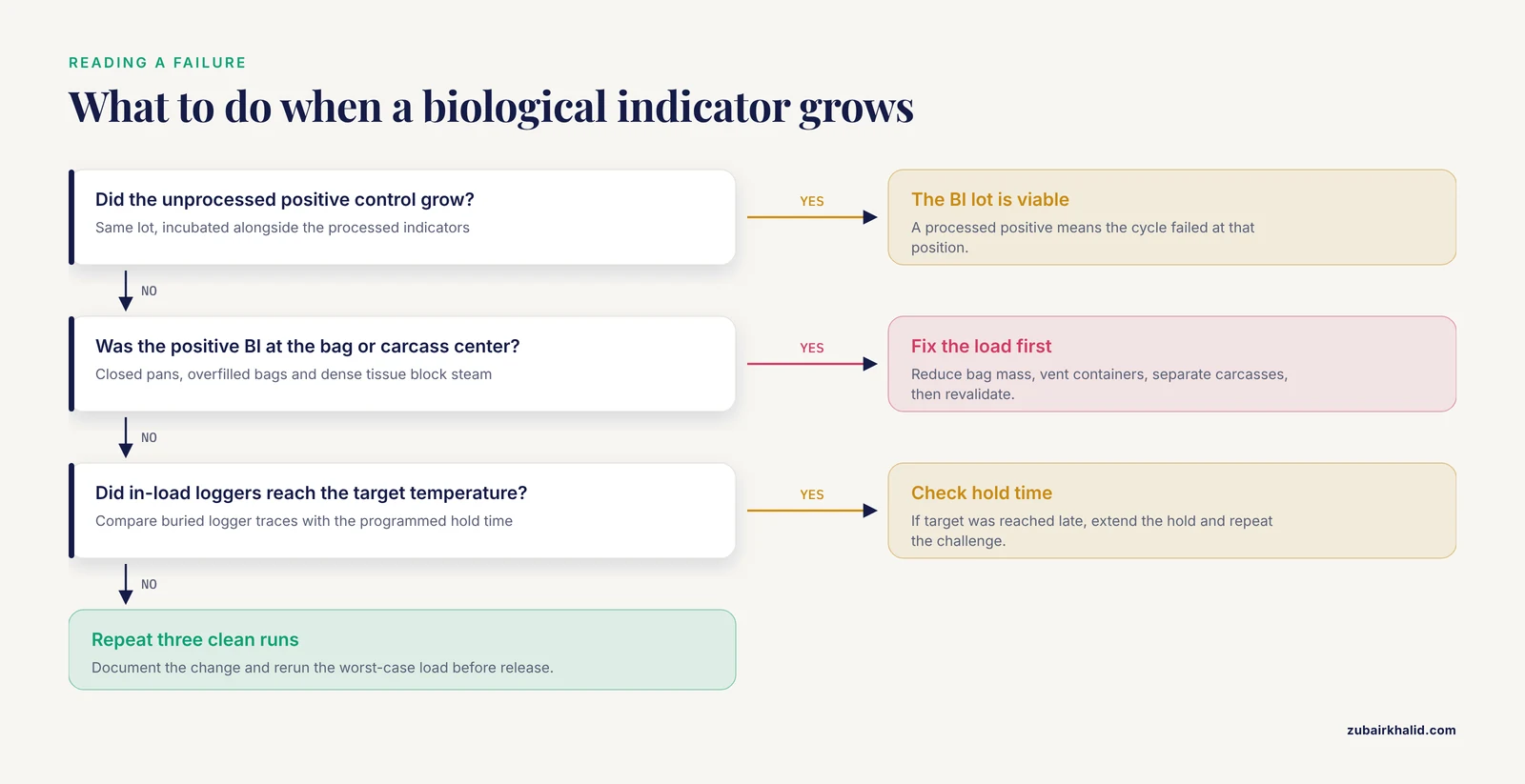
Pass. All processed BIs show no growth (self-contained vials stay their baseline color, typically purple for many systems, rather than flipping to yellow). All in-load positions held at or above the target temperature for the specified duration. The positive control grew. Three consecutive challenge runs meeting both criteria validate the cycle for that waste stream and load configuration.
Fail. Any processed BI grows. Read this as evidence that steam, temperature, or time failed to reach that position in sufficient combination, not as a defective BI (assuming the positive control grew). The troubleshooting table below covers causes.
Interpretation cautions. A cycle that passes on bagged PPE can fail on carcasses or dense wet waste, because heat transfer differs fundamentally. In the mouse carcass study, heat sensors revealed broad differences in temperature inside carcasses compared with the autoclave chamber, and reaching sterilization temperature was considerably prolonged in carcasses compared with typical laboratory waste [6]. Similarly, the ferret carcass study showed general solid biohazardous waste cycle parameters did not ensure sterilization of carcasses [5]. Treat each waste stream as its own validated entity and do not extrapolate a pass from one stream to another.
Published Validation Examples With Concrete Parameters
These studies illustrate what real waste validations look like and give defensible starting points for cycle design.
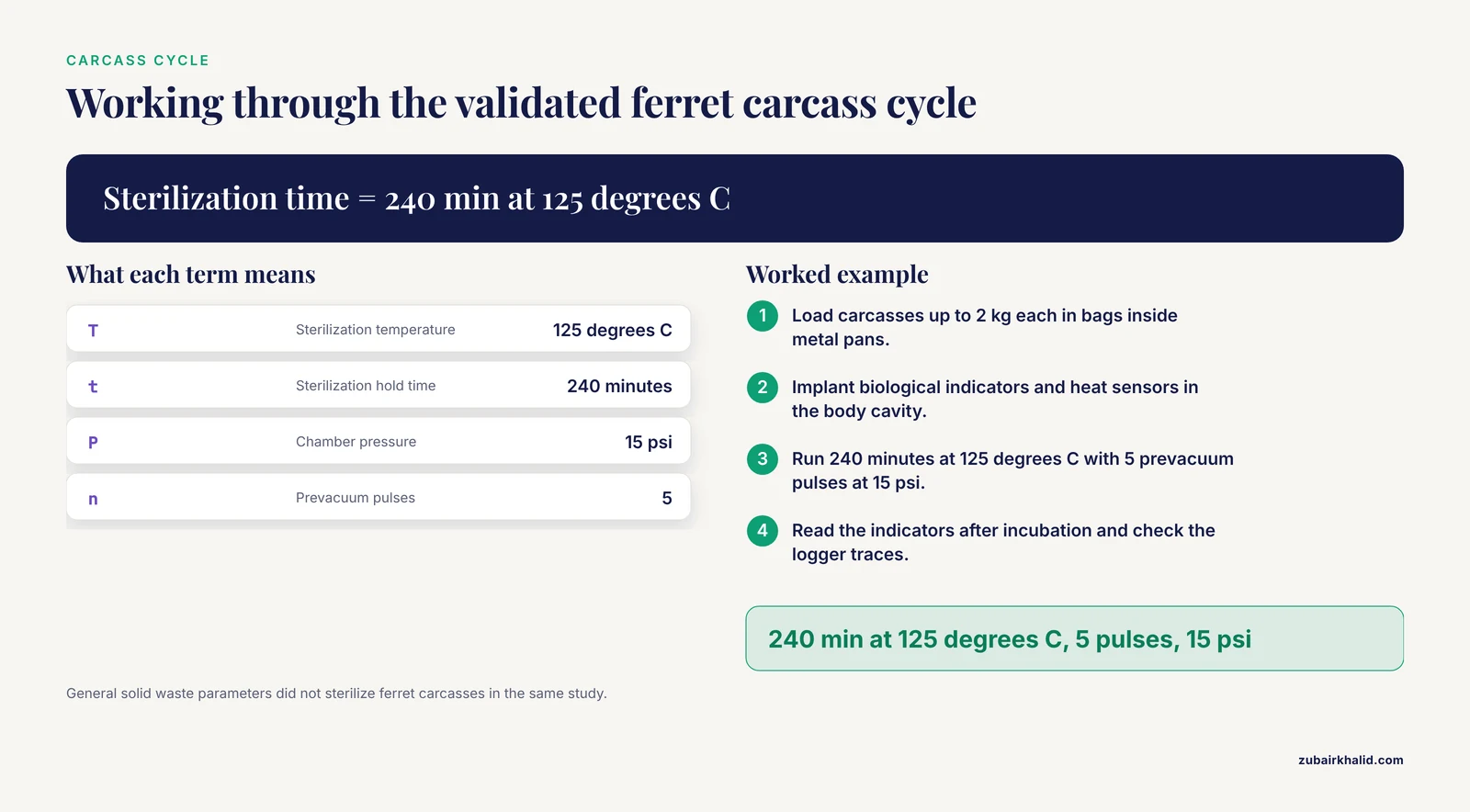
Ferret carcasses in ABSL-2/3 containment. Intact ferret carcasses implanted with biological indicators were placed in biohazard bags inside metal pans, testing 1, 2, or 4 carcasses per bag. After initial runs, a validated cycle was established for carcasses up to 2 kg each: sterilization time 240 minutes, temperature 125 degrees C, 5 prevacuum pulses, and chamber pressure 15 psi. The study concluded that an extended sterilization time is required to decontaminate animal carcasses compared with regular solid biohazardous waste [5].
Mouse carcasses. Two validated protocols emerged. For 5 cadavers placed well separated inside an individually ventilated cage, a modified mouse cage sterilization program using 134 degrees C for 15 minutes was suitable. To sterilize approximately 1 kg of carcasses in autoclavable boxes, 6 hours were required to bring the center of the waste to 121 degrees C for 60 minutes using a liquid-cycle program [6]. The same study showed load density and packaging (IVC cages versus metal boxes) changed the required cycle dramatically.
Category A clinical waste. Simulated waste bags for PPE, dry linens, wet linens, and solidified liquids were validated at a sterilization temperature of 132 degrees C with loggers buried mid-load, over 36 bags in a 2-day study. All bags reached the target temperature, all BIs passed, and processing PPE waste saved an estimated 15 hours per 24-hour period compared with prior practice [3].
BSL-3 select agent waste. Factory-programmed cycles were found inefficient for waste decontamination. Lethality calculations across defined waste amounts and distributions drove the design of a new load configuration and cycle that guaranteed sterilization before materials left the facility [2].
High-consequence patient waste in a large steam sterilizer. Using biological indicators to assess successful sterilization, cycle parameters that would inactivate four categories of Category A medical waste were identified and validated on a STERIS Amsco 630LS steam sterilizer [4].
Alkaline hydrolysis (tissue dissolvers) as an alternative. A tissue dissolver using manufacturer-recommended cycle parameters inactivated a high concentration of chemically resistant bacterial spores used as surrogates, digested animal tissues completely into non-infectious liquid effluent suitable for sanitary sewer disposal, and even a 50 percent reduced cycle time still inactivated all spores, though some tissue remained undigested. The authors recommend each facility run its own verification experiments because tissue dissolver design and tissue load composition vary between facilities [10].
Variations by Waste Type
Animal carcasses
Carcasses are the hardest common waste stream because intact tissue insulates the interior and fat repels steam. Implant BIs and heat sensors into the body cavity or thickest tissue, load at worst-case density, and expect cycle times far beyond routine waste cycles [5][6]. Where carcass mass is large or continuous, dedicated equipment such as alkaline tissue digesters or renderers may replace or supplement the autoclave, as is common in high-containment agricultural facilities [10][11].
Liquid waste and effluent
Small liquid volumes can be sterilized with validated autoclave liquid cycles, while large volumes are treated in continuous-flow heat systems designed for complete inactivation [8]. For chemically complex liquid waste, holding time can serve as a validated inactivation step: in liquid waste from a viral nucleic acid extraction workflow, bacteriophage MS2 as a viral surrogate followed exponential decay, with a predicted 6-log10 reduction at an average of 2.41 hours (95 percent confidence interval 1.34 to 4.05 hours), and a 24-hour holding time was recommended as the conservative practical point at which waste can be safely disposed [7]. Effluent decontamination systems can also be chemically based: a bleach-based chemical effluent decontamination system was biologically validated for BSL-3 and BSL-4 waste effluent using laboratory-prepared spore packets and commercial biological indicators, achieving decontamination of more than 10^6 Bacillus spores at a free chlorine concentration of at least 5700 parts per million with a 2-hour contact time [12].
Mixed institutional waste
In biomanufacturing and BSL-1/2 settings, thermal inactivation is regarded as the most reliable and sustainable method for both liquid and solid waste, with solid waste collected in leakproof containers, autoclaved, and then disposed [8]. Toxins that resist heat, such as saxitoxin or palytoxin, require chemical inactivation with sodium hypochlorite or sodium hydroxide, with validated reaction parameters and pH adjustment before disposal [8].
Troubleshooting
| Symptom | Likely cause | Fix |
|---|---|---|
| BI positive at bag center, negative elsewhere | Bag overfilled or packed too tightly, steam cannot penetrate | Reduce bag mass, loosen packing, define a smaller maximum bag size, revalidate |
| BI positive in closed pan or box, negative in open bags | Container blocks steam contact | Use lidded but vented containers or open pans, extend cycle, revalidate |
| BI positive inside carcass | Heat-up inside tissue far slower than chamber | Extend hold time substantially, separate carcasses, use liquid-type cycles, reduce mass per container [5][6] |
| In-load loggers show temperature never reaches target | Chamber overloaded, prevacuum insufficient, or steam quality problem | Reduce load, increase prevacuum pulses, verify steam supply and trap function, re-run |
| All BIs grow including positive control | BI lot nonviable, incubator at wrong temperature, medium failure | Discard run, check incubator settings, use a new BI lot, repeat |
| Cycle passes but routine weekly BI later fails | Load configuration drifted, bag sizes increased, staff overpacking | Re-audit loads against the validated configuration, retrain staff, revalidate if the load cannot be restored |
| Chamber gauge reads target but in-load loggers do not | Expected behavior, chamber probe reflects environment not load center | Base validation on in-load data, never chamber gauges alone [3] |
| Wet waste at cycle end with soaked packaging | Insufficient dry time or excessive condensate load | Extend dry time, reduce wet items per load, verify drain function |
| Factory cycle fails challenge [2] | Default cycles tuned for light wrapped goods, not dense waste | Design a custom cycle from lethality data, validate it, stop using defaults for this stream |
Tips for a Smooth Validation
- Build the worst case first. Start with your densest, most realistic load. Passing an easy load then failing the real one wastes weeks.
- Use super rapid BIs during cycle development so each iteration takes minutes to read rather than days, then confirm the final cycle with standard BIs, mirroring the multi-format BI approach used in Category A waste validation [3].
- Photograph every instrumented load. Photos are the fastest way to control the load configuration during routine use and audits.
- Challenge both extremes of load size if your routine loads vary widely, since heat-up time scales with mass.
- Keep the positive control physically close to the incubator workflow so it is never forgotten.
- Budget spare loggers and BIs. A failed cycle consumes them, and adjustments require repeat runs.
- Fold validation into microbiology biosafety training so operators understand why bag mass limits and load maps exist. Facilities with documented biosafety training programs show better adherence to waste disposal and decontamination practices than facilities without them [13].
Common Mistakes and Limitations
- Trusting the chamber display. Chamber temperature is measured at a probe, not in the waste. Validation studies using buried loggers showed reliance on autoclave temperature readings overestimates time at sterilization temperature inside the actual load [3]. Always instrument the load.
- Validating one stream and applying it to all. Carcass cycles, bagged solid waste cycles, and liquid cycles are separate validations. General solid waste parameters did not sterilize ferret carcasses [5], and mouse carcass heat-up lagged typical lab waste by wide margins [6].
- Using factory default cycles for containment waste. Factory settings were inadequate for both BSL-3 waste [2] and Category A clinical waste [3]. Defaults can be a starting point only.
- Ignoring load density and distribution. The amount and distribution of waste in the chamber changed lethality outcomes in BSL-3 validation [2]. A cycle validated at half capacity does not cover a full chamber.
- Skipping the positive control. Without it, a no-growth result is uninterpretable.
- Confusing chemical indicators with biological indicators. Integrating indicators and tape confirm exposure conditions visually but never prove spore kill. Only BIs demonstrate inactivation, which is why BI-based validation is the benchmark in waste autoclave studies [4][2][3].
- No revalidation triggers. After major repair, chamber replacement, cycle edits, or new waste types, the validated state no longer applies. Waste management programs should define these triggers in the written infectious waste management plan [9].
- Assuming heat inactivation covers every hazard. Prion agents require destruction approaches beyond standard steam cycles per biosafety guidance for high-consequence agents [14], and thermally treated recombinant DNA can persist and renature after autoclaving at 120 degrees C in aquatic microcosms, which matters for facilities concerned with nucleic acid release into the environment [15].
- Underestimating documentation. Validation without signed protocols, raw logger traces, and BI records cannot support release decisions during inspections or incident investigations.
Individual facilities differ in equipment, agents, and waste composition, so treat published parameters as starting points and confirm them with your own instrumented challenge runs, with institution-specific questions directed to your biosafety officer or veterinarian.
Storage and Stability Notes
Biological indicators are living spore preparations. Store unprocessed BIs at the manufacturer's stated temperature, usually room temperature or 2 to 8 degrees C depending on format, away from sterilants and direct sunlight. Track expiration dates and lot numbers on every validation record. Do not use expired BIs for validation, since declining spore population can produce false passes. Processed BIs should be incubated promptly, and the positive control must come from the same lot as the challenge BIs so viability comparisons are valid [3]. Calibrated data loggers should be recalibrated on the schedule your metrology program defines, and their calibration status recorded in the validation report. For liquid waste streams relying on holding time rather than immediate sterilization, the validated holding duration, container labeling, and release criteria become part of the standing procedure [7].
Frequently Asked Questions
How often must autoclave validation for biological waste be repeated?
Repeat validation after major repair or relocation of the autoclave, any change to cycle parameters, packaging, or load configuration, and whenever a new waste stream is introduced. Between validations, routine biological indicator monitoring at a defined frequency confirms the validated cycle still performs. Your infectious waste management plan should name the revalidation triggers explicitly [9].
What biological indicator should I use for waste cycle validation?
Use a self-contained or strip biological indicator carrying a standard population of Geobacillus stearothermophilus spores, from a single lot for the whole study. Published waste validations used commercial BIs embedded directly in the waste at worst-case positions, with super rapid, rapid, and standard readout formats validated side by side [3].
Why can't I rely on the autoclave's own temperature display?
The display reflects conditions at the chamber probe, not inside a dense waste bag or carcass. When researchers buried data loggers in the middle of simulated Category A waste loads, reliance on chamber readings overestimated time at the target sterilization temperature inside the waste [3]. In-load loggers are the standard for waste validation.
Do animal carcasses need a different cycle than bagged waste?
Yes. Carcass composition insulates the interior and dramatically slows heat penetration, so a validated solid waste cycle failed to sterilize ferret carcasses, which required an extended cycle of 240 minutes at 125 degrees C with 5 prevacuum pulses [5]. Mouse carcass validations similarly showed carcass temperature lagging the chamber and required either 134 degrees C for 15 minutes for well-separated cadavers or 6 hours to achieve 121 degrees C for 60 minutes at the center of boxed carcasses [6].
Can a biological indicator fail be due to a bad indicator rather than a bad cycle?
Only if the positive control also failed to grow. A positive processed BI with a growing positive control means the cycle failed to kill spores at that position. Check for physical explanations first: overpacking, closed containers, or a dense load center that never reached temperature.
Is chemical disinfection an acceptable substitute for autoclaving waste?
For liquid effluent streams, yes, when validated. A bleach-based chemical effluent decontamination system was biologically validated for BSL-3 and BSL-4 effluent using spore packets and commercial BIs, achieving inactivation of more than 10^6 Bacillus spores at free chlorine concentrations of at least 5700 ppm with 2-hour contact [12]. Heat-resistant toxins may also require chemical treatment rather than steam [8].
Does autoclaving destroy nucleic acids and prions?
Not reliably. Thermally treated recombinant plasmid DNA remained detectable and could renature into functional double-stranded form after autoclaving at 120 degrees C [15], and biosafety guidance recognizes that prion agents require thorough destruction approaches beyond standard terminal steam treatment [14]. Facilities with prion or nucleic acid release concerns need dedicated validated pathways.
Can I shorten validated cycle times once they pass?
Only with new validation data. Reduced cycles can succeed, as shown when a tissue dissolver cycle shortened by 50 percent still inactivated resistant spores [10] and when validated shortened Category A cycles saved an estimated 15 hours per 24-hour period for PPE waste [3], but any reduction must be supported by its own instrumented challenge runs with biological indicators before implementation.
Sources
- Defining and managing biohazardous waste in U.S. research-oriented universities: a survey of environmental health and safety professionals.
- Development and Validation of Waste Decontamination Cycle in a Biosafety Level 3 Laboratory.
- The Use of Temperature and Pressure Data Loggers to Validate the Steam Sterilization of Category A Clinical Waste.
- Validation of the STERIS Amsco 630LS steam sterilizer autoclave for inactivation of category a medical waste from patients with high-consequence infectious diseases.
- Validating Autoclave Cycles for Carcass Disposal in Animal Biosafety Level 2/3 Containment Laboratories.
- Validation of an Autoclave Procedure for Sterilization of Mouse (Mus musculus) Carcasses.
- Evaluating viral inactivation in the liquid waste stream from a viral total nucleic acid extraction kit for safe disposal.
- Toolbox for Bio Safety Manufacturing Waste Treatment.
- Infectious waste management and laboratory design criteria.
- Decontamination and digestion of infectious animal waste using a tissue dissolver in an animal biosafety level 3 facility.
- Challenges and Solutions With Agricultural Animal High Containment Waste Disposal.
- Biological Validation of a Chemical Effluent Decontamination System.
- Assessment of biosafety measures in clinical laboratories of Al-Madinah city, Saudi Arabia.
- What's hot in animal biosafety?
- Persistence and renaturation efficiency of thermally treated waste recombinant DNA in defined aquatic microcosms.