Autoclave Bags vs. Rigid Containers: Which Is Best
By Dr. Zubair Khalid, DVM, MS, PhD ·
Autoclave bags are flexible, single-use biohazard bags that hold soft laboratory waste for steam sterilization, while rigid containers are reusable pans, bins, and latched sterilization cases that give a load structure, spill protection, and predictable steam access. The rule of thumb is simple: bag the soft, disposable solid waste from routine biosafety level 1 and 2 work, and choose a rigid container whenever the load is heavy, wet, sharp, dense, high-risk, or part of a validated decontamination program. Most laboratories use both formats together, because the bag works as the primary wrap and the rigid container works as the secondary containment that carries the bag through handling and the autoclave.
Getting this decision wrong is not a paperwork problem. A bag tied shut, a pan that shadows its own contents, or a cycle borrowed from the wrong load type can release viable pathogens into a waste stream that staff, custodial teams, and downstream disposal systems will handle. The container is part of the sterilization system, and this guide treats it that way, comparing autoclave bags and rigid containers on steam access, spill and puncture safety, liquids, carcasses, workflow, and waste volume, then working through scenarios, a decision framework built on a biosafety risk assessment, and the mistakes that show up most often on the bench.
The Core Difference Between Autoclave Bags and Rigid Containers
The difference between autoclave bags and rigid containers is the difference between a primary wrap and a structural system. A bag is a flexible film whose job is to contain soft waste, present it to steam, and leave the facility with the autoclaved load. A rigid container is a hard wall whose job is to hold its shape under weight, catch what a bag cannot, shield handlers from sharps and liquids, or, in its filtered form, protect sterile goods through storage and transport.
That division of labor explains why the question "which is best" usually has a stacked answer. In waste handling, the two formats sit one inside the other, bag inside pan, and each does what the other cannot. In sterile supply, the rigid container stands alone and bags have no role. The comparison below therefore explains each format on its own terms first, then scores them on the criteria that decide real purchases and protocols.
What an Autoclave Bag Is
An autoclave is a steam sterilizer, a sealed chamber that uses pressurized saturated steam, most commonly at 121°C, to coagulate microbial proteins and destroy vegetative bacteria, fungi, viruses, and resistant bacterial spores. Whether a cycle works depends on time, temperature, and direct steam contact with every surface of the load.
An autoclave bag, also called a biohazard bag or steam sterilization bag, is a heavy-gauge plastic bag manufactured to survive those conditions. Most are made from polypropylene or another heat-stable polymer, because ordinary polyethylene trash bags soften and melt at autoclave temperatures and cannot be substituted. In United States practice the bags are color coded red or orange and printed with the universal biohazard symbol, and many carry indicator ink that changes color after steam exposure. They come as flat bags, gusseted bags that stand upright in a bin, and versions with drawstring closures or built-in vent features.
Standard bench practice treats the bag as a permeable wrap, not a sealed pouch. Bags are filled to roughly two-thirds capacity, left open or loosely closed so steam can displace the air inside, and sometimes given a small amount of water so a dry load generates steam from within. Double bagging, one bag inside a second, is common for leak-prone or higher-risk loads. These habits exist because steam, not dry heat, does the killing, and trapped air is the main enemy of a steam cycle.
When to Use Autoclave Bags
Use an autoclave bag when the waste is a soft solid and the agent risk falls within the routine laboratory range:
- Used culture plates, agar slants, and inoculated solid media
- Plastic pipettes, pipette wrappers, and disposable tubes
- Gloves, gowns, masks, and other single-use personal protective equipment
- Contaminated paper towels, bench liners, and wipe waste
- Single-use filters, tubing, and consumable components from biosafety level 1 and 2 processes
Guidance for biosafety level 1 and 2 biomanufacturing waste describes exactly this stream, solid waste including single-use components, filters, and contaminated materials collected in leakproof containers, autoclaved, and disposed of through approved routes, with thermal inactivation identified as the most reliable and sustainable decontamination method for both liquid and solid waste [1].
When a Bag Is the Wrong Choice
An autoclave bag is the wrong primary container for sharps, for bulk liquids, and for intact animal carcasses unless a carcass-specific cycle has been validated. Those limits come from the physics of steam and the mechanics of plastic film, both covered below.
What a Rigid Container Is
"Rigid container" covers three distinct tools that share one property, a hard wall that holds its shape under load.
Autoclave pans and bins. Stainless steel or polypropylene trays and tubs used as secondary containment. A biohazard bag sits inside the pan, the pan carries the weight, catches leaks, and protects staff during transport. This bag-in-pan arrangement is the standard configuration for infectious solid waste and was the tested configuration in carcass decontamination studies [2].
Lidded biohazard bins and rigid leakproof containers. Hard-walled, closable containers used at the bench and in waste staging areas so that a torn bag never becomes a spilled bag. The same leakproof-container principle appears in biomanufacturing waste guidance, which calls for solid waste to be collected in leakproof containers before autoclaving [1].
Rigid sterilization containers. Latched aluminum, stainless steel, or engineered-plastic cases with filter-retention plates and valves, designed to carry reusable surgical and laboratory instruments through washing, steam sterilization, sterile storage, and transport. These are the workhorses of a hospital central sterile supply department, the department that cleans, sterilizes, stores, and distributes reusable instruments, and their valves and filters are engineered to let air out and steam in during the cycle while blocking environmental contamination afterward [3].
A fourth rigid category deserves mention, the puncture-resistant sharps container, which is the only acceptable primary container for needles, blades, and broken glass.
Side-by-Side Comparison: Autoclave Bags vs. Rigid Containers
| Criterion | Autoclave bags | Rigid containers |
|---|---|---|
| Form | Flexible single-use film, usually polypropylene | Hard-walled pans, bins, and latched sterilization cases, usually steel, aluminum, or engineering plastic |
| Reuse | Single use | Reusable across many cycles, requires washing and inspection between uses |
| Steam access | Good when underfilled and open or vented, poor when packed tight or tied shut | Filtered cases engineered for air and steam exchange, solid pans can shadow contents and slow heating |
| Spill containment | Limited, film punctures and seams leak | Strong, a pan or latched case catches leaks and protects handlers |
| Sharps and broken glass | Never, film punctures | Only in puncture-rated sharps containers or latched cases designed for them |
| Bulk liquids | No, bags cannot hold or heat liquids safely | Only in dedicated vessels with loosened caps, never sealed |
| Heavy or dense loads | Tear under weight, center of load may not reach temperature | Carry weight, but dense loads need longer validated cycles |
| Validation burden | Cycle must be validated for the waste form inside the bag | Cycle must be validated for the container, filter, and load together |
| Labor and workflow | Fast to line and load, no washing, light per unit | Slower to wash and inspect, but faster per set at scale in sterile supply |
| Waste generated | Adds plastic to the waste stream every cycle | Generates wash water, detergent, and spent filters instead of packaging waste |
| Typical best use | Soft disposable solid waste at biosafety level 1 and 2 | Secondary containment, carcasses, sharps, reusable instruments, high-containment programs |
| Classic failure mode | Tied shut or overfilled, steam never reaches the center | Closed pan or expired filter, an air pocket blocks sterilization |
How Steam Behaves in Bags and Containers
Steam sterilization works by condensation. When saturated steam touches a cooler surface it condenses, releases latent heat, and destroys microorganisms on and inside the material. Any barrier between steam and surface, an air pocket, a sealed film, a solid wall, prevents that condensation and leaves viable organisms behind.
Flexible bags and rigid containers interfere with steam in different ways. A bag packed tight or tied airtight traps air, and air heated to 121°C does not sterilize anything, it sits as an insulating pocket while the outside of the load reads cycle-complete. A solid pan with a closed lid does the same thing at a larger scale, shielding its contents from circulating steam. Filtered rigid sterilization containers solve the problem with engineered airflow, venting air during the ramp to temperature and filtering organisms out during cooldown.
Autoclave cycle design reflects this physics. Gravity displacement cycles admit steam at the top of the chamber and push heavier air down and out through a drain, which suits simple, loose loads. Prevacuum cycles pull air out with vacuum pulses before steam admission, which suits porous, dense, or wrapped loads, and a Bowie-Dick type test is the standard check that a prevacuum cycle is removing air properly. Applied microbiology has treated waste packaging as a measurable part of this system for decades, with evaluations of steam decontamination of laboratory microbiological waste [4] anchoring the modern consensus that the container belongs inside cycle design, not after it.
How a Container-and-Cycle Combination Is Validated
Validation is how a laboratory proves its container-and-cycle combination actually kills. A biological indicator, usually a vial or strip carrying a standardized population of Geobacillus stearothermophilus spores, is placed at the least accessible point of the load, run through the cycle, and incubated. If no spores survive, the cycle is lethal at that position. Chemical indicators such as autoclave tape and integrator strips respond to temperature, or to time and temperature together, which proves exposure but not kill. The distinction matters because a bag printed with color-change ink can look successful while the center of a dense load inside it never reached sterilizing conditions. Every load type, soft solid, liquid, carcass, wrapped instrument set, earns its own validation with biological indicators at the worst position.
Comparing Autoclave Bags and Rigid Containers on the Criteria That Decide Real Choices
Steam access and cycle validation
For soft, loose waste, a properly filled and vented bag gives steam excellent access, and a simple validated cycle handles it. For wrapped or reusable goods, a filtered rigid container gives engineered, repeatable steam access while keeping contents sterile afterward. For solid pans, steam access is the weakest of the three, so pans demand the most from cycle validation, longer holds, careful loading, and biological indicators placed under and inside the load. Whichever format a laboratory picks, the rule holds: the cycle is validated for that container and that load, never assumed from a different waste stream.
Spill, puncture, and handling safety
Bags leak at seams and puncture on anything rigid, which is why unsupported bags carried by hand are a classic exposure setup. Rigid secondary containment converts a bag failure from an exposure event into a housekeeping event, and that single fact explains the bag-in-pan standard for infectious waste. Sharps never go into bags. Rigid containers add their own handling burden, they are heavy, they must be washed and inspected, and a latched case with a compromised filter or gasket can look protective while it is not.
Liquids and effluent streams
Neither an autoclave bag nor an open pan is the right container for liquid waste. Bags cannot hold liquid, and open pans boil over and aerosolize. Modern practice treats liquids as their own waste stream with its own containers and inactivation method. Guidance for biosafety level 1 and 2 waste states that small liquid volumes can be sterilized in validated autoclave programs, that large volumes belong in continuous-flow heat systems designed for energy efficiency and complete inactivation, and that chemical inactivation with sodium hypochlorite (NaOCl) or sodium hydroxide (NaOH) serves as the alternative for heat-resistant toxins such as saxitoxin or palytoxin, provided reaction parameters and post-treatment pH are validated [1]. Liquid cycles in the autoclave use slow exhaust to prevent boiling, and caps stay loosened so steam can enter and vessels cannot pressurize.
The validation mindset behind liquid waste is well illustrated by a recent study of liquid waste from a viral total nucleic acid extraction kit containing guanidinium chloride, isopropanol, and ethanol residues. Bacteriophage MS2, a hardy RNA virus widely used as a surrogate for infectious viruses, was followed through chemical holding, and inactivation followed an exponential decay pattern. The model predicted a 6-log10 reduction, a millionfold drop in viable virus, at an average of 2.41 hours, but only a 24-hour holding time significantly exceeded the 6-log10 threshold, so the authors recommended 24 hours as the conservative, practical holding time before disposal [5]. The container in that workflow is a rigid bottle and the cycle is a holding time, neither of which a bag can provide.
High-containment facilities extend the same logic to building effluent. A bleach-based effluent decontamination system, an engineered system that chemically treats all liquid drain waste before sewer discharge, was biologically validated for biosafety level 3 and 4 waste effluent using spore packets and commercial biological indicators, achieving inactivation of more than 10^6 spores at a free chlorine concentration of at least 5,700 parts per million with a 2-hour contact time, with practical lessons around bleach sourcing, dechlorination, and disposal of treated waste [6].
Carcasses and dense biomass
Animal carcasses are the hardest common load in laboratory waste handling. They are dense, wet, insulated by their own tissue, and they shield interior surfaces from steam. World Health Organization guidance on the hygienic disposal and rendering of dead animals and animal waste separates low-risk materials, such as slaughter offal from healthy animals, which can be sterilized in autoclaves or cooked, from high-risk materials, such as animals that died of infectious disease, which must at minimum be sterilized or burned, and it stresses preventing cross-contamination between raw and decontaminated material while protecting personnel [7].
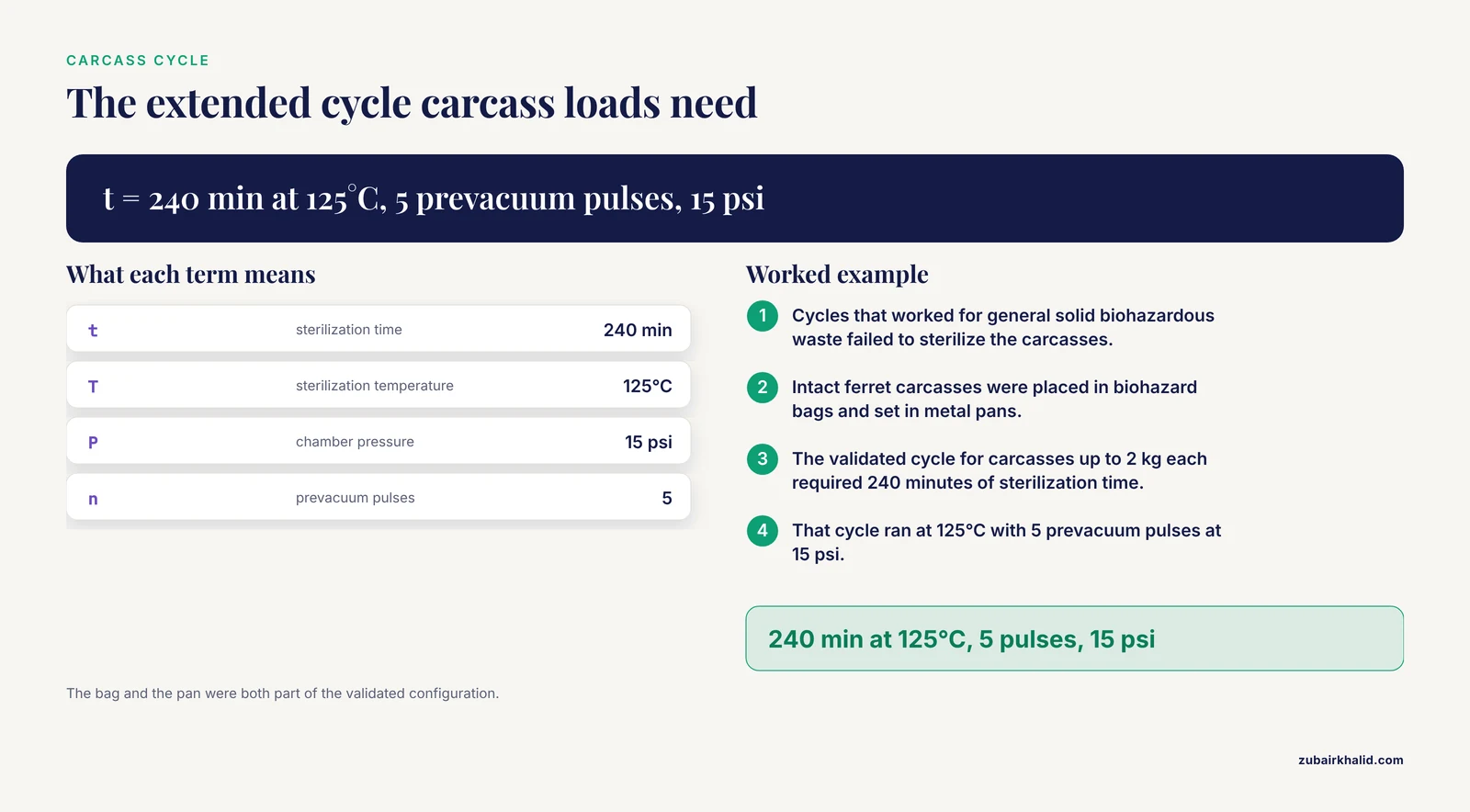
Inside a containment laboratory, the container answer is a bag inside a rigid pan, and the cycle answer is a dedicated validation. In a study in an animal biosafety level 2/3 containment suite, intact ferret carcasses were implanted with biological indicators, placed in biohazard bags, and set in metal pans, with one to four carcasses per bag and four carcasses per pan. Cycles that worked for general solid biohazardous waste failed to sterilize the carcasses. The validated cycle for carcasses up to 2 kg each required 240 minutes of sterilization time at 125°C with 5 prevacuum pulses at a chamber pressure of 15 psi, far longer than routine solid waste treatment [2]. The bag and the pan were both part of the validated configuration, which is the clearest demonstration in the literature that the two formats are complements, not competitors.
Alkaline hydrolysis offers a container-light alternative for carcass waste. A tissue dissolver, an alkaline hydrolysis unit that digests tissue in a heated alkaline solution, in an animal biosafety level 3 facility completely digested animal tissues into a non-infectious liquid effluent suitable for sanitary sewer disposal and inactivated a high concentration of chemically resistant bacterial spores used as surrogates. Cutting the cycle time by 50 percent still inactivated all spores, although a small amount of tissue remained undigested, and the authors recommended that each facility verify its own tissue dissolver performance because machine design and tissue load vary [8].
Workflow, labor, and capacity
For reusable goods processed at scale, rigid containers have a strong workflow record. A scenario-based evaluation of rigid sterilization containers in a high-volume central sterile supply department found that switching from single-use wrap reduced average packaging time per instrument set by 61 percent, increased autoclave capacity per cycle by 25 percent, and cut the sterilization cost per set by 40.4 percent, from 2.75 to 1.64 euros, with the investment reaching breakeven after approximately six years [3]. The same evaluation found new pressure points in the cleaning process, particularly with large-capacity washer-disinfectors, a reminder that rigid containers move labor rather than eliminate it.
Bags remain the workflow choice for disposable waste. They line a bin in seconds, weigh little, and leave the facility with the autoclaved waste. Their hidden labor cost is small but real, secondary containment, tie-off discipline, and cleanup when a bag fails.
Waste volume, sustainability, and cost
Every autoclave bag adds plastic to the regulated waste stream, and every rigid container replaces packaging waste with wash water, detergent, and periodic filter replacement. Healthcare facilities are moving from single-use wrap toward rigid sterilization containers partly to reduce packaging waste and meet sustainability goals [3]. For a laboratory, the honest accounting compares bag purchasing and disposal volume against container purchasing, washing utilities, validation, and maintenance. Neither format wins on sustainability in the abstract, the answer depends on cycle frequency, load type, and the local cost of each waste stream.
Worked Scenarios
Scenario 1: Routine solid waste in a teaching microbiology laboratory
A biosafety level 2 teaching lab generates stacked culture plates, used gloves, and plastic pipettes. Choice: polypropylene autoclave bags set in rigid polypropylene bins on a wheeled cart. Bags are filled no more than two-thirds, left open or loosely closed, and autoclaved in a validated gravity cycle at 121°C. Chemical indicators confirm exposure, and biological indicators run on a schedule at the center of a representative bag load. The rigid bin is not optional, it is what stands between a cracked plate and a corridor spill.
Scenario 2: Infectious animal carcasses in a containment vivarium
A vivarium working at animal biosafety level 2/3 must remove infectious ferret carcasses for disposal. The choice is not bag versus pan, it is bag plus pan plus a separately validated extended cycle, because carcass loads need their own cycle validation as described in the carcass section above. Biological indicators are implanted into carcasses at the worst position, records are kept per load type, and if the facility adds an alkaline hydrolysis tissue dissolver, its performance is verified on site before it replaces the autoclave route.
Scenario 3: High-containment agricultural research waste
An agricultural animal facility at biosafety level 3Ag houses livestock loose, so the animal room itself is the primary containment barrier and the waste stream includes bedding, feed, manure, and carcasses at high volume. Waste handling in such facilities may include autoclaves, effluent decontamination systems, incinerators, high-temperature renderers, alkaline tissue digester systems, high-efficiency particulate air filtration of exhaust and supply air, gas decontamination systems, and laundry facilities, and operational lessons from a decade of running such a facility emphasize the detail required to move decontaminated waste out safely [9]. At this tier, bags and pans are the first step of a chain, not the decision itself.
Scenario 4: Reusable instrument sets in sterile supply
A hospital central sterile supply department processes surgical and laboratory instrument sets daily. Choice: rigid sterilization containers, which cut packaging time per set, raise autoclave capacity per cycle, and lower per-set sterilization cost at volume, while adding washing, inspection, and filter management to the workflow [3]. Autoclave bags have no role here, because wrapped goods need a container that protects sterility through storage and transport.
Scenario 5: Liquid molecular biology waste
A molecular laboratory generates liquid waste from nucleic acid extraction, containing chaotropic salts and alcohols that disrupt proteins and nucleic acids. Choice: rigid chemical-resistant bottles or an engineered holding or effluent treatment step, never an autoclave bag. The laboratory adopts a validated holding time or chemical inactivation protocol using the approach described in the liquids section above, and small volumes may be steam sterilized in dedicated liquid cycles with loosened caps.
Choosing Between Autoclave Bags or Rigid Containers: A Decision Framework
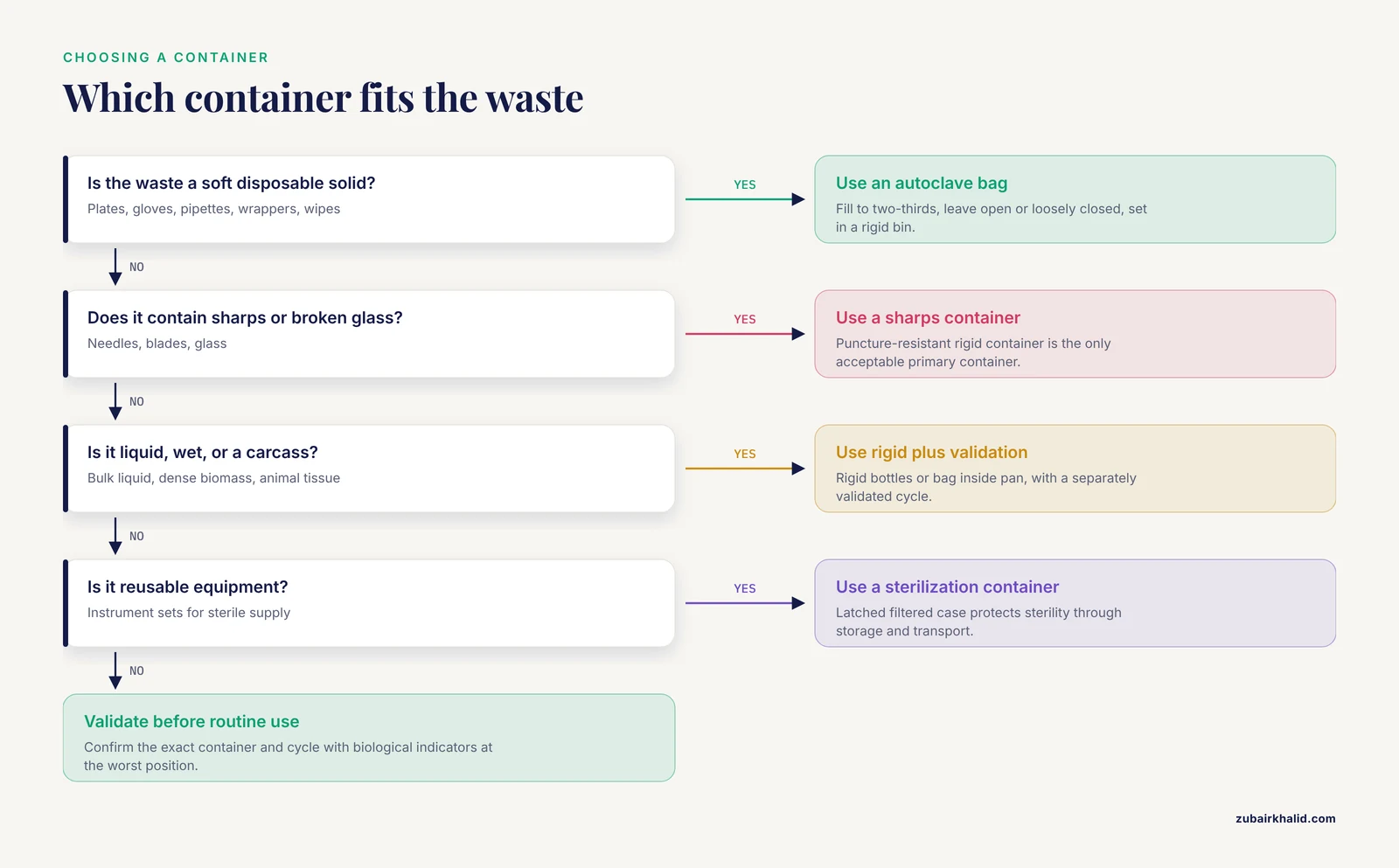
A biosafety risk assessment is the formal process of identifying the agents in use, the forms waste takes, the volumes generated, the exposure routes, and the disposal routes, then matching controls to that risk. Container selection is one of those controls, and it resolves into a set of concrete questions:
- Is the waste a soft solid? An autoclave bag is the primary container.
- Does the waste contain sharps or glass? A puncture-resistant rigid sharps container is the only acceptable choice.
- Is the waste wet, or is it a liquid? Rigid bottles, dedicated liquid cycles, validated holding protocols, or engineered effluent systems [5], [1].
- Is the load a carcass or dense biomass? Bag inside a rigid pan, plus a separately validated extended cycle [2], or an alkaline hydrolysis alternative verified on site [8].
- Is the item reusable equipment? A rigid sterilization container with filters and latches [3].
- Is the agent high-risk or is the containment level high? Container choice becomes part of an engineered waste system that may combine thermal, chemical, and physical treatment steps [9].
- Has this exact container-and-cycle combination been validated with biological indicators at the worst position? If not, validation comes before routine use.
Two of those questions sit outside the bench. Container handling, bag closure, overfill limits, secondary containment, and spill response belong in microbiology biosafety training, and the risk assessment should confirm that training is current for everyone authorized to move waste.
Common Mistakes and Limitations
- Tying bags airtight before autoclaving. Sealed film blocks steam entry, the trapped air pocket stays unsterilized, and pressure buildup can rupture the bag. Leave bags open or loosely closed, or use vented designs.
- Overfilling bags. An overfilled bag insulates its own center, tears under its own weight, and jams chamber loading. Fill to about two-thirds.
- Trusting color-change ink or tape as proof of sterility. Chemical indicators show exposure to cycle conditions, not organism kill. Only biological indicators demonstrate lethality.
- Assuming one validated cycle fits every load. Dense, wet, and porous loads heat differently, and each load type needs its own validation with biological indicators at the worst position.
- Putting sharps or broken glass in bags. Puncture injuries during collection and autoclave unloading are among the most preventable laboratory exposures.
- Using ordinary polyethylene trash bags. They melt, fuse to loads, and contaminate chamber surfaces.
- Skipping secondary containment. An unsupported bag carried by hand is the classic setup for a spill in a corridor.
- Autoclaving sealed liquids or closed pans. Sealed vessels burst, closed pans shield their contents, and open pans boil over. Liquids need dedicated vessels, loosened caps, and validated liquid cycles.
- Copying another facility's validation. Tissue dissolver performance, autoclave behavior, and load composition vary between facilities, which is why on-site verification is recommended even when a technology works elsewhere [8].
- Forgetting the washing side of rigid containers. Rigid containers move labor from packaging to cleaning, and at scale the washer, not the autoclave, becomes the limiting step.
- Assuming a latched container stays sterile indefinitely. Filters, gaskets, latches, and door surfaces need inspection and maintenance, and a compromised filter defeats the design.
One limitation applies to every scenario above, individual facilities face different agents, equipment, and regulations, so high-stakes container and cycle decisions deserve sign-off from a biosafety professional, veterinarian, or sterilization specialist.
Frequently Asked Questions
Are autoclave bags sterile after a single cycle?
No. A cycle is only proven sterile when it has been validated with biological indicators placed at the hardest-to-sterilize position in the load, and the color change on a bag or on indicator tape only shows exposure to cycle conditions, not organism kill.
Can I put liquid waste in an autoclave bag?
No. Bags cannot hold or safely heat liquids, so liquid waste belongs in rigid chemical-resistant bottles with loosened caps, in validated holding protocols, or in engineered effluent treatment systems depending on volume and risk.
Do rigid containers replace autoclave bags?
No. In most waste workflows they are complements, with the bag as the primary wrap and the rigid pan or bin as secondary containment that carries the bag through handling and the autoclave.
Why did my indicator tape change color but my biological indicator fail?
Chemical indicators such as tape respond to temperature and time, so tape can change color in steam that never reached the center of a dense or air-trapped load, while a biological indicator placed at that position demonstrates the failure.
When should a laboratory choose rigid containers over autoclave bags?
Choose rigid containers for sharps, bulk liquids, carcasses and dense biomass, reusable instruments, and high-containment programs, and choose autoclave bags for soft disposable solid waste in routine biosafety level 1 and 2 work.
How does a biosafety risk assessment decide between autoclave bags or rigid containers?
It identifies the agent, the waste form, the volume, the containment level, and the disposal route, then matches the container and a validated cycle to that risk, with training and validation records included as part of the control.
Sources
- Toolbox for Bio Safety Manufacturing Waste Treatment.
- Validating Autoclave Cycles for Carcass Disposal in Animal Biosafety Level 2/3 Containment Laboratories.
- Evaluating the implementation of rigid sterilization containers in a Dutch central sterile supply department: a scenario-based cost and workflow analysis
- Decontamination of laboratory microbiological waste by steam sterilization.
- Evaluating viral inactivation in the liquid waste stream from a viral total nucleic acid extraction kit for safe disposal.
- Biological Validation of a Chemical Effluent Decontamination System.
- [[The hygienic disposal and rendering of dead animals and animal waste].](https://pubmed.ncbi.nlm.nih.gov/3750305/)
- Decontamination and digestion of infectious animal waste using a tissue dissolver in an animal biosafety level 3 facility.
- Challenges and Solutions With Agricultural Animal High Containment Waste Disposal.