Troubleshooting Audit Trail Gaps in Microbiology Electronic Records
By Dr. Zubair Khalid, DVM, MS, PhD ·

An audit trail is the automated, time-stamped record of who did what, to which record, when, and often why, inside an electronic system such as a laboratory information system (LIS) or instrument middleware. In microbiology, the audit trail is what proves that an organism identification was changed by a specific technologist at a specific time, that a susceptibility result was amended after a repeat run, and that a corrected report reached the chart. A gap in that trail means a laboratory cannot demonstrate data integrity for the affected records.
The most likely cause of audit trail gaps in microbiology electronic records is a failure at the handoff between the source of the data and the system that should have recorded it, most often the instrument-to-middleware or middleware-to-LIS interface, followed closely by the use of shared or generic user logins that strip user attribution out of every event. The first thing to check is simple and takes minutes: pick the gap window, count the records that should exist in the source system for that window, count what actually arrived in the LIS, and compare the timestamps. A mismatch in counts points to transmission loss. Matching counts with identical timestamps but no user identity points to shared credentials. That single comparison tells you which branch of this guide to follow.
This article walks through the causes from most common to rarest, explains the mechanism behind each one, gives a diagnostic sequence you can follow at the bench, and ends with the prevention practices that keep gaps from recurring as part of routine laboratory quality management.
What a Complete Audit Trail Looks Like in a Microology Setting
Before you can troubleshoot a gap, you need a definition of "complete." In a regulated laboratory, electronic records are expected to meet the ALCOA+ principles: attributable, legible, contemporaneous, original, and accurate, plus complete, consistent, enduring, and available. Professional bodies and accreditation frameworks treat electronic documentation, retention, validation, and quality control as a single connected system rather than separate chores. Expert recommendations for laboratory data practices now explicitly group messaging, storage and retention, documentation, validation, and quality control into one set of standards that laboratories are expected to apply without a heavy staffing burden [1].
For a microbiology result, a complete audit trail typically contains, at minimum:
- The unique specimen and isolate identifiers linking the electronic record back to the physical culture.
- The user identity of every person who accessed, entered, modified, verified, or amended the record, captured through individual logins.
- A trusted date and time stamp for every event, drawn from a synchronized clock.
- The original value and the new value whenever a result is changed, with a reason for the change.
- The identity of the system or interface that created the record, so an automated entry is distinguishable from a human entry.
- Evidence that corrected reports were transmitted and that the version history of the report is preserved.
Traceability from the electronic record back to the specimen is a core expectation of laboratory quality standards. Integrated diagnostic protocols aligned with ISO 15189 and Clinical and Laboratory Standards Institute (CLSI) recommendations explicitly include data management and sample traceability components alongside the analytical procedures [2]. Quality management system reviews in other laboratory disciplines reach the same conclusion from a different direction: documentation and traceability systems must track every stage of testing, supported by electronic platforms and independent witnessing systems [3].
When any of these elements is missing for a stretch of records, you have a gap. The gap might be invisible in day-to-day work and surface only during an inspection, an internal audit, or an external quality assessment (EQA) reconciliation.
Troubleshooting Table: Symptom, Likely Cause, Confirmation, and Fix
The table below is the core of troubleshooting audit trail gaps in microbiology electronic records. Work from the symptom you actually observed.
| Symptom in the electronic record | Likely cause | How to confirm it | Fix |
|---|---|---|---|
| Blocks of results present in the analyzer output but absent from the LIS for defined time windows | Interface or middleware transmission failure | Export the analyzer worklist for the window and compare record counts and accession numbers against the LIS. Look for interface engine error logs and retry queues. | Re-transmit from the source where possible, document each recovered record as a late entry with the true collection and analysis times, and correct the interface. |
| Records exist but show "system" or a generic account as the user, or show no user at all | Shared or generic analyzer logins, auto-login on middleware workstations | Query the audit table for the account in question and check whether it maps to many simultaneous workstations. Review analyzer configuration for stored credentials. | Assign individual accounts or attribute each event to the supervising user, disable auto-login, and document the attribution method in a standard operating procedure (SOP). |
| Events appear out of order, or timestamps jump backward, or two records created by different instruments show impossible time relationships | Clock desynchronization between instruments, middleware, and the LIS | Compare the displayed clock on each analyzer with the LIS server time at the same moment. Check whether network time protocol (NTP) synchronization is configured on each device. | Enable NTP or an equivalent service on every device, document the offset found, and annotate affected records with the corrected true time. |
| Gaps begin on a specific date that coincides with a LIS upgrade, middleware patch, or configuration change | System change without audit settings carryover or without regression testing of audit functions | Correlate the gap start with the change-control log. Re-run a test record through the full workflow and inspect every field of its audit entry. | File a deviation, notify the vendor, apply the patch or setting, and add audit-trail verification to the change-control checklist for future upgrades. |
| Values in records changed with no old value, no reason code, and no authorizing user recorded | Direct database edits or manual overrides outside the application layer | Ask the database administrator for direct-update logs and review application permission lists for write access to clinical tables. | Remove direct write access from routine staff, require all corrections through the application, and perform an impact assessment on the affected results. |
| Records older than a certain date cannot be retrieved, or archived records open without their audit history | Retention, archiving, or storage misconfiguration | Attempt retrieval of records at the boundary date. Compare the archive configuration against the documented retention schedule. | Restore from backup, correct the archive mapping so audit metadata travels with the record, and verify retrieval of records from every archive tier. |
| Entire days missing across all systems, with paper worksheets also incomplete | Power, network, or disaster event with downtime procedures not followed | Match the gap window against facility downtime logs, network outages, and uninterruptible power supply (UPS) events. | Recover what exists from instrument memory and local caches, complete records from source documents, and retrain staff on the downtime SOP. |
| Gap affects a narrow set of specimens or a single test menu, and records appear deliberately altered | Unauthorized access or falsification | Compare the affected records against raw instrument data, culture plates where retained, and EQA or reference laboratory results. Escalate through the laboratory quality management system. | Initiate a formal data integrity investigation, restrict the implicated accounts, and report through the institution's defined channels. |
Cause 1: Interface and Middleware Transmission Failures
Modern microbiology workflows pass data through several hops. A blood culture system flags a positive bottle, the identification and antimicrobial susceptibility testing (AST) instrument generates the organism and susceptibility profile, middleware interprets and applies rules, and the LIS receives the final record. Every hop is an opportunity for the audit metadata to be lost even when the analytical result itself survives.
The mechanism is usually one of three things. First, a transient network interruption drops messages, and the interface engine either silently discards them or parks them in a retry queue that nobody monitors. Second, a message is rejected by the LIS for a formatting reason, such as an unrecognized test code after a new panel was added to the analyzer, and the rejection lands in an error queue. Third, the message arrives but a transformation in middleware strips fields, and user or timestamp fields are among the casualties because the interface was never configured to map them.
Transmission failures are the most common cause because they occur silently during normal operation. Results eventually get entered by hand, the patient is treated, and nobody notices that the electronic trail for those records is thin until an audit asks for it. Research on laboratory information platforms shows why centralized, well-configured data handling matters. In a regional laboratory network, an integrated informatics platform was built specifically to centralize quality control data processing, with a dedicated electronic recording system overseeing documentation, analytics, and approval workflows across multiple hospitals of different sizes [4]. Networks that consolidate records in one governed system detect transmission anomalies far faster than laboratories where each instrument writes into its own silo.
The fix has two parts. Recover the missing records: re-transmit from the analyzer or middleware where the vendor supports it, or enter them as clearly labeled late entries that preserve the true analysis date and identify both the person performing the entry and the reason. Then correct the root cause: monitor the interface error queue as a daily task, and treat any backlog as a deviation rather than a housekeeping item.
Cause 2: Shared and Generic User Accounts
The second most common cause is not a technical failure at all. Many microbiology analyzers are configured with a single shared login, or with auto-login enabled so the instrument never asks who is operating it. When that instrument or the middleware in front of it writes to the LIS, every event arrives attributed to "micro," "analyzer1," or whatever generic identity was configured. The result is not a missing record. It is a record with missing attribution, which auditors treat as a gap because the trail no longer proves who performed the work.
The mechanism is convenience. Technologists rotate through benches, shifts hand over mid-run, and instrument vendors historically shipped analyzers with a default service account. Over time the shared account becomes the path of least resistance, and individual logins fall out of use. A study of determinants of quality laboratory service provision found that adherence to standard operating procedures and documentation practices was a decisive administrative factor in whether laboratory services met quality expectations, independent of equipment availability [5]. Shared credentials are, at their core, an SOP adherence failure with a technical footprint.
Confirming the cause is straightforward. Run a query grouping audit events by user account over a representative month. An account showing continuous activity across twenty-four hours, or activity on multiple instruments simultaneously, is a shared account. Cross-check the analyzer configuration menus for stored credentials and auto-login settings.
The fix requires both configuration and behavior change. Where the analyzer supports individual badge or user logins, enable them. Where it does not, establish a documented attribution workflow: the technologist performing the work is recorded on the run sheet or in a bench-level electronic log, and a supervisor cosigns in the LIS under their own identity, which restores a human audit chain. In high-throughput settings, electronic witnessing systems serve the same purpose by independently confirming that each step was performed by an identified, qualified person [3].
Cause 3: Clock Desynchronization
Every timestamp in an audit trail inherits the clock of the device that wrote it. When an analyzer, a middleware server, and the LIS each maintain their own clock, drift accumulates. A clock that loses even a few minutes per month creates records that appear out of sequence. A clock that jumps after a power failure or a manual reset creates timestamps that fall inside already-audited windows, which auditors flag as impossible events or as gaps in an otherwise continuous timeline.
The mechanism is absent or broken network time protocol (NTP) configuration. NTP is the standard service that keeps computer clocks aligned to a trusted time source. Instruments that were installed before the laboratory standardized on NTP, or that sit on an isolated network segment after a switch change, quietly drift. Confirming the cause requires nothing more than standing at each analyzer and comparing its displayed clock against the LIS server clock at the same moment. Record the offset for every device. Offsets larger than a minute or two across a fleet of instruments indicate an unsynchronized environment.
The fix is to enable NTP on every device that writes a timestamp, point all devices at the same authoritative source, and document the correction. For records already written with drifted clocks, do not silently edit the timestamps. Annotate each affected record with the measured offset and the true event time, and record the annotation itself in the audit trail. The annotation is honest, recoverable, and defensible. A silent edit is falsification.
Cause 4: System Upgrades, Migrations, and Patches That Drop Audit Settings
A gap that starts on a precise calendar date almost always coincides with a change. LIS upgrades, middleware patches, interface engine updates, and even vendor-side configuration pushes can reset audit settings, disable logging of specific event types, or change message formats in ways that drop fields. The analytical results continue to flow, so the laboratory keeps working, but the audit trail narrows silently.
The mechanism is incomplete change control. Validation efforts concentrate on whether results are correct after the change, and audit functionality is treated as an assumed feature rather than a tested one. The literature on laboratory software deployment emphasizes the opposite approach. A cloud-based platform unifying laboratory information management and quality management functions was designed with a control matrix aligned with 21 CFR Part 11, the United States Food and Drug Administration regulation governing electronic records and electronic signatures, so that audit and compliance behaviors were mapped and verified as part of deployment rather than assumed [6]. Experiences with structured diagnostic data also show how versioning and traceability failures compound when document identifiers and change communication are weak, as documented in an analysis of SARS-CoV-2 Emergency Use Authorization data, where inconsistent versioning and untraceable amendments limited the usability of the entire data resource [7].
Confirming the cause means correlating the gap start with your change-control log down to the day, then running a single test specimen through the complete workflow and inspecting every field of its resulting audit entry against the pre-change specification. The fix is to restore the logging configuration, file a deviation documenting the affected window, and add a permanent step to your change-control checklist: after every upgrade or patch, generate a test record and verify its audit trail field by field before releasing the system to production.
Cause 5: Direct Database Edits and Manual Overrides
Clinical databases should only ever be written through the application layer, where the LIS enforces audit capture. When a database administrator, a vendor support engineer, or a technically adept staff member updates a table directly, the change bypasses the audit mechanism entirely. The record shows a new value with no author, no reason, and sometimes no timestamp consistent with a user session. This cause is less common than the first four but carries the highest compliance weight because it looks like data manipulation even when the intent was benign, such as fixing a corrupted field during a vendor support call.
Confirm the cause by requesting direct-update logs from the database administrator and by reviewing application-level permission lists. Any account with write access to clinical tables outside the application is a finding on its own. The fix is to remove direct write privileges from routine accounts, require a documented change ticket for any direct database intervention, and perform an impact assessment on every record touched during the unlogged window, tracing each affected result forward to the report and, where applicable, to patient care decisions.
Cause 6: Retention, Archiving, and Storage Configuration Failures
A gap does not always mean data was never captured. It can mean data was captured and then became unreachable. Archiving configurations that move old records to colder storage sometimes fail to carry the audit metadata along, so the archived record opens but its history does not. Retention schedules that were configured for a fixed horizon can silently delete event tables while preserving result tables. Storage tier migrations can break the links between a record and its attached audit entries.
Expert recommendations for laboratory data management identify storage and retention as a distinct, standards-requiring component of data governance, on par with documentation and validation, precisely because retrieval failures erode the evidentiary value of the record even when the analytical values are intact [1]. Confirm the cause by attempting retrieval of records at the boundary date where the gap begins, then checking whether the archived result arrives with or without its audit history. The fix is to correct the archive mapping, restore affected records from backup where backups exist, and add periodic retrieval testing, meaning an actual restoration of a random old record every quarter, to your quality calendar.
Cause 7: Power, Network, and Disaster Events
Sustained outages create the widest gaps and the least ambiguous causes. When power fails, analyzers stop, network equipment drops, and the LIS may go down entirely. The gap is real, and the question becomes whether the laboratory's downtime procedures preserved enough source information to reconstruct the missing window.
A study of laboratory service determinants in resource-constrained hospitals identified power stability and service continuity as measurable technical determinants of laboratory quality, alongside equipment reliability and workflow organization [5]. The same physics applies in any laboratory. Confirm the cause by matching the gap window against facility downtime logs, network operations records, and UPS event histories.
The fix has an immediate and a preventive half. Immediately, recover what exists from instrument memory and local caches, since many analyzers buffer results internally, and complete records from source documents such as worklists and run logs, marking each as a downtime back-entry with the true times. Preventively, revise the downtime SOP so that manual recording templates capture the same data elements the electronic system would have captured, because a reconstructed record is only defensible if the reconstruction itself is documented.
Safety note. During any outage that interrupts electronic reporting, treat delayed or unrecovered results as a patient safety issue before treating them as a documentation issue. Verify that no critical results, including positive blood cultures and reportable organism identifications, are pending recovery, and confirm that public health notification obligations for reportable pathogens were met through the manual channel if the electronic channel was down.
Cause 8: Unauthorized Access and Falsification
The rarest cause is deliberate. Unauthorized access or record falsification produces narrow, targeted gaps: specific specimens whose histories were altered, specific values whose original entries vanished. The distinguishing feature is selectivity. Environmental causes produce broad, date-bounded gaps. Falsification produces gaps shaped like the records someone wanted gone.
Confirmation requires triangulation. Compare the affected electronic records against raw instrument data files, against retained culture plates and isolate stocks, and against EQA or reference laboratory results for the same period. External quality assessment provides an independent benchmark. In a piloted EQA program for rapid diagnostic tests, specimen results were submitted through a portal using QR code scanning, and the reference-tier laboratory achieved full concordance while some peripheral sites showed discrepancies, illustrating how an external reference exposes performance gaps that internal records alone would not [8]. The same logic applies to record integrity: an external anchor makes internal alteration detectable.
This cause escalates beyond routine troubleshooting. Restrict the implicated accounts, preserve system logs before they rotate out, and run the investigation through your institution's defined data integrity channels. Do not attempt to resolve it at the bench level.
A Diagnostic Sequence You Can Follow
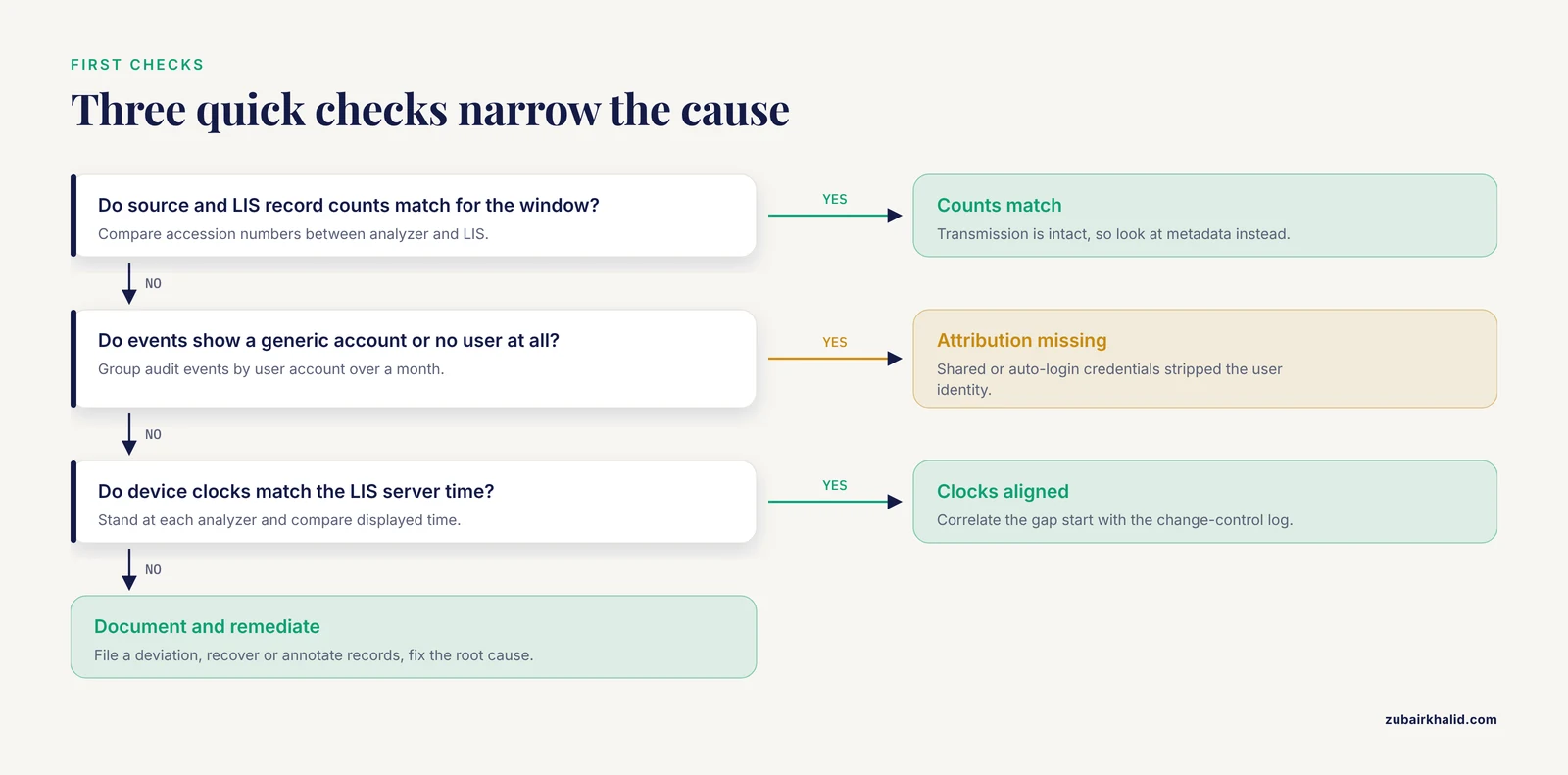
When a gap is reported or discovered, follow this sequence in order. Each step either identifies the cause or eliminates one.
- Define the window precisely. Establish the first and last affected records, the systems involved, and the test menus affected. A gap bounded by date, instrument, and test type is usually mechanical. A gap shaped by specimen selection is not.
- Count and compare. Compare record counts and accession numbers between the source system and the LIS for the window. A shortfall indicates transmission loss. Full counts with thin metadata indicate attribution or configuration failure.
- Check the clock. Compare displayed times on every involved device against the LIS server time. Record each offset.
- Pull the interface and system logs. Review interface engine error and retry queues, middleware logs, and LIS system logs for the window. Look for the exact start time of the anomaly.
- Correlate with the change-control log. Match the anomaly start against upgrades, patches, and configuration pushes. A same-day match is a strong lead.
- Group audit events by user account. Identify accounts with implausible activity patterns that indicate shared credentials.
- Query direct database access. Ask the database administrator for updates executed outside the application layer during the window.
- Test the present state. Run a fresh record through the full workflow now. If its audit trail is complete, the cause was historical. If it is incomplete, the cause is active and ongoing, which changes the urgency.
- Assess impact. For every affected record, determine whether patient-facing results, amendments, or corrected reports were involved, and trace each to its final disposition.
- Document and remediate. File a deviation, recover or annotate the affected records, fix the root cause, and define the effectiveness check that will prove the fix held.
Steps 1 through 8 take a single experienced technologist and an informatics colleague one working day in most laboratories. The impact assessment in step 9 usually takes longer than the diagnosis, which is the correct order of priorities.
How to Fix the Records After the Cause Is Found
Fixing the system does not fix the record. Two distinct remediation tracks run in parallel.
Record recovery. Where the source data still exists, re-transmit or re-enter it as late entries that carry the true analysis and result dates, the identity of the person performing the recovery, and a reason code referencing the deviation number. Where source data exists only on paper, scan or transcribe it with the same annotations. Where source data no longer exists, write a documented statement of what is missing and why, signed by the laboratory director. A documented absence is an acceptable record. A fabricated entry is not. This distinction between reconstruction and fabrication is the single most consequential judgment in gap remediation, and it belongs in your SOP before the first gap ever occurs.
Impact assessment. For each recovered or unrecoverable record, determine whether the result reached the chart, whether it was later amended, and whether the amendment was communicated. Where a result cannot be recovered and no amendment trail exists, the laboratory director decides whether re-notification of the clinician is required. Software-based quality assurance programs in laboratory medicine demonstrate the value of structured discrepancy monitoring. A frozen section quality assurance program built on custom software categorized discrepancies by source of error, whether interpretive or technical, specifically to understand how errors arise and to drive documentation and communication when errors were discovered [9]. Apply the same categorization discipline to audit gap records: classify each affected record by whether patient care was affected, whether the gap was mechanical or behavioral, and whether the record was recoverable.
Close the loop with a corrective and preventive action (CAPA) that names the root cause, the fix, the effectiveness check, and the due date. Quality improvement frameworks built on structured audits followed by prioritized interventions show that improvement sticks when the audit findings are converted into a ranked, resource-matched action list rather than a narrative report [10].
Integrating Audit Trail Review Into Microbiology Quality Control
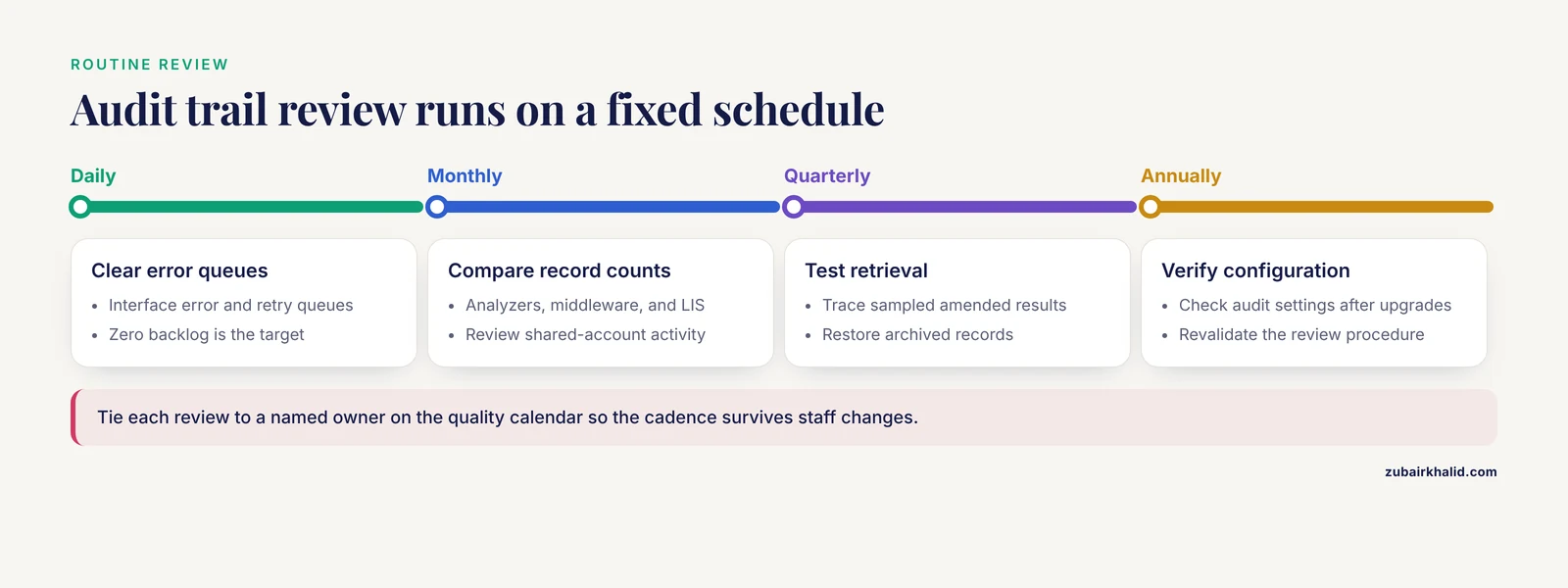
Audit trail review should not wait for an inspection. Treat it as a line of microbiology quality control alongside internal quality control (IQC) and external quality assessment. A practical schedule looks like this:
- Daily. The interface error queue is cleared and any backlog is logged. Zero backlog is the target.
- Monthly. A gap report compares record counts between analyzers, middleware, and the LIS for the month. Shared-account activity is reviewed.
- Quarterly. A random sample of amended results is pulled, and each amendment is traced from original entry through corrected report. Archived records from the previous quarter are retrieved to prove that retention works.
- Annually. The full audit configuration is verified after any upgrades, and the audit trail review procedure itself is revalidated.
Dedicated informatics platforms make this sustainable. The iLab platform deployed in a regional laboratory network centralized internal quality control and external quality assessment processing, with the electronic recording system handling documentation, analytics, and approvals across a pilot network of district hospitals, a central laboratory, and community health stations [4]. Modular quality control frameworks designed for other data-heavy fields follow the same architecture, enforcing standardized validation at every stage from data entry through expert adjudication, with format validation and consistency analysis built into the workflow rather than bolted on afterward [11]. The transferable principle is that QC of the record, not just QC of the assay, must be engineered into the system.
Laboratory Quality Management and the Standards Context
Audit trails sit inside a larger framework of laboratory quality management. ISO 15189, the international standard for medical laboratory quality and competence, and CLSI guidance both treat data management and sample traceability as required elements of a functioning quality system, and published laboratory protocols designed for resource-limited settings now build these components into the workflow alongside the analytical procedures themselves [2]. For laboratories whose records feed regulated manufacturing or development work, FDA 21 CFR Part 11 defines the expectations for electronic records and electronic signatures, and modern platforms map their controls to that regulation explicitly as part of deployment [6].
Data standards work reinforces the same message from a different angle. Professional society recommendations for high-volume genetic data management call for comprehensive standards covering messaging, storage and retention, documentation, validation, and quality control, with an explicit concern for feasibility so laboratories can implement them without unsustainable staffing burden [1]. Structured, well-defined data products with documented quality assurance steps make diagnostic data findable, accessible, interoperable, and reusable, while unstructured and inconsistently versioned records do the opposite [7]. An audit trail that captures complete, structured events is the foundation of all of it.
Even fields far from the microbiology bench converge on the same lesson. A multi-stakeholder quality assurance workshop on environmental sensor data identified documentation of hardware and data handling, alongside defined QA protocols and active management of deployed instruments, as the most pressing needs for credible data [12]. Every measurement community that has audited its own data integrity arrives at the same short list, and microbiology electronic records are no exception.
Prevention Practices That Keep Gaps From Recurring
Prevention is cheaper than remediation, and the practices below are all implementable within an existing laboratory quality management system.
- Individual attribution everywhere. Individual logins on analyzers, middleware, and the LIS. Where technology does not allow it, a documented cosignature workflow that restores human attribution.
- Single time source. NTP synchronization on every device that writes a timestamp, verified quarterly by direct clock comparison.
- Audit verification in change control. A mandatory post-upgrade test record whose audit entry is inspected field by field before the system returns to production.
- Monitored error queues. Interface error and retry queues reviewed daily, with any backlog logged as a deviation.
- Scheduled audit reviews. Monthly gap reports and quarterly amendment-trace reviews on the quality calendar, with named owners.
- Restricted database access. No routine direct write access to clinical tables. Any direct intervention requires a ticket, an approval, and a post-hoc record of what was changed.
- Downtime readiness. Manual recording templates that capture the same data elements as the electronic system, plus a defined recovery procedure with true-time annotations.
- Retention testing. Quarterly retrieval of random archived records, verifying that results and audit histories return together.
- Training with competency assessment. Staff trained on the SOPs that govern attribution, amendments, and downtime, with documented competency. Personnel qualification and structured competency assessment are core components of quality management across laboratory disciplines [3], and adherence to SOPs is a demonstrated determinant of laboratory service quality [5].
- Periodic structured audit. A scheduled internal audit of the electronic record system, with findings prioritized and tracked to closure, following the audit-then-prioritize pattern that quality improvement frameworks use to convert findings into action [10].
Common Mistakes and Limitations
- Fixing the symptom and not the interface. Re-entering missing records by hand and declaring the problem solved guarantees recurrence. The recovery entry is necessary, the interface correction is the fix.
- Silently editing timestamps. Adjusting drifted timestamps in place destroys the very evidence the audit trail exists to preserve. Annotate, never overwrite.
- Treating a shared account as a convenience issue. Auditors treat missing attribution as a data integrity finding, not a workflow preference. The compliance exposure is disproportionate to the configuration effort required to fix it.
- Validating upgrades for results but not for audits. If your post-upgrade test checklist does not include audit trail verification, every future patch is an unmonitored experiment on your record system.
- Assuming archived means available. Retention schedules on paper mean nothing if nobody has ever restored an archived record. Retrieval testing is the only proof.
- Letting the gap investigation drift. Audit windows age poorly. System logs rotate, staff memories fade, and instrument local caches overwrite. Start the diagnostic sequence within days of discovery.
- Over-documenting the wrong thing. A hundred pages describing the outage is less useful than one page per affected specimen stating what was recovered, what was not, and what the impact was.
- Expecting the audit trail to prove something it was never configured to capture. If your system does not record amendment reasons, no amount of troubleshooting creates them retroactively. Configuration gaps discovered during an investigation should be added to the CAPA, not treated as findings against individuals.
One limitation applies to every laboratory reading this: the specific configuration menus, log locations, and recovery tools vary by LIS and analyzer vendor, and the steps here describe the general method rather than vendor-specific commands. Individual cases, especially those involving potential falsification or patient harm, require escalation through your institutional quality and legal channels.
Frequently Asked Questions
What exactly is an audit trail gap in microbiology electronic records?
It is any period or set of records for which the electronic system cannot show who performed each action, when it occurred, and what changed. Gaps include missing records entirely, records with no user attribution, missing original values on amended results, and archived records that lost their history.
What is the most common cause of audit trail gaps?
Interface and middleware transmission failures between analyzers and the LIS, followed by shared or generic login accounts that strip user identity from every recorded event. Both occur silently during routine operation, which is why they dominate real-world findings.
How do I check for audit trail gaps in my own laboratory?
Compare record counts and accession numbers in the source system against the LIS for a defined window, group audit events by user account to spot shared credentials, and compare device clocks against the server clock. These three checks take under an hour and identify the majority of causes.
Are audit trail gaps a compliance violation?
They can be. Under ISO 15189 principles and, for records in regulated contexts, FDA 21 CFR Part 11, an incomplete audit trail undermines the attributability and completeness requirements for electronic records. The severity depends on the cause, the records affected, and whether patient care or reported results were involved.
Can a gap be repaired after the fact?
Yes, through documented reconstruction. Records can be re-transmitted from the source, re-entered as late entries with true dates and a reason code, or formally documented as unrecoverable. What cannot be done is fabricating an entry to make the trail look complete, which converts a documentation gap into a data integrity violation.
How do shared analyzer accounts create gaps if the records still exist?
The record arrives in the LIS with a generic identity instead of the technologist who did the work, so the attribution element of the audit trail is missing for every event under that account. Auditors treat a trail that cannot identify the responsible person as a gap even when the analytical values are intact.
How often should audit trails be reviewed?
A practical cadence is daily clearance of interface error queues, monthly gap reports comparing record counts across systems, quarterly retrieval tests of archived records, and annual verification of the full audit configuration after upgrades. Tie each review to a named owner on the quality calendar.
What belongs in a CAPA after a gap is discovered?
A named root cause, the specific correction applied, the record recovery method used, an impact assessment of every affected record, an effectiveness check with a defined date, and any configuration or training changes needed to prevent recurrence.
Sources
- Recommendations for HLA Genotyping Data Standards and Clinical Laboratory Staffing Considerations.
- Integrated laboratory protocol for the diagnosis of Sexually Transmitted Infections (STIs): Standardized pre-analytical procedures, rapid screening, hemagglutination, and ELISA methods for use in resource-limited settings.
- Quality Control in Assisted Reproduction Centers.
- Development and Implementation of an Internal Quality Control and External Quality Assessment Information System for a Regional Medical Laboratory Center: Pilot Design and Implementation Study.
- Determinants of quality laboratory service provision amongst government comprehensive specialized hospitals in Northwest Ethiopia.
- A cloud-enabled LIMS-QMS platform with large language model-assisted standard operating procedure generation for GLP/GMP-aligned theranostics laboratory operations.
- Challenges in Structuring SARS-CoV-2 Emergency Use Authorization Diagnostics Data: Leveraging Findable, Accessible, Interoperable, and Reusable Principles for the Next Era of Diagnostic Data Transparency.
- Piloting an external quality assurance program (QAP) for COVID-19 antigen rapid diagnostic tests (Ag-RDTs): findings and lessons learned from Cambodia.
- Software solution for integration of frozen section quality assurance into daily practice.
- From Consensus Through Prioritization: A Delphi Method, Clinical Audit, and Analytic Hierarchy Process Framework for Quality Improvement in Primary Diabetes Care.
- Semi-automated end-to-end quality control system for annotation data based on automated Cobb angle measurement.
- Air Quality Sensor Experts Convene: Current Quality Assurance Considerations for Credible Data.