Building an Audit-Ready Data Management System for Microbiology QC
By Dr. Zubair Khalid, DVM, MS, PhD ·

An audit-ready data management system for microbiology quality control lets any reviewer, internal or external, reconstruct every QC decision your laboratory made, in chronological order, without asking anyone for context. It converts scattered notebook entries, spreadsheets, and instrument printouts into a controlled record set that shows what was tested, with what reagents, on which instruments, by whom, and what happened when a result fell outside limits.
Use this guide when you are preparing for an accreditation inspection under ISO 15189 or a similar laboratory quality management standard, when you are standing up a new microbiology bench, or when a previous audit flagged documentation gaps. The method applies to clinical bacteriology, mycology, mycobacteriology, and veterinary diagnostic laboratories alike.
The initial build takes roughly 40 to 80 hours of hands-on work from a lead technologist and the quality manager, spread over 6 to 12 weeks of elapsed time depending on how much of the record set already exists. Once running, steady-state operation needs about 2 to 4 staff-hours per week for a small laboratory and one dedicated quality review session per month. The payoff is that audit preparation stops being a scramble. You already have the evidence.
Principle of Audit-Ready Data Management in Microbiology Quality Control
Microbiology quality control (QC) generates a specific and difficult kind of data. Unlike a chemistry analyzer that prints a numeric value every run, microbiology QC produces zone diameters, minimum inhibitory concentrations, growth versus no-growth calls, stain reactions, and biochemical profile checks, and much of it is recorded by hand. The system described here treats every one of those observations as a controlled data point with four mandatory properties: it is captured at the time of the observation, it is traceable to the person who made it, it is linked to the exact reagent lot and instrument, and its disposition (accept, reject, investigate) is documented even when the disposition is "acceptable".
The organizing framework is data integrity, often summarized as ALCOA-plus: records must be attributable, legible, contemporaneous, original, and accurate, and by extension complete, consistent, enduring, and available. Where records are electronic, alignment with 21 CFR Part 11-style controls (audit trails, access control, electronic signatures) and with ISO/IEC 17025 computer software assurance expectations is the benchmark used by modern laboratory platforms [1].
Why bother? Because documentation quality is one of the strongest determinants of overall laboratory service quality. A cross-sectional study of comprehensive specialized hospitals in Northwest Ethiopia found that workflow organization, equipment reliability, quality management practices, adherence to standard operating procedures (SOPs), and documentation all significantly influenced laboratory service quality, with weak documentation among the persistent technical and administrative barriers to reliable diagnosis [2]. Auditors reach the same conclusion from the other direction: they sample records and judge the laboratory by what can be proven on paper, not by what staff remember.
The system has three layers. The capture layer records raw QC observations at the bench. The evaluation layer applies acceptance criteria and control rules to those observations. The governance layer manages documents, deviations, corrective actions, and retention. A laboratory that integrates all three layers in one informatics platform, as was done in the Shenzhen regional laboratory network that unified internal quality control (IQC) and external quality assessment (EQA) processing with documentation, analytics, and approval workflows, demonstrates the model at network scale [3]. This article shows how to build the same architecture at single-laboratory scale.
Materials, Software, and Documents
| Item | Specification or working strength | Purpose | Notes |
|---|---|---|---|
| QC reference organisms | S. aureus ATCC 25923 (disk diffusion), E. coli ATCC 25922, P. aeruginosa ATCC 27853, E. faecalis ATCC 29212, S. pneumoniae ATCC 49619 | Antimicrobial susceptibility QC, media growth checks, stain and biochemical QC | Stock at minus 20 °C or below in a validated preservation method, subculture per CLSI-style schedules |
| Inoculum standard | 0.5 McFarland suspension (approximately 1 × 10^8 CFU/mL for bacteria grown in broth) | Standardizing inoculum density for disk diffusion and broth MIC QC | Verify with a densitometer at each use |
| Gram stain reagents | Crystal violet, Gram iodine mordant, 95% ethanol or acetone-alcohol decolorizer, safranin counterstain | Daily or per-use stain QC with known gram-positive and gram-negative controls | Document lot numbers and expiration for each bottle |
| Oxidase reagent | 1% tetramethyl-p-phenylenediamine dihydrochloride | Biochemical identification QC | Prepare fresh or per manufacturer, store dark and cold |
| Catalase reagent | 3% hydrogen peroxide | Catalase QC on known positives and negatives | Never apply directly to colonies growing on blood-containing media |
| Culture media lots | Blood agar, MacConkey agar, Mueller-Hinton agar and broth, plus any specialty media in use | Sterility and performance QC on each new lot | Record manufacturer, lot, expiration, and QC strain results for every lot |
| Temperature monitoring | Calibrated thermometers or continuous data loggers for refrigerators (2 to 8 °C), incubators (35 ± 2 °C for routine bacteriology), and freezers | Environmental QC with documented calibration | Logger calibration certificates are audit records |
| Levey-Jennings capability | Spreadsheet with locked formulas, QC software module, or LIMS QC package | Plotting quantitative QC (zone diameters, MIC values) against control limits | Spreadsheets require the controls described below |
| Document control register | Versioned register of every SOP, form, and worksheet, with effective dates and review dates | The spine of the governance layer | A shared, access-controlled drive is acceptable at small scale |
| EQA materials | Proficiency test panels appropriate to the test menu | External check of analytic performance | Results must be entered, reviewed, and investigated like IQC data |
| Deviation and CAPA log | Structured form (paper or electronic) capturing event, cause, action, owner, due date, and effectiveness check | Demonstrates that QC failures were handled, not hidden | CAPA stands for corrective and preventive action |
| Access-controlled storage | Restricted-drive LIMS, validated QC software, or controlled network folders with audit logging | Protects record integrity and supports the traceability requirement | Aligned with 21 CFR Part 11-style expectations where electronic [1] |
Audit-Ready Data Management for Microbiology QC Step by Step
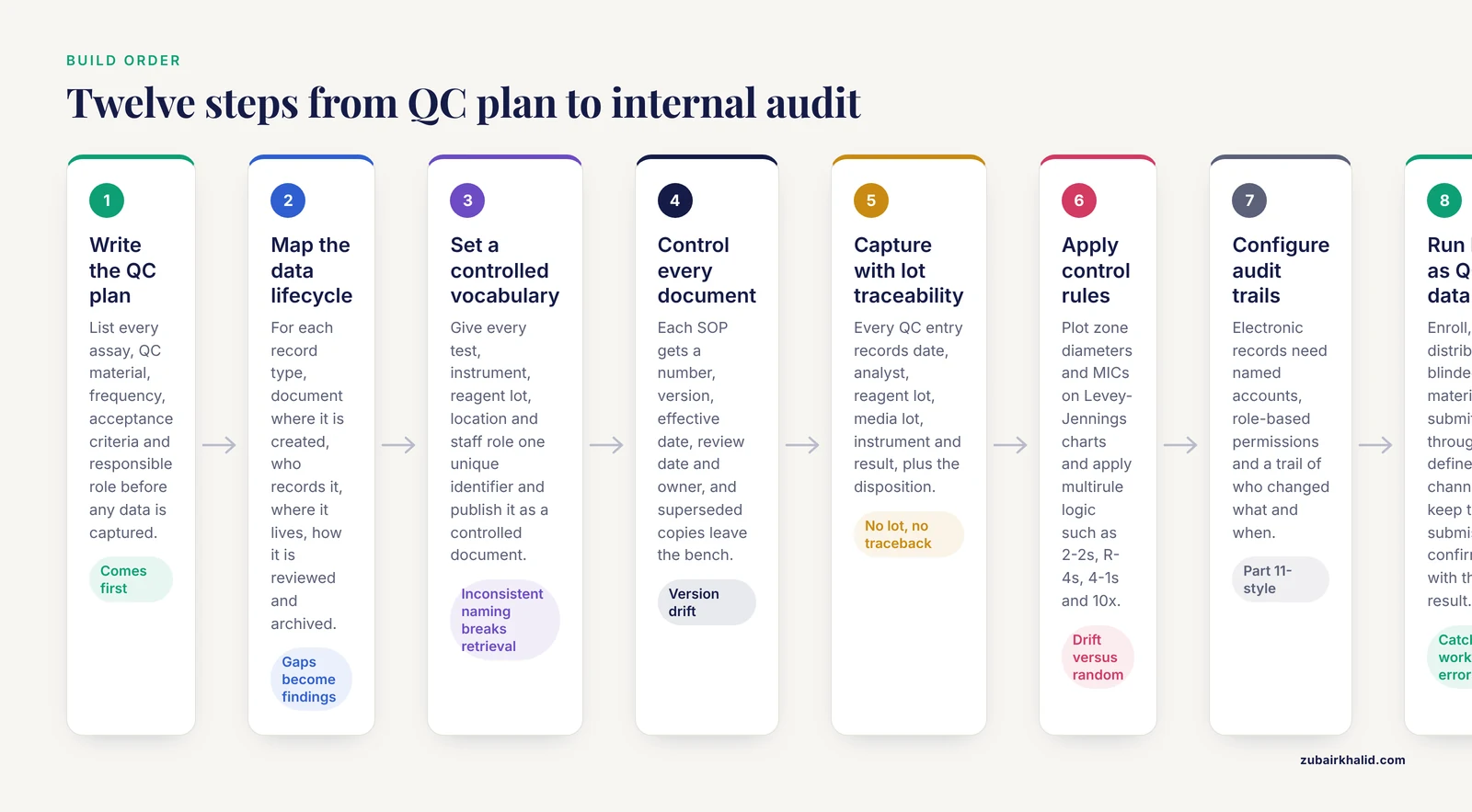
Each step states the action and the reason it exists in the sequence.
- Write the QC plan before touching any data. Draft a one-page QC plan that lists every assay, every QC material for that assay, the QC frequency, the acceptance criteria, and the responsible role. The reason this comes first is that every downstream form, field, and rule is derived from it. A QC plan also satisfies the quality management element of ISO 15189-style standards, and standardized protocols with defined internal and external quality assurance components are explicitly recommended in aligned laboratory protocol publications [4].
- Map the data lifecycle for every record type. For each record (media QC log, stain QC log, antimicrobial QC chart, temperature log, EQA report, deviation report), document where it is created, who records it, where it lives, how it is reviewed, how it is archived, and when it is destroyed. The reason is that auditors follow records through their lifecycle, and gaps between "created" and "archived" are where findings concentrate. Recommendations for laboratory data practices consistently emphasize covering messaging, storage and retention, documentation, validation, and quality control as one connected set of processes rather than isolated policies [5].
- Design a controlled vocabulary and naming convention. Assign every test, instrument, reagent lot, location, and staff role a unique, unambiguous identifier, and publish the vocabulary as a controlled document. The reason is that inconsistent naming is a documented cause of unusable data. In an analysis of FDA Emergency Use Authorization diagnostics data, similar test names, inconsistent naming conventions, inconsistent document identifiers, and unclear versioning made data effectively impossible to retrieve and maintain reliably [6]. Your laboratory should not reproduce those failure modes at bench scale.
- Establish document control for every SOP and form. Give each SOP a document number, a version, an effective date, a review date, and an owner, and retire superseded copies from bench circulation. The reason is that QC results are only interpretable against the procedure version that was in effect when they were generated. Automated SOP generation and version governance, demonstrated in a cloud LIMS-QMS platform for regulated laboratory operations, illustrates where document control is heading, but a manual register satisfies the same principle if it is complete and current [1].
- Build the IQC capture forms around lot traceability. Every QC observation must record the date, analyst, reagent lot, media lot, instrument, and result. For media, perform sterility checks (incubate a defined sample of each new lot and document zero growth) and performance checks with reference organisms (for example, confirming typical colony morphology and hemolysis on a new blood agar lot). For stains, run known gram-positive and gram-negative controls each day of use or with each new lot. The reason is that a QC result without a lot number cannot be traced back when a lot is later found defective, which defeats the entire recall function of QC.
- Apply quantitative control rules where QC produces numbers. For antimicrobial susceptibility QC, record zone diameters or MIC values for the reference strains and plot them on Levey-Jennings charts with control limits from the published QC tables, applying standard multirule logic (for example, a single point beyond plus or minus 3 standard deviations triggers immediate rejection, and rules such as 2-2s, R-4s, 4-1s, and 10x detect drift and shift). The reason is that visual and rule-based evaluation distinguishes random one-off variation, which is acceptable, from systematic shift, which means patient results are at risk and must be reviewed.
- Configure electronic records with real access control and audit trails. If any record is electronic, require individual named accounts, role-based permissions, and an audit trail that captures who changed what and when. Spreadsheets on a shared drive do not meet this bar unless they are locked, versioned, and access-limited with change logging. Where a full LIMS is out of reach, integrated QC information systems that centralize data processing with structured documentation, analytics, and approval steps show that even modest software stacks can deliver Part 11-style traceability [3] [1].
- Institute EQA and proficiency testing as first-class QC records. Enroll in an external quality assessment program appropriate to the test menu, translate the instructions for staff if needed, distribute blinded material to all participating sites or benches, and submit results through a defined channel with the submission itself documented. In a Cambodian pilot EQA program for COVID-19 antigen rapid diagnostic tests, a tiered distribution model with translated documentation and portal-based result submission let a national reference laboratory and peripheral sites participate in a single QC framework, and the reference tier achieved full concordance while peripheral sites revealed actionable discordances [7]. The reason this step matters is that EQA catches problems that internal controls miss, particularly interpretation and workflow errors.
- Create the deviation pathway and categorize errors at entry. Every out-of-limit QC result gets a deviation record with a categorized cause: reagent, media, instrument, environment, technique, or documentation error. Classifying errors by source, as implemented in a frozen section quality assurance software program that separates interpretive from technical errors, lets you see which categories drive your failure rate and target corrective action where it will matter [8]. The reason for categorizing at entry is that free-text narratives resist trend analysis, and uncategorized deviations cannot be prioritized.
- Link every deviation to a CAPA with an effectiveness check. For each deviation, record the root cause, the corrective action, the responsible person, the due date, and a scheduled effectiveness check (a defined re-review at a set interval). The reason is that unclosed or unverified CAPAs are among the most common audit findings, and the check is the only evidence that the problem actually stopped recurring.
- Schedule internal audits against key performance indicators. Define a small set of KPIs, for example percentage of media lots with complete QC documentation, on-time EQA submissions, and CAPA closure within target. Run a scheduled internal audit, score the KPIs, and prioritize improvements by impact and feasibility. A quality improvement framework from primary diabetes care demonstrates the pattern, combining consensus-validated KPIs, a retrospective audit of adherence, and structured prioritization of interventions, and showed that laboratory-based indicators can perform well while softer process measures lag behind [9]. The reason for a KPI-driven audit is that it turns the audit from an event into a trend you can manage.
- Train, qualify, and re-verify staff against the system. Document initial training on every SOP a person uses, competency assessment with defined pass criteria, and re-training when a document version changes. Personnel qualification, structured competency assessment, and training records are core elements of any quality management system in laboratory medicine [10]. The reason is that an auditor sampling a QC record will trace it to the analyst and then ask for that analyst's competency file, and an untraceable competency file converts a clean record into a finding.
Safety note throughout: QC reference organisms are handled at Biosafety Level 2 practices as a baseline. Work within a certified biosafety cabinet when preparing inocula and stocks, wear laboratory coat and gloves, decontaminate surfaces with an approved disinfectant after handling cultures, and autoclave all QC cultures before disposal. Avoid aerosol-generating manipulation of undiluted cultures, and never mouth-pipette.
Controls and Expected Results
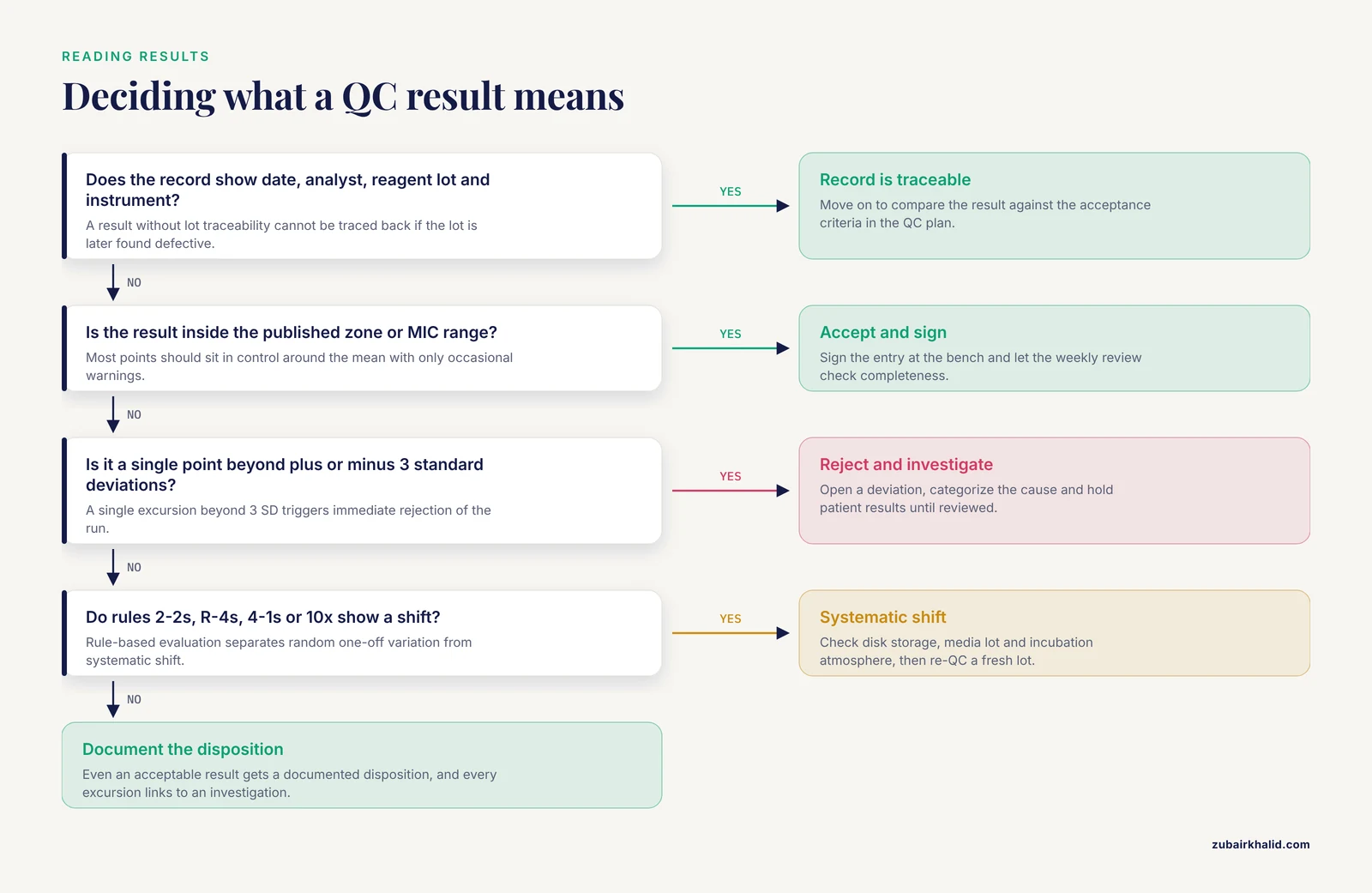
A well-built system produces a predictable set of control outputs, and auditors will expect to see all of them.
Internal controls (bench level). Daily stain QC showing correct reactions on known controls. Media lot QC showing growth and morphology consistent with expectations for the reference strains. Antimicrobial QC results falling within published zone or MIC ranges for the reference strain. Temperature logs within the specified band for every controlled space. Expected appearance: sequential, dated, signed entries with no gaps, and lot numbers present on every line.
Analytic controls (evaluation level). Levey-Jennings charts for quantitative QC showing points distributed around the mean with occasional warnings but no sustained shift. Acceptance rates above the laboratory's defined threshold, with every rule violation linked to a deviation record. Expected appearance when things are working: most points in control, documented single-excursion events, and charts that are actually plotted, not blank.
External controls (system level). EQA results within acceptable performance categories, and for any unsatisfactory result, a documented investigation with root cause and CAPA. Expected appearance: submission confirmations retained alongside results.
Governance controls (management level). A current document register, a deviation log with zero orphan entries (every deviation either closed or on a dated plan), CAPA effectiveness checks completed on schedule, and internal audit reports with tracked action items.
How to read them. Green means the record exists, is contemporaneous, and passes acceptance criteria. Yellow means an excursion occurred and was documented and dispositioned, which is a healthy outcome, not a failure. Red means a missing record, an unexplainable excursion, or a result with no traceability to lot, analyst, or instrument. Red items are your audit exposure, and the weekly quality review exists to find them before an inspector does.
Troubleshooting Guide
| Symptom | Likely cause | Fix |
|---|---|---|
| QC entries appear in batches, all written at week's end | Contemporaneous capture not enforced or not convenient | Move capture to the point of observation, provide bench tablets or pre-printed worksheets, and make delayed entry a deviation |
| Zone diameters drifting steadily upward on the Levey-Jennings chart | Aging Mueller-Hinton lot, incorrect incubation atmosphere, or expired antimicrobial disks | Check disk storage and expiration, verify CO2 requirements for the organism, order a fresh media lot and re-QC before reporting patient results |
| Frequent stain QC failures with correct reagents | Decolorizer evaporation changing its strength, or reagent bottles left open on the bench | Cap bottles between uses, replace the decolorizer, and log open dates on every reagent bottle |
| Staff cannot find the current SOP version | Retired copies still on the bench or multiple versions circulating | Physically remove superseded copies, mark versions in headers, and make the controlled register the only retrieval point |
| EQA results submitted late or twice with different values | No single accountable submitter and no submission log | Assign a named EQA coordinator, log every submission, and require a second-person verification before submission |
| Deviation log shows open items older than the CAPA due date | CAPA owners not held to deadlines, no escalation path | Add a monthly CAPA review with escalation to laboratory leadership and record the review itself |
| Spreadsheet QC charts break after staff edits | Unlocked formulas and free cell editing | Lock formula cells, protect the sheet, version the file, and migrate to validated QC software at the earliest opportunity |
| Two records for the same QC event with different values | Duplicate capture without a unique record identifier | Apply unique identifiers per event and define one system of record, retiring duplicates as deviations |
Variations for Different Laboratory Settings
Small or low-resource laboratory. A fully paper system with a controlled document register, bound numbered logbooks, and handwritten daily review signatures can be audit-ready. Standardized integrated protocols designed for resource-limited settings demonstrate that ISO 15189-aligned quality assurance, including internal and external QC components and sample traceability, is achievable without advanced infrastructure [4]. The non-negotiable elements are contemporaneous entry, lot traceability, and document version control, none of which require software.
Multi-site or regional network. When several laboratories of different sizes share QC oversight, centralize data processing and decentralize capture. The Shenzhen regional model, which integrated a LIS with dedicated IQC and EQA software modules plus an electronic documentation, analytics, and approval layer across district hospitals and community stations, shows that heterogeneous sites can be governed under one QC framework when the tooling is integrated [3]. Distribute EQA materials through a tiered structure with a single accountable reference site, as piloted in the Cambodian Ag-RDT program [7].
Point-of-care and rapid-test benches. Rapid diagnostic tests need QC tied to test kit lots and operator competency rather than to analytical instruments. An integrated digital application used for multiplexed point-of-care STBBI screening showed how app-based workflows can maintain quality assurance, documentation, and operator training records at the point of care in outreach settings [11]. If your microbiology service includes rapid antigen or lateral-flow testing, replicate that pattern with a lot-level QC log per kit.
Molecular and genotyping benches. Sequence and typing data add metadata, file formats, and storage-burden considerations on top of classic QC. Expert recommendations for HLA genotyping data emphasize comprehensive guidelines covering messaging, storage, retention, documentation, validation, and quality control, with an explicit requirement that implementation not impose a disproportionate staff and cost burden [5]. Borrow that feasibility principle when scoping molecular QC records.
Automated and semi-automated QC. Where QC itself involves data production (for example, image-based or instrument-interpreted results), modular end-to-end QC systems with format validation, structured protocol enforcement, and multi-reviewer consistency checks demonstrate the architecture to aim for when manual review becomes the bottleneck [12]. The same holds for environmental monitoring programs, where documented QA protocols, performance evaluation, and active management of instrument condition and data handling are the accepted pillars of credible data [13].
Record Storage, Retention, and Stability
Treat records the way you treat reagents, with defined storage conditions and defined stability.
Electronic records. Store originals in a system with access control, audit trails, and scheduled backups, and verify restoration at a defined interval rather than assuming backups work. Version-controlled, individually identified documents with traceable amendment history are the expectation for laboratory data management going forward [5] [6]. Cloud-based unified LIMS-QMS platforms aligned with 21 CFR Part 11 and ISO/IEC 17025 provide a reference architecture if you are choosing or replacing a system [1].
Paper records. Store logbooks in a dry, secure, designated archive, indexed by year and record type. Never discard a logbook until the retention period defined in your retention policy has elapsed and the destruction itself is documented.
Retention periods. Define retention per record type in your quality manual and follow your accreditor's and jurisdiction's requirements. Laboratory data management recommendations consistently call for explicit retention policies rather than informal practice [5], so a written retention schedule is itself an audit deliverable.
Reagent and media stability. Note that record stability interacts with physical QC. Store prepared media at 2 to 8 °C unless the manufacturer states otherwise, store antimicrobial disks per manufacturer instructions with desiccant, and date every in-house reagent on preparation with an assigned expiration. A QC result from an expired reagent is automatically a deviation, so the expiration field in your data system is a control, not a label.
Practical Tips That Keep the System Audit-Ready
- Review daily, weekly, and monthly at defined levels. The bench technologist reviews and signs each day, the supervisor reviews weekly for completeness, and the quality manager reviews monthly for trends. Review signatures are the cheapest audit evidence you can generate.
- Make the deviation record the default response. A QC failure that is documented, investigated, and closed strengthens your audit position. A QC failure that is quietly rerun until it passes is the single most damaging pattern an inspector can find.
- Sample your own records the way an auditor does. Pick three random dates, pull the complete record chain for one assay, and time how long it takes. If it takes more than a few minutes, fix the indexing before an external audit measures the same thing.
- Keep controlled vocabularies short. Ten well-defined test identifiers beat fifty overlapping ones, because naming inconsistency is what makes data irretrievable at scale [6].
- Record the "why" alongside the "what". When a QC result is accepted despite a warning rule violation, write the justification in the record at that moment. Retrospective justification reads as what it is.
- Tie training records to documents, not to people alone. When SOP version 3 becomes effective, the register should show exactly which staff have signed version 3 and who still owes training.
Common Mistakes and Limitations
These are the errors that recur across laboratories building audit-ready data management for microbiology QC.
- Building the archive before the capture layer. Laboratories often invest in storage and indexing while QC is still being recorded on loose paper. Fix capture first, because an archive of incomplete records is an organized liability.
- Using spreadsheets as systems of record. Unlocked spreadsheets lack audit trails, individual accountability, and version control, which are the core requirements for electronic records under Part 11-style frameworks [1]. A spreadsheet can serve for interim charting if it is locked and versioned, but it should not be the record of origin.
- Shared logins and communal signatures. If two people use one account, attribution collapses and every downstream record loses its ALCOA "attributable" property. Individual accounts are non-negotiable where records are electronic.
- Recording QC results without reagent and media lots. Without lot numbers, a defective lot cannot be traced to affected results, which is the primary reason QC documentation exists. Laboratories with weak documentation and SOP adherence show measurably worse quality outcomes overall [2].
- Treating EQA as a pass-fail formality. Unsatisfactory EQA performance that is filed without investigation discloses a broken governance layer. The EQA pilot experience shows the value comes from analyzing discordances, not from the concordance score itself [7].
- CAPAs without effectiveness checks. Closing a corrective action because the due date passed, rather than because recurrence was verified, is a finding waiting to happen.
- Version drift between SOP, form, and practice. When the SOP says one thing, the form captures another, and the bench does a third, the auditor will find all three in an afternoon. Reconcile documents whenever any one of them changes.
- Letting the vocabulary rot. New tests get added under ad hoc names, old names linger, and within two years the data cannot be queried reliably, which is exactly the failure documented at scale in the FDA EUA data analysis [6].
Limitations. This system establishes documentation and governance, not analytic performance. It cannot compensate for unvalidated methods, uncalibrated instruments, or insufficiently trained staff. Implementation effort scales with test menu breadth, and a laboratory with hundreds of assays will need software support rather than manual registers. Individual laboratories remain responsible for meeting the specific accreditation standard and regulatory requirements that apply to them.
Frequently Asked Questions
What does audit-ready mean for microbiology QC records?
It means any record can be located, understood, and traced to its origin by a reviewer without verbal explanation. In practice, every QC entry shows date, analyst, reagent lot, instrument, result, and disposition, and every excursion links to a documented investigation.
Can spreadsheets be part of an audit-ready system?
Only in a limited role. A locked, version-controlled, access-restricted spreadsheet can serve for charting or interim calculation, but it cannot provide the individual accountability and audit trails expected for electronic records, so the record of origin should live in a controlled system [1].
How often should QC be performed on media and stains?
Each new media lot receives sterility and performance QC before or at release for use, and stains are QC'd with each new lot and on each day of use according to your QC plan. The exact frequencies should match the requirements of your accreditation standard and the manufacturers' instructions, and the QC plan is where you commit to them.
Which QC organisms do we actually need to keep?
At minimum, the reference strains specified for the methods you run, for example S. aureus ATCC 25923 and E. coli ATCC 25922 for antimicrobial susceptibility QC, plus strains that support your identification and stain QC. Maintain them under a documented subculture and storage schedule and record every passage.
How long must QC records be retained?
Retention periods come from your accreditation body, applicable regulation, and institutional policy, and they vary by record type. What auditors check first is not the number of years but whether a written retention schedule exists and whether destruction events are documented [5].
What do auditors actually check in microbiology QC?
They trace records, not intentions. Expect sampling of QC logs for completeness and contemporaneity, tracing of a reagent lot from receipt through QC to disposal, review of deviation and CAPA closure, verification of staff competency files, and inspection of electronic record controls such as access logs and audit trails.
Do we need a validated LIMS to be audit-ready?
No, but electronic records require controls equivalent to what a validated system provides, including access control, audit trails, and backup verification. Small laboratories can be audit-ready on paper. Laboratories with electronic records should align their systems with recognized expectations for data integrity and software assurance [1].
How should we handle an EQA failure?
Record the result, stop treating it as a grade and start treating it as a deviation, investigate the root cause across pre-analytic, analytic, and post-analytic steps, implement a CAPA, and document an effectiveness check. Investigating the discordance, as the Cambodian Ag-RDT pilot demonstrated, is where the quality benefit actually comes from [7].
Sources
- A cloud-enabled LIMS-QMS platform with large language model-assisted standard operating procedure generation for GLP/GMP-aligned theranostics laboratory operations.
- Determinants of quality laboratory service provision amongst government comprehensive specialized hospitals in Northwest Ethiopia.
- Development and Implementation of an Internal Quality Control and External Quality Assessment Information System for a Regional Medical Laboratory Center: Pilot Design and Implementation Study.
- Integrated laboratory protocol for the diagnosis of Sexually Transmitted Infections (STIs): Standardized pre-analytical procedures, rapid screening, hemagglutination, and ELISA methods for use in resource-limited settings.
- Recommendations for HLA Genotyping Data Standards and Clinical Laboratory Staffing Considerations.
- Challenges in Structuring SARS-CoV-2 Emergency Use Authorization Diagnostics Data: Leveraging Findable, Accessible, Interoperable, and Reusable Principles for the Next Era of Diagnostic Data Transparency.
- Piloting an external quality assurance program (QAP) for COVID-19 antigen rapid diagnostic tests (Ag-RDTs): findings and lessons learned from Cambodia.
- Software solution for integration of frozen section quality assurance into daily practice.
- From Consensus Through Prioritization: A Delphi Method, Clinical Audit, and Analytic Hierarchy Process Framework for Quality Improvement in Primary Diabetes Care.
- Quality Control in Assisted Reproduction Centers.
- Feasibility, Preference, and Impact of a Rapid Multiplexed Point-of-Care Digital Innovation (AideSmart!) to Expedite Screening of Sexually Transmitted Blood-Borne Infections in At-Risk Populations in Canada: Cross-Sectional Study.
- Semi-automated end-to-end quality control system for annotation data based on automated Cobb angle measurement.
- Air Quality Sensor Experts Convene: Current Quality Assurance Considerations for Credible Data.