Web-Based vs. Local Protein Sequence Analysis Tools
By Dr. Zubair Khalid, DVM, MS, PhD ·

Web-based protein sequence analysis tools run on someone else's servers through a browser, while local tools are installed and run on your own computer or cluster. The rule of thumb is simple. If you are annotating one or a handful of sequences and want an answer today, use a web server. If you are analyzing hundreds or thousands of sequences, handling unpublished or sensitive data, or building a reproducible pipeline, install the tools locally.
Most protein sequence work, from basic property prediction to remote homology detection and structure modeling, can now be done either way. The right choice depends on data volume, data sensitivity, the need for reproducibility, and how much computational infrastructure and expertise you have. This guide explains each deployment model on its own terms, compares them on the criteria that actually decide real choices, and walks through concrete scenarios so you can pick the right option for your next analysis.
What Web-Based and Local Actually Mean
Before comparing anything, the two terms need precise definitions, because the difference is about where the software runs and who maintains it, not about the underlying algorithms.
Web-based tools are programs hosted on a remote server that you access through a browser. You paste or upload sequences, set parameters on a web form, submit the job, and collect results from a results page, often with interactive graphics. The server owner handles software installation, database updates, and hardware. Examples include the MPI Bioinformatics Toolkit, which provides browser access to 35 external and in-house tools for sequence similarity searching, feature prediction, and sequence classification [1], and Phyre2, a web portal that predicts and analyzes protein structure, function, and mutations from a submitted sequence [2]. Web servers can be single-purpose, like the iMolTalk server for protein structure analysis [3], or broad platforms that integrate many services, like the Dundee Resource for Sequence Analysis and Structure Prediction (DRSASP), whose services have completed over 1.5 million jobs since 2016 [4].
Local tools are programs you install on your own workstation, lab server, or high-performance computing (HPC) cluster. You run them from the command line or through a desktop interface, and you manage databases, versions, and compute resources yourself. A local installation can be as small as a single command-line utility or as large as an automated system like MannDB, a relational database built to execute 36 open-source protein analysis tools at whole-proteome scale, running tools on local systems or by batch submission to external servers as needed [5].
A useful mental model: web-based tools trade control for convenience. Local tools trade convenience for control. Everything else in this comparison follows from that trade.
Side-by-Side Comparison
This table is the core of the bioinformatics tools comparison. Use it to shortlist, then read the detailed sections for the reasoning behind each row.
| Criterion | Web-based tools | Local tools |
|---|---|---|
| Setup effort | None. Open a browser and submit a job [1] | Installation, configuration, dependency management |
| Time to first result | Minutes to a few hours for typical jobs (a typical Phyre2 structure prediction returns between 30 minutes and 2 hours after submission) [2] | Sl initially slower, then very fast once the pipeline exists |
| Throughput | Suited to small and moderate job sizes, though batching is possible on some servers [2] | Suited to large batch jobs and whole-proteome scale [5] |
| Data privacy | Sequences leave your institution. Public servers are inappropriate for confidential or pre-publication data | Data stays on hardware you control |
| Reproducibility | Depends on the server. Tool and database versions can change without notice | Full control over versions, parameters, and databases |
| Maintenance burden | None for you. The server team applies updates and keeps services running [4] | Yours entirely. Updates, databases, and hardware |
| Expertise required | Low. Interfaces are designed for biologists, including non-experts [6] | Higher. Command-line skills and scripting are usually needed |
| Cost | Often free for academic use, funded by institutions or grants | Hardware, electricity, and staff time, or cloud fees |
| Customization | Limited to the options the server exposes | Complete. You can modify code, chain tools, and build pipelines |
| Queue and downtime risk | Real. Public servers throttle jobs and occasionally go offline | None from shared queues, but your hardware can still fail |
| Automation | Limited, though some services expose APIs [4] | Full scripting and workflow-engine support |
No single row makes one model the best bioinformatics software choice in absolute terms. The best choice is the one that matches your dataset size, sensitivity, and workflow maturity.
Web-Based Protein Sequence Analysis Tools in Practice
What Web Servers Do Well
Web servers exist to remove barriers. SPiCE, a web tool for sequence-based protein classification, was built precisely because available software for feature extraction and classifier construction required users to install various packages and convert data into different formats, which hampered quick, exploratory use by biologists. SPiCE bundles data upload, feature calculation, visualization, and classifier construction into a single interactive environment so non-experts can apply advanced classification techniques [6]. The pattern repeats across the field. H3NGST, a fully automated web platform for end-to-end ChIP-seq analysis, was designed to reduce technical barriers by eliminating the need for local installations, programming skills, or large file uploads, with an interface accessible enough to work from a mobile phone [7].
The second major strength is curated, up-to-date content. When you submit to a web server, you are using the version the developers consider current, running against databases they maintain. The MPI Bioinformatics Toolkit gives interactive access to state-of-the-art comparison methods such as HHblits and HHpred, tightly interconnected so the output of one tool feeds the input of another, which is why it has become a resource for both research and teaching protein sequence analysis [1]. Phyre2 similarly wraps advanced remote homology detection behind a simple interface that guides users from sequence submission through interpreting secondary and tertiary structure, domain composition, and model quality [2].
The third strength is integration across data types. IIS (Integrated Interactome System) is a web platform with four connected modules covering data submission, search, annotation from multiple databases, and interactome mapping for proteins, genes, metabolites, and drugs, designed so that a pipeline connecting different tools can automatically integrate data from diverse sources [8]. d-Omix unifies four domain analysis services, including domain architecture-based phylogenetic trees, domain graphs, domain architecture alignment, and putative protein networks from domain-domain interactions, accepting either user-supplied InterProScan files or raw protein sequences that the server can process for you [9]. Building that kind of multi-database integration locally would take weeks of setup. On a web platform, it is a form submission.
Where Web Servers Fall Short
The limits show up quickly as your ambitions grow.
Scale. Public servers throttle job sizes. Phyre2 handles batch submission of large numbers of sequences, but the standard portal is designed around analyzing one protein at a reasonable pace, with results returned between 30 minutes and 2 hours [2]. Paste in a thousand sequences and you are either queue-bound or politely refused.
Privacy. Anything you paste into a public server leaves your control. For published sequences this is irrelevant. For a candidate therapeutic target, a patent-pending enzyme, or patient-derived data, it can be disqualifying.
Reproducibility. A results page is not a methods section. If the server updates its underlying model or database between your pilot experiment and your revision, rerunning the same job may not reproduce the original output. Journals increasingly expect exact tool versions in methods, and web servers rarely advertise when they change.
Pipeline rigidity. Web servers are points, not pipelines. You can chain some of them manually, exporting output from one and reformatting it for another, but automated chaining across independent servers is fragile. GARSA, a web-based system for genomic data analysis, was conceived because growth in genome data and analysis possibilities made it difficult for scientists to integrate, analyze, and present information from several bioinformatics tools and databases, and even integrated web platforms impose the pipeline the developers chose [10].
Local Protein Sequence Analysis Tools in Practice
What Local Tools Do Well
Local tools shine where web servers strain. MannDB demonstrates the ceiling of the local approach: a fully automated system for executing many tools and storing, integrating, and displaying protein sequence analysis results, built because a large number of open-source tools had to run at whole-proteome scale to support pathogen detection target selection. Its analyses cover cleavage prediction, chemical properties, classification, functional assignment, post-translational modifications, motifs, antigenicity, and secondary structure [5]. No public web server will run 36 tools across an entire proteome on demand for you.
Local execution also gives you determinism. When you pin versions, freeze your database files, and record parameters, the same input produces the same output months later. That property matters for methods sections, for regulatory contexts, and for any analysis you may need to defend later.
The third advantage is composability. Local tools connect through files and scripts. You can wrap a multiple sequence alignment, a domain scan, and a phylogeny inference in a single workflow that reruns end to end whenever new sequences arrive. Modern workflow engines make this routine. Web-based services increasingly offer APIs to narrow this gap [4], but the command line remains the native environment for automation.
Finally, some analyses are simply local-native. In silico protein design, where computational molecular design and protein sequence analysis converge to guide rational mutagenesis, relies on academic software packages run locally with user-defined structures, design regions, and input parameters [11]. Deep exploratory work, such as combining protein sequence, structure, and dynamics to trace functional evolution in a protein superfamily [12], or comparative analysis of nanobody sequence and structure datasets built from nonredundant sets of antigen-bound crystal structures [13], generally requires local compute and custom code.
Where Local Tools Fall Short
Local means you own every layer of the stack. Installation, dependency conflicts, database downloads that consume hundreds of gigabytes, version upgrades that break old scripts, and hardware that is either idle or oversubscribed. SPiCE's authors described the problem from the user's side: applying sequence-based classification required installing various packages and converting data between formats, obstacles that pushed them to build a web alternative [6]. Every lab that maintains a local bioinformatics stack recognizes the same problem from the maintenance side.
Local also raises the expertise floor. A researcher comfortable with a web form may not be comfortable with environment modules, path variables, or a job scheduler. This is not a small difference. It determines who on a team can actually run the analysis, and therefore how long results take.
The Criteria That Decide Real Choices
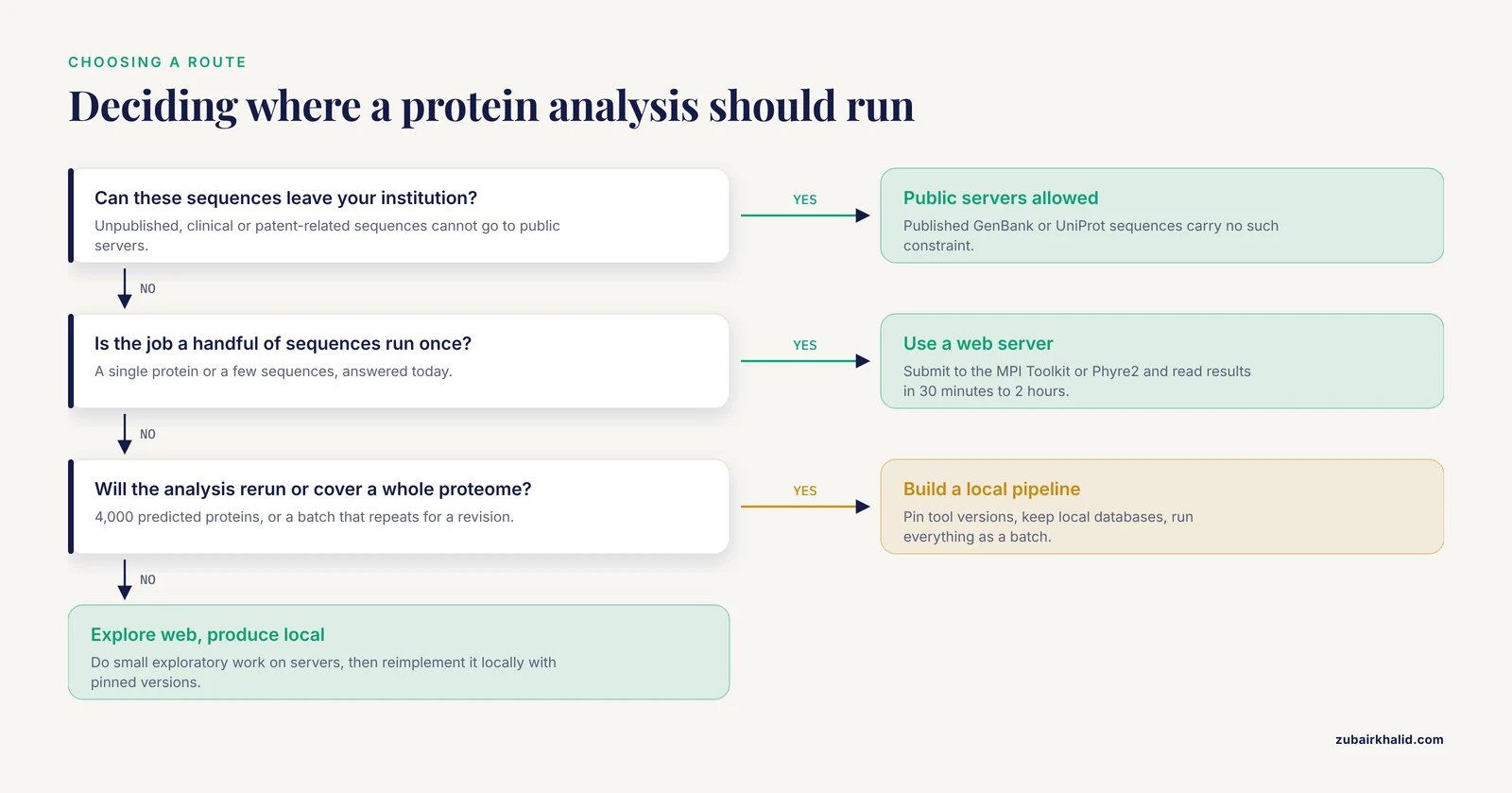
Generic feature lists are easy to write. These are the criteria that come up in real decisions about web-based or local protein sequence analysis tools, in roughly the order they actually matter.
Data Sensitivity and Privacy
Ask one question: can these sequences leave my institution? If yes, public web servers are on the table. If no, they are not, regardless of every other criterion. Unpublished sequences tied to a competitive project, clinically derived samples, or sequences covered by a material transfer agreement all belong on local infrastructure or on private cloud instances you control. Published sequences from GenBank or UniProt carry no such constraint.
Scale and Throughput
Estimate your real job size honestly. A handful of sequences, run occasionally, is web-server territory. A whole proteome, a large metagenomic set, or a weekly recurring batch is local territory. MannDB exists because whole-proteome analysis with dozens of tools needed a system to scale the computations, running tools on local systems or via batch submission to external servers when appropriate [5]. Somewhere between a few sequences and a whole proteome, the economics flip.
Reproducibility and Versioning
If the analysis will appear in a publication, decide now whether you need bit-level reproducibility or whether reporting the tool name, version, and parameters is sufficient. Many web servers document their versions clearly, and some expose APIs that let you pin behavior [4]. But web platforms evolve continuously, and a server that adds a better algorithm next year is, from a reproducibility standpoint, a different tool. Local installations with version pinning and containerization give you the strongest guarantees.
Time to First Result
For a one-off question, nothing beats a browser. A structure prediction submitted to Phyre2 returns in 30 minutes to 2 hours [2], with zero setup on your side. The same question answered locally might take you a day to set up the first time and minutes thereafter. If you will run this analysis exactly once, web-based wins. If you will run it every week for a year, the local setup cost amortizes to nothing and the web-based friction compounds.
Expertise and Who Has to Run It
Web interfaces lower the floor so that experimental biologists can run sophisticated analyses themselves. That is a feature, not a consolation prize. The developers of SPiCE [6], the MPI Toolkit [1], and H3NGST [7] all explicitly designed for users without programming backgrounds. If your lab has no dedicated bioinformatician, web servers are often the realistic path to good results. If your lab has one, that person will usually prefer local tools they can script, audit, and chain.
Accuracy and Tool Choice Are Separate from Deployment
This is the point people most often miss. The difference between web-based and local tools is about deployment, not about algorithm quality. The best implementations of a given method are frequently available both ways. SignalP, for example, exists as a public server and as a downloadable package, and studies routinely use several signal peptide predictors side by side precisely because the tools disagree. In one study of mycobacterial PE/PPE proteins, secretory nature predictions from SignalP 6.0, SignalP 5.0, Phobius, PSORTb, and TBpred showed little agreement, leading the authors to conclude that multiple computational tools must be considered together [14]. Whether you run those tools through their web interfaces or from a local install changes nothing about that disagreement. Deployment and analytical rigor are separate decisions.
Worked Scenarios
Abstract criteria become clear with concrete cases. These three cover the most common real situations.
Scenario 1: You cloned a new protein and want to know what it does
You have one sequence, roughly 400 amino acids, from an organism with no prior characterization. You want subcellular localization, domains, secondary structure, and ideally a 3D model.
This is squarely a web-based job. Submit the sequence to the MPI Bioinformatics Toolkit for HHpred-based remote homology detection and structure prediction [1]. Run Phyre2 in parallel for a model with ligand binding site and variant analysis built in, knowing results will arrive within 30 minutes to 2 hours [2]. Add secondary structure prediction from JPred, part of the Dundee resource, which also offers conservation and disorder prediction through its JABAWS services [4]. For localization, run two or three predictors rather than one, because localization tools disagree even on the same sequence, as the PE/PPE study showed when Gpos-mPLoc and TBpred concorded best for extracellular prediction while PSORTb and TBpred concorded best for membrane localization [14]. Total effort: an afternoon of form submissions. Local installation would add days for no gain in accuracy.
Scenario 2: Your lab sequenced a new bacterial genome and needs every protein annotated
You have 4,000 predicted proteins. Every one needs BLAST, domain analysis, signal peptide and transmembrane prediction, and subcellular localization, and the whole thing will rerun for the revision.
This is a local job. At this scale, web submissions become a bottleneck and a bookkeeping hazard. Build a local pipeline with pinned tool versions, keep local copies of the databases, and run everything as a batch. This is exactly the logic behind MannDB, which was built to scale automated protein sequence analyses to whole proteomes because individual tools could not be run manually at that volume [5]. Your pipeline does not need to match MannDB's ambition, but the architectural principle does: automated execution, integrated storage of results, and display that lets you interrogate the annotations. When the reviewers ask you to rerun with an updated database, a local pipeline does it in an afternoon. A folder of browser bookmarks does not.
Scenario 3: You are characterizing a proprietary enzyme before filing a patent
The sequence cannot leave the institution, but you need homology detection, structure modeling, and property predictions.
Local tools are the default answer, and the privacy constraint overrides everything else. Install homology search, alignment, and prediction tools on an internal server. For structure-adjacent questions, local or institutionally hosted software can replicate much of what public servers do, since the underlying analytical approaches for mapping residues, identifying interfaces, and examining contacts are well established [3]. Where a local open-source implementation of a specific method does not exist, the practical compromise is to submit a stripped-down or already-published sequence to the public server to validate that your local setup behaves comparably, then keep the confidential sequence entirely in-house.
Hybrid Workflows Are the Normal Case
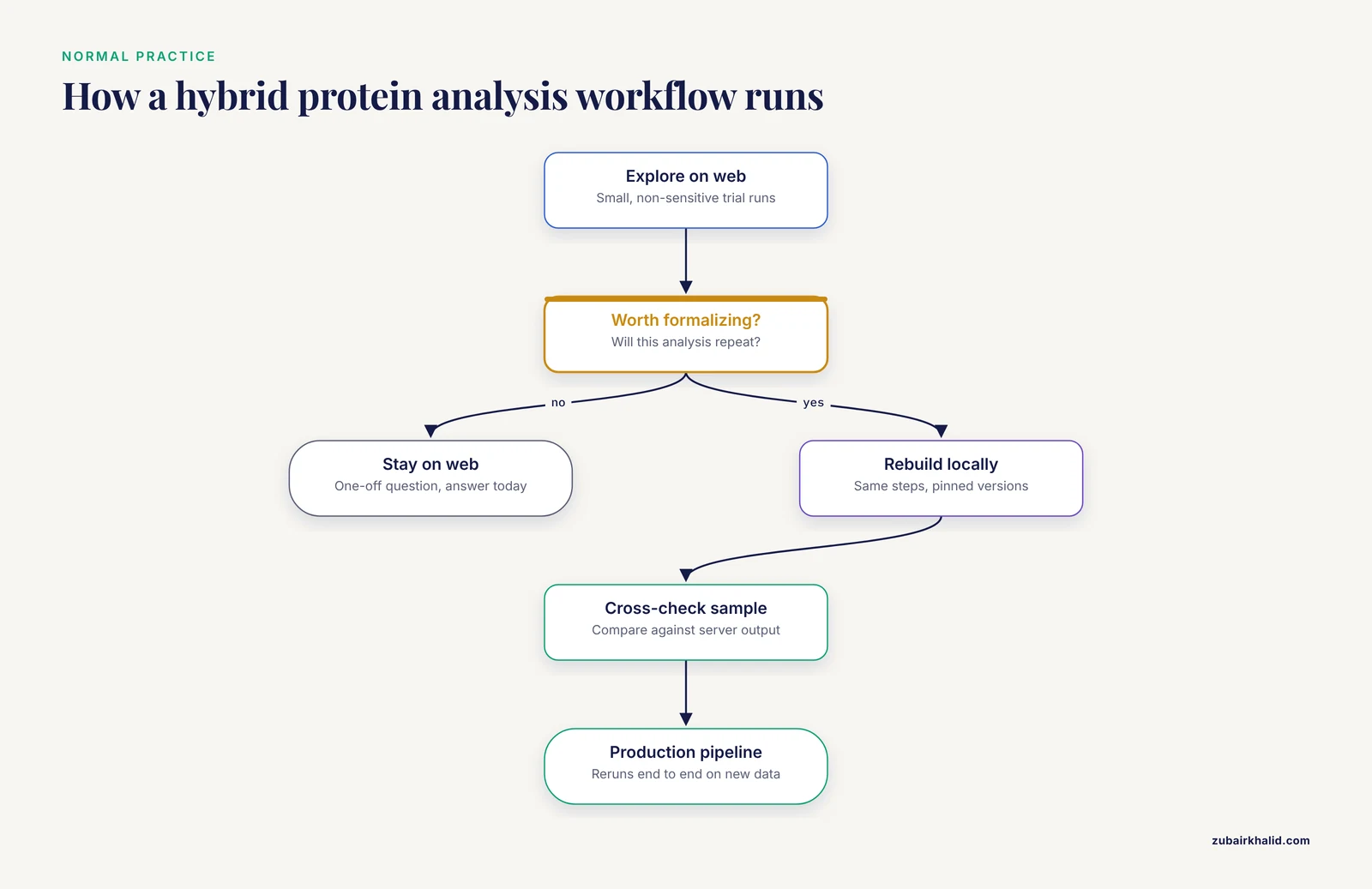
The framing of web-based versus local suggests a binary choice, but productive workflows almost always mix both, and the published literature reflects that. The PE/PPE study used web servers for localization and signal prediction across 30 selected protein sequences [14]. The hepatitis C epitope study used web-based prediction tools to evaluate epitope binding across 13 class I and 8 class II HLA alleles [15]. MannDB, although fundamentally a local high-throughput system, explicitly runs some tools by batch submission to external servers [5]. Even DRSASP, a mature web service collection, exposes APIs precisely so that local workbenches like Jalview can compose multitool interactive workflows against remote services [4].
A sound hybrid pattern looks like this. Do exploratory, small-scale work on web servers, where setup cost is zero and interactivity is high. Once an analysis proves worth formalizing, move it local, reimplementing the same steps with pinned versions. Use public servers as validation references, cross-checking a local pipeline's output on a small sample against the server version of the same tool. Keep anything sensitive local from the start. This gets you the speed of the browser during exploration and the rigor of the command line during production.
Common Mistakes and Limitations
These are the errors that show up repeatedly in real protein sequence analysis projects. Each one has a concrete fix.
Trusting a single predictor. The most consequential mistake in this field. Localization and secretory prediction tools frequently disagree with one another, and the PE/PPE study found little agreement among the secretory prediction tools it tested, concluding that multiple computational tools must be considered and that laboratory experiments should confirm the computational findings [14]. Run at least two independent predictors for any high-stakes call, and treat consensus, not any single output, as your evidence.
Confusing tool choice with deployment choice. Researchers sometimes assume a web tool is a watered-down version of the local equivalent or the reverse. Usually the same algorithm runs in both places. The deployment decision should be driven by scale, privacy, and reproducibility, never by a belief that one model is inherently more accurate.
Losing the parameter record. A screenshot of a web form is not a methods section. Record the exact URL, tool version if stated, submission date, and every non-default parameter, for every web submission. For local runs, the equivalent is a script and a log file. If you cannot reproduce the analysis from your notes, you do not have a result, you have an anecdote.
Uploading data that should not leave the building. Paste a sequence into a public server and assume it is public from that moment. Web platforms may store submissions, log them, or use them in ways you did not anticipate. Decide the sensitivity question before the first submission, not after.
Ignoring database version drift. A BLAST hit that existed last year may vanish from a updated database, and a hit that appears this year may have been absent when you ran the original search. For any claim that depends on an absence of homology, database version is part of the result.
Skipping wet-lab confirmation. Computational predictions, however carefully triangulated, remain predictions. The authors of the PE/PPE analysis stated directly that laboratory experiments should be used to confirm the tools' findings [14]. Sequence analysis narrows candidates and generates hypotheses. It does not close questions.
Treating bioinformatics as a substitute for domain knowledge. Modern protein sequence analysis extends from basic parameters like amino acid composition, molecular weight, and post-translational modification sites, through multiple sequence comparison and conservation analysis, to structure and function prediction [16]. Each layer rests on assumptions about the protein family and the biological context. A prediction that makes no sense for your organism or your experimental data is more often wrong than the biology is. Use the tools as one stream of evidence among several.
When to Use Web-Based (and When Not To)
The keyword question behind most searches on this topic deserves a direct answer. Use web-based when all of the following are true: your dataset is small enough for the server's job limits, your sequences are already public or not sensitive, you need the result once rather than as part of a recurring pipeline, and you want the answer without infrastructure investment. Classic examples are the single-protein annotation in Scenario 1 and exploratory classification work of the kind SPiCE was designed for, where the goal is quick, interactive feature exploration rather than production analysis [6].
Go local when any of the following is true: the data is confidential, the job is too large for server limits, the analysis must rerun reproducibly, the pipeline must chain many tools automatically, or your team has the expertise to maintain the stack. Whole-proteome annotation [5], custom analyses combining sequence with structure and dynamics [12], and protein design applications [11] all sit naturally in the local column.
Go hybrid when you are moving from exploration to production, or when you want public servers as an external check on a local pipeline. That is the most common steady state for an active lab.
Frequently Asked Questions
What is the difference between web-based and local protein sequence analysis tools?
Web-based tools run on remote servers that you access through a browser, with the host managing installation, databases, and hardware, while local tools are installed on your own computer or cluster and managed entirely by you. The algorithms are often identical, so the choice comes down to data sensitivity, job scale, reproducibility needs, and available expertise rather than accuracy.
When to use web-based tools for protein sequence analysis?
Use web-based tools for small, non-sensitive, one-off analyses where you want results without setup, such as annotating a single protein with homology detection, secondary structure prediction, and 3D modeling. Web servers are also the right entry point when the analysis is exploratory and the team lacks command-line expertise.
Are web-based protein analysis tools accurate enough for publication?
Yes, provided you document the tool, version, and parameters and treat predictions appropriately. Accuracy depends on the algorithm, not the deployment, and many widely used web servers implement the same state-of-the-art methods available locally. For high-stakes predictions, run multiple independent tools and seek experimental confirmation, because even well-established predictors of the same property can disagree substantially.
Do I need to install anything to use local protein analysis tools?
Yes, by definition. Local tools require installing the software itself, its dependencies, and usually substantial reference databases, plus enough command-line fluency to run and chain the programs. Integrated local systems that automate many tools and store their outputs reduce but do not eliminate this burden.
Can I combine web-based and local tools in one workflow?
Yes, and most productive workflows do. A common pattern is to explore on web servers, formalize the analysis as a reproducible local pipeline, and use public servers as validation references. Some web services provide APIs that let local software call remote tools directly, which keeps interactive workflows connected to server-side compute.
What are the best bioinformatics tools for protein sequence analysis?
There is no single best tool, because the right choice depends on the question. For remote homology detection and modeling, HHpred and Phyre2 are widely used web resources, and for large-scale annotation, automated local systems running many open-source predictors are the practical standard. Rather than chasing a single winner, pick per-task tools with strong track records, run more than one predictor for critical calls, and record versions for reproducibility.
Sources
- Protein Sequence Analysis Using the MPI Bioinformatics Toolkit
- The Phyre2 web portal for protein modelling, prediction and analysis
- iMolTalk: an interactive, internet-based protein structure analysis server.
- The Dundee Resource for Sequence Analysis and Structure Prediction
- MannDB - a microbial database of automated protein sequence analyses and evidence integration for protein characterization.
- SPiCE: a web-based tool for sequence-based protein classification and exploration.
- H(3)NGST: a fully automated, web-based platform for end-to-end ChIP-seq analysis.
- IIS--Integrated Interactome System: a web-based platform for the annotation, analysis and visualization of protein-metabolite-gene-drug interactions by integrating a variety of data sources and tools.
- d-Omix: a mixer of generic protein domain analysis tools.
- GARSA: genomic analysis resources for sequence annotation.
- In silico protein design: fitting sequence onto structure.
- Combining protein sequence, structure, and dynamics: A novel approach for functional evolution analysis of PAS domain superfamily
- Comparative analysis of nanobody sequence and structure data
- Identification and In silico analysis of proline-glutamate/proline-proline-glutamate proteins of Mycobacterium tuberculosis complex: A comparison of computational web-based tools.
- Sequence-based in silico analysis of well studied hepatitis C virus epitopes and their variants in other genotypes (particularly genotype 5a) against South African human leukocyte antigen backgrounds.
- Bioinformatics-aided Protein Sequence Analysis and Engineering.