Reviewed vs. Unreviewed Entries in UniProt
By Dr. Zubair Khalid, DVM, MS, PhD ·

Every entry in UniProtKB carries one of two status labels. A reviewed entry lives in Swiss-Prot and has been checked by a human curator against published literature, while an unreviewed entry lives in TrEMBL and carries annotations produced by automated pipelines with no curator sign-off. The rule of thumb for the uniprot reviewed unreviewed filter is simple. Filter to reviewed entries when you need annotations you can defend in a paper or a clinical report. Include unreviewed entries when you need complete coverage of every predicted protein and you are willing to treat the annotations as provisional.
This guide is a working uniprot database tutorial for the decision itself. It explains what each status means, where the filter appears in the web interface, the REST API, BLAST, and flat files, how to choose between the two for real tasks, and the mistakes that most often corrupt downstream analyses.
What Reviewed and Unreviewed Mean in UniProt
UniProt is a collaboration between EMBL-EBI, the SIB Swiss Institute of Bioinformatics, and the Protein Information Resource. The knowledgebase called UniProtKB is deliberately split into two sections with different standards, and the two-letter words you see on the website, Reviewed and Unreviewed, are labels for that split.
Reviewed entries, the Swiss-Prot section
The Swiss-Prot section descends from a protein sequence database started in Geneva in 1986, which was unusual at the time because it attached rich, manually verified annotation to each sequence. Today the reviewed section contains on the order of 570,000 entries. Each one is assigned to a curator who reads the primary literature, standardizes gene and protein names against nomenclature committees, attaches cross-references to resources such as PDB, Pfam, and OMIM, and tags every annotation statement with its evidence. Reviewed entries therefore represent the small, high-confidence core of UniProtKB.
Unreviewed entries, the TrEMBL section
The TrEMBL section, short for Translation of EMBL nucleotide sequence database, has existed since 1996. It is populated largely by translations of coding sequences submitted to the nucleotide archives such as ENA, together with other imported protein records. The counts here are enormous, more than 250 million entries in recent releases, because every newly submitted gene from every genome project generates a predicted protein. Nothing in TrEMBL has been read by a curator before release.
That does not mean TrEMBL is raw. Each unreviewed entry passes through an automatic annotation pipeline that transfers information in three main ways. First, similarity to Swiss-Prot clusters, managed through the UniRef clustering system, carries functional statements from reviewed to unreviewed proteins. Second, curated rules in the UniRule system apply annotations when a protein matches a family signature from resources such as PROSITE or Pfam. Third, an association-rule-based annotation method called ARBA infers annotation from patterns of co-occurring signatures and terms. These systems keep TrEMBL useful at scale, but every statement they produce is a prediction by construction.
The label travels with the entry
You can read the status directly from an entry. On the website, the status appears next to the entry name at the top of the page. In a UniProt flat file, the first line, the ID line, contains the entry name, then the status word, Reviewed or Unreviewed, then the sequence length. Entry names also give the status away at a glance. Reviewed entries use mnemonic names such as BRCA1_HUMAN, while most unreviewed entries use names built from their accession, such as A0A024R161_HUMAN. The two sections are searched together by default, which is exactly why the filter matters. A naive search returns a mixture of both, and the ratio is heavily skewed toward unreviewed entries for most organisms.
Side-by-Side Comparison
The following table is the core of this article. Keep it next to your terminal when you configure a pipeline.
| Criterion | Reviewed (Swiss-Prot) | Unreviewed (TrEMBL) |
|---|---|---|
| Who wrote the annotation | Human curators with literature review | Automated pipelines, similarity transfer, UniRule, ARBA |
| Evidence standard | Experimentally supported or curator-validated statements with evidence tags | Computationally inferred statements |
| Scale | On the order of 570,000 entries | More than 250 million entries |
| Entry names | Mnemonic, for example BRCA1_HUMAN | Mostly accession-based, for example A0A024R161_HUMAN |
| Cross-references | Rich, curated links to PDB, OMIM, DrugBank, Pfam, and many others | Sparse, mostly rule-derived links |
| Nomenclature | Standardized against committee-approved gene and protein names | Often inherited verbatim from the submitting laboratory |
| Annotation depth | Detailed function, domains, sites, PTMs, pathology, interaction notes | One-line function at best for most entries |
| Accession stability | Accessions stable for life, entry names can change | Entries merge into Swiss-Prot when promoted, redundant accessions become secondary |
| Redundancy | Curated, one canonical entry per protein with separate isoform lines | Many near-duplicate entries per protein across strains and submissions |
| Update cadence | Both sections update together, about six releases per year | Same release schedule |
| Best used for | Reference sets, annotation transfer, teaching, reporting, clinical interpretation | Complete proteome coverage, novel organism annotation, sensitivity-first searches |
| Main risk | False sense of completeness, curated entries are summaries, not the full literature | Annotation errors, duplicates inflating results, unstable entry metadata |
One point needs emphasis before you choose a filter. The protein existence line, labeled PE in flat files, is a separate axis from review status. Reviewed entries can still carry existence level 3, inferred by homology, or level 4, predicted, because a curator can validate a protein record while the protein itself has never been purified. Many people conflate the two filters and assume reviewed equals experimentally observed. It does not.
How Curation Quality Differs in Practice
The gap between the two sections is not just volume. It is the depth and defensibility of every annotation statement.
A reviewed entry for a well-studied human protein can carry dozens of annotated features. These include catalytic residues, post-translational modification sites, subcellular localization with experimental evidence codes, disease-associated variants, isoform-specific differences, and a curated bibliography where each claim is tied to a specific publication. An unreviewed entry for the same protein in a poorly studied organism may carry nothing more than a predicted function line derived from the closest reviewed relative.
That curated bibliography deserves a closer look, because it is both the strength and the boundary of the reviewed section. A recent study compared how much biological information lives in UniProt records versus the full texts of the papers those records cite. Using AI systems to answer a fixed set of questions about 50 human kinases from ten kinase groups, the analysis retained 1,749 protein-publication records representing 1,655 distinct publications, and compared the answers derived from the two evidence sources across 87,500 question-level comparisons [1]. The cited literature answered 1,211 of 1,750 protein-question combinations, while the UniProt records answered 1,151 [1]. Literature coverage was significantly higher than UniProt coverage for two of the corrected question categories, autoinhibition and inhibitor type, and mean semantic agreement between answers drawn from matched pairs of a record and its own literature, 0.692, exceeded agreement between answers from different proteins in the same kinase group, 0.384, and from different kinase groups, 0.279 [1].
Three practical lessons follow from that work, and they apply whether you filter to reviewed entries or keep both sections. First, even a reviewed entry is a condensed summary, and the underlying papers can contain detail the entry does not, which matters when you care about regulation by autoinhibition or drug mechanisms [1]. Second, the record and its bibliography agree with each other far more than either agrees with unrelated proteins, so using UniProt records as the anchor for an evidence chain is reasonable [1]. Third, no filter setting turns a database into the literature. Deep questions still require reading the cited papers, which the entry links to directly.
UniProt Reviewed Unreviewed Filter Options
The filter is not a single button. It appears in several places, and knowing all of them is the difference between a reproducible workflow and a silent data problem.
The website facet
Open uniprot.org/uniprotkb and run any search. The left sidebar contains a Reviewed facet with two checkboxes, one for Reviewed Swiss-Prot entries and one for Unreviewed TrEMBL entries. Checking Reviewed immediately narrows results. The facet is the friendliest option and the one to teach students first when they are learning how to use UniProt, because the result count updates live and you can see exactly how many entries each choice leaves you with.
Query syntax in the search box
The search box accepts structured field queries, and the status fields are simply reviewed:true and reviewed:false. Combine them with other fields using AND, OR, and NOT, with parentheses for grouping. Useful combinations include the following.
- reviewed:true AND organism_id:9606 returns reviewed human entries, where 9606 is the NCBI taxonomy identifier for Homo sapiens
- reviewed:false AND gene:BRCA1 returns all unreviewed entries whose gene field mentions BRCA1
- reviewed:true AND organism_id:9606 AND keyword:1185 returns reviewed human entries carrying the keyword for a topic such as disease
- (reviewed:true OR reviewed:false) AND proteome:UP000005640 returns every entry belonging to a specific proteome
You can also build the same query through the URL, which makes the search shareable and reproducible in a methods section. A URL of the form uniprot.org/uniprotkb?query=(reviewed:true) AND (organism_id:9606), with the space encoded, reproduces the facet choice exactly. Recording this URL in your lab notebook or paper is one of the cheapest reproducibility wins available in a uniprot tutorial context.
The REST API
Programmatic access uses the same query syntax against rest.uniprot.org. The search endpoint returns up to a page of results in formats including TSV, JSON, FASTA, and the full flat file text, while the stream endpoint returns an unlimited result set as a single download. Both accept a fields parameter that controls which columns you get in tabular output.
A request for a compact reviewed human table looks like this.
curl "https://rest.uniprot.org/uniprotkb/search?query=reviewed:true+AND+organism_id:9606&format=tsv&fields=accession,id,protein_name,gene_primary,organism_name,length&size=500"To download every reviewed human protein as a FASTA file for downstream use, use the stream endpoint.
curl "https://rest.uniprot.org/uniprotkb/stream?query=reviewed:true+AND+organism_id:9606&format=fasta&compressed=true"Two details save hours of debugging. The protein_existence field, when added to the fields list, shows you the PE level of each row so you can apply a second filter on experimental support. And pagination in the search endpoint follows the Link header in the response, so a simple loop that follows that header retrieves all pages rather than the first 500 rows.
BLAST and other UniProt tools
The UniProt BLAST service lets you pick the target database. The dropdown offers Swiss-Prot and TrEMBL as separate choices, alongside full UniProtKB. For identifying an unknown sequence, searching Swiss-Prot first gives cleaner hits with meaningful one-line descriptions. Searching TrEMBL or the combined database maximizes sensitivity and finds close relatives in under-studied taxa. The peptide search tool and the ID mapping tool also respect the split, since ID mapping accepts UniProtKB accessions from both sections and lets you restrict targets by status through the query syntax.
Flat files and local parsing
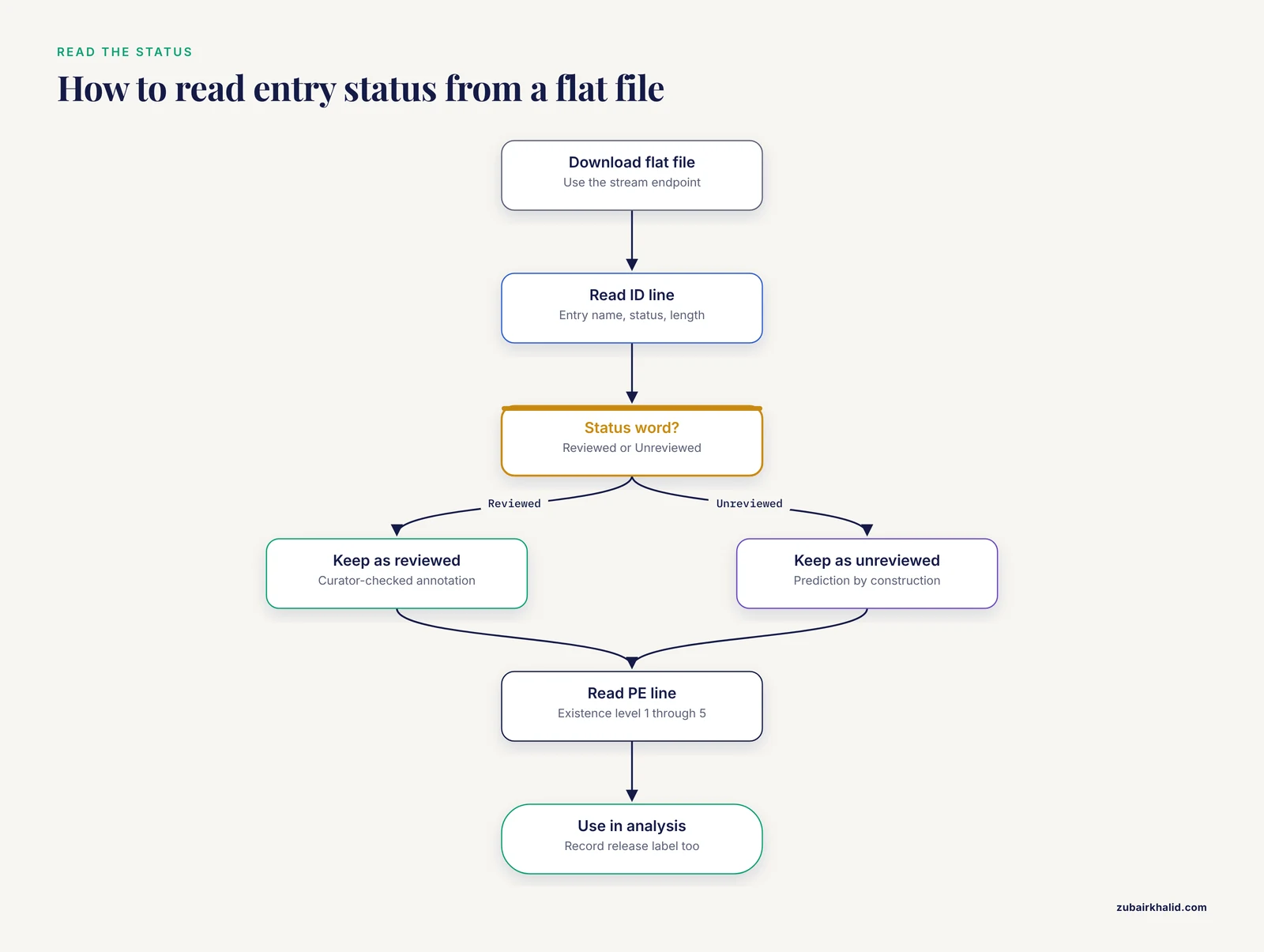
When you download entries as text, parse the status from the ID line rather than guessing from the accession. The PE line gives the protein existence level as a number from 1, evidence at protein level, through 5, uncertain. A robust local parser reads both. If you work in Python, a short script using requests against the stream endpoint with the flat format, then filtering lines that begin with ID and checking for the Reviewed token, reproduces the filter offline and pins your analysis to the release you downloaded, which is far safer than re-querying the live site mid-project.
Pros and Cons of Each Filter Choice
Pros of filtering to reviewed entries only
- Every annotation has been checked by a curator, so function calls and gene names are defensible in manuscripts and reports
- Entry names are meaningful mnemonics, which makes alignment files, tables, and figures readable by humans
- Cross-references are rich, so downstream mapping to structures, pathways, and disease resources works with few gaps
- Redundancy is controlled, giving you roughly one canonical entry per protein plus explicit isoforms rather than thousands of near-duplicate fragments
- Standardized nomenclature keeps gene names consistent across species comparisons
Cons of filtering to reviewed entries only
- Coverage is a small fraction of the known protein universe, so most organisms, especially non-model bacteria, eukaryotic parasites, and metagenome-assembled genomes, will be missing or sparsely represented
- Reviewed does not mean experimentally complete, because existence levels 3 through 5 include predicted proteins that a curator validated as records rather than as purified proteins
- A curated entry is a summary of its literature, and studies that compare record content with the cited papers show the papers can hold detail the record omits [1]
- Model organism bias is real, the reviewed core is dense for humans, mice, yeast, and E. coli and thin elsewhere
Pros of including unreviewed entries
- You get complete coverage of predicted proteomes, which is essential for mass spectrometry searches against complete genome annotations, metagenomics, and any organism outside the well-studied set
- Automatic annotation pipelines still transfer useful signals from Swiss-Prot, so an unreviewed entry frequently carries a correct broad function
- You avoid missing paralogs and strain-specific proteins that have not yet been curated
Cons of including unreviewed entries
- Function lines can be wrong, especially for distant similarity transfers, and there is no curator to catch the error
- Redundancy is severe, the same protein can appear as many near-identical entries from separate nucleotide submissions, which inflates search spaces and produces ambiguous peptide-to-protein mappings in proteomics
- Entry metadata is less stable, entries get merged, renamed, or promoted as curation proceeds
- Rich cross-references are largely absent, so pathway and structure mapping from unreviewed entries is patchy
The pros and cons balance differently by task, which is why the next section walks through real decisions rather than declaring one option universally best.
Choosing the Best UniProt Reviewed Unreviewed Filter for Your Task
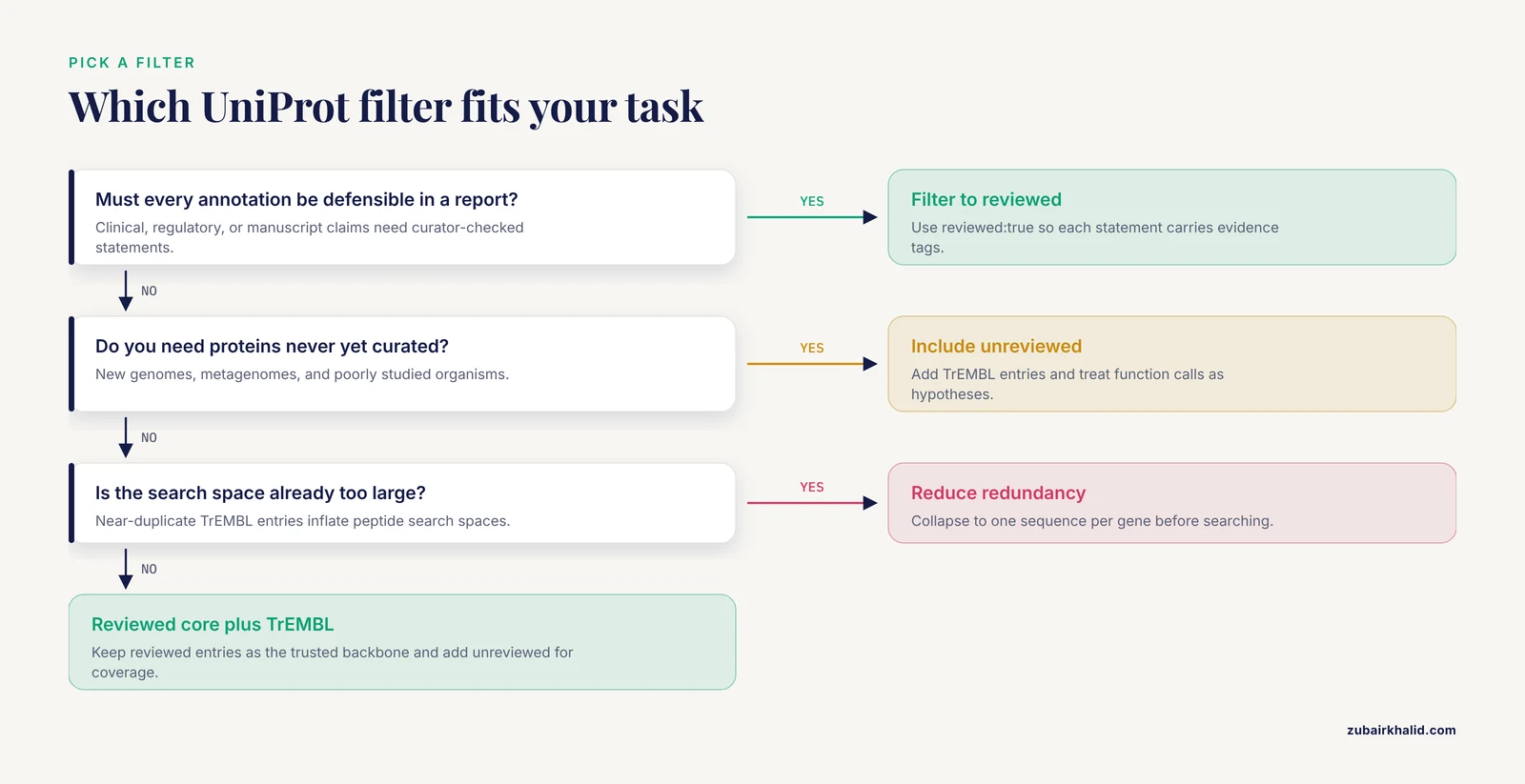
The best uniprot reviewed unreviewed filter is task-dependent, and there is no single correct answer. The scenarios below cover the choices that come up most often.
Scenario 1, identifying a protein from a single sequence
You have a sequence from a cloned fragment or a de novo transcript and you want to know what it is. Start with UniProt BLAST against Swiss-Prot. Reviewed hits come with readable descriptions, curated domain annotations, and links to structures, so you can usually identify the protein family in minutes. If the best hit is weak or absent, rerun against full UniProtKB to catch close relatives that exist only as unreviewed entries in related species. Record which database you searched, because the same sequence can produce a clean family-level answer in Swiss-Prot and a tempting but misleading species-level guess in TrEMBL.
Scenario 2, building a search database for mass spectrometry
Peptide identification depends on a complete and correctly sized candidate set. Filtering to reviewed entries only risks missing genuine proteins that have not been curated, particularly for organisms with limited literature. Downloading everything risks an inflated search space, thousands of near-duplicate TrEMBL entries, and a higher false discovery rate at any given score threshold. The standard compromise is to work at the proteome level, download all entries for a specific reference proteome accession, then reduce redundancy, often to one protein sequence per gene, and add a separate contaminant set. Whatever you choose, freeze the FASTA file, record the release number, and reuse it, because peptide identifications are only interpretable against the exact database used for the search.
Scenario 3, comparing orthologs across species
For cross-species work, reviewed entries give you standardized gene names and curated function, which makes ortholog tables legible. Build your query set from reviewed entries in the well-studied species, then use BLAST or a dedicated orthology resource to find counterparts in other organisms, where the hits will often be unreviewed entries. Track status per column in your results table. A comparison built entirely from unreviewed entries in both species inherits prediction errors from both sides and multiplies them.
Scenario 4, annotating a new genome or metagenome
Here the answer flips. For a newly assembled genome, filtering to reviewed entries would discard most of the coding potential, because the genes have never been curated. Include unreviewed entries and the full automatic annotation machinery. Treat every functional assignment as a hypothesis, and escalate individual genes of interest to a literature review, using the reviewed entries of homologs as your starting map. Reviewed entries remain valuable in this workflow as the trusted backbone that similarity-based annotation propagates from.
Scenario 5, clinical or regulatory reporting
When the output supports a patient-facing document, a diagnostic method, or a regulatory submission, filter to reviewed entries and keep the filter choice in your record. Curator-validated statements with literature evidence tags are the version of UniProtKB you can defend. For human genes, cross-references on reviewed entries also lead to variant and disease resources that unreviewed entries rarely carry. This is also the setting where the gap documented between record content and cited literature matters most, so pull the primary papers for any claim that carries clinical weight [1].
Scenario 6, teaching and quick lookups
For a uniprot database tutorial or a quick lab meeting lookup, reviewed only. The reduced result list, clean entry names, and curated descriptions make the resource learnable, and students avoid the common trap of citing a TrEMBL one-liner as established fact.
Worked Examples with Commands
The following examples turn the filter into reproducible artifacts.
Retrieve a TSV table of reviewed human kinases carrying the ATP-binding keyword.
curl "https://rest.uniprot.org/uniprotkb/search?query=reviewed:true+AND+organism_id:9606+AND+keyword:KW-0067&format=tsv&fields=accession,id,protein_name,gene_primary,length,protein_existence&size=500"Download all reviewed mouse entries as compressed FASTA.
curl "https://rest.uniprot.org/uniprotkb/stream?query=reviewed:true+AND+organism_id:10090&format=fasta&compressed=true" -o mouse_reviewed.fasta.gzPull the same set with Python and filter on the protein existence level, keeping only entries with evidence at protein or transcript level.
import urllib.parse, urllib.request

query = "(reviewed:true) AND (organism_id:10090) AND (protein_existence:1 OR protein_existence:2)"
url = ("https://rest.uniprot.org/uniprotkb/stream?"
       + urllib.parse.urlencode({"query": query, "format": "fasta"}))
fasta = urllib.request.urlopen(url).read().decode()
Check the status of entries in a downloaded flat file with standard Unix tools, reading the ID line and printing the status word for each entry.
grep "^ID" uniprot_sprot.dat.gz | head
zcat uniprot_trembl.dat.gz | awk '/^ID/ {print $3}' | sort | uniq -c
The awk command above counts how many entries carry each status token in the third field of the ID line, which is a fast sanity check that a supposedly reviewed-only file really contains what you expect.
Finally, remember that release numbers are part of your methods. UniProt publishes about six releases a year, each with a version label of the form 2025_01. When you write a methods paragraph, record the status filter, the query string, the organism or proteome restriction, and the release label. That combination, not the filter alone, is what makes the dataset reproducible.
Common Mistakes and Limitations
These are the errors that most often cost people time or credibility.
- Treating reviewed as experimental proof. A reviewed entry can carry existence level 3, 4, or 5, meaning the protein record is curated but the protein itself was never observed directly. If your claim requires physical evidence, filter additionally on protein_existence:1 or check the evidence tags on individual annotations.
- Treating unreviewed as garbage. TrEMBL annotations are predictions, but the sequences are real translations of real submitted genes. The error to avoid is citing an unreviewed one-line function as established biology, not excluding the entries from coverage-driven analyses.
- Mixing sections silently. Searching UniProtKB without a status filter returns both sections, and for most organisms the results are dominated by unreviewed entries. Any summary statistic, count, or protein list generated from an unfiltered search is not comparable to one generated from a reviewed-only search. State the filter in every methods section.
- Duplicate inflation. In combined searches, the same protein can appear as a reviewed entry plus dozens of unreviewed near-copies. Downstream tools that count hits, compute enrichment, or map peptides can be skewed by this redundancy. Collapse to unique accessions or unique protein sequences before counting anything.
- Ignoring accession history. When a TrEMBL entry is promoted into Swiss-Prot, its accession usually travels with it and the entry name changes. When redundant TrEMBL entries merge, the losing accessions become secondary and redirect to the merged entry. Pipelines that cache entry names rather than accessions can break or report stale names.
- Confusing review status with proteome completeness. A proteome export for an organism includes entries of both statuses. If you filter the export to reviewed only, you are no longer searching the complete predicted proteome, and peptide coverage statistics will drop in ways that look like sensitivity loss rather than filter choice.
- Over-trusting any single record. Even reviewed entries condense their literature. The comparison of UniProt records against the papers they cite found that the cited literature covered some topics, notably autoinhibition and inhibitor type, more completely than the records themselves [1]. For deep mechanistic questions, follow the entry bibliography into the primary papers rather than stopping at the entry page.
One general limitation applies to everything above. Filter choices shape the dataset, but they do not substitute for biological judgment about individual proteins. Ambiguous cases deserve a direct look at the evidence tags, the bibliography, and the underlying publications.
Frequently Asked Questions
What is the difference between reviewed and unreviewed entries in UniProt?
Reviewed entries belong to Swiss-Prot and have been checked by human curators against published literature, with standardized names and evidence-tagged annotations. Unreviewed entries belong to TrEMBL and carry annotations generated automatically by similarity transfer and rule-based systems, with no curator review.
Should I use reviewed or unreviewed entries for my analysis?
Use reviewed entries when accuracy and defensibility matter more than coverage, for example in reporting, annotation transfer, and teaching. Include unreviewed entries when coverage matters more than annotation confidence, for example in proteomics search databases, metagenome annotation, and work on poorly studied organisms. Many real workflows use reviewed entries as the trusted core and add unreviewed entries for completeness.
How do I filter UniProt to only reviewed entries?
On the website, check the Reviewed box in the Reviewed facet of the left sidebar. In the search box or the REST API, add reviewed:true to your query, for example reviewed:true AND organism_id:9606 for reviewed human entries. Use reviewed:false for unreviewed entries only.
Are unreviewed TrEMBL entries wrong?
Not inherently. The sequences come from real gene predictions in the nucleotide archives, and the annotations come from systematic automated methods. The risk is not that every entry is wrong, it is that errors are not caught before release, so any specific functional claim from an unreviewed entry should be treated as a prediction until you confirm it against a reviewed homolog or the literature.
Do reviewed and unreviewed entries share accessions?
No entry has two live accessions, but accessions do migrate between sections. When a TrEMBL entry is promoted to Swiss-Prot, its accession is generally retained and only the status and entry name change. When redundant entries merge, the absorbed accessions become secondary and redirect to the surviving entry, which is why you should key pipelines on accessions rather than entry names.
How often does UniProt update the reviewed and unreviewed sections?
Both sections update together on a single release schedule of roughly six releases per year, each labeled with a version such as 2025_01. Because promotion, merging, and demotion happen between releases, pin your analyses to a named release and record it in your methods.
Further Reading
- Dual-source abdominopelvic computed tomography: Comparison of image quality and radiation dose of 80 kVp and 80/150 kVp with tin filter
- Comprehensive Comparison of Machine Learning and Kalman Filter Battery State of Charge Estimators
- Comparison of Tin Filter-Based Spectral Shaping CT and Low-Dose Protocol for Detection of Urinary Calculi.
- Flattening filter-free technique in volumetric modulated arc therapy for lung stereotactic body radiotherapy: A clinical comparison with the flattening filter technique.
- Comparison of a New, Filter-Free Stereopsis Test (BEST) With the Randot Stereotest in a Pediatric Cohort.