How to Choose the Right Isoform Sequence in UniProt
By Dr. Zubair Khalid, DVM, MS, PhD ·

The canonical sequence in UniProt is one representative protein form per entry, while isoform sequences are the alternative protein forms produced from the same gene by alternative splicing, alternative initiation, or other processing events. The rule of thumb for uniprot isoform sequence selection is simple: start with the canonical sequence, and only switch to isoform-level analysis when your actual question (a peptide, a primer, a domain, a variant, an antibody epitope) falls in a region that differs between isoforms. For human proteins specifically, prefer the MANE Select sequence when your downstream tool supports it.
This guide walks through every isoform sequence selection option UniProt offers, the tradeoffs of each, and the concrete decisions that come up in homology searching, proteomics, primer design, and annotation work. It also doubles as a short UniProt database tutorial for anyone who has never inspected the isoform section of an entry page.
What Isoform Selection Means in UniProt
Before you can choose between options, you need to know exactly what UniProt is offering. UniProtKB (the UniProt Knowledgebase) contains two sections. Swiss-Prot holds reviewed entries with expert curation. TrEMBL holds unreviewed entries, annotated by automatic systems, that await full curation. Both sections can carry multiple protein sequences per gene, and the vocabulary around those sequences is where most confusion starts.
The canonical sequence
Every UniProtKB entry has exactly one canonical sequence. This is the sequence curators (or the automatic annotation pipeline, for TrEMBL) treat as the default representative. When you download a FASTA file of "human reviewed proteins," you are downloading canonical sequences. When a paper says "the protein is 1,048 amino acids," it is almost always quoting the canonical length.
For reviewed entries, curators choose the canonical sequence based on biological evidence. The longest isoform is often picked, but not always. Curators favor the isoform with the strongest expression evidence, the most complete annotation, or the form present across the widest range of species.
Isoform sequences
Isoform sequences get their own identifiers. If the accession for a gene product is Q9Y6K9, the canonical sequence is Q9Y6K9 and the alternative isoforms are Q9Y6K9-2, Q9Y6K9-3, and so on. Each isoform carries a description of how it differs from the canonical sequence, such as "VSP_001234" variation splicing tags that denote an alternative exon, an extended N-terminus from an alternative start codon, or an truncation caused by an alternative stop site.
Two properties of isoform sequences matter for your analysis:
- Isoforms are sequences, not transcripts. UniProt maps transcript-level splicing evidence onto protein sequences, so an isoform entry is a plausible protein product, not an mRNA.
- Isoforms usually share most of their sequence with the canonical form. A 400-residue isoform of a 500-residue canonical protein might differ by only one skipped exon, meaning most tryptic peptides are identical between them.
Reviewed versus unreviewed entries change the game
For reviewed (Swiss-Prot) human entries, isoform annotation is explicit and evidence-backed. For unreviewed (TrEMBL) entries, the situation is rougher. A recent analysis of canonical sequence selection across eight mammalian reference proteomes found that for TrEMBL sequences, the longest sequence in a gene-centric group is automatically chosen as canonical, and this mechanical rule produces inconsistencies, including pairs of orthologs that are more than 95% identical in sequence yet dramatically different in length, a pattern that is biologically unlikely [1]. That paper reports that among roughly 140,000 proteins from eight mammals in UniProtKB release 2022_05, the ortho2tree pipeline proposed 7,804 canonical changes for release 2023_01 while confirming 53,434 existing canonical choices, and that 82% of its proposed changes agreed with MANE Select, rising to 92% agreement for confirmed canonicals [1].
The practical takeaway: on a reviewed human entry, isoform annotation is trustworthy and the canonical choice is deliberate. On an unreviewed entry, the "canonical" tag may simply mean "longest sequence in the cluster," and you should look at the underlying evidence before trusting it.
How to Use UniProt to Inspect and Retrieve Isoforms
This section is a working UniProt database tutorial for the isoform workflow. You can complete every step in a browser or with a script in a few minutes.
Step 1: Find the entry
Search uniprot.org by gene name, protein name, or accession. Filter by organism to avoid grabbing the ortholog from the wrong species. In the results list, the "Reviewed" column separates Swiss-Prot entries from TrEMBL entries. For serious work, start with reviewed entries when they exist for your organism.
Step 2: Read the isoform section
On an entry page, the "Sequences" or "Isoforms" area lists every annotated isoform with its ID, its length, and a short description of how it differs from the canonical sequence. Each difference is tagged (for example, alternative splicing, alternative initiation, ribosomal frameshifting) with a link to the underlying evidence, including publications and cross-references to resources such as Ensembl or RefSeq transcripts. The entry page also flags whether the sequence matches MANE, which stands for Matched Annotation between NCBI and EBI. MANE Select is the jointly agreed human transcript and protein pair that UniProt, the EBI, and NCBI promote as the default for a given gene.
Step 3: Download what you need
There are three common retrieval routes:
- The web download page. From any search results page, use the Download button. In the format options, choose FASTA, and toggle the setting to include isoform sequences. The resulting file contains canonical entries with their plain accessions plus isoform entries with hyphenated accessions, so downstream scripts can tell them apart by the accession pattern.
- The REST API. For a single entry,
https://rest.uniprot.org/uniprotkb/P04637.fastareturns the canonical FASTA. Adding the query syntax and theisoformfield handling, or using the unisave endpoint, lets you pull isoform sequences and version history programmatically. For batch work, submit a list of accessions in the ID mapping tool or stream results withhttps://rest.uniprot.org/uniprotkb/stream?query=...&format=fasta. - Proteome sets. Reference proteome downloads for an organism give you the canonical-per-entry set by default. If you need isoform-expanded proteomes for a proteomics search, download them through the proteome pages and verify the sequence count against the reported proteome statistics before committing to a search.
Step 4: Verify with a quick sanity check
Before running a week of analysis, spend two minutes confirming your sequence set did what you think it did. Count the sequences in the FASTA file. Grep the headers for hyphenated accessions to confirm isoforms came along. Compare the length of the canonical sequence you downloaded against the length stated on the entry page. Most isoform-selection errors we see in practice are retrieval errors, not decision errors.
UniProt Isoform Sequence Selection Options at a Glance
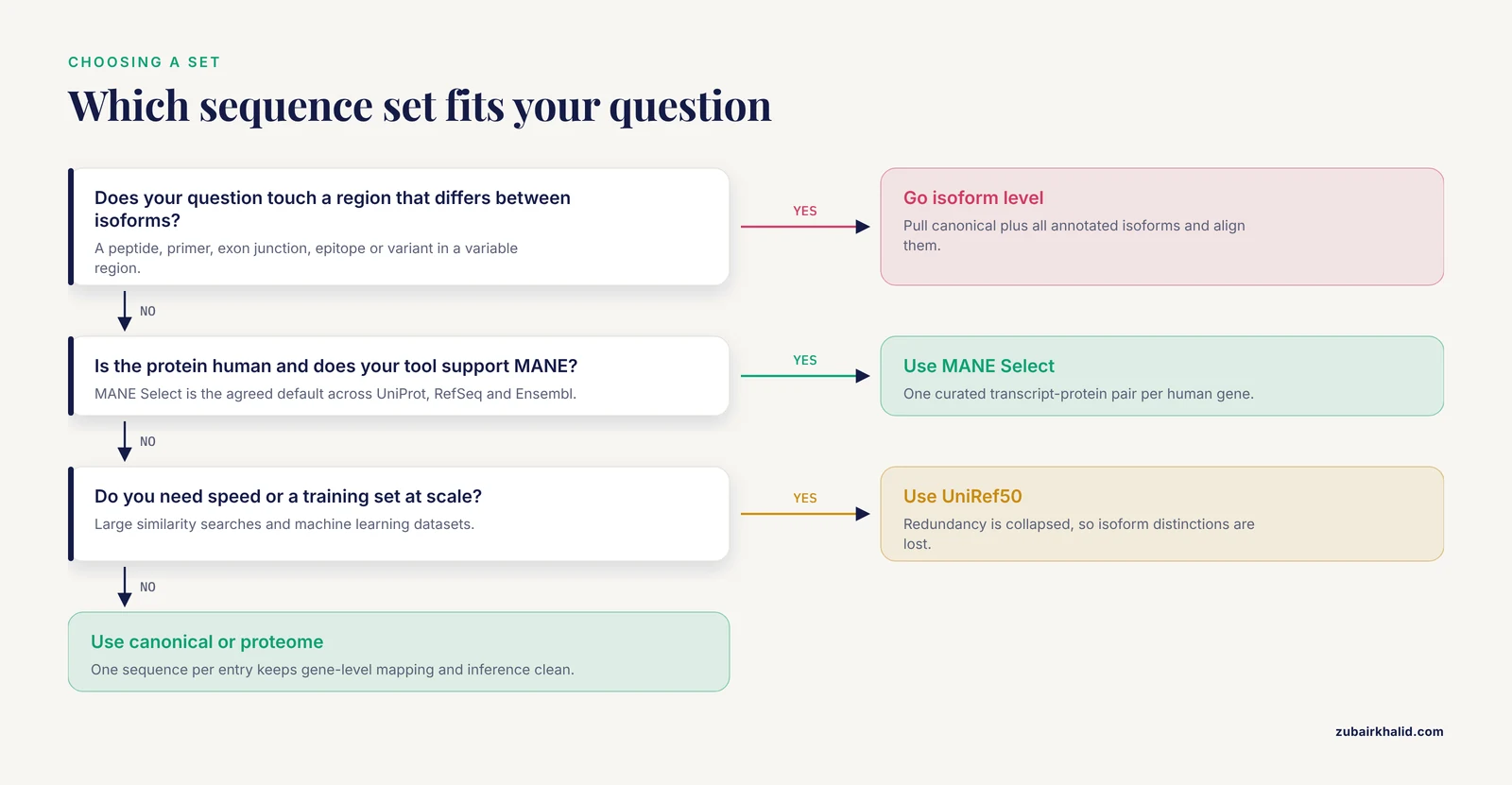
The table below is the core of this article. Each row is a defensible choice for a specific class of problem, and the columns summarize the pros and cons developed in the following sections.
| Option | What you get | Best for | Pros | Cons |
|---|---|---|---|---|
| Canonical sequence only | One sequence per UniProtKB entry | Homology searching, annotation transfer, teaching examples | Small search space, clean one-to-one gene mapping, matches most databases | Misses isoform-specific biology, under-represents real protein diversity |
| Canonical plus all annotated isoforms | Every protein form UniProt annotates | Isoform-aware proteomics, splice-variant studies, epitope design | Captures isoform-specific peptides, complete coverage of annotated diversity | Inflated search space, many shared peptides complicate protein inference |
| MANE Select (human only) | One curated transcript-protein pair per human gene | Human proteomics, expression constructs, clinical reporting, Gene Ontology mapping | Jointly agreed between UniProt, EBI, and NCBI, stable, matches RefSeq and Ensembl defaults | Human only, one isoform per gene, not always the longest or most studied isoform |
| Reference proteome set | Canonical sequences for one organism, with protein counts verified | Bottom-up proteomics, reannotation pipelines, cross-organism comparability | Consistent, versioned, organism-scoped | TrEMBL-based proteomes inherit the longest-sequence canonical rule and its inconsistencies |
| UniRef clusters (100, 90, 50) | Sequences merged into clusters at 100%, 90%, or 50% identity | Large-scale similarity searches, redundancy reduction, machine learning datasets | Dramatically smaller search spaces, faster BLAST and HMM runs | Cluster representative may not be the isoform you care about, loses isoform distinctions at 90% and 50% |
| Full TrEMBL or gene-centric groups | Every predicted sequence, grouped by gene | Very broad discovery searches, metaproteomics of poorly annotated organisms | Maximum recall | Largest search space, canonical choice may be an artifact of the longest-sequence rule |
The Options on Their Own Terms
Canonical sequence only
Using canonical sequences alone is the historical default and remains the right answer more often than beginners expect. The canonical sequence is what most BLAST databases, domain architecture viewers, and functional annotation pipelines assume you mean when you provide an accession. Keeping one sequence per entry keeps a one-to-one mapping between your results and gene-level interpretations, which simplifies reporting.
The pros are real: smaller files, faster searches, fewer ambiguous matches, and compatibility with the widest range of downstream tools. The cons appear the moment your question touches alternative splicing. If the functionally dominant form of your protein in your tissue of interest is a short isoform that skips a domain, the canonical sequence will quietly give you the wrong answer, and nothing in the output will warn you.
Canonical plus all annotated isoforms
Downloading the canonical and isoform sequences together gives you the full annotated protein diversity for each gene. This is the correct choice when your question is explicitly isoform-aware: you are validating a splice event with RT-PCR, designing a peptide to an isoform-specific exon junction, or checking whether a disease variant lands inside a region present in only some isoforms.
The pros are coverage and honesty. The cons concentrate in mass spectrometry and any method that must uniquely attribute a measurement to a protein. Because isoforms share most residues, many peptides map to several isoforms simultaneously. Deciding which isoform was actually present in the sample then depends on at least one isoform-unique peptide, and if none was observed, your inference is ambiguous. A comprehensive study of the tryptic search space in UniProt human and mouse datasets compared complete proteome sets against other UniProtKB sets and against IPI, RefSeq, Ensembl, and UniRef100 organism-specific sets, evaluating both canonical sequences and isoforms along with natural and disease-associated variants, and examined peptide unicity for each dataset as well as which peptides had been observed in mass-spectrometry repositories [2]. The broad lesson from that work is that dataset choice measurably changes both the size of the searchable peptide space and how uniquely peptides map to proteins, which is precisely the tradeoff you accept when you expand from canonical-only to all isoforms [2].
MANE Select for human proteins
For human genes, MANE Select gives you one transcript and one protein per gene, chosen collaboratively so that the same sequence is the default in UniProt, RefSeq, and Ensembl. The ortho2tree evaluation found that the large majority of its canonical recommendations agreed with MANE, with 82% agreement for proposed changes and 92% agreement for confirmed canonicals, which is independent evidence that MANE Select tracks biologically sensible choices [1].
The pros are strong: cross-database consistency, stable identifiers, and alignment with what clinical and annotation resources treat as the reference. The cons are equally real. MANE Select is one form per gene, it is human-only, and it is not guaranteed to be the longest or the most highly expressed isoform. If your experiment targets an alternatively spliced exon, MANE Select is simply not the question you are asking, and you should reach for the explicit isoform entries instead.
Reference proteome sets
A reference proteome is the curated set of canonical sequences for one organism, versioned and released as a unit. This is the pragmatic middle ground. You get reproducibility (release numbers you can cite), correct organism scoping, and a size that keeps proteomics and annotation searches tractable.
The cons are inherited from whatever section of UniProtKB the proteome was built from. Proteomes assembled from TrEMBL entries inherit the automatic longest-sequence canonical rule, with the ortholog-length inconsistencies that rule creates [1]. When comparing canonical proteins across species, a recent evaluation showed that orthologous canonical sequences selected by that mechanical rule can differ wildly in length despite very high sequence identity, and that tree-based reselection produces gap distributions resembling those seen in bacteria and yeast, organisms where isoform selection is not a complication [1].
UniRef clusters
UniRef merges sequences into clusters at 100% (UniRef100), 90%, and 50% identity, with a representative sequence per cluster. UniRef100 is closest to the full search space, while UniRef50 compresses databases to roughly a fraction of their raw size and is the standard choice for large-scale similarity searches and for training datasets in structure prediction and machine learning.
The pros are speed and scale. The cons are exactly the isoform issue this article is about. Clustering collapses sequences that differ, and the representative chosen for a cluster may be an isoform you would never have selected deliberately. UniRef is a discovery and reduction tool, not an isoform-aware retrieval tool.
Full TrEMBL and gene-centric groups
Searching against full TrEMBL maximizes recall when your sample might contain proteins absent from curated sets, such as in metaproteomics or poorly studied organisms. The cost is the largest possible search space, slower searches, and a higher false discovery rate at a fixed score threshold in mass spectrometry. Additionally, as described above, canonical selection within TrEMBL gene-centric groups is mechanical rather than biological [1], so even the "one sequence per gene" view of TrEMBL deserves scrutiny.
How the Options Compare on the Criteria That Decide Real Choices
Peptide uniqueness and the proteomics search space
If you are doing bottom-up proteomics, three properties of your database matter: its size, the fraction of peptides that uniquely identify one protein, and whether the isoforms you care about are present at all. The dataset comparison work in UniProt showed that these properties differ substantially across the commonly used organism-specific datasets, and that observed peptides in mass spectrometry repositories can serve as evidence for protein forms that are otherwise only predicted [2].
In practice:
- Canonical-only searches give the smallest search space and the cleanest protein inference, at the cost of missing isoform-specific peptides entirely.
- Isoform-expanded searches capture isoform-specific biology but require you to handle shared peptides deliberately, typically by reporting protein groups rather than single proteins.
- UniRef-based searches trade protein-level resolution for speed, which is usually acceptable for discovery but not for targeted quantification.
The best uniprot isoform sequence selection for a proteomics project is therefore usually the reference proteome plus explicitly added isoforms for the handful of genes where splicing matters to your hypothesis, rather than either extreme.
Orthology and cross-species consistency
If your work spans species, sequence selection consistency matters as much as per-gene correctness. A canonical sequence that is the longest isoform in one species and a medium-length isoform in another will distort alignments, gene tree inference, and length-based filters. The ortho2tree analysis demonstrated that this is not a theoretical concern, documenting proposed changes to thousands of canonical assignments across eight mammals on the basis of alignment gap patterns and tree structure [1]. If you build pipelines that compare canonical sequences across eukaryotic species, check whether your canonical pairs have comparable lengths, and treat large length differences between highly identical orthologs as a warning sign rather than a finding.
Annotation and variant mapping
Variant annotation, domain annotation, and post-translational modification annotation in UniProt are positioned relative to specific sequences. If you map a variant onto the canonical sequence and then interpret it on an isoform that skips that region, you will draw the wrong conclusion about functional impact. Always check the isoform section of the entry to see which forms contain the feature you care about before interpreting coordinates.
Reproducibility
Whichever option you choose, record the UniProt release number, the exact download URL or API call, the date, and whether isoforms were included. UniProt re-releases every few weeks, sequences get added and merged, and a proteomics search run against release 2024_01 is not strictly comparable to one run against a later release. This single habit prevents most "my colleague cannot reproduce my peptide list" incidents.
Worked Scenarios
Scenario 1: Quantitative proteomics of a human cell line
You are measuring protein abundance changes across a treatment series. Your hypothesis is at the gene level, and you have no prior reason to expect isoform switching. Download the human reference proteome from UniProt, confirm it is the Swiss-Prot-derived reviewed set or the full reference proteome depending on your preference for sensitivity versus inference simplicity, and add a contaminants database. Because MANE Select aligns with what expression and reporting resources assume, and because MANE agreements with independent canonical-selection analyses are high, building your gene-level quantification on MANE-matched sequences keeps your results compatible with clinical and annotation resources [1]. If a striking hit later turns out to be a gene with known functional splicing, expand to isoforms for that gene only and re-check whether the changing peptides are shared or isoform-unique.
Scenario 2: Designing an RT-PCR or primer pair to validate a splice event
Your RNA-seq data suggest an exon-skipping event. Here, canonical-only selection is actively wrong. Pull the entry, read the isoform descriptions, and identify which hyphenated isoform corresponds to the splice event. Download the canonical and the relevant isoform FASTA sequences, align them, and place your primer pair so that one primer spans the exon junction unique to the isoform you are validating. This is the clearest case where the answer to how to choose the right isoform sequence in UniProt is "the specific isoform, by ID."
Scenario 3: BLAST-based ortholog identification across species
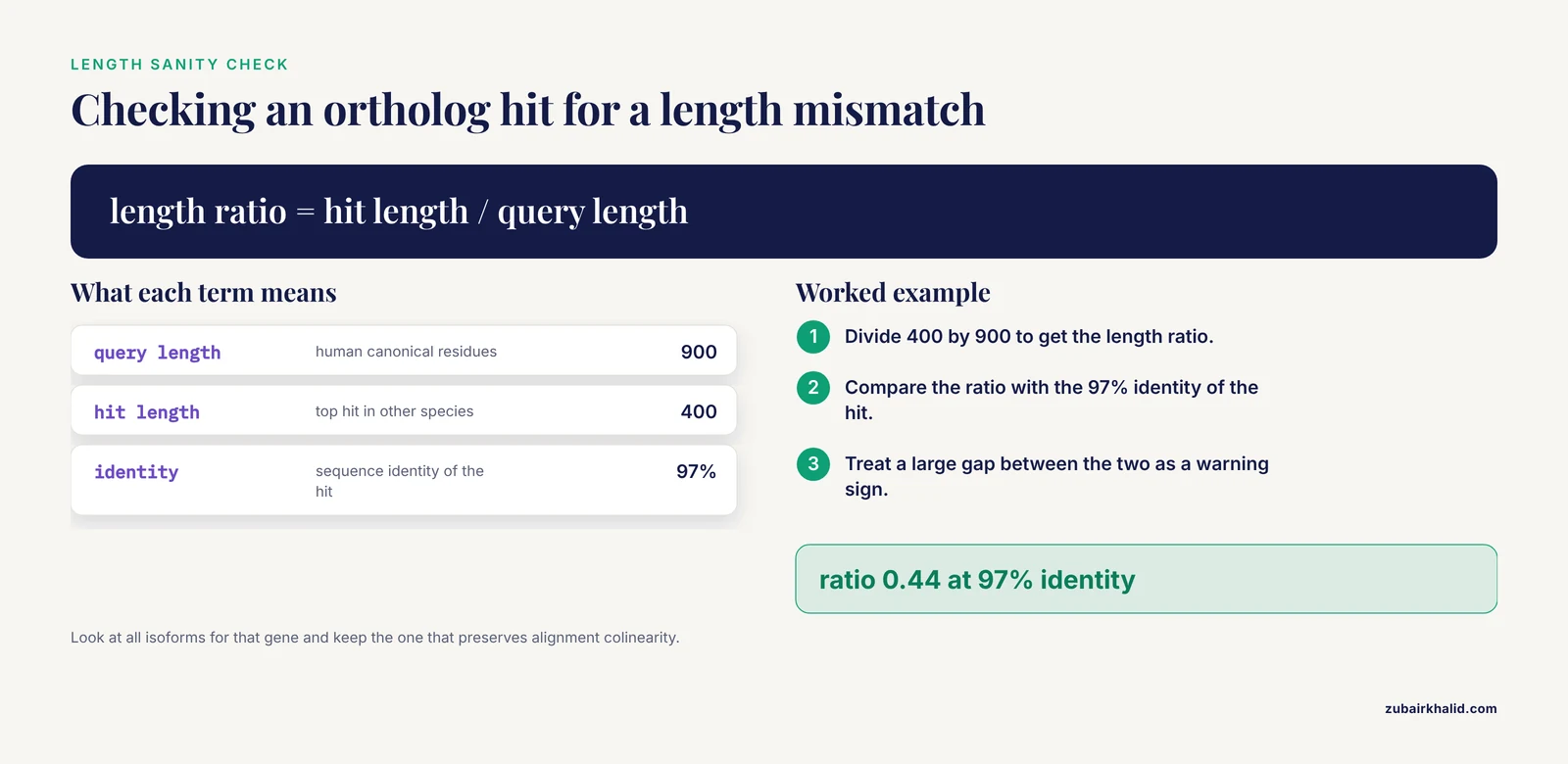
You want the ortholog of a human protein in eight other mammals. Download canonical sequences from each reference proteome, run your BLAST or HMM search, and sanity-check the length distribution of the hits. If your human query is 900 residues and the top hit in a species is 400 residues at 97% identity, do not accept it uncritically. That pattern matches the ortholog-length inconsistency documented in unreviewed canonical selections, and the correct response is to look at all isoform sequences for that gene in the hit species and choose the one that preserves alignment colinearity [1].
Scenario 4: Choosing a peptide for an antibody or targeted mass spectrometry assay
You need a peptide that identifies one isoform and not its siblings. Retrieve the canonical sequence and all isoforms, perform an in silico tryptic digest of every form, and select peptides present in the target isoform and absent from the others. If no such peptide exists, acknowledge that your assay measures a protein group, not a unique isoform, and design accordingly. The peptide unicity concept formalized in the UniProt search-space analysis is exactly this calculation, and doing it explicitly before ordering peptides saves expensive failures [2].
Scenario 5: Building a large-scale training dataset
You need several million nonredundant sequences for model training. Canonical sequences or UniRef50 give you manageable size and reduced redundancy. Be explicit in your methods section about which level you used, because a model trained on UniRef50 sees a different protein universe than one trained on UniRef100, and isoform-level diversity is deliberately collapsed at the lower identity thresholds.
Common Mistakes and Limitations
- Treating the isoform number as a rank of importance. Q9Y6K9-2 is not "the second most important form." Hyphenated numbers are identifiers, not expression rankings. Read the isoform descriptions and their evidence.
- Assuming the canonical sequence is the most abundant isoform. Canonical selection balances evidence quality, cross-species representation, and annotation completeness. Abundance in a given tissue is a separate question that UniProt cannot answer for you.
- Trusting TrEMBL canonical choices blindly. For unreviewed entries, the longest sequence in the gene-centric group becomes canonical, a rule that demonstrably produces biologically implausible length differences between highly identical orthologs [1]. Inspect the alternatives for any TrEMBL protein that matters to your conclusions.
- Expanding to all isoforms without updating your inference logic. Adding isoform sequences to a proteomics database without adjusting how you assign peptides to proteins produces protein groups you may not know how to interpret. Decide your shared-peptide policy before the search.
- Mixing release versions mid-project. Isoform sets grow and canonical choices are revised between releases, as the ortho2tree-driven changes between UniProt releases illustrate [1]. Freeze one release for a project and record it.
- Forgetting that isoform coordinates differ. A residue position 250 in the canonical sequence may be position 173 in an isoform that skips an early exon. Never transfer coordinates between isoforms without realigning.
- Assuming MANE Select is always the longest or best-studied isoform. It is the agreed default, not a superlative. Check the entry page when the distinction matters.
- Ignoring peptide evidence for unreviewed proteins. Mass spectrometry repositories contain observations that support the existence of predicted protein forms, and cross-checking your candidate isoforms against observed peptides is a fast reality check [2].
Individual genes and individual projects still require judgment that no single rule captures. When the stakes are high, examine the entry yourself rather than delegating the decision to a default.
Frequently Asked Questions
What is the difference between a canonical sequence and an isoform sequence in UniProt?
The canonical sequence is the single default representative for a UniProtKB entry, while isoform sequences are additional protein forms from the same gene, each labeled with a hyphenated accession such as P12345-2. Isoforms usually differ from the canonical form by specific exons, start sites, or stop sites.
How do I download all isoform sequences for a UniProt entry?
On the entry page, use the Download option and select FASTA with isoform sequences included, or query the REST API at rest.uniprot.org with the FASTA format and the appropriate fields. Isoform accessions appear with hyphenated suffixes so you can separate them from canonical entries in scripts.
Should I use the canonical sequence or MANE Select for human proteins?
Use MANE Select when your tooling supports it, because it is the agreed default sequence for each human gene across UniProt, RefSeq, and Ensembl. Use explicit isoform entries when your question concerns a splice form that MANE Select does not represent.
Does including all isoforms in a proteomics database search hurt results?
It can. Isoform expansion increases the search space and adds shared peptides that complicate protein inference, so report protein groups and require isoform-unique peptides when you claim isoform-level identifications. For gene-level quantification, canonical or reference-proteome searches remain simpler and defensible.
Why is the canonical sequence of an unreviewed UniProt entry sometimes the longest one, and does that matter?
For unreviewed TrEMBL sequences, the longest sequence in the gene-centric group is automatically chosen as canonical, and this rule can select orthologs with mismatched lengths across species. It matters whenever you compare canonical sequences across species or interpret length as biology.
How do I know which isoform my antibody, peptide, or primer will target?
Retrieve the canonical sequence and all annotated isoforms, align them, and check whether your target region is present in other isoforms. If the region is shared, your reagent targets a protein group rather than a single isoform, and you should either redesign or report it accordingly.