UniProt BLAST vs. NCBI BLAST: Which Should You Use
By Dr. Zubair Khalid, DVM, MS, PhD ·

UniProt BLAST searches protein databases built for annotation, so every hit arrives attached to curated function, while NCBI BLAST searches the broadest public collection of sequences, so it maximizes coverage and sensitivity. The working rule is simple. If your question is what a protein does, start with UniProt BLAST. If your question is whether anything anywhere resembles your sequence, start with NCBI BLAST. Most real projects use both, in that order.
The difference between UniProt BLAST and NCBI BLAST is not the alignment algorithm. Both services run the BLAST family of local similarity searches. The difference is what sits behind the search button, meaning which sequences are in scope, how redundant they are, and what each hit tells you after the alignment ends. This guide compares the two services on those terms, gives a side-by-side table, walks through worked scenarios, and closes with the mistakes that cost people the most time.
What BLAST Does Before the Comparison
BLAST stands for Basic Local Alignment Search Tool. It is a heuristic algorithm that finds short matching stretches between a query sequence and every sequence in a target database, extends those seed matches into local alignments, and scores the alignments for statistical significance. A few terms recur throughout this article, so here they are up front.
- Query: the sequence you submit.
- Subject or target: a database sequence aligned against your query.
- Hit: a query-subject alignment that passes the significance threshold.
- E-value: the number of alignments at least this good that you would expect to find by chance in a database of this size. Lower is more significant. An E-value of 0.001 means roughly one alignment of this quality per thousand searches of a database this size.
- Bit score: a normalized alignment score, higher is better, and comparable across searches of differently sized databases.
- Percent identity: the fraction of aligned residue positions that match exactly.
- Coverage: the fraction of the query spanned by the alignment.
Both UniProt and NCBI wrap the same core algorithm family. That is why the UniProt BLAST vs. NCBI BLAST decision is really a decision about databases, annotation, and workflow, and those are the criteria that follow.
UniProt BLAST: A Search Built Around Annotation
What sits behind UniProt BLAST
UniProt, the Universal Protein Resource, is a consortium resource for protein sequence and annotation data. Its knowledgebase, UniProtKB, has two sections. Swiss-Prot contains reviewed entries curated by biologists, with evidence-tagged function, Gene Ontology terms, keywords, domain descriptions, cross-references to other databases, and linked literature. TrEMBL contains unreviewed entries with computational annotation, and it captures most of the translated protein sequence space that flows in from sequencing projects. On top of UniProtKB sit the UniRef clusters, UniRef100, UniRef90, and UniRef50, which collapse identical or highly similar sequences at those identity thresholds so that one representative stands in for many near-duplicate entries.
The BLAST tool is one of four main tools at UniProt, alongside Align for multiple sequence alignment, Peptide Search for finding proteins that contain a short peptide, and Retrieve/ID Mapping for converting identifier lists between UniProt and external databases. The UniProt website receives about 800,000 unique visitors per month [1]. An earlier protocol from 2016 described three main tools and about 400,000 monthly visitors [2], so both the toolset and the audience have grown substantially in under a decade.
When to use UniProt BLAST
Reach for UniProt BLAST in these situations.
- You have a protein sequence and want to know what it does. Curated Swiss-Prot hits come with function, evidence, and literature attached.
- You want a hit list a human can actually read. Searching the reviewed subset returns a handful of high-confidence homologs instead of thousands of near-identical predicted proteins.
- You plan to move results into other resources. UniProt entries cross-reference PDB structures, Ensembl genes, RefSeq records, Pfam domains, and more, and Retrieve/ID Mapping converts a hit list into those identifiers in one step [1].
- You care about evidence quality. Reviewed entries label each annotation as experimental, inferred by curator, or predicted electronically, which tells you how much to trust the functional claim.
How to use UniProt, step by step
This mini UniProt database tutorial covers a standard first search.
- Open the BLAST tool at uniprot.org.
- Paste your sequence in FASTA format. Raw sequence also works, but FASTA headers keep your records tidy.
- Choose the target database. UniProtKB gives maximum annotation. UniRef50 gives the fastest, broadest sweep with the least redundancy. Swiss-Prot restricts results to reviewed entries only.
- Set the E-value cutoff and the number of target sequences to return. The defaults are reasonable for a first look.
- Run the search, then sort hits by bit score or E-value.
- Open the best hits and read the entry, not just the alignment. Check the annotated function, the evidence tags, the domain architecture, and the taxonomy.
- If you launched the search from a text search results page or from a basket of saved entries, the results inherit that context, which keeps related proteins together. The published UniProt protocols cover both of those routes alongside the main BLAST form [1].
For pipelines, UniProt provides programmatic access to BLAST and to Retrieve/ID Mapping, so batch annotation jobs can run without the web form [1].
NCBI BLAST: A Search Built Around Coverage
What NCBI BLAST searches
The National Center for Biotechnology Information hosts BLAST services over a far wider collection of data.
- nr: the large protein database, named non-redundant for historical reasons, which in practice contains many near-identical entries from different strains, isolates, and annotation pipelines.
- nt: the nucleotide collections.
- RefSeq: curated reference genomes, transcripts, and proteins.
- Genome and transcriptome assemblies: searchable per organism, so you can restrict a search to one species or clade.
- Specialized services: Primer-BLAST for PCR primer specificity, IgBLAST for immune receptor repertoires, and VecScreen for vector contamination.
The program types matter for the choice between services. blastp compares a protein query to a protein database. blastn compares nucleotide to nucleotide. blastx translates a nucleotide query in all six frames against a protein database. tblastn compares a protein query against a translated nucleotide database. tblastx compares translated queries to translated targets. NCBI also offers PSI-BLAST for iterative profile searching and bl2seq for direct two-sequence comparison [3].
A published hepatitis B virus study shows the two services working together in one workflow. The researchers extracted the viral protein X sequence from UniProt, then ran psi-blast and bl2seq through NCBI against a GenBank record to support a structural model built with threading and homology modeling tools [3]. That pattern, UniProt for the annotated starting point and NCBI for the broad sweep, recurs across the literature.
NCBI's strength is integration. It pulls together many types of biomolecular data and connects them through the Entrez system, so a BLAST hit links to taxonomy, genome browsers, Gene records, and PubMed, and Gene and BioProject pages serve as portals to external resources such as UniProt [4].
When to use NCBI BLAST
Choose NCBI BLAST in these situations.
- Your query is a nucleotide sequence. UniProt BLAST accepts protein queries only, so any DNA or RNA question starts at NCBI.
- You need maximum sensitivity against raw sequence space, including unreviewed, draft, and unpublished data that never reaches curated databases.
- You need organism-restricted searches, for example a protein against all mosquito sequences, or everything except a given clade.
- You need genomic context, such as flanking genes or conserved neighborhoods.
- You want iterative profile searching with PSI-BLAST to pull out remote homologs.
- You need a specialized search such as primer validation or vector screening.
UniProt BLAST vs. NCBI BLAST at a Glance
The table below is the core of the UniProt BLAST vs. NCBI BLAST comparison. The decisive rows are data type, annotation depth, and redundancy. Everything else follows from them.
| Criterion | UniProt BLAST | NCBI BLAST |
|---|---|---|
| Core question | What is this protein and what is known about it? | What else in sequence space resembles this sequence? |
| Data types accepted | Protein queries only | Nucleotide and protein, with translated searches in both directions |
| Databases | UniProtKB (Swiss-Prot and TrEMBL), UniRef100, UniRef90, UniRef50 | nr, nt, RefSeq, per-organism genome and transcriptome assemblies |
| Annotation returned | Curated function, GO terms, keywords, domains, cross-references, evidence tags, literature | Taxonomy, accession links, RefSeq annotation where present |
| Redundancy control | Preclustered UniRef views collapse near-identical sequences | nr contains many near-identical entries, taxonomy filters help navigate them |
| Iterative profiling | Not offered in the web tool | PSI-BLAST with position-specific scoring matrices |
| Identifier system | UniProt accessions, for example Q7Z3E2 | NCBI accessions, for example NM_018017 |
| Specialized searches | Standard protein BLAST, plus Align and Peptide Search tools | Primer-BLAST, IgBLAST, VecScreen, bl2seq, organism-restricted searches |
| Best for | Functional annotation, readable hit lists, identifier mapping | Exhaustive sensitivity, nucleotide queries, genomic context, clade-restricted sweeps |
| Typical next step | Retrieve/ID Mapping to convert hits into Ensembl, PDB, or gene identifiers | Follow links into Taxonomy, Genome, or Gene, or download hit sequences |
Read the table this way. UniProt answers the question a biologist usually has first, which is what the protein is and does. NCBI answers the question a biologist usually has second, which is what else is out there. The order matters because curated hits give you a hypothesis you can then test against the full sequence record.
The Databases Decide More Than the Algorithm
Redundancy is where the two services diverge most in practice. A search against nr returns clusters of near-identical entries from different strains and sequencing centers, and the sheer volume slows iterative searches and buries the informative hits. Reducing redundancy by similarity clustering improves both the speed and the sensitivity of iterative searches, which is why clustering tools built for databases the size of UniProt exist at all [5].
The numbers make the scale concrete. kClust clusters UniProt down to 20 to 30 percent maximum pairwise identity, runs two to three orders of magnitude faster than clustering based on NCBI BLAST, and achieves comparable sensitivity with a lower false discovery rate on multidomain sequences in that identity range [6]. MMseqs pushes further, clustering databases the size of UniProt down to roughly 30 percent identity at hundreds of times the speed of BLASTclust, and its search module is more sensitive and 4 to 30 times faster than UBLAST and RAPsearch while not quite reaching BLAST sensitivity [5]. UniRef is the same idea delivered as a maintained resource, and it is why a UniRef50 search at UniProt feels so much lighter than an nr search at NCBI.
For metagenome annotation, the database choice has direct consequences. A methods study on shellfish viral metagenomes compared BLAST, DIAMOND, and Taxonomer as annotation engines and compared NCBI nr against UniProt UniRef as reference databases, then proposed DIAMOND where computing resources and data transfer speed are limiting [7]. The lesson generalizes. The database defines the ceiling on what you can find, and the engine defines what you can afford to search.
One caution applies to clustered databases. A UniRef50 representative stands in for a cluster whose members can differ by up to 50 percent identity from each other, so your true closest match may hide inside a cluster whose representative looks more distant. For final claims about the single best homolog, search UniProtKB or nr directly.
Choosing by Task: Worked Scenarios
So, UniProt BLAST or NCBI BLAST first? The scenarios below answer that for common tasks.
Scenario 1: An unknown protein from a new transcriptome
You assembled a transcriptome from a non-model organism and one contig encodes a protein with no obvious relative. Run UniProt BLAST against UniProtKB first. If a reviewed Swiss-Prot entry hits with strong coverage, you have function, domains, and literature in one step. Then run blastp at NCBI against nr to see the full spread of homologs, including unreviewed sequences from related organisms. Reconcile the two views, and use Retrieve/ID Mapping to pull Ensembl or PDB identifiers for the hits you care about [1].
Scenario 2: A 16S rRNA amplicon for species identification
You sequenced a 16S rRNA gene and want to identify the organism. This is a nucleotide question, so NCBI blastn against the 16S ribosomal RNA database or nt, with organism filters, is the right tool. UniProt BLAST is the wrong instrument here because it searches proteins. The general rule is to match the molecule type to the service before you touch any parameters.
Scenario 3: Functional annotation of a viral metagenome
You have thousands of predicted proteins from a metagenome and need annotations. This is a scale problem, and the published comparison of BLAST, DIAMOND, and Taxonomer against nr and UniRef points to DIAMOND as the practical choice when computing resources and data transfer are constrained [7]. Run the fast engine against a reduced database for the bulk annotation, then confirm a subset of important hits with full BLAST against nr for maximum sensitivity.
Scenario 4: Allergen cross-reactivity
You want to know whether epitopes from inhalant allergens resemble food proteins linked to oral allergy syndrome. One published analysis assembled thousands of allergy epitopes from the Immune Epitope Database, compared them by BLAST to intact food protein sequences held in the protein database hosted at uniprot.org, and found high sequence similarity within mite, grass, and tree allergen classes [8]. The UniProt-hosted database worked as the annotation-rich target precisely because cross-reactivity questions need named, well-annotated proteins rather than raw contigs.
Scenario 5: Protein engineering and interaction modeling
You are planning site-directed mutagenesis or predicting interaction sites. HotSpot Wizard, a web server for identifying mutation hot spots in protein engineering, integrates data from RCSB PDB, UniProt, PDBSWS, Catalytic Site Atlas, and nr NCBI, and runs BLAST, CD-HIT, MUSCLE, and Rate4Site to rank residues by estimated mutability [9]. HOMCOS, a server for modeling protein complexes, runs BLAST to find homologous templates in a curated heterodimer structure set and then reports candidate interacting partners as UniProt entries homologous to the template proteins [10]. Both pipelines treat the two resources as complementary layers, NCBI for the search breadth and UniProt for the annotated identifiers that downstream steps consume.
Iterative Searches: PSI-BLAST and the Over-Extension Trap
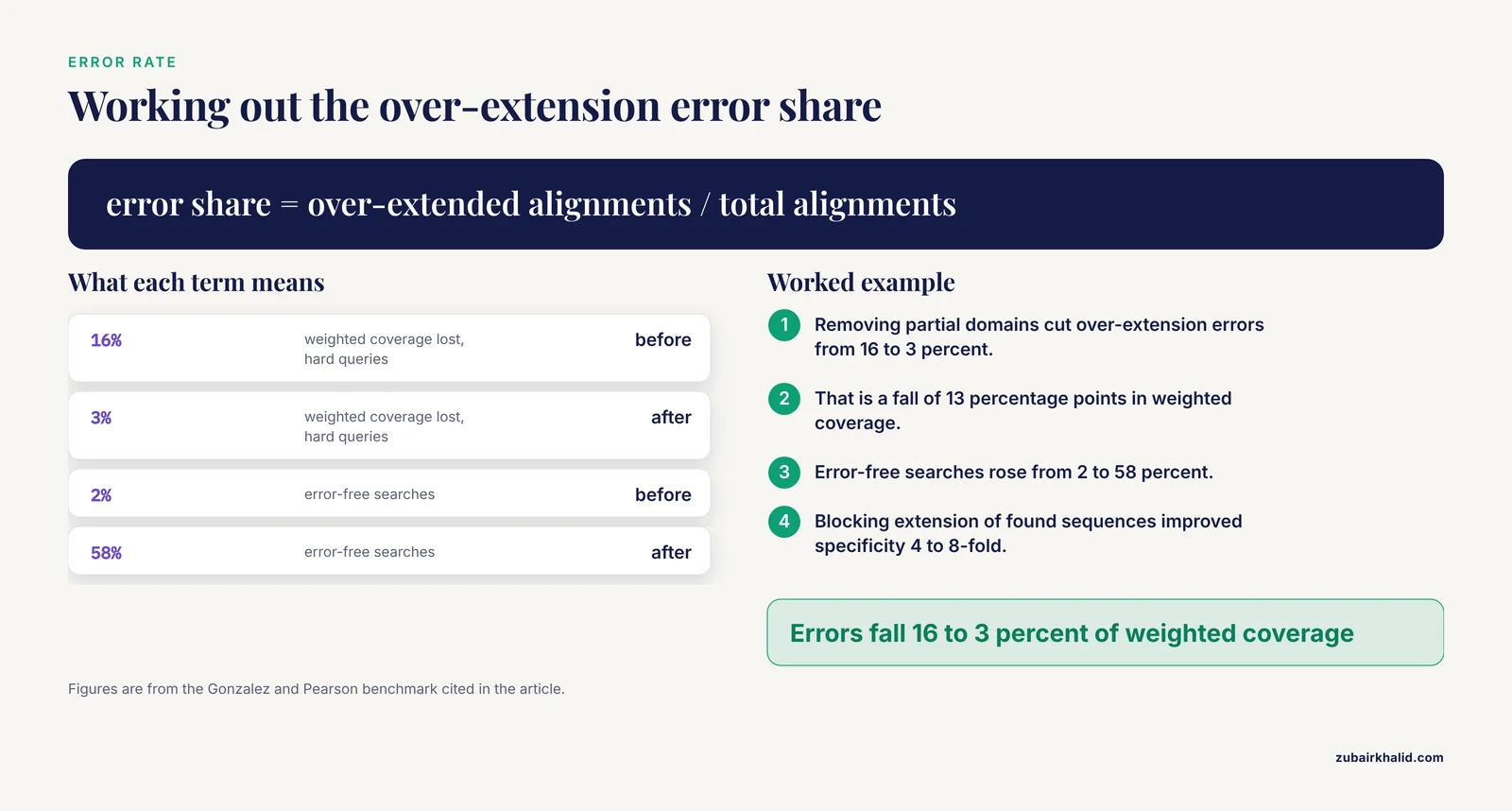
PSI-BLAST, available at NCBI, repeats a blastp search and folds significant hits into a position-specific scoring matrix, a profile that captures which positions in the alignment family are conserved and which tolerate substitutions. Each iteration sharpens sensitivity to remote homologs. Each iteration also compounds whatever errors the previous iteration accepted.
The main failure mode is homologous over-extension, documented in a benchmark by Gonzalez and Pearson. An alignment begins in a genuinely homologous region but extends beyond the homology into neighboring sequence, and if that neighboring region contains an unrelated domain, PSI-BLAST folds the unrelated sequence into its scoring matrix. The contaminated profile then pulls in non-homologous proteins with significant expectation values. Homologous over-extension accounts for the largest fraction of false positives, both initially and at iteration 5. In searches against complete protein sequences, 5 to 9 percent of alignments at iteration 5 are non-homologous. Removing partial domains from the library cut over-extension errors from 16 to 3 percent of weighted coverage on hard queries and raised the share of error-free searches from 2 to 58 percent, and simply preventing the extension of previously found sequences improved specificity 4 to 8-fold with little loss in sensitivity [11].
The practical rules follow directly. Inspect every alignment you accept, especially from the second iteration onward. Drop hits whose alignment extends into regions with no shared domain architecture. Limit the number of iterations rather than running to convergence. And remember that redundancy reduction helps here too, since clustered databases were motivated in part by the speed and sensitivity problems of iterative searches [5].
What You Get After the Search: Annotation and Its Limits
A hit list is not an answer. The value of UniProt BLAST shows up after the alignment, because each hit carries structured annotation you can aggregate. Function prediction servers are built on exactly this idea. Argot2.5 runs similarity searches against a clustered version of UniProt, weighs Pfam domain hits, and applies taxonomic constraints to filter out annotations that cannot apply to the species under study, outperforming a plain BLAST baseline in benchmarks [12]. PANDORA takes sets of proteins, often the output of BLAST searches, and builds a graph-based hierarchy over annotations drawn from Gene Ontology, UniProt Keywords, InterPro, Enzyme, SCOP, CATH, Gene-3D, and NCBI taxonomy, roughly 200,000 annotation terms associated with about 3.2 million UniProtKB sequences [13].
The limits are just as real. Classification schemes across databases often conflict, especially for poorly characterized proteins. ProGMap was built to expose exactly that problem, mapping a non-redundant set of over 6.6 million protein sequences to 240,000 protein group descriptions collected from UniProt, RefSeq, Ensembl, COG, KOG, OrthoMCL-DB, HomoloGene, TRIBES, and PIRSF, and it incorporates BLAST similarity search so users can check where a sequence sits relative to conflicting group definitions [14].
The rule for interpretation is to transfer function conservatively. Prefer reviewed Swiss-Prot hits with experimental evidence. Weight domain architecture and taxonomic distance alongside percent identity. Treat a single weak hit as a hypothesis, not a result.
Speed, Scale, and When to Leave the Web Forms
Web forms handle tens to thousands of queries comfortably. Beyond that, move to the command line. The NCBI BLAST+ toolkit installs locally and searches databases you build or download. A typical protein search looks like this.
blastp -query query_protein.fasta -db swissprot -evalue 1e-5 -outfmt "6 qseqid sseqid pident length evalue bitscore" -out hits.tsvThe -outfmt 6 flag produces tabular output that drops straight into a spreadsheet or a script. For custom targets, makeblastdb -in mydb.fasta -dbtype prot builds a database from your own sequences.
When even local BLAST is too slow, faster engines are standard practice. MMseqs2 offers near-BLAST sensitivity at a fraction of the runtime on large datasets [5]. DIAMOND is the common choice for metagenome-scale annotation under resource limits [7]. On the web side, SANSparallel returns immediate results against UniProt, UniRef90, UniRef50, Swiss-Prot, or PDB, with sensitivity comparable to BLAST above 50 percent sequence identity, and it can be used interactively or programmatically [15]. PairsDB takes a different approach entirely, storing precomputed BLAST and PSI-BLAST alignments covering all UniProt sequences so that similarity relationships can be retrieved instantly and filtered, for example to human proteins with solved structures and no transmembrane segments [16].
The decision rule is straightforward. Use the UniProt or NCBI web forms for interactive exploration and small batches. Use local BLAST+ for reproducible pipelines. Use MMseqs2 or DIAMOND when the query volume or database size makes BLAST itself the bottleneck.
Common Mistakes and Limitations
These are the errors that show up repeatedly in real projects.
- Sending the wrong molecule type. A nucleotide query submitted to a protein database returns nothing useful, and neither does the reverse. Match the program, blastp, blastn, blastx, or tblastn, to the data before you run anything.
- Reading UniRef representatives literally. A UniRef50 hit represents a cluster whose members can differ by up to 50 percent identity from one another. Confirm final best-homolog claims against UniProtKB or nr directly.
- Trusting the top line. A 95 percent identity hit over 30 residues says less than a 45 percent identity hit covering the entire protein. Judge E-value, bit score, alignment length, and coverage together, and look at the alignment itself.
- Mixing identifier systems. The same gene product can carry different accessions in different resources. The C10orf118 protein, for example, is reported with NCBI accession NM_018017 and UniProt identifier Q7Z3E2 in the same publication [17]. Map identifiers explicitly with a tool such as UniProt Retrieve/ID Mapping before joining datasets [1].
- Over-iterating PSI-BLAST. Errors compound with each iteration as questionable alignments fold into the profile. Inspect alignments at every step and cap the iteration count.
- Treating annotation as ground truth. Classification schemes across UniProt, RefSeq, Ensembl, COG, and other databases often conflict, particularly for poorly characterized proteins, which is precisely the problem ProGMap was designed to surface [14].
- Ignoring taxonomic distance. Functional annotation transfers reliably between close homologs and decays with evolutionary distance. Taxonomic constraints measurably improve function prediction pipelines [12], and the same logic should govern how you read your own hits.
- Forgetting small proteins. Proteins under 100 amino acids, and especially under 50, remain under-annotated across public databases, and functional descriptions are often missing even when potential homologs exist [18]. A weak hit for a small query may reflect the database, not the biology.
- Running large jobs through web forms. Web services are built for interactive use and throttle big batches. Move to local tools for genome-scale and metagenome-scale work [7].
- Failing to record the search context. Both services update continuously, so results are snapshots. Record the database, its version or release date, the program, and every parameter, or the search cannot be reproduced later.
One limitation frames all of the above. Sequence similarity is evidence, not proof, and no database search substitutes for expert interpretation. For conclusions that carry clinical, diagnostic, or regulatory weight, involve a specialist who can verify the primary evidence behind the annotations.
Frequently Asked Questions
Is UniProt BLAST a different algorithm from NCBI BLAST?
No. Both services run the BLAST family of local alignment algorithms. The practical difference between UniProt BLAST and NCBI BLAST comes from the databases searched and the annotation attached to the results, not from the mathematics of the alignment.
When should I use UniProt BLAST instead of NCBI BLAST?
Use UniProt BLAST when your query is a protein and your goal is functional annotation, curated hits, or identifier mapping. Start there for most protein questions, then sweep NCBI against nr when you need exhaustive coverage or unreviewed sequence space.
Can I search a nucleotide sequence with UniProt BLAST?
No. UniProt BLAST accepts protein queries and searches protein databases. For DNA or RNA questions, use NCBI blastn, blastx, or tblastn, which handle nucleotide queries and translated searches directly.
What is the difference between Swiss-Prot, TrEMBL, and UniRef?
Swiss-Prot is the manually reviewed section of UniProtKB with evidence-tagged curation. TrEMBL is the larger, computationally annotated section awaiting full review. UniRef clusters collapse redundant sequences at 100, 90, or 50 percent identity so that searches run faster and hit lists stay readable.
Which service and database should I cite in a paper?
Cite the database you actually searched, its version or release date, the program, and the parameters. Both services expect users to cite the underlying database resources, and reviewers increasingly expect the search context to be complete enough for reproduction.
Can I run these searches in a pipeline instead of a web form?
Yes. NCBI distributes the BLAST+ command-line tools for local searches against downloaded or custom databases, and UniProt offers programmatic access to BLAST and Retrieve/ID Mapping for batch jobs. For very large workloads, faster engines such as MMseqs2 or DIAMOND are the standard choice.
Sources
- UniProt Tools: BLAST, Align, Peptide Search, and ID Mapping.
- UniProt Tools.
- Protein-x of hepatitis B virus in interaction with CCAAT/enhancer-binding protein α (C/EBPα)--an in silico analysis approach.
- Fungal genome resources at NCBI.
- MMseqs software suite for fast and deep clustering and searching of large protein sequence sets.
- kClust: fast and sensitive clustering of large protein sequence databases.
- Comparison of methods for library construction and short read annotation of shellfish viral metagenomes.
- Allergen cross-reactivity in allergic rhinitis and oral-allergy syndrome: a bioinformatic protein sequence analysis.
- HotSpot Wizard: a web server for identification of hot spots in protein engineering.
- HOMCOS: a server to predict interacting protein pairs and interacting sites by homology modeling of complex structures.
- Homologous over-extension: a challenge for iterative similarity searches.
- Enhancing protein function prediction with taxonomic constraints--The Argot2.5 web server.
- PANDORA: analysis of protein and peptide sets through the hierarchical integration of annotations.
- ProGMap: an integrated annotation resource for protein orthology.
- SANSparallel: interactive homology search against Uniprot.
- PairsDB atlas of protein sequence space.
- The Secreted Protein C10orf118 Is a New Regulator of Hyaluronan Synthesis Involved in Tumour-Stroma Cross-Talk.
- sORFdb - a database for sORFs, small proteins, and small protein families in bacteria.