Interpreting UniProt BLAST Results
By Dr. Zubair Khalid, DVM, MS, PhD ·

Interpreting UniProt BLAST results means reading the ranked list of matching proteins produced by the BLAST tool on the UniProt website and deciding which hits represent true biological relationships rather than statistical noise. A sound interpretation weighs the expectation value, alignment coverage, percent identity, and the curated annotation of each hit against the biological question you started with.
This skill matters because a BLAST search is often the first and sometimes the only computational evidence a researcher has for what an uncharacterized protein does. UniProt is the comprehensive resource for protein sequence and annotation data, and its BLAST tool is one of the four main tools the site provides, alongside Align, Peptide Search, and Retrieve/ID Mapping [1]. The site receives roughly 800,000 unique visitors per month, and the web interface is the primary way people access the data [1], so the interpretation habits formed on the UniProt BLAST page shape conclusions across molecular biology, clinical research, and biotechnology. Reading those results carelessly leads to misannotated proteins, wrong functional claims, and wasted experiments. Reading them well turns a table of numbers into a defensible statement about homology, domain architecture, and probable function.
What the UniProt BLAST Tool Actually Does
BLAST, the Basic Local Alignment Search Tool, finds locally similar regions between your query sequence and every sequence in the database you select. "Local" means the algorithm does not force the two sequences to align end to end. It looks for shorter stretches of similarity, called high-scoring segment pairs, and then extends and scores them. This design is what allows BLAST to detect a shared kinase domain between two proteins whose termini have nothing in common.
When you submit a job through the UniProt BLAST tool, several things happen behind the interface [1][2]:
- Your input, which can be a raw sequence in FASTA format, an accession number, or a sequence identifier, is validated and formatted as a query.
- You choose a target database, for example UniProtKB reviewed (Swiss-Prot), UniProtKB (the full knowledgebase including TrEMBL), or a UniRef cluster database.
- The search engine scans the database for word or k-mer matches to your query, extends those seeds into local alignments, and computes an alignment score for each.
- Raw scores are converted into normalized bit scores and into an expectation value (E-value), which estimates how many alignments with a score at least this good you would expect to see by chance in a database of this size.
- Hits are ranked, typically by E-value, and returned with pairwise alignments, links to UniProt entries, and downloadable output.
The E-value deserves special attention because it is the number most people misread. An E-value of 0.001 means you would expect roughly one alignment this good purely by chance in a database of the size searched. Smaller is better, and the value depends on database size, so the same alignment can show a different E-value when searched against different databases. The bit score is normalized so that it is comparable across searches. A hit with a bit score above roughly 50 and an E-value well below 0.01 usually deserves a close look, while the exact thresholds you accept should depend on query length and the biology of your question, a point covered in detail below.
Running a Search on UniProt: A Practical Workflow
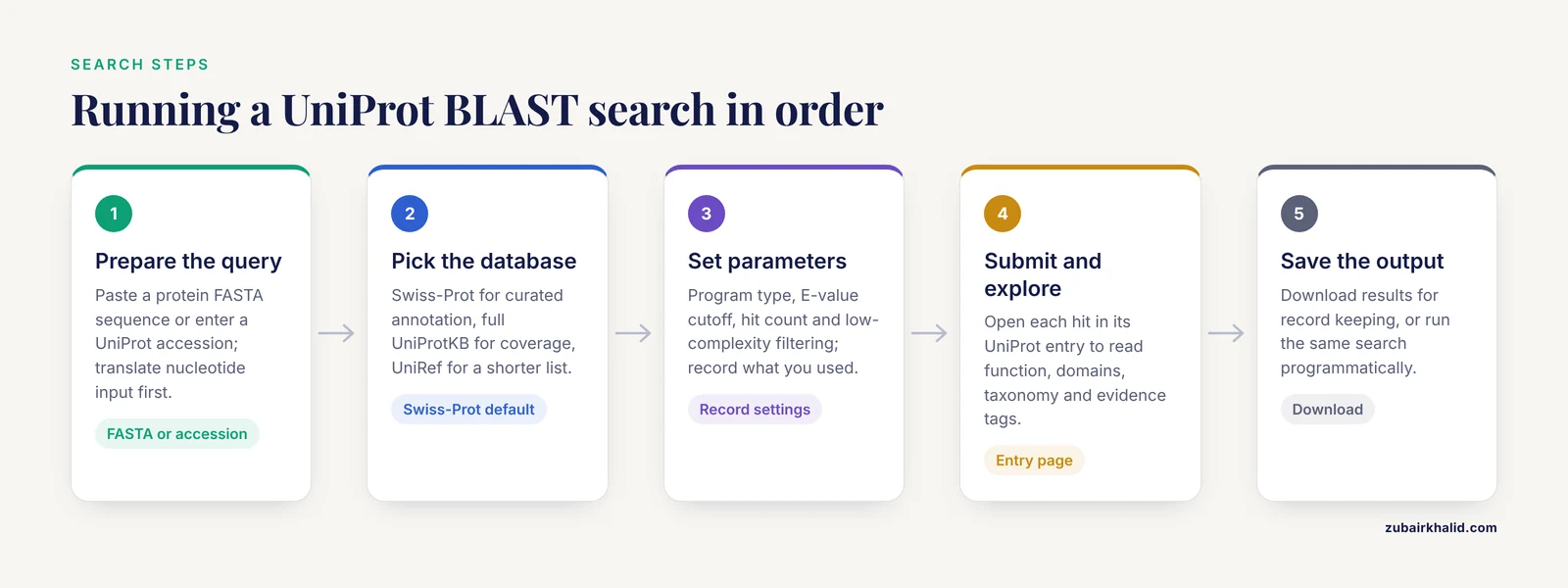
For readers looking for a UniProt database tutorial in compressed form, the basic BLAST protocol on the UniProt site follows a repeatable sequence of steps [1].
Step 1. Prepare your query. Paste a protein sequence in FASTA format (a line beginning with ">" followed by a name, then the amino acid sequence) or enter an existing UniProt accession. If your starting point is a nucleotide sequence, translate the open reading frame first, because the UniProt BLAST interface compares protein sequences to protein databases.
Step 2. Choose the target database deliberately. This choice changes what your results mean, and it is covered in its own section below. A quick default for functional interpretation is UniProtKB reviewed (Swiss-Prot), because every entry there carries curator-reviewed annotation with evidence tags.
Step 3. Set parameters or accept the defaults. The interface exposes the program type (protein to protein BLASTP by default, with PSI-BLAST for iterative profile searches), an E-value cutoff, the number of hits to display, and filtering options such as removing low-complexity regions. For a first pass, the defaults are reasonable. For a publication-grade analysis, record every parameter you used, because reproducibility depends on it.
Step 4. Submit and wait. Jobs against the full UniProtKB take longer than searches against the reviewed subset. The results page shows progress and then presents the hit list.
Step 5. Explore the results interactively. Each hit links to its full UniProt entry, where you can inspect function statements, Gene Ontology terms, domain annotations from sources such as Pfam and PROSITE, taxonomy, cross-references to structures in the Protein Data Bank, and literature. The UniProt entry page is where interpretation actually happens, because the BLAST table alone never tells you whether an alignment is biologically meaningful.
Step 6. Save your output. The interface lets you download results, which you should do both for record keeping and for downstream scripting. UniProt also supports programmatic access, so the same search can be run in an automated pipeline rather than through the web form [1][3].
The UniProt site also supports entry points beyond the main BLAST form. You can launch a BLAST from a text search results page or from the UniProt basket, which is useful when you want to search against a specific preselected subset of proteins [1].
Reading the Results Table Field by Field
The UniProt BLAST results page presents a summary graphic and a table of hits. Interpreting UniProt BLAST results explained at the level of individual columns looks like this.
E-value (Expect). The expected number of chance alignments with a score at least this good. Values approaching zero, displayed as 0.0 for extremely strong hits, indicate alignments that are very unlikely to arise by chance. E-values degrade as the database grows, which is one reason two searches of the same query against Swiss-Prot and full UniProtKB can rank a hit differently.
Bit score. A normalized score, reported in bits, that accounts for the scoring matrix and gap penalties. Bit scores are more comparable across searches than raw scores or E-values. When two hits from different searches have similar bit scores, they represent alignments of similar statistical strength.
Percent identity. The fraction of aligned residue positions holding identical amino acids. High identity over a short stretch can be less informative than moderate identity over a long alignment, which is why identity should never be read alone.
Alignment length and coverage. The number of residues in the aligned region, often shown both for the query and the subject. Coverage, the fraction of the query (or subject) included in the alignment, separates two very different situations. A hit covering 95 percent of your query suggests a full-length homolog. A hit covering 30 percent of the query suggests you have matched a single domain, which may still be real and useful, but it is not evidence that the whole proteins are related.
Gaps and mismatches. The table and the alignment view report gaps, which reflect insertions and deletions over evolutionary time or artifacts of aligning divergent sequences. Long insertions in the subject relative to the query often mean the subject carries an extra domain your query lacks.
A compact reference for the columns follows.
| Field | What it measures | How to read it |
|---|---|---|
| E-value | Chance expectation of a score this good in this database | Smaller is more significant, and values scale with database size |
| Bit score | Normalized alignment quality | Larger is better, comparable across searches |
| Percent identity | Identical residues in the aligned region | Meaningful only together with alignment length |
| Coverage | Fraction of query or subject aligned | High query coverage suggests full-length homology, low coverage suggests a domain-level match |
| Gaps | Insertions and deletions in the alignment | Many gaps can signal domain differences or alignment artifacts |
Two terms that students most often confuse in this table are homology and similarity. Sequences are similar or not, as a measurable property. Homology means descent from a common ancestor, which is an inference you draw from strong similarity combined with length, architecture, and context, not something the percent identity column can prove by itself. A related confusion is between orthologs, genes in different species that diverged after a speciation event, and paralogs, genes related by a duplication event within a genome. A high-scoring hit can be either, and assuming orthology from a BLAST ranking alone has produced real errors in the literature, including a documented case in zebrafish where a gene once treated as the TCOF1 ortholog was later shown to be a paralog of NOLC1, with BLAST searches across teleost genomes required to resolve the relationship [4].
Inspecting the Alignment Itself
The numbers in the table decide which hits deserve inspection. The alignment view decides what those hits mean. When you expand a hit, check four things.
Where the alignment starts and ends. Map the aligned block onto the domain architecture shown on the UniProt entry page. If your query aligns to the catalytic kinase domain of the subject but the subject carries large additional regions with no alignment, say precisely that in your conclusions. Domain-level matches are the normal and expected outcome of BLAST against multidomain proteins.
The distribution of identities. A run of identical residues clustered at one end with divergence elsewhere can indicate a conserved motif inside an otherwise unrelated sequence. Conserved catalytic residues, for example the nucleotide-binding motifs of kinases, carry more functional weight per residue than scattered identity elsewhere.
Low-complexity and repetitive regions. Segments rich in a single residue type, such as polyglutamine tracts or serine-rich runs, produce spurious high-scoring alignments between unrelated proteins. The BLAST interface offers filtering for low-complexity sequence, and if a hit depends entirely on a low-complexity segment, treat it with suspicion. This is a classic false positive mechanism.
Gap structure. A single large gap in the middle of an alignment usually reflects a missing or inserted domain. A scatter of single-residue gaps across an otherwise good alignment can indicate that the scoring parameters are fighting a genuinely divergent but homologous pair.
Large, repetitive, and low-complexity proteins test all of these checks at once. The TCOF1 and NOLC1 case mentioned above involved exactly this problem, because those large proteins contain unstructured and repetitive regions that complicate alignments and comparisons [4]. The lesson generalizes. When your query or your hits are repetitive, the alignment view and the domain annotations deserve more weight than the raw ranking.
Choosing the Right Database: UniProtKB, Swiss-Prot, TrEMBL, and UniRef
The database selector changes both the sensitivity and the interpretability of results.
UniProtKB reviewed (Swiss-Prot). A curated set in which entries carry reviewed annotation, evidence codes, and standardized names. Searches here return fewer hits, but every hit comes with interpretation-ready annotation. This is the best default when your goal is functional inference.
UniProtKB (including TrEMBL). The full knowledgebase, including computationally annotated entries. Sensitivity is higher and the hit list is longer, but many hits are themselves predictions, so a match to a TrEMBL entry annotated "predicted" carries weaker evidence than a match to a reviewed entry. Annotation errors can also propagate this way, a theme that recurs in the literature on automated function transfer [5][6].
UniRef100, UniRef90, and UniRef50. Clustered databases that merge sequences at 100, 90, and 50 percent identity thresholds. Searching UniRef50 returns one representative per cluster, which shortens the hit list dramatically and speeds the search, at the cost of hiding near-identical sequences behind a cluster representative. Clustered representations improve the speed and sensitivity of large searches and make iterative searching more efficient [7][8].
Redundancy is a practical interpretive problem, not just a cosmetic one. Sequence databases grow quickly and contain many near-identical proteins, especially from well-sampled species and from mass sequencing projects. A hit list dominated by dozens of copies of essentially the same protein is harder to read and biases iterative searches. Clustering tools such as kClust can reduce UniProt-scale databases to 20 to 30 percent maximum pairwise identity, and clustering at that depth achieves comparable sensitivity with a lower false discovery rate on multidomain sequences than clustering at higher identity thresholds [8]. MMseqs can cluster such databases down to about 30 percent sequence identity and searches them far faster than earlier alternatives, although it does not fully reach BLAST sensitivity [7]. On the UniProt website, the practical consequence is simple. Search Swiss-Prot or a UniRef database first for a clean interpretable picture, then search full UniProtKB when you need comprehensiveness, for example to check whether your protein has close relatives in a poorly sampled lineage.
Alternatives exist for cases where the standard BLAST interface is too slow for interactive work. SANSparallel provides near-instant searches against UniProt and UniRef databases using a suffix array method, with sensitivity comparable to BLAST above 50 percent sequence identity, and it presents stacked alignments for direct inspection [9]. Precomputed services such as PairsDB, which stored BLAST and PSI-BLAST alignments among UniProt sequences for instant retrieval, served the same goal of making similarity relationships explorable without repeated computation [10]. EMBL-EBI offers its own BLAST service against UniProt and other databases through a unified interface at its sequence similarity search tools site [3]. Knowing these options matters when your workflow requires many searches, but the interpretation principles below are identical across them.
From Hits to Function: How Far Can You Push the Inference?
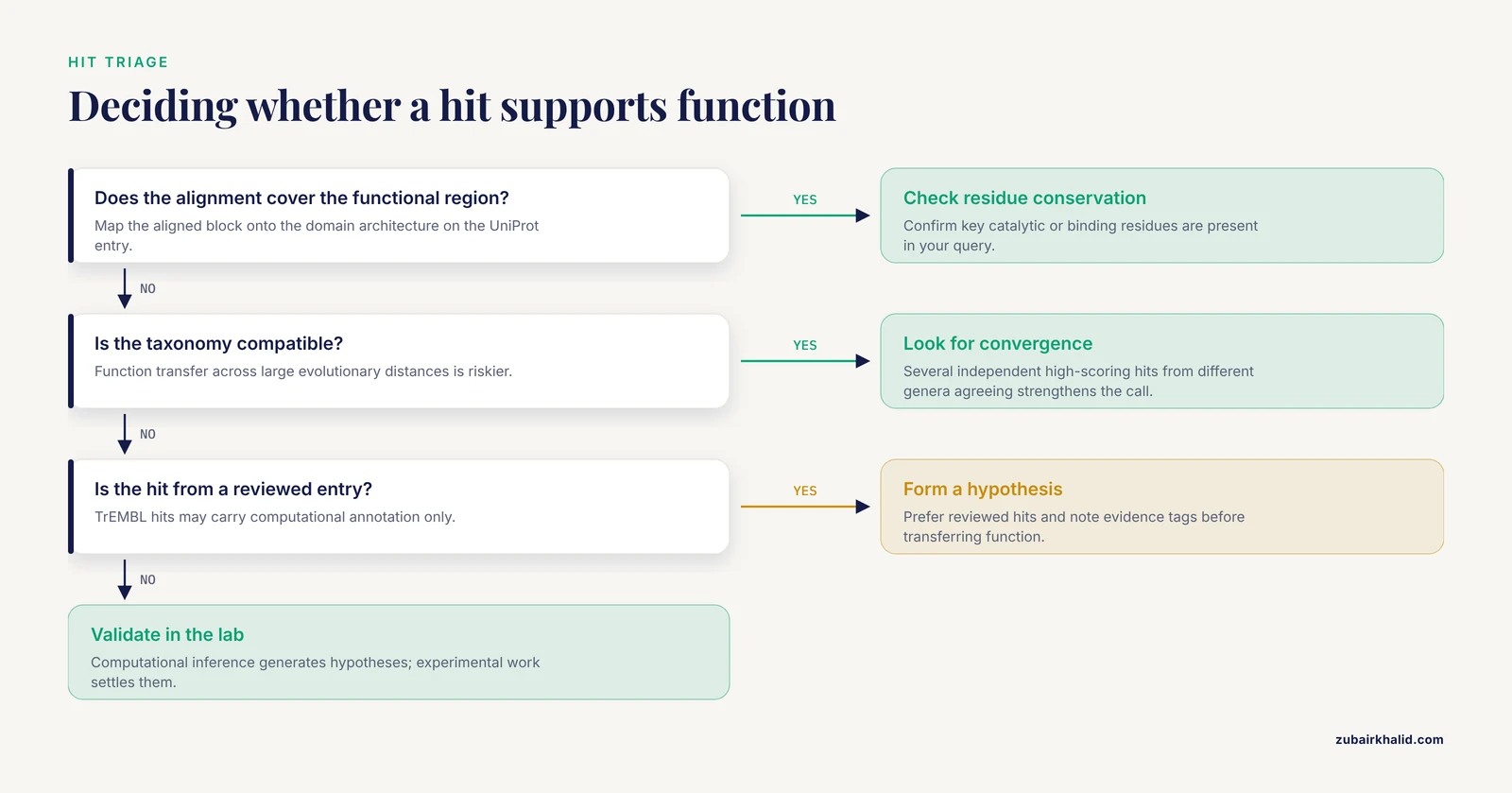
The most common reason researchers run UniProt BLAST is functional inference for an uncharacterized protein. The results table does not hand you a function. It hands you candidates whose annotation you evaluate.
The defensible chain of reasoning runs as follows. First, confirm that the alignment covers the same functional region in both proteins, not just an isolated conserved segment. Second, check that the key residues responsible for the annotated activity are conserved in your query, which you verify by looking at the feature table and domain annotations on the UniProt entry. Third, check the taxonomy of the hits. Function transfer across large evolutionary distances is riskier, and taxonomic constraints on annotation transfer measurably improve prediction quality, a principle implemented in tools such as Argot2.5, which applies taxonomic rules to filter out annotations that cannot apply to the species under investigation [5]. Fourth, look for convergent evidence. If several independent high-scoring hits from different genera share the same annotated function, the inference is stronger than one built on a single match, even a strong single match.
Database curation quality varies, and your interpretation should account for it. Resources such as ProGMap were built precisely because different classification schemes often provide conflicting annotations for poorly characterized proteins, and because assessing the coherence of protein groups helps annotators and users judge new annotations [11]. When your top hits disagree about function, for example when one curated entry says kinase and several automated entries say something broader, the conflict itself is information. It tells you the annotation is not settled.
A related and underappreciated use of UniProt BLAST results is the negative result. If a search against reviewed Swiss-Prot returns only low-scoring, short alignments, that is evidence your protein is not a member of any well-characterized family, which redirects the analysis toward tools such as HMMER searches against profile databases or structure prediction. Many small bacterial proteins under about 50 amino acids fall into exactly this category, where few known homologs exist and functional descriptions are often missing despite detectable sequence relatives [12].
Iterative Searches, PSI-BLAST, and the Over-Extension Trap
UniProt BLAST offers PSI-BLAST, Position-Specific Iterated BLAST, which builds a position-specific scoring matrix from the hits of the first search and re-searches the database with that profile, typically finding remote homologs a single search misses. The power is real, and so is a specific failure mode documented in detail by Gonzalez and Pearson.
Their study of homologous over-extension (HOE) showed that PSI-BLAST alignments can begin in a genuinely homologous region and then extend beyond the boundary of homology into neighboring sequence [13]. When the neighboring region contains a non-homologous domain, the corrupted alignment gets incorporated into the profile, and the matrix then retrieves unrelated proteins with significant expectation values. HOE accounted for the largest fraction of initial false positive errors and remained the largest contributor at iteration five. Against complete protein sequences, 5 to 9 percent of alignments at iteration five were non-homologous [13]. The errors concentrated in partial domains. Removing partial domains from the library cut HOE errors from 16 percent to 3 percent of weighted coverage on hard queries, and from 35 percent to 5 percent on sampled queries, while no-error searches rose from 2 percent to 58 percent of weighted coverage for hard queries [13]. Preventing extension of previously found sequences improved specificity 4 to 8-fold with little sensitivity loss [13].
For someone clicking through the UniProt BLAST interface, the practical translation is this. Inspect every alignment you accept into an iterative round, and reject any hit whose aligned region spills past the boundaries of the domain you actually care about. After iteration two or three, stop scanning the hit list by E-value alone and scan by domain boundaries. If your query contains a single domain fused to unrelated regions, restrict your attention to the region that is truly conserved. The general lesson extends beyond PSI-BLAST. Any similarity search can return alignments that are locally real and globally misleading, and the alignment view is the only place where that distinction is visible.
Worked Examples from the Literature
Concrete cases make the interpretation rules stick, and the published literature contains several instructive ones.
Viral protease cleavage site screening. A study of short stretches of homologous host pathogen sequences spanning viral protease cleavage sites used PHI-BLAST, a variant that constrains the search to alignments containing a user-defined pattern, together with the UniProt database to attach Gene Ontology terms and disease relationships to candidate host targets [14]. Searching the human proteome for roughly 20 amino acid cleavage-like motifs produced candidate substrates for nine neuroinvasive viruses, and the workflow converged on a common predicted target, the adhesion G protein-coupled receptor ADGRA2. The authors then validated cleavage experimentally for several predictions. The interpretive lesson is that pattern-constrained searching changes the meaning of a hit list, because every hit satisfies the pattern by construction, and the ranking then reflects flanking similarity.
Viral protein function modeling. An analysis of the Hepatitis B virus protein-x began by retrieving the sequence from UniProt and running psi-BLAST and bl2seq similarity searches before threading and homology modeling of its interaction with the transcription factor C/EBPα [15]. Here the BLAST result served a narrow, well-defined purpose, establishing which characterized proteins share detectable similarity, and the functional model was built on that scaffolding rather than on annotation transfer alone.
Allergen cross-reactivity. A bioinformatic analysis of allergic rhinitis and oral allergy syndrome assembled known allergy epitopes from the Immune Epitope Database for common inhalant allergens and compared them, and intact food protein sequences from UniProt, using BLAST-based algorithms with exact matching, gaps, and conservative substitutions, then built a phylogenetic tree of relationships [16]. Twenty-three inhalant allergens contributed 4,429 unique epitopes, and 19 implicated foods contributed 9,497 protein sequences, with high similarity found among mites, grasses, and trees [16]. The interpretive point is that the biological question defined the analysis. Cross-reactivity depends on shared epitope segments, so short, local alignments were the biologically relevant unit, not whole-protein matches, and the phylogenetic framing helped separate cross-class similarity from chance matches.
High-throughput annotation pipelines. When microarray reporters needed functional annotation, one study BLASTed reporter sequences against a species-specific subset crosslinked to curated UniProt entries, filtered the alignments with strict quality criteria, and combined that with a second route through EnsEMBL, raising the fraction of reporters linkable to Gene Ontology terms from 32.7 percent to 58.3 percent on one platform [17]. The interpretation lesson is that "high quality alignment" was an explicit, predefined filter, not an afterthought, and that combining independent evidence routes beat either alone.
Venom transcriptomics quality control. A proteomic comparison of centipede venom profiles against four transcriptomic toxin annotation approaches, including BLAST searches against toxins in UniProt, showed that even lineage-specific homology searches are prone to substantial annotation errors, and that adding comparative transcriptomics and phylogenetic analysis of toxin families improved accuracy considerably [6]. When your BLAST-derived annotation feeds a paper, this result is a caution worth internalizing. Sequence similarity is evidence, not proof, and orthogonal data can overturn it.
Common Mistakes and Limitations
The recurring errors in interpreting UniProt BLAST results are predictable, which makes them avoidable.
Trusting the E-value alone. A tiny E-value on a 40-residue alignment between two low-complexity regions is weaker evidence than a moderate E-value on a 300-residue alignment with conserved catalytic residues. Always read the alignment.
Equating the top hit with the right answer. The top hit is the best-scoring sequence in the database you searched, not necessarily the closest evolutionary relative or the best functional model. A truncated or fragmentary entry can outrank the true full-length homolog. Scan several hits, and check whether the top region of the list is dominated by redundant near-identical sequences.
Confusing identity with coverage. Ninety percent identity over 60 amino acids is a motif match. Ninety percent identity over 900 amino acids is strong evidence of close homology. Report both numbers together.
Assuming the top hit is an ortholog. Paralogs within the same proteome often outrank true orthologs, especially after lineage-specific duplications. The zebrafish TCOF1 versus NOLC1 case, where a BLAST-identified candidate turned out to be a paralog lacking essential functional features, is a clear published example [4]. Orthology claims need reciprocal searches or phylogenetic analysis, not a single ranked list.
Carrying annotation errors forward. Transferring function from a TrEMBL entry whose annotation is itself computational creates chains of inference with no experimental anchor. Prefer reviewed hits, check evidence tags on the UniProt entry, and note when several hits only agree because they derive from the same automated pipeline.
Ignoring domain boundaries in iterative searches. As described above, homologous over-extension corrupts PSI-BLAST profiles when alignments extend past true homology, and this mechanism drives a substantial share of false positives at later iterations [13].
Overlooking database and parameter choices in reporting. A result is not reproducible unless the database version, database choice, program, and parameters are stated. UniProtKB changes continuously, so a search run today is not identical to one run last year.
Treating a computational annotation as an experimental conclusion. The centipede venom study demonstrated that proteomic data could contradict BLAST-based annotation built from transcriptomes [6]. Computational inference generates hypotheses. Experimental work settles them. Any individual research conclusion built on BLAST interpretation should be validated in the laboratory before it is treated as fact.
Quick Review
- The E-value estimates how many alignments that good you would expect by chance in the database searched. Smaller is stronger, and database size matters.
- Percent identity without alignment length and coverage is meaningless. Report all three.
- High query coverage suggests a full-length homolog. Low coverage usually means a single domain matched.
- Search Swiss-Prot for interpretable curated hits, full UniProtKB for comprehensiveness, and UniRef clusters for speed and a shorter hit list.
- The UniProt entry page, with its domains, features, taxonomy, and evidence tags, is where real interpretation happens.
- PSI-BLAST finds remote homologs but introduces homologous over-extension errors when alignments extend beyond true homology, so inspect every alignment before accepting it into a profile [13].
- A BLAST hit supports a hypothesis about homology and function. Orthology, function, and biological role need additional evidence.
Frequently Asked Questions
What does an E-value mean in UniProt BLAST results?
The E-value is the expected number of alignments with at least that score that you would find by chance in a database of the size searched. An E-value of 1e-5 means roughly one such alignment per 100,000 chance events. Lower values indicate stronger evidence, but the number must be read together with alignment length, coverage, and biological context.
Is there a universal E-value cutoff I should use?
No. There is no single defensible threshold, because the meaning of a given E-value depends on query length, database size, and the evolutionary distance your question requires. Very strong hits can be recognized confidently, but borderline hits should be judged by inspecting the alignment, domain architecture, and annotation directly rather than by a fixed numeric cutoff.
Should I search UniProtKB or Swiss-Prot first?
For functional interpretation, start with Swiss-Prot, the reviewed subset of UniProtKB, because every hit there carries curator-checked annotation with explicit evidence. Then search full UniProtKB if you need to detect relatives outside the reviewed set, for example in poorly sequenced lineages. Record which database and version you used either way.
Can I assign a protein function based on a single BLAST hit?
You can form a hypothesis, but not a defensible assignment. Sound practice requires the alignment to cover the relevant functional region, the key catalytic or binding residues to be conserved, the taxonomy to be compatible with the transferred annotation, and ideally multiple independent hits to agree. Published benchmarks show that annotation transfer based purely on sequence similarity produces real errors, and that adding taxonomic constraints and convergent evidence improves accuracy [5].
Why do my results differ when I search against different UniProt databases?
Database composition changes both the E-values and the ranking, since E-values scale with database size and a larger database can contain better-scoring matches. Searches against UniRef cluster databases also return one representative per cluster rather than every sequence, which changes the apparent hit list while preserving the underlying relationships. Compare results across databases with bit scores, which are normalized, rather than raw E-values.
How do I reproduce or automate a UniProt BLAST search?
Record the query accession, target database, program, all parameter settings, and the database release, then download the output so the exact result set is archived. For repeated or scripted analyses, use programmatic access to UniProt or to equivalent services such as the EMBL-EBI sequence similarity search interface, which exposes BLAST and other tools over web services for pipeline integration [1][3].
Sources
- UniProt Tools: BLAST, Align, Peptide Search, and ID Mapping.
- UniProt Tools.
- A new bioinformatics analysis tools framework at EMBL-EBI.
- Untangling Zebrafish Genetic Annotation: Addressing Complexities and Nomenclature Issues in Orthologous Evaluation of TCOF1 and NOLC1.
- Enhancing protein function prediction with taxonomic constraints--The Argot2.5 web server.
- True Lies: Using Proteomics to Assess the Accuracy of Transcriptome-Based Venomics in Centipedes Uncovers False Positives and Reveals Startling Intraspecific Variation in Scolopendra Subspinipes.
- MMseqs software suite for fast and deep clustering and searching of large protein sequence sets.
- kClust: fast and sensitive clustering of large protein sequence databases.
- SANSparallel: interactive homology search against Uniprot.
- PairsDB atlas of protein sequence space.
- ProGMap: an integrated annotation resource for protein orthology.
- sORFdb - a database for sORFs, small proteins, and small protein families in bacteria.
- Homologous over-extension: a challenge for iterative similarity searches.
- Automated SSHHPS Analysis Predicts a Potential Host Protein Target Common to Several Neuroinvasive (+)ssRNA Viruses.
- Protein-x of hepatitis B virus in interaction with CCAAT/enhancer-binding protein α (C/EBPα)--an in silico analysis approach.
- Allergen cross-reactivity in allergic rhinitis and oral-allergy syndrome: a bioinformatic protein sequence analysis.
- Linking microarray reporters with protein functions.