Using UniProt BLAST to Find Orthologs and Paralogs: A Guide
By Dr. Zubair Khalid, DVM, MS, PhD ·

UniProt BLAST is a web-based sequence similarity search service that compares a protein query against the UniProt Knowledgebase and ranks matching proteins by statistical significance. Orthologs are homologous genes that separated through speciation, paralogs are homologous genes that separated through gene duplication, and the practical first step toward telling them apart is a well-designed BLAST search whose results you read with care.
This matters because nearly every protein annotation in modern biology rests on similarity. When a newly sequenced gene has no experimental characterization, its function, its interaction partners, and even its disease relevance are usually inferred from related proteins found by search tools. The UniProt website is the primary access point for this data and receives roughly 800,000 unique visitors per month, and its BLAST tool is one of the four core tools the resource provides alongside Align, Peptide Search, and Retrieve/ID Mapping [1]. But a raw list of BLAST hits is not a list of orthologs. The hits mix orthologs, paralogs, partial-domain matches, and occasional false positives, and misreading them leads to wrong conclusions about function and evolution. This guide walks through the vocabulary, the workflow, the interpretation of results, and the traps that catch students and experienced researchers alike.
Orthologs, Paralogs, and Homologs: The Vocabulary
Before touching the search interface, you need the vocabulary, because every downstream decision depends on it.
A homolog is any gene or protein related to another by descent from a common ancestral sequence. Homology is a binary statement (two sequences either share ancestry or they do not), and BLAST evidence for homology is sequence similarity, a measurable quantity. Confusing these two words is the oldest mistake in comparative genomics.
An ortholog is a pair of homologous genes that diverged because the species they live in split. Human hemoglobin alpha and mouse hemoglobin alpha are orthologs. Orthologs frequently retain the same function, which is why orthology is the backbone of functional annotation transfer.
A paralog is a homologous gene that arose by duplication within a genome. Human hemoglobin alpha and hemoglobin beta are paralogs. Paralogs often diverge in function over time, so transferring annotation from a paralog to your query can be wrong in informative ways.
Two refinements matter in practice. In-paralogs are duplicates that arose after a speciation event (two copies in human that both arose after the human-mouse split are in-paralogs relative to the mouse gene). Out-paralogs duplicated before the speciation being considered. The distinction depends entirely on the species pair you are discussing, which is why "ortholog or paralog" is never a property of a gene pair in isolation but of a gene pair plus a speciation event.
A bidirectional best hit (sometimes called a reciprocal best hit) is a practical proxy for orthology: protein A gives the best BLAST score against protein B in the other organism's proteome, and protein B gives the best score against protein A when the search is reversed. Many database projects, including the small-protein database sORFdb, have used bidirectional best BLAST hits followed by clustering to build protein families at scale [2]. It is a heuristic, not a proof, as you will see below.
Terms often confused with each other
| Term | What it means | What it does not tell you |
|---|---|---|
| BLAST hit | Any database sequence with a statistically significant alignment to your query | Whether the two proteins are homologs, and if so which kind |
| Homolog | Two sequences sharing a common ancestor | Whether the ancestor relationship came from speciation or duplication |
| Ortholog | Homologs separated by a speciation event | That the function is identical, especially over long evolutionary distances |
| Paralog | Homologs separated by a gene duplication | That the function has diverged, some paralogs retain near-identical roles |
| In-paralog | Duplicate arising after the speciation event of interest | Anything on its own, the label is relative to a chosen species pair |
| Out-paralog | Duplicate arising before the speciation event of interest | Anything on its own, the label is relative to a chosen species pair |
| Reciprocal best hit | Mutually best-scoring BLAST pair between two proteomes | A guarantee of orthology, especially after duplications in one lineage |
What the UniProt Database Contains and Why It Matters for Your Search
The Universal Protein Resource (UniProt) is a comprehensive resource for protein sequence and annotation data, and its Knowledgebase (UniProtKB) has two divisions [1]. Swiss-Prot contains manually curated entries with expert-verified function, domain annotations, and literature-backed evidence. TrEMBL contains computationally analyzed entries awaiting full curation, and it is vastly larger. For ortholog and paralog work, this division changes your search strategy. A Swiss-Prot search returns fewer, cleaner, better-annotated hits, which is usually what you want for a first pass on a single protein. A TrEMBL-inclusive search finds more raw relatives but buries you in near-duplicate unreviewed entries.
UniProt also offers UniRef clusters (UniRef100, UniRef90, UniRef50), which merge highly similar sequences into representative entries. Reducing redundancy this way improves the speed and sensitivity of large-scale searches and makes result lists readable [3]. When your goal is surveying a whole family across distant species rather than cataloging every near-identical bacterial entry, UniRef90 or UniRef50 targets are often the better choice.
Redundancy reduction at this scale is a serious computational problem in its own right. MMseqs can cluster databases the size of UniProt down to roughly 30 percent maximum pairwise sequence identity at speeds hundreds of times faster than earlier clustering tools, and earlier systems such as kClust achieved similar clustering down to 20 to 30 percent identity while running two to three orders of magnitude faster than BLAST-based clustering [3][4]. You benefit from this work every time you select a UniRef database in a search interface, because the redundancy has already been collapsed for you.
Using UniProt BLAST to Find Orthologs and Paralogs: The Core Workflow
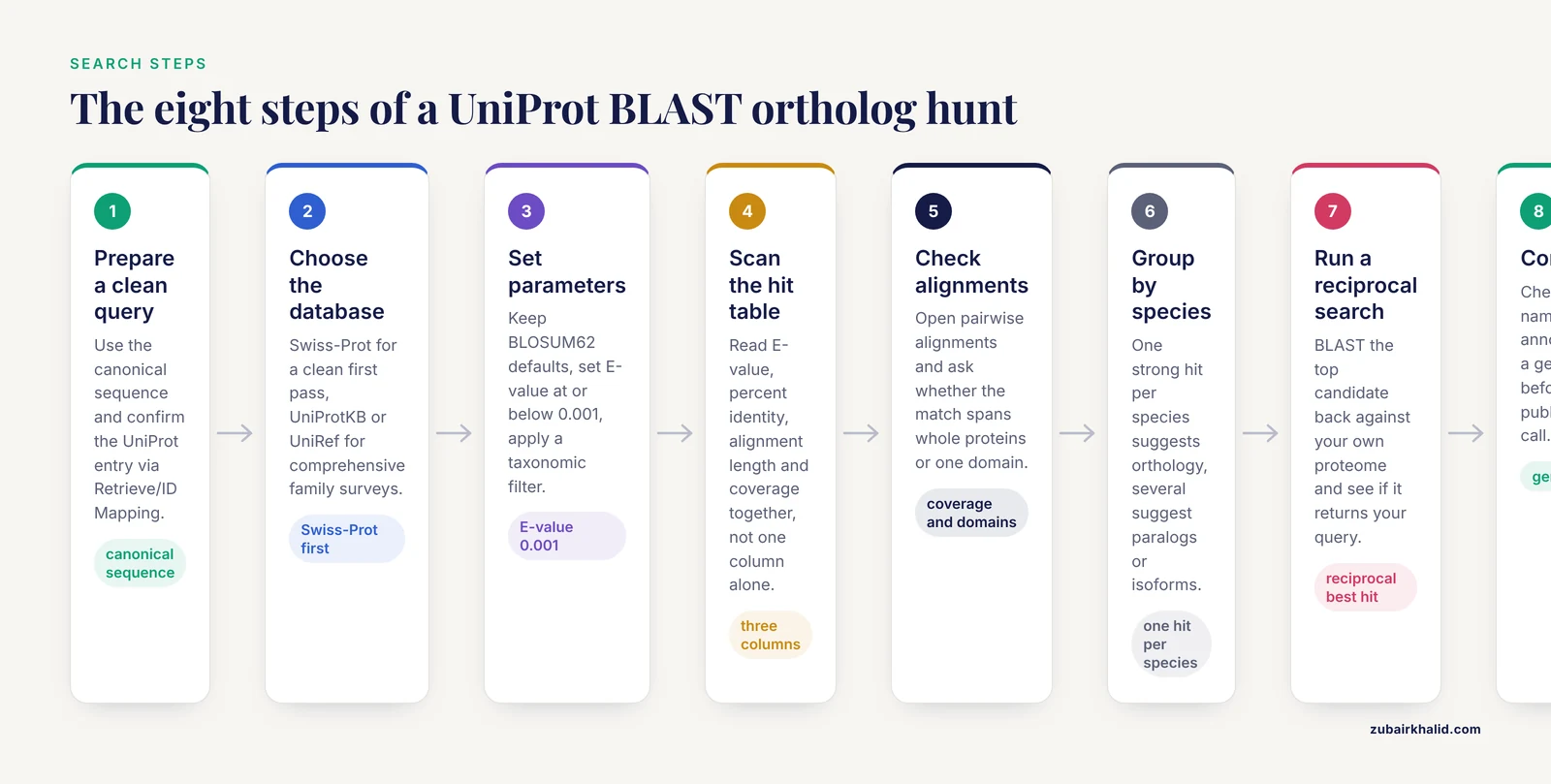
The published UniProt tool protocols describe BLAST as Basic Protocol 1, with alternate routes that let you launch a search directly from text search result pages or from your UniProt basket [1][5]. The interface details change over time, so treat the following as a workflow, not a screenshot transcription.
Step 1. Prepare a clean query
Retrieve your query protein sequence from its UniProt entry and use the canonical sequence unless you have a specific reason to choose an isoform. Check the entry first. If your protein has annotated domains of unknown relationship to your real question, or a long low-complexity tail, note this now, because both will shape your BLAST interpretation later. If your sequence came from another database, use the Retrieve/ID Mapping tool to convert identifiers and confirm you have the right UniProt entry, since identifier conversions are a common source of silent errors [1][5].
Step 2. Choose the target database deliberately
For a focused ortholog hunt in well-studied organisms, search Swiss-Prot. The hits will be fewer, better annotated, and easier to interpret. For comprehensive family surveys, or when your query comes from a poorly studied organism, search the full UniProtKB or a UniRef cluster. A useful pattern is to run Swiss-Prot first to orient yourself, then widen to UniProtKB or UniRef90 to catch anything the curated set missed.
Step 3. Set parameters that fit the question
The default scoring matrix (BLOSUM62) and default gap penalties are appropriate for most protein searches. Two parameters deserve deliberate choices. The E-value threshold (the number of hits with scores this good you would expect to find by chance in a database of this size) is commonly set at or below 0.001 for homolog detection in teaching and routine work, though the right cutoff always depends on database size and query length. Second, use the taxonomic filter. If your question is "who is the ortholog of this human protein in zebrafish," restricting the target sequences to vertebrates sharpens the result list and removes a flood of distant bacterial matches that only share a common domain.
Step 4. Run the search and scan the hit table
Each row of the results typically shows the hit's identifier, its E-value, the percent identity, the alignment length, and a graphical summary of where the alignment falls on the query. Sort and read the table with three columns in mind rather than one. A hit with 95 percent identity over 50 amino acids is far weaker evidence than a hit with 60 percent identity over 400 amino acids, and the E-value already folds coverage and length into its calculation, which is why a short high-identity hit can carry a worse E-value than a long moderate-identity hit.
Step 5. Open the alignments and check both coverage and domain structure
This is where uniprot blast orthologs paralogs interpretation actually happens. For each serious candidate, open the pairwise alignment and ask:
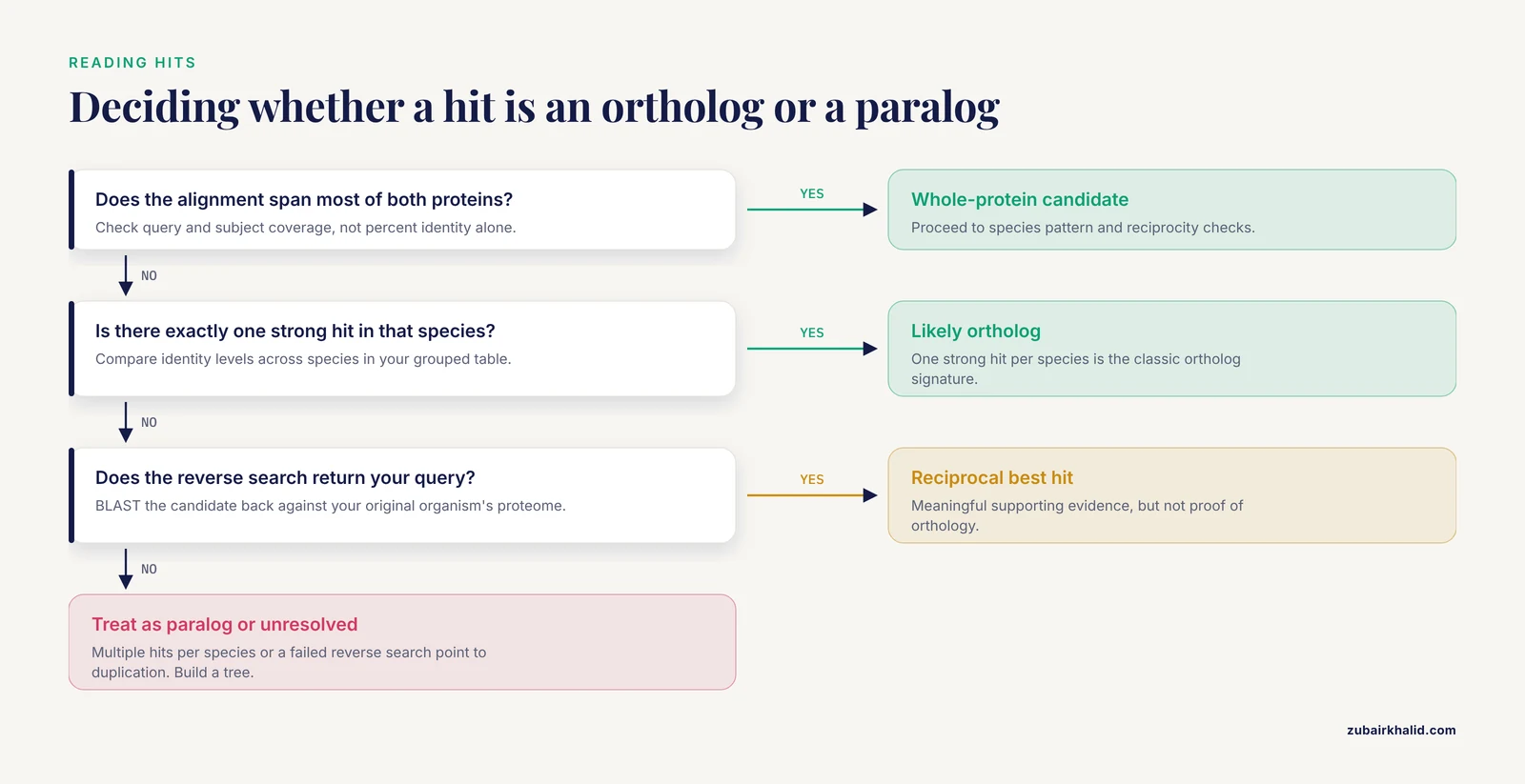
- Does the alignment span most of both proteins, or only one domain?
- Are the aligned regions in the same order in both proteins?
- Where do the alignments start and stop relative to annotated domains in the UniProt entries?
A hit that aligns only to a single kinase domain or a single helicase domain is evidence of a domain-level homolog, not an ortholog of the whole protein. Multidomain proteins routinely produce dozens of such hits, and naively reading the top of the hit list as "most orthologous" produces errors.
Step 6. Group the hits by organism and by gene family
Organize your significant hits into a table with one column per organism. A pattern of exactly one strong hit per species, with roughly similar levels of identity, is the classic signature of an orthologous gene evolving under comparable constraint. Multiple strong hits within a single species point to paralogs, recent duplications, or isoforms of the same gene. Species with no hit at all are also informative, since they may lack the gene entirely.
Step 7. Test candidates with a reciprocal search
For your top ortholog candidate, copy its sequence and run BLAST back against your original organism's proteome. If the best hit is the gene you started with, you have a reciprocal best hit, which is meaningful supporting evidence for orthology. If the reverse search prefers a different gene in your query organism, you are likely looking at a paralogous pair, or at a lineage with a duplication history that simple best-hit logic cannot resolve.
Step 8. Corroborate with gene names, curated annotations, and trees
Use the candidate's UniProt entry as evidence, not just its sequence. Curated entries carry gene names, function statements, domain annotations, and cross-references to organism databases that either support or contradict an orthology call. For final calls in publications, build a multiple sequence alignment of the family (the UniProt Align tool handles this directly [1][5]) and inspect the gene tree, because a tree shows where duplications happened, which is the information BLAST alone does not provide.
Reading the Output: E-values, Identity, and Coverage in Context
Understanding the statistics in the hit table is the difference between interpretation and guessing.
The E-value answers the question "how many alignments with a score at least this good would I expect to see purely by chance in a database of this size?" An E-value of 0.001 means roughly one such hit per thousand database-sized searches. E-values are not probabilities that a hit is a true homolog, and they scale with database size, so the same alignment scores slightly differently against Swiss-Prot and against full UniProtKB.
The bit score is a normalized measure of alignment quality that does not depend on database size, which makes it the better number for comparing hits across searches. Higher bit scores indicate stronger evidence of homology.
Percent identity is the fraction of aligned positions with identical residues. Positives add conservative substitutions. Gaps carry penalties and often mark indels or alignment artifacts in low-complexity regions. Query coverage and subject coverage tell you what fraction of each sequence participated in the alignment, and they are the numbers students most often ignore.
A working habit that serves well: never quote percent identity without quoting the aligned length. Thirty percent identity over 300 aligned residues in a family with known distant homologs is strong evidence. Thirty percent identity over 60 residues is close to noise in many contexts. The standard rules of thumb (roughly 25 to 30 percent identity over a substantial length as the fuzzy border of homology detection, and much higher confidence above that) come from decades of benchmarking and are part of standard bioinformatics teaching, but they are guidelines, not cutoffs, and domain architecture always trumps a single number.
Interpreting Hits as Orthologs or Paralogs: The Hard Part
Species patterns and their failure modes
The one-hit-per-species pattern described above is a good default heuristic, but it fails in predictable places. Lineages that underwent whole-genome duplications (fish after the teleost genome duplication, plants after multiple polyploidy events, vertebrates after the two rounds of early duplication) often retain two or more orthologs of your query gene, called co-orthologs. Conversely, gene loss can erase the true ortholog while a paralog survives, so the single remaining hit in a species may be a paralog standing in for a lost ortholog.
The case study that teaches this best: TCOF1 and NOLC1 in zebrafish
A recent analysis of the Treacher Collins syndrome gene TCOF1 shows how treacherous simple BLAST-based assignment can be [6]. A zebrafish gene on chromosome 13 (UniProt ID B8JIY2) had been treated as the TCOF1 ortholog and used in a knockdown model of the syndrome. Later database updates renamed that gene as nolc1, while the zebrafish database ZFIN designated a different gene on chromosome 14 (UniProt ID E7F9D9) as the TCOF1 ortholog. The proteins involved are large, rich in unstructured and repetitive regions, and therefore difficult to align reliably, which inflates similarity between NOLC1 and TCOF1. The authors' analysis concluded that NOLC1 and TCOF1 are themselves paralogs, and that the chromosome 14 zebrafish gene is a low-complexity, LisH-domain-containing protein with homology to NOLC1 but lacking sequence features essential for TCOF1's nucleolar functions. Their survey of teleost genomes suggested zebrafish lack a true TCOF1 ortholog [6]. The lessons are concrete: paralogy between families can masquerade as orthology within a family, low-complexity sequence inflates BLAST scores, database annotations change under your feet, and in whole-genome-duplicated lineages the "missing" ortholog may genuinely be missing.
Reciprocal best hits and their limits
Reciprocal best hits remain a workhorse for genome-scale orthology prediction, and projects continue to build on them [2]. But the method inherits every limitation of BLAST scores. When one lineage duplicated a gene after the split (in-paralogs), each copy may beat the other in the reciprocal search, or one copy may win both directions while the true ortholog in the duplicated lineage is a co-ortholog. When two families descend from a single ancestral duplication (out-paralogs), the more slowly evolving paralog can out-score the true ortholog. UniProt's own annotation practices acknowledge this reality by combining similarity evidence with curation and with taxonomic context.
Taxonomic constraints on what you do next
If your ortholog or paralog calls feed into functional annotation, taxonomy matters at the next step too. The Argot2.5 function prediction server improved its performance partly by running its similarity searches against a clustered version of UniProt and partly by applying taxonomic constraints that filter out annotations that cannot biologically apply to the species under investigation [7]. The same logic applies to your manual work. A GO term like "spermatogenesis" attached to a BLAST hit in a fungus should not transfer to your plant query, no matter how good the E-value is.
Iterative Searching and the Over-Extension Trap
Standard BLAST compares a single sequence against the database. PSI-BLAST (Position-Specific Iterated BLAST) goes further: it builds a position-specific scoring matrix (PSSM), a profile that records which residues are tolerated at each alignment position, from the first round of hits, then re-searches with that profile. This finds distant homologs a single sequence cannot reach, and it is a standard tool in published analyses, from viral oncoprotein characterization [8] to molecular mimicry studies [9].
Iterated searching also introduces a distinctive failure mode called homologous over-extension (HOE). In a detailed characterization, Gonzalez and Pearson showed that PSI-BLAST alignments can begin in a genuinely homologous region and then extend beyond the boundary of homology into neighboring sequence. When the neighboring region contains a non-homologous domain, the PSSM absorbs unrelated sequence, and the corrupted profile then pulls in non-homologous proteins with significant E-values [10]. The scale of the problem was measured directly: in searches against complete protein sequences, 5 to 9 percent of alignments at the fifth iteration were non-homologous, and HOE accounted for the largest fraction of false positives both initially and at iteration 5. Removing partial protein domains from the library cut HOE errors from 16 percent to 3 percent of weighted coverage for hard queries, and simply refusing to extend previously found sequences improved specificity 4- to 8-fold with little loss in sensitivity [10].
The practical guidance for your own searches follows directly. Keep iteration counts low rather than iterating until results stop changing. Inspect which sequences the profile absorbed after each iteration, and be suspicious when a hit aligns across a domain boundary into unrelated sequence. Mask low-complexity regions, and distrust profiles built from multidomain queries unless you check them domain by domain.
Faster and Companion Tools Around the UniProt Ecosystem
UniProt BLAST is the default entry point, but the surrounding ecosystem offers tools tuned to different jobs, and knowing them makes you faster and sometimes more accurate.
SANSparallel provides homology searches against UniProt, UniRef90/50, Swiss-Prot, and the Protein Data Bank with immediate response. Its suffix-array neighborhood search method is as sensitive as BLAST above 50 percent sequence identity, and its stacked alignments can be viewed in Jalview or as sequence logos, which makes it well suited to interactive exploration of the evidence behind an annotation [11].
MMseqs (Many-against-Many sequence searching) handles large-scale work where classical BLAST is too slow. In homology detection benchmarks it was much more sensitive and 4 to 30 times faster than UBLAST and RAPsearch respectively, and its cascaded clustering workflow clusters databases the size of UniProt down to about 30 percent sequence identity at speeds far beyond BLAST-based clustering [3]. If your orthology project grows into an all-against-all comparison of many proteomes, this is the practical path.
EMBL-EBI's analysis framework exposes BLAST, FASTA, InterProScan, and alignment tools such as ClustalW, MUSCLE, and T-Coffee through one consistent interface, searchable against UniProt and thousands of complete proteomes, with web services for programmatic pipelines [12]. For building gene trees, running the multiple sequence alignment step at EBI after collecting ortholog candidates from UniProt BLAST is a common and effective pairing.
PairsDB took a different approach entirely, precomputing BLAST and PSI-BLAST alignments among UniProt sequences so that similarity relationships can be retrieved instantaneously and filtered by criteria such as organism, solved structure, and transmembrane status, with the all-against-all similarity graph explicitly intended as a starting point for clustering and orthology definition [13].
ProGMap addresses a subtler problem: different databases classify proteins into groups in conflicting ways. Built on a non-redundant set of over 6.6 million protein sequences mapped to 240,000 protein group descriptions from UniProt, RefSeq, Ensembl, COG, OrthoMCL-DB, HomoloGene, TRIBES, and PIRSF, it lets you check whether the "ortholog group" you found in one resource agrees with the others, and it includes BLAST and identity search services for sequence-based queries [14]. When your BLAST-derived ortholog call disagrees with a database's grouping, ProGMap is the kind of tool that tells you why.
Where the Results Get Used: Real Applications
Seeing how ortholog and paralog information flows into downstream analyses helps you calibrate how carefully to make the calls in the first place.
Function prediction. As noted above, Argot2.5 builds function predictions on similarity searches against a clustered UniProt and refines them with taxonomic constraints derived from Gene Ontology-based rules, benchmarking favorably against BLAST-based baselines and competing servers [7]. The quality of the underlying orthology and paralogy structure is the ceiling on the quality of the predictions.
Interaction prediction. HOMCOS predicts interacting protein pairs and interacting sites by finding BLAST matches between user queries and a dataset of known heterodimer and homodimer structures, then outputs candidate interacting partners as the UniProt entries homologous to the template's interacting proteins [15]. Orthology here is doing direct mechanistic work, since a modeled interaction inherited through orthologous pairs is only as trustworthy as the orthology assignment.
Allergy and cross-reactivity. In a study of allergic rhinitis and oral-allergy syndrome, researchers compiled 4,429 unique inhalant allergen epitopes from five species and compared them by BLAST against 9,497 protein sequences from 19 foods implicated in oral-allergy syndrome, then built a phylogenetic tree of the relationships [16]. The cross-reactivity patterns that clinicians observe map onto sequence similarity structure, which is orthology and paralogy analysis in clinical clothing.
Molecular mimicry in autoimmunity. A study of cardiovascular autoimmune disease searched for sequence identity between human cardiovascular proteins and pathogen antigens using PSI-BLAST, finding ten cardiovascular proteins with 30 to 88.24 percent amino acid identity to antigens from ten pathogens, with actin showing 71.47 percent identity to Trypanosoma cruzi antigens and heat shock proteins reaching 88.24 percent identity with Cryptococcus neoformans and 80.61 percent with Chlamydia trachomatis [9]. High cross-species similarity between host and pathogen proteins is the molecular substrate of cross-reactive immunity, and finding it requires exactly the interpretive discipline this guide describes.
Therapeutic and reagent design. OpenAntigens, a structure-aware database for antigen construct design covering 5,328 human secreted and membrane proteins, explicitly integrates mouse and cynomolgus monkey orthologs, paralog and family context, and 148,722 sequence-similarity hits so that designers can assess cross-reactivity risk before ordering DNA, yielding 55,305 construct suggestions [17]. Choosing an antibody target region that avoids the closest paralogs is a paralogy problem with commercial consequences.
Underexplored protein families. For small bacterial proteins under 100 (and especially under 50) amino acids, functional description is often impossible because known homologs are scarce, and sORFdb addresses this by extracting small proteins, quality-filtering them against Swiss-Prot, UniProt, and other sources, and building families with bidirectional best BLAST hits followed by Markov clustering [2]. Short sequences are the hardest case for BLAST-based orthology because there is little length for statistics to work with, which is a limitation to keep in mind whenever your query is small.
Characterizing uncharacterized viral proteins. A typical in silico characterization workflow extracts the sequence from a UniProt entry, runs PSI-BLAST and pairwise BLAST searches to find structural and sequence relatives, and combines the results with threading and homology modeling [8]. The similarity search is the foundation everything else sits on.
Worked Example: Human p53, Step by Step
To make the workflow concrete, consider human TP53 (UniProt P04637), the best-studied tumor suppressor.
- Start from the UniProt entry for human TP53 and copy the canonical sequence.
- Search Swiss-Prot with the taxonomic filter set to mammals. The top non-human hits are the rodent p53 proteins (mouse Trp53, rat Tp53), with very high full-length identity and near-full-length coverage. One strong hit per mammalian species, full-length alignment, consistent gene naming: this is a textbook ortholog pattern.
- Remove the taxonomic filter and scan the full Swiss-Prot results. New hits appear from birds, fish, and invertebrates at decreasing identity, still with good full-length coverage. These are orthologs at increasing evolutionary distance.
- Now notice a second cluster of hits. The p63 (TP63) and p73 (TP73) proteins align strongly to TP53 over the DNA-binding domain but poorly or not at all over the full length, and multiple p63 and p73 hits appear per vertebrate species. These are paralogs, products of ancient duplications within the p53 gene family that occurred before the origin of vertebrates. The domain-restricted alignment is exactly the signature you learned to recognize in Step 5.
- Run a reciprocal search with mouse Trp53 against human Swiss-Prot. The best hit is human TP53. Combined with the species pattern and full-length coverage, you now have sequence evidence, directionality evidence, and naming evidence all pointing the same way.
- For a publication-grade call, align TP53, TP63, and TP73 representatives across species, inspect the tree, and confirm that the TP53/TP63/TP73 split lies deeper than the mammalian speciation events, which makes TP53 and mouse Trp53 orthologs and makes the TP63 relationship paralogy.
Contrast this with the TCOF1/NOLC1 situation [6], where the reciprocal pattern, the gene names, and even the curated databases disagreed, and the resolution required domain-level analysis of repetitive, unstructured proteins. Most proteins fall closer to the p53 case. The TCOF1 case is worth remembering because it shows what the hard tail of the distribution looks like.
Common Mistakes and Limitations
- Calling every significant hit an ortholog. BLAST reports similarity. Orthology is an evolutionary statement that requires reasoning about duplications and speciation, ideally with a tree.
- Reading percent identity without aligned length or coverage. A short high-identity domain match is not a whole-protein ortholog. Always check that the alignment spans comparable fractions of both sequences.
- Letting domains over-extend in iterative searches. PSI-BLAST profiles corrupted by homologous over-extension pulled in 5 to 9 percent non-homologous alignments at iteration 5 in benchmark searches, and the majority of false positives traced to this mechanism [10]. Limit iterations and audit what the profile absorbs.
- Trusting low-complexity and repetitive regions. These regions inflate scores and distort alignments, as the TCOF1/NOLC1 analysis demonstrated [6]. Mask them or analyze the globular domains separately.
- Ignoring isoforms. Several UniProt entries per gene (isoforms) can make one gene look like several paralogs. Count genes, not entries, by checking the gene identifier on each hit.
- Counting redundant TrEMBL entries as independent evidence. Near-identical entries from many strains or annotations of the same protein multiply your apparent support. Use UniRef clusters or deduplicate by organism before drawing conclusions.
- Transferring annotation without taxonomic reasoning. Function predicted from a hit in a distant taxon can be biologically impossible for your organism, which is why dedicated pipelines apply explicit taxonomic constraints [7].
- Assuming orthologs always retain function. After duplication, one copy often diverges or dies. A confirmed ortholog relationship constrains but does not guarantee identical function, and the older the duplication relative to your species pair, the weaker the guarantee.
- Forgetting that paralogs can out-score orthologs. Slowly evolving out-paralogs sometimes beat the true ortholog in a best-hit search. When the best hit looks odd, widen the hit list and build a tree before deciding.
- Not recording database versions. UniProt entries, gene names, and orthology designations change between releases, as the zebrafish TCOF1 renaming showed [6]. Record the release version and date of every search that supports a conclusion you intend to publish.
A final boundary worth stating plainly: a BLAST-derived orthology call is a hypothesis supported by evidence, and for medically or evolutionarily consequential conclusions it should be corroborated with tree-based or curated orthology resources and, where possible, experimental validation. Individual ambiguous cases need expert evaluation rather than a mechanical rule.
Quick Review
- Homologs share ancestry. Orthologs separated by speciation, paralogs by duplication, and the distinction is relative to a chosen speciation event.
- BLAST finds similarity, not evolutionary history. Interpretation requires coverage, domain architecture, species patterns, and reciprocity checks on top of the raw scores.
- Search Swiss-Prot for a clean first pass, UniProtKB or UniRef for comprehensiveness, and use the taxonomic filter to match your biological question [1][3].
- Judge every hit by E-value plus aligned length plus coverage on both sides, never by percent identity alone.
- One strong hit per species suggests orthology, multiple strong hits within a species suggest paralogs or isoforms, and whole-genome duplication lineages break both patterns.
- Bidirectional best hits are a useful heuristic and the basis of several family-database pipelines, but duplications and gene loss can defeat them [2].
- Iterative PSI-BLAST searches gain sensitivity but risk homologous over-extension, which corrupts the profile with non-homologous sequence [10]. Iterate conservatively and audit every round.
- Curated annotations, gene names, and trees are your arbiters when sequence evidence alone is ambiguous, and databases themselves sometimes disagree [14][6].
Frequently Asked Questions
What does "UniProt BLAST orthologs paralogs" mean?
It refers to using the BLAST tool on the UniProt website to identify a query protein's evolutionary relatives, then classifying those relatives as orthologs (relatives separated by speciation) or paralogs (relatives separated by gene duplication). UniProt BLAST supplies the similarity data, and the classification is your interpretation layered on top of that data.
Can BLAST alone prove that two genes are orthologs?
No. BLAST establishes sequence similarity and supports a hypothesis of homology, but orthology is a statement about where a speciation event lies relative to gene duplications, which requires gene tree analysis or corroborating curated evidence. Reciprocal best hits and species patterns strengthen an orthology argument but cannot guarantee it, particularly in lineages with whole-genome duplications.
Should I search Swiss-Prot, UniProtKB, or UniRef?
Search Swiss-Prot when you want a small set of well-annotated hits for a focused ortholog hunt, full UniProtKB when you need comprehensive coverage including poorly studied organisms, and UniRef90 or UniRef50 when you want redundancy collapsed so family surveys stay readable. Running Swiss-Prot first and then widening is a sensible default pattern.
Why does my hit list contain several proteins from the same species?
Multiple strong hits within one species usually indicate paralogs from gene duplications, splice isoforms of a single gene, or redundant unreviewed database entries. Check gene identifiers to separate real paralogs from isoforms, and consider switching to a UniRef target database to collapse near-identical entries.
What E-value cutoff should I use?
A common working threshold is an E-value at or below 0.001 for routine homolog detection, but the right cutoff depends on your query length and database size, and no single number replaces inspecting the alignment. Always evaluate hits by combined evidence (E-value, coverage, identity over length, and domain architecture) rather than by E-value alone.
How do I handle a query protein with repeated domains or low-complexity regions?
Treat each domain as its own search question, because BLAST hits may align to a single repeat or domain rather than the whole protein, which signals domain-level homology rather than whole-gene orthology. Mask or discount low-complexity regions during interpretation, since they inflate scores and have been shown to drive over-extension errors in iterative searches, and analyze the structured domains separately.
Sources
- UniProt Tools: BLAST, Align, Peptide Search, and ID Mapping.
- sORFdb - a database for sORFs, small proteins, and small protein families in bacteria.
- MMseqs software suite for fast and deep clustering and searching of large protein sequence sets.
- kClust: fast and sensitive clustering of large protein sequence databases.
- UniProt Tools.
- Untangling Zebrafish Genetic Annotation: Addressing Complexities and Nomenclature Issues in Orthologous Evaluation of TCOF1 and NOLC1.
- Enhancing protein function prediction with taxonomic constraints--The Argot2.5 web server.
- Protein-x of hepatitis B virus in interaction with CCAAT/enhancer-binding protein α (C/EBPα)--an in silico analysis approach.
- [[Molecular mimic between cardiovascular diseases and microorganism antigens].](https://pubmed.ncbi.nlm.nih.gov/38683079/)
- Homologous over-extension: a challenge for iterative similarity searches.
- SANSparallel: interactive homology search against Uniprot.
- A new bioinformatics analysis tools framework at EMBL-EBI.
- PairsDB atlas of protein sequence space.
- ProGMap: an integrated annotation resource for protein orthology.
- HOMCOS: a server to predict interacting protein pairs and interacting sites by homology modeling of complex structures.
- Allergen cross-reactivity in allergic rhinitis and oral-allergy syndrome: a bioinformatic protein sequence analysis.
- OpenAntigens: a structure-aware database for antigen construct design across the human cell-surface and secreted proteome.