SWISS-MODEL vs AlphaFold: Key Differences
By Dr. Zubair Khalid, DVM, MS, PhD ·

The one-sentence difference: SWISS-MODEL builds your protein model by adapting an experimentally solved template structure that matches your sequence, while AlphaFold predicts the fold directly from the sequence with a deep neural network.
The rule of thumb: if a close experimental template exists and you want a conservative, traceable model, start with SWISS-MODEL. If no good template exists, or you want a ready-made model for any sequenced protein in seconds, use AlphaFold. When the result matters, run both, compare them, and let validation metrics decide.
The difference between SWISS-MODEL and AlphaFold is ultimately a difference in workflow philosophy. One tool copies and adapts known structures, the other reasons from evolution. That distinction determines what each tool can and cannot do for your project, from bound cofactors to oligomeric state to proteome-scale screening. This guide covers how each method works, where each one wins, what published head-to-head comparisons actually measured, which quality metrics should drive your choice, and a hands-on workflow from raw sequence to a model you can defend in a methods section.
Two Families of Structure Prediction
Protein structure prediction means generating a three-dimensional model of a protein from its amino acid sequence. Experimentally determined structures, solved by X-ray crystallography, cryo-electron microscopy, or NMR spectroscopy, are deposited in the Protein Data Bank (PDB), the public archive that both tools ultimately depend on. Sequences are far cheaper to produce than structures, and closing that gap is the reason automated modeling servers exist at all [1].
Classical computational structural biology recognized three approaches [2]. Homology (comparative) modeling builds your target protein using an experimental structure of an evolutionary relative as a template. Threading matches a sequence to known folds even when sequence similarity is weak. Ab initio modeling folds a protein from physical and statistical principles alone. SWISS-MODEL grew out of the first family and became its most durable automated implementation. AlphaFold emerged from the deep learning wave, absorbed ideas from all three traditions, and reset expectations for the entire field.
Why does the split matter in practice? Template-based modeling gives you provenance. Every coordinate descends from a structure someone solved, so you can open the template, inspect its ligands, and judge its oligomeric state. Deep learning gives you generalization. It can produce a credible fold for a protein with no structural neighbor, and it attaches confidence estimates calibrated across an enormous training corpus. The trade-offs that follow, bound chemistry, quaternary state, interpretability, and scale, run through every comparison in this guide.
The two tools also differ in pedigree. SWISS-MODEL pioneered automated homology modeling on the web and had been continuously developed for a quarter century as of its 2018 server update [1]. Its companion database, the SWISS-MODEL Repository, has offered precomputed models for Swiss-Prot sequences since the mid-2000s [3] and held more than 400,000 annotated models covering roughly 20 percent of Swiss-Prot entries by 2016, with a REST API and bulk downloads under an open license [4].
AlphaFold, developed by DeepMind, announced itself at CASP13 in 2018 and settled the argument at CASP14, the 14th Critical Assessment of Structure Prediction, the field's blind benchmarking competition. AlphaFold2 achieved a median Global Distance Test (GDT) score of 92.4 across 87 of 92 domains, an accuracy level that led the CASP organizers to declare the half-century-old protein structure prediction problem solved for single protein chains [5]. That trajectory, from CASP13 to a Nobel Prize, has been reviewed in detail [5]. The AlphaFold Protein Structure Database followed, launching in 2021 with about 300,000 structures and expanding to cover more than 214 million protein sequences [6]. Adoption has been explosive. One scientometric analysis of the AlphaFold literature reported an annual publication growth rate of about 180 percent and identified structure prediction, artificial intelligence, drug discovery, and molecular dynamics as the field's core research hotspots [7].
How SWISS-MODEL Works
The modeling pipeline
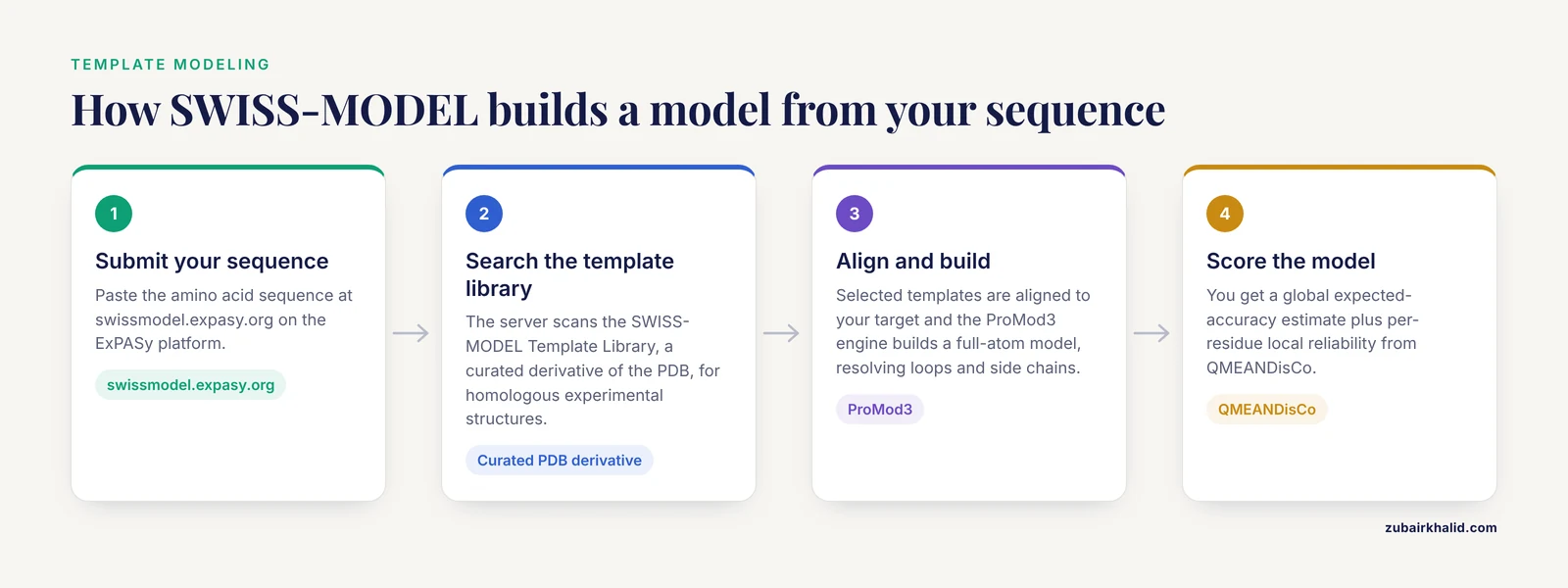
SWISS-MODEL is a homology modeling server hosted on the ExPASy platform at swissmodel.expasy.org [1]. You submit an amino acid sequence. The server searches the SWISS-MODEL Template Library, a curated derivative of the PDB, for experimental structures of homologous proteins. Selected templates are aligned to your target, and the ProMod3 modeling engine builds a full-atom model, resolving loops and side chains wherever the template offers no answer [1]. Because every coordinate descends from an experimental structure, the model inherits physically sensible geometry, and when something is wrong you can usually trace the error back to the target-template alignment.
Quality estimation is built into the pipeline rather than bolted on afterward. The server reports a global estimate of expected accuracy derived from the target-template relationship, plus per-residue local reliability from QMEANDisCo, a method that assesses each residue of the model against features extracted from homologous structures [1]. The pipeline itself is continuously graded by CAMEO (Continuous Automated Model EvaluatiOn), which dispatches newly released sequences to automated servers before their experimental structures are published and scores the returned models blind [2][8].
Templates, ligands, and quaternary structure
Two capabilities decide many real-world projects. First, the template library annotates quaternary structure (the number and arrangement of protein subunits) and essential ligands and cofactors, so a model can be built in its correct oligomeric state with bound chemistry in place [8]. Second, when multiple plausible templates exist, you can select them yourself and build models of alternative functional states, for example an inactive and an active conformation of the same enzyme [8]. Since the 2018 update, SWISS-MODEL has also modeled homo- and heteromeric complexes directly from the sequences of the interacting chains, inferring both stoichiometry and overall arrangement by homology [1].
Template-based methods have a hard boundary you should respect: they cannot invent a fold that no template shows. For proteins with distant or nonexistent structural relatives, accuracy degrades sharply, which is the gap AlphaFold was built to close.
Practical entry points
In practice you will use one of three routes. The automated pipeline takes a sequence and handles template selection end to end. The alignment route accepts your own target-template alignment when you want control over difficult regions. The custom template route forces a specific PDB structure, which is exactly what you want when a ligand-bound or alternative-conformation template exists [8]. For validation, the server's Structure Assessment tools provide Ramachandran statistics and related checks on any model you build [9].
The SWISS-MODEL Repository
Before building anything, check the SWISS-MODEL Repository. It stores precomputed, annotated models for Swiss-Prot entries and core model organisms, refreshes them as sequences and templates change, exposes a REST API, and permits bulk download under an open license [4]. For a well-studied protein, the model you need may already exist.
How AlphaFold Works
From CASP13 to AlphaFold 3
AlphaFold treats structure prediction as a learned mapping rather than a template-copying exercise. AlphaFold2 consumes a multiple sequence alignment (MSA), a column-wise alignment of evolutionarily related sequences in which co-varying positions reveal which residues sit near each other in three dimensions, and iteratively refines geometric reasoning over every residue pair until a structure module emits atomic coordinates [5]. The network learns from two complementary signals. Co-evolution within the MSA fingerprints physical contacts, and patterns learned across PDB structures supply the geometry that turns contacts into coordinates. When both signals are strong, backbone accuracy approaches experimental quality. When the MSA is thin, for rapidly evolving proteins, orphan folds, or designed sequences, confidence drops and the model can produce plausible-looking but unsupported geometry in isolated regions.
AlphaFold 3 rebuilt the architecture around a diffusion model and extended the prediction target to the joint structure of complexes: proteins, nucleic acids, small molecules, ions, and modified residues in one framework [10]. It reports substantially higher accuracy than previous specialized tools for protein-ligand interactions, better protein-nucleic acid accuracy than nucleic-acid-specific predictors, and higher antibody-antigen accuracy than AlphaFold-Multimer v2.3 [10].
What the AlphaFold server and database give you
Most users never install anything. The AlphaFold Protein Structure Database, maintained at EMBL-EBI and reachable at alphafold.ebi.ac.uk, hosts precomputed AlphaFold2 models for more than 214 million protein sequences, accessible through the website, bulk FTP, Google Cloud Public Datasets, and programmatic endpoints [6]. Predictions are integrated into primary resources including PDB, UniProt, Ensembl, InterPro, and MobiDB [6]. Recent additions include an AlphaMissense layer that maps predicted pathogenicity for human missense variants onto the structure, togglable against model quality at residue level, plus a Foldseek integration for fast structure-based search [11]. The related 3D-Beacons framework aggregates model coordinates from multiple providers and now includes datasets of homomeric AlphaFold 2 models [11].
For sequences not yet in the database, DeepMind operates the AlphaFold 3 server, a web interface for interactive predictions including complexes, subject to per-user usage limits [10]. The AlphaFold2 code and weights are openly available, so local and batch execution remain standard practice for large-scale work [5].
Reading the confidence scores
Every AlphaFold output ships with two self-assessments, and misreading them is the most common beginner error. pLDDT (predicted local distance difference test) scores each residue from 0 to 100 for local structural accuracy. The predicted aligned error (PAE) matrix estimates, in angstroms, how wrongly positioned one residue could be relative to another even if each is locally correct [6]. The metrics section below explains how to act on both.
Hard cases and the state of the art
AlphaFold is not a closed chapter. Targets with shallow or noisy MSAs and complicated multi-domain architectures remain challenging [12]. The field keeps responding. At CASP16, the MULTICOM4 system, which wraps AlphaFold2 and AlphaFold3 in diverse MSA generation, large-scale model sampling, and ensemble quality assessment, reached an average top-1 TM-score of 0.902 across 84 domains, with correct folds (TM-score above 0.5, the usual threshold for the same fold [2]) for 97.6 percent of them [12]. Vanilla AlphaFold is the baseline, not the ceiling.
SWISS-MODEL vs AlphaFold at a Glance
| Dimension | SWISS-MODEL | AlphaFold (AF2/AF3) |
|---|---|---|
| Core method | Homology modeling, the ProMod3 engine adapts experimental templates to your sequence [1] | Deep learning, AlphaFold2 reasons from evolutionary alignments, AlphaFold 3 adds a diffusion architecture [5][10] |
| What you supply | Amino acid sequence, optionally your own alignment or a chosen template [8] | A sequence, or nothing at all if the model is already in the database [6] |
| Template dependence | Essential, accuracy tracks target-template identity [13] | Not required, though shallow MSAs still degrade accuracy [12] |
| Precomputed coverage | Repository models for Swiss-Prot entries and core organisms [4] | Proteome-scale coverage across UniProt [6] |
| Complexes and oligomers | Homo- and heteromers inferred by homology, stoichiometry included [1] | AlphaFold 3 predicts joint complexes with proteins, nucleic acids, small molecules, ions, and modified residues [10] |
| Ligands and cofactors | Inherited from annotated templates [8] | Database models are apo, predicted without small molecules, ions, or cofactors [14] |
| Confidence output | QMEANDisCo per-residue scores plus a global expected-accuracy estimate [1] | pLDDT per residue and a PAE matrix between residues [6] |
| Typical turnaround on public servers | Seconds to a few minutes per protein | Seconds for a database lookup, up to hours for a fresh prediction of a large protein |
| Access and licensing | Free web server, REST API, bulk repository download under an open license [1][4] | Free database and AlphaFold 3 server, openly available AlphaFold2 code and weights [5][6] |
| Sweet spot | Close templates, ligand-aware models, defined oligomeric state, full provenance [8] | Novel folds, low-identity targets, complexes, proteome-scale screening [10][14] |
| Characteristic failure mode | Distant or wrong templates produce locally wrong geometry that can look plausible [14] | High confidence on disordered or spurious regions, missing bound chemistry [15][14] |
Three nuances sit behind the table. Coverage asymmetry is by design, because a neural network generalizes to sequences that have no template at all. The ligand row is the one that bites drug discoverers, since SWISS-MODEL can carry bound chemistry from annotated templates [8] while AlphaFold database models cannot [14]. And the runtime row depends entirely on whether you are downloading a file or folding a 2,000-residue protein from scratch.
When to Use SWISS-MODEL
- A close experimental template exists. Homology modeling accuracy tracks target-template sequence identity, and reliability drops sharply once identity to the nearest template falls toward and below roughly 30 percent [13][14]. If a template search returns an experimental structure with comfortable identity covering most of your target, SWISS-MODEL turns it into a target-specific model in minutes, and you can hand-pick alternative templates to capture different functional states [8].
- You need ligands, cofactors, or a defined oligomeric state. Both come from template annotations [8], which matters for metalloproteins, nucleotide-binding sites, heme proteins, and multimeric assemblies.
- You value provenance. Every coordinate traces back to a specific PDB entry you can open and inspect, and expected accuracy is documented through continuous CAMEO benchmarking [8].
- Your downstream application rewards template-anchored geometry. In published docking-preparation benchmarks, SWISS-MODEL models have held their own against AlphaFold and sometimes edged ahead (details in the evidence section below) [16].
- You need a citable, no-install service. The server, repository, REST API, and open licensing make the tool easy to automate and easy to describe in a paper [1][4].
Concrete case: you are modeling a human kinase domain for medicinal chemistry. Kinase domains are densely covered by PDB structures in multiple conformational states, so a high-identity template with a bound inhibitor almost certainly exists. Building with SWISS-MODEL from the state-matched template anchors your hinge and activation-loop geometry to experimental reality [8].
When to Use AlphaFold
- No usable template exists. This is the decisive case. The HDAC11 catalytic domain shares low sequence identity with other HDAC isoforms, which made conventional homology modeling unreliable, yet an AlphaFold model, once optimized by adding the catalytic zinc ion and minimizing in the presence of known inhibitors, powered a virtual screening campaign that found a selective inhibitor with an IC50 of 3.5 micromolar, confirmed experimentally and by molecular dynamics [14].
- You need breadth rather than depth. With proteome-scale coverage integrated into UniProt, Ensembl, InterPro, and MobiDB, the database answers questions no modeling queue can [6].
- You are modeling interactions. AlphaFold 3 predicts complexes spanning proteins, nucleic acids, small molecules, ions, and modified residues in a single framework [10].
- You need speed at the single-protein level. A database lookup returns a model with confidence scores in seconds [6], and Foldseek-powered search finds structural relatives fast [11].
- You accept responsibility for preparation. AlphaFold gives you coordinates and confidence, not bound chemistry or protonation states, so ligand and ion modeling moves to you [14].
Concrete case: you are annotating a bacterial genome and want structural hints for 300 hypothetical proteins. Modeling each one through a template server is slow and template-limited. The AlphaFold database likely contains precomputed models for most of them already [6], and a bulk download plus a pLDDT filter separates structured domains from probable disorder in an afternoon.
Head-to-Head Evidence from Published Benchmarks
A kinase drug-discovery benchmark
Bahena-Culhuac and Bello benchmarked AlphaFold2 and SWISS-MODEL on a curated set of 20 kinase structures with co-crystallized ligands [16]. Each target was evaluated three ways: as a raw predicted structure, after energy minimization, and after refinement with triplicate 100-nanosecond unbiased molecular dynamics (MD) simulations. Performance was scored with structural accuracy metrics, docking across AutoDock Vina, AutoDock, and MOE, post-docking trajectory stability analysis, and MM/GBSA binding energy estimates. Experimental structures docked best, as expected. Among the predictions, SWISS-MODEL produced slightly lower RMSD values and better interaction similarity than AlphaFold, although overall docking scores were statistically comparable [16]. The sharpest practical finding concerned refinement: running MD before docking increased binding-pocket deviations and was associated with misoriented ligand poses [16].
Membrane receptor case studies
Kamguia and colleagues modeled octopamine receptors from the cockroach Periplaneta americana and the mosquito Culex quinquefasciatus, receptors with no experimental structure in the PDB, using AlphaFold models, SWISS-MODEL models, and a Chimera/Modeler workflow [13]. The AlphaFold and SWISS-MODEL structures agreed reasonably with each other, sharing 75 percent structural similarity for the cockroach receptor and 35.12 percent for the mosquito receptor, the latter just clearing the authors' threshold for pairwise structural validity. The largest disagreements appeared against the Chimera/Modeler models, at 21.46 and 14.92 percent similarity, a reminder that method choice alone can move a model dramatically even when the primary sequences are highly identical [13].
Not every comparison favors AlphaFold. For the murine beta2-adrenergic receptor, a GPCR relevant to metabolic disease research, a four-way comparison of SWISS-MODEL, Phyre2, I-TASSER, and AlphaFold found SWISS-MODEL produced the most reliable structure, with 93.1 percent of residues in favored regions of the Ramachandran plot and none in disallowed regions [17].
A multi-server consensus workflow
For the SARS-CoV-2 nonstructural protein 6 (NSP6), a transmembrane protein central to viral replication organelle formation with no crystal structure, one comprehensive pipeline generated models with eight prediction servers including SWISS-MODEL and AlphaFold, refined them with six refinement servers into 48 candidate models, and validated everything with Ramachandran analysis, ERRAT, PROSA Z-scores, PROQ, and TM-align [9]. The refinement stage measurably improved model quality [9]. The procedural lesson matters as much as the numbers: when a model will support claims, generate alternatives and let independent validation arbitrate.
What the evidence says
Three patterns hold across these studies. Experimental structures still outperform both predictors for structure-based drug discovery [16]. Neither tool dominates universally, and the winner changes with the target class. The step that most often decides whether a model is useful is not the predictor choice but the quality assessment and preparation that follow [16][9].
Quality Metrics That Decide the Call
pLDDT bands
AlphaFold colors every model by pLDDT, and AlphaFold resources use a consistent convention. Scores above 90 mark very high accuracy, where the backbone and most side-chain conformations are trustworthy. Scores from 70 to 90 mark a generally confident backbone with less certain side chains. Scores from 50 to 70 mark low confidence. Scores below 50 usually indicate intrinsic disorder, and the standard advice is to treat those regions as unmodeled rather than as a wrong structure.
PAE for domains and interfaces
For any protein with more than one domain, read the PAE plot before trusting the cartoon. Low PAE between residues in different domains means their relative arrangement is well determined. High PAE means the network is guessing the domain orientation, and single-domain extraction or experimental input may be needed. Interface questions belong on the PAE plot, not on the pLDDT rainbow.
SWISS-MODEL quality output
For SWISS-MODEL models, read QMEANDisCo per-residue scores alongside the global expected-accuracy estimate [1]. A model can look respectable overall and still have a broken loop exactly where your active site sits. The per-residue track is where you find that out.
Independent validation
Do not let a predictor grade its own homework. Standard validation includes Ramachandran favored and disallowed fractions, ERRAT composite quality scores, PROSA Z-scores, and TM-align superpositions against related experimental structures [9]. Global similarity metrics such as the TM-score, GDT_TS (the fraction of residues within increasing distance cutoffs), and lDDT (a reference-free local measure) let you compare models and report accuracy consistently [2]. Superposing your SWISS-MODEL and AlphaFold models on each other is the cheapest sanity check available, and large divergences flag exactly the regions that deserve scrutiny before you trust either one [13].
The pLDDT trap
One caution is specific to confidence scores. AlphaFold2, AlphaFold3, and ESMFold all assign unexpectedly high pLDDT to short spurious protein sequences, the kind produced by gene prediction errors, and discrimination between spurious and real proteins only becomes reliable beyond about 100 amino acids [15]. Treat short, confidently folded predictions with extra suspicion, especially when annotating newly assembled genomes.
Hands-On Workflow: From Sequence to Model
Step 1: Check what already exists
Search your protein's UniProt accession in the AlphaFold database [6] and the SWISS-MODEL Repository [4], and search the PDB directly for experimental structures of your protein or its close homologs. Ten minutes here can save days, because an experimental structure beats both tools.
Step 2: A short AlphaFold tutorial
- Open alphafold.ebi.ac.uk and search by UniProt accession, protein name, or sequence [6].
- Read the pLDDT coloring before anything else. For human proteins, toggle the AlphaMissense pathogenicity layer to see variant annotations at residue level [11].
- For multi-domain proteins, open the PAE viewer and check whether inter-domain blocks are dark (confident) or light (uncertain) [6].
- Download the coordinates. Files follow the naming pattern AF-\<UniProt accession\>-F1-model_v\<N\>.pdb, and the version suffix increments as models are regenerated, so take the exact filename from the record page [6].
# Fetch a precomputed AlphaFold model by UniProt accession
wget https://alphafold.ebi.ac.uk/files/AF-P12345-F1-model_v4.pdb

# Per-residue pLDDT lives in the B-factor column of AlphaFold PDB files
awk '$1 == "ATOM" {print substr($0, 61, 6)}' AF-P12345-F1-model_v4.pdb- If your protein is not in the database, submit it to the AlphaFold 3 server for an interactive prediction, or run AlphaFold2 locally for batch work [5][10].
Step 3: Run SWISS-MODEL on the same sequence
Paste the identical sequence at swissmodel.expasy.org [1]. Start in automated mode, then open the template gallery. If several plausible templates exist, rebuild with your own selection to compare functional states [8]. Read the QMEANDisCo track before trusting any loop or terminus.
Step 4: Compare and validate
Superpose the two models with TM-align [9]. Regions where they agree are probably right. Regions where they diverge need external evidence, such as conservation, mutagenesis data, or a better template. Finish with Ramachandran statistics, ERRAT, and PROSA before anyone downstream sees the model [9].
Step 5: Prepare for docking
Prefer an experimental structure whenever one exists [16]. Otherwise choose the model with the better-ordered binding pocket, add missing cofactors and metals explicitly, as the HDAC11 work did with its catalytic zinc [14], energy-minimize, and keep pre-docking refinement gentle [16].
Automating the whole thing
For batch work, published Nextflow pipelines chain AlphaFold predictions into physicochemical profiling, evolutionary analysis against Pfam and Swiss-Prot/UniRef90, pocket detection with P2Rank, and AutoDock Vina docking, all summarized in a MultiQC HTML report [18]. On the retrieval side, the SWISS-MODEL Repository REST API and the AlphaFold database programmatic endpoints support scripted access at scale [6][4].
Common Mistakes and Limitations
- Trusting pLDDT as experimental validation. High pLDDT means the network is confident, not that biology agrees. Short spurious sequences from gene prediction errors routinely receive high confidence scores [15].
- Docking into raw AlphaFold models. Database models are predicted without small molecules, ions, or cofactors [14]. Add the catalytic zinc, the heme, or the ATP magnesium before you interpret a pocket.
- Over-refining right before docking. Heavy MD refinement immediately before docking hurt docking readiness in the kinase benchmark described above [16]. Keep pre-docking preparation light and verify the pocket after any refinement.
- Ignoring oligomeric state. AlphaFold database models are generated per protein sequence, while many proteins function as assemblies. SWISS-MODEL annotates and builds oligomers from templates [8], and AlphaFold 3 handles complexes directly [10].
- Pushing homology modeling into the twilight zone. Below the identity threshold described earlier, template-based models stop being trustworthy [13][14], which is precisely where AlphaFold earns its keep.
- Expecting structure from disorder. Low pLDDT usually means real disorder. In malaria parasite P5 ATPases, homology modeling revealed multiple low-complexity insertions forming intrinsically disordered loops, and the approach could not resolve substrate specificity [19]. Do not force a ribbon diagram onto a region the evidence says is a floppy shroud.
- Reporting a single method. Independent models from different tools can disagree dramatically for the same sequence [13][9]. Single-method analyses hide that uncertainty from your readers.
- Reading "solved" too literally. The CASP14 declaration applied to single chains [5]. Multi-chain assemblies, shallow MSAs, and multi-domain geometries still challenge the best current systems [12].
- Skipping independent validation. Predictor self-scores are not enough. Ramachandran statistics, ERRAT, PROSA, and superposition against experimental relatives are cheap and catch real problems [9].
- Ignoring versioning. Both databases regenerate models as sequences and methods evolve [6][4]. Record the model version and access date, or your figure will not be reproducible a year from now.
The overarching limitation applies to both tools equally. A predicted structure is a hypothesis. For high-stakes conclusions, pair it with experimental validation or review by an experienced structural biologist, because no confidence score substitutes for data on your specific protein.
Frequently Asked Questions
Is AlphaFold more accurate than SWISS-MODEL?
Neither tool wins universally. AlphaFold2 set accuracy records for single chains at CASP14 [5], but published head-to-head benchmarks are protein-dependent, and SWISS-MODEL has matched or outperformed it in some receptor modeling and docking-preparation tasks [13][16][17]. When the model matters, generate both and let validation metrics decide.
Can I use SWISS-MODEL or AlphaFold models for molecular docking?
Yes, with preparation. Prefer an experimental structure when one exists, add missing cofactors and metals, energy-minimize the model, validate the binding pocket, and keep pre-docking refinement gentle [16][14]. Optimized AlphaFold models have supported virtual screens that produced experimentally confirmed hits [14].
What does a low pLDDT score mean?
pLDDT is AlphaFold's per-residue confidence score from 0 to 100. Scores below 50 usually mark intrinsically disordered or unstructured regions, which should be treated as unmodeled rather than as a mispredicted structure.
Does SWISS-MODEL need a template?
Yes. SWISS-MODEL is a homology modeling server and always builds from an experimental template structure [1]. Template selection is automatic by default, you can override it [8], and accuracy depends strongly on how close the template is to your target.
Is the AlphaFold database free to use?
Yes. The AlphaFold Protein Structure Database is free to access through its website, bulk FTP, Google Cloud Public Datasets, and programmatic endpoints [6], with added services such as AlphaMissense overlays and Foldseek structure search [11].
Which tool should I try first for a protein with no experimental structure?
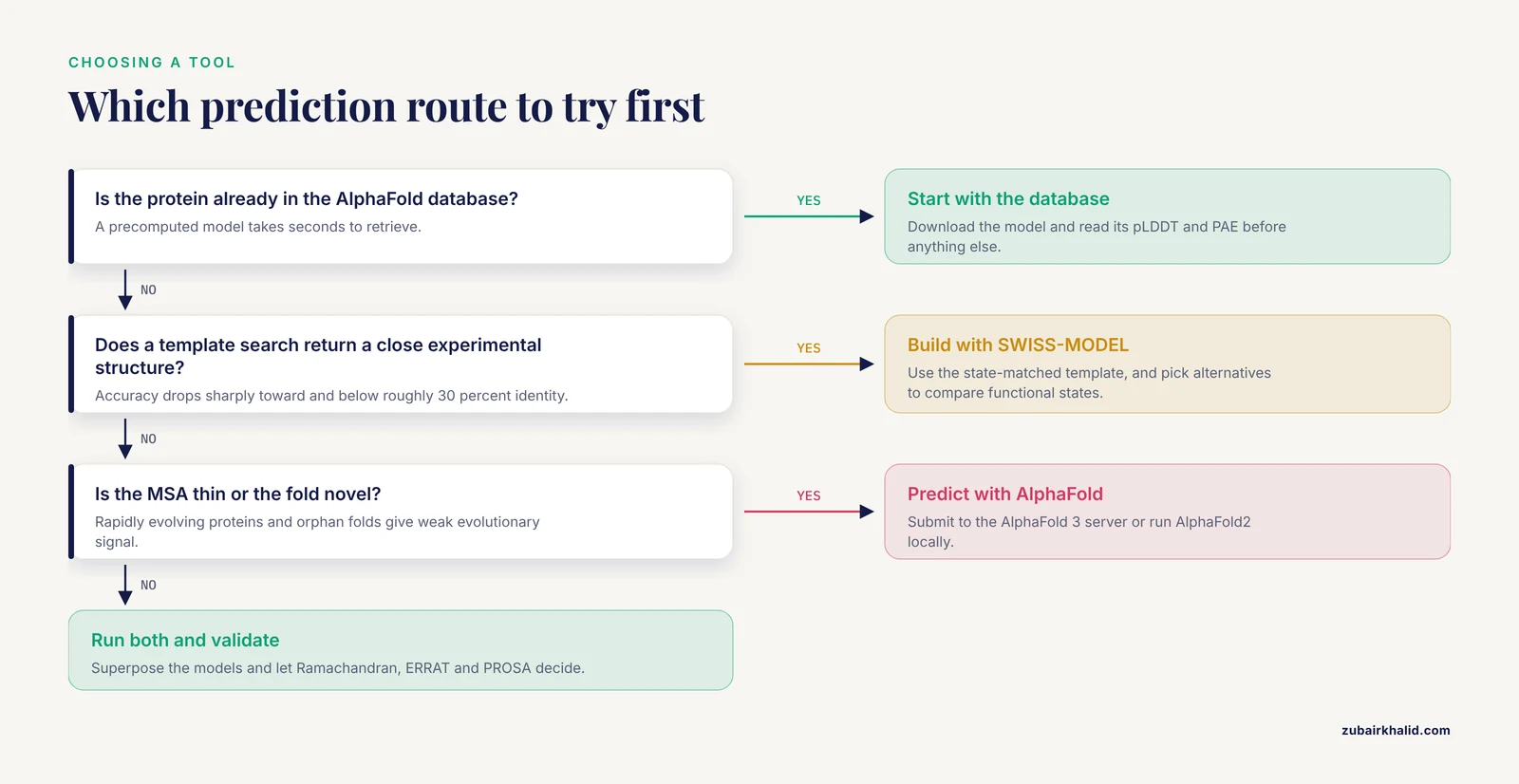
Check the AlphaFold database first, since a precomputed model takes seconds [6]. In parallel, run SWISS-MODEL to see whether a usable template exists. If the protein is absent from the database and no template convinces you, submit it to the AlphaFold 3 server or run AlphaFold2 locally [5][10].
Sources
- SWISS-MODEL: homology modelling of protein structures and complexes
- AI-Driven Deep Learning Techniques in Protein Structure Prediction
- The SWISS-MODEL Repository and associated resources
- The SWISS-MODEL Repository-new features and functionality
- From CASP13 to the Nobel Prize: DeepMind's AlphaFold Journey in Revolutionizing Protein Structure Prediction and Beyond.
- AlphaFold Protein Structure Database in 2024: providing structure coverage for over 214 million protein sequences
- Artificial intelligence alphafold model for molecular biology and drug discovery: a machine-learning-driven informatics investigation
- SWISS-MODEL: modelling protein tertiary and quaternary structure using evolutionary information
- Computational Modeling and High-confidence Tertiary Structure Prediction of the SARS-CoV-2 NSP6 Protein: Implications for Viral Pathogenesis and Host Interaction
- Accurate structure prediction of biomolecular interactions with AlphaFold 3
- AlphaFold Protein Structure Database and 3D-Beacons: New Data and Capabilities.
- Boosting AlphaFold Protein Tertiary Structure Prediction through MSA Engineering and Extensive Model Sampling and Ranking in CASP16
- A Comparative Analysis of Cockroach and Mosquito, Octopamine Receptor Homologues Produced Using Chimera, Swiss-Model, and AlphaFold Molecular Modeling Tools
- Comparative Structure-Based Virtual Screening Utilizing Optimized AlphaFold Model Identifies Selective HDAC11 Inhibitor
- Folding the unfoldable 2: using AlphaFold and ESMFold to explore spurious proteins
- Systematic benchmarking of AlphaFold and SWISS-MODEL kinase structures for structure-based drug discovery.
- Optimizing 3D Structural Predictions of Murine β2-Adrenergic Receptor: Swiss-Model Outperforms AlphaFolds
- AlphaFold-based protein analysis pipeline
- Homology Modeling of Type-P5 ATPases from the Malaria Parasite: Insight into Their Functions and Evolution, and Implications About the Effect and Role of Intrinsically Disordered Protein Structure.