Sequence Alignment Tools for DNA vs. RNA vs. Protein
By Dr. Zubair Khalid, DVM, MS, PhD ·

DNA alignment compares four-letter nucleotide strings, RNA alignment additionally has to respect the molecule's folded secondary structure, and protein alignment compares twenty-letter amino acid strings through a substitution matrix that scores biochemically similar residue swaps. The rule of thumb is simple: pick the tool whose alphabet and evolutionary model match your molecule first, then pick among those tools by data size, error profile, and the question you actually need to answer.
This guide is a practical bioinformatics tools comparison for anyone deciding between the main sequence alignment tool for dna rna protein options. It covers how each class of tool works, the pros and cons of the major programs, worked scenarios from real publications, and the mistakes that cost people the most time.
What Sequence Alignment Actually Does
Sequence alignment arranges two or more sequences in rows, inserting gaps so that matching or functionally related positions line up in columns. The core math goes back to two dynamic programming algorithms that every bioinformatics course teaches: Needleman and Wunsch's global alignment algorithm from 1970, which aligns sequences end to end, and Smith and Waterman's local alignment algorithm from 1981, which finds the best matching segment inside longer sequences. Every widely used tool is either an exact implementation of one of these, a heuristic approximation, or a statistical model built on top of them.
Three vocabulary terms recur throughout this article.
Pairwise alignment compares exactly two sequences. It is what you run when you have one query and one candidate match.
Multiple sequence alignment (MSA) aligns three or more sequences at once, usually to find conserved positions across a family. MSAs are the input for phylogenetic trees, motif discovery, and structure models.
Substitution scoring is how a tool decides which mismatches are tolerable. For nucleotide sequences, a match and a mismatch carry simple fixed scores. For proteins, position-specific scoring matrices such as PAM and BLOSUM62 give positive scores to conservative substitutions, for example leucine to isoleucine, and negative scores to disruptive ones, for example tryptophan to aspartate. This single difference explains most of why protein alignment is not just DNA alignment with a different alphabet.
A fourth distinction matters for choosing tools: homology versus identity. Two sequences are homologous if they descend from a common ancestor. Nucleotide identity decays quickly with evolutionary distance, while conserved protein structure and function persist far longer. That is why distant relationships are usually found at the protein level, and why the best sequence alignment tool for a job depends heavily on how diverged your sequences are.
The Core Comparison Table
The table below is the heart of this article. It lists the tools that come up most often when researchers compare sequence alignment tools for dna vs. rna vs. protein, what each is built for, and the tradeoffs that decide real choices.
| Tool | Molecule type | Task | Strengths | Weaknesses |
|---|---|---|---|---|
| BLASTN | DNA | Local search of nucleotide queries against nucleotide databases | Ubiquitous, easy web access, standard for identification and barcoding | Weak for distant homologs, scores raw nucleotide identity |
| BLASTP | Protein | Protein query against protein database | Sensitive, mature statistics, domain links | Needs a translated or protein query |
| BLASTX / TBLASTN | DNA versus protein | Translates a nucleotide query in six frames to find protein matches | Finds coding regions and remote homologs in genomic or transcript data | Slower, six-frame output needs filtering |
| BLAT | DNA | Very fast near-exact alignment of long sequences to a genome | Designed for sequences of 25 bases or more, extremely fast on close matches | Misses distant or fragmented homologs by design |
| Minimap2, BWA | DNA | Short-read and long-read mapping to a reference genome | Built for millions of reads, splice-aware modes for RNA-seq reads | Not designed for two-sequence comparative analysis |
| MAFFT | DNA, RNA, protein | Multiple sequence alignment | Accurate, fast, has RNA structure-aware modes | Many options confuse newcomers |
| MUSCLE, Clustal Omega | DNA, protein | Multiple sequence alignment | Fast, easy defaults for large sets | Less accurate than MAFFT on hard sets |
| Clustal W | DNA, protein | Classic progressive MSA | Historical standard, still used in scripted pipelines, gentle scoring for diverged species comparisons | Older algorithm, slower and less accurate on large sets |
| Spaln and Prrn5 | DNA plus transcript | Gene-structure-aware MSA that aligns genomic and transcript sequences respecting introns and exons | Detects gene-prediction errors, no annotation files required | Specialized, two-component workflow |
| Infernal / Rfam | RNA | Covariance-model search for structured noncoding RNAs | The standard for detecting homologs of known structured RNAs | Slow on large databases, RNA-specific expertise needed |
| PSI-BLAST | Protein | Iterative profile search | Finds remote homologs a single BLASTP pass misses | Profile drift if run carelessly |
| HMMER | Protein | Profile hidden Markov model search against Pfam and similar databases | Gold standard for family and domain detection | Protein only, model building has a learning curve |
| US-align | Protein, RNA, DNA | Structural alignment, pairwise and multiple, monomer and complex | One program handles sequential and nonsequential structure comparison and cross-molecule comparison, TM-score based | Needs 3D structures, not a sequence tool |
| VAST+ | Protein (extends to RNA and DNA) | Comparison of biological assemblies on NCBI Structure | Detects biologically relevant conformational differences across whole assemblies | Web-based, assembly-level focus |
| cRegions | Coding DNA via protein MSA | Detects conserved cis-elements where amino acid conservation is driven by nucleotide conservation | Detects splice sites, stem-loops, overlapping reading frames, frameshifting signals | Narrow purpose, web-based |
| MSABrowser | DNA, RNA, protein | Browser-based visualization of alignments with variants, modifications, and annotations | No installation, co-visualizes annotations with alignment positions | Visualization only, does not compute alignments |
| DiMA | DNA, RNA, protein | Diversity analysis over an input alignment using entropy-corrected k-mers | Big-data ready, dissects index, major, minor, and unique variants | Analyzes existing alignments, does not build them |
No single program wins every column. The rest of this article explains each row in its own terms and then compares the options on the criteria that actually decide a project.
DNA Alignment Tools
DNA sequences are strings of A, C, G, and T (or U in RNA sequences written as nucleotides). Alignment at the nucleotide level is straightforward mathematically, which is why DNA tools emphasize speed and scale.
BLASTN for identification and barcoding
The Basic Local Alignment Search Tool is the most used program in biology. A bacterial genomics study, for example, used BLAST for comparative genome analysis alongside Mega for phylogenetics after sequencing an Acinetobacter nosocomialis genome on the PacBio RS II platform [1]. A plant science study used BLASTn to identify species from amplified ITS barcode amplicons, finding the ITS region gave 22 percent sequence divergence between the target species and its closest relative, more than the psbA-trnH (10.9 percent) and rbcL (3.1 percent) barcode loci, and combined the BLASTn identifications with UPGMA trees [2].
BLASTN's pros are availability, speed for close matches, and well-calibrated statistics. Its cons follow directly from the alphabet: raw nucleotide identity saturates. For sequences sharing less than roughly 60 to 70 percent identity at the nucleotide level, a translated protein search almost always finds the relationship more reliably. This is textbook behavior of nucleotide scoring, not a defect in the program.
For high-volume BLAST work, visualization helps. BLASTmap, a Shiny-based R application, was built to compare large numbers of BLAST results as interactive heat maps and to design gene-specific baits for target enrichment sequencing in plant pathology studies [3]. If your BLAST job produces thousands of hits, a visualization layer beats scrolling through tabular output.
BLAT for fast near-exact searches
BLAT, the BLAST-like alignment tool from UC Santa Cruz, aligns a query of 25 bases or more to a genome and is optimized for near-exact matches. It earned a spot in the COVID-19 literature when researchers used it to search the human genome for SARS-CoV-2 sequence and found a 117-base pair stretch of the viral orf1b gene embedded in an intron of the NTNG1 gene on chromosome 1, at 94.6 percent identity [4]. The lesson generalizes: BLAT is the tool when your sequences should be nearly identical to the reference, and the wrong tool when you expect divergence.
Read mapping is a different job
Aligning millions of sequencing reads to a reference is the domain of mappers such as BWA for short reads and minimap2 for long reads. These are heuristics tuned for throughput, not for producing a curated alignment you can inspect base by base. Keep the two jobs separate in your head: read mapping for resequencing projects, pairwise and multiple alignment for comparative analysis.
Gene-structure-aware alignment
A frequent DNA alignment mistake is ignoring introns. Spaln and Prrn5 solve this by constructing gene-structure-aware multiple sequence alignments in which genomic sequences and transcript sequences (protein or full-length cDNA or CDS) are aligned with intron gain and loss taken into account, without requiring external annotation files [5]. The authors point out a use that surprises many people: GSA-MSA is a powerful tool for detecting and remedying gene-prediction errors in genome annotations, not just for studying intron evolution [5]. If you are comparing eukaryotic genes across species and the exon boundaries matter, this is the specialized option to know.
Beyond alignment: language models
Species-aware DNA language models trained on more than 800 species spanning over 500 million years of evolution can distinguish transcription factor and RNA-binding protein motifs from background sequence and capture conserved regulatory elements over much larger evolutionary distances than sequence alignment allows [6]. Alignment remains the right tool for most work, but for regulatory DNA that is too diverged to align, model-based approaches are now a credible alternative [6].
RNA Alignment Tools
RNA is where the tools genuinely differ from DNA, because most functional RNAs conserve structure more strongly than they conserve sequence.
Why RNA needs special treatment
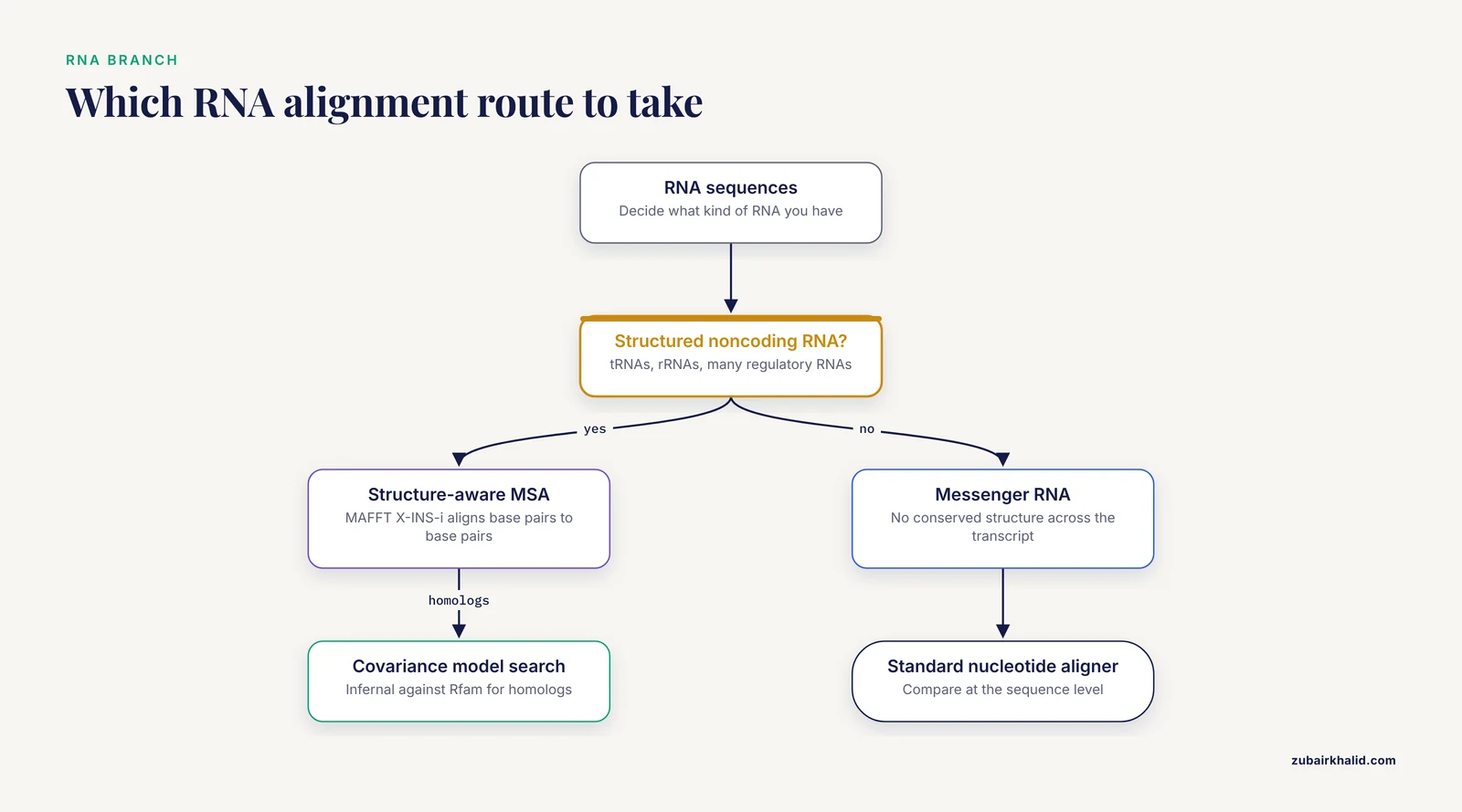
A transfer RNA from yeast and one from a bacterium may share under half of their nucleotides yet fold into the same cloverleaf. Aligning them as plain text destroys that signal. Structure-aware aligners, such as the X-INS-i framework inside MAFFT, incorporate RNA secondary structure predictions into the scoring so that base-paired positions align to base-paired positions. For homology search, covariance models as implemented in Infernal and curated in the Rfam database are the standard, because they score both sequence and the base-pairing pattern jointly. These are textbook standards rather than results from a single study, and they should be your default for structured noncoding RNAs such as rRNAs, tRNAs, and many regulatory RNAs.
For messenger RNA and other RNAs compared at the sequence level, standard nucleotide aligners are appropriate, since there is no conserved structure to respect across the whole transcript.
RNA from sequencing data and error handling
Third-generation sequencing platforms produce long reads but carry higher error rates, and most processing pipelines rely on multiple sequence alignment to manage those errors. A 2024 evaluation framework called MSA Limit was built to run and compare MSA methods under conditions representative of third-generation sequencing reads, measuring alignment accuracy, time, and memory [7]. Its findings are a useful corrective to tool tribalism: popular methods do not consistently perform best, and the most effective method varies with sequencing depth, genome characteristics, and read error patterns [7]. The practical takeaway is that there is no universally best MSA tool for error-prone long reads, so benchmark on data resembling your own before committing.
Noncoding RNAs with hidden coding past
Cross-molecule questions also reach into RNA. One computational method searched for remnants of protein-coding sequences within long intergenic noncoding RNAs (lincRNAs), testing the hypothesis that lincRNAs arise from pseudogenes, and identified 203 human lincRNA genes with regions significantly similar to protein-coding sequences [8]. That kind of evolutionary tracing depends on doing both nucleotide and translated protein comparisons correctly, and it illustrates why researchers who work on RNA keep protein tools in their toolbox [8].
Protein Alignment Tools
Protein alignment is where scoring sophistication matters most, because amino acid substitutions carry chemical meaning.
BLASTP, PSI-BLAST, and domain search
BLASTP compares a protein query against a protein database with a BLOSUM or PAM matrix, and for most identification tasks it is the first and often the last tool you need. When homologs are distant, PSI-BLAST builds a position-specific profile from an initial search and iterates, each round pulling in new sequences, which substantially increases sensitivity. The risk of PSI-BLAST is profile drift: if an early round pulls in a spurious sequence, later rounds amplify the error, so you must inspect every iteration.
For family and domain membership, profile hidden Markov models in HMMER against databases such as Pfam are the accepted standard. An alignment of homologs is the raw material for building these profiles, which makes the MSA tools below the foundation of protein family analysis.
One caution from downstream analysis: genes sharing a protein family domain show increased correlation in their expression counts, and using correlated domain-sharing genes as predictors measurably worsens classifier performance in RNA-seq machine learning analyses [9]. If your protein alignment work feeds into biomarker selection, this connection between domain sharing and prediction quality is worth internalizing.
Multiple sequence alignment for proteins
The workhorse protein MSA tools are MAFFT, MUSCLE, and Clustal Omega. MAFFT is generally the accuracy leader on difficult sets and offers multiple algorithms under one interface. MUSCLE and Clustal Omega are valued for speed and simple defaults on large datasets.
Clustal W, the older progressive alignment program, remains in active use inside scripted pipelines where its behavior is well characterized. A mitochondrial genomics tool called Canis MitoSNP used Clustal W to align dog and human mitochondrial DNA reference sequences gene by gene, so that each canine genomic position could be mapped to the corresponding human position, codon, amino acid, or RNA structure element, sparing users from manually extracting genes and translating them [10]. That example shows a mature, deliberate use of a classic tool: the goal was deterministic, reproducible positional mapping between two well-annotated genomes, not maximum accuracy on a hard family.
Structural alignment when sequence runs out
When sequence similarity is too weak for reliable residue-by-residue alignment, structure takes over. US-align is an open-source program for sequential and nonsequential structure comparison of proteins, RNAs, and DNAs, in pairwise and multiple alignment forms, for monomers and multimeric complexes, built on iterative superimposition guided by the length-independent TM-score [11]. Its notable design point is that it is the only protocol of its kind applicable across different molecular types, which supports template-based heteromolecular structure prediction and function annotation [11].
At the assembly level, VAST+ at NCBI compares two protein assemblies by clustering rotation matrices from pairwise protein-protein structural alignments, applies Monte Carlo refinement to trim alignments so that biologically relevant conformational differences stand out, and extends naturally to include RNA or DNA molecules [12]. For a protein question involving complexes, domain motion, or diverged homologs with a solved structure, structural alignment answers questions sequence alignment cannot.
Cross-Molecule Alignment: DNA to Protein and Back
Several of the most useful sequence alignment tools for dna rna protein work sit exactly between the molecule types.
BLASTX takes a nucleotide query, translates it in all six reading frames, and searches against a protein database. TBLASTN does the reverse, searching a protein query against a translated nucleotide database. These translated searches routinely find coding genes and remote homologs that nucleotide-level search misses, and they are the correct first move whenever you suspect a nucleotide fragment is a remnant of a coding gene, as in the lincRNA study discussed above [8].
Specialized tools exploit the relationship in the other direction. cRegions is a web-based tool that takes a multiple sequence alignment of a diverged protein-coding sequence and identifies regions where amino acid conservation is actually caused by conservation at the nucleotide level, which flags candidate cis-acting elements [13]. Applied to alphavirus polyproteins, it detected all known cis-acting elements, and across DNA and RNA viruses it has found splice sites, stem-loops, overlapping reading frames, internal promoters, and ribosomal frameshifting signals [13]. The insight behind cRegions is one of the most underused ideas in practical bioinformatics: an MSA of a protein can contain nucleotide-level signals if you look for the positions where codon-level constraint exceeds amino acid-level constraint [13].
How to Choose: Pros and Cons on the Criteria That Decide
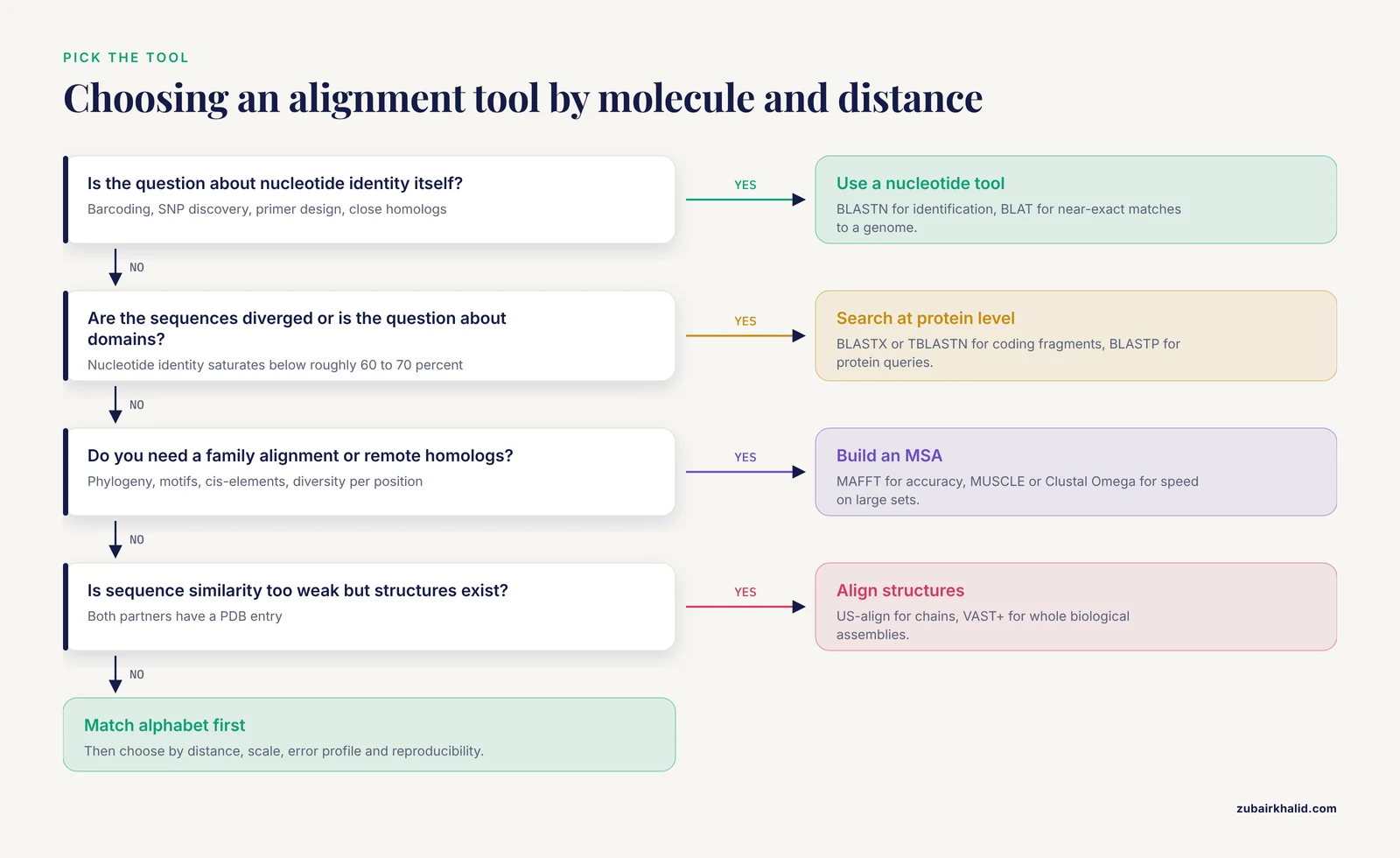
Comparing the best bioinformatics software for alignment comes down to six practical criteria.
1. Molecule and question match. Match the alphabet first. Nucleotide question, nucleotide tool. Protein question, protein tool. Coding question spanning both, translated search. Structured RNA question, covariance model or structure-aware MSA.
2. Evolutionary distance. Close homologs, use fast nucleotide tools like BLASTN or BLAT. Distant homologs, use protein search, PSI-BLAST, profile HMMs, or structural alignment. Regulatory elements too diverged to align may need model-based methods rather than alignment at all [6].
3. Scale. A few sequences, use a web server and inspect the alignment by eye. Thousands of reads, use a mapper. Genome-scale diversity analysis of an existing alignment, use tools built for it. DiMA, for example, processed an input alignment of over two million SARS-CoV-2 spike sequences plus smaller HIV pol datasets, applying Shannon entropy corrected for size bias over a user-defined k-mer sliding window and classifying each k-mer position into index, major variant, minor variant, and unique variant motifs [14]. You would not attempt that with a desktop MSA editor.
4. Error profile. Short reads, modern mappers handle the low error rates well. Third-generation long reads, error handling dominates, and the MSA Limit evaluation showed that method choice should be driven by depth, genome properties, and error pattern rather than reputation [7].
5. Output and interpretation. The alignment is only as useful as your ability to read it. MSABrowser, written entirely in JavaScript, runs in any modern browser without installation and co-visualizes pairwise or multiple alignments with genetic variations, post-translational modifications, and annotations such as protein domains, for DNA, RNA, or protein sequences [15]. For motif-level summary, sequence logo plots are the standard, and the EDLogo approach extends them to highlight both enrichment and depletion of characters with Empirical Bayes stabilization, applicable to DNA bases, RNA bases, or amino acids [16].
6. Reproducibility. Command-line tools with versioned databases beat interactive websites for anything you may need to repeat or publish. Note the version of the tool and the database build every time.
Worked Scenarios
Scenario 1: Identifying a barcoded plant sample
You have an ITS amplicon from an herbal medicine sample suspected of adulteration. Extract genomic DNA, PCR-amplify the ITS region, Sanger-sequence it, then run BLASTn against the nucleotide collection. Follow the published pattern: identify species by BLASTn, confirm with a UPGMA tree, and check that the barcode region actually diverges enough between candidate species, as ITS did with 22 percent divergence in the Smithia study versus 10.9 percent for psbA-trnH and 3.1 percent for rbcL [2]. If your candidate species are closer than your barcode locus can resolve, add a second chloroplast barcode rather than changing alignment tools [2].
Scenario 2: Tracking diversity in a viral outbreak
You have thousands of viral genome sequences already aligned and want to know where the variable spots are. Build your MSA with MAFFT, then run DiMA over the alignment. It returns quantitative, entropy-corrected diversity per k-mer position, decomposed into index sequences and their major, minor, and unique variants, and it accepts sequence metadata so you can stratify by lineage or date [14]. The same pipeline works for DNA, RNA, or protein alignments, which is exactly why tools that declare their alphabet support up front are easier to build workflows around [14].
Scenario 3: Building constructs in synthetic biology
You are designing a modular Golden Gate assembly platform and need to recycle fragments across many plasmid variants. The FRAGLER tool was built for this exact workflow, performing codon optimization, multiple sequence alignment, and automated generation of reusable fragments, and its developers used it to generate SARS-CoV-2 protein reagent plasmids and parallelized libraries of chimeric antigen receptor variants [17]. The point for tool selection is that MSA inside an engineering pipeline has different requirements than MSA for phylogenetics: determinism and automation matter more than squeezing out the last percent of alignment accuracy [17].
Scenario 4: Auditing a genome annotation
You suspect mispredicted intron boundaries in a newly annotated eukaryotic genome. Align the genomic sequences with a set of full-length cDNA or CDS transcripts using Spaln together with Prrn5 to build a gene-structure-aware MSA, and inspect columns where transcript evidence and gene prediction disagree [5]. This workflow requires no annotation files and no external tools beyond the two programs [5].
Scenario 5: Annotating transcripts from an unsequenced organism
You have ESTs from a cDNA library of a non-model organism. After quality trimming and clustering, annotate the unique sequences by BLAST against curated databases, following the earthworm EST workflow that used phred and crossmatch for processing, clustering into contigs and singletons, BLAST against KEGG with an E-value cutoff of 1e-8, and Gene Ontology annotation of the hits [18]. The alignment step here is a lookup, and the E-value threshold is a policy decision you should state in your methods.
Scenario 6: Comparing two protein complexes with weak sequence identity
Your proteins are too diverged for a trustworthy sequence MSA but both have structures in the PDB. Run US-align for pairwise and, if needed, multiple structural comparison, which handles both sequential and nonsequential (circularly permuted or domain-rearranged) topologies and reports a TM-score you can compare across pairs [11]. For full biological assemblies rather than single chains, use VAST+ through the NCBI Structure site by entering a PDB accession and following the VAST+ link [12].
A Short Practical Command Sketch
For readers who want concrete starting points, these are standard invocations from each tool's own documentation. Check current flags in the official manual for your version.
BLASTN against the nucleotide database:
blastn -query myseq.fa -db nt -out results.txtA multiple sequence alignment with MAFFT using automatic strategy selection:
mafft --auto input.fasta > aligned.fastaA protein database search:
blastp -query prot.fa -db swissprot -out hits.txtKeep inputs in FASTA format, keep one query set per file, and record the database version date in your notebook. Every serious pipeline log should let a stranger reproduce the exact alignment.
Common Mistakes and Limitations
Using BLASTN for distant homologs. Nucleotide identity erodes roughly several times faster than amino acid identity over deep evolutionary time because much of the nucleotide divergence is synonymous. If BLASTN returns nothing meaningful, translate and search at the protein level before concluding there is no homolog.
Aligning structured RNAs as plain text. A text MSA of diverged tRNAs or rRNAs will misalign the base-paired stems. Use structure-aware MSA modes or covariance model search.
Trusting a single MSA program on hard datasets. Different MSA tools disagree most in the regions you care about, the poorly conserved ones. The MSA Limit results showing that method ranking changes with sequencing depth and error pattern [7] apply equally to ordinary MSA practice: if a downstream conclusion hinges on a specific alignment region, check that the region survives a second aligner.
Confusing percent identity with homology. Two 30-meter stretches of poly-A tract are near-identical and meaningless. Look at alignment length, E-value, and whether the match covers a conserved domain.
Forgetting introns when comparing eukaryotic genes. A nucleotide MSA of genomic sequences across species scrambles exon boundaries. Use gene-structure-aware alignment when intron positions matter [5].
Reading raw BLAST tabular output at scale. Thousands of hits in plain text hide structure. Heat map and interactive visualizations exist precisely for this, as the BLASTmap developers demonstrated for large-scale probe design [3].
Interpreting alignment columns without annotations. An MSA column only means something in context. Overlay domains, variants, and modifications on the alignment with a viewer such as MSABrowser before drawing conclusions [15].
Applying diversity statistics without size correction. Shannon entropy per column is biased by the number of sequences sampled, which matters enormously when comparing a two-million-sequence alignment against a two-thousand-sequence alignment. Use size-corrected measures when comparing diversity across datasets of different depths.
Assuming alignment solves regulatory DNA. Conserved cis-regulatory elements often lie beyond the reach of sequence alignment over large distances. Language-model approaches trained across hundreds of species capture some of these elements where alignment cannot [6], though their outputs require validation and do not replace alignment where alignment works.
Letting protein domains contaminate machine learning. If alignments feed feature selection for prediction models, remember that domain-sharing genes are correlated and reduce classifier performance, so diversify feature sets [9].
Assuming codon conservation means amino acid conservation or vice versa. The whole premise of cRegions is that these conservation patterns dissociate, and the dissociation is exactly where cis-elements hide [13]. Check which level your signal lives at before annotating function.
One general limitation applies to all of the above: an alignment is a model, not a truth. Individual datasets, especially short or repetitive sequences, can produce ambiguous alignments that no tool resolves, and those cases need expert review of the underlying evidence.
Frequently Asked Questions
Can I use the same alignment tool for DNA, RNA, and protein sequences?
Sometimes, but rarely well. Programs like MAFFT accept all three alphabets and adjust their scoring, and viewers like MSABrowser display all three. However, structured RNA homology needs covariance models, deep protein homology needs substitution matrices and profiles, and large-scale read mapping needs dedicated mappers. Matching the tool to the molecule is the single highest-leverage decision in the workflow.
What is the best sequence alignment tool for DNA, RNA, and protein sequences overall?
There is no single best tool, and the evidence supports that conclusion rather than contradicting it. Systematic evaluations of MSA methods under third-generation sequencing conditions found that the most effective method varies with sequencing depth, genome characteristics, and error pattern [7]. Start with BLAST for identification, MAFFT for multiple alignment, HMMER or PSI-BLAST for distant protein homology, and a structure aligner such as US-align when sequences are too diverged but structures exist [11].
When should I align nucleotide sequences instead of translated protein sequences?
Align nucleotides when the nucleotide identity itself is the question, for example species barcoding, SNP discovery, primer design, or comparing close homologs [2]. Translate and align proteins when sequences are diverged, when you care about conserved domains, or when reading frame and codon structure are the objects of interest. For coding fragments of unknown status, run both a nucleotide and a six-frame translated search.
Do I need a special tool for RNA alignment?
For messenger RNA compared at the sequence level, no. For structured noncoding RNAs such as tRNAs, rRNAs, and many regulatory RNAs, yes, because structure conservation outlasts sequence conservation, and only structure-aware aligners and covariance model search preserve the base-pairing signal.
How do I choose between pairwise alignment and multiple sequence alignment?
Use pairwise alignment to answer whether two sequences match, and multiple sequence alignment to answer where a family agrees. If you plan to build a phylogeny, find motifs, detect cis-elements [13], or quantify diversity per position [14], you need an MSA from the start, because all of those analyses operate on alignment columns.
How do I check whether my alignment is good?
Inspect the conserved regions against known biology first. For proteins, check that catalytic residues and conserved glycines or cysteines line up, and overlay domains and modifications in a viewer [15]. For nucleotides, check codon integrity in coding regions and splice boundaries against transcript evidence [5]. For difficult datasets, repeat the alignment with a second program and treat regions that agree as reliable, regions that disagree as uncertain. Sequence logo plots that show both enrichment and depletion per column are a fast visual sanity check [16].
Sources
- Complete genome sequence and phylogenetic analysis of nosocomial pathogen Acinetobacter nosocomialis strain NCTC 8102.
- Molecular Authentication of the Traditional Medicinal Plant "Lakshman Booti" (Smithia conferta Sm.) and Its Adulterants through DNA Barcoding.
- BLASTmap: A Shiny-Based Application to Visualize BLAST Results as Interactive Heat Maps and a Tool to Design Gene-Specific Baits for Bespoke Target Enrichment Sequencing.
- SARS-CoV-2 orf1b Gene Sequence in the NTNG1 Gene on Human Chromosome 1.
- Cooperation of Spaln and Prrn5 for Construction of Gene-Structure-Aware Multiple Sequence Alignment.
- Species-aware DNA language models capture regulatory elements and their evolution.
- Automated evaluation of multiple sequence alignment methods to handle third generation sequencing errors.
- Identification of transcribed protein coding sequence remnants within lincRNAs.
- Genes sharing the protein family domain decrease the performance of classification with RNA-seq genomic signatures.
- Canis MitoSNP database: a functional tool useful for comparative analyses of human and canine mitochondrial genomes.
- A graphic and command line protocol for quick and accurate comparisons of protein and nucleic acid structures with US-align.
- Biological Assembly Comparison with VAST.
- cRegions-a tool for detecting conserved cis-elements in multiple sequence alignment of diverged coding sequences.
- DiMA: sequence diversity dynamics analyser for viruses.
- MSABrowser: dynamic and fast visualization of sequence alignments, variations and annotations.
- A new sequence logo plot to highlight enrichment and depletion.
- FRAGLER: A Fragment Recycler Application Enabling Rapid and Scalable Modular DNA Assembly.
- Construction of a cDNA library and preliminary analysis of the expressed sequence tags of the earthworm Eisenia fetida (Savigny, 1826).