Speed vs. Accuracy in Sequence Alignment
By Dr. Zubair Khalid, DVM, MS, PhD ·

Sequence alignment speed measures how fast a tool converts input sequences into an alignment, while accuracy measures how closely that output matches the biologically correct alignment. The two compete because every shortcut that saves computation can also discard evidence. The rule of thumb for choosing is simple: screen fast, finalize accurately. Use fast heuristic tools to reduce large datasets to a manageable candidate set, then run the most accurate method your time budget allows on the sequences that will carry your conclusions.
This guide explains where the trade-off comes from, compares the major tool families side by side, and works through the decisions that separate a quick exploratory run from a defensible final alignment. It is written for students, analysts, and researchers who need to pick an aligner and defend the pick.
What Speed and Accuracy Mean in Sequence Alignment
The difference between sequence alignment speed and accuracy is easiest to see at the extremes. A tool that reports an answer in seconds but misplaces half the columns is fast and useless. A tool that produces a perfect alignment of two short sequences is accurate and irrelevant when you have a billion reads. Real projects live between those extremes, so both terms need precise definitions.
Speed is wall-clock runtime and throughput, reported as sequences per second, reads per hour, or total runtime on a defined dataset. Memory footprint belongs here too, because a method that exhausts available RAM is effectively infinitely slow. Three factors drive speed. Algorithmic complexity sets the baseline, since exact pairwise alignment fills a scoring matrix whose size grows with the product of the two sequence lengths. Implementation quality multiplies or divides that baseline, because SIMD vectorization, multithreading, and GPU offload change runtime by orders of magnitude without changing the underlying algorithm [1][2]. Hardware sets the ceiling, since identical code runs very differently on a laptop, a 28-core server, or a GPU.
Accuracy is fidelity to a trusted reference. For pairwise alignment, exact dynamic programming methods are optimal by construction under their scoring system, so accuracy questions shift to the scoring system itself, meaning the match and mismatch scores and the gap penalties. For multiple sequence alignment, abbreviated MSA, the alignment of three or more DNA, RNA, or protein sequences arranged in rows with gaps so that homologous residues share a column, accuracy is estimated against curated reference sets such as BAliBASE. The two standard metrics are the sum-of-pairs score, the fraction of correctly aligned residue pairs recovered, and the total column score, the fraction of complete alignment columns recovered exactly [3][4].
Accuracy also has direction. Sensitivity describes whether true homologous regions are found at all. Precision describes whether reported alignments correspond to real homology. Screening tools are usually tuned for sensitivity, while final-alignment tools aim for both.
MSA output feeds phylogenetic tree construction, protein secondary and tertiary structure analysis, and function prediction, which is why alignment errors propagate into nearly every downstream inference [5].
One subtlety reframes the whole topic. An alignment can be optimal under its scoring system and still be biologically wrong, because every scoring system is an approximation of evolution. Speed and accuracy are therefore not two ends of a single dial. They interact with a third variable, the scoring model, and all three deserve attention when you evaluate a tool.
Why the Trade-Off Exists

The competition between speed and accuracy has a precise computational origin, and knowing that origin tells you which shortcuts are safe for your data.
Exact pairwise alignment by dynamic programming, the Needleman-Wunsch algorithm for global alignment and the Smith-Waterman algorithm for local alignment, costs time proportional to the product of the two sequence lengths. Two sequences of a few thousand bases align in milliseconds. Every read in a high-throughput dataset against every sequence in a large reference database does not scale, because the number of comparisons multiplies the per-comparison cost into prohibitive territory.
Multiple sequence alignment is worse. Finding the alignment that maximizes the sum-of-pairs score across many sequences is NP-complete, so no exact method can scale, and every practical MSA tool is a heuristic compromise. Each heuristic family buys speed by making a different assumption, and each assumption fails in a characteristic way.
Progressive alignment, the Clustal lineage, builds a guide tree, aligns the closest pairs first, then merges profiles in a single pass. It is fast. Its weakness is error propagation, because a mistake made early in the guide tree is frozen into every later step.
Iterative refinement, used by MUSCLE and by several MAFFT modes, starts from a progressive alignment and revises it through repeated passes. The extra passes trade time for accuracy.
Consistency-based scoring, used by T-Coffee, ProbCons, and MAFFT L-INS-i, computes many pairwise alignments and rewards column assignments that agree across them. These methods sit at the top of accuracy benchmarks and near the bottom of speed rankings [4].
Seeding and filtering, the BLAST strategy, indexes short words from the reference and extends full alignments only from word hits. This converts a database-wide scan into a targeted lookup. The speed gain is enormous. The cost is that true homology without a detectable seed hit can be missed, so sensitivity becomes a tunable parameter rather than a guarantee.
Scoring design sits inside the trade-off as well. Affine gap costs, a penalty for opening a gap plus a smaller penalty for each extension, model indel biology better than simple linear costs. Richer schemes such as piecewise linear gap costs improve accuracy further at some computational cost [4].
Memory is the quiet fourth factor. Dynamic programming matrices grow quadratically with sequence length, and memory-saving formulations such as Hirschberg's divide-and-conquer method trade extra computation for a smaller footprint, a trade Spaln3 exploited on its way to large speedups [1].
Finally, some systems manage the trade-off explicitly instead of picking one fixed point. Multi-level alignment runs a fast coarse pass and escalates to accurate fine passes only where the coarse pass flags uncertainty, an adaptive control strategy formalized for document comparison [7]. That coarse-screen-then-verify pattern drives most production bioinformatics pipelines, and it is the single most useful idea in this article.
Sequence Alignment Speed vs. Accuracy: Side-by-Side Comparison
The table below is the core of this article. No row wins everywhere, and the right choice depends on the task, the data volume, and the cost of an error.
| Approach | Representative tools | Task | How it gains speed | How it protects accuracy | Best suited for | Main caveat |
|---|---|---|---|---|---|---|
| Exact dynamic programming | Needleman-Wunsch (global), Smith-Waterman (local) | Pairwise | None, optimal by design | Provably optimal score under its scoring system | Gold-standard checks, short sequences, benchmark truth | Quadratic time, unusable for all-vs-all database search |
| Vectorized exact alignment | Parasail, SeqAn, GASAL2, NVBIO | Pairwise at sequencing scale | SIMD lanes, GPU parallelism, sequence packing [2] | Same optimal scores as exact dynamic programming | High-throughput pairwise scoring and filtering | Needs capable hardware and integration work |
| Seed-and-extend search | BLAST family, MALT | Read and reference screening | Word hits seed only promising extensions [8] | Tunable seed and extension parameters | Metagenomic binning, large reference searches | Homology without a seed hit can be missed |
| Progressive MSA | Clustal Omega | MSA of many sequences | Guide tree and single pass | Profile scoring, optional iteration | Quick alignments of large families | Early errors propagate through the tree |
| Iterative refinement MSA | MUSCLE, MAFFT (progressive modes) | MSA with balanced needs | Progressive start plus refinement passes [6] | Refinement corrects early errors | Everyday MSA work | Slower than pure progressive, faster than consistency methods |
| Accuracy-first MSA | MAFFT L-INS-i, T-Coffee, ProbCons, PRIME | Publication-quality MSA | Restricted alignment zones, optimized group-to-group dynamic programming [4] | Consistency scoring, piecewise linear gap costs [4] | Phylogenetics, structure modeling, final figures | Runtime and memory grow steeply with sequence count and length |
| Domain-specific aligners | TM-Aligner, GMAP, GSNAP, Spaln3 | Specialized mapping tasks | Seeding and dynamic programming variants tuned to the task [9][1][10] | Models matched to the biology of the target class | Transmembrane proteins, genome mapping, spliced alignment | Narrow scope, not general-purpose |
| Alignment-free comparison | k-mer methods, DV-curve, ML-DSP | Composition and classification | No alignment computed at all [11][12] | Feature design and trained models | Whole-genome phylogeny, rapid classification | No residue-level alignment is produced |
| Optical acceleration | HELIOS, HAWPOD | Pairwise DNA, RNA, and protein alignment | Wavelength and polarization parallelism in optics [13][14] | Accuracy validated against classical methods in simulation | Future high-throughput hardware | Simulation-stage, not standard laboratory equipment |
Three patterns in the table deserve emphasis. First, the exact methods never left. They were accelerated rather than replaced, and vectorized implementations now deliver optimal pairwise scores at sequencing scale [2]. Second, accuracy-first MSA methods earn their runtime by spending it where it matters, on consistency checks and richer gap models [4]. Third, alignment-free methods escape the trade-off by refusing to align at all, a legitimate strategy when the question does not require residue-level correspondence [12].
Exact Methods: When the Alignment Must Be Defensible
Smith-Waterman local alignment and Needleman-Wunsch global alignment remain the reference standard for pairwise work. Their guarantee is precise. Under the chosen scoring system, the returned alignment is optimal. The dynamic programming matrix stores the best score for every pair of prefixes, and a traceback step recovers the alignment itself, so nothing is left to chance except the scoring values you supply.
That guarantee makes exact methods the tool of record for three jobs: verifying a hit found by a fast screener, benchmarking new methods against a known optimum, and any pairwise comparison short enough to run exhaustively. Semi-global variants, which align one sequence fully inside the other while ignoring overhanging ends, cover the common case of a short query against a long reference.
The historical problem was speed. The modern answer is to keep the algorithm and accelerate the implementation. SIMD, short for single instruction, multiple data, computes many dynamic programming matrix cells per processor cycle. Libraries such as SeqAn and Parasail brought SIMD exact alignment to commodity CPUs [2]. GASAL2 moved the same computation to GPUs, with specialized kernels for local, global, and semi-global alignment, with or without traceback, and asynchronous execution that overlaps CPU and GPU work [2].
The measured gains show how much headroom implementation alone provides. On a GeForce GTX 1080 Ti, GASAL2 ran up to 21 times faster than Parasail on a dual-socket, hyper-threaded 28-core Intel Xeon system for queries up to 300 bases, and up to 13 times faster than NVIDIA's NVBIO library for 100-base queries, while its GPU-side sequence packing ran up to 750 times faster than NVBIO [2]. Plugged into BWA-MEM, it accelerated the local alignment step 20-fold, which translated into an overall application speedup of 1.3 times against a 12-thread CPU run [2].
The lesson generalizes. Hardware acceleration shifts the speed side of the trade-off without touching accuracy, because the computation is unchanged. It does not abolish the trade-off, it moves the frontier of what is feasible, and it applies only to the pairwise step of a pipeline, which is why an end-to-end speedup is smaller than the speedup of its hottest step.
Heuristic Screening: Where Speed Earns Its Keep
When the dataset is millions or billions of reads, exhaustive alignment is off the table, and seed-and-extend search is the workhorse. The tool indexes short words from the references, finds word hits in the queries, and spends full alignment effort only on promising extensions. Sensitivity is a dial controlled by seed length and spacing, and the art of using these tools is choosing a sensitivity floor your analysis can tolerate.
The characteristic failure mode is a missed homology, a true relationship with no seed hit strong enough to trigger extension. Mitigations include shorter seeds, multiple seed models, translated search that compares at the protein level to absorb synonymous codon changes, and a sensitivity floor validated on known positives before the full run.
MALT, the MEGAN Alignment Tool, illustrates what a speed-first design delivers on real data. It processes hundreds of millions of sequencing reads within a few hours, implements a taxonomic binning algorithm that assigns reads to bacterial species, and integrates tightly with MEGAN for interactive analysis [8]. In a demanding test, it aligned metagenomic samples from the 5,300-year-old Tyrolean Iceman and recovered the weak signal of the original oral and lung microbiomes despite a strong environmental background [8].
When to Use Sequence Alignment Speed First
Speed-first choices are correct in three situations. The dataset is too large for exhaustive methods, as in metagenomic screening. The downstream analysis aggregates over many reads, so a modest per-read sensitivity floor washes out statistically. The goal is exploration, meaning candidate generation for later verification rather than final evidence. In each case the fast tool performs triage, and the accuracy-critical work happens later on the shortlist.
Multiple Sequence Alignment: The Clearest Speed-Accuracy Spectrum
MSA is where the trade-off is most visible, because the underlying problem is NP-hard and every tool embodies a different compromise. A survey of the field counted 103 free MSA tools and observed that many techniques maximize speed while ignoring alignment accuracy, while others prioritize accuracy over speed, which makes tool selection genuinely difficult for non-specialists [15].
The major programs occupy distinct points on the spectrum.
MUSCLE was designed to improve both dimensions at once. Edgar's implementation combined a progressive stage with iterative refinement and delivered accuracy competitive with the slower T-Coffee on standard benchmarks at a fraction of its runtime, improving on ClustalW in both speed and accuracy [6]. That combination made it a default for routine MSA work for years.
PRIME pushed the accuracy end of the middle ground. Its group-to-group alignment algorithm with a piecewise linear gap cost optimizes the sum-of-pairs score directly, and benchmark tests on BAliBASE 3.0 and PREFAB 4.0 showed accuracy comparable to the most accurate programs available, including MAFFT L-INS-i, ProbCons, and T-Coffee, without relying on consistency-based pairwise information [4]. Later development improved both the speed and the accuracy of the program further.
The standard evaluation protocol appears in a four-way comparison of MAFFT, Clustal Omega, MUSCLE, and ProbCons on BAliBASE 3.0, which recorded the sum-of-pairs score, the total column score, and execution time for each method [3]. That trio of measurements, pair recovery, column recovery, and runtime, is the template for any rigorous bioinformatics tools comparison.
Domain specialization is the other route past the trade-off. TM-Aligner targets transmembrane proteins, estimated to constitute roughly 30 percent of proteins at genomic scale and difficult to align well with general tools. Built on the Wu-Manber string matching algorithm combined with dynamic programming, it was benchmarked against three reference sets, BAliBASE 3.0 reference set 7 for alpha-helical transmembrane proteins, structure-based alignments from Pfam, and structure alignments from GPCRDB, and showed the least turnaround time among compared tools with improvements over accurate general methods such as PROMALS and MAFFT [10]. Matching the algorithm to the biology bought speed and accuracy together.
Third-generation sequencing adds a modern twist. Long reads carry error profiles that differ sharply from short-read data, and an automated pipeline called MSA_Limit now evaluates MSA methods under conditions representative of those reads, measuring alignment accuracy, time efficiency, and memory use across real and simulated datasets [16].
Genome Mapping and Spliced Alignment
Genome-scale alignment adds its own constraints. A transcript or a protein must be mapped onto a genome of billions of bases, introns interrupt the correspondence, and the alignment model must permit very long gaps that represent introns rather than errors. Ordinary read aligners and ordinary MSA tools handle neither requirement well.
GMAP and GSNAP are long-standing tools for genomic sequence alignment whose development has focused explicitly on enhancements to speed, accuracy, and functionality, with GMAP handling mRNA and EST alignments to genomes and GSNAP addressing spliced short-read RNA-seq data [9].
Spaln3 shows how algorithmic refinement and hardware awareness combine. Its dynamic programming core was sped up in two ways, through a multi-intermediate unidirectional Hirschberg method that reduces memory traffic and through SIMD-based vectorization. The result is roughly 7 times faster than the previous Spaln version 2, with gene prediction accuracy consistently higher than Miniprot in its benchmarks [1]. This is the current shape of progress in alignment software, less a new heuristic family than a better-engineered version of an established one.
Alignment-Free Methods: Skipping the Alignment Entirely
A third path avoids the trade-off by not aligning. Alignment-free methods compare sequences through features such as word frequencies, signal transforms, or learned representations, and they have been applied to problems ranging from whole-genome phylogeny to protein family classification, identification of horizontally transferred genes, and detection of recombined sequences [12]. Their strength is speed and robustness on large NGS datasets and on sequences too divergent or too rearranged for reliable alignment.
ML-DSP, a fusion of machine learning and digital signal processing, demonstrates the ceiling of this approach for classification tasks. Applied to 7,396 complete mitochondrial genomes, it achieved average classification accuracy above 97 percent from kingdom to genus level, and it outperformed the alignment-centric MEGA7 workflow using MUSCLE or CLUSTALW on processing speed while reaching similar or superior accuracy [11].
The boundary is equally clear. Alignment-free methods answer similarity and classification questions. They do not produce residue-level correspondences, so they cannot support a phylogeny with column-level support values, a structural model, or a mutation-level interpretation. Use them to route and classify, then align the subsets that need residue-level evidence.
Hardware Frontiers: SIMD, GPUs, and Optics
Most of this article concerns algorithms. The frontier also includes hardware, and optical computing is its most radical branch.
HELIOS is an all-optical high-throughput method for pairwise alignment of DNA, RNA, and protein sequences. It exploits wavelength and polarization of optical beams for parallel operation, uses optical operations to locate matches, single and multiple mutations, and single and multiple indels, and was validated through behavioral and optical simulation studies with performance estimated analytically. Its reported pairwise alignments were highly similar to those of Smith-Waterman, Needleman-Wunsch, BLAST, MUSCLE, ClustalW, Clustal Omega, T-Coffee, Kalign, and MAFFT, and its estimated performance exceeded alternative electrical and optical architectures [13].
An earlier optical design paired an optical correlator for global alignment with an extended DV-curve method for local alignment, was validated in electromagnetic simulations, and was reported to run much faster than electrical counterparts such as BLAST [14].
These systems remain simulation-stage, and none sits in a production pipeline today. They matter for a different reason. They show that the speed side of the trade-off can be attacked below the algorithm layer, and that a physically parallel implementation can track classical methods closely in simulation [13]. If such hardware matures, the practical meaning of fast changes for everyone.
How to Decide: Speed or Accuracy in Sequence Alignment
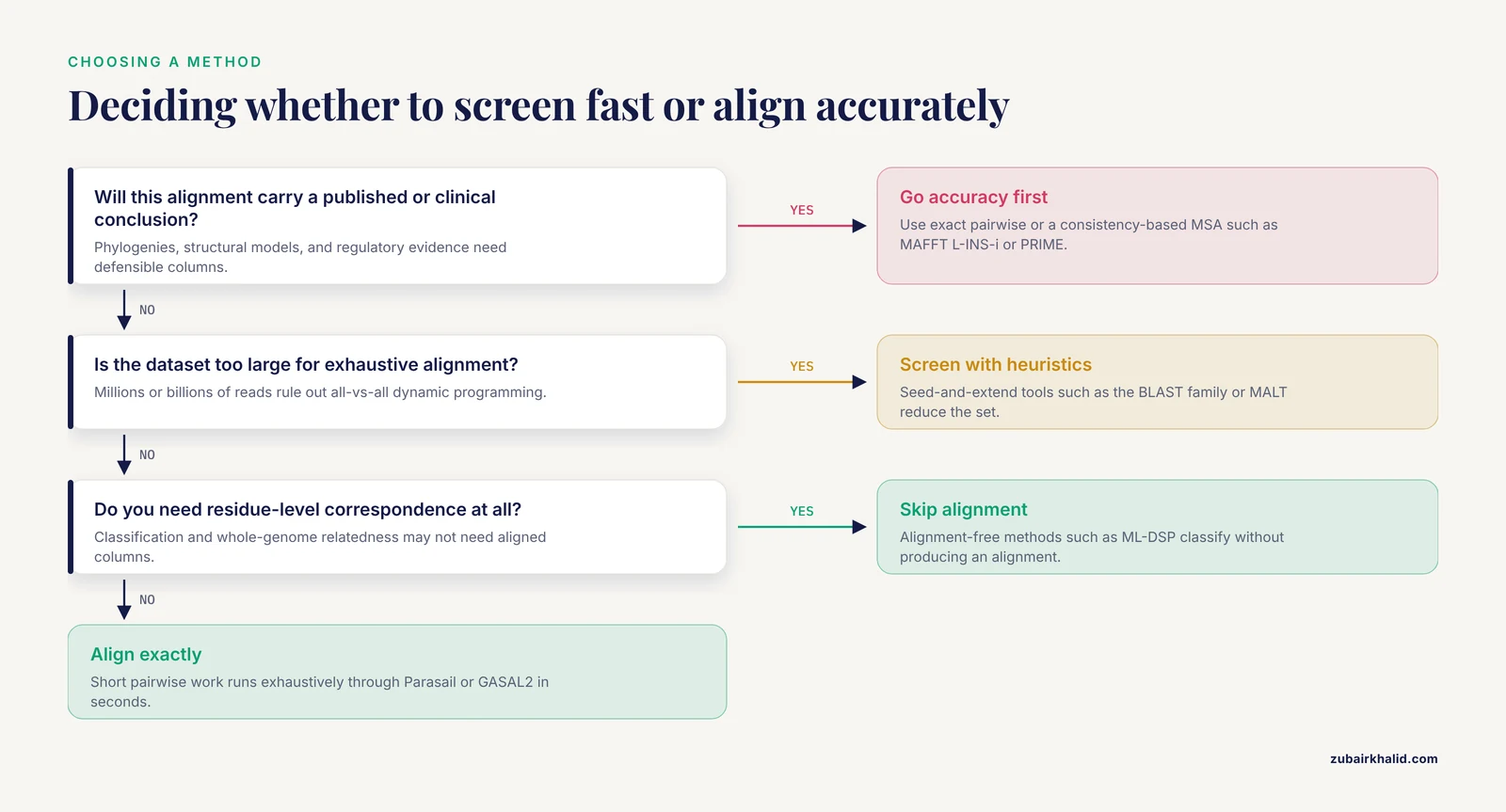
Five questions resolve most decisions.
- What question does the alignment answer? Candidate generation tolerates heuristics. Published phylogenies, structural models, and clinical or regulatory evidence do not.
- How large is the data? Sequence count and length determine whether exact or accuracy-first methods are even runnable.
- What does an error cost? An error in a screen costs compute time. An error in a final alignment costs a wrong conclusion.
- What hardware is available? SIMD and GPU libraries move the feasible frontier for exact pairwise work [2].
- Can the work be staged? A fast screen followed by accurate verification captures most of the speed benefit while concentrating accuracy where it counts.
The best bioinformatics software for alignment is therefore task-relative. The honest answer to "which tool is best" is "best for which of these five answers," and any claim that skips the question is marketing rather than guidance.
Worked Scenarios
Scenario 1: Metagenomic screening of hundreds of millions of short reads against a reference database. Speed first. A MALT-class tool aligns the reads and bins them taxonomically within hours, with results flowing into MEGAN for analysis [8]. The sensitivity floor set by seed parameters is acceptable because taxonomic conclusions aggregate over many reads.
Scenario 2: A 200-sequence protein family destined for a published phylogeny. Accuracy first. A consistency-based or high-accuracy iterative method such as MAFFT L-INS-i or PRIME is the appropriate class, since these sit at the top of BAliBASE and PREFAB benchmarks [4]. Runtime is affordable at this scale, and alignment errors would contaminate the tree.
Scenario 3: Verifying a single suspicious hit from a fast screen. Exact pairwise alignment through a SIMD or GPU library such as Parasail or GASAL2 returns the optimal score under the scoring system in seconds [2]. There is no reason to accept a heuristic answer when the exhaustive answer costs seconds.
Scenario 4: Spliced alignment of protein sequences to a mammalian genome for gene prediction. Use a purpose-built spliced aligner such as Spaln3, which was engineered for exactly this task [1].
Scenario 5: Classifying thousands of mitochondrial genomes by taxonomic level. An alignment-free classifier such as ML-DSP handles the job faster than alignment-centric workflows and avoids alignment errors entirely at this stage [11].
Scenario 6: A new long-read dataset with an unknown error profile. Benchmark before committing. Run an evaluation pipeline such as MSA_Limit on a representative subset and choose the MSA method based on your own sequencing depth, genome characteristics, and error pattern, because published rankings may not transfer [16].
For any comparison between two candidate tools on your own sequences, a visual cross-check is a practical final step. SinicView overlays the outputs of different nucleotide alignment tools and scores their agreement in fixed windows using the sum-of-pairs method, which helps you judge whether poorly aligned regions are genuinely non-homologous or merely artifacts of one tool or scoring system [17].
Common Mistakes and Limitations
Treating one benchmark as universal. Reference sets are curated and finite, and evaluation across third-generation read conditions found that popular methods are not consistently optimal, with the best choice depending on sequencing depth, genome characteristics, and error patterns [16]. Benchmark on data that resembles yours before committing.
Confusing alignment score with alignment accuracy. A high score certifies optimality under the scoring system, not biological correctness. Scoring systems approximate evolution, and a better-scoring alignment can still misplace columns.
Running fast tools with default parameters for final results. Defaults in screening tools favor throughput. For the final pass, tune seed parameters, gap penalties, and scoring matrices to your data, or hand the shortlist to an accuracy-first method.
Using global alignment on sequences with long indels. Global MSA methods perform better on families of similar length, while local approaches perform better when some sequences carry long insertions or deletions relative to others [4]. Match the alignment mode to the expected indel structure.
Ignoring the scoring model as a variable. Gap cost design materially changes accuracy, as the gains from piecewise linear gap costs demonstrate [4]. Two tools with identical algorithms but different gap models can produce different alignments.
Generalizing speedups across hardware. Reported accelerations are tied to specific processors, query lengths, and implementations, so a published speedup figure does not predict your runtime [2]. Treat published speedups as hypotheses to verify on your own hardware.
Reading accuracy metrics without their reference. Sum-of-pairs and total column scores measure recovery of a curated reference alignment, which itself embeds expert assumptions [3]. High benchmark scores indicate agreement with the reference, not access to ground truth.
Overlooking alignment-free options. When the question is classification or whole-genome relatedness, forcing an alignment adds cost without adding evidence [12].
Assuming newer tools beat older ones everywhere. Domain fit beats novelty. TM-Aligner's gains came from matching its algorithm to transmembrane protein structure, not from general-purpose superiority [10].
The overarching limitation is transferability. Every dataset differs in size, divergence, indel structure, and error profile, so pilot any pipeline on a representative subset before committing to it, and re-validate whenever the data changes.
Frequently Asked Questions
What is the difference between sequence alignment speed and accuracy?
Speed is runtime and throughput, how fast a tool processes your sequences. Accuracy is fidelity, how closely the output matches the biologically correct alignment. Speed depends on the algorithm, the implementation, and the hardware, while accuracy depends on the algorithm class and the scoring model. The two compete because speed comes from shortcuts, and shortcuts can discard evidence.
Should I prioritize speed or accuracy in sequence alignment?
Screen fast, finalize accurately. Large exploratory datasets tolerate fast heuristic tools because downstream analysis aggregates over many candidates. Small, decision-driving alignments deserve the most accurate method your time budget allows, because alignment errors propagate into phylogenies, structural models, and functional predictions.
Which sequence alignment tool is the fastest?
No single tool is fastest across all tasks. Seed-and-extend searchers lead for screening large read sets against references. GPU-vectorized dynamic programming libraries lead for exact pairwise scores at scale. Alignment-free methods are fastest of all when no residue-level alignment is needed.
Which sequence alignment tool is the most accurate?
For pairwise alignment, exact dynamic programming is optimal under its scoring system. For multiple sequence alignment, consistency-based and high-accuracy iterative methods such as MAFFT L-INS-i, T-Coffee, ProbCons, and PRIME sit at the top of standard benchmarks. Domain-specific tools can beat general ones on their own target class, and rankings shift with the data, so verify on your own sequences.
Can you get both high speed and high accuracy in sequence alignment?
Partly. Hardware acceleration through SIMD and GPUs raises speed without changing accuracy for exact methods. Two-stage pipelines deliver most of the speed benefit while concentrating accuracy where it counts. For multiple sequence alignment, the most accurate settings still cost real time, and no tool currently tops both rankings at once.
Are alignment-free methods a replacement for sequence alignment?
No. Alignment-free methods answer similarity and classification questions quickly and scale well, but they produce no residue-level correspondences. Use them for screening, classification, and whole-genome comparison, and use alignment when you need column-level evidence for phylogeny, structure, or mutation interpretation.
Sources
- Spaln3: improvement in speed and accuracy of genome mapping and spliced alignment of protein query sequences
- GASAL2: a GPU accelerated sequence alignment library for high-throughput NGS data
- Performance Evaluation of Leading Protein Multiple Sequence Alignment Methods
- Improvement in accuracy of multiple sequence alignment using novel group-to-group sequence alignment algorithm with piecewise linear gap cost
- Performance Analysis of Multiple Sequence Alignment Tools
- MUSCLE: multiple sequence alignment with improved accuracy and speed
- Multi-Level Sequence Alignment : An Adaptive Control Method Between Speed and Accuracy for Document Comparison
- MALT: Fast alignment and analysis of metagenomic DNA sequence data applied to the Tyrolean Iceman
- GMAP and GSNAP for Genomic Sequence Alignment: Enhancements to Speed, Accuracy, and Functionality
- TM-Aligner: Multiple sequence alignment tool for transmembrane proteins with reduced time and improved accuracy
- Enhancing Classification Accuracy and Speed with ML-DSP: A Game-Changer in Genomic Sequence Analysis
- Alignment-free sequence comparison: benefits, applications, and tools
- HELIOS: High-speed sequence alignment in optics
- High Speed All-optical extended DV-Curve-based DNA sequence alignment utilizing wavelength and polarization modulation
- An Enhanced Web-based Tools for Multiple Sequence Alignment: A Comparative Approach
- Automated evaluation of multiple sequence alignment methods to handle third generation sequencing errors
- SinicView: A visualization environment for comparisons of multiple nucleotide sequence alignment tools