Secure Transfer of Large Genomic Files
By Dr. Zubair Khalid, DVM, MS, PhD ·

The one-sentence difference between methods is this: encrypted command-line transfer moves a file point-to-point between two machines you control, while managed transfer services, cloud object storage, and federated access platforms trade some direct control for automation, speed, resumability, and auditable access. The rule of thumb for choosing is simple. Use SSH-based transfer such as rsync for routine pushes to a known collaborator, use a managed transfer service or cloud object storage for anything that must survive interruptions, reach many recipients, or run at scale, and use a secure enclave or a federated controlled-access platform when the data is human genomic, regulated, or dual-use and the risk lies in ongoing access rather than a single delivery.
This article covers the practical options for secure transfer of large genomic files, the pros and cons of each, the security and integrity practices that matter regardless of method, and the governance decisions that decide whether a transfer is even appropriate. The focus is bioinformatics data management for sequencing cores, research groups, and clinical genomics labs, with genomics data storage treated as the other half of the same problem, because a file you transfer insecurely once is a file you stored insecurely all along.
Why Genomic Files Are a Distinct Transfer Problem
A single 30x whole-genome sequence produces a BAM file of roughly 100 GB, and a aligned CRAM of roughly half that. A sequencing run from an Illumina flow cell produces hundreds of gigabytes of BCL and FASTQ output in a day. A population study with thousands of participants accumulates files in the tens of terabytes, which matches the scale reported by large epidemiology data management programs, where a central system captured around 5 terabytes in its first year and a half of operation [1]. Variant call sets, jointly called VCFs, annotation databases, and raw read archives add more.
Three properties make these files different from ordinary large documents.
First, the files are individually small enough to lose in bulk. A single VCF for one sample is a few megabytes, which tempts people to email it, yet a VCF is a direct measurement of a person's genome and is more identifying than most documents in the project. Genomic variants reveal potentially private facts about individuals, which is why access control and audit logging receive so much attention in the literature [2].
Second, the data is rarely single-copy. A sequencing experiment costs hundreds to thousands of dollars and often cannot be repeated, because the sample may be exhausted. Losing a transfer in progress is therefore not just an inconvenience. Loss of the only moving copy of data can be a scientific loss. This shapes every recommendation below toward resumability and verification.
Third, the legal exposure is asymmetric. Transferring a movie torrent improperly may violate a license. Transferring a identifiable human genome without a proper agreement may violate research consent, institutional policy, the Health Insurance Portability and Accountability Act, or, in Europe, the General Data Protection Regulation. The GDPR has pushed European archives away from centralized controlled-access models toward federated ones, where each holding institution controls its own data and a central node only helps with discovery [3]. Institutional review boards, data access committees, and funding agreements all constrain who can receive the file and under what terms, before any technical question is asked [4].
Core Vocabulary for Secure Transfer
Secure transfer discussions collapse quickly when terms are undefined, so here is the working vocabulary used throughout.
Encryption in transit protects the file while it moves across networks. TLS, the protocol behind HTTPS, and SSH, the Secure Shell protocol used by scp, sftp, and rsync, both provide this.
Encryption at rest protects the file while it sits on a disk, whether that disk is a laptop, a lab server, a tape archive, or a cloud bucket. Disk-level encryption, file-level encryption with tools such as GnuPG (usually written GPG), and cloud server-side encryption all provide this.
Authentication proves who is at each end. SSH keys, identity federation through an institutional single sign-on, or signed URLs for cloud storage are common mechanisms.
Integrity verification proves the file that arrived is byte-for-byte the file that left. A checksum is a fixed-length fingerprint computed from the file contents. SHA-256 is the current default choice. MD5 is still widespread in genomics pipelines for legacy reasons but is cryptographically broken and should be treated as a convenience check rather than a security control.
Controlled access is a governance process in which a data access committee reviews requests and approves recipients under a data use agreement. Federated access distributes that enforcement to each institution holding data, with a central node handling discovery rather than data movement [3].
Audit logging records who accessed what, when. Tamper-resistant logs matter because an access log that the system administrator can silently edit proves little after an incident. Blockchain-based ledgering was developed for exactly this reason in the iDASH Secure Genome Analysis Competition, where a winning solution logged cross-site genomic dataset access using the MultiChain platform's data streams for efficient storage and query [2].
The Main Options Compared
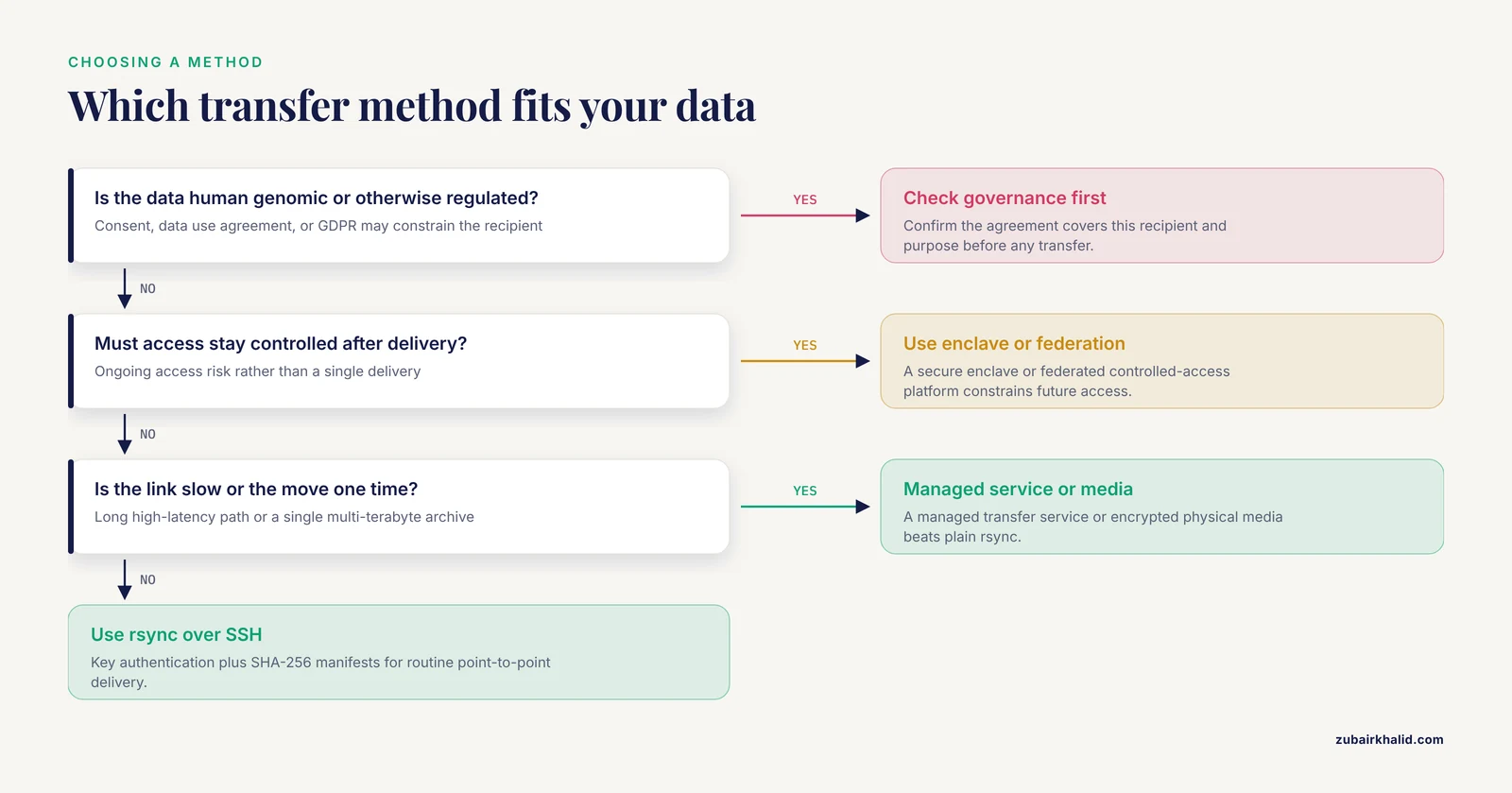
The table below is the core of this article. Each row is expanded in the sections that follow.
| Option | Best for | Security model | Strengths | Drawbacks |
|---|---|---|---|---|
| SSH-based transfer (rsync, scp, sftp) | Point-to-point delivery between two institutions you both control | SSH encryption in transit, SSH key authentication | Free, scriptable, resumable with rsync, works everywhere | Needs accounts on both ends, no built-in audit trail, manual orchestration |
| Managed transfer services (UDP-accelerated, shared endpoints) | Large or many transfers to external collaborators, multi-user cores | TLS in transit, at-rest encryption at endpoints, per-user credentials | Fast on long high-latency links, resumable, shared endpoints remove account provisioning, some audit features | Commercial licensing or hosted service dependency, endpoint setup effort |
| Cloud object storage with signed URLs | Distributing files to many recipients, automated pipeline handoffs | TLS in transit, server-side or client-side encryption at rest, scoped time-limited URLs | Scales to petabytes, cheap tiering, programmatic, integrates with pipelines | Bucket misconfiguration is the top real-world failure, URL leakage, egress costs, shared responsibility confusion |
| Secure enclave or institutional secure computing environment | Analysis of sensitive human genomic data where data must not leave institutional control | Hardened environment, role-based access, audit, controlled ingress and egress | Access and data controls designed as a system, proven at academic scale [5] | Recipients must work inside the enclave, highest setup and governance cost |
| Federated controlled-access sharing | Multi-institution human data sharing under GDPR-style regimes | Access control management centralized, enforcement distributed to holding nodes | Data stays at source, legal alignment with federation agreements, reusable middleware exists [3] | Requires infrastructure and data stewardship capacity at each node |
| Data obfuscation before transfer (read pooling) | Dual-use pathogen sequences and other data too sensitive to move raw | Data itself rendered non-reconstructable during storage and transfer | Protects the data even if the channel or storage is breached [6] | Alters the data for many analyses, niche tooling, requires agreement on pooling scheme |
| Encrypted physical media | One-time multi-terabyte transfers with no reliable network path | Full-disk or file-level encryption plus physical custody control | Deterministic bandwidth, no egress fees, works where networks cannot | Courier risk, customs, slow turnaround, custody chain must be formalized |
Option 1: SSH-Based Command-Line Transfer
The OpenSSH suite is the baseline tool for secure transfer of large genomic files between Unix systems, and it remains the right answer for a large share of day-to-day bioinformatics data management. scp and sftp copy files over an encrypted SSH channel. rsync does the same and adds resumability, delta transfer, and easy scripting.
A typical delivery from a sequencing core to a collaborator's cluster looks like this:
rsync -avP --partial sample_A.bam \
  [email protected]:/project/shared/incoming/
The flags mean archive mode (-a), verbose (-v), partial progress display (-P), and keep interrupted partial files (-partial) so a dropped connection resumes rather than restarts. Because rsync hashes blocks and only sends differences on re-transfer, an interrupted 100 GB BAM resumes from where it stopped, which is the single biggest practical advantage over plain scp.
Before sending, generate a checksum manifest:
sha256sum sample_A.bam > sample_A.bam.sha256The recipient verifies after arrival:
sha256sum -c sample_A.bam.sha256This two-command habit costs seconds and catches truncated files, which are the most common real-world failure in genomic delivery, far more common than interception.
Authentication should use SSH keys, not passwords. Generate a dedicated key pair for the transfer identity, restrict the key on the receiving side in the authorized_keys file to the specific command or directory where possible, and disable password authentication for the transfer account. Key rotation should follow institutional policy.
Pros and cons. The strengths are zero licensing cost, universal availability, scriptability for automation, and resumability. The drawbacks are that both sides need accounts and firewall access, there is no built-in audit trail suitable for compliance reviews, bandwidth on long-distance TCP paths is limited by window sizes unless tuned, and someone must own the operational details, such as what happens when a 400 GB delivery fails at 3 a.m. For many labs the honest answer to the last point is that a managed service is worth its cost precisely because someone else owns those details.
Option 2: Managed Transfer Services and Accelerated Endpoints
Long-distance transfers over the public internet routinely achieve a small fraction of available bandwidth with plain TCP-based tools, because packet loss and latency throttle the protocol. Managed transfer services solve this by replacing TCP with UDP-based protocols that keep sending through loss, and by running dedicated endpoints with tuned hardware. Commercial products in this family include Aspera-style and Signiant-style transfer platforms, and Globus provides managed endpoints with identity federation that have become a de facto standard in research data movement.
The workflow difference matters as much as the speed. With a shared endpoint model, the sender's institution runs an endpoint once, and any collaborator with an eligible institutional identity can be granted a collection to pick up files, without the sender creating Unix accounts or exchanging SSH keys. Delegated sharing, notifications, transfer scheduling, and transfer logs come with the service. For a sequencing core handling dozens of external deliveries a month, this replaces a pile of ad hoc scripts with an auditable process.
Pros and cons. Strengths are speed on long paths, resumability, no account provisioning on the sender's systems for each recipient, usable web interfaces for non-technical recipients, and transfer records that help with institutional reporting. Drawbacks are licensing or subscription costs, dependence on a hosted service or on maintaining your own endpoint hardware, and the fact that a polished web interface can create a false sense of security if the underlying access policy is set carelessly. A managed service with permissive sharing links is less secure than a careful rsync setup, which is why the access rules on the endpoint deserve the same scrutiny as the transfer itself.
Option 3: Cloud Object Storage with Signed URLs
Cloud object storage, such as Amazon S3 and comparable services from other providers, is the workhorse for genomics data storage at scale and a common transfer mechanism. The sender uploads to a bucket, then gives each recipient a pre-signed URL, a time-limited link that grants download access without granting account credentials. Uploads from instruments in the field or from satellite labs follow the same pattern in reverse.
A minimum-viable secure pattern:
# Upload with server-side encryption under a customer-managed key
aws s3 cp sample_A.bam s3://proj-bucket/incoming/ \
  --sse aws:kms

# Generate a 24-hour download link for one recipient
aws s3 presign s3://proj-bucket/incoming/sample_A.bam \
  --expires-in 86400
The security model depends on three settings that must be deliberate. First, block public access at the bucket level, because the most common real-world genomic data exposure in cloud storage is an incorrectly configured public bucket, not a clever attacker. Second, enforce encryption in transit by denying requests that do not use TLS through a bucket policy. Third, enable access logging or object-level logging so that downloads are attributable, and version the bucket so that deletions and overwrites are recoverable.
For human genomic data, many institutions add client-side encryption before upload. Encrypting the file with GPG before it ever touches the cloud means the cloud provider never holds plaintext:
gpg --encrypt --recipient [email protected] \
  --output sample_A.bam.gpg sample_A.bam
The recipient decrypts with their private key. This closes the gap between provider-side encryption, which protects against storage-layer exposure, and end-to-end confidentiality, which protects against anyone with provider-side access.
Pros and cons. Strengths are effectively unlimited scale, pay-as-you-go storage tiering that also solves the genomics data storage problem for the transferred copy, programmatic integration with pipelines, and precise, revocable, time-limited access through signed URLs. Drawbacks are configuration complexity, shared-responsibility confusion where teams assume the provider handles access control, egress bandwidth costs when moving data out again, and signed URLs that leak through email forwarding, Slack, or ticket systems. Treat a signed URL as a bearer credential. Anyone holding the string can download the file until it expires.
Option 4: Secure Enclaves and Institutional Secure Computing Environments
When the question is not how to move a file but whether it should move at all, the alternative is to move the analyst's workload to the data. A secure computing environment, often called an enclave or secure enclave in this context, is a hardened computing platform where sensitive data is loaded under controlled ingress, analyzed inside, and released only through controlled egress review.
A case report from Weill Cornell Medicine describes such a Data Core built to serve sensitive data from electronic health records, payer claims, and genomic pipelines for analytical and educational use, with explicit attention to user access, data controls, hardware, software, audit, and financial sustainability. In its first two and a half years the environment supported more than 200 faculty, staff, and students across nearly 60 research and education projects, and the institution published tooling so other centers could adopt the approach [5]. The practical lesson from that deployment is that the hard parts are policy and workflow, not crypto: deciding who gets accounts, what code may run, what output may leave, and who reviews each export.
Pros and cons. Strengths are that access control, audit, and data handling are designed as one system rather than assembled per-transfer, that egress review catches re-identification risks that a one-time file transfer cannot, and that the model scales to many users and projects. Drawbacks are substantial setup and governance cost, friction for external collaborators who must work inside your environment on your terms, and the operational burden of running the platform. An enclave is the best secure transfer of large genomic files in the sense that the files often do not need to be transferred at all.
Option 5: Federated Controlled-Access Sharing
A federation inverts the enclave logic. Instead of collecting data into one secure place, the data stays at each holding institution, and a central node handles discovery while each distributed node handles access requests, agreements, and secure data delivery to approved users. This model has grown rapidly under GDPR pressure in Europe, where moving human genome-phenome data across borders into centralized archives became legally and politically difficult [3].
The operational challenge is that most research institutions lack the staff to run controlled-access processes, which is where reusable middleware enters. The DS-PACK tool assembly is an open-source solution that semi-automates the end-to-end controlled-access process, from data submission through access request, agreement execution, and data access, including cloud-based application access. Access control management is centralized while enforcement is distributed, and the assembly is in production at the ELIXIR Luxembourg data hosting platform alongside legal facilitation and data stewardship services [3].
Pros and cons. Strengths are legal alignment for cross-border human data sharing, data locality that satisfies both regulators and data subjects, and reuse of tested infrastructure instead of building bespoke systems. Drawbacks are the need for data stewardship and legal capacity at each node, the overhead of per-request access decisions, and the reality that federated queries and federated analysis have their own performance trade-offs compared to moving everything to one place. For a single lab transferring one file, this is overkill. For a consortium sharing human data across jurisdictions, it may be the only compliant architecture.
Option 6: Data Obfuscation Before Transfer
All the options above protect the channel or the storage. A complementary approach protects the data itself, so that even a successful breach yields nothing usable. For dual-use genetic data, meaning sequences whose release could enable harm as well as benefit, standard encryption protects the file during transfer, but the transferred artifact itself remains a complete pathogen genome once decrypted by any recipient, and controlling appropriate security across many institutions, especially internationally, is difficult [6].
One proposed method pools raw sequencing reads from multiple samples of the same organism before sharing. The pooled file retains most genomic information for population-level and surveillance analyses, but no individual sample can be fully reconstructed from it, because reads from different samples are interleaved and the association between a read and a donor sample is destroyed. The demonstrated result is that pooling raw sequence data prevents full reconstruction of any individual sample while keeping most of the information usable, and the protection holds both while the data is stored and during electronic transfer [6].
Pros and cons. Strengths are that security survives storage breaches, transfer interception, and recipient misuse in a way no transport-layer control can match, which matters most for pathogen sequences where recreation of the organism from synthetic DNA is a stated concern [6]. Drawbacks are that many analyses requiring sample-level resolution become impossible on pooled data, that the method is specialized tooling rather than a standard pipeline component, and that deciding what analysis needs are worth preserving requires coordination between sharer and recipient before the pooling scheme is chosen. This is a data-transformation decision, made during project design, not a transfer setting selected at send time.
Encryption, Integrity, and Key Handling in Practice
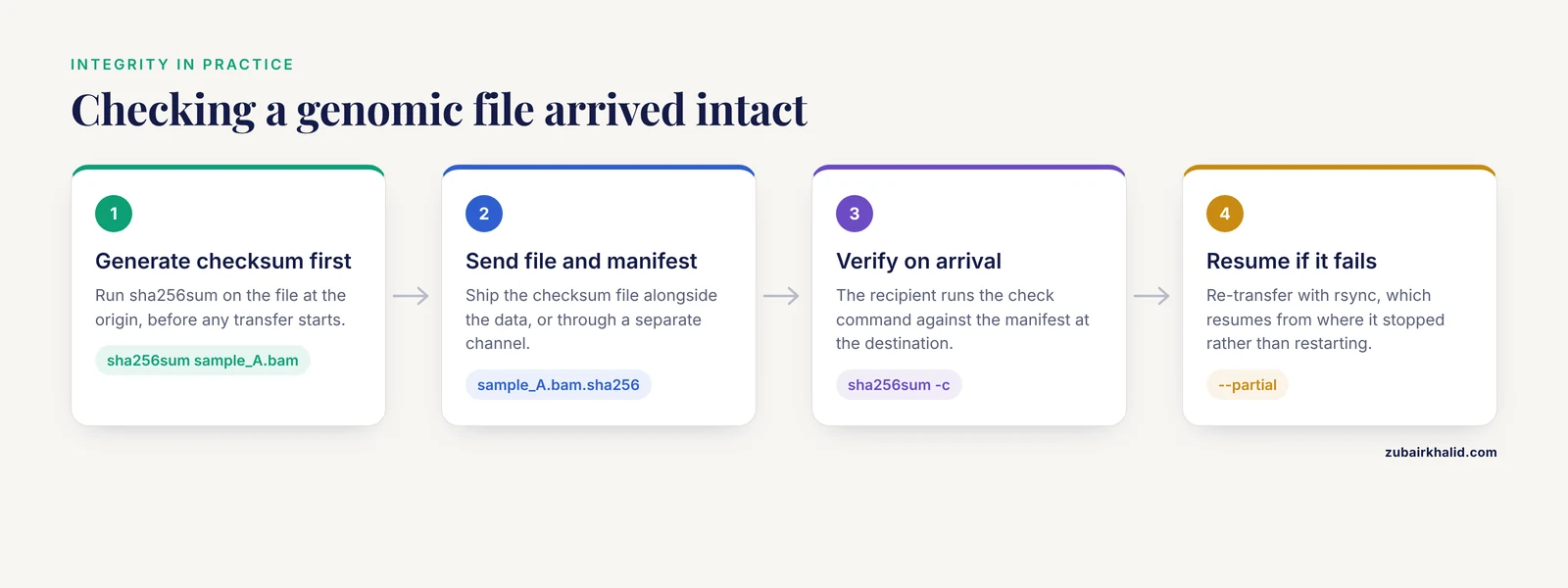
Regardless of which option you pick, four practices apply to every transfer.
Encrypt in transit always, at rest almost always. SSH and TLS cover transit. At rest, the question is who could access the storage medium. A laptop in transit, a courier package, a cloud bucket shared across a department, and a lab server with shared accounts all warrant encryption at rest. Full-disk encryption on the sending workstation, GPG file encryption for the payload, and cloud server-side encryption under a customer-managed key cover the common cases.
Generate checksums before sending, verify after receiving. SHA-256 is the default. Ship the checksum file alongside the data and, for human data, treat a checksum mismatch as a security event to investigate, not merely a re-send trigger, because truncation and tampering look identical without provenance context.
Treat keys and URLs as the real secrets. An encrypted file sent with the passphrase in the same email is not encrypted in any meaningful sense. Send keys and data through separate channels, for example data through the transfer service and the passphrase through a phone call or an institutional messaging system. Rotate SSH keys when collaborators change roles. Expire signed URLs at the shortest practical lifetime.
Log and review. Even a simple script that records timestamp, source, destination, file, and checksum into an append-only log gives you an audit trail that a spreadsheet never will. For multi-site access logging with tamper resistance, blockchain-based ledgering has been demonstrated as a workable design, specifically for logging and querying user activity across genomic datasets held at multiple sites [2]. Most groups will not need a blockchain, but every group handling human data needs an access log, and the design goal from that work, tamper resistance with efficient query, is the standard to aim for.
Governance Before Transfer
The technical transfer is usually the easiest part of a compliant genomic data movement. Three governance layers come first.
Consent and authorization. The data use agreement or consent framework must permit transfer to the specific recipient for the specific purpose. Ethical analysis of whole-genome sequencing programs, particularly in contexts where participants and researchers have limited prior exposure to genomics governance and where historical data flows have bred distrust, emphasizes that access to genotype-phenotype and pedigree data needs careful control to prevent identification of individuals and families [4]. A transfer that a data access committee has not approved is not a transfer with a security problem, it is a transfer that should not happen.
Individual-level access for personal data. A different governance pattern is emerging where individuals themselves grant access. The PROMISE system implemented a cryptographic concept that allows only the patient to grant selective access to defined parts of their genetic information, with single DNA base-pair resolution cryptography, and evaluated it in a pilot study with nineteen cardiomyopathy patients. In that pilot, 79 percent of patients rated the safety of their genetic data as very important, and after a median of four months using the app, more than half reported a changed attitude toward handling of their genomic data, with higher confidence in data security and greater willingness to share with third parties [7]. The transfer implication is concrete: recipient permissions may need to be scoped at sub-file granularity, and the data subject may be an active party in the access decision rather than a distant consent signer.
Central coordination for large projects. Population-scale projects benefit from a defined central data management function that unifies capturing, integration, storage, refinement, and transfer, backed by role-based access control, de-identification of identifying data, and a defined backup process. One long-running program implemented this with ETL pipelines and electronic case report forms on a high-availability Oracle cluster and captured roughly 5 terabytes of participant data over eighteen months without a critical incident or data loss [1]. The transfer lesson is that ad hoc transfers between project sites are where sensitive data leaks, and a formal transfer process inside a central data management framework reduces that surface.
Personal-level initiatives add a cautionary note. Online platforms where individuals share their own genomic data face challenges around individuals balancing risks and benefits of sharing on their own, and around awareness of what personal genomic sharing actually implies [8]. If your transfer workflow touches participant-shared data, assume the consent chain is weaker than for cohort data and verify it explicitly.
Worked Scenarios
Scenario A: A sequencing core delivers 30 whole-genome BAMs, roughly 3 TB total, to a collaborator at another university, monthly. Use rsync over SSH if both institutions have cluster accounts and the link performs adequately, with SHA-256 manifests on every delivery. If the collaborators are non-technical, or the link is transcontinental and slow, a managed transfer service with a shared endpoint removes both the account provisioning and the bandwidth frustration. In either case, the delivery manifest, checksum verification, and a record of who received what belong in the core's log, because next quarter someone will ask.
Scenario B: A five-institution consortium shares human genome-phenotype data, with two institutions in the EU. Centralized transfer into one archive invites GDPR problems and creates a single point of governance failure. A federated model, with a discovery node and per-institution access enforcement through reusable middleware, keeps data at source and automates the agreement workflow [3]. Transfers to approved users happen from the holding node under the local data access committee's decision, and access logs are retained per node. The consortium budget line for data stewardship is not optional.
Scenario C: A one-time 40 TB raw-read archive must move to a national archive, and the site's internet uplink is 1 Gbps with contention. At sustained practical throughput well below line rate, a network transfer takes weeks and competes with production traffic. Encrypted physical media, full-disk encrypted drives shipped under a documented custody chain, with SHA-256 manifests verified on ingest, is the deterministic answer. The encryption is what turns a stolen courier box from a breach into an inconvenience. This is also the case where the receiving archive's published ingest procedures, not your preference, dictate the method, so read them first.
Scenario D: A public health network shares pathogen sequences with dual-use potential among many institutions internationally. Encryption in transit and at rest protects the channel, but every recipient ends up with a complete, reconstructable genome. Read pooling before transfer changes the shared artifact so that no individual sample can be fully reconstructed, while preserving most genomic information for surveillance use [6]. Combine pooling with a federation-style access agreement so that sample-level resolution is available only to vetted users under defined terms.
Scenario E: A clinician-scientist wants patients to control who sees which parts of their genomic results. A patient-facing cryptographic access model, where the patient grants selective access to defined genomic segments rather than all-or-nothing file access, addresses this directly, and the PROMISE pilot demonstrates the pattern in a clinical research setting [7]. Technically this shifts the transfer problem from moving whole files to serving scoped views, which changes the infrastructure from file transfer to an access-controlled API with fine-grained cryptography.
Common Mistakes and Limitations
Emailing links as a transfer method. A link to a file on a personal cloud drive is not a secure transfer. There is no institutional access control, no audit trail, no retention control, and links get forwarded. For a 5 MB VCF, which feels like an email attachment, this is the most common violation in practice.
Assuming transport encryption implies end-to-end security. An HTTPS download protects the file in transit. The file then sits unencrypted on the recipient's laptop, gets copied to a USB stick, and travels to a conference. Encryption at rest and recipient-side handling rules are separate requirements.
Skipping checksums because the transfer tool said success. Transfer tools verify transport, not semantic integrity. A corrupted source file transfers perfectly. Checksums must be generated at the origin, before any transfer, and verified at the destination.
MD5 as a security control. MD5 checksums remain common in genomics for legacy compatibility. They detect accidental corruption. They do not resist deliberate tampering. Use SHA-256 for anything with a security requirement.
Signed URLs treated like access grants. A pre-signed URL is a bearer token. Forwarding the email forwards access. Scope them, expire them quickly, log downloads, and never generate one URL for a distribution list.
Public cloud buckets. The recurrent real-world genomic data exposure is a bucket with public access left on. Block public access at the account level, not the bucket level, so a new bucket cannot repeat the mistake.
No audit trail until it is needed. Access logging bolted on after an incident reconstructs nothing. Decide the log format and retention at project start. If tamper resistance matters because multiple sites are involved, that requirement shapes the design from the beginning, as the cross-site genomic access logging work demonstrated [2].
Transferring data the agreement does not cover. The most serious failure is not technical. Verify that the data use agreement, consent, and institutional approvals permit the transfer, the recipient, and the purpose before moving a single byte [4].
Limitations. Every environment differs in network paths, institutional policy, and legal jurisdiction, and the right choice in one setting can be wrong in the next. Where precise regulatory obligations apply, the institution's privacy office and legal counsel own that decision, and the technical team implements it. Security is a process with maintenance costs, not a one-time configuration, and any architecture described here degrades without ongoing operational ownership.
Frequently Asked Questions
What is the most secure way to transfer large genomic files?
For most research transfers, SSH-based rsync with key authentication and SHA-256 verification is secure and practical. For human genomic data where ongoing control matters more than one delivery, a secure enclave or a federated controlled-access platform is more secure because it constrains all future access, not just the transfer. The most secure single technique is obfuscating the data itself, such as read pooling, so that even a breach during transfer or storage yields no reconstructable sample [6].
Should I encrypt files if the transfer channel is already encrypted?
Yes, when the data is sensitive. Channel encryption protects only the movement. File-level encryption with GPG before upload or shipping protects the copy at rest, in cloud storage, on backup media, and in the recipient's hands until they decrypt it. Keep the passphrase or key on a separate channel from the file.
How do I verify a genomic file arrived intact?
Generate a SHA-256 checksum at the source before transfer, ship the checksum file separately or alongside, and run sha256sum -c at the destination. For large multi-file deliveries, generate one manifest for the whole set. If the checksum fails, re-transfer with rsync, which resumes rather than restarts.
What file sizes can these methods handle?
SSH and rsync handle terabytes given time and a stable link, but lack central management. Managed transfer services and cloud object storage scale to petabytes and handle interruption well. A one-time multi-terabyte move over a constrained link is often faster and more predictable on encrypted physical media than over the network.
Is a signed cloud URL a safe way to share a VCF file?
A signed URL is safe only if it is time-limited, scoped to the exact object, generated per recipient, and sent to the recipient alone, with download logging enabled. It is a bearer credential, so any forwarded copy grants access until expiry. For human genomic VCFs, add client-side encryption so that a leaked link yields an unreadable file.
What is the difference between controlled access and federated access?
In controlled access, data sits in one archive and a central process approves and serves all requests. In federated access, data stays at each holding institution, a central node supports discovery, and each institution manages access requests, agreements, and delivery for its own data. The federated model spread under GDPR because it keeps data within each institution's legal control while still enabling cross-institution sharing [3].
Sources
- Efficient data management in a large-scale epidemiology research project.
- Using blockchain to log genome dataset access: efficient storage and query.
- DS-PACK: Tool assembly for the end-to-end support of controlled access human data sharing.
- Ethical and legal implications of whole genome and whole exome sequencing in African populations.
- Design and Implementation of a Secure Computing Environment for Analysis of Sensitive Data at an Academic Medical Center.
- Methods for safely sharing dual-use genetic data.
- Controlling my genome with my smartphone: first clinical experiences of the PROMISE system.
- Challenges of web-based personal genomic data sharing.