How to Set Up a Secure Genomic Data Lake on AWS
By Dr. Zubair Khalid, DVM, MS, PhD ·

By the end of this guide you will have a working secure genomic data lake AWS setup built from infrastructure-as-code: a VPC-isolated landing zone for raw sequencing files, encrypted S3 storage for FASTQ, BAM, CRAM, and VCF objects, fine-grained query governance through AWS Lake Formation, least-privilege IAM roles for pipeline compute, and CloudTrail plus GuardDuty coverage for auditing and threat detection. You will also know how to validate each control, what the common failure modes look like, and where this design stops short of a full compliance program.
Everything here runs in us-east-1 with the AWS CLI v2. Before you start, have the following ready:
- An AWS account where you hold administrator access, ideally a dedicated account for the genomics workload rather than your organization's shared account.
- AWS CLI v2 installed and configured (
aws, versionshould report 2.x, andaws sts get-caller-identityshould return your principal). - Either the CloudFormation snippets below or Terraform, since manual console builds do not survive audits or personnel changes.
- A small test FASTQ file (a few hundred MB of real or synthetic reads is plenty) so you can exercise the full path before loading production data.
- A decision, made with your compliance office, about which regulation governs your data. Human genomic data linked to identities carries obligations under HIPAA in US clinical contexts, GDPR-aligned controls in multinational consortia, and institutional policy almost everywhere.
A note on scale before the walkthrough. Whole-genome sequencing at population scale routinely means thousands of samples per month. The Celeste infrastructure built for the All of Us Research Program processed fluctuating workloads of up to 9,000 whole-genome samples monthly, coordinating roughly 200 million serverless function invocations and 1.8 million analysis jobs in a single AWS Region over 12 months of production [1]. The controls in this guide scale to that magnitude because every one of them is policy-based rather than manually enforced.
Why Genomic Data Demands More Than a Default S3 Bucket
Genomes are identifiers. A raw read set can be re-identified against reference panels, and a single variant file can reveal information about relatives who never consented to anything. Surveys of people who have received genomic testing show that privacy and security concerns, including insurance discrimination and use of data without consent, remain central to how patients weigh participation, even as familiarity with testing grows [2]. In practice, most breaches of biomedical cloud storage do not come from exotic external attacks. They come from insiders misusing legitimate entitlements, either deliberately or through credential mishandling, which is exactly the failure mode that perimeter-based security models miss [3].
The corrective is a zero-trust posture: no implicit trust for any principal, every access request evaluated in real time against identity, context, and data classification. On AWS that translates into concrete mechanisms you will build below:
- Network isolation so the data plane is unreachable from the public internet.
- Envelope encryption with customer-managed KMS keys, so storage encryption and key policy are two independent gates.
- Identity-based and resource-based authorization with explicit deny boundaries, so no role can read everything.
- Fine-grained table and column governance through Lake Formation, layered on top of IAM rather than replaced by it.
- Continuous audit and behavioral monitoring, because entitlements drift and credentials leak.
A published reference architecture for a regulated big data environment on AWS combines an S3-based data lake, Glue and Kinesis ingestion, Athena and Redshift serving, and governance through IAM, KMS, Lake Formation, CloudTrail, and GuardDuty to satisfy data residency and GDPR-aligned controls [4]. That is essentially the skeleton of this guide, hardened further for genomics.
Architecture Overview: Zone Separation and the Storage Format
A data lake for genomics should be split into zones with different trust levels and different lifecycles. Zone separation is the single highest-value structural decision, because it lets you apply restrictive controls to raw data while keeping the analysis tier usable.
| Zone | Example bucket | Contents | Lifecycle | Who reads it |
|---|---|---|---|---|
| Landing | acme-genomics-landing-use1 | Raw BCL demultiplex output, unverified FASTQ | Retain 30 to 90 days, then expire | Ingestion pipeline only |
| Curated | acme-genomics-curated-use1 | Aligned BAM/CRAM, gVCF, QC reports | Long-term, versioned | Analysts, pipelines |
| Delivery | acme-genomics-delivery-use1 | Annotated VCF, project-level outputs | Per-project retention | External collaborators via pre-signed URLs |
| Audit | acme-genomics-audit-use1 | CloudTrail logs, GuardDuty findings | Retain per compliance policy | Security team only |
Your bucket naming format should encode purpose, scope, and Region, for example <org>-genomics-<zone>-<region>. That convention pays off later when you write IAM policies that match on bucket name prefixes and when auditors ask you to enumerate data stores.
Cloud bioinformatics increasingly separates storage from compute, and the object formats reflect that. Store aligned reads as CRAM where possible, since CRAM references the reference genome and shrinks storage substantially compared with BAM. Keep region-based variant data as block-compressed (bgzipped) VCF with Tabix indexes so query engines can read it column-wise. Metadata travels in sidecar files and table schemas, and adherence to FAIR principles (findable, accessible, interoperable, reusable) at the metadata layer is what makes a lake usable across projects rather than a pile of files [5].
Infrastructure-as-code is the correct way to assemble this. Published AWS data lake designs emphasize that a multi-account, reproducible data platform can be provisioned largely from a single CLI command or template rather than hand-built in the console [6]. The CloudFormation snippet below is the template skeleton for the storage and key layer. You can extend it with the resources described in the steps that follow.
Resources:
  GenomicsCMK:
    Type: AWS::KMS::Key
    Properties:
      Description: Genomic data lake customer-managed key
      EnableKeyRotation: true
      KeyPolicy: !Sub |
        {
          "Version": "2012-10-17",
          "Statement": [
            {
              "Sid": "RootAccess",
              "Effect": "Allow",
              "Principal": {"AWS": "arn:aws:iam::${AWS::AccountId}:root"},
              "Action": "kms:*",
              "Resource": "*"
            }
          ]
        }

  LandingBucket:
    Type: AWS::S3::Bucket
    Properties:
      BucketName: !Sub "acme-genomics-landing-${AWS::Region}"
      BucketEncryption:
        ServerSideEncryptionConfiguration:
          - ServerSideEncryptionByDefault:
              SSEAlgorithm: aws:kms
              KMSMasterKeyID: !Ref GenomicsCMK
            BucketKeyEnabled: true
      PublicAccessBlockConfiguration:
        BlockPublicAcls: true
        IgnorePublicAcls: true
        BlockPublicPolicy: true
        RestrictPublicBuckets: true
      VersioningConfiguration:
        Status: Enabled
Prerequisites and Account Hygiene
Two checks before any resource creation. First, confirm the account is not sharing space with unrelated workloads, because an account boundary is the cheapest blast-radius control you have. Second, verify that the root user has MFA and is not used for daily work, and that your own human access is through AWS IAM Identity Center rather than long-lived IAM users. The entire threat model below assumes human access is federated and short-lived.
aws sts get-caller-identityExpected output:
{
    "UserId": "AIDAXAMPLE1234567890",
    "Account": "123456789012",
    "Arn": "arn:aws:sts::123456789012:assumed-role/AWSReservedSSO_AdministratorAccess/your.name"
}
The assumed-role prefix in the Arn confirms you are working through a temporary role session, which is what you want.
Step 1: Isolate the Network with a VPC and Private Endpoints
The data lake should sit in a VPC (Virtual Private Cloud), AWS's logically isolated network, with no internet gateway attached to the subnets that hold compute touching genomic data. VPC isolation combined with VPN-based access for remote work is a well-documented pattern for protecting sensitive resources on AWS, separating public and private logical domains and forcing remote access through authenticated tunnels [7].
Create the VPC and two private subnets across Availability Zones:
aws ec2 create-vpc \
  --cidr-block 10.42.0.0/16 \
  --tag-specifications 'ResourceType=vpc,Tags=[{Key=Name,Value=genomics-lake-vpc}]'
Expected output (abridged):
{
    "Vpc": {
        "VpcId": "vpc-0abc123def4567890",
        "CidrBlock": "10.42.0.0/16",
        "State": "available"
    }
}
aws ec2 create-subnet \
--vpc-id vpc-0abc123def4567890 \
--cidr-block 10.42.1.0/24 \
--availability-zone us-east-1a
aws ec2 create-subnet \
--vpc-id vpc-0abc123def4567890 \
--cidr-block 10.42.2.0/24 \
--availability-zone us-east-1bThen create an S3 Gateway VPC endpoint so that traffic from your private subnets to the lake buckets never traverses the public internet, and attach an endpoint policy that restricts access to your buckets:
aws ec2 create-vpc-endpoint \
  --vpc-id vpc-0abc123def4567890 \
  --service-name com.amazonaws.us-east-1.s3 \
  --vpc-endpoint-type Gateway \
  --route-table-ids rtb-0123456789abcdef0
Expected output (abridged):
{
    "VpcEndpoint": {
        "VpcEndpointId": "vpce-0feed1234567890ab",
        "VpcEndpointType": "Gateway",
        "ServiceName": "com.amazonaws.us-east-1.s3",
        "State": "available"
    }
}
Write down the vpce- ID. Later you will add a bucket policy condition on aws:SourceVpce so the buckets accept traffic only through this endpoint, which closes the most common exfiltration path: a compromised credential used from outside your network.
Step 2: Create the Landing Zone Bucket with KMS Encryption and Lockdown
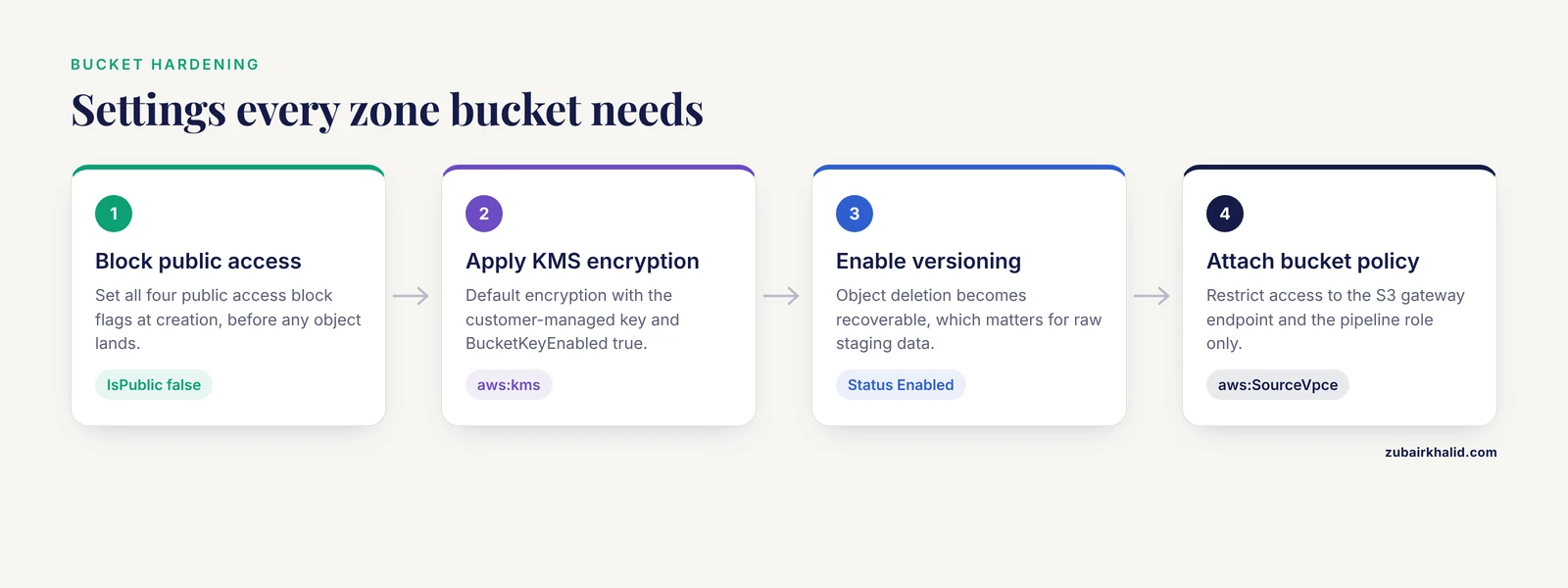
Each zone bucket needs four settings applied at creation: block public access, default encryption with your customer-managed key, versioning, and a restrictive bucket policy. Do this for the landing bucket first.
aws s3api create-bucket \
  --bucket acme-genomics-landing-use1 \
  --region us-east-1
Expected output:
{
    "Location": "/acme-genomics-landing-use1"
}
aws s3api put-public-access-block \
--bucket acme-genomics-landing-use1 \
--public-access-block-configuration \
BlockPublicAcls=true,IgnorePublicAcls=true,BlockPublicPolicy=true,RestrictPublicBuckets=trueNo output means success. Then apply encryption with the KMS key you created (Step 3 covers key creation, so if you are following strictly in order, create the key first and substitute its ARN):
aws s3api put-bucket-encryption \
  --bucket acme-genomics-landing-use1 \
  --server-side-encryption-configuration \
  '{"Rules":[{"ApplyServerSideEncryptionByDefault":{"SSEAlgorithm":"aws:kms","KMSMasterKeyID":"arn:aws:kms:us-east-1:123456789012:key/1234abcd-12ab-34cd-56ef-1234567890ab"},"BucketKeyEnabled":true}]}'
BucketKeyEnabled reduces KMS request charges by roughly an order of magnitude for large objects, which matters when your objects are 100 GB FASTQ files. Enable versioning so object deletion becomes recoverable:
aws s3api put-bucket-versioning \
  --bucket acme-genomics-landing-use1 \
  --versioning-configuration Status=Enabled
Repeat the block-public-access and encryption calls for the curated, delivery, and audit buckets. A lifecycle rule on the landing bucket keeps raw staging storage from growing unbounded:
aws s3api put-bucket-lifecycle-configuration \
  --bucket acme-genomics-landing-use1 \
  --lifecycle-configuration '{
    "Rules": [{
      "ID": "expire-staging-raw",
      "Filter": {"Prefix": "runs/"},
      "Status": "Enabled",
      "Transitions": [{"Days": 90, "StorageClass": "GLACIER_IR"}],
      "Expiration": {"Days": 365}
    }]
  }'
Cloud storage materially lowers the long-term cost of holding sequencing data compared with shipping every raw file to institutional disk arrays, which is one reason laboratories moved genomic storage to AWS in the first place [8]. Glacier Instant Retrieval at the 90-day mark captures most of that saving while keeping re-analysis feasible.
Step 3: A Dedicated KMS Key with a Scoped Policy
Create one symmetric customer-managed key (CMK) for the genomic zones, separate from keys used elsewhere in the account, so that key policy becomes an independent access gate on top of IAM and bucket policy:
aws kms create-key \
  --description "Genomic data lake CMK us-east-1" \
  --key-usage ENCRYPT_DECRYPT \
  --origin AWS_KMS \
  --customer-master-key-spec SYMMETRIC_DEFAULT
Expected output (abridged):
{
    "KeyMetadata": {
        "KeyId": "1234abcd-12ab-34cd-56ef-1234567890ab",
        "Arn": "arn:aws:kms:us-east-1:123456789012:key/1234abcd-12ab-34cd-56ef-1234567890ab",
        "KeyState": "Enabled",
        "Enabled": true
    }
}
Enable annual rotation and attach a scoped policy. The root principal statement preserves account-level administrative control. Add a second statement granting only kms:Decrypt and kms:GenerateDataKey to the roles that genuinely need to read or write data. Anyone who can pass the IAM and bucket checks but fails the key check sees AccessDenied, which is the layered-control design working as intended.
A research direction worth knowing about: classification-driven encryption, where machine learning assigns data to confidentiality levels and generates distinct encryption keys per level, has been demonstrated as an automated pipeline on AWS Lambda writing encrypted output to S3, with the design aimed at healthcare and enterprise environments [9]. You do not need chaotic-map key generation to get the underlying idea right: classify your objects (identifiable, de-identified, public aggregate) and let classification drive key choice and access policy rather than treating the whole lake as one sensitivity tier.
Long-term confidentiality is a genuine planning question for genomes, since a genome does not expire the way a credit card does. Post-quantum lattice-based encryption frameworks have been evaluated on AWS and competitor clouds for exactly this threat, with reported throughput of up to 30.3 MB/s at the 500 MB scale and higher entropy than AES-256 and RSA-2048 baselines in that study's tests [10]. Practical guidance today: keep keys in KMS with rotation enabled, plan a re-encryption path, and track NIST post-quantum standards as your cryptographer, not a blog post, directs.
Step 4: IAM Roles, Permission Boundaries, and Least Privilege
IAM (Identity and Access Management) is where most genomic data lake breaches are enabled or prevented. The pattern to enforce: no human IAM users, one role per workload, permission boundaries that cap what any role can accumulate, and explicit deny on actions that would weaken the controls you just built.
Create the pipeline execution role:
cat > trust.json <<'EOF'
{
  "Version": "2012-10-17",
  "Statement": [{
    "Effect": "Allow",
    "Principal": {"Service": "ecs-tasks.amazonaws.com"},
    "Action": "sts:AssumeRole",
    "Condition": {
      "StringEquals": {"aws:SourceAccount": "123456789012"}
    }
  }]
}
EOF

aws iam create-role \
  --role-name genomics-pipeline-role \
  --assume-role-policy-document file://trust.json
Expected output (abridged):
{
    "Role": {
        "RoleName": "genomics-pipeline-role",
        "Arn": "arn:aws:iam::123456789012:role/genomics-pipeline-role",
        "AssumeRolePolicyDocument": {
            "Statement": [{
                "Effect": "Allow",
                "Principal": {"Service": "ecs-tasks.amazonaws.com"},
                "Action": "sts:AssumeRole"
            }]
        }
    }
}
The inline policy for this role should grant read on the landing bucket, read-write on curated, and nothing else. Attach a permissions boundary so that even an administrator who later attaches AdministratorAccess to this role is capped:
aws iam put-role-permissions-boundary \
  --role-name genomics-pipeline-role \
  --permissions-boundary arn:aws:iam::123456789012:policy/GenomicsComputeBoundary
Add explicit denies for the actions that would defeat your other controls: s3:PutBucketPolicy, s3:DeleteBucketEncryption, kms:ScheduleKeyDeletion, and cloudtrail:StopLogging. Analyst roles get read on curated plus Lake Formation grants (next step), not bucket-level wildcards.
For monitoring depth, IAM policy enforcement pairs naturally with behavioral analytics over CloudTrail logs. One published model trained SVM, Random Forest, and LSTM classifiers on CloudTrail data to detect anomalous access behavior, with the LSTM approach reaching 94.3 percent accuracy, a 60 percent reduction in unauthorized access attempts, and a 47 percent improvement in detection time [11]. You will collect the raw material for such analytics in Step 8 even if you start with manual review.
Step 5: Govern Queries with AWS Lake Formation
IAM alone answers "can this role call S3 APIs." It does not answer "can this analyst query only the columns of the variant table belonging to their study." Lake Formation provides table-, column-, and row-level authorization on top of the AWS Glue Data Catalog, and it is a standard component in regulated AWS data lake architectures [4].
Register a curated bucket as a Lake Formation resource:
aws lakeformation register-resource \
  --resource-arn arn:aws:s3:::acme-genomics-curated-use1 \
  --role-arn arn:aws:iam::123456789012:role/LakeFormationRegistrationRole \
  --use-service-linked-role
Grant a analyst role SELECT on a variant table, restricted to specific columns:
aws lakeformation grant-permissions \
  --principal DataLakePrincipalIdentifier=arn:aws:iam::123456789012:role/genomics-analyst-role \
  --resource '{"Table":{"DatabaseName":"genomics_curated","Name":"variants","CatalogId":"123456789012"}}' \
  --permissions SELECT \
  --permissions-with-grant-option []
For row-level scoping, create a data filter so analysts only see rows for their cohort, then grant on the filtered table. This is how a single lake serves multiple studies without copy-per-study sprawl.
Point Athena at the catalog and verify with a real query:
SELECT chrom, pos, ref, alt
FROM genomics_curated.variants
WHERE chrom = 'chr17' AND pos BETWEEN 7674000 AND 7680000
LIMIT 10;
If Lake Formation grants are right, you get rows. If the same query runs under a role without grants, you get an AccessDeniedException from Lake Formation even though IAM would have allowed the Athena query itself. That distinction is the entire point of this layer.
For large-scale region-based analysis across thousands of experiments, tools such as PyGMQL demonstrate the scalable extraction pattern over distributed engines, applying set-oriented genomic queries across heterogeneous processed datasets with Spark underneath [12]. Athena handles tabular variant metadata well. Heavier region algebra belongs in dedicated engines on your compute layer.
Step 6: Event-Driven Ingestion and Containerized Pipelines
Cloud genomics works best as an event-driven pipeline rather than a cron job. A published AWS genomics architecture accepts FASTQ uploads through a web interface into S3, triggers a Lambda function on the object event, and launches a containerized pipeline on ECS Fargate running FastQC, MultiQC, and Ensembl VEP for annotation, with results delivered through pre-signed URLs [13]. This design maps directly onto your zones.
First, the S3 event notification that triggers ingestion (attach as a bucket notification configuration on the landing bucket, or declare it in your template):
{
  "LambdaFunctionConfigurations": [
    {
      "Id": "fastq-arrival-trigger",
      "LambdaFunctionArn": "arn:aws:lambda:us-east-1:123456789012:function:genomics-ingest-dispatcher",
      "Events": ["s3:ObjectCreated:*"],
      "Filter": {"Key": {"FilterRules": [{"Name": "prefix", "Value": "runs/"}, {"Name": "suffix", "Value": ".fastq.gz"}]}}
    }
  ]
}
The dispatcher Lambda validates the manifest, then launches the Fargate task:
aws ecs run-task \
  --cluster genomics-pipeline-cluster \
  --launch-type FARGATE \
  --task-definition genomics-qc-annotation:12 \
  --network-configuration 'awsvpcConfiguration={subnets=["subnet-0aaa1111bbbb2222"],securityGroups=["sg-0123456789abcdef0"],assignPublicIp="DISABLED"}' \
  --overrides '{"containerOverrides":[{"name":"pipeline","environment":[{"name":"SAMPLE_ID","value":"SRR12345678"}]}]}'
Note assignPublicIp="DISABLED", which keeps the task inside your private subnets. It reaches S3 and ECR through VPC endpoints.
The pattern scales dramatically. Celeste runs on serverless technology and container orchestration and has sustained the workload volumes described earlier, making those numbers a useful stress-test reference point for your own capacity planning [1]. Older and still relevant platforms took the same approach with different tools, extending Galaxy with Globus Transfer for reliable bulk data movement and HTCondor auto-scaling for on-demand execution of large NGS workflows [14], and domain portals such as VDJServer show the end-user-facing side, where immunologists reach a full repertoire analysis suite through a browser over cloud-hosted compute [15]. Whatever executor you choose, the security invariants are identical: pipeline roles see only their zone buckets, container images live in private repositories, and every job writes QC and audit artifacts to the curated zone.
For clinical-adjacent data models, AWS HealthLake stores and indexes FHIR-compliant patient records and pairs with Kinesis for real-time streaming ingestion in healthcare architectures, [17]. Genomic variants and FHIR clinical records meet in the curated zone, which is where cross-domain joins (variant plus phenotype) become possible.
Step 7: Validate and Verify the Controls
Deployed controls you have not tested are decoration. Run this verification sequence and keep the output as evidence.
Check that encryption is set and public access is fully blocked:
aws s3api get-bucket-encryption --bucket acme-genomics-landing-use1
aws s3api get-bucket-policy-status --bucket acme-genomics-landing-use1
Expected: the encryption call returns your KMS ARN with BucketKeyEnabled: true, and the policy status returns "IsPublic": false.
Verify the VPC endpoint restriction by attempting access from outside the VPC with a role that has IAM permission. The bucket policy condition on aws:SourceVpce should produce:
An error occurred (AccessDenied) when calling the GetObject operation: Access DeniedThat denial is the expected result. Confirm legitimate access from inside the VPC succeeds:
aws s3 cp ./SRR12345678_1.fastq.gz s3://acme-genomics-landing-use1/runs/2026-11/SRR12345678_1.fastq.gzExpected output:
upload: ./SRR12345678_1.fastq.gz to s3://acme-genomics-landing-use1/runs/2026-11/SRR12345678_1.fastq.gzFinally, confirm KMS protection end to end by trying to read an object with the key policy deliberately denying the calling role. You should see KMS.AccessDeniedException from S3, which proves that even a valid S3 credential cannot bypass the key gate.
Step 8: Monitoring, Audit Trail, and Sharing
Turn on the audit substrate before any real data lands. CloudTrail writes an immutable record of every API call into your audit bucket:
aws cloudtrail create-trail \
  --name genomics-audit-trail \
  --s3-bucket-name acme-genomics-audit-use1 \
  --is-multi-region-trail \
  --enable-log-file-validation
aws cloudtrail start-logging --name genomics-audit-trail
Expected output:
{
    "IncludeGlobalServiceEvents": true,
    "Name": "genomics-audit-trail",
    "IsMultiRegionTrail": true,
    "LogFileValidationEnabled": true
}
Enable GuardDuty for threat detection across the account:
aws guardduty create-detector --enableExpected output:
{
    "DetectorId": "b6b992d6d2f48e64bc59180bfexample"
}
This pair, CloudTrail plus GuardDuty, is the monitoring core of the reference regulated data lake architecture discussed earlier [4]. Behavioral analytics over the resulting logs can go further. The ML-on-CloudTrail study cited above demonstrated that LSTM models over CloudTrail records detect anomalous access with high accuracy and materially shorten detection time, and zero-trust designs for biomedical cloud storage depend on exactly this continuous evaluation, behavioral monitoring, and dynamic policy enforcement against insider misuse [3].
Sharing is the other half of security. For results delivered to collaborators, short-lived pre-signed URLs avoid creating any permanent credential:
aws s3 presign s3://acme-genomics-delivery-use1/projects/psor-01/results/sample-A.annotated.vcf.gz --expires-in 3600Expected output:
https://acme-genomics-delivery-use1.s3.amazonaws.com/projects/psor-01/results/sample-A.annotated.vcf.gz?X-Amz-Algorithm=AWS4-HMAC-SHA256&X-Amz-Expires=3600...Set expiry to hours, not days, and log the generation event in CloudTrail. Serverless architectures on AWS rely on this combination of pre-signed access and secure IAM configuration to protect user data while keeping workflows usable [18], [13].
For genuinely public data, the model to emulate is a curated public database with stringent upload filtering and streamlined transfer, as the diversID forensic STR and identity-SNP database does for population statistics on cloud infrastructure [19]. Publish aggregates through a separate, dedicated bucket or account, never by loosening policy on the private lake. Where sovereignty rules prevent raw data movement across institutions, decentralized compute patterns that bring code to the data have been evaluated on AWS with roughly a 30 percent runtime overhead versus a centralized baseline under ideal conditions, and complete job completion under injected network faults, a trade-off some consortia accept deliberately [20].
Common Mistakes and Limitations
- One giant bucket, one wildcard policy.
s3:GetObjectonarn:aws:s3:::genomics-*is how a junior analyst ends up reading every cohort in the organization. Use zones, and use Lake Formation for row and column scope. - Default S3 encryption instead of a CMK. SSE-S3 protects against bucket misconfiguration but gives you no key policy gate. The CMK policy is what blocks a role that has valid bucket access from reading bytes.
- Building in the console. Console-built infrastructure cannot be reviewed, reproduced, or rolled back. Everything above is expressible as a CloudFormation template or Terraform module for a reason.
- Public access blocks applied only to new buckets. AWS changed defaults for new buckets, but pre-existing buckets can still be public. Run a iam_access_analyzer or S3 public access audit on every existing bucket before migrating data in.
- Forgetting the KMS cost of bulk analytics.
BucketKeyEnabledmatters. Athena scanning terabytes with per-object KMS decrypt calls without bucket keys produces surprising KMS charges. - Assuming encryption equals compliance. HIPAA for covered entities requires a signed BAA, administrative and technical safeguards, and breach procedures. Cloud-native healthcare designs still emphasize vendor access control and adherence obligations explicitly [16]. This guide gives you the technical layer, not the legal one.
- Unbounded retention of raw staging data. Landing zone data past its validation window is liability without value. Enforce lifecycle expiry.
- Sharing via long-lived IAM users for collaborators. External access should be federated or pre-signed, never a shared static key.
Frequently Asked Questions
Do I need AWS Lake Formation if I already have strict IAM policies?
Yes, if you need table, column, or row-level control. IAM governs service APIs and buckets. Lake Formation governs rows and columns inside cataloged tables, which is what multi-study genomic lakes actually require.
Is server-side encryption alone enough to protect genomic data?
No. Encryption protects data at rest from storage-layer exposure. Protection against misuse of valid credentials comes from layered access control, key policy separation, network isolation, and monitoring on top of encryption.
What storage format should I use for sequencing data in the lake?
Keep raw FASTQ in the landing zone, store aligned data as CRAM where possible for smaller footprints, and keep variants as bgzipped VCF with Tabix indexes so query engines can read them efficiently.
Can this setup be used for clinical or HIPAA-regulated samples?
The technical controls support a regulated deployment, but a compliant clinical use also requires a signed BAA with AWS, a formal risk analysis, and institutional sign-off. Treat this guide as the infrastructure layer, not the compliance program.
How do I share a single results file with an external collaborator?
Generate a pre-signed URL with a short expiry, such as one hour, send it over a secure channel, and rely on CloudTrail logging of the generation event as your audit record.
How large can an AWS genomic data lake realistically get?
Very large. Production population-scale systems have processed thousands of whole-genome samples monthly and millions of analysis jobs within a single AWS Region using serverless and container-based designs, so regional S3 scale is not the constraint. Governance and cost discipline are.
Should I plan for quantum computing threats to stored genomes?
Plan, yes. Genomes must stay confidential for decades, so keep keys in KMS with rotation, design a re-encryption path, and track standardized post-quantum algorithms rather than deploying experimental schemes in production.
What does a new analyst role need to query the curated zone?
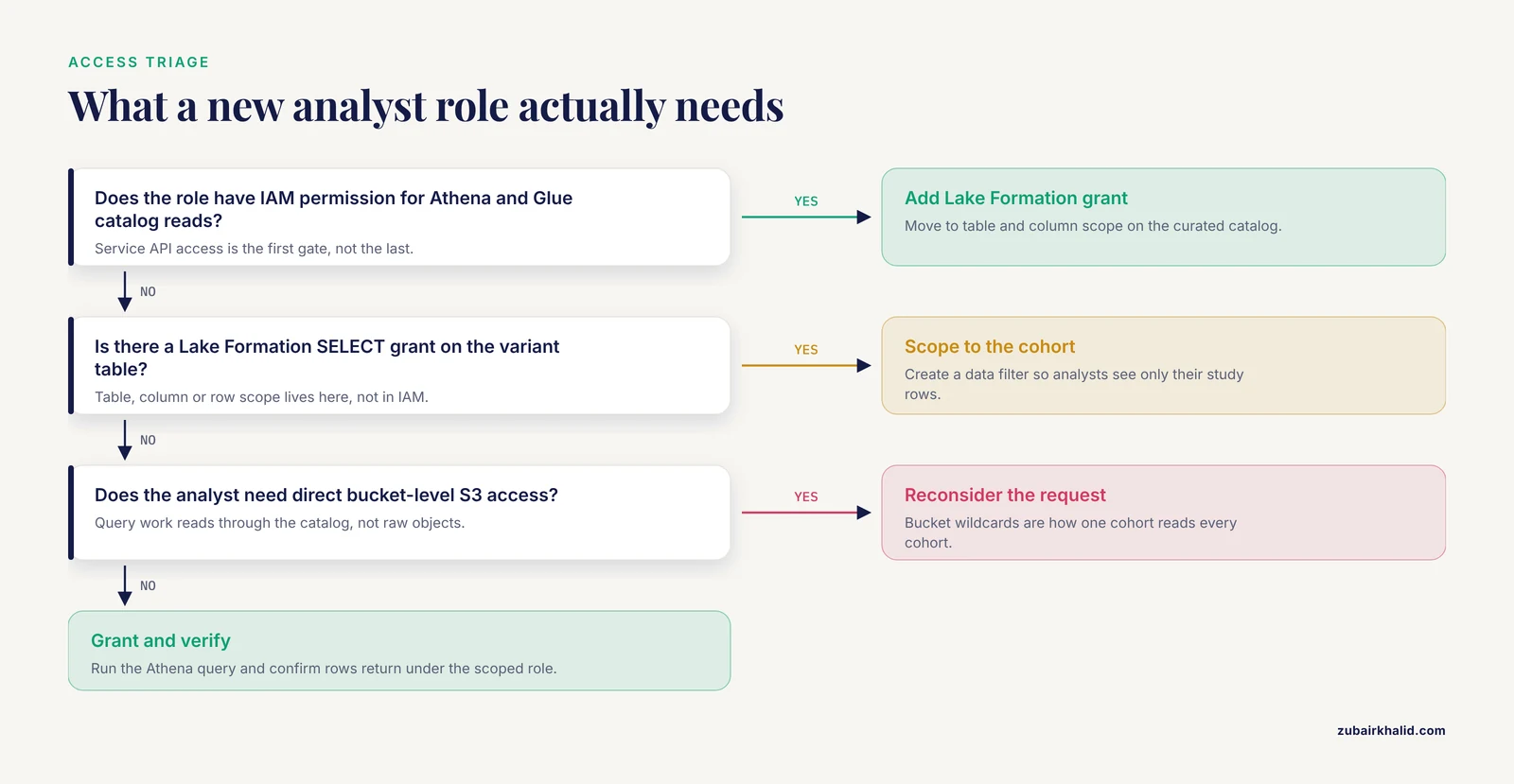
A Lake Formation SELECT grant on the relevant tables or data filters, plus IAM permissions to call Athena and Glue catalog read APIs. No direct bucket-level S3 access is needed for query work.
Sources
- Celeste: A cloud-based genomics infrastructure with variant-calling pipeline suited for population-scale sequencing projects.
- OP043: The evolving attitude towards privacy and security of personal genomic data
- Employ Zero-Trust Architectures to Securing Genomic and Medical Data from Insider Threats: Cybersecurity Techniques for Biomedical Cloud Storage
- Architecting Future Finance: Secure, Intelligent, and Scalable Big Data Banking with Mlops on Aws
- Biofilm marker discovery with cloud-based dockerized metagenomics analysis of microbial communities.
- ТЕОРЕТИЧНА ОСНОВА ДЛЯ СТВОРЕННЯ АРХІТЕКТУРИ REAL WORLD DATA LAKE
- Utilizing AWS Cloud-Enhanced VPN and VPC Integration to Improve Data Security and Access Control in Library Management Systems
- Cloud-based adaptive exon prediction for DNA analysis.
- Data Classification on Data Confidentiality for Secure With Hybrid Chaotic Encryption in AWS Cloud Environment
- Quantum-Resilient Multi-Cloud Encryption Framework for Securing Big Data Using Post-Quantum Lattice-Based Cryptography and Chaotic Slicing
- A Secure Cloud-Based Cybersecurity Model Leveraging AWS Identity and Access Management for Multi-Tenant Environments
- PyGMQL: scalable data extraction and analysis for heterogeneous genomic datasets.
- Scalable Cloud Architecture for Real Time Genomic Pipeline Processing
- Cloud-based bioinformatics workflow platform for large-scale next-generation sequencing analyses.
- VDJServer: A Cloud-Based Analysis Portal and Data Commons for Immune Repertoire Sequences and Rearrangements.
- Developing IoT Healthcare Networks Based on Cloud-Based Big Data Analytics to Maximize Performance and Security
- Real-Time Patient Monitoring and Alerting in Hospitals Using AWS Lake House Architecture
- Cloud-Based Facial Recognition System Architecture Using AWS Services: A Comprehensive Analysis
- A cloud-based solution for managing next-generation sequencing data to comprehend forensic population statistics.
- Empirical Evaluation of Decentralized Genomic Data Computation Using Bacalhau and IPFS