RNA-seq Alignment Errors: Causes and Fixes
By Dr. Zubair Khalid, DVM, MS, PhD ·

Most alignment failures trace back to the reference, not the sequencer. The single most common cause is a mismatch between the reads and what you align them to: the wrong genome build, an annotation file from a different build, or an index that no longer matches either. The first thing to check is the aligner's own summary log next to the identity of your reference files. STAR writes uniquely mapped, multimapped, and unmapped read fractions to Log.final.out, and HISAT2 prints a comparable summary to the console. If one sample aligns far worse than its siblings, suspect the library. If every sample aligns poorly, or if reads align well but gene counts look wrong, suspect the reference and annotation pair.
This guide walks through rna-seq pipeline troubleshooting for alignment errors in the order you should attack them. It defines the failure modes, explains the mechanism behind each one, gives a diagnostic sequence you can complete in under an hour, and closes with prevention practices and workflow design choices that keep errors from returning.
What an Alignment Error Actually Is
RNA-seq measures gene expression by sequencing fragments of RNA and mapping the resulting short reads, stored in FASTQ files, onto a reference genome. Quantification then counts the reads that fall inside annotated genes. Alignment is the step that assigns each read a genomic location, and it is harder for RNA than for DNA because mature transcripts are spliced. A read can span two exons that sit far apart in the genome, so the read has no contiguous match anywhere in the reference. Splice-aware aligners such as STAR and HISAT2 solve this by splitting a read across exon boundaries. General DNA aligners do not, and using one for RNA-seq is itself a classic mistake that produces massive apparent mismatches and lost reads.
An alignment error is any of the following failures:
- Reads map to the wrong genome or the wrong location because the reference is wrong for the sample.
- Reads fail to map because of contamination, poor quality, or gaps in the reference.
- Reads map correctly but are counted against the wrong gene because the annotation does not match the genome.
- Counts are distorted by errors introduced before or after mapping, such as barcode sequencing errors or unfiltered artifacts in variant calling.
The consequences scale from lost statistical power to outright wrong conclusions, because a distorted count matrix flows directly into differential expression and every interpretation built on it. In one documented plant example, a handful of false gene models inside ribosomal DNA regions came to dominate the expression profile of entire datasets [2].
Three terms recur throughout this article. Multimapping means a read aligns equally well to several locations, which is common in repeats and paralogous gene families. An index is a preprocessed search structure built from the reference FASTA before alignment begins. An annotation is a GTF or GFF file that lists gene, transcript, and exon coordinates.
RNA-seq Pipeline Troubleshooting: Alignment Errors in Order of Frequency
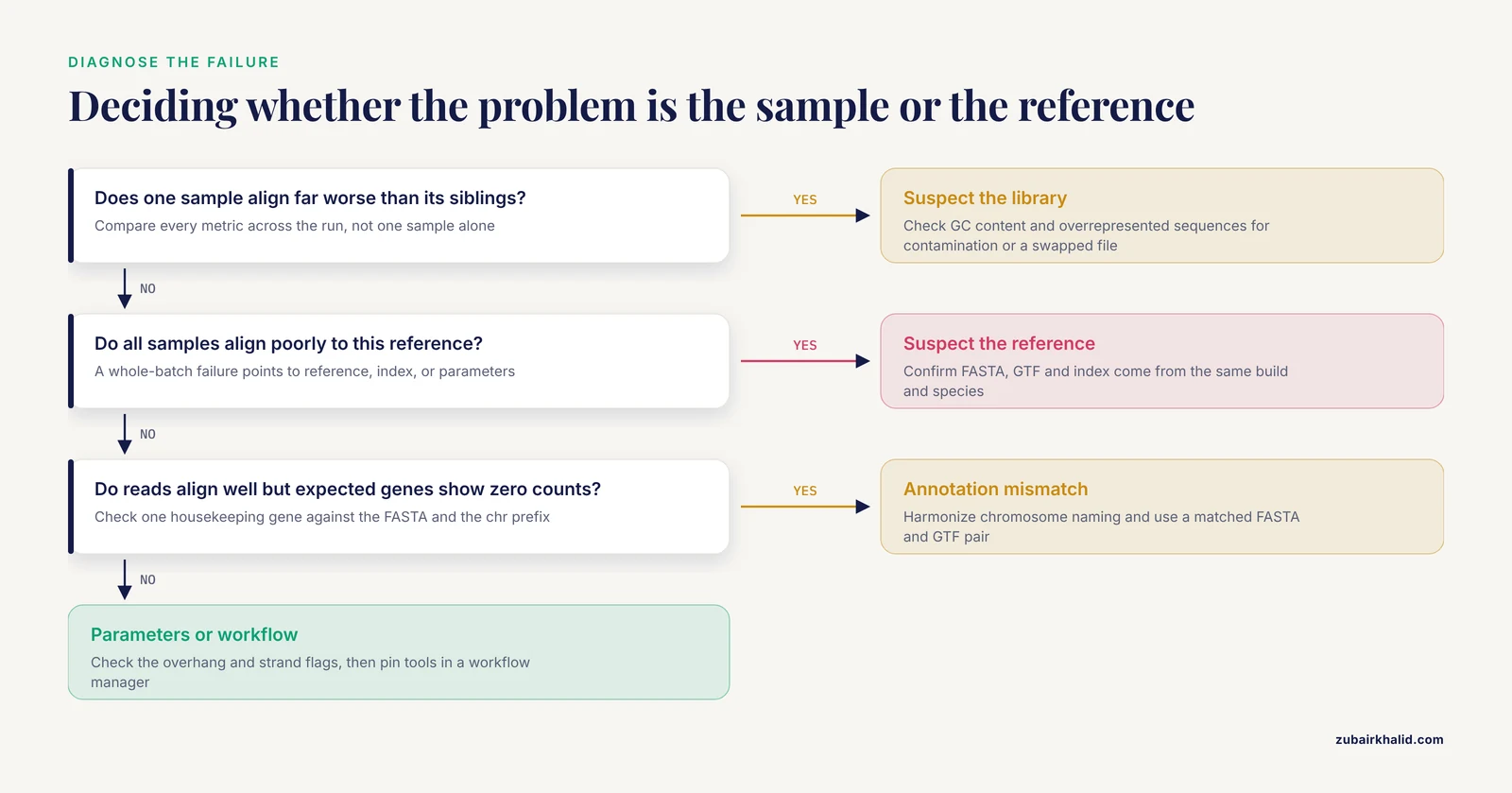
Work through these five checks before changing anything. They resolve or localize the majority of alignment problems.
- Read the aligner summary. STAR's Log.final.out reports the uniquely mapped fraction, the multimapped fraction, unmapped reads, splice junctions per read, and the mismatch rate per base. HISAT2 prints a similar summary. Compare every metric across all samples in the run rather than judging one sample alone.
- Inspect the raw reads. Run FastQC and review per-base quality, adapter content, overrepresented sequences, and the GC distribution. FastQC is a standard first step in published clinical and research pipelines [3], [4].
- Confirm the reference identity. Verify that the genome FASTA, the annotation GTF, and the prebuilt index all come from the same build, for example GRCh38 paired with a GRCh38 GTF, and that chromosome names match the aligner's expectations, such as chr1 versus 1.
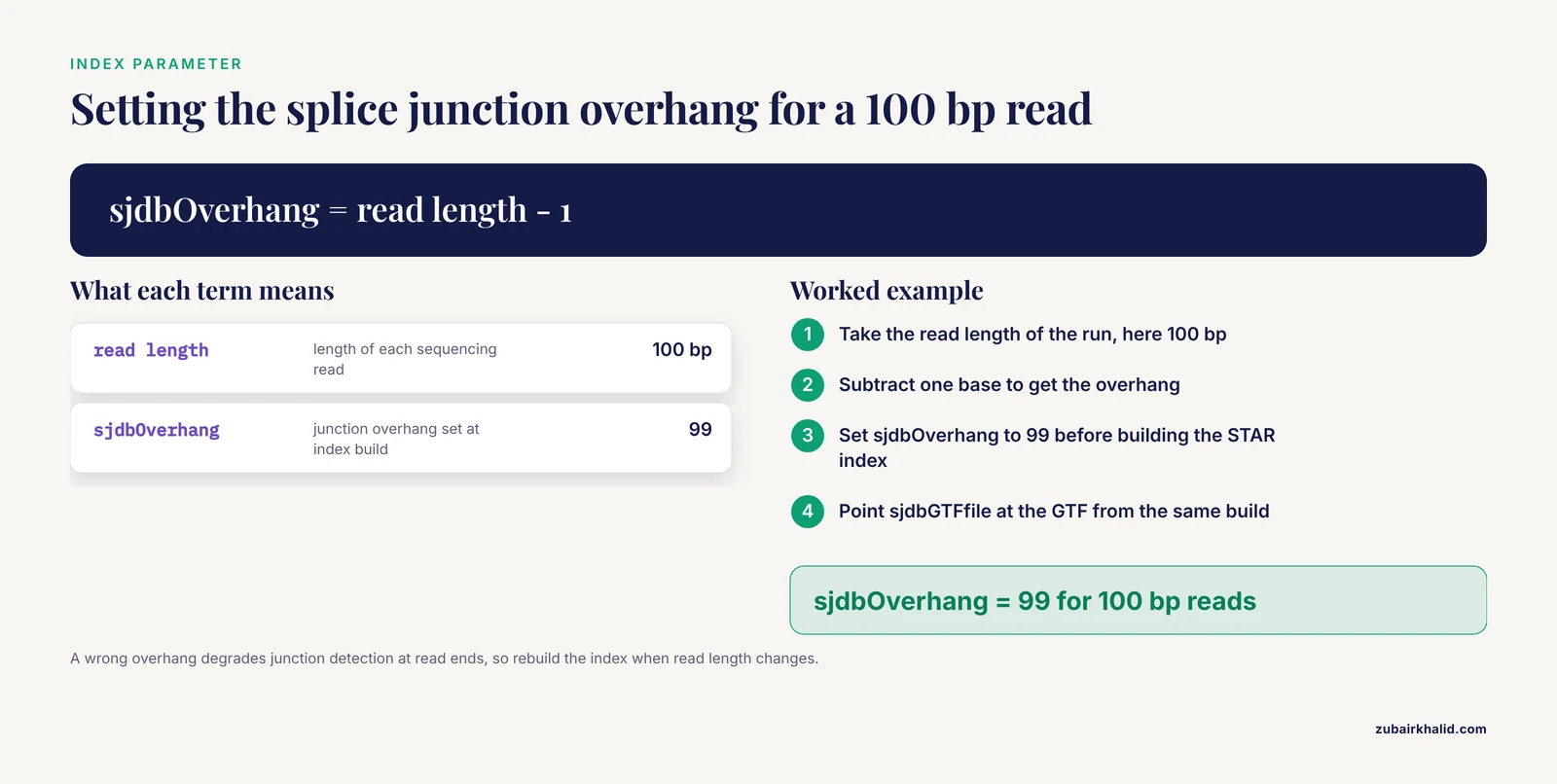
- Check index parameters. Splice-aware indexes record junction information from the annotation at build time. The overhang parameter should equal the read length minus one, which is 99 for 100 bp reads.
- Separate sample-level from run-level problems. One bad sample among good ones points to contamination or a swapped file. All bad samples point to a reference, index, or parameter problem that affects the whole batch.
Aggregating these logs across samples with a report generator such as MultiQC, which the IntegrateALL pipeline runs alongside FASTQC, turns the comparison into a single glance [3].
Troubleshooting Table: Symptom, Likely Cause, How to Confirm, and Fix
| Symptom | Likely cause | How to confirm | Fix |
|---|---|---|---|
| , - | , - | , - | , - |
| Alignment rate far below the rest of the run | Wrong species or genome build, or a contaminated library | FastQC GC content and overrepresented sequences, then align a read subset to the correct reference | Rebuild the index from the correct FASTA and screen for contamination |
| Reads align well but expected genes have zero counts | Annotation does not match the genome build, or chromosome names differ | Compare one housekeeping gene's GTF coordinates against the FASTA and check chr prefixes | Use a matched FASTA and GTF pair and harmonize chromosome naming |
| Very high multimapping fraction | Repetitive elements, paralogous gene families, or reads too short to place uniquely | Multimapper fraction in the aligner summary, then inspect a few loci in a genome browser | Document multimappers, count them consistently, and consider longer reads for future runs |
| A handful of genes dominate total TPM | False gene models inside rDNA repeats | Run riboCleaner to quantify rRNA-derived reads [2] | Drop the misannotated models and report the rRNA fraction |
| One immune gene family missing or biased | Polymorphic genes absent from the single reference genome | Low or skewed counts in high-expression MHC or KIR genes despite good overall alignment | Supplement with custom gene spaces using a pseudoaligner such as nimble [5] |
| Splice junctions at implausible positions | Adapter contamination, a wrong overhang parameter, or genomic DNA carryover | Check junctions against the annotation and review adapter content in FastQC | Trim adapters and rebuild the index with the correct overhang |
| Variant calls skewed by strand or multi-allelic | RNA modification-induced mismatches, strand bias, or PCR duplicates | Multiple alternative alleles at one position, strand ratios far from 1:1 | Apply strand-bias and multi-allelic filters and keep valid biological duplicates [6] |
| UMI or cell barcode counts inflated | Sequencing errors in barcodes | Barcode correction statistics from the processing tool | Apply barcode error correction as in dropEst [7] |
| Results differ between machines or reruns | Unpinned tool versions and hand-run steps | Diff the logs and tool versions across runs | Move the workflow into a workflow manager with containers [8], [9] |
| Fusion or variant calls differ between analysts | Error-prone manual integration of separate tools | Re-run the same inputs through a unified pipeline | Adopt an integrated pipeline with a defined ruleset [3] |
Treat the table as a map, not a recipe. The sections below explain why each failure happens, because the mechanism tells you which fix is safe.
Causes of Alignment Errors, From Most Common to Rarest
1. Wrong Reference Genome or Mismatched Annotation
This is the most frequent cause and the cheapest to fix. A genome build defines a coordinate system, and builds differ. GRCh37 and GRCh38, the two common human builds, place many genes at different coordinates, so a GTF from one build paired with a FASTA from the other produces reads that align to positions outside annotated exons. The alignment rate can look perfectly healthy while the counts are quietly wrong. Chromosome naming adds a second silent failure: a GTF that says chr1 against an index that says 1 yields zero-count genes with no error message anywhere in the log.
The failure stays invisible because every downstream step reports success. The aligner sees a valid genome, the counter sees a valid GTF, and the statistics see plausible numbers. The only symptom is biology that makes no sense, such as housekeeping genes that swing wildly between groups.
Species mismatch is the extreme case. Reads from one organism aligned to another genome produce low alignment rates and spurious hits in conserved regions. For non-model organisms without a finished genome, structured plant pipelines explicitly pair transcriptome assembly with alignment and differential expression, and they stress selecting or building the correct reference before any alignment happens [10].
2. Contaminating and Low-Quality Reads
Ribosomal RNA reads, adapter dimers, and reads from off-target organisms consume sequencing depth and distort quantification. The problem compounds when annotation is also wrong. The riboCleaner work showed that false gene models inside rDNA regions, where hundreds of near-identical repeats invite mistaken gene predictions, made a handful of genes appear to supply more than 50 percent of the total TPM in entire RNA-seq datasets [2]. FastQC flags this class of problem through overrepresented sequences and an abnormal GC profile. Adapter and quality trimming with a tool such as Trimmomatic is standard practice in pipelines that need clean input, including toxin-focused workflows that pair FastQC and Trimmomatic before assembly [4].
3. Aligner Choice and Default Parameters
Aligners differ in seed length, mismatch penalties, and how they report repeated matches, so the same read can land differently under different tools and settings. Defaults are not interchangeable. A comparative study on HeLa RNA-seq data evaluated four widely used tools, HISAT2, Novoalign, TopHat, and Subread, and measured precision, recall, F-measure, false discovery rate, error tolerance, parameter stability, runtime, and memory. The settings of each tool differed significantly, Subread and TopHat performed best with optimized parameters, and Novoalign's default setting proved optimal for those HeLa reads [11]. The practical lesson is that a default is a starting point, not a guarantee.
Pipeline-level comparisons reach compatible conclusions. When five pipelines built from common tools were compared on acute myeloid leukemia cell line data, the combination of HISAT2 for alignment, featureCounts for quantification, and edgeR for differential analysis delivered the shortest runtimes, the lowest peak RAM, and the most reliable results of the set [12]. The Rsubread and edgeR quasi-likelihood workflow remains a well-documented path from alignment through differential expression entirely inside R [13].
4. Splice, Strand, and Index Parameter Mistakes
Three parameters fail quietly. The overhang parameter, sjdbOverhang in STAR, should match the read length minus one, and a wrong value degrades junction detection at read ends. Library strandedness must match the wet-lab protocol: in featureCounts, the -s flag distinguishes unstranded, forward-stranded, and reverse-stranded libraries, and the wrong setting can cut usable counts roughly in half or assign them to the antisense strand. Finally, an index built before a reference or annotation update keeps serving stale junctions, so any reference change requires a rebuild. STAR's two-pass mode, which aligns once, collects novel junctions, and then realigns with those junctions inserted, improves splice sensitivity at the cost of runtime, and the choice should be recorded as part of the method.
5. Sequencing Errors in Barcodes and Base Calls
Droplet-based single-cell experiments attach a cellular barcode and a molecular identifier to each read. Two reads sharing a molecular barcode are presumed to come from the same original transcript molecule, so a single base error in that barcode splits one molecule into two apparent ones and inflates counts. dropEst addresses this with barcode correction methods and diagnostic reporting, correcting sequencing errors that affect both cellular and molecular barcodes to produce more accurate count estimates [7].
Base-call errors also masquerade as biology in variant-aware analyses. A pipeline for mitochondrial DNA SNVs from single-cell RNA-seq filters sequencing errors by removing strand-biased artifacts that exceed a 1:3 ratio, removing RNA modification-induced errors identified by multiple alternative alleles at the same position, and retaining duplicates because most are valid biological molecules rather than PCR artifacts [6].
6. Reference Gaps: Polymorphism, rDNA Models, and Annotation Bias
A single reference genome cannot represent every allele in a population. Balancing selection has generated many polygenic immune gene families that a one-size-fits-all reference represents poorly, so genes in the major histocompatibility complex and killer-immunoglobulin-like receptor families show systematically missing or inaccurate data in standard pipelines [5]. The mechanism is straightforward: when a sample carries an allele divergent from the reference, reads from that allele either fail to map or map preferentially to the reference allele, producing both missing data and reference bias. The same class of failure appears as annotation inaccuracy, including incorrect gene models inside repetitive rDNA arrays and annotation bias in poorly characterized genomes [2], [4]. Viral RNA in infected samples fails for the same reason when the reference lacks the viral sequence [5].
7. De Novo Assembly Errors in Reference-Free Workflows
When no good genome exists, reads are assembled into a transcriptome first, and assembly errors then propagate into every downstream number. Complex tissues bring assembly errors, isoform diversity, and annotation bias together, which is why a toxin transcriptome pipeline combines deep sequencing, rnaSPAdes-based de novo assembly, and a tailored annotation strategy to minimize misassemblies and resolve isoforms accurately [4]. Plant workflows face the same issue and pair assembly with alignment and differential expression inside one structured pipeline [10]. A chimeric misassembly acts like a fake gene: reads from two real transcripts map to it, the real genes lose counts, and the fake one gains them.
8. Workflow-Level Failures: Manual Glue and Unpinned Environments
Many alignment errors are actually reproducibility errors. Stitching tools together by hand is error-prone, which motivated integrated pipelines that run QC, STAR alignment, fusion calling, SNV calling, and virtual karyotyping under one ruleset instead of manual integration [3]. The same fragmentation problem drives the design of end-to-end packages that replace hand-written scripts spanning QC through differential expression [14]. When tool versions float, the same FASTQ files produce different alignments on different machines, and the discrepancies look like biological signals.
How to Fix RNA-seq Alignment Errors, Step by Step
The fixes below pair with the causes above. Run them in order on a small subset of reads first, then scale up. These are the practical solutions behind every row of the troubleshooting table.
Step 1: Audit the Inputs
Confirm the species and build of every file, record checksums, and run FastQC:
fastqc sample_R1.fastq.gz sample_R2.fastq.gzLook for adapter content rising toward the read ends, overrepresented sequences, and a GC distribution that does not match the expected organism. If the GC profile suggests contamination, identify the contaminant before aligning, because alignment will only hide it.
Step 2: Rebuild the Index From Matched Files
Download the genome FASTA and the GTF from the same build and the same source, then build the index once and record the versions. For HISAT2:
hisat2-build GRCh38.fa GRCh38For STAR, set runMode to genomeGenerate, point sjdbGTFfile at the matched GTF, and set sjdbOverhang to the read length minus one, which is 99 for 100 bp reads. Never mix a prebuilt index from one source with an annotation from another. Keep a short text file in the pipeline repository listing the FASTA checksum, the GTF version, and the date the index was built.
Step 3: Align With Documented Parameters
hisat2 -x GRCh38 -p 8 -1 sample_R1.fastq.gz -2 sample_R2.fastq.gz -S sample.sam

featureCounts -a genes.gtf -o counts.txt -t exon -g gene_id -s 0 sample.bam
Set the -s flag to match the library protocol, using 0 for unstranded, 1 for forward-stranded, and 2 for reverse-stranded libraries in featureCounts. STAR users should record the two-pass choice and every non-default parameter in the output, because those settings are part of the result. STAR embeds version information in its BAM header and HISAT2 reports it in the summary, so keep both in the archived output.
Step 4: Remove Contamination Before and After Alignment
Trim adapters and low-quality tails with Trimmomatic or an equivalent tool, then quantify rRNA-derived reads with a dedicated tool such as riboCleaner, which was built specifically to identify misannotated gene models in rDNA regions and measure the rRNA fraction in plant RNA-seq data [2]. Automated pipelines add a gate here: ARACRA separates its pre-alignment phase from its statistical phase with an extensive QC step so a human can visually inspect the processed data and filter noise and outlier samples before any downstream analysis [15].
Step 5: Correct Barcodes and Filter Variant Artifacts
For droplet single-cell data, apply barcode error correction as implemented in dropEst, and audit the correction statistics it reports rather than accepting them blindly [7]. For variant-aware analyses, filter strand-biased calls, remove positions showing multiple alternative alleles that indicate RNA modification-induced errors, and keep duplicates where they represent valid biological molecules [6].
Step 6: Supplement the Reference for Polymorphic Genes
When specific gene families matter and the standard reference underrepresents them, supplement rather than replace. nimble processes bulk or single-cell RNA-seq with a pseudoaligner, which assigns reads against a curated set of target gene sequences instead of scanning a whole genome, using custom gene spaces with scoring criteria tailored to each gene set. It recovers data for incorrect annotation, viral RNA, and immune genotyping cases that standard pipelines miss [5]. For allele-specific questions, NEXT-scASV performs de novo allele-specific variant calling from single-cell data without prior genotyping, inside a containerized Nextflow workflow [9].
Step 7: Benchmark Before You Commit
Before locking an aligner and its parameters for a project, test candidates on a small representative subset of your own reads. The HeLa comparison measured precision, recall, F-measure, false discovery rate, parameter stability, runtime, and memory across settings [11], and those are exactly the quantities worth estimating for your data. Keep the winning settings in version control next to the pipeline.
Nextflow vs Snakemake: Picking a Bioinformatics Workflow Manager
A bioinformatics workflow manager executes each step with recorded versions and parameters, skips steps whose inputs have not changed, and reruns everything identically on another machine. That alone eliminates a large share of alignment errors, the ones caused by stale references, forgotten flags, and hand-run steps.
Nextflow describes pipelines in a Groovy-based language with native support for containers, schedulers, and cloud execution. LYNX-RNA uses Nextflow to take raw data through alignment, QC, differential expression, and pathway analysis in a scalable and repeatable way, and adds large language model summaries that make results readable for clinicians and other non-specialists [8]. NEXT-scASV demonstrates the same stack at single-cell atlas scale, processing 135,000 peripheral blood mononuclear cells from 57 donors in a week on a single node with 100 threads, fully containerized [9].
Snakemake describes pipelines in Python-style rule files and integrates with Conda and container runtimes. riboCleaner ships as a containerized Snakemake workflow [2], and AutoRNAseq uses Snakemake to automate the entire path from data retrieval and reference preparation through QC, alignment, and quantification with minimal intervention [16].
Nextflow vs Snakemake is a reasonable question with an unspectacular answer: both are mature, both support containers and partial reruns, and both are proven in published RNA-seq pipelines. Nextflow tends to fit teams that run on heterogeneous infrastructure, from laptops to cloud batches, because its executor layer abstracts that difference. Snakemake tends to fit teams already living in Python who want their pipeline files to read like the rest of their code. Either way, commit to one manager for the whole project. If no one on the team wants to write code at all, web platforms such as THRAISE, which runs QC through functional enrichment from raw NCBI Sequence Read Archive input without programming [17], and command-line frameworks such as Compi, which packages demultiplexing, alignment, counting, and differential expression in a customizable pipeline [1], offer workable alternatives.
Safety note: these steps are computational, but two hazards are real. Pull container images only from registries you trust and pin exact versions, because an image runs with your file permissions. Raw human sequencing data is identifiable, so store and share it under your institution's data governance rules.
Common Mistakes and Limitations
- Rebuilding the index but keeping the old annotation. The FASTA, GTF, and index must change together. A half-updated reference set is worse than a consistent old one because it fails silently.
- Trusting defaults on a new organism. The aligner benchmark showed significant performance differences between settings, and the best setting for one dataset is not transferable as a matter of course [11].
- Deleting multimappers instead of documenting them. Multimapping is information about repeats and paralogous families. Discard it deliberately and record how many reads were affected.
- Ignoring strandedness. A wrong -s setting in featureCounts, or the equivalent elsewhere, halves counts or moves them to the antisense strand, and the error survives every downstream statistical test.
- Gluing tools by hand. Manual integration across alignment, fusion calling, and variant calling is error-prone, which is the explicit motivation for unified pipelines [3], [14].
- Assuming published benchmarks transfer. The comparisons cited here used specific cell lines and datasets. Treat them as evidence that settings matter, not as a prescription for your organism [11],.
- Over-trimming. Aggressive trimming shortens reads, and shorter reads multimap more. Trim to fix a measured problem, not by habit.
Prevention Practices That Stop Recurrence
- Pin everything. Record the exact FASTA build, GTF version, index build date, aligner version, and every non-default parameter in the pipeline repository.
- Use containers for every tool. Published workflows run STAR, FASTQC, MultiQC, and variant callers inside containers precisely so that versions cannot drift [3], [9].
- Gate the pipeline with QC. Put an explicit review point between alignment and statistics so outlier samples and artifacts are caught before they contaminate results [15].
- Aggregate QC reports. MultiQC-style summaries make a drifted sample visible in seconds [3].
- Benchmark once per organism. Run the Step 7 comparison when a new species, read length, or library type enters the lab, and reuse the result [11].
- Supplement known problem genes. For immune, viral, or other polymorphic targets, add a supplemental alignment pass with custom gene spaces rather than accepting missing data [5].
- Keep duplicates when they are biology. In molecular-count and variant contexts, decide deliberately whether duplicates are artifacts or signal [6].
- Re-run from raw data periodically. A scheduled full rerun from FASTQ through counts catches silent reference and environment drift.
Frequently Asked Questions
Why is my RNA-seq alignment rate so low?
The most common reason is a mismatch between the reads and the reference, usually the wrong genome build, the wrong species, or an index built from different files than the annotation. Check the aligner summary and the reference identity before touching any parameters.
Which aligner should I use, STAR or HISAT2?
Both are splice-aware, widely validated, and reasonable defaults. Head-to-head work shows results depend on both the tool and its parameter settings, and one pipeline comparison found HISAT2 with featureCounts and edgeR fastest and most reliable on their data, so benchmark briefly on your own reads before committing.
Can trimming fix alignment errors?
Trimming fixes adapter contamination and low-quality tails, which do cause real alignment failures. It cannot repair a wrong reference, a mismatched annotation, or a stale index, so confirm the reference is correct before trimming anything.
Do I need to rebuild my index after changing the annotation file?
Yes, for splice-aware aligners such as STAR, because junction and transcript information from the annotation is incorporated into the index at build time. A new GTF with an old index produces stale junctions and wrong splice-aware quantification.
What alignment percentage is acceptable?
No universal threshold exists, because acceptable rates depend on organism, tissue, read length, and reference quality. Compare samples processed identically in the same run and investigate any sample that falls far below its peers.
Nextflow vs Snakemake, which should I choose for RNA-seq?
Both are mature bioinformatics workflow managers that produce reproducible, containerized pipelines, and published RNA-seq workflows demonstrate both at production scale. Choose based on your team's language preference and infrastructure, then standardize on one.
Why do my HLA genes show zero or unreliable counts?
Highly polymorphic gene families such as MHC and killer-immunoglobulin-like receptors are poorly represented in a single reference genome, so reads from divergent alleles fail to map or map to the wrong place. Supplemental alignment against custom gene spaces recovers this data.
How do I make my alignment results reproducible?
Pin the reference build, annotation version, index parameters, and tool versions, wrap the tools in containers, and run everything through a workflow manager that records each step. Re-running from raw FASTQ should then reproduce your counts exactly.
Sources
- Updates and validation of the Compi RNA-seq pipeline with a case study in Alzheimer’s disease
- riboCleaner: a pipeline to identify and quantify rRNA read contamination from RNA-seq data in plants
- Integrateall, a Machine Learning Pipeline for Multi-Level Data Extraction from RNA-Seq Profiles Unravels Novel Drivers and Systematic Subtype Classification in B-Cell Precursor ALL
- ToxIR: an accurate RNA-seq pipeline for high-precision toxin transcriptome profiling, validated in odontobuthus doriae venom glands
- An immune-focused supplemental alignment pipeline captures information missed from dominant single-cell RNA-seq analyses, including allele-specific MHC-I regulation
- A bioinformatics pipeline for identifying homoplasmic and heteroplasmic mitochondrial DNA SNVs in single-cell RNA-Seq datasets.
- dropEst: pipeline for accurate estimation of molecular counts in droplet-based single-cell RNA-seq experiments
- LYNX-RNA: A Scalable Nextflow Workflow for RNA-Seq Analysis with Integrated Large Language Models for Comprehensive Result Interpretation
- NEXT-scASV: a Nextflow pipeline for allele-specific variant calling from single-cell RNA-seq data
- RNA-Seq Data Analysis Pipeline for Plants: Transcriptome Assembly, Alignment, and Differential Expression Analysis.
- A Comparative Study of RNA-Seq Aligners Reveals Novoalign’s Default Setting as an Optimal Setting for the Alignment of HeLa RNA-Seq Reads
- A comprehensive RNA-Seq pipeline includes meta-analysis, interactivity and automatic reporting
- From reads to genes to pathways: differential expression analysis of RNA-Seq experiments using Rsubread and the edgeR quasi-likelihood pipeline
- SeqExpressionAnalyser: An R Package for Automated End-to-End RNA-Seq Analysis From Reads to Differential Expression
- ARACRA: Automated RNA-seq Analysis for Chemical Risk Assessment
- AutoRNAseq: Automated Bulk RNA-seq Analysis Pipeline
- THRAISE: An automated and reproducible web platform for RNA-seq analysis