Reproducible Testing in Nextflow and Snakemake: Options Compared
By Dr. Zubair Khalid, DVM, MS, PhD ·

Nextflow and Snakemake solve reproducible testing with different philosophies: Nextflow pairs a Groovy-based engine with nf-test, a dedicated snapshot-testing framework that records expected outputs, while Snakemake leans on the general-purpose Python testing ecosystem, chiefly pytest-workflow and pytest-style unit tests, because the workflow itself is plain Python. The rule of thumb is simple. If you want a batteries-included, declarative test framework with snapshot support and you are comfortable in the JVM-adjacent world, choose Nextflow with nf-test. If you want tests you can read, write, and extend with ordinary Python skills, and you value a single dependency stack, choose Snakemake with pytest-workflow. Both approaches work, both are used in large community ecosystems, and the difference that decides real projects is usually team skill set, not raw capability.
This article walks through every mainstream reproducible testing option in both managers, compares them on the criteria that actually decide choices, works through concrete scenarios, and lists the mistakes that waste the most time.
Why Reproducible Testing Is a First-Class Concern
A bioinformatics workflow manager is a tool that orchestrates multi-step computational pipelines, managing dependencies between tasks, parallel execution, and logging. Nextflow and Snakemake are the two most widely adopted workflow managers in bioinformatics. Both are mature, both support containers and conda environments, and both have large module ecosystems.
Reproducibility in bioinformatics remains difficult even with these systems in place. A recent software-engineering review argues that reproducibility failures usually originate in pipeline-specific code, not in the engines themselves, and proposes treating pipeline development with the same engineering discipline as ordinary software [1]. That discipline has a direct testing component: the authors recommend systematic validation of the environment, the inputs, and the runtime behavior, together with comprehensive test strategies that combine real and synthetic data inside continuous integration workflows [1].
Reproducible testing means that when you run your test suite on any machine, at any time, with the pinned inputs and pinned software environment, you get the same assertions passing or the same outputs produced. It is distinct from scientific reproducibility (reproducing a published result) and from environment reproducibility (rebuilding the same software stack). Reproducible testing depends on environment reproducibility but adds a third ingredient: a test suite whose verdict does not drift over time.
A continuous integration (CI) system, such as GitHub Actions or GitLab CI, automatically runs your tests whenever code changes. CI is where reproducible testing earns its keep, because a test that only runs on one developer's laptop is not reproducible in any meaningful sense [1].
What You Are Actually Testing: Four Layers
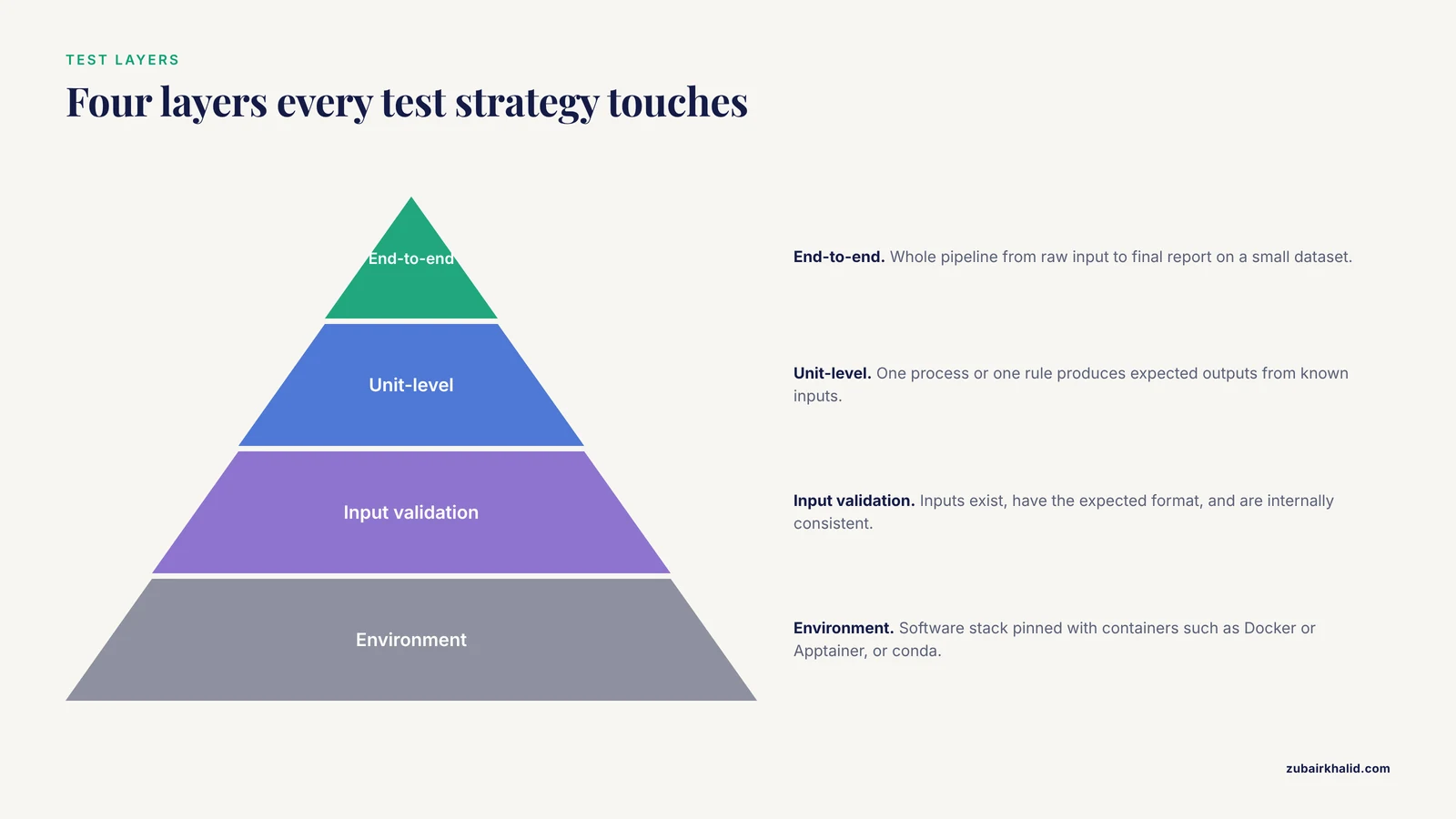
Before comparing options, separate the four layers that every test strategy touches. Confusing these layers is the single most common source of wasted effort.
- Environment reproducibility. The software stack (tools, versions, libraries) is pinned. The standard mechanisms are containers such as Docker or Apptainer (the project formerly known as Singularity) and conda, a package manager that resolves software environments from a YAML recipe. Both Nextflow and Snakemake support both mechanisms natively.
- Input validation. The pipeline checks that inputs exist, have the expected format, and are internally consistent before burning compute. A recent engineering review places environment, input, and runtime validation among the core practical recommendations for reproducible pipelines [1].
- Unit-level behavior. A single process in Nextflow or a single rule in Snakemake produces the expected outputs from known inputs. This is where nf-test and snakemake-unit-tests operate.
- End-to-end behavior. The whole pipeline, from raw input to final report, produces the expected results on a small dataset. This is where pytest-workflow and test profiles operate.
A reproducible test strategy covers all four layers, but the layers are mostly independent. You can pin environments perfectly and still have an untested pipeline. You can have beautiful unit tests and an environment that silently changes underneath them.
Testing Options in Nextflow
Nextflow is written in Groovy, a language that runs on the Java virtual machine. Each unit of work is a process, and processes are connected into a directed acyclic graph (DAG), a dependency structure in which each task consumes the outputs of earlier tasks. Testing options fall into four groups.
Option 1: nf-test, the purpose-built framework
nf-test is a dedicated test framework for Nextflow, developed for and heavily adopted by the nf-core community, the largest collection of peer-reviewed-style Nextflow pipelines. Its defining feature is snapshot testing: the framework records the exact expected state of outputs, channels, and process metadata on the first run, then compares future runs against that recorded snapshot. A snapshot is a stored, versioned record of expected output that lives in your repository and evolves through explicit review.
A minimal nf-test file for a single process looks like this:
nextflow_process {

    name "Test FASTQC process"
    script "../main.nf"
    process "FASTQC"

    test {

        when {
            params {
                input = "${projectDir}/../../data/tiny/sample_R1.fastq.gz"
            }
        }

        then {
            assert process.out.html.size() == 1
            assert path(process.out.html).contains("fastqc_report.html")
        }
    }
}
You run it from the pipeline root:
nf-test test tests/ --profile testThe strengths of nf-test follow directly from its design. It understands Nextflow's channel model, so it can assert on the emitted values of a process, not just on files on disk. It supports tags for selective runs, a config block for injecting test profiles, and a verbose mode that prints channel contents, which shortens debugging dramatically. Snapshot assertions let you lock in a whole output state with one line, which is a fast way to catch accidental behavior changes.
The weaknesses are equally concrete. Snapshot tests fail loudly whenever any output byte changes, including harmless ones such as timestamps embedded in logs, so you spend time approving snapshot updates that carry no real signal. The framework is a separate dependency with its own release cycle. And the Groovy-based assertion language is a second dialect to learn if your team is mostly Python-fluent.
Option 2: The test profile convention
A test profile is a named configuration preset, declared in nextflow.config, that swaps real production inputs for small synthetic ones and caps compute resources so tests run on CI hardware. The nf-core template formalized this convention, and it has become a de facto standard across the Nextflow ecosystem.
A typical test profile looks like this:
profiles {
    test {
        params.max_cpus   = 2
        params.max_memory = '6.GB'
        params.max_time   = '6.h'
        params.input      = "${projectDir}/assets/test_samplesheet.csv"
    }
}
You invoke it with:
nextflow run . -profile test -with-dockerThe test profile on its own is not a test framework. It is the data and resource harness that every other Nextflow testing option plugs into. Running nextflow run . -profile test in CI and asserting that the pipeline exits successfully is the minimal reproducible smoke test, and many production pipelines run exactly that on every commit alongside deeper nf-test suites. The pairing matters: the test profile supplies the small dataset and resource caps, and the framework supplies the assertions.
Option 3: pytest-workflow with Nextflow
pytest-workflow is a pytest plugin, from the general Python testing ecosystem, that executes a workflow command and then asserts on the files it produced. It predates nf-test as the dominant Nextflow testing tool and still appears in older pipelines and in Snakemake projects, which is why it is worth knowing in a nextflow vs snakemake comparison.
Its tests are declared in YAML rather than code:
- name: run_smoke_test
  command: nextflow run main.nf -profile test
  files:
    - path: results/multiqc/multiqc_report.html
      contains:
        - "MultiQC"
    - path: results/pipeline_info/software_versions.yml
      contains_regex:
        - "FastQC.*0\\.1"
The strengths are a single tool across both managers, human-readable YAML, and direct file-content assertions, including SHA-256 checksums for byte-level comparison. The weaknesses are the mirror image. pytest-workflow does not understand channels, so it cannot inspect intermediate Nextflow state, only files that land on disk. Debugging a failing test means reading Nextflow logs plus pytest output, a two-layer error surface. Development has been slower than the surrounding ecosystem, and new nf-core pipelines have standardized on nf-test instead.
Option 4: Environment pinning as a test target
Nextflow makes the software environment a first-class, testable configuration object. Each process can declare a container image, and a top-level configuration can switch between Docker, Singularity, Apptainer, or conda with profile-level directives. This turns "does the pipeline run under the pinned environment?" into an automated CI check rather than a manual hope. The engineering literature treats this environment validation as one of the systematic checks a reproducible pipeline should perform [1].
The practical pattern is a CI matrix that runs the test profile under at least two environment backends, for example Docker and Apptainer. If a container rebuild breaks a tool version, the test suite catches it before users do.
Testing Options in Snakemake
Snakemake takes the opposite path. Workflows are written in Python-flavored Snakefiles, each unit of work is a rule, and the ecosystem deliberately reuses Python testing conventions rather than building a bespoke framework.
Option 1: pytest-workflow
pytest-workflow is the workhorse of reproducible testing in Snakemake. The YAML format shown above works identically, with the command swapped:
- name: run_full_smoke
  tags: smoke
  command: snakemake --cores 2 --use-conda --directory test_out
  files:
    - path: results/counts/counts.tsv
      contains:
        - "gene_id"
    - path: logs/bowtie2/bowtie2.log
      must_not_contain:
        - "error"
The -use-conda flag tells Snakemake to build the conda environments declared in the rules, so the test runs against the pinned software rather than whatever happens to be installed on the CI runner. Combined with small test fixtures committed to the repository, this gives an end-to-end test that is reproducible across machines.
The strengths for Snakemake teams are that pytest is already familiar to Python developers, that file-based assertions match Snakemake's file-oriented mental model, and that tags let you partition fast and slow tests. The weaknesses mirror the Nextflow case: no introspection of the DAG or rule metadata, a two-layer debugging surface, and YAML assertions that grow awkward as they accumulate conditional logic.
Option 2: pytest-style unit tests for rules
Snakemake's own project provides a unit-testing package, snakemake-unit-tests, that runs pytest against individual rules with mocked inputs and a mocked execution environment. This addresses a specific and annoying problem: rules with run: directives embed Python code directly in the Snakefile, and that code is hard to exercise in isolation without running the whole workflow.
Unit tests in this style verify that a rule's logic produces the right calls and outputs given fixed inputs, without launching the underlying tools. They run in seconds, they catch logic regressions before expensive compute runs, and they complement rather than replace end-to-end pytest-workflow tests. The tradeoff is setup cost: mocking Snakemake's input and output objects requires understanding of Snakemake's internals, so small teams often skip this layer and rely on end-to-end tests alone.
Option 3: Test data and resource capping conventions
Snakemake does not have a profile mechanism equivalent to nf-core's test profile baked into a community template, so most projects implement the same idea by hand. Common patterns include:
- A
test/directory with tiny FASTA, FASTQ, or VCF fixtures committed to the repository. - A config file, for example
config/test.yaml, that pointssamplesat the fixtures and reduces parameters. - A CI job that runs
snakemake, cores 2, configfile config/test.yaml, use-conda.
The result is functionally equivalent to a Nextflow test profile, but it is per-project convention rather than an ecosystem standard. The Snakemake wrappers and module ecosystem, which packages common tools as reusable components, partially compensates by standardizing inputs and outputs for popular tools, which in turn makes fixtures easier to reuse across projects [1].
Option 4: Environment pinning as a test target
Snakemake declares environments per rule, either as conda environment YAML files (conda: "envs/bowtie2.yaml") or as container directives (container: "docker://biocontainers/bowtie2:v2.5.1", shown here as an illustrative pattern). Running the test suite with -use-conda forces environment resolution on every CI run, which verifies that the pinned environments still build. This is the same environment-validation layer the engineering literature recommends, achieved through the manager's native mechanism [1].
One practical caveat: fresh conda resolution on every CI run is slower and slightly less deterministic than a cached container image. Teams that need strict determinism pin conda via containers or export solved environments to lockfiles.
Side-by-Side Comparison
The table below is the core of this comparison. It treats each manager's mainstream options on the criteria that decide real projects.
| Criterion | Nextflow + nf-test | Nextflow + pytest-workflow | Snakemake + pytest-workflow | Snakemake + snakemake-unit-tests |
|---|---|---|---|---|
| Test granularity | Process and pipeline level | End-to-end (files on disk) | End-to-end (files on disk) | Rule logic level (mocked) |
| Assertion style | Groovy asserts plus snapshots | YAML file checks, checksums | YAML file checks, checksums | Python asserts on mocked objects |
| Understands engine internals (channels, DAG) | Yes | No | No | Partial |
| Environment pinning tested via | Profiles with Docker, Apptainer, conda | Same, via command | -use-conda, per-rule envs or containers | Not applicable, mocked |
| Learning curve | Moderate, new DSL to learn | Low if you know pytest | Low if you know pytest | High, requires Snakemake internals |
| Debugging experience | Good, channel inspection and verbose output | Two-layer, logs plus pytest | Two-layer, logs plus pytest | Good once mocking is set up |
| Snapshot support | Yes, first-class | No | No | No |
| Ecosystem maturity | Standard in nf-core, actively maintained | Legacy in Nextflow, maintained | Standard choice for Snakemake | Official but niche |
| Fixture data convention | nf-core test profile and test-datasets | Reuses test profiles | Per-project conventions | Per-project conventions |
| Best fit | Production nf-core-style pipelines | Cross-manager tooling, legacy pipelines | Python-heavy teams, most Snakemake projects | Rules with complex run directives |
Two meta-observations fall out of the table. First, both managers converge on the same outer harness: small synthetic fixtures, pinned environments, CI execution. The engineering literature describes exactly this combination of synthetic data, validation checks, and CI as the backbone of reproducible pipeline development [1]. Second, the frameworks differ mainly in where they draw the boundary between engine awareness and engine independence. nf-test sits inside Nextflow's world. pytest-workflow sits outside both engines and treats them as black boxes that consume commands and produce files.
Comparing on the Criteria That Decide Real Choices
Language and team skills
Nextflow pipelines are Groovy, Snakemake pipelines are Python. This single fact propagates through testing more than any framework feature. A team of Python developers testing a Snakemake pipeline uses tools they already know. A Python team testing a Nextflow pipeline must learn either Groovy-style assertions in nf-test or accept the YAML layer of pytest-workflow. Reverse the team's skill set and the calculus reverses. When people ask about nextflow vs snakemake in a testing context, this is usually the real question, and it has no framework-level answer.
Snapshot testing versus explicit assertions
Snapshots are fast to write and painful to maintain. You record once and detect any change, which makes them excellent regression alarms for stable pipelines. Explicit assertions, whether Groovy asserts or YAML checks, take longer to write but fail with informative messages and survive intentional refactors better. A pragmatic nf-test suite mixes both: snapshots for outputs you consider frozen, explicit asserts for properties you consider invariants, such as "the output has one file per input sample."
CI integration and runtime
Both ecosystems run comfortably in GitHub Actions and GitLab CI. The dominant cost driver is not the framework but the fixture design. A test suite built on full-size sequencing data takes hours and gets skipped, which means it stops protecting you. A suite built on synthetic or aggressively downsampled fixtures runs in minutes on every commit, which is what the software-engineering literature prescribes for reproducible pipeline development [1]. Both managers support the downsampled approach equally well, and the nf-core ecosystem's tiny test datasets are the most developed example of the pattern.
Conda-based testing adds environment build time to every run unless you cache. Container-based testing pulls images unless you cache those. Neither is unique to either manager, but Nextflow's profile system makes swapping backends a one-flag change, while Snakemake's per-rule declarations make the same swap slightly more verbose.
Error messages and debugging
When a test fails, you want to know why in one step. nf-test's channel inspection puts the failure close to the cause. pytest-workflow failures require correlating a YAML assertion with a workflow log. Snakemake unit tests, once mocked correctly, give the tightest failure loops but only for rule logic. In day-to-day maintenance, debugging experience often outweighs feature lists, and this is where nf-test's engine awareness pays off most.
Ecosystem and community gravity
If you adopt nf-core conventions, you inherit test profiles, tiny datasets, nf-test suites, and CI templates as a package. That is a large hidden advantage for reproducible testing in Nextflow and it compounds over a pipeline's life. If you adopt Snakemake, the wrappers and module ecosystem give you standardized component interfaces, which the engineering literature identifies as a foundation for reuse and maintainability, but the test scaffolding remains more per-project [1]. The modular ecosystems on both sides, nf-core modules and Snakemake wrappers, are explicitly cited as community-driven mechanisms that support reproducible engineering practice [1].
Worked Scenarios
Scenario 1: A genomics core facility standardizing on nf-core
A sequencing core runs several nf-core pipelines and one homegrown Nextflow pipeline. The right move is to adopt the ecosystem wholesale. Every pipeline gets a test profile, an nf-test suite covering each module's process with tiny fixtures, and a GitHub Actions workflow that runs nf-test test tests/, profile test on every pull request. The homegrown pipeline reuses the same template. The core gets reproducible testing almost for free because the scaffolding already exists, and new hires onboard against familiar conventions. The cost is Groovy exposure for Python-centric staff, mitigated by the fact that nf-test scripts are mostly copied from existing modules rather than written from scratch.
Scenario 2: A two-person lab with a Snakemake RNA-seq pipeline
A small lab pipeline processes a handful of samples per run. The team knows Python, has no dedicated DevOps support, and wants tests that fail loudly on a shared CI runner. The right stack is pytest-workflow with a committed fixture directory: three tiny samples, a config/test.yaml that points at them, and a YAML test asserting that the count matrix, QC report, and log files exist with expected content. Add snakemake-unit-tests later only if a specific rule with a run: directive becomes a recurring source of bugs. Total setup is a day, and every test is readable by anyone who knows Python.
Scenario 3: A new team choosing between the two managers
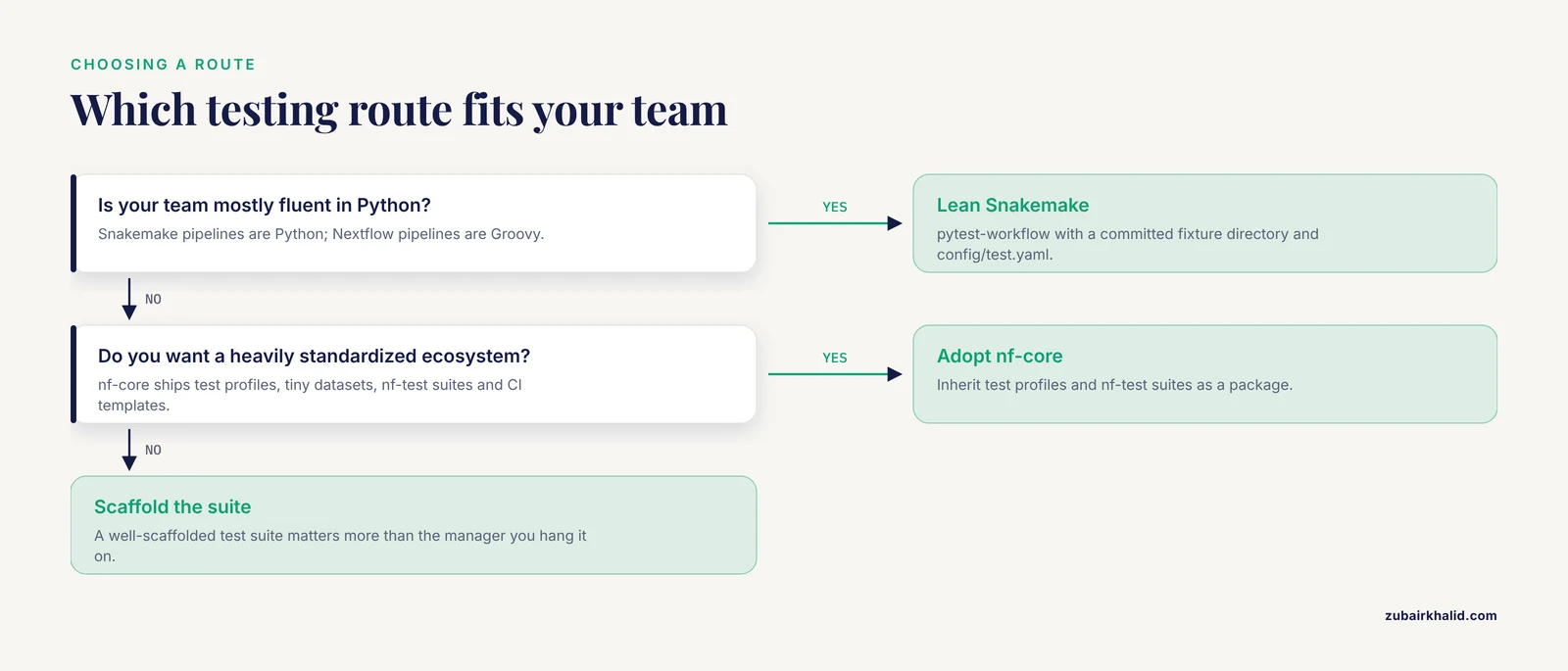
A five-person group is starting a flagship pipeline from scratch and testing is one input to the choice. The honest framing: both managers support every layer of reproducible testing, so the decision should weight (a) the team's existing language fluency, (b) whether the team wants to live inside a heavily standardized ecosystem or prefers per-project freedom, and (c) the operational environment, for example HPC scheduler support. Nextflow's Groovy base and JVM runtime fit teams with mixed scripting backgrounds and cloud deployments. Snakemake's Python base fits teams that want one language from analysis code through tests. Neither choice is wrong, and a well-scaffolded test suite matters more than the manager you hang it on.
Scenario 4: Migrating legacy pytest-workflow Nextflow tests
An older Nextflow pipeline has a pytest-workflow suite that still passes but is drifting from the ecosystem. The pragmatic migration path is incremental: add nf-test files for the highest-risk processes first, keep pytest-workflow end-to-end tests as the safety net, and retire YAML tests as their nf-test equivalents stabilize. This avoids a big-bang rewrite and lets the team learn nf-test on small surfaces before committing.
Common Mistakes and Limitations
Testing with real production data. Full-size real datasets make suites slow, expensive, and sometimes impossible to share for privacy reasons. The recommended practice is synthetic or downsampled fixtures in the repository, with real data reserved for occasional validation runs [1]. Synthetic data also lets you construct edge cases that real data rarely contains, such as malformed headers or empty inputs.
Confusing a passing smoke test with coverage. nextflow run . -profile test exiting zero proves the pipeline completes on one tiny dataset. It proves nothing about correctness of results, edge-case handling, or behavior on realistic inputs. Smoke tests are the floor of a test strategy, not the ceiling.
Snapshot churn. Teams new to nf-test approve snapshot updates reflexively whenever CI fails. Each approved update is a silent acceptance of a behavior change. Review snapshot diffs with the same care as code diffs, or the snapshots stop being tests and become mirrors.
Unpinned environments inside tests. A test that resolves conda packages without version constraints or pulls container images without digests will eventually break when upstream projects release. Pin versions, and treat the environment definition itself as tested code [1].
Ignoring input validation as a test layer. Bad inputs fail late and confusingly. Checking that a samplesheet has the required columns and that FASTQ files are non-empty belongs in the pipeline's own validation, exercised by dedicated negative tests with deliberately broken fixtures [1].
Testing only on the author's machine. A test suite that has never run in CI has not demonstrated reproducibility. Running under at least one container backend on a clean runner is the minimum bar.
Assuming the framework guarantees determinism. Non-determinism lives in the tools, not the manager. Parallel-threaded aligners, hash-order-dependent scripts, and timestamped outputs can all produce byte-different results from identical inputs. Design assertions around semantic content, or set explicit seeds and thread counts in the test harness.
Skipping the glue-code layer. A recent engineering treatment of pipeline design separates compute tasks from glue and adaptation tasks, arguing that well-defined task interfaces and explicit input and output specifications are what make modular, testable pipelines possible [1]. Teams that test only the compute steps leave the brittlest code, the glue, untested. These engineering principles also connect to broader research-software guidance such as the FAIR4RS principles, which aim at robustness and long-term sustainability of research code [1].
One honest limitation of both ecosystems. No mainstream framework in either manager gives you automatic scientific correctness checking. Tests verify that outputs match expectations, and expectations come from humans. A pipeline can pass every reproducible test and still compute the wrong quantity.
Frequently Asked Questions
Do I need nf-test, or can I test a Nextflow pipeline without it?
No, nf-test is not mandatory. The minimum reproducible setup is a test profile with tiny fixtures run in CI, which verifies the pipeline completes under pinned resources. pytest-workflow can add file-level assertions. What nf-test adds is channel-level assertions, snapshot testing, and better debugging, which is why the nf-core ecosystem standardized on it.
Does Snakemake have its own built-in testing framework?
Snakemake does not ship a test runner the way nf-test does for Nextflow. The official ecosystem provides snakemake-unit-tests for pytest-style unit tests of rule logic, and the standard practice for end-to-end testing is the pytest-workflow plugin. Both plug into ordinary Python tooling.
What is a test profile and why do both ecosystems use one?
A test profile is a named configuration preset that swaps production inputs for small fixtures and caps CPU, memory, and time so tests fit CI runners. Nextflow has native profile support and the nf-core template standardizes it. In Snakemake projects the same effect is usually achieved with a dedicated test config file and a reduced -cores setting.
How do I test a pipeline when the real input data is too large or sensitive to share?
Commit tiny synthetic or downsampled fixtures to the repository and point the test configuration at them. Synthetic data gives you control over edge cases and avoids privacy exposure, and it is the approach recommended in current software-engineering guidance for pipeline testing inside CI [1].
Which manager is easier to test in CI, Nextflow or Snakemake?
Both integrate cleanly with GitHub Actions and GitLab CI, and neither holds a structural advantage. The practical differences are that Nextflow's profile system makes environment-backend switching a one-flag change, while Snakemake's Python base means the test stack and the workflow language are one ecosystem. Fixture design and environment caching dominate CI runtime for both.
How often should reproducible pipeline tests run?
Run fast unit-level tests on every commit and the full end-to-end suite on every pull request, with a scheduled periodic run, for example weekly, against freshly resolved environments to catch upstream tool and dependency changes. A suite that runs less often than your dependencies change will not catch breakage before your users do.