Reproducible Genomics in the Cloud
By Dr. Zubair Khalid, DVM, MS, PhD ·

Reproducible genomics in the cloud is the practice of executing genomic analyses on hosted, on-demand computing infrastructure in a way that records the exact data, software, parameters, and environment used, so a second researcher can re-run the analysis and obtain the same result. It works by combining three ingredients that a laptop or departmental server rarely provides together: compute and storage located next to the data, software locked into containers, and analysis logic written as a versioned, machine-readable workflow.
This matters because a modern genomic paper rests on a pipeline with dozens of moving parts. A variant calling run involves an aligner, a caller, quality filters, a reference genome build, and hundreds of parameter choices. If any one of those parts drifts between the original analysis and a reanalysis, the results can differ in ways that look like biology but are actually software. Cloud bioinformatics attacks that problem directly. Instead of mailing hard drives or downloading terabytes to a lab server, the analysis moves to where the data already lives, and the platform records what happened. The National Cancer Institute funded the Cancer Genomics Cloud for exactly this reason, to colocalize massive public cancer datasets with analysis tools and compute so that analyses become scalable and reproducible by design [1].
What Is Reproducible Genomics in the Cloud? A Plain-Language Explanation
To answer "what is reproducible genomics cloud" work in concrete terms, start with the three layers that every such system shares.
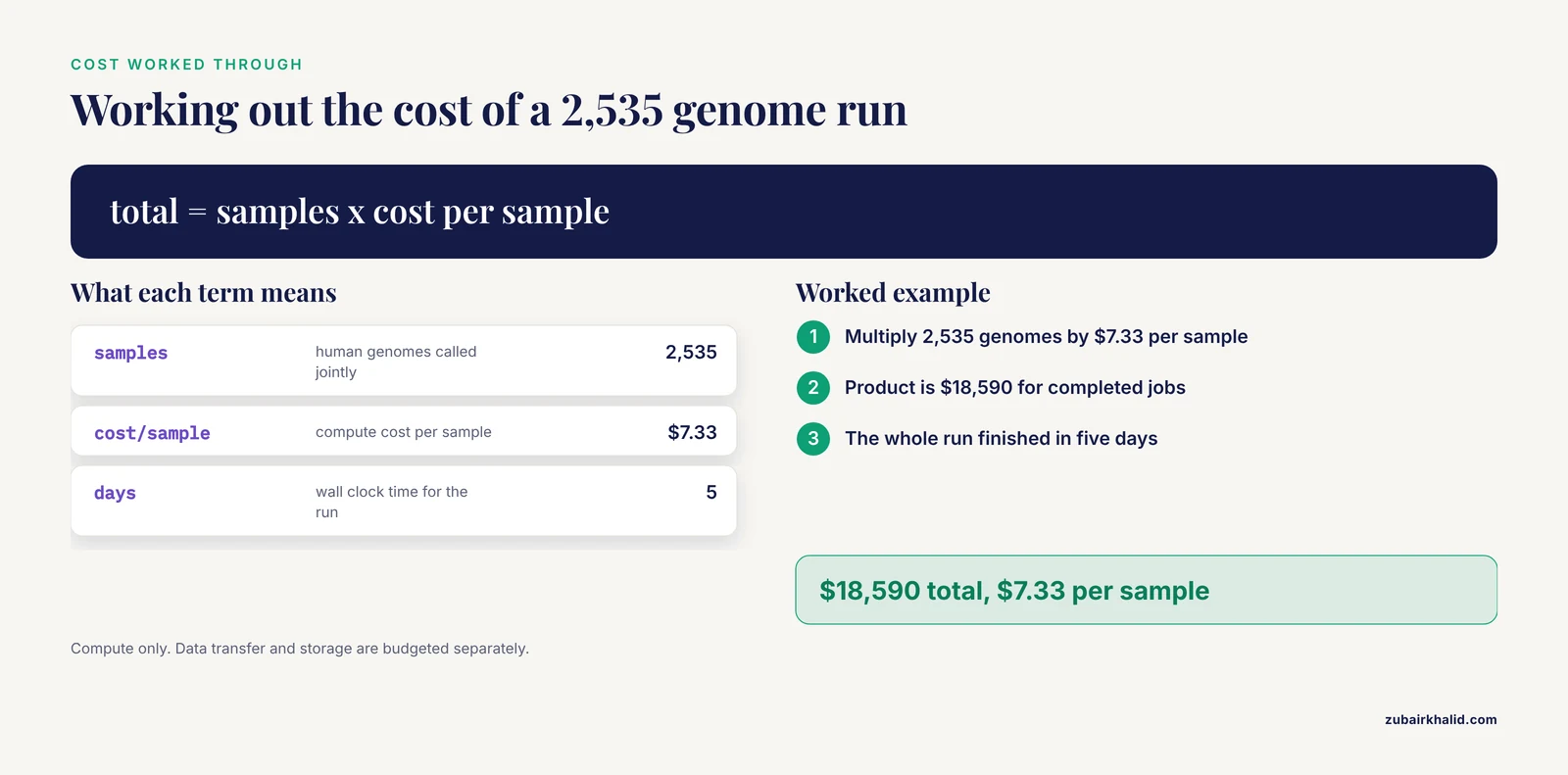
Compute and storage on demand. Cloud providers such as Amazon Web Services rent virtual machines and object storage by the hour. A researcher can request 200 cores for an afternoon, align a cohort, release the machines, and pay only for the time used. Shringarpure and colleagues demonstrated this on a real scale when they called variants jointly across 2,535 human genomes from Phase 3 of the 1000 Genomes Project, processing the data in five days at a compute cost of $7.33 per sample, for a total of $18,590 for completed jobs [2]. No single university department could have absorbed that burst of demand on local hardware.
Software pinned in containers. A container is a package that bundles a program with its exact dependencies, libraries, and system files, so the program behaves identically everywhere. Docker is the dominant container format for local, web-based, cloud, and interactive systems, while Singularity and its successor Apptainer are favored in shared high-performance computing environments because they run without administrator privileges [3]. Pinning a tool means recording not just its name but an immutable version, ideally a content digest, so "bwa version 0.7.17" cannot silently become "whatever bwa is on PyPI today."
Analysis logic as a versioned workflow. A workflow language, such as the Common Workflow Language (CWL), Nextflow, Snakemake, or WDL, describes an analysis as a directed set of steps with explicit inputs, outputs, and parameters. The Cancer Genomics Cloud implements its bioinformatics tools in CWL precisely to support computational reproducibility [4]. When the workflow file, the container references, and the input data all have stable identifiers, the entire analysis becomes a citable object.
When people search for "reproducible genomics cloud explained," they usually want to know how these layers interact. The short answer is that the platform acts as an orchestrator. You point it at data, it schedules containers onto virtual machines in the order the workflow specifies, and it logs every task. The reproducibility claim is not a promise about the researcher's discipline. It is a property of the recorded system.
Why Colocating Data and Compute Changed Everything
The central insight of cloud genomics is that moving data to compute is the wrong default at scale. The Cancer Genome Atlas alone generated more than 2.5 petabytes of genomic data over a decade [4]. Downloading even a fraction of that to a local cluster is slow, expensive, and a reproducibility hazard, because each download is a fresh opportunity for file corruption, version confusion, and partial copies.
The Seven Bridges Cancer Genomics Cloud, an NCI-funded resource, hosts nearly 5 petabytes of public data including TCGA, the Simons Genome Diversity Project, the TARGET initiative, The Cancer Imaging Archive, and the Clinical Proteomic Tumor Analysis Consortium, and pairs that data with collaborative analysis tools [4]. The platform's design goal, stated in its foundational paper, was to let researchers worldwide rapidly access and collaborate on massive public cancer datasets, using more than 200 pre-installed, curated bioinformatics tools and workflows, and extending the platform with their own tools through a software development kit [1]. Because the data never moves, the analysis starts from a known, shared copy of every input.
This model predates the cancer-specific platforms. The Genomics Virtual Laboratory, published in 2015, provided machine images, cloud management tools, and online services that let researchers spin up arbitrarily sized compute clusters pre-populated with configured bioinformatics tools, reference datasets, and interfaces such as Galaxy and RStudio [5]. The GVL established a pattern the field still follows: the cloud is not just rented servers, it is a fully configured analysis workbench that arrives ready to use.
A second benefit is democratization. A researcher at a small institution with no cluster can run the same curated pipeline on the same public data as a large center, because the platform equalizes access to compute. Lau and colleagues framed this explicitly, describing the CGC as enabling researchers from diverse backgrounds to visualize, query, and explore cancer genomic datasets visually or programmatically [1].
The Technology Stack, Step by Step
A reproducible cloud genomics analysis proceeds through a predictable sequence. Understanding each step clarifies where reproducibility is won or lost.
- Data landing and access control. Public data is ingested into object storage, often mirrored inside the platform. Controlled-access human data sits behind authorization layers tied to dataset access agreements. Platforms such as the CGC organize datasets, tools, and collaborators into projects, with upload and download APIs connecting users' local hardware to the cloud [6].
- Reference data versioning. Every alignment or annotation depends on a reference genome build, an index, and annotation files. Reproducible systems store these as versioned, checksummed objects that workflows reference by identifier rather than by a mutable local path.
- Workflow definition. The analyst writes the pipeline in CWL, WDL, Nextflow, or Snakemake. Each step declares its container image, its inputs, its command line, and its outputs. The Cancer Genomics Cloud translated machine learning models, including the ATOM Modeling Pipeline (AMPL), into CWL specifically to support reproducible execution and scaling [7].
- Containerization. Each tool runs inside a container. The systematic literature review by Alamoush and colleagues found that Docker dominates in local, web-based, cloud, and interactive settings, while Singularity and Apptainer dominate in shared high-performance computing environments due to security and permission constraints [3]. Most platforms accept either format.
- Orchestration and execution. The workflow engine, whether a platform service such as Terra or DNAnexus or an engine such as Nextflow or Snakemake running on cloud batch services, schedules each task onto virtual machines, retries failures, and parallelizes across samples. Snakemake-based pipelines such as snpArcher are explicitly designed to run on both HPC clusters and cloud environments without modification [8].
- Provenance capture. The engine records which container digest ran, on which machine type, with which inputs and parameters, and how long it took. This record is what turns a successful run into a reproducible one.
- Publication and sharing. The finished workflow and containers are registered in public repositories. The GA4GH Workflow Execution Service and Tool Registry Service concepts formalize this step, and the dockstore.org registry lets researchers cite executable workflows alongside their papers [9].
The stack can be summarized in a single reference table.
| Layer | Function | Concrete examples |
|---|---|---|
| Storage and data access | Host reference and study data near compute | S3 object storage, platform-hosted TCGA mirrors [4] |
| Workflow language | Encode analysis logic in machine-readable form | CWL [4], Nextflow [10], Snakemake [8], WDL [9] |
| Containers | Pin tool versions and dependencies | Docker [3], Singularity, Apptainer [3] |
| Workflow registry | Publish citable, executable workflows | Dockstore [9] |
| Execution platform | Orchestrate, log, and scale tasks | Terra [9], DNAnexus [2], [11], Cancer Genomics Cloud [1] |
| Provenance record | Capture what actually ran | Task logs, container digests, parameter files |
| Interactive layer | Support exploration and visualization | Jupyter notebooks [7], Galaxy and RStudio [5] |
Reproducible Genomics Cloud Platforms in Practice
The field has settled into a few recognizable platform archetypes, and knowing them helps a new analyst choose sensibly.
Managed science platforms. These combine storage, a workflow engine, curated tools, and collaboration features behind a web interface. The Cancer Genomics Cloud is the canonical example, offering 200-plus curated tools and project-based collaboration [1]. DNAnexus hosted the Mercury pipeline, an automated, flexible, and extensible workflow deployed on Amazon Web Services that has been applied to more than 10,000 whole genome and whole exome samples [11]. Terra, developed within the Broad and Data Sciences community ecosystem, hosts workspaces that combine workflows with Jupyter notebooks, and the GA4GH-Bioconductor pancancer analysis ran as a formally archived workflow and container on Dockstore with a workspace and notebook on Terra [9]. In the clinical and national-scale space, Genomics England's Research Environment runs on the Lifebit CloudOS platform, where a fully automated, containerized GenePy gene-burden workflow was deployed through Nextflow under governance constraints appropriate for population-scale rare disease data [10].
Workflow-native infrastructure. Here the analyst brings their own engine. Nextflow and Snakemake pipelines run on cloud batch services, with containers pulled from public registries. This archetype suits teams who want portability between their university cluster and the cloud. The snpArcher variant calling workflow is a leading example, built in Snakemake to serve nonmodel organism genomics and validated across 26 public resequencing datasets from nonmammalian vertebrates, with the resulting variant datasets hosted publicly for reuse [8].
Virtual appliances. The Genomics Virtual Laboratory approach ships preconfigured machine images that boot into a working analysis environment with Galaxy, RStudio, and reference data already installed [5]. This lowers the barrier for groups that want cloud compute without adopting a full commercial platform.
Where "AWS genomics" fits. The phrase usually refers to running genomic workloads on Amazon Web Services, either through managed batch and storage services or through partner platforms that run on AWS. Both the 1000 Genomes variant calling study, which used the DNAnexus platform on the Amazon cloud [2], and the Mercury deployment on AWS via DNAnexus [11] are concrete aws genomics implementations. The CGC similarly supports hardware resources from providers including Amazon Web Services and Google Cloud Platform [12]. The provider itself is interchangeable. What makes the workload reproducible is the workflow and container layer above it, which is why the same CWL or Nextflow pipeline can often run across providers with minimal changes.
Reproducible Genomics Cloud Examples That Shaped the Field
Abstract descriptions only go so far. These published examples show what reproducible cloud genomics looks like when it is done at scale.
Population-scale variant calling. The 1000 Genomes Phase 3 joint calling run identified 68.3 million variants across 2,535 samples, processed in five days at $7.33 per sample [2]. The authors noted that near-linear scalability suggests cloud computing can cheaply and efficiently serve even larger sequencing studies. Equally important, the pipeline components were fully specified, which is what separated this run from the countless unrepeatable variant calling efforts that preceded it.
A validated clinical-grade pipeline in the cloud. Mercury demonstrated that a robust, fully validated software pipeline could ride on a scalable cloud resource, delivering reproducible results from single individuals to large cohorts [11]. Validation, the systematic demonstration that a pipeline produces correct and consistent results, is a clinical requirement, and Mercury showed the cloud could host it rather than undermining it.
Democratized cancer genomics. The CGC allowed a team to HLA type tumors across TCGA at low cost directly beside the 5 petabyte public data mirror [4]. Another team transferred 371.60 GB of single-cell sequencing data, 13.3k paired-end files representing an estimated 6.6k cells, from the Human Cell Atlas Data Portal to the CGC, processed it with an optimized SmartSeq2 pipeline, and studied transcriptome changes in endothelial tumor cells over time in a mouse melanoma model [13]. In both cases the analysis ran beside the data, on shared, versioned tools.
Federated standards in action. The GA4GH and Bioconductor collaboration executed a pancancer transcriptomics analysis by blending the GA4GH Workflow Execution Service and Tool Registry Service concepts with the Bioconductor curatedTCGAData and BiocOncoTK packages. The analysis, archived on dockstore.org with a workspace on app.terra.bio, identified relationships between microsatellite instability and biomarkers of immune dysregulation at finer granularity than previously reported [9]. This example matters because it shows reproducibility emerging from shared standards rather than from a single vendor's platform.
Nonmodel organisms. snpArcher addressed a chronic reproducibility problem in comparative genomics, where variability in variant calling pipelines, data quality, and the need for computationally intensive reanalysis prevent simple reuse of data across studies and species [8]. By standardizing the pipeline and publishing the resulting variant datasets, the project made downstream comparative analyses straightforward rather than heroic.
Clinical and drug discovery machine learning. NCI's MoDaC program worked with the CGC to migrate machine learning models for drug discovery, mirroring the ATOM Modeling Pipeline through Jupyter Notebook access and translating AMPL and JDACS4C models into CWL to support reproducible execution at scale [7]. On the imaging side, the pyCERR framework packages AI-based analysis workflows for radiological and radiotherapy data, with radiomics features validated against Image Biomarker Standardization Initiative reference values and unit tests running on every code update, deployed on the CGC with compute from providers such as AWS and GCP [12]. The same platform hosts a reproducible whole slide imaging machine learning solution built on data from the Imaging Data Commons and the Human Tumor Atlas Network, covering data preparation, model training, evaluation, and prediction inside one interactive environment [14].
Community workflow building. The Fifth Annual Baylor College of Medicine and DNAnexus Structural Variation Hackathon brought together 49 scientists from 14 countries and 8 US states, who produced six prototype workflows for structural variation research using open-source software orchestrated with Docker and Snakemake, tested on public example data [15]. Hackathons like this one function as reproducibility stress tests, because workflows written by one group must run in another group's hands within days.
Interactive image analysis. Not all genomics is batch processing. The containerized, cloud-enabled BioDepot-workflow-builder supports graphical, interactive applications such as Fiji, and automated the complex cloud setup for stitching 3D digital pathology datasets with BigStitcher, letting users launch multi-step workflows from a form-based interface [16]. This matters for reproducibility because many imaging-heavy analyses were previously documented only as loose collections of macros.
How Reproducibility Is Actually Tested
Claiming reproducibility and demonstrating it are different activities. In practice, verification takes several forms.
Re-execution by an independent party. The strongest test is that someone else re-runs the archived workflow on the registered containers and input data and obtains equivalent outputs. The pancancer GA4GH-Bioconductor analysis was built so that its workflow and container were formally archived and its notebook workspace was shared, which is what made replication and extension practical [9].
Container integrity checks. Referencing a container by digest rather than by a mutable tag guarantees the same bytes run every time. The systematic review of containerization in biomedical computing concluded that reproducibility is highest when containers are paired with provenance-aware platforms and workflow managers such as Nextflow, Galaxy, CWL, and DataLad [3].
Unit and regression testing. pyCERR runs unit tests covering data input and output, radiomics, dose-volume histogram features, and visualization on every code update, and validates its radiomics features against published IBSI reference values [12]. Testing inside the workflow, not just around it, catches breakage before users do.
Methodologically sound benchmarking. Performance claims need their own discipline. Papadopoulos and colleagues proposed eight methodological principles for reproducible performance evaluation in cloud computing, combining best practices from neighboring fields with cloud-specific concepts and new ideas about the time-accuracy trade-off [17]. Their systematic survey of top venues from 2012 to 2017 found that few published studies actually follow those principles, a finding that should temper how much confidence readers place in uncited speed and cost claims.
Cost and runtime accounting. Reporting the machine types, hours consumed, and dollars spent, as the 1000 Genomes study did with its per-sample and total cost figures [2], makes an analysis auditable in the practical sense that a reviewer can judge whether the approach is affordable for their own cohort.
Comparative and Clinical Relevance
For a clinical laboratory, reproducibility is not optional polish, it is a regulatory expectation. A validated pipeline such as Mercury, applied across more than 10,000 whole genome and exome samples [11], demonstrates that cloud execution can meet the consistency demands of clinical-grade genomics. The GenePy deployment inside the Genomics England Research Environment shows how the same principles extend to governed environments, where computation must be scalable, secure, and auditable within a national health data context [10].
For research groups, the comparative case against local-only analysis rests on three grounds. First, burst capacity. A cohort of thousands of genomes is a poor fit for a fixed departmental cluster, as the five-day, 2,535-genome run demonstrated [2]. Second, data access. When the reference copies of TCGA, TARGET, or the Human Cell Atlas already live inside the platform, the analysis inherits the canonical version of the data rather than a local copy of uncertain provenance [1], [13]. Third, collaboration. Platforms with shared projects let co-authors inspect each other's actual executions rather than reconstruct them from methods paragraphs.
The comparison students most often get wrong is between "cloud bioinformatics" in general and reproducible cloud genomics specifically. Renting virtual machines and installing tools by hand is cloud bioinformatics, but it reproduces nothing unless versions, containers, and workflow definitions are recorded. The reproducibility lives in the discipline of the stack, not in the cloud provider.
Common Mistakes and Limitations
Mistaking a Dockerfile for a guarantee. Building a container does not make an analysis reproducible if the container is referenced by a floating tag such as "latest," if reference data paths are hard-coded, or if parameters live in an unrecorded interactive session. The systematic review found that while deployment consistency, portability, and dependency control are well supported by containers, independent reproducibility is validated far less often, and stronger practice requires complete artifacts, defined parameters and reference data, provenance capture, and sustainable image preservation [3].
Trusting performance numbers without methodology. Because cloud environments vary in instance types, contention, and regional placement, informal benchmarks are unreliable. Few of the published cloud performance studies examined by Papadopoulos and colleagues followed the eight proposed principles, so reported speedups and costs deserve skepticism unless the methodology is stated [17].
Underestimating the engineering residue. Even a well-executed cloud analysis leaves loose ends. The GA4GH-Bioconductor team explicitly reported challenges related to container design, script archiving, and unit testing, and concluded that best practices and cost-benefit metrics for federated genomic data management are still evolving [9]. Budget time for those tasks rather than treating them as afterthoughts.
Ignoring egress and storage costs. The celebrated per-sample compute costs of cloud variant calling [2] do not include the price of moving data in and out, keeping intermediate files in storage between runs, or re-downloading outputs. A reproducible re-run doubles some of these costs by definition, which is a budget line many first-time cloud users miss.
Assuming the cloud solves data governance. Controlled-access human data requires authorization, audit trails, and sometimes jurisdictional constraints. Platforms built for this, such as the Genomics England Research Environment on CloudOS [10], handle governance as a first-class feature. A generic virtual machine does not.
Confusing interactivity with reproducibility. Notebooks are excellent for exploration and were central to several cited analyses [9], [7], [14]. But an unexecuted or out-of-order notebook is a reproducibility liability. Restart-and-run-all from a clean state, or exporting notebook logic into the workflow layer, is the practical fix.
Neglecting image preservation. Containers stored only in a personal registry account can vanish when an account lapses or an image is overwritten. Sustainable image preservation, flagged in the systematic review as a requirement for stronger practice, means archiving images in durable public registries and recording digests in the publication itself.
Quick Review
- Reproducible genomics in the cloud means running analyses where the data lives, with every tool version, parameter, and input recorded so a second researcher can re-run the analysis and match the result.
- Three layers carry the reproducibility load: versioned workflows in languages such as CWL, Nextflow, and Snakemake, pinned containers such as Docker and Apptainer, and platform-level provenance capture [3], [4].
- Colocalization is the economic argument. The CGC hosts nearly 5 petabytes of public cancer data beside its compute, eliminating the download problem [4].
- Real deployments prove the scale. Joint variant calling on 2,535 genomes finished in five days at $7.33 per sample [2], and the Mercury pipeline processed more than 10,000 whole genome and exome samples on AWS through DNAnexus [11].
- Independent reproducibility is still under-validated in the literature, even though containers reliably deliver deployment consistency and dependency control [3].
- Cloud performance and cost claims need methodological rigor, and few published studies meet the proposed standards for cloud benchmarking [17].
- The strongest reproducibility pattern combines an archived workflow and container in a public registry such as Dockstore with an executable workspace, as demonstrated in the GA4GH and Bioconductor pancancer analysis [9].
Frequently Asked Questions
What is reproducible genomics in the cloud, in one sentence?
It is the practice of running genomic pipelines on hosted infrastructure with the data, containerized software versions, parameters, and execution logs all recorded, so another researcher can re-run the analysis and get the same result.
Do I need to be a cloud engineer to use a reproducible genomics platform?
No. Managed platforms such as the Cancer Genomics Cloud provide pre-installed curated tools, web interfaces, and project-based collaboration, so a biologist can configure and launch workflows without writing infrastructure code [1]. Workflow-native approaches with Nextflow or Snakemake do require more scripting skill.
How much does cloud genomics analysis actually cost?
It varies enormously with cohort size, but a documented benchmark exists. Joint variant calling on 2,535 whole human genomes cost $7.33 per sample in compute, or $18,590 for completed jobs, and finished in five days [2]. Budget separately for data transfer and long-term storage.
Is Docker mandatory for reproducible cloud genomics?
Docker is the most common format, but it is not the only one. Singularity and Apptainer are preferred in shared high-performance computing environments because they run without root privileges, and most cloud platforms accept multiple container formats [3].
How is a reproducible genomics platform different from just renting an AWS account?
A raw cloud account gives you virtual machines and storage but no workflow engine, no curated tools, and no provenance capture. Platforms layer versioned workflows, containers, collaboration, and access control on top of providers such as AWS, and it is that layer, not the provider, that produces reproducibility [12], [11].
Can cloud reproducible workflows be used with controlled-access human data?
Yes. Systems such as the Genomics England Research Environment on the Lifebit CloudOS platform run containerized, auditable Nextflow workflows on population-scale rare disease data inside a governance-compliant environment [10], and the CGC manages controlled cancer datasets with project-level collaborator and access controls [1].
Sources
- The Cancer Genomics Cloud: Collaborative, reproducible, and democratized-a new paradigm in large-scale computational research
- Inexpensive and Highly Reproducible Cloud-Based Variant Calling of 2,535 Human Genomes
- Containerization and Virtualization for Reproducible Biomedical Computing: A Systematic Literature Review
- Abstract 2348: Low-cost and accurate human leukocyte antigen (HLA) class I typing of The Cancer Genome Atlas on the Seven Bridges Cancer Genomics Cloud
- Genomics Virtual Laboratory: A Practical Bioinformatics Workbench for the Cloud
- Abstract B026: Artificial Intelligence Apps for Medical Image Analysis using pyCERR and Cancer Genomics Cloud
- Abstract 5356: Collaborating to ensure data-driven drug discovery on the Cancer Genomics Cloud: Realizing the possibilities for MoDaC and ATOM
- A Fast, Reproducible, High-throughput Variant Calling Workflow for Population Genomics
- Global Alliance for Genomics and Health Meets Bioconductor: Toward Reproducible and Agile Cancer Genomics at Cloud Scale
- Automated GenePy gene-burden computation via a reproducible Nextflow workflow integrated with the Genomics England (GEL) Lifebit platform
- Launching genomics into the cloud: deployment of Mercury, a next generation sequence analysis pipeline
- Artificial intelligence apps for medical image analysis using pyCERR and cancer genomics cloud.
- Abstract 4414: Single-cell analysis on the Cancer Genomics Cloud reveals changes in the transcriptome profiles of endothelial tumor cells over time - novel insights from a public dataset of a mouse model of melanoma
- Abstract 7434: Cloud-based machine learning for enhanced tumor classification in cancer genomics: an end-to-end solution for whole slide imaging data
- The fifth international hackathon for developing computational cloud-based tools and resources for pan-structural variation and genomics
- Cloud-enabled Fiji for reproducible, integrated and modular image processing
- Methodological Principles for Reproducible Performance Evaluation in Cloud Computing