Reproducible Cloud Bioinformatics Workflows: Step-by-Step Guide
By Dr. Zubair Khalid, DVM, MS, PhD ·

By the end of this guide you will be able to take a bioinformatics analysis, wrap it in a version-controlled workflow with containerized software, run it on cloud infrastructure such as AWS or Google Cloud, capture enough provenance to reproduce it months later, and hand it to a collaborator so they get the same numbers. You will need a laptop with Git, Docker (or Apptainer), and either Nextflow, Snakemake, or a WDL-capable executor installed, plus a cloud account with billing alerts enabled and access to one or more public genomics datasets.
Why Cloud and Reproducibility Belong Together
Bioinformatics has moved through distinct eras, from command-line tools on single machines, to web servers, to containerized workflows running on cloud platforms, and each transition has been driven by the same forces: data volume, scalability, accessibility, and reproducibility [1]. Sequencing costs keep falling, so the bottleneck is no longer generating data but analyzing it consistently, especially when hundreds or thousands of samples are involved [2]. Ten years ago, an analysis of that scale required an institutional compute cluster. Today anyone with internet access can run it, provided the analysis is built so that it runs the same way twice [2].
Reproducibility in cloud bioinformatics rests on four pillars:
- Workflow engine. A tool such as Nextflow, Snakemake, WDL with Cromwell, or the Common Workflow Language (CWL) that defines every step, its inputs, and its outputs in code rather than in a document.
- Containers. Docker or Apptainer images that pin exact tool versions and system libraries.
- Pinned data. Reference genomes, annotation files, and inputs stored at fixed locations with checksums.
- Provenance. Automatic capture of every command, container digest, parameter, and output hash for each run.
The cost of skipping these pillars is well documented. The National Cancer Institute's Genomic Data Commons published its DNA and mRNA sequencing pipelines as text-based standard operating procedures. The authors of a recent harmonization effort point out that text SOPs cannot capture a computational workflow at the level of detail and accuracy needed to reproduce results, because documentation drifts behind code revisions and small discrepancies accumulate. Their solution was to convert the SOPs into self-installing, containerized, executable workflows [3]. The same lesson appears across domains, from cancer immunotherapy biomarker pipelines [4] to population-scale rare-disease analysis [5].
Choose Your Stack Before You Build
Two decisions shape everything else: the workflow language and the execution target. The major options are summarized below.
| Engine | Language style | Typical cloud targets | Ecosystem examples |
|---|---|---|---|
| Nextflow | Groovy DSL | AWS Batch, Google Life Sciences, Kubernetes, HPC via Slurm | nf-core collections, microbial genomics pipelines such as Bactopia [6] |
| Snakemake | Python DSL | Any SSH cluster, cloud VMs, Kubernetes | CIMAC-CIDC WES and RNA-Seq pipelines on Google Cloud [4], GRAPEVNE modules [7], fedflow integration [8] |
| WDL + Cromwell | Declarative WDL | Google Cloud (via Pipelines API), AWS Batch, HPC | Broad Institute WARP pipelines, importable from Dockstore into Terra [9] |
| CWL | YAML descriptions | Seven Bridges platforms, Arvados, Toil | Cancer Genomics Cloud tutorials with Docker and CWL [2] |
Two practical observations from the literature should guide the choice. First, community-maintained pipeline collections give you tested, containerized, cloud-ready workflows for free, which is why microbial genomics reviews now list workflow projects such as nf-core and Bactopia as standard practice [6], and why the WARP repository at the Broad Institute versions, tests, and documents every pipeline before publishing it [9]. Second, if your team already lives in one language, the switching cost usually outweighs theoretical benefits. An R-heavy group, for example, can run AnVIL-hosted workflows such as Salmon RNA-seq or bioBakery metagenomics directly from R through the AnVILWorkflow package, which handles environment setup, submission, and result retrieval without the user managing cloud infrastructure directly [10].
Step-by-Step: Building a Reproducible Cloud Workflow
The following walkthrough uses Nextflow on AWS as the primary example, because Nextflow plus AWS Batch is the most common pairing in AWS genomics work, with notes for Snakemake and WDL where they differ materially. Every step produces an artifact you should keep under version control.
Step 1: Express the Analysis as a Workflow, Not a Script
Create a project directory and initialize Git:
mkdir rnaseq-demo && cd rnaseq-demo
git init
A minimal Nextflow process that counts reads with seqkit looks like this, saved as main.nf:
nextflow.enable.dsl = 2

process COUNT_READS {
    tag "${meta.id}"
    container 'quay.io/biocontainers/seqkit:2.8.0--h925dc2a_0'

    input:
    tuple path(fastq), val(meta)

    output:
    tuple val(meta), path("${meta.id}.counts.txt"), emit: counts

    script:
    """
    seqkit stats \${fastq} > \${meta.id}.counts.txt
    """
}
The three properties that make this reproducible rather than just runnable are the tag (which carries sample identity into logs), the container directive (which pins the exact seqkit build), and the declared input and output channels (which let the engine resume and cache). A Snakemake equivalent pins software with a container: directive per rule and runs with -use-apptainer, a pattern used in production pipelines for clinical biomarker detection [4] and in federated learning orchestration where Snakemake embeds external services as reproducible steps [8].
Commit early and often:
git add main.nf
git commit -m "Initial workflow with containerized seqkit step"
Step 2: Pin Software with Containers
Any tool you did not write yourself belongs in a container. For custom code, write a Dockerfile that starts from a pinned base image:
FROM python:3.11.9-slim-bookworm

RUN pip install --no-cache-dir multiqc==1.25.1

CMD ["multiqc", "--version"]
Build, tag, and push:
docker build -t yourorg/demo-multiqc:1.25.1 .
docker run yourorg/demo-multiqc:1.25.1
# multiqc, version 1.25.1
docker push yourorg/demo-multiqc:1.25.1
Two habits separate robust practice from fragile practice. Use version tags like 1.25.1, never latest, because latest is a moving target that will silently change under you. And when a workflow engine supports digests, prefer them, since WARP maintains a companion repository of Docker containers and custom tools specifically so that each pipeline release is tied to fixed images [9].
On systems where Docker daemons are restricted, such as shared HPC front ends, Apptainer pulls the same images and runs them without root:
apptainer pull docker://yourorg/demo-multiqc:1.25.1Many cloud platforms handle this transparently. The Seven Bridges Cancer Genomics Cloud, for example, takes Docker containers wrapped in CWL tool descriptions and executes them in parallel across cloud resources, which the tutorial authors present as the core pattern for reproducible biomedical computation at scale [2].
Step 3: Pin Data and Reference Assets
Reproducible workflows fail most often at the data layer, not the code layer. Treat every reference file as a versioned artifact:
- Store reference genomes and annotations in an immutable bucket or a release-tagged location, not in a folder people edit.
- Record checksums for every input in a manifest file, and verify them at pipeline start.
- Use a metadata sheet (sample ID, condition, fastq path, checksum) as a workflow input, so sample-to-file mapping is itself version controlled.
A minimal manifest check in Nextflow:
Channel.fromPath("manifest.csv")
    .splitCsv(header: true)
    .map { row -> tuple([id: row.id], file(row.fastq)) }
and a shell-level checksum verification you can run before submission:
sha256sum -c checksums.txt
# 97a3f...  sample01_R1.fastq.gz: OK
Public datasets deserve the same treatment. Projects that harmonize public repositories, such as the GDC workflows that reprocess raw RNA-Seq data from multiple repositories under one pipeline, make this explicit because comparisons across datasets are only valid when every dataset has gone through the same pinned processing steps [3].
Step 4: Provision Cloud Compute
There are two sensible architectures in AWS genomics work, and you should pick one deliberately.
Managed batch. Nextflow submits each task as an AWS Batch job, and AWS handles scheduling, autoscaling, and spot instances. Create the prerequisites once per account:
aws s3 mb s3://myproject-rnaseq-demo
aws s3 mb s3://myproject-rnaseq-demo-work
Then configure nextflow.config:
profiles {
    awsbatch {
        process.executor = 'awsbatch'
        process.queue = 'my-nextflow-queue'
        workDir = 's3://myproject-rnaseq-demo-work'
        aws.region = 'us-east-1'
        aws.batch.cliPath = '/usr/local/bin/aws'
        process.withLabel: big_mem {
            memory = 32.GB
            cpus   = 8
        }
    }
}
Key parameters explained:
executor = 'awsbatch'tells Nextflow to submit jobs to AWS Batch instead of running them locally.workDirpoints task scratch space at S3 so intermediate files survive between jobs and so the run can be resumed from any machine.aws.regionmust match the region of your Batch compute environment, a mismatch that produces opaque failures.- Resource directives (
memory,cpus) should be attached to labels so that per-step sizing lives in configuration, not code.
Cluster as code. For applications with specialized needs such as GPU workloads, an alternative is a reproducible virtual cluster. The GoToCloud platform for cryo-EM structure-based drug design uses AWS ParallelCluster to deploy secure clusters inside a Virtual Private Cloud, with a shared Amazon EFS filesystem and automated scripts that pre-install software such as RELION, removing specialized IT maintenance from the researchers while giving every group the same environment [11]. The same pattern works for any genomics workload where you want a classic HPC interface backed by cloud elasticity.
Step 5: Run at Small Scale First
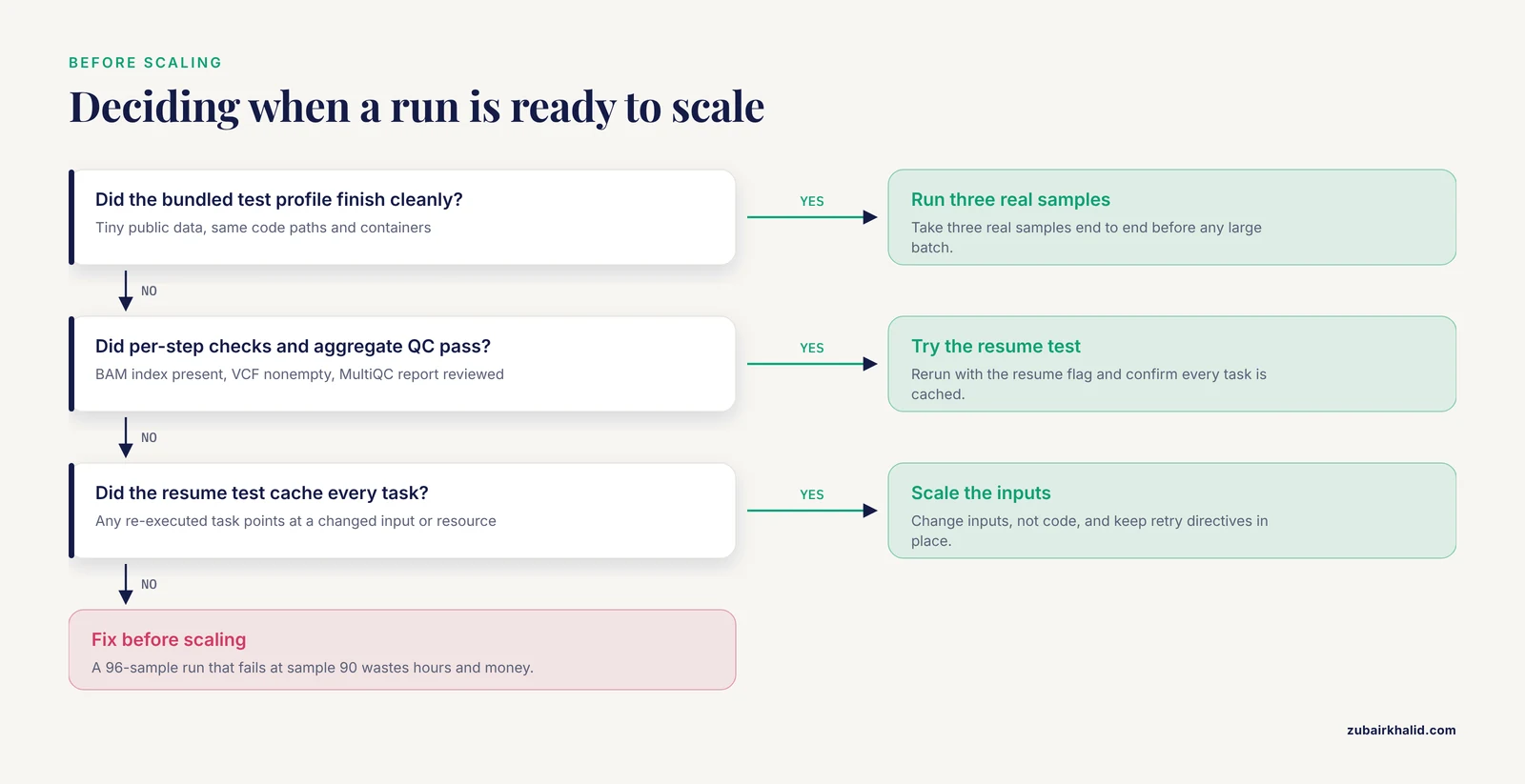
Never scale before validating. Most community pipelines ship a test profile with tiny public data:
nextflow run myorg/my-pipeline \
    -profile test,awsbatch \
    -w s3://myproject-rnaseq-demo-work
Expected output (abbreviated):
Launching `https://github.com/myorg/my-pipeline` [trusting_poincare] - revision: 1a2b3c4 [main]
executor > awsbatch (12)
[8f/2c1a99] process > MYPIPELINE:FASTQC (sample01) [100%] 6 of 6 ✔
[4d/99b2e1] process > MYPIPELINE:ALIGN (sample01)  [100%] 6 of 6 ✔
Completed at: 11-Nov-2026 14:02 UTC
If you are writing your own pipeline, generate a downsampled dataset for testing. Downsampling with seqkit on the fastq files above is one line:
seqkit sample -s 42 -p 0.01 sample01_R1.fastq.gz > sample01_R1.sub.fq.gzHere -s 42 is the random seed (always record it) and -p 0.01 keeps 1 percent of reads. A run that takes hours at full scale takes minutes at 1 percent, and it exercises the same code paths, containers, and cloud plumbing. The NIGMS Sandbox for Cloud-Based Learning uses exactly this strategy for teaching: its bulk RNA-seq tutorials on Google Cloud start learners on a subset of the data so analysis steps can be learned rapidly before running the full workflow [12].
Step 6: Validate the Results
Checking that a run is right has three layers:
- Per-step checks. Make each process assert its own output validity, for example by verifying a BAM index exists or a VCF is nonempty before declaring success.
- Global QC. Aggregate quality metrics across samples. Community pipelines typically produce a MultiQC report as the final process, which lets you spot a single failed library before it contaminates a downstream analysis.
- Truth sets. Where possible, benchmark against validated reference material. The CIMAC-CIDC network validated its rebuilt whole exome sequencing and RNA-Seq pipelines against truth sets for variant calling, transcript quantification, and fusion detection, and the benchmarking showed improved reproducibility, precision, and recall after the modernization [4]. In clinical genomics, analytical validation is formal: a 1080-gene comprehensive genomic profiling assay reported greater than 99 percent sensitivity and 100 percent specificity for variant detection, with inter- and intra-run testing confirming 100 percent reproducibility [13]. That level of precision claim is only possible when the software layer is pinned.
A concrete numeric sanity check you can automate: for human WES, the number of variants called per sample should fall in a known range given your pipeline and capture kit, and a sample wildly outside that range is usually a sample swap, a wrong reference build, or a corrupted input. Encode the check in the workflow so the run fails loudly instead of producing a plausible-looking report.
Step 7: Scale Up with Cost Controls
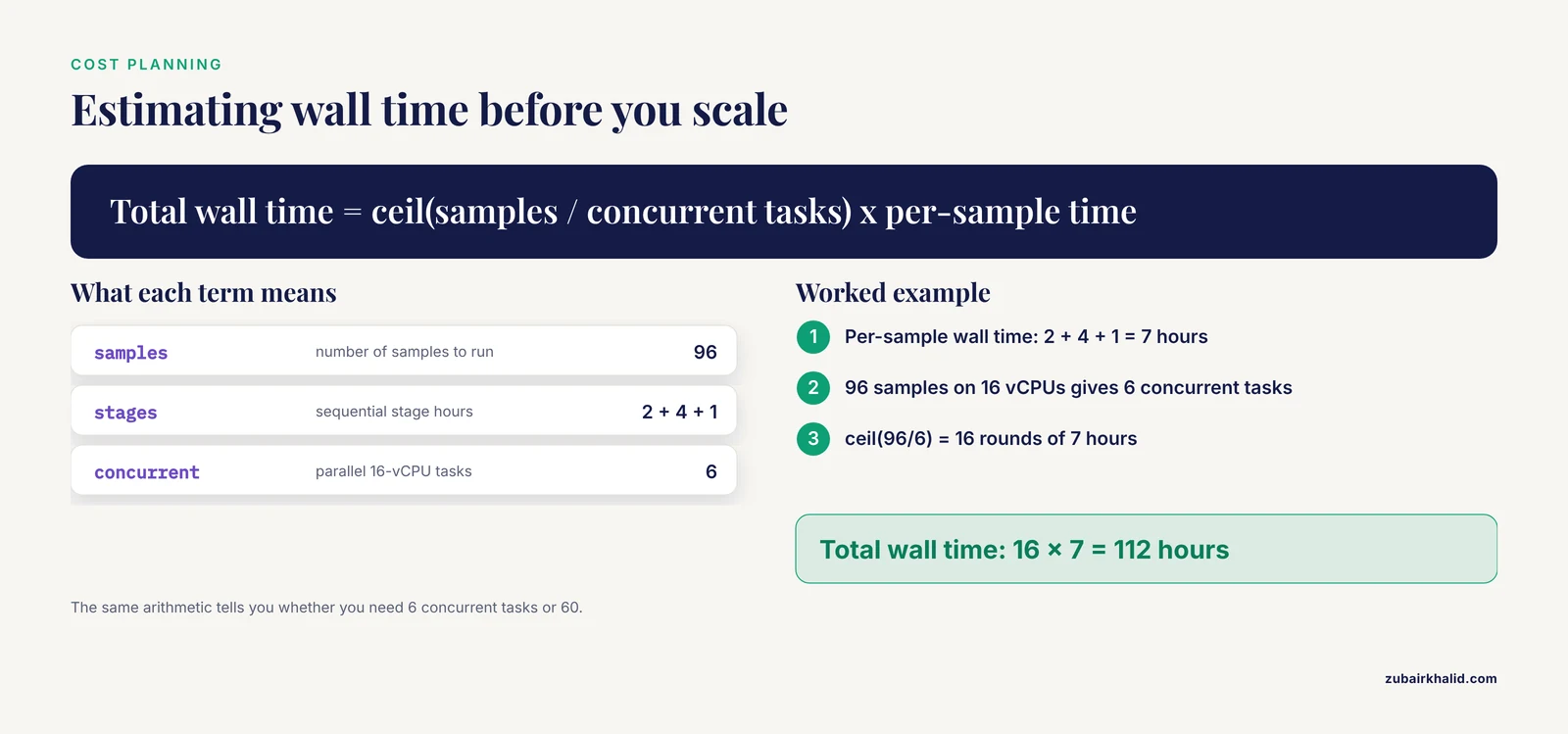
Once a small run passes, scale by changing inputs, not code. To estimate parallelization, do the arithmetic before submitting. Suppose you have 96 samples, each passing through three sequential stages of 2, 4, and 1 hours on a 16 vCPU instance, and each stage parallelizes fully across samples:
Per-sample wall time:      2 + 4 + 1 = 7 hours
96 samples on 16 vCPUs:    6 concurrent 16-vCPU tasks = 96 vCPUs
Total wall time:           ceil(96/6) x 7 = 16 x 7 = 112 hours
That estimate tells you whether you need 6 concurrent tasks or 60, which drives both instance count and cost. On AWS, spot instances routinely cut compute cost substantially for interruptible batch genomics work, and Nextflow handles task retry on spot interruption automatically with the maxRetries directive:
process {
    maxRetries = 2
    errorStrategy = 'retry'
}
For GPU workloads, instance choice is a genuine optimization problem rather than a rule of thumb. The GoToCloud benchmarks identified specific NVIDIA GPU instance types, comparing the T4 against the A10G, that balance processing speed against expense for cryo-EM refinement, and the platform's practical datasets reached 1.83 Å resolution, revealing a cost-performance wall around 2.0 Å where additional compute buys progressively less [11]. Treat your own workload the same way: benchmark two or three instance types on a representative sample before committing to a fleet.
A note on scope: managed platforms and platform-as-a-service layers exist precisely because this plumbing is hard. The AnVIL platform packages large-scale genomics data and analysis so that researchers without deep cloud expertise can run complex workflows, with the AnVILWorkflow R package handling setup, submission, and retrieval [10]. EAP does the equivalent for ChIP-seq and ATAC-seq, providing a configuration-free web environment so experimental biologists can run large-scale epigenomic analyses without managing infrastructure [14]. Using a platform is not a shortcut you have to apologize for. It is a legitimate reproducibility decision when the platform itself version-controls workflows and data.
Step 8: Capture Provenance and Archive
The final step makes the run reproducible by people who are not you. Nextflow generates a machine-readable record with the trace and report flags:
nextflow run myorg/my-pipeline \
    -profile awsbatch \
    -w s3://myproject-rnaseq-demo-work \
    -with-trace trace.tsv \
    -with-report report.html
trace.tsv contains one row per task with the container digest, the exact command, the start and end times, and the exit status. Archive the run directory, the params file, the trace, the Git commit hash of the pipeline, and the checksum manifest together in your results bucket:
git rev-parse HEAD > PIPELINE_COMMIT.txt
aws s3 sync results/ s3://myproject-rnaseq-demo/results/run-2026-11-11/ \
    --exclude "*.tmp"
The full provenance record should let someone answer, without asking you: which code version, which container digests, which parameters, which inputs, which cloud region and executor. Standards work is consolidating this layer. The Bio-OS framework aligns cloud platforms with the Global Alliance for Genomics and Health cloud workstream standards, including the Workflow Execution Service (WES), Task Execution Service (TES), Data Repository Service (DRS), and Tool Registry Service (TRS) APIs, specifically to make biomedical cloud platforms interoperable and to promote FAIR-aligned reproducibility [15]. If you build or buy platform capacity today, checking for GA4GH API support is a reasonable hedge against lock-in.
Verify Reproducibility: The Resume Test
The single most informative check costs nothing. Rerun the identical pipeline with the resume flag:
nextflow run myorg/my-pipeline -profile awsbatch -resumeExpected output:
Launch completed successfully
[..] Cached 96 of 96 tasks
Nothing to execute -- provided processes have already been completed
If every task is cached, the engine has confirmed that code, containers, and inputs are byte-identical to the previous run. Any task that re-executes tells you exactly which input or resource changed, which is the fastest debugging signal you will ever get. Snakemake offers the equivalent semantics: an unchanged Directed Acyclic Graph with unchanged file timestamps and checksums re-executes nothing, which is the property that lets modular platforms like GRAPEVNE compose self-contained Snakemake modules with configs, scripts, and metadata while remaining deterministic [7].
For higher confidence, do a clean-room rerun: delete the work directory, restore from the archived manifest, and rerun from scratch on a different date. Diff the key outputs. Byte-identical outputs are the gold standard for deterministic pipelines. Statistical outputs (for example, those with random initialization) are reproducible when you record and reuse seeds.
Common Errors, Exact Messages, and Fixes
Exit status 137 (out of memory). Nextflow reports:
Command error:
  .command.sh: line 5:  123 Killed    bwa mem ...
Exit 137 means the Linux OOM killer terminated the process. Fix by raising the memory directive for that process label, and set it from observed data using the peak memory in the trace file rather than guessing.
Docker permission denied.
Got permission denied while trying to connect to the Docker daemon socketYour user is not in the docker group, or you are on a system where rootless execution is required. Either add your user to the group and re-login, or switch the workflow to Apptainer, which is the standard answer on shared HPC systems.
Image pull rate limit.
toomanyrequests: You have reached your pull rate limitDocker Hub throttles anonymous pulls, and a 100-task batch job pulling the same base image can exhaust it in minutes. Fix by mirroring images into your own registry (ECR on AWS, Artifact Registry on Google Cloud) and pointing workflow directives at your mirror.
Missing input files in Snakemake.
MissingInputException in line 12 of Snakefile:
Missing input files for rule align:
sample01.sorted.bam
The rule graph references a file no rule produces and that does not exist on disk. This is almost always a filename or path templating mistake. Print the resolved inputs with snakemake, dry-run and fix the pattern.
S3 Access Denied.
An error occurred (AccessDenied) when calling the ListObjectsV2 operationThe credentials in the compute environment lack permission on the bucket. In managed batch setups this is usually the instance role or the job role, not your laptop credentials. Verify with a small test job that runs aws s3 ls s3://myproject-rnaseq-demo-work and iterate on the IAM policy until it passes.
Root volume full on workers.
No space left on deviceTasks write scratch to the instance root volume, which is smaller than your data. Fix by pointing workDir to S3, mounting a larger scratch volume in the Batch compute environment configuration, or adding disk sizing per process label.
Region mismatch. A Batch compute environment in us-west-2 with a Nextflow aws.region of us-east-1 produces queue-not-found or credential-style errors that look unrelated to region. Confirm that region, queue name, and bucket all live in the same region before debugging anything else.
Reproducibility Cloud Bioinformatics Workflows Tips
These tips come directly from how successful production pipelines behave.
- Version the pipeline itself. WARP publishes open-source cloud-optimized workflows with semantic versioning, testing, and documentation, and distributes them through Dockstore for import into platforms like Terra [9]. Adopt the same discipline even for a ten-process in-house pipeline.
- Prefer community pipelines when they fit. nf-core pipelines bring pinned containers, test datasets, and CI testing maintained by many labs, which is why they are cited as standard infrastructure in microbial genomics reviews [6] and why adopting one is usually faster and safer than writing your own.
- Make workflows modular. The CIMAC-CIDC effort rebuilt its exome and RNA-Seq pipelines as modular Snakemake workflows with Docker so that individual components could be upgraded without rewriting the whole pipeline, a property that mattered when the coordinating center migrated organizations [4]. Modularity is what keeps a pipeline maintainable, and maintainability is what keeps it reproducible.
- Wrap services, not just tools. If part of your analysis depends on an external service, embed it in the workflow rather than running it by hand. The fedflow tool exists because a graphical federated learning platform required manual interaction from every participant, killing automation and reproducibility, so the authors wrote a headless orchestrator that integrates FeatureCloud into Snakemake pipelines [8]. The general principle applies to any web service in your analysis.
- Design for interactive plus batch use. Bio-OS highlights interactive execution models alongside batch workflow execution, reflecting the reality that exploration and production runs need different interfaces to the same versioned environment [15].
- Keep a test profile runnable in minutes. A pipeline whose test takes a day never gets tested. The ImmunoNX neoantigen protocol, which has supported over 185 patients across 11 clinical trials with WDL on Cromwell at Google Cloud, pairs its pipeline with a structured review process rather than informal checks, which is the clinical-scale version of build validation into the workflow [16].
- Write the workflow where the expertise is. Accessibility cuts both ways. Lowering the barrier lets more scientists run analyses [10], [12], but each era of tooling that lowers barriers also raises new questions about transparency and rigor [1]. A workflow an experimentalist can run must still expose the version and parameter trail an auditor would demand.
Common Mistakes and Limitations
These are the mistakes that show up repeatedly when labs move analyses to the cloud, along with what to do instead.
Treating the cloud as a bigger laptop. Running everything on one giant instance serializes work and wastes money. The value of cloud bioinformatics is fine-grained parallelism, which requires a workflow engine that emits independent tasks. If your "pipeline" is a 400-line bash script, containerizing it is not enough. Restructure it as tasks.
Unpinned images with floating tags. FROM python:3 will resolve to a different build next quarter. The failure is silent: your code runs, your results shift. Pin to specific versions and digests.
Text SOPs as the reproducibility plan. A PDF describing the analysis is not reproducibility. The GDC experience demonstrates why: documentation lags code, details get excluded, discrepancies accumulate, and the SOP becomes an approximation of what actually runs [3]. Keep SOPs, but point them at the executable workflow as the source of truth.
Editing shared references in place. The moment someone overwrites hg38.fa in a shared bucket, every pipeline using that path becomes unrepeatable. Copy reference assets into release-prefixed, versioned locations and checksum them.
Scaling before validating. A 96-sample run that fails at sample 90 wastes hours and money, and worse, it tempts people to hand-fix outputs, which destroys provenance. Run the test profile, then three real samples end to end, then scale.
Ignoring the retry and spot story. Spot interruptions are normal on AWS. Pipelines without retry directives interpret a spot kill as a software failure, and a human starts debugging a bug that does not exist.
Assuming cloud resources last forever. Instance types get deprecated, regions change pricing, and hosted notebooks vanish. Everything that defines your analysis must live in your own Git repository and your own bucket. Anything that exists only inside a platform console should be exportable, and if it is not, that is a risk to record.
Confusing reproducibility with correctness. A workflow that produces identical wrong answers twice is reproducible but useless. Validation against truth sets [4], orthogonal platforms [13], and QC thresholds is a separate, mandatory activity. Reproducible pipelines make validation easier because the thing you validate is fixed.
One honest limitation of cloud platforms. Governance constraints shape architecture in regulated settings. The Genomics England deployment of the GenePy workflow through Nextflow on the Lifebit CloudOS platform had to satisfy governance-compliant, secure computation at population scale inside a controlled research environment [5]. Data residency, access control, and audit requirements can force design choices (such as keeping data inside a platform boundary) that differ from a researcher's ideal of fully portable pipelines. Plan for governance early rather than retrofitting it.
Frequently Asked Questions
Which workflow engine should I choose for cloud bioinformatics?
Choose based on your team's language and your execution target. Nextflow dominates AWS Batch-based genomics, Snakemake is natural for Python-centric groups and runs anywhere Nextflow runs, WDL with Cromwell is the standard around Broad-style pipelines [9], and CWL is strongest on platforms like the Seven Bridges Cancer Genomics Cloud [2]. All four can be reproducible, so team fit matters more than benchmarks.
Do I still need containers if the workflow engine pins everything else?
Yes. Workflow engines orchestrate steps but do not control the software inside each step. Without containers, a tool upgrade on the host or in a conda channel changes results between runs. Container digests, recorded automatically in run traces, are what make the software layer of a cloud workflow fixed [9].
How do I keep cloud costs under control on large genomics runs?
Run a test profile first, benchmark two or three instance types on a representative sample before scaling [11], use spot instances with retry logic for interruptible work, and set billing alerts before the first submission. The largest avoidable costs come from rerunning failed large batches, which is why small-scale validation saves money as well as time.
Can I reproduce a run exactly after the cloud provider changes things?
Yes, if the run's definition lives outside the provider. A Git repository with the workflow code, container digests, parameter files, and input checksums defines the analysis independently of any console state. Instance type deprecation affects cost and speed, not the reproducibility of the recorded run.
What files must be in version control for a reproducible cloud workflow?
At minimum: the workflow code, the configuration profiles, the parameter files, the sample metadata sheet, the checksum manifest, and the container definitions. Generated results and intermediate files belong in object storage, not Git. The Git commit hash recorded in your provenance archive ties a result set to an exact code state.
How do I hand a workflow to a collaborator so they get the same results?
Share the Git repository, a params file, the manifest with checksums, and instructions that reference a released pipeline version, not a branch tip. Community pipelines solved this by publishing through registries such as Dockstore so users can import a specific version into their platform of choice [9]. For collaborators who want less machinery, a platform wrapper like AnVILWorkflow lets them run the same hosted workflow from R with a few function calls [10].
Do GA4GH cloud standards like WES and TES matter for my lab?
If you run analyses on one platform and plan to stay there, they matter indirectly. If you anticipate moving between platforms or building tooling across institutions, they matter directly, because standards such as WES, TES, DRS, and TRS define portable interfaces for workflow execution, task execution, data access, and tool registries [15]. Frameworks like Bio-OS demonstrate that interoperable biomedical cloud platforms can be built on these APIs.
How do I test a workflow before scaling to hundreds of samples?
Use a bundled test profile with tiny public data, then run three real samples end to end, checking per-step outputs, aggregate QC, and the resume test at each stage. Starting on a data subset is also the recommended learning path for newcomers to cloud analysis, which is how the NIGMS cloud tutorials structure their bulk RNA-seq materials [12].
Sources
- Eras of bioinformatics technologies from command-line interfaces to artificial intelligence (AI) chatbots.
- Building Portable and Reproducible Cancer Informatics Workflows for Scalable Data Analysis: An RNA Sequencing Tutorial.
- Harmonizing and integrating the NCI Genomic Data Commons through accessible, interactive, and cloud-enabled workflows.
- Modular and cloud-based bioinformatics pipelines for high-confidence biomarker detection in cancer immunotherapy clinical trials.
- Automated GenePy gene-burden computation via a reproducible Nextflow workflow integrated with the Genomics England (GEL) Lifebit platform.
- Advancements and challenges in bioinformatics tools for microbial genomics in the last decade: Toward the smart integration of bioinformatics tools, digital resources, and emerging technologies for the analysis of complex biological data.
- GRAPEVNE - Graphical Analytical Pipeline Development Environment for Infectious Diseases.
- Fedflow: cloud orchestration for federated learning with the FeatureCloud platform.
- Warp analysis research pipelines: cloud-optimized workflows for biological data processing and reproducible analysis.
- AnVILWorkflow: A runnable workflow package for Cloud-implemented bioinformatics analysis pipelines.
- GoToCloud: Development and future of the cloud-based platform for cryo-EM structure-based drug DesignDevelopment and future of GoToCloud.
- Reusable tutorials for using cloud-based computing environments for the analysis of bacterial gene expression data from bulk RNA sequencing.
- Analytical Validation and Clinical Implementation of a 1080-Gene Comprehensive Genomic Profiling Assay with Integrated Cloud-Based Analysis for Solid Tumor Molecular Oncology.
- EAP: A versatile cloud-based platform for efficient quantitative analysis of large-scale ChIP/ATAC-seq datasets.
- Bio-OS: An Integrated Cloud-native Environment for Data-Intensive Biomedical Research.
- ImmunoNX: a robust bioinformatics workflow to support personalized neoantigen vaccine trials.