RefSeq vs GenBank Genome: Key Differences
By Dr. Zubair Khalid, DVM, MS, PhD ·

A GenBank genome record is the archived, submitter-provided assembly and annotation as deposited in the INSDC archive, while a RefSeq genome record is NCBI's separately produced, curated, and pipeline-annotated version of that same organism, filtered for quality and reannotated with NCBI's own tools. The rule of thumb for choosing between them is simple. Start every analysis from RefSeq when a RefSeq record exists for your organism or taxon of interest, because it has passed NCBI's contamination screening and annotation checks. Fall back to GenBank when no RefSeq record exists, when you need maximum strain or environmental diversity, or when you are analyzing your own submissions and those of the broader community. This guide walks through what each database actually is, how the records differ at the level of accessions and gene coordinates, where those differences change real analysis results, and how to work with both in a reproducible workflow.
Two Databases, One Underlying Data Stream
If you are new to the NCBI databases guide territory, the first thing to internalize is that GenBank and RefSeq are not two copies of the same thing. They serve different roles in the same data ecosystem.
GenBank is the primary archive. It is part of the International Nucleotide Sequence Database Collaboration, together with ENA in Europe and DDBJ in Japan. Anything a laboratory sequences, assembles, and submits ends up in GenBank with whatever annotation the submitter produced, using whatever gene prediction and functional annotation tools they chose. GenBank is comprehensive by design. It holds draft assemblies, annotated genomes from every annotation pipeline imaginable, submitted MAGs, and everything from a single plasmid to a 20 Gb plant genome. Nobody at NCBI vouches for the biological correctness of a GenBank record beyond basic format validation.
RefSeq is NCBI's derived reference collection. For organisms deemed important enough, NCBI staff select a representative assembly, screen it, reannotate it with NCBI's own pipelines, and maintain it as a stable reference. For bacteria and archaea, that pipeline is PGAP, the Prokaryotic Genome Annotation Pipeline, which has produced consistent annotation for a collection of over 315,000 bacterial and archaeal genomes containing 236 million proteins [1]. RefSeq records carry NCBI's implicit stamp of having passed validation, and they are updated when better assemblies or better annotation methods become available.
This division of labor explains almost every practical difference between the two databases. GenBank is exhaustive and immediate. RefSeq is selective and consistent. When you ask "refseq or genbank genome" for a given project, you are really asking whether you value completeness or curation more for that particular question.
What GenBank Is, on Its Own Terms
GenBank is where genome data enters the public record. A submitter assembles a genome, optionally annotates it, and deposits the result. The record then exists permanently with a stable accession. Three properties of GenBank matter for day-to-day work.
First, annotation in GenBank is the submitter's annotation. Different groups use different gene callers and functional annotation stacks. A gene caller like GeneMarkS, which self-trains a model on the input genome to predict gene starts accurately in microbial genomes [2], produces different start coordinates than a different caller trained on a different model. Two GenBank records for closely related organisms can therefore carry annotation generated under entirely different statistical assumptions. This heterogeneity is the single biggest analytical hazard when you mix GenBank records in a comparative study.
Second, GenBank is fast and inclusive. New species descriptions, outbreak genomes, and environmental MAGs typically appear in GenBank long before they appear in RefSeq, if they ever do. When the Rossellomorea strain H39_3 was isolated from the Hindon River and its 16S sequence showed 100 percent identity to a strain already in the INSDC databases, the whole-genome sequencing and analysis workflow operated against that INSDC layer of data before any RefSeq consideration [3]. Similarly, the ZCURVE_CoV coronavirus gene-finding system was run across the 24 completely sequenced coronavirus genomes then available in GenBank, because GenBank was where the complete viral genome set lived [4].
Third, GenBank records are increasingly machine-generated at scale. Prokaryotic genomes submitted through automated pipelines dominate the collection. That scale is what makes large-screen studies possible. One contamination survey used a dedicated tool to screen 1.6 million GenBank assemblies in a matter of minutes per genome, which is only conceivable because GenBank aggregates everything the community submits [5].
What RefSeq Is, on Its Own Terms
RefSeq exists to solve the consistency problem. Rather than accepting submitter annotation as-is, NCBI reannotates selected assemblies through its own pipelines and applies quality filters before accepting a genome into the collection.
For prokaryotes, the pipeline is PGAP. Its gene prediction models have been updated repeatedly, and recent versions include improved detection of protein-coding genes across the collection [1]. The functional side has been standardized aggressively. Nearly 83 percent of RefSeq proteins are now named by a curated Protein Family Model, and Gene Ontology terms are assigned to 48 percent of RefSeq proteins, which makes multi-genome comparison far easier than reconciling hundreds of different submitter vocabularies [1]. Those are the numbers that matter when someone asks whether RefSeq annotation is "better." It is not necessarily more complete per gene. It is uniform, versioned, and traceable to a single pipeline.
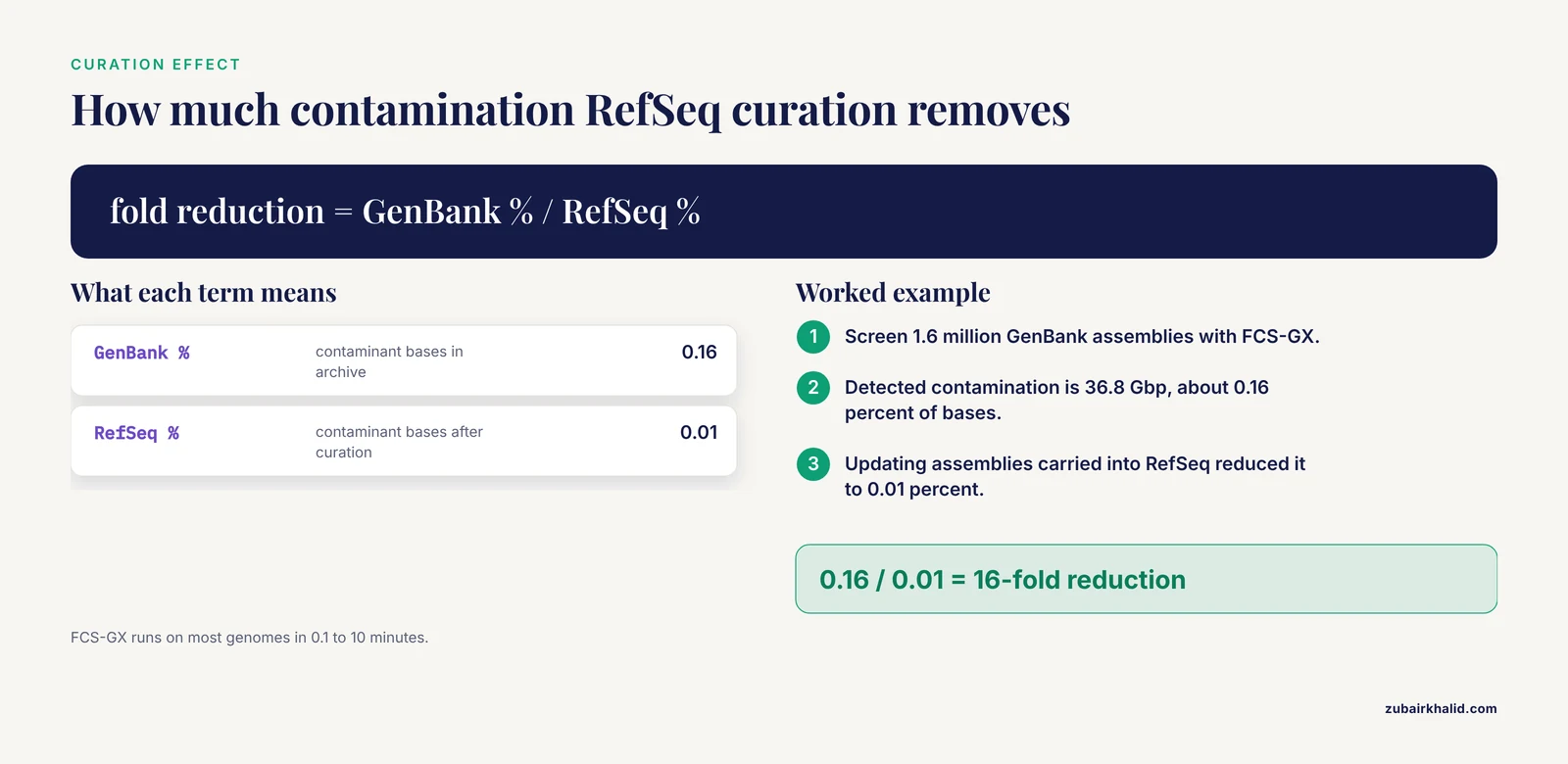
RefSeq also applies admission criteria. Assemblies are evaluated more stringently for contamination and for completeness of annotation before acceptance [1]. NCBI's Foreign Contamination Screen, specifically the FCS-GX tool, screens assembled sequences against a reference of known contaminants, flags foreign sequence, and runs on most genomes in 0.1 to 10 minutes. When NCBI used FCS-GX to screen 1.6 million GenBank assemblies, it found 36.8 gigabase pairs of contamination, about 0.16 percent of total bases, concentrated heavily in a minority of assemblies. Updating the assemblies carried into RefSeq reduced detected contamination there to 0.01 percent of bases [5]. That two-order-of-magnitude difference is the cleanest quantitative statement available of what RefSeq curation buys you.
RefSeq has also opened its gates to metagenome-assembled genomes, or MAGs, which are reconstructions from environmental metagenomes rather than isolates. Over 17,000 MAGs now sit in RefSeq, spread across 165 orders and 362 families, but each passed the same contamination and annotation checks before admission [1]. So "RefSeq only has isolates" is no longer a valid reason to abandon the database for microbiome-adjacent work.
Finally, RefSeq is curated at the sequence level, not just the annotation level. A published complete mitochondrial genome of the Spotted Greenshank carried GenBank accession MK905885 and RefSeq accession NC_044665. Investigators later showed the sequence was a chimera containing fragments of both the sandpiper and the Red-necked Stint, and that the erroneous record had already been reused in at least three phylogenies [6]. Records like this illustrate both sides of the story. The chimeric sequence entered through the submission route, and the correction and deprecation process runs through the curated layer. If you cite a genome in a paper, the RefSeq accession is the one most likely to reflect a corrected record.
Side-by-Side Comparison Table
This table is the core of the refseq vs genbank genome comparison. Each row is a decision criterion that actually changes analysis outcomes.
| Criterion | GenBank | RefSeq |
|---|---|---|
| Role | Primary public archive (INSDC member with ENA and DDBJ) | Derived, curated reference collection maintained by NCBI |
| Who annotates | The submitter, using tools of their choice | NCBI, using standardized pipelines such as PGAP for prokaryotes [1] |
| Annotation consistency | Heterogeneous across records | Uniform, versioned, functionally standardized (Protein Family Models, GO terms) [1] |
| Contamination screening | Not systematic at admission. A screen of 1.6M GenBank assemblies found 0.16 percent contaminant bases [5] | Stringent pre-admission screening. Detected contamination reduced to 0.01 percent of bases [5] |
| Coverage of taxa and strains | Essentially everything submitted, including drafts and novel isolates | Selective. Includes representative, reference, and quality MAGs (over 17,000 MAGs) [1] |
| Accession prefixes | GCA_ for assemblies, NZ_ (and others) for sequences | GCF_ for assemblies, NC_, NG_, NM_, NP_ and related prefixes for sequences |
| Update behavior | Static once published. Submitters can update, records do not reannotate | Reannotated when pipelines improve, replaced when better assemblies arrive |
| Assembly quality control | Minimal beyond format checks | Completeness and contamination checks, plus provenance review |
| Best for | Maximum diversity, newest data, novel species, your own submission records | Reference-based analyses, comparative genomics, training data, proteomics and RNA-seq references |
| Turnaround for new genomes | Days | Weeks to months, and only for selected taxa |
If you remember nothing else from this ncbi databases guide, remember the accession prefixes. When you fetch a genome and the assembly accession starts with GCF, you are holding a RefSeq record. GCA means GenBank. The sequence-level accessions follow the same split, with NC_ prefixes marking RefSeq molecules and NZ_ prefixes marking most prokaryotic GenBank WGS master records.
Where the Difference Actually Bites: Gene Coordinates and Function
The abstract distinction between submitter annotation and pipeline annotation becomes concrete the moment you overlay the two records for the same genome. A systematic comparison of the two annotated versions of the Pseudomonas putida KT2440 genome found that approximately 16 percent of its open reading frames show differences in predicted genomic positions between the GenBank and RefSeq records, despite the two versions sharing equivalent locus tag codes. Because the locus tags match, nothing warns you. The same gene symbol points to two different coordinate intervals depending on which record you pulled. The study then processed RNA-seq expression datasets using both annotations and showed that the discrepancies propagate into high-throughput results [7].
This finding generalizes. Gene callers differ most at gene boundaries, especially starts, because start prediction is the hardest part of microbial gene finding. Self-training methods like GeneMarkS were developed precisely because finding the true start codon requires modeling ribosome binding sites and coding statistics together [2]. When a submitter's pipeline and NCBI's PGAP disagree by 30 bases at a start, downstream consequences include wrong protein N-termini, wrong signal peptide predictions, wrong mass for proteomics peptides, and shifted coordinates in a genome browser.
Functional annotation diverges even more than coordinates. GenBank product names come from whatever the submitter ran, sometimes homology-based tools, sometimes automated pipelines with their own naming conventions. RefSeq product names come from curated Protein Family Models, and the fraction of RefSeq proteins carrying such a name has risen to about 83 percent, with GO terms now covering 48 percent of proteins [1]. For a cross-genome study that counts genes by function, pulling product strings from mixed GenBank records is a data-cleaning nightmare. Pulling them from RefSeq records is mostly a non-problem.
Third-party annotation tools recognize this split. Bakta, one of the most widely used bacterial annotation tools, generates standard outputs in GFF3, GenBank, and EMBL formats and attaches cross-references to external databases including RefSeq, UniRef, and Gene Ontology [8]. When you reannotate a genome yourself with Bakta or with the standalone version of PGAP, which NCBI distributes on GitHub and which produces GenBank-ready files [1], you are deliberately choosing one consistent annotation layer over the heterogeneity of the archive.
Where the Difference Actually Bites: Assembly Quality
Annotation differences are annoying. Assembly quality differences can invalidate conclusions.
The clearest demonstration comes from a study of numts, which are fragments of the mitochondrial genome that integrated into the nuclear genome over evolutionary time. Researchers examined 37 rodent and 26 additional vertebrate genomes and found that higher-quality RefSeq genomes produced lower estimates of numt abundance than GenBank genomes for the same groups. Lower-quality assemblies, with their fragmented contigs and misplaced sequence, inflated apparent numt counts. The same study also showed that combining protein-to-translated-DNA searches with DNA-DNA BLASTN searches detected 50 percent more numts than DNA-DNA searches alone [9]. Two lessons follow. First, genome quality varies systematically between the two databases in the direction you would expect. Second, even a perfect assembly cannot rescue a one-method survey, because detection method and assembly quality interact.
Misassembly is the more dangerous failure mode. When the first complete genome of Bifidobacterium longum NCC2705 was analyzed with simple genometric criteria, the cumulative GC skew and ORF orientation skew curves, which normally show two linear segments peaking at the replication origin and terminus, instead showed six segments, and the dnaA locus sat nowhere near the expected origin. Comparison with related high-GC Gram-positive genomes strongly suggested the chromosome was misassembled, and an alternative configuration was proposed [10]. A misassembled genome can carry perfectly plausible annotation and pass naive QC. Genomic signatures like GC skew and gene orientation are cheap to compute and catch exactly these errors, which is a good habit regardless of which database you download from.
RefSeq admission does not guarantee perfection, and the chimeric mitogenome case [6] proves that errors can enter and persist through the curated layer for a time. But the contamination numbers [5] and the systematic quality effect [9] both point the same way. For assembly-level quality, RefSeq records are, on average, the safer starting point.
Choosing Between Them: Worked Scenarios
The difference between refseq and genbank genome records stops being abstract when you map it onto actual project types. Here are the scenarios that come up most often.
Scenario 1: Building a pan-genome or comparative gene set
Use RefSeq. Comparative gene counting assumes that a gene called "hypothetical protein" in genome A means the same thing as in genome B, and that coordinates are comparable. With RefSeq, one pipeline (PGAP for prokaryotes) produced the calls, and 83 percent of proteins carry names from curated family models [1]. If your taxon of interest has thin RefSeq coverage and you must dip into GenBank, reannotate everything yourself with a single tool such as Bakta or standalone PGAP rather than mixing submitter annotations [8][1]. The alternative, concatenating GenBank features from dozens of submitters, guarantees inconsistent gene models.
Scenario 2: Identifying a novel isolate and describing a new species
You will touch both databases, and that is correct. The diagnostic sequence comparison goes against the INSDC archive because you need to know what has ever been submitted. In the Rossellomorea case, a 16S sequence showing 100 percent identity to an INSDC record triggered whole-genome sequencing, and the species decision rested on ANI of 92.23 percent and digital DNA-DNA hybridization of 46.1 percent against the reference strain, values far below the roughly 95 percent ANI threshold that genome-scale analysis of 90,000 prokaryotic genomes identified as the empirical species boundary [3][11]. Then, when annotating the new genome for publication, the authors compared it against RefSeq and GTDB references, which is the curated layer doing its job [3]. Search GenBank for everything, anchor your species-level claims with ANI against curated references.
Scenario 3: Building an MLST or typing scheme for surveillance
Build the scheme on RefSeq genomes, then validate it against GenBank. That is exactly the workflow used for Xanthomonas citri. A seven-gene MLST scheme developed from NCBI RefSeq genomes yielded 19 sequence types that correlated with phylogenetic clades. Applying it to 2,911 GenBank assemblies then identified 15 novel sequence types from 37 isolates that had been misclassified in NCBI, and 545 X. citri assemblies in GenBank showed 95 percent ANI to the type strain [12]. The pattern generalizes. Curated data teaches the scheme, archive-scale data tests it, and the archive will contain mislabeled or misclassified material that your scheme, built on clean references, can flag.
Scenario 4: Proteomics and proteogenomics search databases
For a standard proteomics search, use the RefSeq proteome for your organism. For proteogenomic discovery, where the goal is finding proteins the standard annotation missed, supplement the RefSeq database with six-frame translations of GenBank assemblies. In the Paenibacillus larvae study, searching mass spectrometry data against NCBI-protein, RefSeq, and UniProt databases plus six-frame translations of 15 GenBank assemblies produced 453 protein hits organized into 50 groups, and the variability across assemblies proved useful for marker mining [13]. The GenBank layer added candidate sequences the curated databases did not contain, at the cost of more decoys and more manual review.
Scenario 5: Phylogenetics with mitochondrial or organellar genomes
Both databases feed this workflow, but quality control is on you. Mitogenome phylogenies routinely assemble hundreds of GenBank records, as in the carabid beetle study that combined newly sequenced mitogenomes of four species with 124 carabid mitochondrial genomes retrieved from NCBI [14]. Before running the tree, screen every downloaded record for the failure modes documented in the literature, chimeric sequences [6] and misannotations of gene boundaries. The cheapeast screen is to check genome length, gene order, and GC content against close relatives, and to drop records that fail. A chimeric record has already slipped into at least three published phylogenies [6], so an hour of sanity checks is cheap insurance.
Scenario 6: Large-scale epidemiological or surveillance queries
For pathogen surveillance at scale, the specialized NCBI Pathogen Detection interfaces are built on top of this infrastructure and let you combine epidemiologic metadata with in silico analysis, as demonstrated across 40,371 Campylobacter jejuni genomes [15]. You do not need to hand-assemble this from raw GenBank records. Knowing which underlying database a surveillance resource draws from still matters, because update cadence and contamination filtering inherit from the GenBank and RefSeq split.
Practical Workflows: How to Use NCBI for This
Knowing the difference is only useful if you can act on it at the command line. Here is the minimal reproducible toolkit.
Query and download assemblies with the datasets command-line tool. NCBI's datasets CLI, available from the NCBI GitHub organization, filters by assembly source. To grab all RefSeq assemblies for a species, including the reference:
datasets download genome taxon "Escherichia coli" \
  --assembly-source refseq --reference --include genome,gff3,protein \
  --filename ecoli_refseq.zip
Change -assembly-source refseq to -assembly-source genbank and you get the archive-layer versions of the same taxa. This single flag is the practical interface to the entire refseq vs genbank genome decision. The accompanying data package reports the assembly accession, so you can confirm you received GCF_ (RefSeq) or GCA_ (GenBank) accessions.
Pull a single flat-file record with Entrez Direct. To fetch a RefSeq chromosome in GenBank format for inspection:
efetch -db nuccore -id NC_000913.3 -format gb > ecoli_K12.gbffThe same command with a GenBank accession such as a NZ_-prefixed WGS record returns the submitter-annotated version. Read the FEATURES table of both files for the same organism and you will see the annotation pipeline differences described above.
Inspect and validate visually. Genome Workbench is NCBI's free desktop application for viewing sequences, doing comparative genomics, and preparing GenBank submissions [16]. Loading both the GenBank and RefSeq versions of a genome side by side is the fastest way to convince a collaborator that the 16 percent coordinate discrepancy phenomenon [7] is real and not a parsing artifact.
Screen assemblies you suspect. If you must work with GenBank assemblies of uncertain provenance, run NCBI's FCS-GX contamination screen yourself. The tool is distributed through the NCBI GitHub organization and screens most genomes in 0.1 to 10 minutes [5]. Pair that with a fast genometric sanity check, computing GC skew and gene orientation along the genome, the approach that exposed the B. longum misassembly [10].
Reannotate when you mix sources. If a project requires genomes from both databases, run every genome through one annotation tool. PGAP is available as a stand-alone tool that produces GenBank-ready files [1], and Bakta produces GFF3, GenBank, and EMBL outputs with cross-references to RefSeq and other databases [8]. Your downstream gene-count tables will thank you.
Verify locus tags before joining tables. When merging annotation from both versions of a genome, as the KT2440 study did, remember that matching locus tag codes do not guarantee matching coordinates [7]. Join on sequence identity or coordinate overlap, not on locus tags alone, when the two records come from different annotation pipelines.
Common Mistakes and Limitations
These are the errors that show up repeatedly in real projects. Each one traces back to a specific property of the two databases.
- Mixing annotation sources inside one analysis. Comparing gene counts, orthologs, or RNA-seq counts across a set where some genomes carry submitter annotation and others carry PGAP annotation introduces a systematic confounder. The KT2440 work showed measurable effects on RNA-seq interpretation from exactly this mixing [7]. Pick one annotation layer and regenerate it where needed.
- Assuming locus tags make records interchangeable. Equivalent locus tags appear in both versions of the same genome, yet 16 percent of ORFs sat at different coordinates in the KT2440 case [7]. Locus tag identity is not coordinate identity.
- Downloading blindly by species name without checking the assembly accession prefix. Scripts that match on organism name will happily mix GCA_ and GCF_ records. Filter explicitly on assembly source, whether in the datasets CLI, the Entrez query, or the Assembly database web interface.
- Trusting any single record too much, including RefSeq. The chimeric Spotted Greenshank mitogenome carried both a GenBank and a RefSeq accession and propagated into multiple phylogenies before detection [6]. Curation lowers error rates. It does not eliminate them. Screen what you download.
- Treating GenBank assembly quality as uniform. The numt study showed that GenBank assemblies, on average, inflated apparent features relative to higher-quality RefSeq assemblies [9]. If your metric is sensitive to fragmentation or misassembly, GenBank-heavy datasets need extra QC.
- Ignoring contamination screening for archive-scale downloads. Contamination in GenBank assemblies is real, measurable, and concentrated in a minority of assemblies, with 36.8 Gbp detected across 1.6 million assemblies [5]. For any large pull from GenBank, budget time for FCS-GX or an equivalent screen.
- Assuming RefSeq covers your organism. RefSeq is selective. Novel species and most environmental MAGs from deep lineages may exist only in GenBank. Absence from RefSeq is not a quality verdict, it is a curation-bandwidth verdict.
- One limitation applies to everything in this guide. Database contents, pipelines, and cutoffs change. PGAP itself has been revised repeatedly, changing gene detection across the whole collection [1]. Pin the release date and accession versions of every record you use, and report them in your methods.
Frequently Asked Questions
Should I download the RefSeq or GenBank version of a genome?
Use the RefSeq version when one exists, because it has passed NCBI's contamination screening and carries consistent, pipeline-generated annotation. Use the GenBank version when no RefSeq record exists for your organism, when you need strain or environmental diversity beyond the curated set, or when your question concerns community-submitted data itself.
What is the difference between GCF_ and GCA_ accession numbers?
GCF_ accessions identify RefSeq assemblies and GCA_ accessions identify GenBank assemblies for the same or different genomes. The prefixes let you tell, at a glance, which layer of the NCBI ecosystem a record belongs to before you look at any other metadata.
Can I use GenBank genomes in a serious analysis?
Yes, provided you control for the two known hazards. Annotation heterogeneity across submitters is solved by reannotating all genomes with one tool, and assembly quality problems are largely caught by contamination screening and genomic sanity checks such as GC skew analysis.
Why do gene coordinates differ between the RefSeq and GenBank files for the same organism?
The two records come from different gene prediction pipelines with different statistical models. For Pseudomonas putida KT2440, about 16 percent of open reading frames sat at different predicted positions between the two versions even though locus tags matched, which is why joining tables on locus tags alone is unsafe.
How do I download only RefSeq reference genomes from NCBI?
Use the NCBI datasets command-line tool with the assembly-source filter, for example datasets download genome taxon "Escherichia coli", assembly-source refseq, reference, or filter by "Source database: RefSeq" in the NCBI Assembly database web interface. Both approaches return GCF_ accessions you can verify in the download report.
Is GenBank data unreliable or wrong?
No. GenBank is an archive of community submissions and does exactly that job. Its records are essential for coverage and novelty, and its imperfections, mostly annotation inconsistency and occasional contaminated or misassembled assemblies, are quantified and manageable with the screening and reannotation practices described in this guide.
Sources
- RefSeq and the prokaryotic genome annotation pipeline in the age of metagenomes.
- GeneMarkS: a self-training method for prediction of gene starts in microbial genomes. Implications for finding sequence motifs in regulatory regions.
- Genome description of a potentially novel species of Rossellomorea sp. strain H39_3 isolated from the Hindon River, India.
- Prediction of proteinase cleavage sites in polyproteins of coronaviruses and its applications in analyzing SARS-CoV genomes
- Rapid and sensitive detection of genome contamination at scale with FCS-GX.
- The published complete mitochondrial genome of Spotted Greenshank (Tringa guttifer) is a chimera with DNA from Red-necked Stint (Calidris ruficollis) (Aves: Charadriiformes).
- Differences in GenBank and RefSeq annotations may affect genomics data interpretation for Pseudomonas putida KT2440.
- Bakta Web - rapid and standardized genome annotation on scalable infrastructures.
- Comparison of detection methods and genome quality when quantifying nuclear mitochondrial insertions in vertebrate genomes.
- Genometrics as an essential tool for the assembly of whole genome sequences: the example of the chromosome of Bifidobacterium longum NCC2705.
- High throughput ANI analysis of 90K prokaryotic genomes reveals clear species boundaries
- A Multilocus Sequence Typing Scheme for Rapid Identification of Xanthomonas citri Based on Whole-Genome Sequencing Data.
- Understanding bacterial pathogen diversity: A proteogenomic analysis and use of an array of genome assemblies to identify novel virulence factors of the honey bee bacterial pathogen Paenibacillus larvae.
- Mitochondrial Genome Comparison and Phylogenetic Analysis of the Family Carabidae (Coleoptera: Adephaga).
- The Distribution of Campylobacter jejuni Virulence Genes in Genomes Worldwide Derived from the NCBI Pathogen Detection Database
- NCBI Genome Workbench: Desktop Software for Comparative Genomics, Visualization, and GenBank Data Submission.