How to Choose a Protein Sequence Annotation Tool
By Dr. Zubair Khalid, DVM, MS, PhD ·

By the end of this article you will be able to classify any protein annotation tool by its underlying method, match that method to your dataset and compute budget, run a small head-to-head benchmark on a slice of your own data, and validate the results before you commit to a full run. You will need a protein FASTA file, a Linux or macOS terminal (or WSL on Windows), and roughly 10 to 50 GB of free disk space if you plan to install local databases. If you only have a few hundred sequences, a browser and a text editor are enough for the evaluation steps.
There is no single best bioinformatics software package for this job. A BLAST hit, a Pfam domain, and a language model embedding answer three different questions about the same protein, and the right choice depends on how divergent your sequences are, how many you have, and how much false discovery your project can tolerate. The walkthrough below turns protein sequence annotation tool selection from a forum question into a repeatable procedure.
What a Protein Annotation Tool Actually Does
Protein sequence annotation means attaching biological meaning to a sequence of amino acids: what family it belongs to, what domains it contains, what reaction it catalyzes, where it localizes, and how confident anyone should be in those claims. Every annotation tool makes that assignment through one of five basic strategies, and mixing them up is the root cause of most failed annotation projects.
A homology-based tool transfers function from a similar, already characterized sequence. A profile Hidden Markov Model (pHMM, a statistical model built from a multiple sequence alignment of a protein family) detects remote relationships that pairwise similarity misses. A signature or motif database such as PRINTS matches conserved groups of motifs, called fingerprints, whose unique arrangement identifies a protein family or domain, and can assign an uncharacterized sequence to a known family to infer tentative functional or evolutionary relationships [1]. A de novo machine learning tool predicts properties directly from sequence features without a database lookup. An embedding-based tool represents each protein as a numeric vector learned by a language model, then classifies or retrieves by vector similarity rather than by alignment.
Tools also differ in scope. Some annotate everything they can about everything (general-purpose pipelines), some are narrow and deep (a single functional class in a single clade), and some exploit information beyond the sequence itself, such as which genes sit next to your gene of interest in a genome. Recognizing which of these you need is the first decision in any bioinformatics tools comparison.
The Five Families of Annotation Methods
Homology search against curated databases
Homology search remains the default first pass. BLAST+ , DIAMOND, and MMseqs2 compare your sequences against libraries such as UniProtKB. DIAMOND and MMseqs2 trade a small amount of sensitivity for order-of-magnitude speed gains over BLAST, which matters once your input exceeds roughly ten thousand sequences. Pairwise search is transparent (you can inspect every hit and every alignment) and honest about its limits: if nothing similar is in the database, you get nothing.
Profile HMM search with HMMER and faster alternatives
When sequences are too divergent for pairwise hits, profile HMMs recover them. HMMER3 is the reference implementation, and searching all of Pfam against large datasets is a classic compute sink. The nail tool addresses this bottleneck directly. It approximates the Forward/Backward algorithm by computing only a sparse cloud of high-probability dynamic programming matrix cells, recovering HMMER-quality scores, E-values, and alignments while running about 8.7 times faster than HMMER3. The authors annotated the roughly 2.4 billion protein MGnify metagenomic dataset against all of Pfam in 73.9 hours on a single 48-core machine, and showed that the multi-domain hits HMMER alone reports are often accumulations over short, fragmentary alignments to repetitive regions, consistent with spurious matches rather than genuine homology [2]. If your dataset is metagenomic in scale, this family of tools changes the cost equation, not just the runtime.
Signature and motif databases
Fingerprint databases occupy a middle ground between single-sequence homology and full family models. PRINTS, in its 21st year at the 2012 report, held 2,156 fingerprints encoding 12,444 individual motifs across globular proteins, membrane proteins, and modular polypeptides [1]. Because a fingerprint requires the correct combination of motifs in the correct order, a fingerprint hit is often more specific than a single weak domain hit. Most general pipelines run several signature resources at once, which is where domain combination analysis becomes useful.
Meta-servers and integrated pipelines
Running a dozen tools by hand, with a dozen output formats, is where most annotation projects die. Meta-servers solve this by wrapping many predictors behind one interface and one output format. ANNIE integrates more than 20 function prediction algorithms and displays the results in an integrated viewer so researchers get a quick overview of functional assignments across sequence segments rather than a stack of disconnected reports [3]. PSAT was built as a web-based, extensible meta-server for high-throughput, genome-wide protein annotation, with three explicit goals: integrate multiple sequence-based tools in one platform, enable functional annotations and enzyme predictions over large FASTA inputs, and provide a web interface for convenient execution. Its demonstration annotated the predicted proteins of Herbaspirillum sp. strain RV1423, fed the enzyme predictions into EC2KEGG, and used the resulting functional comparison to identify a putative catabolic pathway that distinguished RV1423 from a well-annotated relative [4]. The lesson from that case study generalizes: pipelines that feed annotations into pathway maps often reveal biology that individual annotations do not.
For domain-focused questions, d-Omix takes InterProScan output and adds analyses that domain-level pipelines rarely include: phylogenetic trees built from domain architectures rather than sequences, domain versatility and co-presence graphs, domain architecture alignment between proteins, and putative protein interaction networks derived from domain-domain interaction data [5]. If your research question is about domain shuffling and evolution rather than per-protein function labels, a domain-architecture tool belongs on your shortlist.
Machine learning, embeddings, and context-aware methods
The newest family replaces or augments alignment. A sequence-based deep learning strategy for protein function annotation was shown, in a systematic comparison against both traditional similarity-based methods and de novo approaches, to improve prediction stability, annotation accuracy, and false discovery rate control simultaneously [6]. That false discovery rate point deserves emphasis. A classifier can report high precision while quietly assigning confident-looking labels to proteins that have no real homolog, and evaluation frameworks that report FDR let you distinguish tools that control this from tools that do not.
Embedding-based systems are the current frontier. Gaia is a context-aware annotation platform built on gLM2, a mixed-modality genomic language model trained on both amino acid sequences and their genomic neighborhoods. It supports real-time search over a curated database of more than 85 million protein clusters from 131,744 microbial genomes and can identify functionally or evolutionarily related genes in conserved genomic contexts that sequence- or structure-based search alone misses [7]. For operon-driven bacterial biology, genomic context is often the decisive evidence, and no amount of BLAST tuning recovers it.
Specialized classifiers show the same pattern within narrow domains. Empathi is an embedding-based classifier for phage proteins that assigns functions hierarchically, from broad categories such as structural and DNA-associated proteins down to molecular-level functions such as nucleases, tail appendages, and endolysins. On a dataset of cultured phage genomes it significantly outperformed homology-based methods, tripling the number of annotated homologous groups [8]. Similarly, E-SNPs&GO encodes protein sequences and GO functional annotations entirely with protein language model embeddings to predict whether a single-residue variant is disease related, reaching an MCC of 0.71 on a blind set of 6,541 human variants after training on 65,888 variants [9].
Protein Sequence Annotation Tool Selection, Step by Step
This is the working procedure. Run it on your real data before you commit compute or trust any output.
Step 1. Characterize your input
Start by counting and sanity-checking your sequences. Every downstream decision depends on these numbers.
# How many proteins?
grep -c '>' my_proteins.fasta
# Expected output (example):
# 48213

# Check for embedded asterisks, long runs of X, or sequences
# that are suspiciously short
seqkit stats my_proteins.fasta
# Expected output (example):
# file              format  type  num_seqs  min_len  avg_len  max_len
# my_proteins.fasta  FASTA   Protein    48,213       18      342    5,207
Two checks matter here. First, sequences shorter than about 30 amino acids generate disproportionate false domain hits and should be flagged. Second, sequences containing invalid characters will crash some tools mid-run. HMMER, for example, exits with an invalid character error naming the offending sequence, and the fix is to filter or re-translate before starting a long job.
If your proteins came from a genome annotation pipeline rather than a trusted database, assess them first. PSAURON assigns each coding DNA or protein sequence a score reflecting the likelihood that it is a genuine protein-coding region, using a machine learning model trained on over 1,000 plant and animal genomes, and is designed for genome-wide annotation assessment and rapid identification of potentially spurious proteins [10]. Running a quality gate before annotation prevents the common failure mode of confidently annotating a fragmented pseudogene.
Step 2. Classify your biological question
Write down which of these you actually need, because each pulls the shortlist in a different direction.
- Transfer function where clear homologs exist. Homology search against Swiss-Prot is the right first tool.
- Find remote family membership. Profile HMMs against Pfam and related libraries.
- Annotate domain architecture and its evolution. InterProScan followed by d-Omix [5].
- Annotate proteins whose homologs are absent or unknown. De novo or embedding-based classifiers, ideally one that reports a calibrated false discovery rate [6].
- Use genomic neighborhood as evidence. A context-aware platform such as Gaia [7].
- Annotate a specific protein class in a specific clade. A lineage-specific tool, discussed below.
Step 3. Match lineage and protein class to specialized tools where they exist
Generic models are measurably worse than lineage-specific ones. For plant DNA-binding proteins, a species-specific support vector machine trained on Arabidopsis data reached 81 percent accuracy versus 74 percent for a generic model, and the derived plant-wide model was applied to the tomato proteome, where it assigned putative DNA-binding function to 36 previously uncharacterized proteins [11]. That 7-point gap is the systematic cost of ignoring taxon-specific sequence characteristics, and it recurs across domains.
Community resources exploit the same principle at the database level. ShrimpGPAT holds quality-filtered sequences from 14 decapod species, roughly 500,000 records, and provides putative functions through homologs, gene ontologies, and protein-protein interactions [12]. CHIKVPRO serves as a single authoritative resource for the chikungunya virus proteome across 25 NCBI strains, covering physicochemical properties, proteolytic cleavage sites, hydrophobicity, transmembrane prediction, and functional family classification [13]. IgMAT handles a different kind of specificity problem: most antibody annotation tools assume human or mouse databases with fixed species lists, so it uses a reduced amino acid alphabet and merges multiple HMM alignments into a single consensus to annotate immunoglobulin sequences from most organisms, and accepts user-defined databases for unusual species or antibody classes [14].
The selection tip here is simple. Before installing a general tool, spend twenty minutes searching for a tool or database built for your organism group or protein class. For post-translational questions the same logic applies. PhosphoPredict predicts kinase-specific phosphorylation substrates and sites for 12 human kinases or kinase families by combining sequence and functional features, and combining those feature types improved performance across every kinase tested, benchmarked against KinasePhos, PPSP, GPS, and Musite [15]. A general PTM predictor is not a substitute for a kinase-specific one when the question is which kinase phosphorylates which substrate.
Step 4. Install a minimal local toolkit
Install three or four shortlisted tools in isolated environments. Conda keeps versions reproducible.
# Create one environment per tool family
conda create -n annot -c bioconda hmmer diamond mmseqs2 seqkit -y
conda activate annot

# Prepare a curated protein database (Swiss-Prot subset shown)
diamond makedb --in uniprot_sprot.fasta -d sprot
# Expected output (last lines):
# Reference sequences = 572000
# Dispatched to 1 threads
# Database = sprot
Version-pin everything and record the database release date in your methods section. An annotation produced against a 2019 Swiss-Prot release and one produced against the current release can differ materially, and reviewers will ask.
Step 5. Run a small head-to-head benchmark
Take a random 200-sequence sample and run every shortlisted tool on the identical file. This is the core of protein sequence annotation tool selection step by step, and it takes minutes, not days.
# Sample 200 sequences deterministically
seqkit sample -p 200 -s 42 my_proteins.fasta -o test200.fasta

# Homology pass with DIAMOND
diamond blastp -d sprot -q test200.fasta \
  -o diamond_hits.tsv \
  -f 6 qseqid sseqid pident length evalue stitle --max-target-seqs 5

# Expected output (trimmed to five tabular columns):
# prot_00172  sp|P04632|KPCA_HUMAN   97.2  612  0.0  Protein kinase C alpha type
# prot_00388  sp|P05067|A4_HUMAN     88.9  695  0.0  Amyloid beta A4 protein
# prot_00019  sp|P24941|CDK2_HUMAN   41.3  284  2e-34  Cell division protein kinase 2

# Profile HMM pass against a hmmpressed Pfam
hmmpress Pfam-A.hmm
hmmscan --cpu 16 --domtblout pfam.domtbl Pfam-A.hmm test200.fasta

# Expected output (domtblout, key columns only, header rows omitted):
# PF00069  Pkinase   prot_00172  612  2.1e-95  311.5
# PF01369  SepC      prot_00388  695  1.4e-40  141.2
Summarize the comparison per sequence.
# Fraction of test sequences with any DIAMOND hit below 1e-5
awk -F'\t' '$5<1e-5 {print $1}' diamond_hits.tsv | sort -u | wc -l
# Expected output (example):
# 137

# Fraction with any Pfam domain
awk '!/^#/{print $4}' pfam.domtbl | sort -u | wc -l
# Expected output (example):
# 118
The two numbers will not match, and the disagreement is the most informative part of the benchmark. Pull ten sequences from the difference sets and inspect them manually. Sequences with a domain hit but no homolog hit are candidates for remote relationships that HMMs catch. Sequences with a homolog but no domain may be partial fragments, spurious domain hits, or genuinely novel architectures. Ten minutes of manual curation on 200 sequences tells you more about which tool suits your data than any published leaderboard.
Step 6. Control the false discovery rate explicitly
Ask of every shortlisted tool what confidence it attaches to a label and whether that confidence is calibrated. The deep learning annotation study cited above found that false annotation rate control was limited or not systematically evaluated in many existing methods, which is precisely the property you cannot fix after the fact [6]. In practice this means preferring tools that report E-values or calibrated probabilities, setting thresholds before looking at results rather than after, and reporting your thresholds in the paper. A BLAST E-value threshold of 1e-5 is a convention, not a law, and for short proteins or biased-composition sequences it is too permissive.
Step 7. Add context and integration where the biology demands it
For microbial datasets, sequence similarity is half the evidence. Gaia demonstrates the value of genomic context by retrieving functionally related genes in conserved neighborhoods that traditional search misses, and it makes that searchable in real time across more than 85 million protein clusters [7]. For enzymatic questions, PSAT's workflow of annotating enzymes and then importing results into EC2KEGG for pathway comparison shows how per-protein labels become genome-scale metabolic insight [4]. If your end goal is a pathway map, choose a pipeline that exports to one, and if your end goal is variant interpretation, note that mapping genomic coordinates onto canonical UniProt sequences and structures is a solved but non-trivial problem handled by tools such as VarMap [16], and that embedding-based variant classifiers such as E-SNPs&GO now operate without any database search at all [9].
Step 8. Document and freeze the pipeline
Record tool versions, database versions, parameters, thresholds, and the benchmark results from Step 5. Reannotation becomes routine later, and the only way to make two annotation runs comparable is a frozen, versioned pipeline.
Selection Matrix: Matching Tool Type to Situation
| Situation | First choice | Backup or complement | Why |
|---|---|---|---|
| Few sequences, close homologs likely | BLAST vs Swiss-Prot | DIAMOND for speed | Transparent, inspectable hits |
| Large dataset, thousands of CPUs available | MMseqs2 or DIAMOND | nail for pHMM-scale sensitivity at speed | Heuristic speed wins the first pass [2] |
| Remote homologs, no pairwise hits | HMMER against Pfam | nail (about 8.7 times faster than HMMER3) [2] | Profile models detect distant family membership |
| Novel proteins, no homologs | De novo ML with FDR reporting | Embedding classifiers | FDR control separates honest tools from confident ones [6] |
| Bacterial operons and metabolic gene clusters | Context-aware search (Gaia) | Manual neighborhood inspection | Genomic context is evidence sequence search cannot see [7] |
| Virus, phage, or unusual clade | Class-specific tool (Empathi, IgMAT, CHIKVPRO) | Generic pipeline as fallback | Specialized models triple annotation yield in phage data [8] |
| Non-model organism proteome | Taxon-specific database (ShrimpGPAT pattern) | General pipelines | Species-specific models outperform generic ones [11][12] |
| Domain evolution questions | InterProScan plus d-Omix | Manual domain plotting | Domain architecture is the unit of analysis [5] |
| One family, structure-level detail | ALLIN-style alignment and structure viewer | iMolTalk-type structure servers | Family comparison needs residues mapped to 3D [17] |
How to Sanity-Check the Output
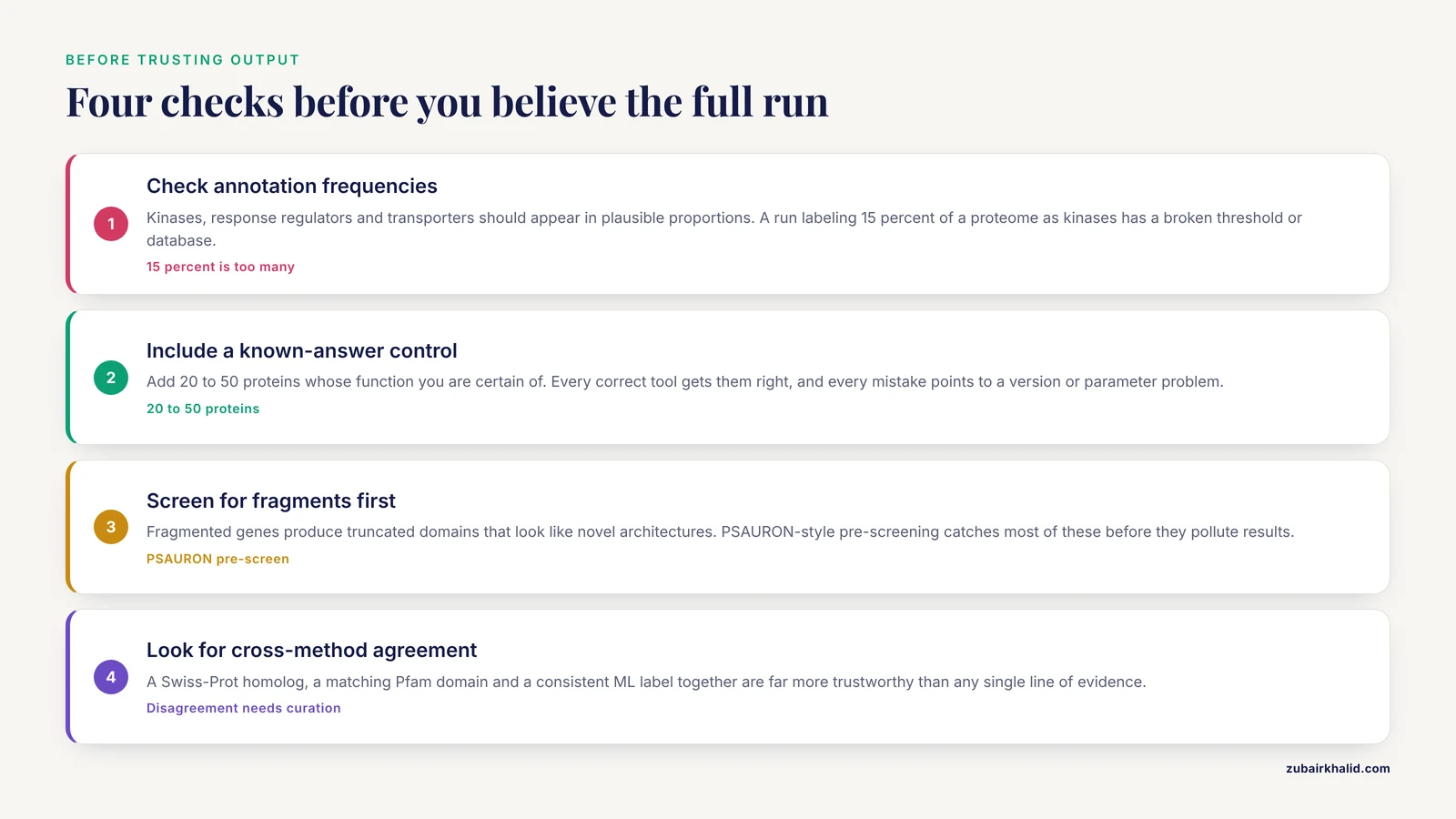
Whichever tool wins your benchmark, run these four checks before believing the full results.
- Frequency sanity. In a typical bacterial proteome, kinases, response regulators, and transporters should appear in plausible proportions. A run that labels 15 percent of a proteome as kinases has a broken threshold or a broken database.
- Known-answer control. Include 20 to 50 proteins whose function you are certain of. Every correct tool gets them right. Every mistake points to a version, parameter, or database problem.
- Fragment check. Fragmented genes produce truncated domains that look like novel architectures. PSAURON-style pre-screening of the input catches most of these before they pollute your results.
- Cross-method agreement. A protein with a Swiss-Prot homolog, a matching Pfam domain, and a consistent ML label is far more trustworthy than any single line of evidence. Where methods disagree is where manual curation pays, and tools that let you integrate outputs (meta-servers such as PSAT [4] and ANNIE [3], or domain-centric analyses in d-Omix [5]) make the disagreement visible instead of buried in separate files.
Common Mistakes and Limitations
These are the mistakes that appear repeatedly in real annotation projects, and each one has a concrete fix.
Trusting the top BLAST hit. The best-scoring hit is frequently a widely annotated model organism protein even when your protein belongs to a different subfamily. Transfer function from the lowest common conserved region, or from a curated family membership, rather than from a single top hit.
Running one tool and stopping. Homology, HMM, and embedding methods have complementary blind spots. The phage annotation work showing a threefold gain over homology methods exists precisely because homology alone leaves most phage protein functions unlabeled [8]. A bioinformatics tools comparison you run yourself on 200 sequences costs less than the damage caused by a single-method annotation.
Ignoring lineage specificity. A generic model applied to plants lost 7 accuracy points against an Arabidopsis-trained model [11]. Applying human- or mouse-centric assumptions to non-model organisms, or generic classifiers to rapidly evolving phage proteins, produces the same silent penalty [8][14].
Skipping the false discovery rate question. Many methods report performance metrics but never tell you what fraction of their confident labels are wrong on out-of-distribution data. The deep learning study that systematically compared FDR control across method classes found traditional approaches limited in this respect [6]. If a tool cannot tell you its FDR behavior, budget for manual validation of a random sample of its labels.
Annotating bad input. Spurious open reading frames, fragments, and contamination all become confident-looking annotations downstream. Screen the protein-coding quality of your input first [10], and reject sequences shorter than roughly 30 residues from domain-level analysis.
Using web servers beyond their design envelope. Meta-servers such as PSAT were explicitly built for high-throughput, genome-scale inputs rather than one sequence at a time, which is what distinguishes them from interactive analysis sites [4]. Submitting a genome-scale job to a server built for a handful of sequences, or expecting an interactive structural tool to batch-process a proteome, wastes days. Match the submission interface to the input size.
Forgetting that genomic context exists. In microbial genomes, a protein's neighbors often identify its function more reliably than its sequence does, and context-aware platforms were built because traditional sequence similarity cannot use that evidence [7]. If your dataset comes with genomic coordinates, tools that ignore them discard information.
Treating output labels as ground truth. Annotation is prediction. Every label should carry its evidence type and confidence, and conclusions built on annotations should state which method produced them. For family-level work, fingerprint-based assignments from resources like PRINTS provide fine-grained family signatures that carry explicit evidence semantics [1], which makes downstream interpretation honest.
A final limitation applies to any individual project. Published accuracies are measured on benchmark sets, not on your data, and the only accuracy that matters for your paper is the one measured in Step 5 on your own sequences.
Frequently Asked Questions
What is the best bioinformatics software for protein sequence annotation?
There is no single best tool. The right answer combines a fast homology search (DIAMOND or MMseqs2), profile HMM search (HMMER, or nail for very large datasets), a domain pipeline (InterProScan), and, for difficult proteins, an embedding-based classifier. Pick by benchmarking on a sample of your own data rather than by reputation.
Should I use homology-based search or machine learning-based annotation?
Use homology first because it is transparent and inspectable, then use machine learning for sequences homology cannot reach. Embedding classifiers outperform homology in specific regimes, for example tripling annotated homologous groups in phage proteomes [8], but their labels are harder to trace to evidence.
Can I annotate thousands of proteins with a web server?
Only if the server was designed for high throughput. PSAT was built specifically as a web-based meta-server for high-throughput, genome-wide annotation of large FASTA inputs [4], while many interactive servers assume small jobs. Check the stated input limits before uploading, and move to a local installation for routine large runs.
How do I know whether my annotations are correct?
Run a known-answer control, check annotation frequencies for biological plausibility, screen input sequences for coding quality before annotation [10], and look specifically at where independent methods disagree. Report thresholds and FDR behavior with your results.
Do I need to install anything, or can I run everything online?
For a few hundred sequences, web servers cover homology, domain, and specialized annotation. For tens of thousands of sequences, or for any analysis you might need to rerun, install HMMER, DIAMOND, and InterProScan locally with version-pinned databases.
What tools work best for unusual organisms such as phages or non-model species?
Look for lineage- or class-specific tools before settling for generic ones. Empathi for phage proteins [8], IgMAT for antibody sequences from any species [14], taxon-focused databases such as ShrimpGPAT for decapods [12], and lineage-specific models such as the plant DNA-binding SVM all outperform generic alternatives in their domains [11].
How much compute does high-throughput annotation require?
It depends on sensitivity demands. A single 48-core machine annotated roughly 2.4 billion metagenomic proteins against all of Pfam in 73.9 hours using nail, whereas the same run with HMMER3 would take about 8.7 times longer [2]. For a typical bacterial proteome, a laptop with 16 GB of RAM handles DIAMOND and HMMER comfortably.
How often should I reannotate my dataset?
Reannotate whenever a major curated database releases a significant update, when you adopt a new method into your pipeline, or before submission so that reported annotations reflect current knowledge. The frozen pipeline from the walkthrough makes each reannotation comparable to the last.
Sources
- The PRINTS database: a fine-grained protein sequence annotation and analysis resource-its status in 2012
- nail: software for high-speed, high-sensitivity protein sequence annotation
- ANNIE: integrated de novo protein sequence annotation
- Protein Sequence Annotation Tool (PSAT): a centralized web-based meta-server for high-throughput sequence annotations
- d-Omix: a mixer of generic protein domain analysis tools.
- Protein functional annotation of simultaneously improved stability, accuracy and false discovery rate achieved by a sequence-based deep learning
- Gaia: An AI-enabled genomic context-aware platform for protein sequence annotation
- Empathi: embedding-based phage protein annotation tool by hierarchical assignment
- E-SNPs&GO: embedding of protein sequence and function improves the annotation of human pathogenic variants
- PSAURON: a tool for assessing protein annotation across a broad range of species
- DNA-binding protein prediction using plant specific support vector machines: validation and application of a new genome annotation tool
- ShrimpGPAT: a gene and protein annotation tool for knowledge sharing and gene discovery in shrimp
- CHIKVPRO - a protein sequence annotation database for chikungunya virus
- IgMAT: immunoglobulin sequence multi-species annotation tool for any species including those with incomplete antibody annotation or unusual characteristics.
- PhosphoPredict: A bioinformatics tool for prediction of human kinase-specific phosphorylation substrates and sites by integrating heterogeneous feature selection
- VarMap: a web tool for mapping genomic coordinates to protein sequence and structure and retrieving protein structural annotations
- ALLIN: A tool for annotation of a protein alignment combined with structural visualization.