How to Select Protein Domain Prediction Tools
By Dr. Zubair Khalid, DVM, MS, PhD ·

The core difference among domain prediction tools is the question each one is built to answer: some classify a sequence region into a known family, some draw the boundaries of a compact structural unit, and some assign biological function to whatever they find. The rule of thumb for protein domain prediction tool selection is to decide your deliverable first (a family label, a boundary coordinate, a GO term, or a construct design), then match the tool category to that deliverable, and only then worry about speed, scale, and how many tools you can afford to run in consensus.
This article walks through the main tool categories, compares them side by side on the criteria that actually decide real choices, works through concrete scenarios, and lists the mistakes that waste the most compute and the most time.
What a Protein Domain Is and What "Prediction" Actually Means
A protein domain is a segment of a protein that folds and often functions as a semi-independent unit. Domains are structural and functional units that dictate how a protein acts at the molecular level, which is why their identification sits at the center of most annotation workflows [1]. A single protein may carry one domain or a dozen, arranged in an architecture that recombination, duplication, and domain shuffling have assembled over evolution.
"Domain prediction" bundles together at least three distinct computational tasks, and confusing them is the most common source of bad tool choices:
- Family classification. Does this region match a known domain family, such as a kinase domain or a helix-turn-helix? The output is a label plus an alignment, usually from a profile method.
- Boundary delineation. Where exactly does the domain start and end in residue coordinates? This matters when you clone a construct, interpret a variant, or model a fragment.
- Function assignment. What does the domain do? This layer maps a detected domain onto function-defining vocabularies such as Gene Ontology (GO) terms, a strategy that recent methods formalize by inferring associations between domains and GO terms from co-annotation patterns across annotated proteins [1].
A fourth adjacent task, architecture analysis, asks how a protein's domains combine and how those combinations compare across a protein family or a whole dataset. Domain combinations provide clues to protein function, interaction, and evolution, and dedicated web tools exist to compare proteins by domain architecture, build domain graphs, and derive putative interaction networks from domain-domain interaction data [2].
Because these tasks differ, a single "best" tool does not exist in any absolute sense. Reviews of motif and structure prediction tools emphasize that user queries vary greatly in size, scope, and character, and that the trade-offs in speed, accuracy, and scale must be weighed when choosing which methods to adopt [3]. That framing, question first and trade-offs second, drives everything below.
Why Tool Selection Is a Context Problem
Three findings from the methodological literature justify treating tool selection as a per-project decision rather than a lookup table.
First, algorithm performance is highly context-dependent. In the docking field, researchers built an embedding-based algorithm-selection model precisely because no single docking method performs reliably across structural, chemical, and protocol regimes, and the same pattern of regime-dependent winners recurs across computational biology. The lesson generalizes: a selector that matches method to case can beat the single best solver, but it degrades when the workflow or protocol shifts the underlying rankings [4].
Second, standard and alternative tools often disagree, and the disagreement can be informative. In a study of orphan neurotransmitter transporters, the author explicitly framed the problem as choosing the tools most appropriate for the specific task and the specific proteins, then combined standard multiple sequence alignment with an alternative hydropathy-distribution analysis and validated the consensus against literature and knowledgebase annotation. The combination recovered biologically meaningful families that either method alone did not resolve [5].
Third, integration usually beats any individual predictor. In subcellular localization prediction, dozens of tools exist, each performs well on certain datasets, and their predictions frequently disagree for a given protein. By integrating the outputs of available tools, in one case with a two-layer decision tree that emphasized biologically relevant features such as targeting peptides and transmembrane domains, accuracy reached 92 percent, far above the individual tools [6]. The same principle applies to domain prediction: where feasible, run a small panel and reconcile.
The Main Tool Categories for Domain Prediction
Sequence-based profile and family scanners
These are the workhorses. They compare your protein against curated multiple sequence alignments or profile hidden Markov models (profile HMMs, statistical models that capture the position-specific conservation pattern of a family). InterProScan is the standard wrapper that runs many member databases at once, and tools in this class, such as the classic hmmpfam-style searches and SUPERFAMILY, are what downstream analysis platforms typically accept as input [2].
Strengths:
- Curated, versioned libraries give reproducible, citable labels.
- Very fast per sequence once profiles are built, and trivially parallelizable for proteome-scale runs.
- Well-understood scoring, with gathering thresholds documented by the member databases.
Limitations:
- Highly divergent domains, especially in remote lineages or rapidly evolving pathogens, may fall below the detection threshold.
- Boundary calls are coarse. A profile hit often extends over regions that are structurally more variable than the core domain.
- Multi-domain proteins with repeating or degenerate domains need careful inspection of all hits, not just the top one.
Structure-based domain identification
When a structure exists, domains can be parsed from geometry rather than sequence similarity. Two developments changed this category. Experimental and predicted structures are now both readily available, and the AlphaFold Protein Structure Database put high-quality models within reach for most well-studied proteomes, which is why structure-selection tools such as PDBminer exist to rank available experimental and predicted structures by coverage against the UniProt sequence, model quality, complex state, and bound ligands or nucleic acid chains [7]. Meanwhile, the CASP16 assessment concluded that protein monomer and domain prediction is largely solved at the backbone level by AlphaFold-class methods, with remaining hard cases in irregular secondary structure, mutational effects, assemblies, antibody-antigen interfaces, nucleic acid modeling, and ligand affinity, which that assessment found totally unreliable [8].
Strengths:
- Physical boundaries that correspond to folded units, which matters for construct design and fragment work.
- Works where sequence similarity fails, for example for remote homologs whose fold is still recognizable.
Limitations:
- Requires a model or structure of reasonable quality, and quality varies by region. Confidence metrics must be read per residue, not per protein.
- A well-folded structural domain can still span several sequence-level family matches or split one, so sequence and structure views need explicit reconciliation.
Servers for structure-region analysis
A related category takes an existing structure, either a Protein Data Bank (PDB) entry or a comparative model in PDB format, and helps you interrogate regions of it. iMolTalk, for example, extracts sequence from coordinates, maps residues between sequence and structure, searches for contacts of residues, cofactors, and substrates, and identifies protein-protein interfaces between chains [9]. These are not predictors of domains from scratch, but they are how you verify that a predicted or detected domain corresponds to a compact, contact-dense region with the ligands and interfaces you expect.
Meta-servers and prediction aggregators
Meta-servers collect predictions from many specialized servers and present them on one canvas. ProteinCCD, built for crystallographic construct design, gathers secondary structure, disorder, coiled coils, transmembrane segments, domains, and domain linkers, displays a condensed view against the sequence, and lets the user choose construct starts and ends interactively [10]. This category directly addresses the boundary-delineation task, because domain boundaries for experimental work are best estimated from convergent evidence rather than any single predictor.
Downstream architecture and network analysis
Once domains are called, a second tier of tools analyzes the calls. d-Omix accepts InterProScan output files and offers four services: phylogenetic trees built from domain-architecture distance matrices, domain graphs showing versatility, abundance, and co-presence, similarity comparisons by domain-architecture alignment, and putative protein networks derived from curated domain-domain interactions [2]. Selecting a domain scanner with these downstream needs in mind changes the calculus, because a tool whose output plugs directly into your architecture analysis saves days of format wrangling.
Domain function and ontology mappers
The newest tier maps detected domains onto controlled function vocabularies. Domain2GO infers domain-GO term associations from documented protein-level GO annotations and domain annotations, uses statistical resampling to keep only reliable associations, propagates domain-level terms to proteins, and was evaluated in the framework of the Critical Assessment of Function Annotation [1]. Separately, DaGO-Fun integrates many information-content-based GO semantic similarity measures so users can compare GO terms and proteins and choose the measure most relevant to their application [11]. For the function-assignment task, these tools sit on top of a domain scan and inherit its errors, so the scan step still has to be chosen well.
Machine-learning and specialist predictors
Beyond general-purpose scanning, a growing set of specialist models predict domain-adjacent properties. For single-domain antibodies, a deep-learning structure-prediction pipeline was used to derive biophysical properties of framework region 2 and combine them into an aggregation score that forecast recombinant nanobody behavior across 106 experimentally characterized variants [12]. For conformational dynamics, AlphaFold2-RAVE-style workflows couple reduced-MSA structure predictions with physics-based molecular dynamics sampling, with an automated feature-selection module that picks the collective variables to monitor, and the approach recovered distinct functional states in enzymes such as adenylate kinase and DDR1 kinase [13]. For the sequence alignments that feed profile methods, a data-centric pipeline called MLProbs uses classifiers to choose the alignment tool and decide whether realignment is needed, and it produced the highest template-column scores across four benchmarks, with the largest gains in low-similarity families [14].
Side-by-Side Comparison of the Main Options
| Tool category | Example approaches | Primary task answered | Key strengths | Key limitations | Best suited when |
|---|---|---|---|---|---|
| Profile and family scanners | InterProScan wrapping HMM libraries, hmmpfam-style searches, SUPERFAMILY [2] | Family classification, coarse boundaries | Curated, reproducible labels, fast at scale, well-documented thresholds | Misses very divergent domains, boundaries can be coarse | Annotating many sequences, standard annotation pipelines |
| Structure-based parsing | Domain parsing on PDB entries or AlphaFold-class models [8] | Physical boundaries, fold recognition in remote cases | Boundaries reflect folded units, works where sequence similarity fails | Needs quality models, per-residue confidence must be read carefully, function does not follow automatically | Construct design, variant interpretation, remote homologs |
| Structure-analysis servers | iMolTalk [9] | Verification of regions in a known structure | Residue mapping, contact and interface analysis, textual and graphical output | Requires a PDB entry or PDB-format model, not a predictor itself | Confirming a domain's contacts, cofactors, and interfaces |
| Meta-servers | ProteinCCD [10] | Boundary delineation from convergent evidence | Aggregates disorder, secondary structure, transmembrane, linker, and domain predictions on one view | Web-bound throughput, output still needs human judgment | Choosing truncation constructs for expression or crystallization |
| Architecture and network analysis | d-Omix on InterProScan files [2] | Architecture comparison, domain graphs, interaction networks | Unified platform with exportable results, flexible choice of upstream search tools | Depends entirely on the quality of the upstream scan | Comparative genomics of a protein family |
| Function mappers | Domain2GO [1], DaGO-Fun [11] | Function assignment via GO terms | Statistical grounding, CAFA-based evaluation, multiple similarity measures to choose from | Inherits errors from the domain scan, coverage limited to characterized domains | Assigning first-pass function to newly detected domains |
| Deep-learning specialists | AF2/AF3-class prediction [8], nanobody aggregation models [12], ensemble generation [13] | Structure, stability, dynamics of domain-level units | Strong backbone accuracy, property scores validated against experiments | Ligand affinity unreliable, some tasks need expert guidance and follow-up | Engineering projects, conformational questions, candidate triage |
Selection Criteria That Actually Decide the Choice
Define the deliverable before comparing tools
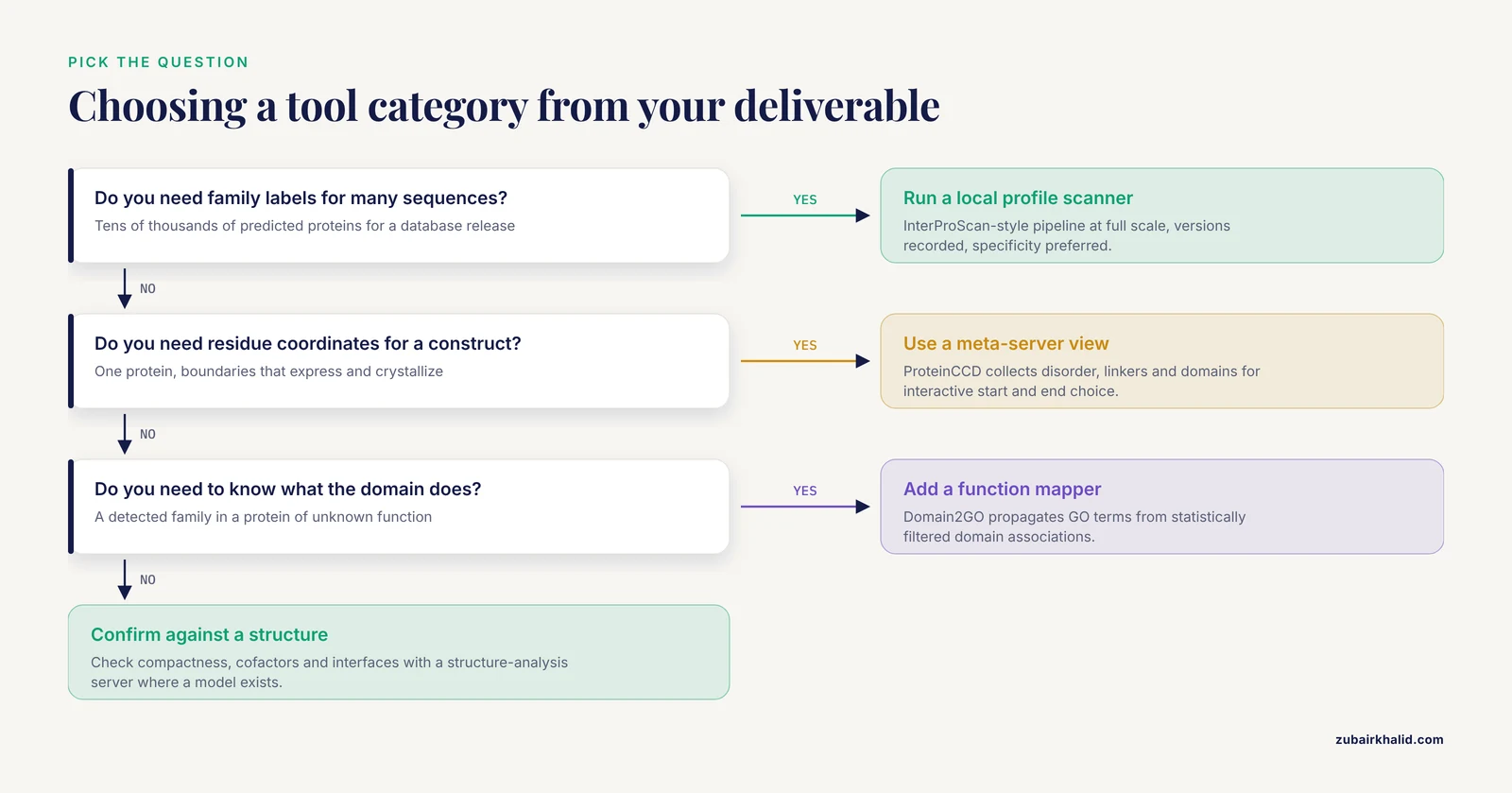
Write down the exact output you need. "Annotate 40,000 predicted proteins from a metagenome" points to a profile scanner run locally. "Pick a 250-residue clone that expresses" points to a meta-server that aggregates disorder and linker predictions [10]. "Say something about what this new protein does" points to a scan followed by a function mapper [1]. "Interpret a missense variant in a known domain" points to structure-aware, domain-specific analysis [15]. The fastest way to waste a week is to run a family scanner when you actually needed boundary coordinates.
Match the tool to sequence character and scale
The classic trade-off triangle is speed, accuracy, and scale [3]. For a handful of proteins, run everything, including slow interactive servers. For a proteome, choose fast local scanners and accept their limits on divergent sequences. Sequence character matters as much as sequence count. Low-similarity protein families benefit from data-centric pipelines that choose the alignment method and the realignment step automatically, a strategy that measurably outperformed ten popular alignment tools on low-identity benchmarks [14]. Highly divergent or compositionally biased proteins deserve an alternative view, such as the hydropathy-distribution analysis that helped classify orphan transporters where standard alignment alone left ambiguity [5].
Sensitivity versus specificity, stated honestly
Profile databases publish trusted thresholds, but no threshold resolves every case. If your deliverable is a conservative annotation for a database release, prefer specificity, report only confident hits, and flag the rest as uncharacterized. If your deliverable is a hypothesis for experiments, prefer sensitivity, run additional and alternative methods, and accept that you will chase some false positives. Say which mode you are in before you look at results, because post hoc threshold changes are how confirmation bias enters a pipeline.
Web server versus local installation
Web servers win on convenience and zero setup, and they are the right call for dozens to a few hundred sequences and for tools you will use occasionally. They lose on throughput, on timeouts for very long or very many sequences, and on reproducibility, because a web service can update without telling you. Local installations of scanner suites win for proteome-scale runs, for integration into automated pipelines, and for exact version pinning. If a platform accepts standardized upstream files, for example the InterProScan-format input that d-Omix expects, you can scan locally at scale and analyze interactively on the web, which is often the best of both [2].
Versions, releases, and reproducibility
Domain databases are living resources. Library contents, member entries, and thresholds change between releases, which means the same sequence can gain or lose a domain label across versions. Record the tool version, the database version, and the parameters in your methods section, and freeze them for the duration of a project. For structure-dependent work, the same discipline applies to model sources, and tools built to rank structures by coverage and quality make that record keeping systematic rather than ad hoc [7].
Consensus versus single best
The evidence is consistent: individual tools each have particular strengths, their predictions often disagree, and principled integration outperforms any single tool [6]. Practically, this means a minimum panel for boundary work should include a profile scan, a disorder prediction, a secondary-structure prediction, and a transmembrane or coiled-coil check, which is exactly the panel a construct-design meta-server assembles for you [10]. For family classification, a consensus of two independent profile libraries plus a structure view covers most discrepancies. When predictions agree, confidence is real. When they disagree, the disagreement is usually localized to a linker, a repeat, or a low-complexity segment, and that localization is itself useful information.
Cost of downstream integration
Tool selection does not end at the scan. If your downstream plan includes architecture phylogenies, domain graphs, or interaction networks, choosing a scanner whose output is directly consumable by those tools matters [2]. If your plan ends in function, choosing a mapper with a documented evaluation history, such as one benchmarked through CAFA [1], and a defensible similarity measure [11] matters more than marginal differences in raw scan sensitivity.
Worked Scenarios
Scenario 1: Annotating a large metagenomic protein catalog
You have tens of thousands of predicted proteins and need family labels for a database release. The deliverable is classification, not boundaries. Run a local InterProScan-style pipeline at full scale. Prefer specificity in reporting, record versions, and do not attempt interactive web servers at this volume. Downstream, if you want to compare genomes by domain content, prepare the scan output in the format your architecture-analysis tool accepts, because domain-architecture trees and domain graphs depend directly on consistent, complete scan results [2]. Anything below the trusted threshold goes into an "uncharacterized" bucket rather than a guessed label.
Scenario 2: Designing a truncation construct for expression and crystallization
You have one protein of interest and need to choose construct boundaries that will express as a folded, crystallizable unit. The deliverable is residue coordinates. Here a meta-server is the right selection, because ProteinCCD collects secondary structure, disorder, coiled coils, transmembrane segments, domains, and domain linkers in one condensed view and lets you choose starts and ends interactively, then designs the oligonucleotides for the constructs you pick [10]. Reconcile the domain calls against a structural view where possible. If a structure exists, use a structure-analysis server to confirm that your chosen fragment corresponds to a compact region and to check for bound cofactors or interface residues inside the fragment, because iMolTalk-style contact and interface searches catch boundary errors that sequence predictors cannot [9]. Remember that even with excellent backbone models, regions of irregular secondary structure remain difficult cases in current assessment results [8].
Scenario 3: Engineering a nanobody candidate panel
You are selecting single-domain antibody variants and want to prioritize candidates that will not aggregate during recombinant production. The deliverable is a ranked candidate list. A validated, domain-aware pipeline exists for exactly this: deep-learning structure prediction of the VHH, extraction of biophysical and biochemical properties of framework region 2, and combination into an aggregation score that was tested against 106 recombinant variants characterized by size-exclusion chromatography [12]. For candidates that pass the aggregation filter, if conformational flexibility matters to your application, ensemble-generation workflows that combine reduced-MSA structure prediction with physics-based sampling can identify distinct functional states with minimal prior knowledge, as demonstrated on adenylate kinase and DDR1 kinase [13]. The general lesson for tool selection in engineering contexts is that a specialist, experimentally validated predictor for your exact protein class will outperform a generic domain scanner applied to the same question.
Scenario 4: Interpreting variants in a clinically important domain
You have missense variants of uncertain significance in a defined domain, for example the BRCT domain of BRCA1, where the RING and BRCT domains are hotspots for pathogenic missense variants. The deliverable is a defensible pathogenicity ranking for each variant. Domain-specific analysis is the correct selection strategy: in silico tools were scored within the specific region of BRCA1, a feature-selection tool identified the most discriminative tools among nine, supervised models were trained on those combinations, and selected predictions were validated by phosphopeptide-binding assays and structural inspection [15]. The transferable points are that restricting in silico tools to the relevant domain improves discrimination, that feature selection over a panel of tools outperforms averaging them blindly, and that computational rankings in clinical contexts need experimental anchors.
Scenario 5: Assigning function to a newly detected domain
Your scan found a domain family in a protein of unknown function. The deliverable is GO terms you can defend. Use a function mapper that derives domain-GO associations from documented co-annotation, with statistical resampling to filter unreliable pairs, and that was evaluated in a community benchmark setting [1]. When you need to compare candidate annotations or assess how close two functional assignments are, use a tool that exposes multiple GO information-content-based similarity measures so you can pick the one appropriate to your application rather than inheriting a default [11]. In pathogen surveillance contexts, evidence-organization frameworks that keep sequence, annotation, structure, and model-derived evidence as traceable, typed nodes can support the review step, as proposed for viral protein annotation [16], and the same evidence-traceability habit serves any domain-to-function claim.
Building the Pipeline: Where Each Piece Fits
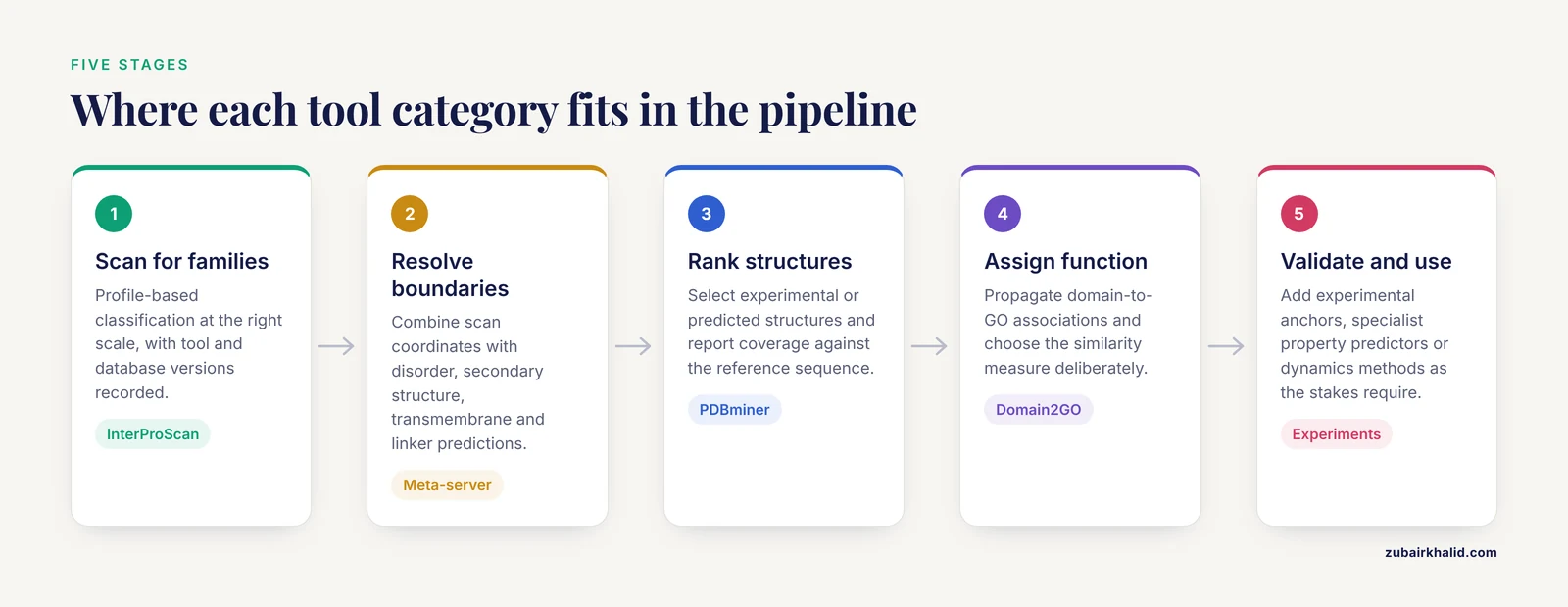
A defensible domain analysis pipeline has five stages, and tool selection happens at each one independently.
- Scan. Profile-based family classification at appropriate scale, with versions recorded.
- Boundary resolution. Consensus of scan coordinates, disorder, secondary structure, transmembrane, and linker predictions, ideally through a meta-server view [10], cross-checked against structural boundaries when a model is available.
- Structure. Selection and quality ranking of experimental or predicted structures, with coverage against the reference sequence reported systematically [7]. Current deep-learning models make backbone-level domain prediction largely a solved problem, but with documented residual hard cases [8].
- Function. Domain-to-GO propagation from statistically grounded associations [1], with similarity measures chosen deliberately [11] and evidence organized so that each claim traces back to its source data [16].
- Validation and use. Experimental anchors where stakes are high [15], specialist property predictors where the application is engineering [12], and ensemble or dynamics methods where conformational state matters [13].
Common Mistakes and Limitations
Treating boundaries as exact coordinates. A predicted domain boundary is an estimate. Neighboring predictors can disagree by tens of residues, especially at linkers and low-complexity regions. For construct design, take the intersection of confident core regions and leave buffer residues, then test empirically [10].
Reading one tool's negative result as proof of absence. A missed profile hit means no detectable similarity at that threshold, not that no domain exists. Remote homologs may need structure-based views or alternative analyses, as demonstrated when hydropathy-distribution analysis resolved families that standard alignment left ambiguous [5].
Ignoring database version drift. Annotations change between library releases. A pipeline that does not record tool and database versions cannot be reproduced, and results quoted in a paper without versions cannot be audited.
Assuming a good structure solves function. Current assessments are clear that backbone-level prediction is strong while ligand affinity prediction is unreliable [8]. A beautiful model of a domain tells you the fold, not the substrate, and function claims still need evidence such as curated domain-GO associations [1] or experiments [15].
Running web servers at industrial scale. Interactive servers are built for interactive jobs. Proteome-scale work belongs in local pipelines, with web tools reserved for spot checks and downstream interactive analysis [2].
Averaging tools instead of selecting among them. Naive consensus can be worse than a good selector, because tools have regime-specific strengths and weaknesses. The docking field's experience with algorithm selection shows that principled selection can gain double-digit improvements over the single best solver, but that the gains depend on the regime being stable [4]. The analogous practice here is to learn which of your panel members wins on your kind of proteins and weight accordingly, rather than averaging everything.
Forgetting that integration method matters. In the localization study, simple integration strategies underperformed a two-layer decision tree that emphasized targeting peptides and transmembrane domains [6]. How you combine predictions is a design decision, not a formality.
Applying a general tool where a specialist exists. Domain-adjacent properties such as aggregation propensity in nanobodies are better predicted by class-specific, experimentally validated models than by generic domain scanning [12].
A final limitation applies to every pipeline here: computational predictions inform decisions, they do not replace validation, and any individual result with real consequences, whether a construct that fails to express, a clinical variant call, or a biomarker candidate, needs experimental confirmation appropriate to that context.
Frequently Asked Questions
What is the best protein domain prediction tool for my project?
There is no single best tool, because the right choice depends on your deliverable. For family labels at scale, use a locally installed profile-scanner suite wrapped by InterProScan. For construct boundaries, use a meta-server that aggregates domain, disorder, and linker predictions. For function, add a domain-to-GO mapper with a benchmarked evaluation record. Match the tool to the question first, then to scale.
Should I run several domain prediction tools or just one?
Run a small panel whenever the decision matters. Individual tools each have particular strengths, their predictions often disagree, and principled integration has been shown to substantially outperform individual predictors in adjacent tasks. Agreement across independent methods is genuine confidence, and localized disagreement usually marks a linker or disordered region, which is itself useful information.
Do I still need domain prediction if I have an AlphaFold model?
Yes, for family labels and function, because a model gives geometry, not classification. Current assessment results show backbone-level domain prediction is largely solved, but ligand affinity prediction is unreliable and irregular structural elements remain difficult, so a structure supports boundary and fold reasoning while profile databases still carry the family and function evidence.
How do I handle a protein with no recognizable domains?
Escalate the evidence rather than forcing a label. Try alternative analyses, such as hydropathy-based comparisons, which helped classify orphan transporters beyond what standard alignment achieved. Check for a structural match if a model exists, consider disorder prediction to confirm the region is genuinely not a folded domain, and report it as uncharacterized rather than guessing.
Web server or command line for domain analysis?
Use web servers for dozens to a few hundred sequences, for occasional tools, and for interactive decisions such as choosing construct boundaries. Use local installations for proteome-scale jobs, for automated pipelines, and whenever exact version control matters, which is most of the time in publication-bound work. A hybrid is common, with local scanning feeding standardized files into web-based analysis platforms.
How should I report domain predictions in a paper or database?
Record the tool name and version, the database name and release, the search parameters and thresholds, and the coordinates of every reported domain. Note how disagreements among tools were reconciled and cite the evaluation basis for any function assignment. This level of reporting is what allows someone else to reproduce your annotation when the underlying libraries update.
Sources
- Mutual annotation-based prediction of protein domain functions with Domain2GO.
- d-Omix: a mixer of generic protein domain analysis tools.
- In silico protein motif discovery and structural analysis.
- Molecular embedding-based algorithm selection in protein-ligand docking.
- A comparative computational analysis of protein sequences and literature mining classify 'orphan' neurotransmitter transporters.
- 'Unite and conquer': enhanced prediction of protein subcellular localization by integrating multiple specialized tools.
- PDBminer to Find and Annotate Protein Structures for Computational Analysis.
- Practical Outcomes From CASP16 for Users in Need of Biomolecular Structure Prediction.
- iMolTalk: an interactive, internet-based protein structure analysis server.
- ProteinCCD: enabling the design of protein truncation constructs for expression and crystallization experiments.
- DaGO-Fun: tool for Gene Ontology-based functional analysis using term information content measures.
- Computational Prediction of Single-Domain Immunoglobulin Aggregation Propensities Facilitates Discovery and Humanization of Recombinant Nanobodies.
- af2rave: protein ensemble generation with physics-based sampling.
- MLProbs: A Data-Centric Pipeline for Better Multiple Sequence Alignment.
- Domain-Specific Computational, Functional and Structural Methods Enable Interpretation of BRCA1 BRCT Variants of Uncertain Significance.
- ViroBioTree: A Tree-Structured Biological Evidence Retrieval Framework for Viral Protein Function Annotation.