Prokaryotic Genome Annotation Tools
By Dr. Zubair Khalid, DVM, MS, PhD ·

Prokaryotic genome annotation tools take an assembled bacterial or archaeal genome and attach biological meaning to it, labeling where genes start and stop and what each gene probably does. The rule of thumb for choosing among them is simple: for a clean, high-quality bacterial isolate, Bakta or Prokka will serve you well, for archaeal genomes or messy assemblies such as metagenome-assembled genomes, NCBI's PGAP tends to hold up better, and for deeper functional detail you layer EggNOG-mapper or InterProScan on top of whichever tool called the genes. That hierarchy is not folklore. A large-scale benchmark of prokaryotic genome annotation tools across 156,033 diverse genomes found exactly these tool-specific strengths, and it remains the most direct evidence base for tool selection in this field [1].
This article walks through what annotation actually does, profiles each major tool on its own terms, compares the options side by side, and works through realistic scenarios so you can pick the right tool the first time.
What Prokaryotic Genome Annotation Actually Does
Annotation is the step that converts a raw assembly, a set of contigs or scaffolds with no labels, into a genome model. A contig is a contiguous stretch of assembled sequence. Annotation splits into two related jobs.
Structural annotation answers the question of where features are. A gene-prediction algorithm scans the sequence and marks protein-coding genes, also called CDS features for coding sequences, along with tRNA genes, rRNA genes, tmRNAs, and other RNAs. Prokaryotes make this easier than eukaryotes because bacterial genes usually lack introns, so gene callers look for open reading frames of reasonable length with appropriate start and stop codons and ribosome-binding signals.
Functional annotation answers the question of what each feature does. For every predicted CDS, the tool searches the predicted protein against databases of known proteins, protein families, or ortholog groups, and transfers names, Enzyme Commission numbers, Gene Ontology terms, or pathway assignments to the query gene. Gene Ontology, usually abbreviated GO, is a controlled vocabulary of gene function terms shared across organisms.
A third concept you will meet repeatedly is the metagenome-assembled genome, or MAG. A MAG is a genome reconstructed from a mixed environmental or host-associated sample rather than from a pure isolate culture. MAGs are frequently fragmented, may contain contamination from more than one organism, and generally produce worse annotation results than isolate genomes, a fact the benchmarking literature treats as a first-class design consideration rather than an afterthought [1].
Finally, a note on what annotation is not. Annotation does not fix a bad assembly. If your contigs are fragmented or your assembly contains chimeric joins, no annotation tool will rescue the underlying data, and the output will inherit every defect.
The Evidence Base for Choosing
For years, tool selection in bacterial genomics rested on habit and word of mouth. Researchers choosing sequencing platforms and annotation pipelines have long faced the same problem, that tools often only work well in limited contexts, and general guidance for genome projects has emphasized matching the pipeline to the project rather than following a single universal recipe [2]. That gap closed for prokaryotes when a large-scale benchmark compared four prominent open-source annotation tools, Prokka, Bakta, EggNOG-mapper, and PGAP, across 156,033 genomes [1].
The benchmark covered Escherichia coli strains as a baseline, thousands of archaeal and bacterial genomes, and deliberately degraded inputs including frameshifted genomes, metagenome-assembled genomes, fragmented assemblies, and contaminated samples [1]. Three findings matter most for practical decisions.
First, Bakta excelled on high-quality bacterial genomes. If your input is a well-assembled isolate with good completeness, Bakta gave the strongest results.
Second, PGAP performed better for archaeal genomes and for challenging bacterial assemblies, including metagenome-assembled, fragmented, or contaminated samples. Robustness to imperfect input is PGAP's distinguishing strength.
Third, on Gene Ontology annotation, PGAP consistently provided broader term coverage, whereas EggNOG-mapper offered more terms per feature. In plain language, PGAP tagged more genes with at least one GO term, while EggNOG-mapper assigned a richer set of terms to the genes it did annotate.
These findings are worth stating in tabular form because they are the core of any honest bioinformatics tools comparison for prokaryotes [1].
| Criterion | Prokka | Bakta | PGAP | EggNOG-mapper |
|---|---|---|---|---|
| Primary role | Rapid structural and basic functional annotation | Comprehensive annotation of high-quality bacterial genomes | NCBI's production annotation pipeline | Orthology-based functional annotation layer |
| Best-supported input | Bacterial isolates, routine pipelines | High-quality bacterial genomes | Archaeal genomes, MAGs, fragmented or contaminated assemblies | Any genome with predicted proteins |
| Input it struggles with | Fragments, contamination, archaea | Degraded or contaminated assemblies | Requires NCBI submission context for full benefit | Depends entirely on the quality of gene predictions upstream |
| GO annotation behavior | Minimal by design | Moderate | Broadest term coverage | Most terms per feature |
| Typical use | Draft circles, quick surveys, pipelines | Reference-grade isolate annotation | GenBank submissions, archaea, difficult assemblies | Functional enrichment, comparative genomics |
Every row in that table traces back to the same benchmark, so treat it as evidence-based guidance rather than opinion [1]. The rest of this article profiles each tool in depth, then adds the pipeline wrappers that bundle these engines into complete workflows.
Prokka
Prokka, developed by Torsten Seemann, is the tool that made rapid bacterial annotation routine. It bundles a gene predictor with curated protein and RNA databases and returns a complete annotation package, including GenBank format files, GFF3 files for genome browsers, protein and nucleotide FASTA files, and a summary table, typically within minutes on a laptop for a standard bacterial genome.
Pros. Prokka is fast, simple to install, needs no internet access once its databases are installed, and produces clean, standards-compliant output that downstream tools accept without complaint. Its speed makes it the default inside larger pipelines, and the MIRRI ERIC Italian node's microbial analysis platform includes Prokka alongside assemblers such as Canu and Flye and the functional annotator InterProScan in a reproducible workflow built on the Common Workflow Language [3]. Teaching environments favor it for the same reason, since students in a bacterial genome assembly and annotation workshop can move from raw reads to annotated genomes and virulence or resistance profiling within a structured lab session [4].
Cons. Prokka's functional annotation is intentionally shallow. Its curated database is compact, which keeps it fast but means many genes receive only generic names such as "hypothetical protein." The benchmark placed it among the four most prominent tools but did not identify it as the top performer on any genome-quality class, and modern alternatives outperform it on annotation depth for well-assembled genomes [1]. If you publish with Prokka-only annotation, reviewers increasingly expect a deeper functional pass.
When to use it. Routine isolate annotation where speed and reproducibility matter more than maximal functional detail, pipeline components where hundreds of genomes must be annotated in parallel, and teaching.
Bakta
Bakta is a successor in the same design spirit as Prokka, but with a substantially larger and more comprehensively curated database, dedicated handling of pseudogenes, and richer functional annotation drawn from multiple sources. The benchmark result is unambiguous. Bakta excelled in annotating high-quality bacterial genomes, which makes it the leading candidate when someone asks for the best prokaryotic genome annotation tool for a clean isolate [1].
Pros. Bakta combines strong structural annotation with functional inference spanning multiple databases, producing output suitable for reference-grade deposits and comparative analyses. Its annotation of well-assembled bacterial input was the benchmark's standout result [1]. It ships as a self-contained software package with a versioned database, which supports reproducibility, a concern that general genome-project guidance identifies as central to sustainable annotation work [2].
Cons. Bakta's database is large, so installation and database download take real time and disk space compared with Prokka. Its advantages concentrate on high-quality bacterial input. On degraded assemblies, MAGs, or contaminated samples, its performance advantage narrows or disappears, and PGAP handled those classes better in the benchmark [1].
When to use it. Reference-grade annotation of finished bacterial isolate genomes, comparative genomics projects where consistent rich functional annotation matters, and any publication where annotation depth will be scrutinized.
PGAP, the NCBI Prokaryotic Genome Annotation Pipeline
PGAP is the pipeline that the National Center for Biotechnology Information, NCBI, runs on every prokaryotic genome submitted to GenBank. It is also available as a standalone version that researchers can run locally. Its gene-calling and protein-homology machinery has been refined over many years of production use on millions of submissions, which shows in its robustness.
Pros. PGAP was the better performer for archaeal genomes and for challenging bacterial assemblies, including metagenome-assembled, fragmented, or contaminated samples, in the large-scale benchmark [1]. It also provided the broadest Gene Ontology term coverage of the four tools compared, meaning a larger fraction of predicted genes received at least one functional term [1]. For GenBank submission, annotation produced through the NCBI pipeline is the path of least resistance, because the submitter-facing validation machinery expects the feature conventions PGAP produces.
Cons. PGAP is heavier. The standalone version requires more setup than Prokka or Bakta, runtime is longer, and the tool is tuned to NCBI's conventions, which can feel rigid for projects with unusual feature needs. For a routine high-quality bacterial isolate where you never plan to submit to GenBank, Bakta's benchmark performance makes it the more efficient choice [1].
When to use it. Archaeal genomes, any assembly you suspect is fragmented or contaminated, MAGs, and genomes destined for a GenBank submission.
EggNOG-mapper
EggNOG-mapper occupies a different niche from the other three. It is not primarily a gene finder. It takes predicted proteins as input and assigns function by mapping them to precomputed orthologous groups from the eggNOG database, transferring names, GO terms, COG functional categories, and pathway links in one pass.
Pros. The benchmark found that EggNOG-mapper offers more GO terms per feature than any other tool compared, making it the strongest option when functional richness per gene is the goal [1]. It scales to thousands of genomes because the ortholog searches use precomputed clusters rather than fresh all-against-all searches. It also annotates across the tree of life, so the same tool serves bacterial, archaeal, and eukaryotic projects.
Cons. EggNOG-mapper's output is only as good as the gene predictions fed into it. It does not solve the structural annotation problem, so you must pair it with Prokka, Bakta, or PGAP. Used alone, it answers what genes do but not where they are.
When to use it. As the functional layer on top of any structural annotation, in comparative genomics where consistent orthology assignment across many genomes matters, and in projects where dense per-gene functional detail, for example for downstream GO enrichment analysis, is a priority [1].
InterProScan and Other Functional Layers
InterProScan deserves mention alongside EggNOG-mapper because it works differently. Rather than orthology transfer, it scans predicted proteins against a consolidated set of protein signature databases, detecting domains and families directly. It integrates into microbial workflows routinely, as in the MIRRI ERIC Italian node platform, where InterProScan sits alongside Prokka as the functional annotation stage for long-read microbial genomes [3]. The general pattern across modern prokaryotic annotation is a two-stage design. A structural tool, chosen for genome quality and taxonomy, calls the genes. A functional tool, chosen for annotation depth, characterizes the proteins.
Pipeline Wrappers That Bundle Annotation Into a Workflow
Standalone annotators answer one question. Many real projects need the whole chain, from raw reads through quality control, assembly, annotation, and downstream analysis, which is where pipeline wrappers earn their place.
Tychus. Tychus is a whole-genome sequencing pipeline for bacterial genomes that performs assembly, annotation, alignment, variant discovery, and phylogenetic inference of large numbers of isolates in parallel, using open-source tools packaged together with all dependencies for straightforward installation on Linux and Mac systems [5]. It suits outbreak-style projects where many related isolates must move through the identical workflow.
Container-based Nextflow pipelines. A set of container-based pipelines built on Nextflow offers quality control, de novo assembly, and bacterial genome annotation in three modular stages, with processing strategies that adapt to the sequencing data type and customization levels for both new and experienced users [6]. Their annotation stage goes beyond standard gene prediction and functional inference to include predictions relevant to clinical applications, such as virulence and resistance gene annotation, secondary metabolite detection, and prophage and plasmid prediction, with results delivered through reports and genome browsers [6]. The container approach addresses a persistent pain point, that analytical tools vary widely in algorithms, parameter settings, and input formats, which makes selecting and combining them difficult for researchers without dedicated informatics support [7].
Integrated service platforms. The MIRRI ERIC Italian node platform provides an end-to-end solution for long-read microbial data, from assembly with Canu or Flye through annotation with Prokka and InterProScan, wrapped in Common Workflow Language for reproducibility and accelerated on high-performance computing infrastructure, with a web interface aimed at non-specialists [3]. It handles both prokaryotic and eukaryotic genomes and demonstrated reliable results across three case-study microorganisms of environmental and clinical significance [3].
Semiautomated pipelines for non-specialists. GAAP, a genome assembly and annotation pipeline, was designed explicitly for semiautomated, iterative, high-throughput whole-genome analysis, performing read correction, de novo assembly, gene prediction, and functional annotation with proven tools and databases, and was written to help non-IT researchers navigate each analysis stage [7]. Though not prokaryote-specific, its design rationale applies directly, since the difficulty of combining heterogeneous tools is the reason wrappers exist at all [7].
The trade-off across all wrappers is the same. You gain convenience, reproducibility, and breadth, and you lose fine-grained control over individual tool parameters unless the pipeline exposes them. The best bioinformatics software choice for a solo researcher annotating one genome is a standalone tool. The best choice for a core facility annotating thousands is a pipeline.
How to Choose Among the Options
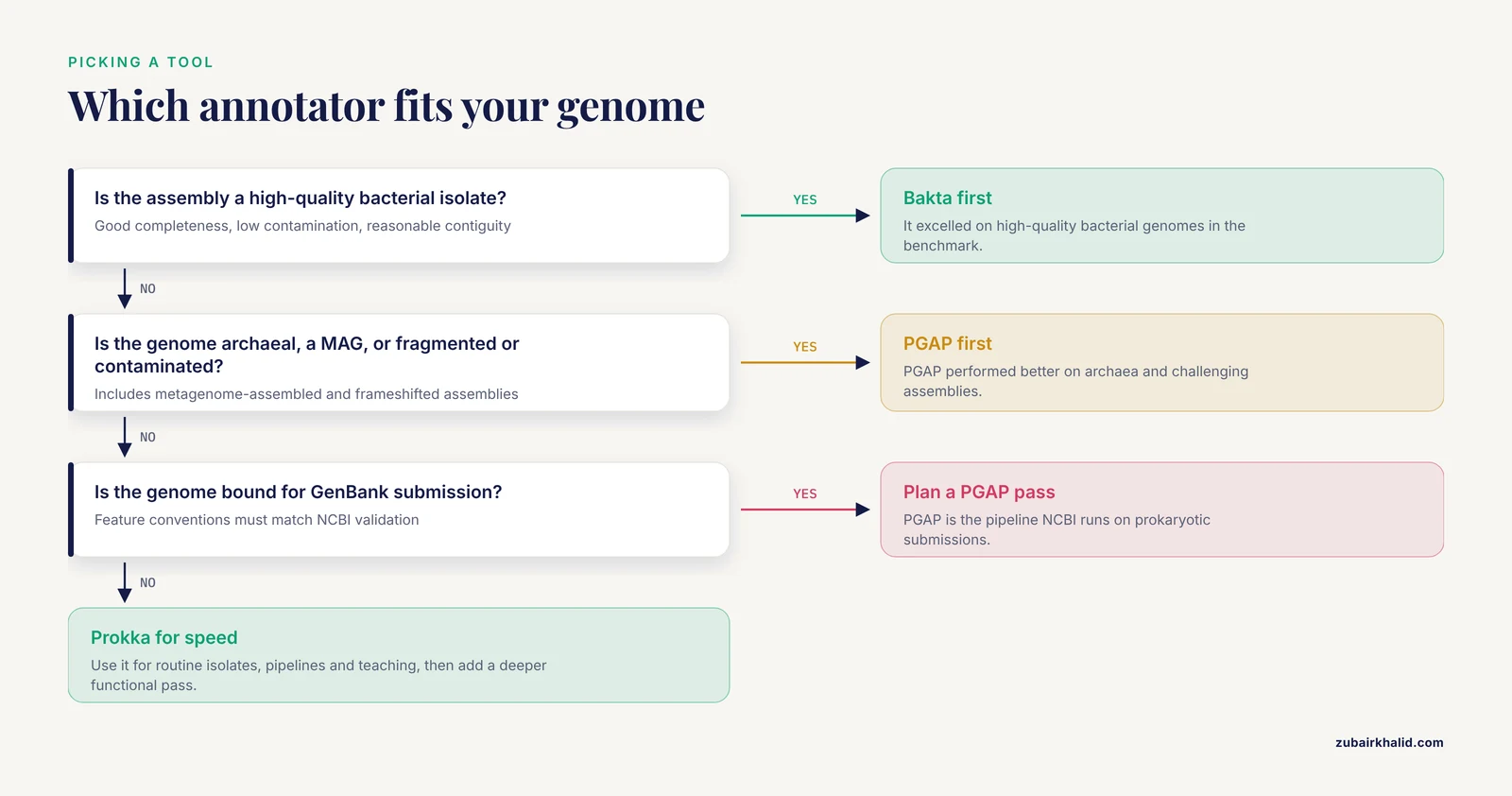
Four criteria decide most real choices, and the benchmark maps onto each of them directly [1].
Genome quality. Ask honestly how good your assembly is. High-quality bacterial isolate, meaning good completeness, low contamination, reasonable contiguity, points to Bakta. Fragmented, frameshifted, contaminated, or reconstructed from metagenomes points to PGAP [1].
Taxonomy. Bacteria and archaea are not symmetric problems. Gene callers and protein databases are far denser for bacteria, and the benchmark showed PGAP holding a real advantage on archaeal input [1]. If you annotate archaea regularly, plan around that.
Origin of the sample. A pure culture gives you an isolate genome. A metagenomic bin gives you a MAG. The benchmark treated MAGs, fragmented assemblies, and contaminated samples as a distinct performance class, and PGAP's advantage there was consistent [1].
Output requirements. If the genome is bound for GenBank, annotation that conforms to NCBI conventions is the practical route, and PGAP is the NCBI production pipeline for exactly this purpose. If the goal is dense functional characterization for enrichment analysis or comparative genomics, EggNOG-mapper's per-feature term depth is the differentiator [1]. If the goal is virulence, resistance, plasmid, prophage, and secondary metabolite profiling for a clinical or applied question, a pipeline that includes those modules, such as the container-based Nextflow workflows, saves you from assembling that stack yourself [6].
Runtime and compute matter too, but less than newcomers expect. Prokka annotates a typical bacterial genome in minutes on a laptop [3]. Bakta and PGAP take longer, and EggNOG-mapper depends on database size. For most single-genome projects, all four tools are computationally affordable, so tool fit should drive the decision, not speed.
Worked Scenarios
Scenario 1, a clinical E. coli isolate sequenced with a hybrid short-and-long-read protocol. You have a complete, closed genome. Run Bakta as the primary annotator, since it excelled on high-quality bacterial genomes [1]. Layer EggNOG-mapper on the predicted proteome for dense functional terms. If the project needs virulence and resistance gene calls plus plasmid and prophage detection for an infection-control report, run a container-based pipeline that includes those modules rather than hand-joining separate tools [6]. For submission of the finished genome and its annotation to GenBank, plan a PGAP-based pass so the record matches NCBI's validation conventions.
Scenario 2, a metagenome-assembled genome from a rumen or soil sample. The bin is fragmented and may carry contamination. Choose PGAP, which the benchmark identified as better for MAGs and challenging bacterial assemblies [1]. Report the assembly quality metrics alongside the annotation, because reviewers will ask. Resist the temptation to run a tool tuned for clean isolates and present the output as equivalent, since degraded inputs degrade predictions in tool-specific ways [1].
Scenario 3, an archaeal genome from a hot-spring isolate. Bacterial-default tools underperform here. PGAP performed better for archaeal genomes in the benchmark [1]. Supplement with EggNOG-mapper for functional depth, since archaeal protein databases are thinner everywhere and orthology-based transfer recovers function that simple homology searches miss [1].
Scenario 4, a teaching laboratory with limited time and compute. A structured workshop format that walks students from raw Illumina and Nanopore reads through quality assessment, assembly method comparison, annotation, and pathogenicity or resistance profiling on a Linux virtual machine shows how much ground a short course can cover [4]. Prokka is the natural annotator in that setting because it is fast and self-contained, and pairing it with InterProScan in a workflow-engine wrapper teaches students the two-stage annotation pattern that production platforms use [3].
Scenario 5, a surveillance project annotating hundreds of outbreak isolates weekly. Consistency beats peak quality. A parallelized pipeline such as Tychus, which bundles assembly, annotation, alignment, variant discovery, and phylogenetic inference for large numbers of WGS isolates under a single installable suite [5], or the Nextflow container pipelines with modular, versioned stages [6], keeps annotations comparable across runs. Ad hoc manual annotation of individual genomes does not survive contact with hundreds of samples.
A Minimal Practical Workflow
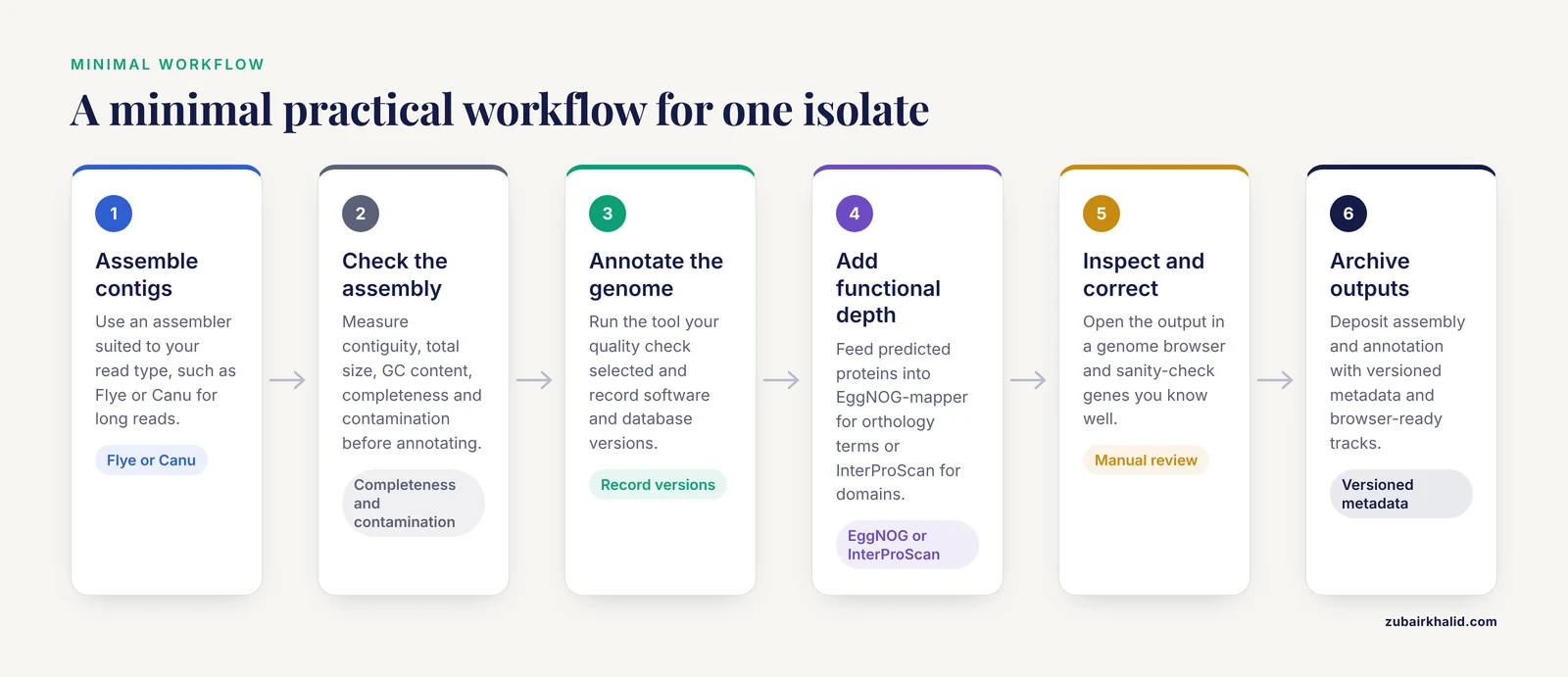
The following sequence reflects standard, documented usage of these tools and works for a typical bacterial isolate. Exact option names differ between versions, so consult the official documentation of each tool for its current flags.
- Assemble. Produce contigs with an assembler appropriate to your read type. Long-read data assembles well with tools such as Flye or Canu, both of which appear in production microbial workflows [3]. Hybrid short-and-long-read strategies improve assembly accuracy and can correct errors introduced by a single sequencing technology, an advantage demonstrated in viral and bacterial contexts alike [8][4].
- Check the assembly. Measure contiguity, total size, GC content, and completeness. For prokaryotes, estimate completeness and contamination with lineage-aware tools before annotating, because annotation choices depend on this assessment [1].
- Annotate structurally and functionally. Run the tool your quality assessment selected. Bakta for a clean isolate, PGAP for an archaeon, a MAG, or a GenBank-bound genome, Prokka for speed [1]. Point the tool at your contigs file, name the outputs sensibly, and record the software version and database version in your lab notebook, since reproducibility across versions is a documented concern for genome projects [2].
- Layer functional depth. Feed the predicted proteins from step 3 into EggNOG-mapper for orthology-based terms or InterProScan for domain-based annotation [1][3].
- Inspect and correct. Open the output in a genome browser, check the summary statistics, and sanity-check a handful of genes you know well. No annotator is perfect, and manual review of key loci, for example the genes you will discuss by name in a paper, remains standard practice.
- Archive. Deposit the assembly and annotation with versioned metadata. Pipelines that emit reports and browser-ready tracks alongside standard GenBank and GFF files simplify this step [6].
Common Mistakes and Limitations
Choosing a tool by brand loyalty instead of genome class. The single most common error is running one annotator on everything. The benchmark demonstrates that the best tool changes with genome quality, taxonomy, and origin, and that a tool ideal for a clean isolate can be the wrong choice for a MAG [1].
Treating annotation output as truth. Every prediction is an inference. Hypothetical proteins are genuinely unknown, functional names are transferred by similarity and can be wrong by one step of evolution or one database curation error. First-order corrections, such as verifying your genes of interest manually, are part of responsible practice.
Ignoring database version. Functional annotation depends on the database snapshot, not just the software version. Two runs of the same tool with different database releases can produce different gene names for the same genome. Record both versions, and reannotate consistently within a comparative study.
Annotating before fixing the assembly. Frameshifts, contamination, and fragmented contigs propagate into annotation. The benchmark explicitly included frameshifted genomes as a test class because real assemblies contain them, and annotation quality suffered accordingly [1]. Sequence errors that introduce premature stop codons turn one real gene into two truncated pseudogene-looking fragments.
Expecting a single tool to cover clinical annotation. Standard annotators assign general function. Virulence factors, antimicrobial resistance determinants, plasmids, and prophages require dedicated databases and classifiers, which is why comprehensive pipelines embed those modules as separate prediction stages [6]. Reading a resistance profile directly off a general annotator's output is an error.
Confusing GO breadth with GO depth. PGAP gives more genes at least one GO term. EggNOG-mapper gives each annotated gene more terms. Projects that need one or the other should pick accordingly rather than assuming more is uniformly better.
Skipping the human pass. Automated annotation is a starting point. Curated reference genomes in public databases reflect substantial manual review layered on automated output. If your genome will become a reference for others, budget time for curation.
One general limitation deserves a plain statement. Annotation tools inherit the completeness of their underlying databases, and organisms distant from well-studied lineages will accumulate more hypothetical proteins regardless of which tool you choose. That is a data problem, not a software defect, and no tool choice fixes it.
Frequently Asked Questions
What are the best prokaryotic genome annotation tools?
For most purposes the short list is Prokka, Bakta, PGAP, and EggNOG-mapper, and the best choice depends on your genome. A large benchmark across 156,033 genomes found Bakta strongest for high-quality bacterial genomes, PGAP strongest for archaeal genomes and challenging assemblies such as MAGs, and EggNOG-mapper the leader in functional terms per feature [1].
Should I use Prokka or Bakta for a bacterial isolate?
Use Bakta when the assembly is high quality and you want richer functional annotation, since that is the class where it excelled in benchmarking [1]. Use Prokka when speed and simplicity dominate, for example in pipelines or teaching, and plan a deeper functional pass if publication requires it.
Which tool should I use for a metagenome-assembled genome?
PGAP. It performed better than the alternatives on metagenome-assembled, fragmented, and contaminated assemblies in the large-scale comparison [1]. Report assembly quality metrics alongside the annotation so readers can judge the reliability of the gene calls.
How do I annotate a genome for GenBank submission?
Use the NCBI Prokaryotic Genome Annotation Pipeline, since PGAP is the pipeline NCBI runs on prokaryotic submissions and its output matches the feature conventions GenBank expects [1]. The standalone version can also be run locally when you want the same annotation behavior before submitting.
Do I need a functional annotation tool in addition to my gene caller?
Yes, if functional depth matters for your project. Structural tools assign gene names by homology but leave many genes hypothetical. EggNOG-mapper provides the most terms per feature among the benchmarked tools, and InterProScan adds domain-based evidence through protein signature databases, which is why production microbial platforms pair them with tools like Prokka [1][3].
Can I run annotation through a pipeline instead of a standalone tool?
Yes, and for multi-sample projects you usually should. Options include Tychus for parallel bacterial assembly, annotation, variant discovery, and phylogenetics [5], container-based Nextflow pipelines that add clinical predictions such as virulence, resistance, plasmid, and prophage modules [6], and integrated platforms such as the MIRRI ERIC Italian node service that wrap assembly and annotation in reproducible Common Workflow Language with a web interface for non-specialists [3]. Standalone tools remain the better fit for a single genome under active manual analysis.
Sources
- Large-scale benchmarking of prokaryotic annotation tools across thousands of species.
- Twelve quick steps for genome assembly and annotation in the classroom
- Long-read microbial genome assembly, gene prediction and functional annotation: a service of the MIRRI ERIC Italian node.
- A bacterial genome assembly and annotation laboratory using a virtual machine
- Tychus: a whole genome sequencing pipeline for assembly, annotation and phylogenetics of bacterial genomes
- Scalable and versatile container-based pipelines for de novo genome assembly and bacterial annotation.
- GAAP: A Genome Assembly + Annotation Pipeline
- Hybrid de novo Whole-Genome Assembly and Annotation of SARS-CoV-2 Virus from Nosocomial Infection in Pahang, Malaysia