Pairwise vs. Multiple Sequence Alignment: Which Tool to Use
By Dr. Zubair Khalid, DVM, MS, PhD ·

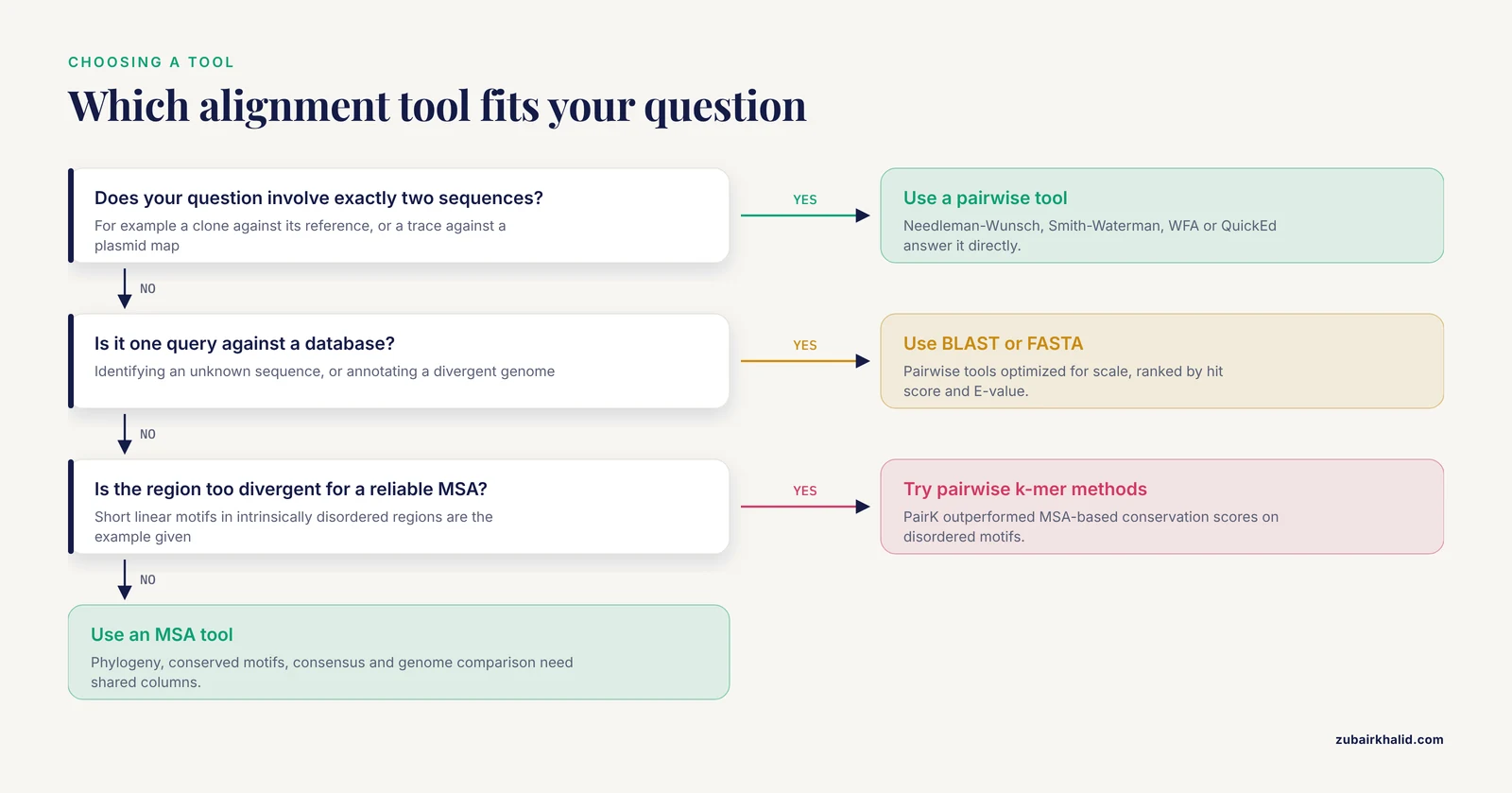
Pairwise alignment compares two sequences against each other, while multiple sequence alignment (MSA) aligns three or more sequences at once so that columns of the output represent positions inferred to descend from a common ancestral residue. The rule of thumb is simple. If your biological question involves exactly two sequences, or one sequence against a database, use a pairwise tool. If your question requires comparing residues across a family of sequences, such as building a phylogeny, finding conserved motifs, or calling a consensus, use an MSA tool.
That rule sounds obvious, but in practice the choice is murky because the two problem types are mathematically intertwined. Most MSA software solves the multiple alignment problem by computing many pairwise alignments under the hood. Some pairwise questions are better answered with an MSA, and some MSA jobs are better decomposed into pairwise ones. This article explains what each class of tool actually computes, compares the two side by side on the criteria that decide real projects, walks through worked scenarios, and lists the mistakes that cost people the most time.
What Pairwise Alignment Does and When to Use It
A pairwise alignment arranges two sequences, introducing gaps where needed, so that matched characters earn a score defined by a scoring system. That system has three parts. A substitution matrix assigns a score to each possible residue match or mismatch. A gap-open penalty charges for starting a gap. A gap-extension penalty charges for lengthening one. Dynamic programming, an algorithmic technique that solves a problem by building up optimal solutions to smaller subproblems, guarantees an optimal alignment for a given scoring system in time proportional to the product of the two sequence lengths, written O(n²) for two sequences of roughly equal length n.
Two flavors matter. Global alignment, implemented classically as the Needleman-Wunsch algorithm, forces the two sequences to align end to end. It suits two sequences you already believe are full-length homologs, such as a synthetic gene insert and the sequence you ordered. Local alignment, implemented as the Smith-Waterman algorithm, finds the single best matching region inside otherwise dissimilar sequences. It suits finding a domain inside a protein or a gene inside a genome. Heuristic local search tools such as FASTA, which extends an earlier program called FASTP, made database-scale searching practical by computing an initial pairwise similarity score, joining multiple regions of similarity to raise the score of related sequences, and evaluating significance with shuffling methods that preserve local sequence composition [1].
The scoring model is a modeling decision
The substitution matrix is not a technical detail. It encodes your hypothesis about how sequences evolve. BLOSUM and PAM matrix families are the standard predefined choices, and each individual matrix within a family reflects a different expected evolutionary distance. Researchers often do not know whether a given matrix family, or any single matrix within it, is the most suitable for their data, and predefined families may poorly reflect a specific hypothesis. Tools such as SubVis, an interactive R package, were built to load several substitution matrices at once and compare their effects on pairwise alignments side by side, precisely because this comparison was previously a laborious manual process [2]. The practical lesson: pairwise alignment quality depends on scoring choices, and it is reasonable to test more than one matrix, especially for divergent sequences.
Modern pairwise alignment is fast and exact
Two sequences at a time is a small problem per comparison, which is why the field keeps producing faster exact pairwise algorithms rather than abandoning exactness. The wavefront alignment algorithm (WFA) computes exact gap-affine alignments in time O(ns), proportional to sequence length n and the alignment score s, instead of quadratic time, and runs 20 to 300 times faster than other methods on short Illumina-like sequences and 10 to 100 times faster on long noisy reads such as those from Oxford Nanopore sequencers [3]. QuickEd applies a related bound-and-align strategy, first bounding the maximum possible alignment score and then using that bound to prune computation, achieving O(ns*) complexity where s* is an estimated upper bound of the score. It delivers 4.2 to 5.9 times the speed of Edlib and 3.8 to 4.4 times that of BiWFA on long, noisy datasets while keeping the optimal result [4].
The takeaway for tool selection is that pairwise alignment no longer forces a hard tradeoff between speed and optimality, even for the long, error-prone reads produced by modern sequencers.
Visual pairwise inspection
For a single comparison, looking at the alignment graphically is often more informative than reading the score. Dot plots, a two-dimensional graphical representation of alignments, reveal repeats, inversions, and rearrangements that a single score line hides. G-SAIP is a parallelized dot-plot generator built for large sequences, reporting up to 1.68 times the speed of other fast tools on supercomputing infrastructure, and dot plots remain standard for genome comparison, repetitive structure identification, and assembly quality checking [5]. The SeqTools package complements this with three viewers: Blixem for many-to-one browsing of pairwise matches against a reference, Dotter for the dot-plot view of a single pairwise alignment, and Belvu for viewing and editing multiple alignments [6].
What Multiple Sequence Alignment Does and When to Use It
An MSA aligns three or more sequences simultaneously so that the whole set shares a common column structure. The goal is different from a collection of pairwise alignments. In an MSA, a column can contain residues from all sequences, and that column is an inference about shared ancestry. That inference is what phylogenetic tree reconstruction, conserved residue identification, profile construction, and primer design across a family all depend on.
The computational situation is fundamentally harder. Finding the optimal MSA under standard scoring is NP-hard, meaning the exact problem scales impractically as sequences are added, so every practical MSA tool uses heuristics. The dominant heuristic family is progressive alignment. It first estimates pairwise similarities among all sequences, builds a guide tree from those similarities, and then aligns sequences or subalignments following the tree from the leaves toward the root. Iterative refinement methods then repeatedly realign subgroups to improve the total score. Consistency-based methods use information from pairwise alignments among all sequence pairs to constrain the final alignment.
MSA tools are built from pairwise comparisons
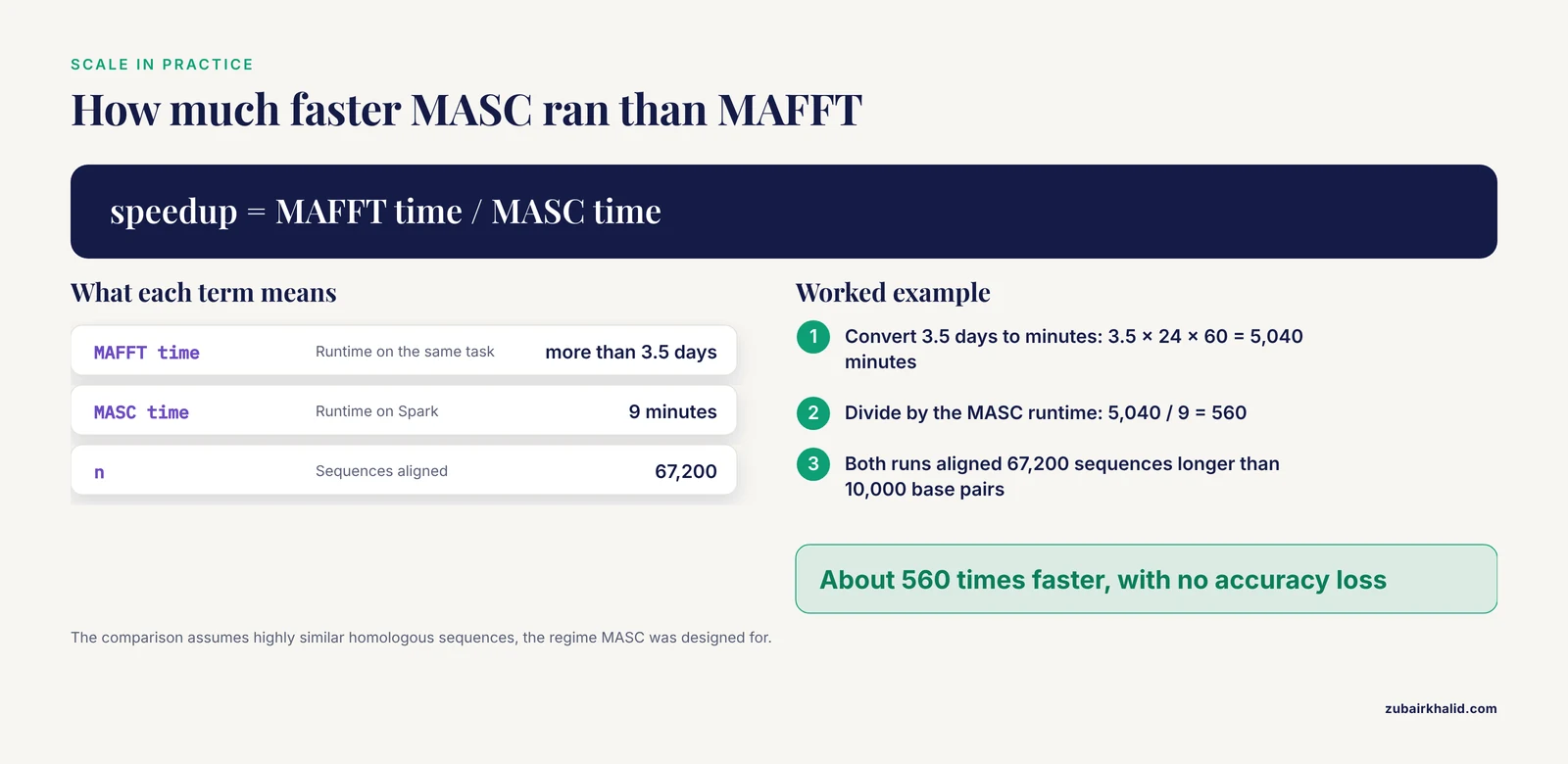
The two problem classes are connected at the algorithm level, not just conceptually. The center-star strategy reduces an MSA problem to a set of pairwise alignments against a chosen center sequence, and the MASC method combines this with a suffix tree, an index structure for fast substring matching, to align highly similar nucleotide sequences in linear time O(mn), where m is the number of sequences and n the average length. Run on the Spark distributed framework, MASC aligned 67,200 sequences longer than 10,000 base pairs in 9 minutes, a job that took MAFFT more than 3.5 days [7]. A fully automated protein database classification pipeline from 1998 followed the same architectural logic at a different scale, integrating compositional similarity search, local similarity search, and then multiple alignment using a fast hierarchical dynamic programming algorithm, and achieved about 93 percent correct family assignment across 12,462 protein sequences in 341 known families [8]. In structural biology the pattern repeats: pmTM-align runs pairwise structure alignments in parallel with Apache Spark and then builds a tree-based multiple structure alignment with OpenMP, accelerating the multiple-alignment stage by a factor of about 2 to 5 [9]. parMATT, a parallel reimplementation of the MATT algorithm, similarly parallelizes the initial all-against-all pairwise structural alignments and the iterative progression of the multiple alignment [10].
So when you ask "pairwise or multiple sequence alignment tools," part of the honest answer is that MSA tools call pairwise alignment machinery internally, often thousands of times. What distinguishes them is how they combine those pairwise results into a single coherent multiple alignment and how they manage scale.
MSA at genome scale
Whole-genome alignment pushes both classes of tools to their limits. Most pairwise and multiple genome alignment methods use fast local homology search to find anchor points, high-scoring local alignments that partition the genomes, then apply slower and more sensitive methods to the segments between anchors. Replacing the exact word matches that the Mugsy pipeline used as anchors with filtered spaced-word matches produced similar quality for closely related genomes and better alignments for distantly related ones [11]. For plant genomes, the challenge is acute: frequent whole-genome duplications, chromosome rearrangements and fractionation, high nucleotide diversity, widespread structural variation, and heavy transposable element activity strain classical pairwise and multiple genome alignment methods alike, and the field continues to develop new approaches [12].
MSA in high-throughput pipelines
Third-generation sequencing error correction leans heavily on MSA methods to manage sequencing errors, and a benchmarking pipeline called MSA Limit was built to evaluate MSA tools across conditions representative of these reads, measuring alignment accuracy, time, and memory. Its experiments with real and simulated data showed that popular methods are not consistently the most efficient, and that the best-performing method varies with sequencing depth, genome characteristics, and read error patterns [13]. This is a recurring theme in bioinformatics tools comparison: the "best bioinformatics software" is conditional on your data, not absolute.
Side-by-Side Comparison
| Attribute | Pairwise alignment | Multiple sequence alignment |
|---|---|---|
| Question answered | How similar are these two sequences, and where? | Which positions are shared across this whole family? |
| Input size | Two sequences, or one query against a database | Typically 3 to thousands of sequences |
| Core algorithm | Dynamic programming (Needleman-Wunsch, Smith-Waterman) or exact/heuristic variants such as WFA and bound-and-align [4], [3] | Heuristics: progressive alignment on a guide tree, iterative refinement, consistency scoring, center-star decomposition [7] |
| Time complexity | O(n²) classically, O(ns) or O(ns*) for modern exact methods [4], [3] | NP-hard exactly, heuristics roughly linear to quadratic in length times number of sequences depending on method [7] |
| Representative tools | BLAST, FASTA [1], EMBOSS needle and water, WFA [3], QuickEd [4], dot-plot tools such as G-SAIP [5] | MAFFT, MUSCLE, Clustal Omega (standard suites), Mugsy-style genome aligners [11], structural tools such as parMATT [10] and pmTM-align [9] |
| Output | One aligned pair, a score, an identity or similarity percentage, often an E-value for database search [1] | One alignment of all sequences with shared columns, suitable for downstream phylogenetics and conservation analysis [14] |
| Compute cost per job | Low to moderate, highly optimized per comparison [3] | Grows with sequence count, memory-intensive at scale [13], [7] |
| Interpretability | Direct, two sequences, easy to inspect visually with dot plots [5], [6] | Richer but harder to verify, column errors can propagate silently into downstream analysis [14] |
| Main uses | Database search [1], functional annotation of divergent organisms [15], construct and trace validation [16], genome comparison [5], clustering at scale when combined with indexing [17] | Phylogenetics, conserved motif and domain discovery, consensus calling, error correction in long-read pipelines [13], protein family and structural superfamily analysis [10] |
| Failure modes | Wrong scoring matrix for the divergence level [2], missed distant homology in heuristic database search [1] | Misalignment of divergent or disordered regions [18], uncertainty in columns that downstream tools treat as fixed truth [14] |
| When it wins | Two-sequence questions, database-scale screening, any workflow needing guaranteed optimal two-sequence results [4], [3] | Any question defined across a family, especially evolutionary inference [14] and multi-sequence consensus [13] |
The Difference Between Pairwise and Multiple Sequence Alignment Tools
The deepest difference between the tool classes is not the algorithm but the inference each supports. A pairwise alignment reports a relationship between two entities. An MSA proposes a homology hypothesis across an entire set, and every residue's placement in a column is a claim that those residues descend from a common ancestor. Downstream tools, especially phylogenetic programs, treat that claim as input data. Research on alignment uncertainty shows this matters: errors in MSAs cause problems ranging from false inference of positive selection to long-branch attraction artifacts in tree reconstruction, and the common fix of deleting error-prone columns has had mixed success. The Divvier software took a different route, using a probabilistic model to identify clusters of characters with strong statistical evidence of shared homology, and it outperformed existing filtering software by retaining more true pairwise homology calls while removing more false positives [14].
A second difference is engineering. Pairwise tool developers compete on the raw speed of one comparison, exploiting vectorization and score-bounding tricks [4], [3]. MSA tool developers compete on scheduling many comparisons, reducing redundant work, and managing memory, which is why approaches like suffix-tree indexing on Spark [7] and distributed pairwise stages feeding tree-based multiple stages [9], [10] keep reappearing. When you benchmark a pairwise tool you are measuring an inner loop. When you benchmark an MSA tool you are measuring an entire strategy, and benchmark results transfer poorly across datasets [13].
A third difference is composability. You cannot make a valid MSA by simply stacking pairwise alignments on top of each other, because the pairwise alignments can disagree with one another about where gaps go. Some workflows nevertheless produce many pairwise alignments against a common reference and need them merged, for example aligning multiple sequencing traces against a circular plasmid sequence for validation, where circularity-aware tools return one pairwise alignment per trace. Biopython added an algorithm for combining alignments that share the same reference into a single MSA that preserves each original alignment structure, exactly because existing tools could align many sequences to one reference or merge two prealigned blocks, but could not merge independent pairwise alignments [16].
When to Use Pairwise Alignment
Reach for a pairwise tool when your question is inherently two-sided.
Database search and annotation. Identifying what an unknown sequence is remains a pairwise problem at its core: query against every candidate in a database, rank the hits. Automated functional annotation pipelines that rely on sequence similarity of a query to annotated proteins depend on this step, and an analysis of trypanosomatid annotation found that not employing pairwise sequence alignment tools in the automated annotation process left significant gaps, with even stringent cutoffs successfully annotating a meaningful number of previously hypothetical proteins [15].
Validation against a known reference. Did the clone come out right. Does the sequencing trace match the plasmid map. Does the synthetic construct match the design. These are one-to-one or many-to-one comparisons. Circularity-aware tools return a pairwise alignment per trace, and a many-to-one browser such as Blixem exists precisely for annotators checking evidence against a single reference sequence [6].
Detecting rearrangements and repeats. A dot plot of one sequence pair, or one genome pair, exposes inversions, duplications, and repeats at a glance, and parallel dot-plot tools make this feasible even for large genomes [5].
Exact distance computation at high throughput. Read mapping, edit-distance calculations, and overlap detection inside larger pipelines are pairwise alignment jobs executed millions of times, which is why exact algorithms with O(ns) scaling such as WFA [3] and QuickEd [4] were built for them.
Conservation analysis where MSA breaks down. Intrinsically disordered protein regions evolve so rapidly that MSAs often misalign short linear motifs and underestimate their conservation. PairK, an MSA-free pairwise k-mer alignment method for quantifying motif conservation in disordered regions, outperformed standard MSA-based conservation scores and an LLM-based conservation predictor, and could quantify conservation over wider phylogenetic distances than MSAs, indicating that some motifs are more conserved than MSA-based metrics imply [18]. The general lesson extends beyond this one tool: when the region of interest is too divergent to align across the whole family, pairwise comparisons against a reference or within k-mer space can answer the biological question that the MSA cannot.
Choosing what to cluster first. At database scale, exhaustive pairwise alignment becomes the bottleneck for clustering and annotation pipelines. Alignment-free preclustering with Min-Wise Independent Hashing over conserved regions produced clusters comparable to semi-exhaustive pairwise methods, reaching a 75 percent average weighted F1 score against Pfam domain subfamilies on a dataset of 90,000 sequences [17]. The pattern to remember is screening cheaply and pairwise-aligning only the candidates that survive.
When to Use Multiple Sequence Alignment
Reach for an MSA tool when your question is defined across a family.
Phylogenetic inference. Tree building consumes MSA columns. Because MSA error propagates directly into tree error, careful analysts treat alignment quality as part of the phylogenetic method, and tools like Divvier exist to address column uncertainty before or instead of crude filtering [14].
Conserved residues, motifs, and domains. A column conserved across dozens of homologs is far stronger evidence of functional constraint than any single pairwise match. Family-level domain identification pipelines have long combined similarity searches with hierarchical multiple alignment for exactly this reason [8].
Consensus and error correction. Long-read sequencing pipelines use MSA methods to separate true biological variation from sequencing noise [13]. If your consensus depends on read depth, the MSA method's accuracy, speed, and memory profile directly determine your results, and the right choice varies with sequencing depth and error profile [13].
Genome-scale comparative genomics. Multiple genome alignment underpins synteny analysis and pan-genome construction, and the anchor-point strategies shared by pairwise and multiple genome aligners determine both speed and sensitivity, especially for distant genomes [11], [12].
Structural superfamilies. Aligning many protein 3D structures by translation and twisting, as MATT and its parallel implementations do, builds superfamily-level alignments that reveal structure-function relationships across distant homologs [10], and topology-independent RNA structure superposition can drive structure-based sequence alignment for noncoding RNAs [19].
Worked Scenarios
Scenario 1: Verifying a cloning construct
You ordered a synthetic insert and sequenced six colonies. Each trace needs comparison to the expected plasmid sequence. This is many-to-one pairwise territory. Run each trace against the reference with a pairwise aligner, inspect the evidence in a many-to-one browser [6], and if the tool accounts for plasmid circularity you will get one pairwise alignment per trace. To visualize all traces together in a single figure, merge the individual alignments into one MSA with the reference-preserving merge available in Biopython's Alignment class [16]. Notice the division of labor: pairwise alignment did the per-trace computation, and a merge step produced the collective view. Do not force all traces into a de novo MSA program, because circularity and per-trace gap placement are handled better one-to-one.
Scenario 2: Building a phylogeny for a protein family
You have 200 homologous proteins and want a tree. Align all 200 with an MSA tool, evaluate column homology, then build the tree. Because alignment errors bias tree inference, apply a homology-aware treatment of uncertain columns rather than assuming the alignment is fixed truth [14]. Pairwise alignment has no role as the final product here, though it runs inside the MSA tool to build the guide tree.
Scenario 3: Annotating a divergent genome
You sequenced a trypanosomatid-like organism with thousands of unannotated genes. Start with pairwise similarity searches against annotated databases, since even stringent cutoffs in such searches recover functional annotations that other pipelines miss [15]. At full database scale, precluster with alignment-free sketches to avoid exhaustive all-against-all alignment, then annotate clusters [17]. The MSA enters later, if at all, when you want to align a retrieved family to confirm domain boundaries.
Scenario 4: Consensus from long reads
You have high-depth long reads from a third-generation sequencer and want an accurate consensus or error-corrected assembly. This is an MSA problem by construction, since error correction compares many overlapping reads simultaneously [13]. Benchmark or at least sanity-check your MSA tool choice, because no single method dominates across sequencing depths, genome characteristics, and error patterns [13]. If your reads are extremely long and the pipeline calls pairwise alignment internally, modern exact methods keep the quadratic cost at bay [4], [3].
Scenario 5: Motif conservation in disordered regions
You study short linear motifs in intrinsically disordered protein regions across a eukaryotic family. A standard MSA will scramble the motifs. Use a pairwise k-mer-based approach designed for this regime [18] rather than fighting the MSA with more gap penalties.
How Performance and Scale Decide the Choice
Concrete benchmark numbers clarify where each class of tool spends its time.
For raw pairwise speed, WFA achieved 20 to 300 times the speed of other methods on short reads and 10 to 100 times on long noisy reads [3]. QuickEd, on long noisy datasets, ran 4.2 to 5.9 times faster than Edlib and 3.8 to 4.4 times faster than BiWFA while producing the optimal alignment [4]. These numbers mean that for read-to-read or read-to-reference work inside a pipeline, exact pairwise alignment is no longer the bottleneck it once was.
For MSA at extreme scale, the center-star and suffix-tree approach of MASC aligned 67,200 nucleotide sequences of over 10,000 base pairs in 9 minutes on Spark, versus more than 3.5 days for MAFFT on the same task, with no accuracy loss for highly similar homologous sequences [7]. That comparison assumes high sequence similarity, which is the regime the method was designed for. For divergent sequences, standard progressive and consistency-based MSA suites remain the default, and structural multiple alignment benefits from parallelization, with reported OpenMP speedups of about 2 to 5 times for the tree-based multiple structure alignment stage [9] and large cluster speedups for the parallel MATT reimplementation [10].
For genome alignment, the anchoring strategy dominates both speed and sensitivity, and better anchor generation measurably improves multiple genome alignment for distant genomes without hurting close ones [11]. Plant-scale genomes with duplications, rearrangements, and transposable element load remain an open engineering frontier [12].
One caution ties all of these together. Benchmark rankings do not transfer automatically. The MSA Limit authors showed that the most effective MSA method varies with sequencing depth, genome characteristics, and read error patterns, and that popular methods are not consistently optimal [13]. Any serious bioinformatics tools comparison should be rerun on a slice of your own data.
Common Mistakes and Limitations
Treating the MSA as ground truth. Downstream tools consume alignments as if every column were certain. Alignment accuracy and uncertainty affect evolutionary inference, including false positive selection signals and long-branch attraction, so budget effort for alignment evaluation [14].
Ignoring the substitution matrix. Running a pairwise alignment with the default matrix and never asking whether BLOSUM or PAM, or which matrix within the family, matches your divergence level, is a silent source of error. Comparing several matrices is practical with tools built for that purpose [2].
Using an MSA where a pairwise question lives. If you need to know whether construct A matches reference B, an MSA adds nothing and can introduce artifacts. Conversely, the reverse error is equally common: quantifying conservation of rapidly evolving disordered-region motifs from a shaky MSA instead of a pairwise method [18].
Assuming one tool is best. Popular MSA methods are not uniformly optimal, and the best choice shifts with data characteristics [13]. The same is true across the pairwise space, where exact, bounded-exact, and heuristic methods each win in different regimes [4], [3].
Underestimating scale effects. Quadratic behavior that is invisible on 20 sequences becomes catastrophic on 20,000 or on whole genomes. Choose indexed, parallel, or bound-constrained implementations before the job grows,,.
Skipping visual inspection. Scores summarize. Dot plots and alignment viewers reveal rearrangements, missing sequence, and misalignment that scores conceal [5], [6]. For any consequential alignment, look at it.
Assuming pairwise and multiple tools are interchangeable in outputs. A pile of pairwise alignments is not an MSA. Merging independent pairwise alignments that share a reference requires an explicit merging algorithm to preserve each alignment's structure [16].
A final limitation applies to any automated comparison: individual analyses, especially those feeding publications or clinical-adjacent decisions, benefit from review by someone with domain expertise in the organisms and families involved.
Frequently Asked Questions
Is pairwise alignment just a two-sequence version of multiple sequence alignment?
Conceptually related, computationally distinct. Both use the same scoring idea, a substitution matrix plus gap penalties, but optimal MSA is NP-hard while optimal pairwise alignment is solvable in polynomial time, and many MSA heuristics actually build their results from many internal pairwise comparisons [7].
Can I merge a set of pairwise alignments into one MSA?
Only with an explicit merging algorithm. If the pairwise alignments all share a common reference, for example multiple sequencing traces against a plasmid, Biopython's Alignment class now provides a method that combines them into a single MSA while preserving each original alignment structure [16]. Naively stacking pairwise alignments does not work because their gap placements can conflict.
When should I use pairwise instead of an MSA for conservation questions?
When the region is too divergent or too disordered for a reliable MSA. For short linear motifs in intrinsically disordered regions, a pairwise k-mer alignment method outperformed MSA-based conservation scoring and detected conservation over wider phylogenetic distances [18].
Which MSA tool should I pick?
There is no single winner. Benchmarking across third-generation sequencing conditions showed that the most effective method varies with sequencing depth, genome characteristics, and read error patterns, and that popular methods are not consistently the most efficient [13]. Test two or three candidates on a representative subset of your own data.
Do I ever need an MSA for only two sequences?
Almost never. A two-sequence question is answered directly by a pairwise aligner, and modern exact methods make even long, noisy two-sequence comparisons fast and optimal [4], [3]. The exception is presentation, when you want to display many pairwise results in one combined figure, which is a merging task rather than an alignment task [16].
How do database search tools like BLAST and FASTA relate to this choice?
They are pairwise tools optimized for scale. FASTA improved on FASTP by joining multiple regions of similarity into a stronger pairwise score and by using shuffling methods to evaluate significance, all generalized across alternative scoring matrices [1]. Database search, annotation, and query-versus-reference work should go to this family, not to an MSA program.
Sources
- Improved tools for biological sequence comparison.
- SubVis: an interactive R package for exploring the effects of multiple substitution matrices on pairwise sequence alignment.
- Fast gap-affine pairwise alignment using the wavefront algorithm.
- QuickEd: high-performance exact sequence alignment based on bound-and-align.
- G-SAIP: Graphical Sequence Alignment Through Parallel Programming in the Post-Genomic Era.
- SeqTools: visual tools for manual analysis of sequence alignments.
- Multiple Sequence Alignment Based on a Suffix Tree and Center-Star Strategy: A Linear Method for Multiple Nucleotide Sequence Alignment on Spark Parallel Framework.
- Automated protein sequence database classification. I. Integration of compositional similarity search, local similarity search, and multiple sequence alignment.
- pmTM-align: scalable pairwise and multiple structure alignment with Apache Spark and OpenMP.
- parMATT: parallel multiple alignment of protein 3D-structures with translations and twists for distributed-memory systems.
- Accurate multiple alignment of distantly related genome sequences using filtered spaced word matches as anchor points.
- New whole-genome alignment tools are needed for tapping into plant diversity.
- Automated evaluation of multiple sequence alignment methods to handle third generation sequencing errors.
- Identifying Clusters of High Confidence Homologies in Multiple Sequence Alignments.
- Revisiting the functional annotation of TriTryp using sequence similarity tools.
- Extending Biopython to combine multiple sequence alignments with the same reference into a Multiple Sequence Alignment.
- Alignment-free clustering of large data sets of unannotated protein conserved regions using minhashing.
- PairK: Pairwise k-mer alignment for quantifying protein motif conservation in disordered regions.
- ARTEMIS: a method for topology-independent superposition of RNA 3D structures and structure-based sequence alignment.