Open Source Access Control for Genomic Databases
By Dr. Zubair Khalid, DVM, MS, PhD ·

Open source access control means the software that decides who can read, write, or download your genomic data ships with source code you can inspect, audit, and modify, while proprietary access control keeps those decisions inside a licensed product you can only configure through a vendor's interface. The rule of thumb for choosing: pick the smallest component that can enforce your policy, put it behind standard login protocols, and reach for heavyweight middleware or federated systems only when data must leave your institution or cross legal boundaries.
This guide walks through the realistic options for data access control for genomic databases, from a PostgreSQL database enforcing row-level security for a small lab, through workflow platforms like Galaxy, up to federated middleware built for controlled access sharing of human genome-phenome data. It also covers the failure modes that sink real deployments.
Why Genomic Data Access Control Is Different
A genomic database is not an ordinary application database. Genomic variants are considered sensitive information because they reveal potentially private facts about individuals, which is why controlled access and secure logging of who touched the data are treated as first-class requirements rather than add-ons [1]. Three forces shape access control in genomics that you rarely see together in other domains.
First, the data can be personal. Human sequence data, even when de-identified, carries re-identification risk that regulators and institutional review boards take seriously. Any system you build must be able to answer, years later, exactly who accessed which dataset and under what agreement. A secure computing environment at an academic medical center that supports genomic pipelines alongside electronic health records and payer claims treats user access, data controls, and audit as one integrated design problem, not separate checklists [2].
Second, the data can be dangerous. Some pathogen sequence data has dual-use potential, since a genome sequence can in principle enable malicious genetic engineering or reconstruction of an organism from synthetic DNA. Standard security methods apply, but when data is shared between institutions, and especially across international borders, ensuring appropriate security becomes difficult because no single administrator controls the whole path [3].
Third, the field genuinely wants openness. Data sharing has driven therapeutic development and lineage tracking, as the COVID-19 sequencing effort demonstrated, and initiatives where individuals share their own genomic data emphasize the person's control over their data as a key theme [4]. Public genomic portals have been built with a conscientious focus on data governance, privacy law compliance, and credit for data generators while still meeting FAIR principles of findability, accessibility, interoperability, and reusability [5]. Good access control for genomics is therefore not a wall. It is a tiered system where some data is open, some is controlled, and the boundary between them is enforced mechanically.
Core Concepts Before You Pick a Tool
Authentication versus authorization versus audit
Authentication establishes who a user is. Authorization decides what that user may do. Audit records what they actually did. Genomic systems fail most often by conflating these three. A system can authenticate users perfectly and still leak data if authorization is enforced only in the web interface and not in the database underneath it.
The four access control models
Discretionary access control (DAC) lets the owner of a resource grant permissions to others. This is how most shared folders and file stores work, and it is convenient but weak for sensitive genomic data because permissions sprawl. Mandatory access control (MAC) has a central authority assign labels, such as data sensitivity levels, and the system enforces rules based on those labels. Role-based access control (RBAC) assigns permissions to roles like "pi", "analyst", or "data steward", and users inherit permissions through role membership. Attribute-based access control (ABAC) evaluates rules against attributes at request time, for example "allow if the user belongs to the same institution as the dataset and the dataset's consent code permits secondary research". Most mature deployments mix models. RBAC handles the everyday case, ABAC handles consent-driven exceptions, and audit closes the loop.
Where enforcement lives
The same policy can be enforced at four layers: in the application code, at an API gateway, in the database engine, or on the file system. The later in the stack you enforce, the fewer paths around your policy exist. A common and expensive mistake is to enforce access only in a web application while the underlying files sit on a network share readable by every account in the group. Data access control for genomic databases is credible only when the enforcement point is below or beside every access path, including the paths researchers will find, such as direct database connections and notebook environments.
Consent and governance sit above the technical layer
Technical controls implement decisions that are made elsewhere. A portal built for SARS-CoV-2 sequences in Canada spent its early phases on data governance principles, Canadian privacy laws, and organizational processes before the technical pipeline was locked in [5]. Your access matrix should map to consent categories and data use restrictions defined by your institution or data access committee, and the software should be able to express those categories directly.
Options for Open Source Access Control in Genomic Databases
The strongest open source options fall into eight functional groups. Most real systems combine two or three of them.
Identity providers: Keycloak and similar platforms
A dedicated identity provider issues authenticated identities to every other service in your stack. Keycloak, a widely deployed open source identity and access management system, speaks standard protocols including OpenID Connect and SAML, supports role definitions per realm, and offers self-service account management and brute-force detection. The reason to start here rather than hand-rolling login pages is protocol standardization. Once users authenticate against one identity provider, every other component in this list can delegate authentication to it, and deprovisioning a departing lab member becomes a single action rather than a hunt through five databases.
For genomics specifically, an identity provider is where institutional affiliation becomes machine-readable. If your policy says analysts may see data only from their own studies, encode "studies a user belongs to" as claims or group memberships in the identity provider and let downstream components consume them.
Strengths: mature, standard protocols, central user lifecycle management, runs on your own hardware. Weak points: it authenticates but does not decide policy for you. You still need an enforcement layer, and misconfiguration of protocol redirection URLs is a common source of outages and subtle security problems.
Policy engines: Open Policy Agent
A policy engine separates the decision "is this request allowed" from your application code. Open Policy Agent evaluates policies written in its Rego language against structured request context. A minimal policy that only exposes public datasets to general readers looks like this:
package genomics.authz

default allow = false

allow {
  input.user.role == "public-reader"
  input.dataset.classification == "open"
}
The application or API gateway calls the engine with the requesting user's attributes and the dataset's attributes, and receives an allow or deny decision. The advantage for bioinformatics data management is that policy changes stop being code changes. When a dataset's consent status changes from open to controlled, you update a data attribute or a policy file, not application logic. Policy files also review well. A data access committee can read a Rego file far more easily than a Django view function.
Strengths: centralized decisions, testable policies, decoupled from any one language or framework. Weak points: it is an engineering tool, not a product. Someone on staff must own the Rego code, and there is no built-in user interface for permissions management.
Database-native controls: row-level security
Row-level security (RLS) in PostgreSQL restricts which rows a database user can see or modify, enforced inside the database engine itself. This is the most underused option in academic genomics. If your data model already records which study or project owns each row, the database can enforce the boundary no matter how a client connects, whether through the web application, a Jupyter notebook, or a command-line client.
A worked example for a variant table with per-user study grants:
CREATE TABLE variants (
  dataset_id text,
  sample_id  text,
  chrom      text,
  pos        integer,
  ref        text,
  alt        text,
  genotype   text
);

CREATE TABLE user_dataset_grants (
  username   text,
  dataset_id text
);

ALTER TABLE variants ENABLE ROW LEVEL SECURITY;

CREATE POLICY dataset_access ON variants
  USING (
    dataset_id = ANY (
      ARRAY(SELECT dataset_id FROM user_dataset_grants
            WHERE username = current_user)
    )
  );
With this policy in place, a researcher who queries SELECT * FROM variants sees only rows for the datasets they are granted, even if their client is a raw psql session on the server. Grant-table rows can be provisioned automatically from your identity provider's group memberships.
Strengths: enforcement cannot be bypassed through alternate clients, no extra software, works with the SQL your analysts already write. Weak points: policy logic lives in SQL, which becomes hard to audit at scale, and RLS does not help you if the sensitive artifact is a BAM or VCF file on disk rather than a row in a table. For genomics data storage that is file-heavy, pair RLS for tabular metadata with file-level permissions underneath.
Application frameworks with built-in permissions: Django and LAMP stacks
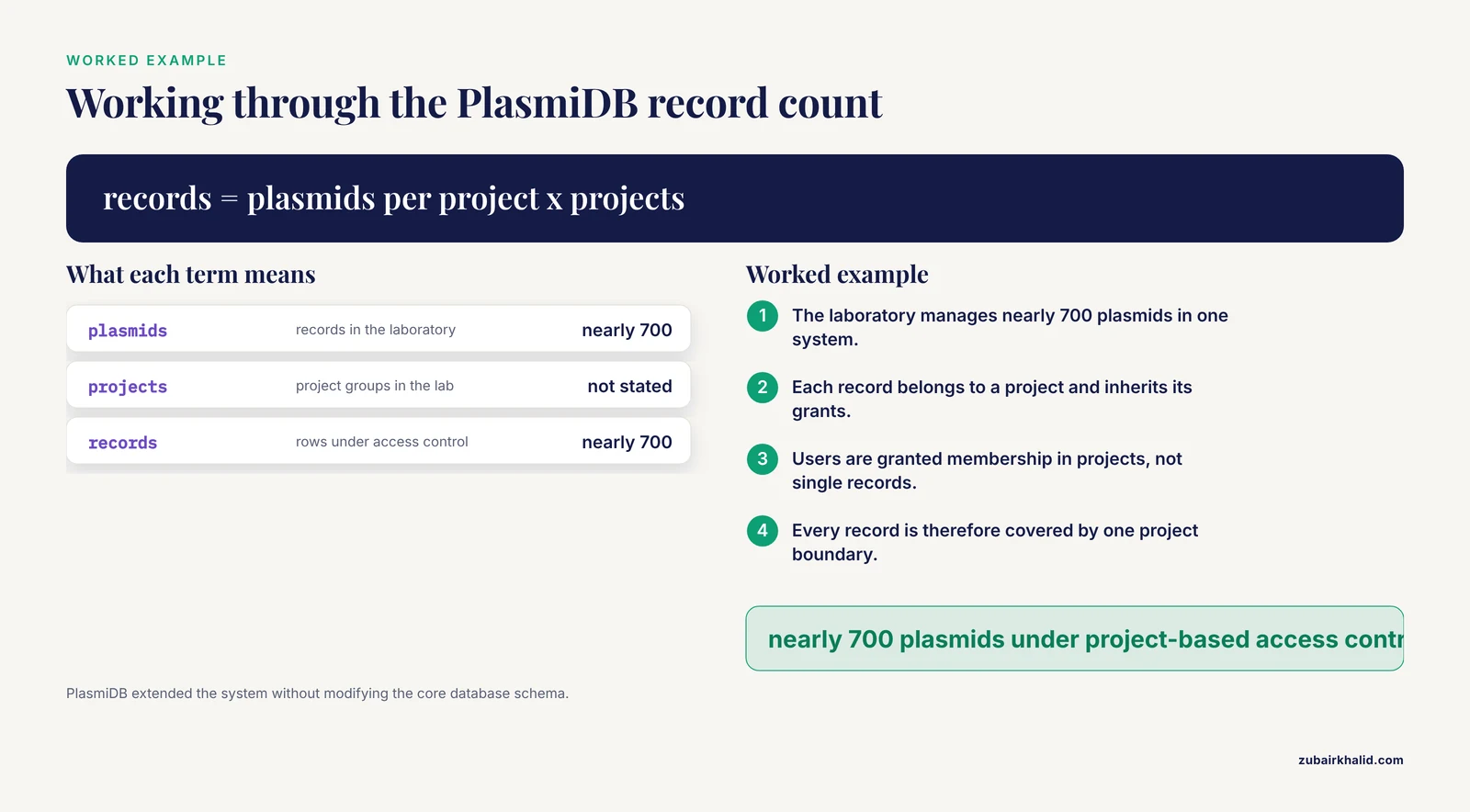
Many genomic databases in practice are web applications built on batteries-included frameworks, and their permission systems are a legitimate access control layer when used deliberately. MoPSeq-DB, an open-source web application for managing curated genomic data on mollusc pathogens, is built with the Python Django framework and was designed for accessibility to non-bioinformaticians with minimal hardware requirements and easy installation and hosting [6]. On the PHP side, PlasmiDB, an open-source web-based database for plasmid lifecycle management in multi-user plant molecular biology laboratories, implements project-based access control on a standard LAMP architecture (Linux, Apache, MySQL, PHP) and deploys via Docker, with extensibility achieved without modifying the core database schema [7]. In that laboratory the system manages nearly 700 plasmids with explicit tracking of plasmid genealogy and inter-laboratory exchanges [7].
The pattern transfers directly to genomic sequence and sample databases. Project-based access control, where every record belongs to a project and users are granted membership in projects, maps naturally onto how research labs actually think about their data. Docker-based deployment matters because it lets you pin the exact version of the application and its dependencies, which is part of reproducibility for the access layer itself.
Strengths: fast to build and adapt, permissions live next to the domain model, framework permission primitives are well documented. Weak points: enforcement depends on every code path being correct, so a forgotten query filter in a new API endpoint becomes a leak, and the access logic is auditable only by reading application source.
Workflow and analysis platforms: Galaxy and friends
Access control does not stop at the database. Analysis environments need it too, because the moment a researcher can run a tool against a file, they can read it. Galaxy, the open-source web platform, provides user accounts, private analysis histories, dataset sharing controls, and optional integration with external authentication such as LDAP, which lets it sit cleanly behind an identity provider. A clinical microbiology team built a bacterial whole-genome sequencing pipeline on Galaxy, consisting of Fastp for trimming, FastQC for read quality control, SPAdes for assembly, Quast for assembly QC, Prokka for annotation, and Staramr and ABRicate for antimicrobial resistance gene screening, and found the platform usable without command line skills [8]. In public health, GalaxyTrakr and the NCBI Pathogen Detection database allow laboratories with limited local computing resources to participate in foodborne pathogen surveillance [9].
Cloud-hosted open pipelines extend the same idea. IDseq is an open source cloud-based metagenomic pipeline and service that accepts raw sequencing data, performs host and quality filtration, and reports taxonomic abundances through a web application, designed with resource-limited laboratories in mind [10]. When you use such a platform, review its sharing model explicitly: who can see a history, who can import a shared dataset, and whether public histories can contain data that your access policy considers controlled.
Strengths: analysis reproducibility and access control in one system, graphical interfaces usable by bench scientists, active communities. Weak points: per-user storage quotas and file permissions are less granular than a purpose-built policy engine, and large cohorts can strain a self-hosted instance.
Controlled-access sharing middleware: DS-PACK and MetaboSERV
Between the open-data tier and full federation sits a growing class of open source middleware for controlled access sharing. DS-PACK is a reusable, open-source tool assembly that semi-automates controlled access processes end to end, from data submission to access, in response to data protection requirements such as the EU General Data Protection Regulation (GDPR) pushing archives toward federated models. It centralizes access control management, distributes access control enforcement, supports data access through cloud-based applications, and is in production use at the ELIXIR Luxembourg data hosting platform alongside an operational model that includes legal facilitation and data stewardship [11]. For a research institution that wants to join a data-sharing federation but lacks the resources to build controlled access processes from scratch, this class of software addresses exactly the gap between having a server and having a governed, agreement-backed sharing node.
MetaboSERV, though built for metabolomics data, illustrates the same architectural pattern in a lighter form: an open-source, browser-based platform for sharing quantitative data and metadata with controlled data access, extensible through self-managed instances with provided source code and configurable Docker images [12]. The design moves cleanly to genomics when a lab wants per-dataset access grants and safe collaborative sharing without building a full federation.
Strengths: purpose-built for the agreement-and-approval workflow that controlled human data requires, reusable across institutions. Weak points: operational maturity varies by project, and adopting them means adopting the governance model they encode, which may need tailoring to your data access committee's process.
Federated analysis: DataSHIELD and Opal
Sometimes the correct access control is to let the data never move. DataSHIELD is a collection of R packages in which data from research studies stay on a server at each responsible institution, each institution controls who can access its data, and analysts pass commands to the servers and receive results that do not disclose individual-level data [13]. It uses Opal, a data integration system developed by the OBiBa open source project in bioinformatics, and a newer "resources" architecture allows large and complex datasets to be stored in efficient formats while retaining the privacy model [13]. For multi-site genomic epidemiology or consortium meta-analysis where ethico-legal constraints prevent physically pooling data, this model is often the only compliant design.
Strengths: strong privacy posture by construction, per-institution control, suitable where data transfer agreements are impossible or slow. Weak points: analytical flexibility is bounded by what the permitted commands can express, and each participating site must operate its own server competently.
Immutable access logging: blockchain-based ledgers
Whoever can alter audit logs can hide misuse, so the audit layer has its own integrity problem. One open approach uses blockchain technology for its properties of security, immutability, and decentralization. In the iDASH Secure Genome Analysis Competition of 2018, one task was to develop time- and space-efficient blockchain-based ledgering to log and query user activity accessing genomic datasets across multiple sites, using MultiChain, a platform whose "data streams" support rapid and secure data storage. A winning solution used keys in the data streams to build a data frame from the chain that permitted efficient querying [1]. For most institutions, a properly configured append-only log with off-site replication achieves similar practical goals with far less operational complexity, but where multiple mutually distrusting sites must agree on a shared access record, the ledger model earns its keep.
Strengths: tamper-evident logs across sites without a single point of failure. Weak points: operational burden, and the authors of the competition solution themselves note practical drawbacks in how the chain is accessed and maintained [1].
Privacy-preserving data formats: read pooling
Access control usually gates whole files, but a complementary open method transforms the data itself. Proposed methods for safely sharing dual-use genetic data obfuscate raw sequence data by pooling reads from different samples of the same organism, which prevents a recipient from fully reconstructing any individual sample while most genomic information in the pooled data remains available [3]. This suits shared pathogen surveillance datasets where lineage-level insight matters but per-sample reconstruction is the risk. It is a data-format control, not a substitute for authentication and authorization, and it cannot be undone once data leaves your control, so it belongs in the design phase.
Open tiers done well: governed public portals
Not every genomic database needs access restrictions, but every database needs governance. The Canadian VirusSeq Data Portal provided open access to Canadian SARS-CoV-2 sequences with standardized contextual data, built on data governance principles, privacy law compliance, quality-checking in the submission pipeline, and explicit acknowledgement of data generators [5]. ProteomeScout v4 moved from a complex relational database to a flat-text file format with the database file version controlled on FigShare, continuous updating processes, and API access for fast analysis, using its open-source nature to allow user-based control and community-based feature integration [14]. Omni-ARMD integrates multi-source genomic and clinical data for antimicrobial resistance, including over 12 million de-identified microbiology records from more than 1 million patients harmonized into over 7.83 million standardized antimicrobial susceptibility testing records, as an open-access knowledgebase [15]. The lesson from all three: when data is intended to be open, the open source investment goes into pipeline quality, versioning, and provenance rather than into locks.
Side-by-Side Comparison
| Option | Access model | Enforcement point | Best fit | Main limitation |
|---|---|---|---|---|
| Keycloak or similar identity provider | RBAC via roles and groups | Front door, delegates identity | Any system with more than one application | Does not enforce policy downstream |
| Open Policy Agent | ABAC via Rego policies | API gateway or application | Teams with changing consent rules and engineering capacity | No UI, needs a policy owner |
| PostgreSQL row-level security | RBAC/ABAC in SQL | Database engine | Labs whose sensitive data is already tabular | Weak for file-heavy artifacts |
| Django or LAMP application permissions | Project-based RBAC | Application layer | Lab databases like PlasmiDB and MoPSeq-DB patterns [7][6] | Depends on every code path being correct |
| Galaxy | Per-user histories and sharing | Analysis platform | Self-service analysis with reproducibility [8][9] | Granularity below the dataset level is limited |
| DS-PACK-style middleware | Controlled access workflow | Central management, distributed enforcement | Institutions joining federated sharing [11] | Adopts its governance model along with the code |
| DataSHIELD with Opal | Per-institution control, non-disclosing outputs | Each site's server | Consortium analysis where data cannot move [13] | Bounded analytical flexibility |
| MultiChain-style blockchain logs | Integrity layer for audit | Log storage | Multi-site access logging with distrust between sites [1] | Operational complexity |
| Read pooling | Data transformation | Data format itself | Dual-use pathogen data sharing [3] | Irreversible, coarse-grained |
| Governed open portal | Open with governance and credit | Submission pipeline and policy | Data intended for public reuse [5][14] | Not applicable to controlled human data |
Pros and Cons of Open Source Versus Proprietary in This Space
The open source access control genomic databases pros and cons resolve into four recurring themes.
Transparency and auditability. You can read the enforcement code, and in regulated settings that matters. A secure computing environment that published its tooling on GitHub explicitly positioned other institutions to benefit from and review the approach [2]. Proprietary systems ask you to trust a vendor's attestation instead.
Control of the roadmap. With PlasmiDB, the laboratory extended the system for its own workflows without modifying the core schema, by design [7]. With MetaboSERV, anyone can run a self-managed instance from source code and configurable Docker images [12]. Proprietary platforms give you feature requests and licensing tiers instead.
Costs shift rather than disappear. Open source removes license fees and adds staffing requirements. Someone must run upgrades, manage the identity provider, and respond to security advisories. A portal built with strong governance and public funding still required organizational processes and sustained effort to operate [5]. The honest comparison is not free versus paid, it is vendor-managed risk versus self-managed risk.
Interoperability by default. Open source options in this list converge on standard protocols and containerized deployment, which is why combinations like Keycloak in front of Galaxy, or RLS beneath a Django application, compose at all. Vendor systems often compose well within their own suites and poorly outside them.
How to Choose: The Criteria That Decide Real Deployments
Ask five questions in order.
Where does my sensitive data actually live? If the sensitive unit is a row in a table, database-level controls give the strongest guarantee per unit of effort. If it is a file, you need file permissions and platform controls, and row-level security only covers metadata.
Who must never see the data, and what happens if they do? If a leak would end a program, prefer defense in depth: identity provider, policy engine or database enforcement, and audit logging with integrity protection [1].
Does data cross institutional or national boundaries? If yes, look at federated and middleware approaches. DS-PACK exists because centralized archives gave way to federated models under GDPR pressure, and it packages the legal facilitation and data stewardship that make federation workable for under-resourced nodes [11]. DataSHIELD answers the same pressure from the analysis side, keeping data resident while results move [13].
Who maintains this in five years? The sustainability motive recurs across recent open source genomics resources, including a deliberate move from a complex relational database to a versioned flat file with continuous updating to reduce maintenance burden [14]. Choose components your successor can operate, not the ones that impress at review time.
Can policy owners read the policy? If your data access committee cannot inspect or reason about the access rules, approval becomes rubber-stamping. Application-level and database-level policies can be opaque. Rego files and grant tables are legible.
Worked Scenarios
Scenario one: a single laboratory with a shared sequence and construct database. The lab runs a small web application for samples, plasmids, and sequencing results. The realistic choice is the PlasmiDB pattern: a LAMP or Django application with project-based access control, deployed via Docker, with role separation for staff, students, and external collaborators [7][6]. Add an identity provider only when a second application appears. Skip federation entirely. The biggest real risk is the network share where FASTQ files sit next to the web application, so spend the limited engineering time on file permissions and backups, not on exotic policy engines.
Scenario two: an academic medical center with genomic pipelines alongside clinical data. This is the Weill Cornell Medicine Data Core problem: making sensitive data from electronic health records, payer claims, and genomic pipelines available for research while ensuring privacy and security, described across user access, data controls, hardware, software, audit, and financial considerations, and supporting more than 200 faculty, staff, and students across nearly 60 projects in its first 2.5 years [2]. The workable stack is layered. An identity provider federates institutional accounts. Row-level security in the database enforces study boundaries regardless of client. A separate secure analysis environment, rather than shared laptops, hosts notebooks and tools. Audit logging is treated as a design requirement because the center must answer access questions after the fact [2][1].
Scenario three: a consortium sharing controlled human genomic data across institutions. Centralized archiving is politically and legally hard. The DS-PACK pattern applies: a central node facilitates discovery, distributed nodes handle access requests, agreements, and secure access, and the middleware semi-automates the process end to end so smaller institutions can participate [11]. Where analysts need combined statistics rather than file access, add the DataSHIELD model so each institution keeps its data resident and only non-disclosing results cross the boundary [13]. If any of the shared data concerns pathogens with misuse potential, consider pooling-based obfuscation at the format layer and treat the access logs themselves as security-sensitive artifacts [3][1].
Common Mistakes and Limitations
Enforcing policy only in the web interface. The most common failure in academic bioinformatics data management. The application checks permissions, but the database, the file share, and the notebook server each have their own path. Enforce at a layer beneath every access route or accept that your control is advisory.
Treating de-identification as access control. Removing identifiers helps but does not remove re-identification risk from genomic data, which is why access logs and agreements accompany even de-identified controlled datasets [1][4]. Personal genomic data sharing initiatives also show that individuals may not grasp the full implications of sharing, so consent design deserves the same rigor as the technical layer [4].
Assuming open source means secure by default. Open source enables review, it does not perform it. Deploy with default passwords unchanged or an out-of-date identity provider and you have worse security than a hardened vendor product because the attack surface is publicly documented. Budget for patching.
Ignoring the audit layer until an incident. Access logs are only useful if they exist before the question is asked, are queryable, and cannot be silently rewritten [1]. Backfilling audit after a suspected misuse event usually produces nothing.
Building federation before you need it. Federated architectures carry real operational cost at every node. An institution that cannot yet operate a single governed portal reliably will not operate a federation node well. Start with a governed single-site deployment and grow toward federation, following the tiered pattern that public portals used, with governance and quality control preceding expansion [5].
Confusing analysis platforms with access control. A pipeline on Galaxy gives you reproducibility and convenience [8], but if the platform is configured to allow open history sharing, controlled datasets can move between accounts within the platform. Review platform sharing settings as part of the access policy, every time you upgrade.
One general limitation applies to everything above: any access control system is only as good as the human processes around it, including onboarding, offboarding, and periodic access reviews, and individual data sharing decisions always need review by your institution's privacy and security offices.
Frequently Asked Questions
What does open source access control mean for a genomic database?
It means the software that authenticates users, enforces permissions, and logs access is built from source code you can inspect and modify, such as Keycloak, Open Policy Agent, PostgreSQL row-level security, Galaxy, or middleware like DS-PACK. You gain auditability and control at the cost of operating the software yourself.
Which open source option is best for a small genomics lab?
A web application with project-based access control, deployed with Docker, is usually the right starting point, following patterns like PlasmiDB for multi-user laboratory data [7]. Add an identity provider when you run more than one application, and fix file permissions on raw sequencing data before investing in anything more elaborate.
Is open source access control safe enough for human genomic data?
It can be, and major implementations use it, but safety comes from the layered design, not the license. A secure academic environment combining user access management, data controls, and audit supported sensitive clinical and genomic analysis at scale [2]. Federated open source middleware exists specifically for controlled access sharing under GDPR-style requirements [11].
Do I need blockchain technology to log database access?
No. Most institutions meet their audit needs with append-only logging and off-site replication. Blockchain-based ledgers, such as the MultiChain-based solution from the iDASH competition, matter mainly when multiple mutually distrusting sites must share a tamper-evident access record [1].
How do open access and controlled access differ in genomics?
Open access data is publicly downloadable, as with governed SARS-CoV-2 portals that pair openness with quality control and data generator credit [5]. Controlled access requires an approved request, often a data access agreement, before a user can retrieve data, which is the model that DS-PACK-style middleware automates [11]. Many systems run both tiers side by side.
Can I combine open and controlled data in one system?
Yes, and you should. Store a classification attribute, such as open or controlled, on every dataset, enforce it at your policy or database layer, and publish the open tier with the same metadata quality standards as the controlled one. Open-source platforms designed with configurable access controls support exactly this mixed model [12].
Sources
- Using blockchain to log genome dataset access: efficient storage and query.
- Design and Implementation of a Secure Computing Environment for Analysis of Sensitive Data at an Academic Medical Center.
- Methods for safely sharing dual-use genetic data.
- Challenges of web-based personal genomic data sharing.
- The Canadian VirusSeq Data Portal and Duotang: open resources for SARS-CoV-2 viral sequences and genomic epidemiology.
- MoPSeq-DB: a user-friendly web application for genomic data management and analysis of marine mollusc pathogens.
- PlasmiDB: an open-source and customizable database for plasmid lifecycle management in multi-user, multi-project plant molecular biology laboratories.
- Easy analysis of bacterial whole-genome sequencing data for clinical microbiologists using open-source Galaxy platform: Characterization of ESBL-producing Enterobacterales from bloodstream infections.
- Genomic Surveillance of Foodborne Pathogens: Advances and Obstacles.
- IDseq-An open source cloud-based pipeline and analysis service for metagenomic pathogen detection and monitoring.
- DS-PACK: Tool assembly for the end-to-end support of controlled access human data sharing.
- MetaboSERV-a platform for selecting, exchanging, and visualizing metabolomics data with controlled data access.
- Orchestrating privacy-protected big data analyses of data from different resources with R and DataSHIELD.
- ProteomeScout v4: An open-source, harmonized, ecosystem for post-translational modifications.
- Omni-ARMD: an integrated genomic and clinical knowledgebase bridging clinical phenotypes and molecular determinants of antimicrobial resistance.