Nextflow Community vs Snakemake Community: Key Differences
By Dr. Zubair Khalid, DVM, MS, PhD ·

The core difference in the Nextflow community vs Snakemake community comparison is how each group packages shared work. The Nextflow community concentrates standardized, reviewed pipelines and versioned modules under the nf-core project, so teams can adopt a complete, tested workflow and borrow shared components piece by piece. The Snakemake community shares a centrally curated library of per-tool wrappers plus a broader catalog of whole workflows contributed by individual labs, so teams get vetted building blocks for analyses they assemble and control themselves.
Rule of thumb: choose the Nextflow community when your priority is adopting a production-grade pipeline with governance, automated testing, and FAIR-aligned documentation already in place, and you can accept a language that runs on the Java Virtual Machine. Choose the Snakemake community when your team writes Python daily, needs fine-grained control over a bespoke analysis, and prefers thin, vetted tool wrappers over whole pipelines.
Both engines are mature choices for a bioinformatics workflow manager, which is software that represents, manages, and executes multistep computational analyses [1]. A good manager gives a team a common language for describing analyses, supports incremental builds and selective re-execution, handles containers, high-performance computing (HPC) clusters, and cloud services, and delegates the mechanics of job submission so scientists can focus on the analysis itself [1]. Because those benefits depend on shared components and shared habits as much as on syntax, the community around each tool decides how much of that value you actually collect.
That distinction matters because effort in this field is spread thin. The growth of multiple workflow systems has distributed work across separate communities, and nobody can realistically learn every system just to run publicly shared workflows [2]. The practical question is therefore not which engine wins in the abstract, but whose components you will reuse, whose review process will vet them, and whose help channels will answer when a run fails at midnight.
Why the community matters as much as the engine
A workflow management system earns its keep through several properties described in the software engineering literature. It provides a common language for describing analyses, which feeds reproducibility and builds libraries of reusable components. It supports incremental build, meaning the manager re-executes only the steps affected by new inputs or changed code, and re-entrancy, the ability to selectively re-execute parts of a workflow when inputs or configuration change and to resume from where a previous run stopped. It handles containers, HPC systems, and clouds, and it delegates execution mechanics so bioinformaticians can concentrate on data analysis and science [1].
Those benefits are collective rather than individual. Shared components only help if someone maintains them, tests them, and documents them. The spread of multiple workflow systems has split effort across separate communities, and learning every system in order to use shared workflows is not feasible [2]. So the component libraries, review culture, and help channels around each engine determine how much value it delivers in practice.
Reproducibility also remains challenging despite workflow management systems and mature computing infrastructure. Closing the gap takes deliberate software engineering: well-defined task interfaces, explicit input and output specifications, separation of compute tasks from glue tasks, systematic validation of environments, inputs, and runtime behavior, standardized project organization, and testing with real and synthetic data inside continuous integration (CI), the practice of running automated checks on every change [3]. Modular ecosystems such as nf-core modules and Snakemake wrappers exist precisely to support those practices in community-driven settings [3]. The two communities converged on the same engineering answer, shared, versioned, tested components, but they differ in granularity, governance, and culture, and those differences drive everything below.
The Nextflow community on its own terms
The Nextflow engine
Nextflow is an open source workflow engine written in Groovy, a language that runs on the Java Virtual Machine (JVM). A domain-specific language (DSL) is a syntax tailored to one job, and Nextflow's DSL expresses pipelines as processes connected by channels. A process is the unit of execution, a template with declared inputs, outputs, and a script. A channel is an asynchronous queue that carries data between processes, which lets the engine start each task the moment its inputs are ready and schedule many tasks concurrently without explicit loops.
Current releases use DSL2 by default, which scopes processes to modules so they can be defined once and included wherever needed [4]. A minimal module looks like this:
process FASTQC {
    input:
    path reads

    output:
    path "*_fastqc.zip", emit: zip

    script:
    """
    fastqc ${reads}
    """
}
The emit tag names the output so other modules can request it. A workflow then includes the module and feeds it data:
include { FASTQC } from './modules/fastqc'

workflow {
    FASTQC(channel.fromPath('data/*.fastq.gz'))
}
An executor is the component that submits tasks to a specific backend. Nextflow ships executors for local runs, common HPC schedulers such as SLURM, SGE, and LSF, Kubernetes, and managed cloud batch services. Container support covers Docker, Apptainer (formerly Singularity), and Podman, so the same pipeline runs on a laptop and a cluster with identical software versions. Nextflow also caches completed tasks by hashing a task's code, inputs, container, and parameters, and the resume flag makes a restarted run skip everything already finished.
nf-core: pipelines, modules, and subworkflows
nf-core, founded in 2018, is the community organization that turns Nextflow from an engine into an ecosystem. It maintains community-reviewed analysis pipelines, including nf-core/rnaseq for RNA-seq analysis and nf-core/sarek for germline and somatic variant calling, plus an extensive library of modules and subworkflows [4]. A module is a single, versioned process with a metadata file documenting its inputs, outputs, and behavior, plus automated tests and pinned software recipes for Conda (an open source package and environment manager), Docker, and Apptainer. A subworkflow bundles several modules into one reusable stage, such as a complete read-alignment step.
nf-core modules carry a convention: a metadata map, a Groovy structure holding sample identifiers and technical attributes, travels alongside the data files through every process. That convention is what lets a module written for one pipeline drop into another with predictable behavior. The nf-core tools command line manages adoption, and one command installs a module at a pinned version:
nf-core modules install fastqcGovernance is explicit. Contributions pass community guidelines, automated linting (checks that code meets structural and style rules), and code review by maintainer teams, and the community runs training events, hackathons, and regular talks. This structure makes standardization practical rather than aspirational. The module and subworkflow library lets research communities adopt common standards progressively, as resources and needs allow, and standardized pipelines of this kind contribute to FAIR research, where FAIR stands for Findable, Accessible, Interoperable, and Reusable, and to collaboration across institutions [4]. Adoption reaches beyond human genomics: six EuroFAANG farmed animal research consortia have adopted the framework [4].
Running a flagship pipeline is deliberately uneventful:
nextflow run nf-core/rnaseq -profile test,docker -resumeA profile is a named bundle of configuration settings. The test profile runs a small bundled dataset, the docker profile forces containerized software, and the resume flag reuses completed work if the run stops partway.
The Snakemake community on its own terms
The Snakemake engine
Snakemake is an open source workflow engine built in Python. You describe each step as a rule, a declarative statement of input files, output files, and how to produce them, and Snakemake resolves the directed acyclic graph (DAG), the dependency structure connecting every rule invocation needed to reach your requested outputs. Because rules bind to files rather than being called directly, the same workflow scales from one sample to thousands without rewriting the code.
A typical rule:
rule fastqc:
    input:
        "data/sample.fastq.gz"
    output:
        html="qc/sample_fastqc.html",
        zip="qc/sample_fastqc.zip"
    conda:
        "envs/fastqc.yaml"
    shell:
        "fastqc {input} -o qc"
The conda directive pins the software for that single rule to an environment file, and the use-conda option at the command line makes Snakemake create and apply it. A container directive does the same for Docker or Apptainer images. Execution targets cover local runs, HPC schedulers through profiles and executor plugins, and cloud platforms.
Snakemake decides what to re-execute from file timestamps and changes to rule code, so editing a script and rerunning rebuilds only the affected part of the DAG. A dry run, a mode that prints planned jobs without executing them, previews the work:
snakemake -n -pA real run then requests eight cores:
snakemake -c 8Wrappers and the workflow catalog
A wrapper is a maintained, versioned bundle of workflow code for one tool step, together with its Conda environment and sometimes a container image. The Snakemake-Wrappers repository curates a large, categorized set, organized into bio for biological tools, meta for combined multi-tool steps, and utils for file operations. You point a rule at a wrapper instead of writing the shell command yourself:
rule map_reads:
    input:
        reads=["data/sample_R1.fastq.gz", "data/sample_R2.fastq.gz"],
        ref="ref/genome.fa"
    output:
        "mapped/sample.bam"
    log:
        "logs/bwa_mem/sample.log"
    wrapper:
        "bio/bwa/mem"
The wrapper resolves the bwa mem invocation, builds the reference index when given a plain reference file, and pins the software environment. Production code should pin a specific wrapper version rather than tracking the latest state of the repository.
Beyond wrappers, the community maintains a searchable catalog of whole workflows contributed by labs, each described with metadata on purpose and usage. The culture is closer to a core development team curating shared infrastructure, with contributions arriving through pull requests and help flowing through issue trackers, community discussion channels, and extensive documentation. Like nf-core modules, wrappers are part of the modular ecosystem that supports disciplined, community-driven pipeline engineering [3].
Side-by-side comparison table
The table condenses the difference between the Nextflow community and the Snakemake community into the dimensions that come up in real decisions.
| Dimension | Nextflow community | Snakemake community |
|---|---|---|
| Engine language | Groovy on the JVM, with a dataflow model built on channels | Python, with declarative rules resolved into a DAG |
| Flagship shared collection | nf-core pipelines, modules, and subworkflows [4] | Snakemake-Wrappers repository plus a community workflow catalog |
| Unit of reuse | Process-level module with a metadata file and tests, bundled into subworkflows | Tool-level wrapper bundling the invocation, Conda environment, and often a container image |
| Versioning | Modules installed at pinned versions, recorded in a manifest | Wrappers pinned by a version tag inside the rule |
| Review and governance | Community guidelines, code review, automated linting and tests on contributions | Central curation of wrappers by the development team, lighter process for contributed workflows |
| Execution targets | Local, many HPC schedulers, Kubernetes, managed cloud batch services | Local, HPC schedulers through profiles and plugins, cloud platforms |
| Containers | Docker, Apptainer (Singularity), Podman | Docker and Apptainer through the container directive, Conda through the conda directive |
| Resume behavior | Task-level caching, resumed runs skip completed jobs | Timestamp and code based incremental rebuild of the DAG |
| Typical adopter | Core facilities, consortia, teams running the same pipeline repeatedly | Academic labs, method developers, teams with evolving bespoke analyses |
| Learning curve | Steeper at the language level, smoother at the adoption level | Gentler for Python users, steeper when building shared infrastructure |
| Help channels | Slack, GitHub, nf-core training and events | GitHub issues, community discussion channels, documentation and tutorials |
| Best first question | Does a reviewed pipeline or module already exist that I can adopt? | Do I need full control of a bespoke analysis with vetted tool steps? |
Nextflow community vs Snakemake community: the criteria that decide real choices
Most Nextflow vs Snakemake debates stop at syntax. The dimensions below are the ones that decide real projects.
Language and mental model
Nextflow asks you to think in dataflow. Data moves through channels, processes fire when inputs arrive, and the engine handles concurrency for you. That model scales elegantly, but Groovy brings JVM-era syntax, operator overloading, and closure semantics that most bioinformaticians have never used elsewhere, and error messages can be indirect. Small language mismatches cause disproportionate confusion for newcomers.
Snakemake asks you to think in files and dependencies. You declare targets, the engine resolves the DAG, and timestamps plus code changes decide what reruns. Rules read like Python, and you can drop real Python into parameters and script blocks. Teams that already write Python usually read a Snakemake workflow on day one. The cost is that dynamic resolution can defer errors until runtime, and very large DAGs need attention to how the graph is held in memory.
Neither model is objectively better. The question is which mental model matches how your team already reasons about data.
Shared components: modules versus wrappers
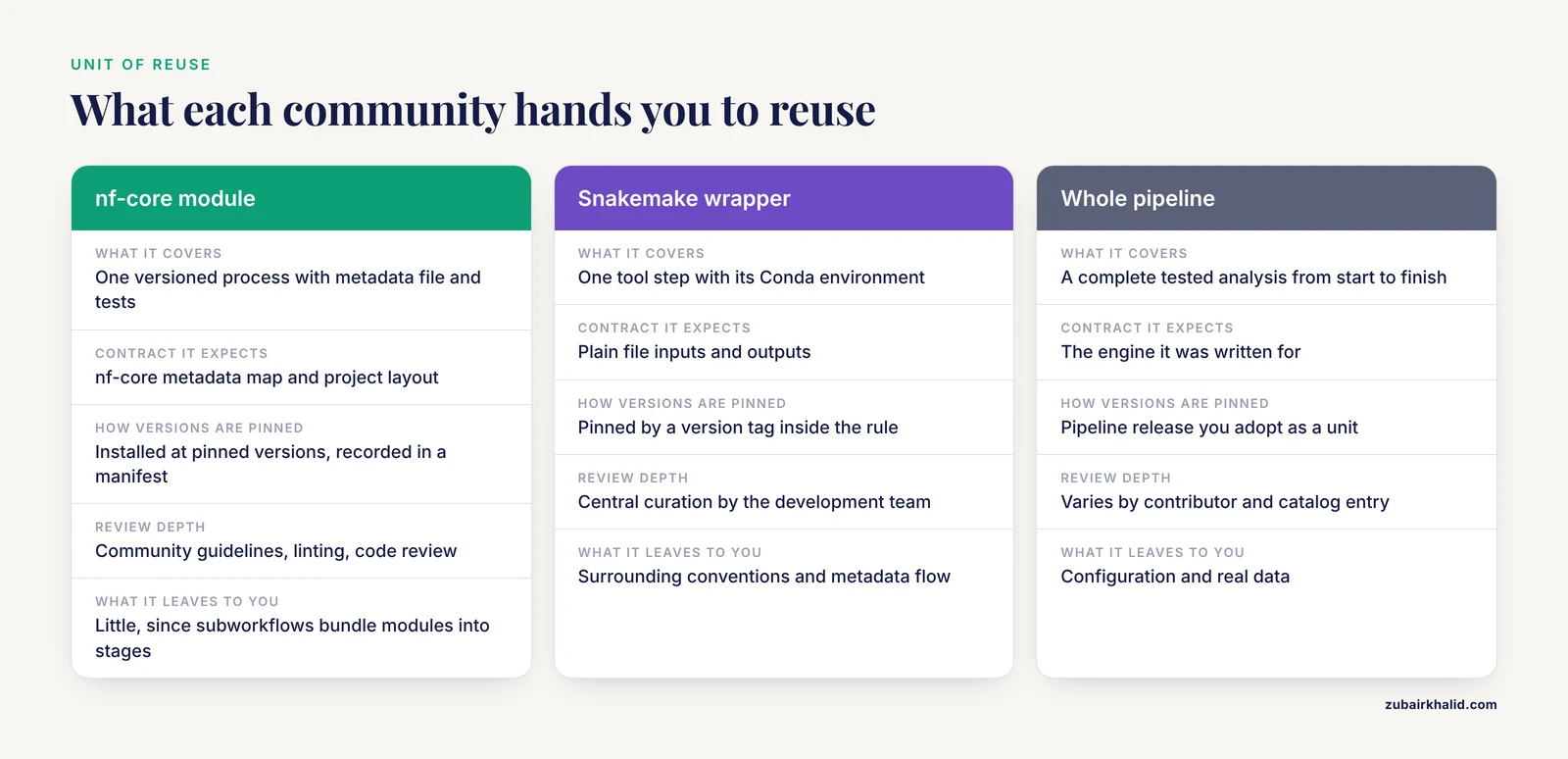
nf-core modules carry a heavier contract. Each module documents its interface in a metadata file, travels with tests, pins software versions across package formats, and expects the nf-core metadata map convention. Subworkflows combine modules into stages that several pipelines share [4]. The payoff is consistency: the same FastQC module behaves identically inside any pipeline that installs it, and nf-core tools records the installed version so upgrades are deliberate.
Snakemake wrappers carry a lighter contract. A wrapper fixes one tool step, brings its own environment, and leaves surrounding conventions to you. Adoption is fast, the wrapper repository is curated centrally, and the thin interface means a wrapper rarely fights your project layout. The tradeoff is less uniformity across projects, since wrappers standardize the tool call but not the metadata flowing around it.
A useful summary: nf-core standardizes pipelines and their parts, wrappers standardize the parts and leave pipelines to you.
Governance, review, and contribution path
nf-core runs like a small open source foundation, with written guidelines, mandatory linting and tests, reviewer teams, a governance structure, and regular community events. Contributing a module means meeting the guidelines, which takes longer but produces a component many institutions will trust without re-review.
The Snakemake community runs closer to a curated upstream project. The core team reviews and curates wrappers, and workflow catalog entries are contributed with metadata and tested to varying degrees. Contribution is lighter and faster, with correspondingly variable depth of review.
Match the contract to your risk profile. If a pipeline's output feeds clinical or consortium deliverables, heavier review is a feature. If a pipeline serves exploratory research, lighter review with fast iteration is often the better trade.
Execution, portability, and interoperability
Both engines solve portability with containers and Conda, and both run on laptops, HPC clusters, and clouds. Differences show at the edges. Nextflow offers a wide executor catalog, including Kubernetes and managed cloud batch services, and its task-level cache makes resumed runs skip completed jobs, which matters for long pipelines that fail at hour nine. Snakemake reaches the same backends through profiles and executor plugins, and its timestamp-based rebuild makes iterative analysis cheap because unchanged steps simply do not rerun.
Interoperability reduces lock-in at the platform level. The Workflow Execution Service (WES) API standard from the Global Alliance for Genomics and Health defines a common interface for running workflows, and Sapporo implements that standard with an API and a browser client, running workflows written in four different systems in its initial release [2]. Groups that must serve Nextflow and Snakemake users at once can put such a layer in front of both engines instead of forcing a single choice.
Reproducibility engineering and FAIR alignment
A workflow manager is necessary but not sufficient for reproducibility. Current guidance treats pipeline development as software engineering: define task interfaces, specify inputs and outputs explicitly, separate compute tasks from glue code, validate environments, inputs, and runtime behavior, organize projects consistently, and test with real and synthetic data inside CI, aligned with FAIR research software guidelines [3]. The modular ecosystems on both sides exist to make those practices cheap, since nf-core modules and Snakemake wrappers give you tested, versioned, documented components instead of hand-written steps [3].
The communities frame the goal differently. nf-core explicitly ties standardized pipelines to FAIR research and cross-institution collaboration, and its library lets groups adopt common standards progressively as resources allow [4]. The Snakemake community emphasizes reproducibility through pinned environments and containers at the rule level, which suits teams building bespoke workflows. Both paths land in the same place when applied with discipline, and both fail the same way when teams skip validation and testing.
Learning curve, documentation, and help
Expect two curves per engine. The syntax curve is steeper for Nextflow, because Groovy and asynchronous channels are unfamiliar to most biologists-turned-developers, and gentler for Snakemake, which reads like Python with file targets. The operations curve is comparable, since the hard parts in both are scheduler configuration, container images, and storage layout rather than language features.
Documentation is strong on both sides. Nextflow benefits from nf-core training materials, a large Slack community, and extensive pipeline documentation. Snakemake benefits from a thorough official tutorial, detailed wrapper documentation, and active issue trackers. In practice, the deciding factor is rarely which community answers faster, but which one already contains the pipeline or components closest to your analysis.
When to use the Nextflow community, and when the Snakemake community fits better
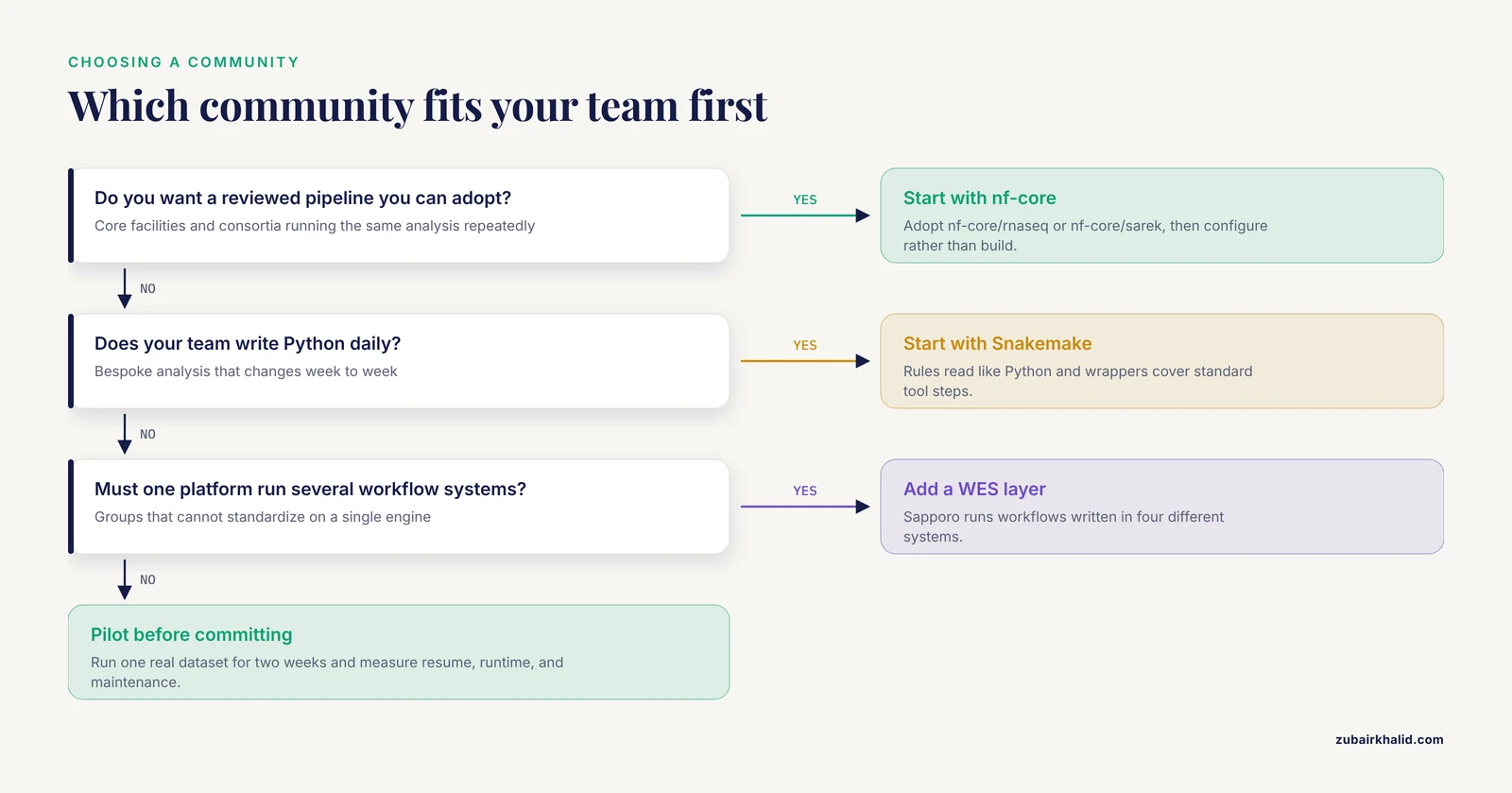
For teams weighing nextflow community or snakemake community, the answer follows from the situation:
- A genomics core facility standardizing recurring analyses. Choose the Nextflow community. Pipelines such as nf-core/rnaseq and nf-core/sarek arrive with tests, containerized software, and documentation, so the facility adopts and configures rather than builds. Start with the bundled test profile, then move to real data. Standardized pipelines of this kind support FAIR outputs and collaboration [4].
- A computational lab with strong Python skills and an evolving bespoke analysis. Choose the Snakemake community. Incremental rebuilds keep weekly iterations cheap, wrappers cover standard tool steps such as alignment and quality control, and custom rules absorb the novel parts. The team stays in one language.
- A multi-institution consortium that wants shared standards without a big-bang migration. Choose the Nextflow community's module and subworkflow model, which is designed for progressive adoption as resources allow [4]. Members can adopt shared modules one stage at a time instead of replacing entire pipelines at once.
- A platform team that must execute workflows written in several systems. Do not force one engine. Put a WES-compatible execution service such as Sapporo in front of both [2], and let each group keep the community whose components it needs.
- A team that cannot decide from documentation alone. Prototype, as the RiboViz developers did when they reimplemented an existing workflow inside candidate systems before committing [1]. A two-week pilot on one real dataset, measuring resume behavior, runtime, and maintenance effort, settles the question faster than any feature table.
Common Mistakes and Limitations
- Judging the engine by syntax alone. Teams pick Snakemake because Python feels safe, then discover they wanted nf-core's governed pipelines. Teams pick Nextflow for nf-core, then discover they must debug Groovy. Name your actual goal, adoption of shared pipelines or authorship of bespoke ones, before comparing languages.
- Mixing eras of Nextflow material. DSL2 changed how processes are scoped, included, and reused, and older DSL1 tutorials still circulate [4]. When a snippet from a blog post fails in ways the documentation says it should not, check which DSL it assumes.
- Treating modules and wrappers as interchangeable. nf-core modules expect the nf-core metadata map and project layout, wrappers expect plain file inputs and outputs. Porting a component across ecosystems is a rewrite, not a copy.
- Assuming the workflow manager delivers reproducibility by itself. Reproducibility remains challenging even with mature workflow systems, and it requires validation of environments, inputs, and runtime, plus testing in CI [3]. A manager that runs your pipeline the same way twice on your machine has not made the pipeline correct.
- Skipping the pilot. Feature tables, including the one above, predict behavior imperfectly. The RiboViz team prototyped inside candidate systems before choosing, and the exercise exposed practical differences the documentation did not [1].
- Adding a third workflow system to dodge the decision. Every additional system splits your team's attention and fragments shared effort, a cost the field already pays across communities [2]. Standardize on one primary system per group unless a platform requirement forces otherwise.
- Ignoring maintenance after adoption. Shared components update. Pin versions, schedule upgrades, and rerun tests after each update, in either ecosystem.
Community practices, engine features, and component libraries change quickly, and the right choice depends on your team's language skills, infrastructure, and existing commitments. A short pilot on your own data and hardware is the decisive test, and no comparison, this one included, replaces measuring resume behavior, runtime, and maintenance burden on your actual workload.
Frequently Asked Questions
What is the main difference between the Nextflow community and the Snakemake community?
The Nextflow community standardizes whole pipelines and versioned modules under the governed nf-core project, while the Snakemake community shares a centrally curated library of per-tool wrappers plus a looser catalog of lab-contributed workflows. Both are healthy, but they package reuse differently.
When should I use the Nextflow community?
Use it when you want to adopt or contribute to reviewed, production-grade pipelines with standardized modules, automated testing, and documentation that support reuse across institutions. It fits core facilities, consortia, and any group running the same analysis repeatedly at scale.
Is Snakemake easier to learn than Nextflow?
For teams that already write Python, usually yes, because rules read like Python and the file-target model feels familiar. Nextflow requires learning Groovy and asynchronous channels, though nf-core training materials shorten that path considerably.
Can I mix nf-core modules and Snakemake wrappers in one workflow?
Not directly. Each component type targets its own engine and metadata conventions, so mixing means porting code. If you need to run both kinds of workflows behind one interface, a WES-compatible execution layer handles that at the platform level.
Do Nextflow and Snakemake both run on HPC clusters and in the cloud?
Yes. Both support containers, Conda environments, common schedulers, and cloud backends, and both can skip completed work when a run resumes or rebuilds.
Which community should a small lab choose first?
Choose the community that matches your reuse goals: nf-core with Nextflow for standardized pipelines you adopt with modest maintenance, Snakemake for flexible, Python-native analyses assembled from vetted wrappers. If truly undecided, pilot both on one real project for two weeks.
Sources
- Using prototyping to choose a bioinformatics workflow management system.
- Sapporo: A workflow execution service that encourages the reuse of workflows in various languages in bioinformatics.
- Software engineering for reproducible pipeline development in bioinformatics.
- Empowering bioinformatics communities with Nextflow and nf-core.