Why Can't I Find My Viral Sequence on NCBI?
By Dr. Zubair Khalid, DVM, MS, PhD ·

The most common cause is a database mismatch. NCBI is not one searchable pile of sequences. It is a set of separate archives, GenBank, RefSeq, the Sequence Read Archive (SRA), whole genome shotgun (WGS) assemblies, Transcriptome Shotgun Assembly (TSA), Protein, and Taxonomy, each indexed on its own. A viral genome that exists only as raw reads in the SRA will never appear in a Nucleotide search or in a BLAST hit list. A GenBank-only isolate will never appear if you search RefSeq alone. The first thing to check is therefore the fastest thing to check. Take the sequence itself, paste it into BLAST against the nucleotide collection (nr/nt), and in parallel confirm the virus name in the NCBI Taxonomy Browser. Those two steps resolve most cases where an NCBI viral sequence is not found.
This guide covers the causes in order of how often they appear in real workflows, explains the mechanism behind each one, provides a troubleshooting table, gives a diagnostic sequence you can follow step by step, and closes with habits that keep the problem from coming back.
How NCBI stores viral data: a short databases guide
You cannot debug a failed search until you know what each database actually contains. The names sound similar, and the contents overlap just enough to mislead.
The archives and the curated layer
GenBank is the public archive of submitted nucleotide sequences. It belongs to the International Nucleotide Sequence Database Collaboration (INSDC), which exchanges records daily with ENA in Europe and DDBJ in Japan. Direct submissions land here: isolate genomes, partial genes, PCR amplicons, and everything else a laboratory uploads.
RefSeq is NCBI's curated reference layer. Records carry NC_, NG_, NP_, or YP_ accession prefixes and are produced by NCBI staff, usually derived from GenBank input but reviewed, sometimes assembled from several sources, and revised as knowledge improves. RefSeq is a layer on top of the archive, not the archive itself.
The SRA stores raw reads from sequencing runs under run accessions in the SRR format. WGS submissions store assembled contigs (contiguous assembled sequences) under project and contig accessions. TSA stores assembled transcripts. The Protein database stores submitted and translated protein sequences. The Taxonomy database assigns every taxon a numeric identifier, the TaxID. NCBI Virus is a dedicated portal that aggregates viral records across these sources with filters for taxon, host, and geography.
Accessions, versions, and retired identifiers
Every record carries an accession with a version suffix, for example NC_045512.2, the SARS-CoV-2 reference genome. The version increments when the record changes, so an outdated version can fail to resolve or can silently return stale content. GI numbers, the older numeric identifiers, were retired in 2016 and no longer resolve. WGS contigs follow a different pattern, a project prefix plus a version plus a contig number, for example AAEX01000001 for contig 1 of project AAEX. The WGS master record is a project-level object, not a sequence you can BLAST.
Why the split matters when you search
BLAST (Basic Local Alignment Search Tool) searches sequence content. Entrez searches text and metadata. A record indexed under an unexpected organism name still shows up in a BLAST search but can be invisible to a name-based Nucleotide query, and the reverse holds when you have a name but no sequence. Because the databases are not cross-indexed, large viral studies routinely pull from more than one source. A genomic surveillance analysis of SARS-CoV-2 in Hong Kong drew 15,982 quality-controlled genomes from both NCBI and GISAID [1]. Comparative work on Lassa and Ebola virus glycoproteins sourced 2,502 sequences from NCBI GenBank [2]. Focused analyses often download full genomes straight from NCBI, as a microsatellite survey of 156 Rhabdoviridae genomes did [3].
Why an NCBI viral sequence is not found: causes in order of frequency
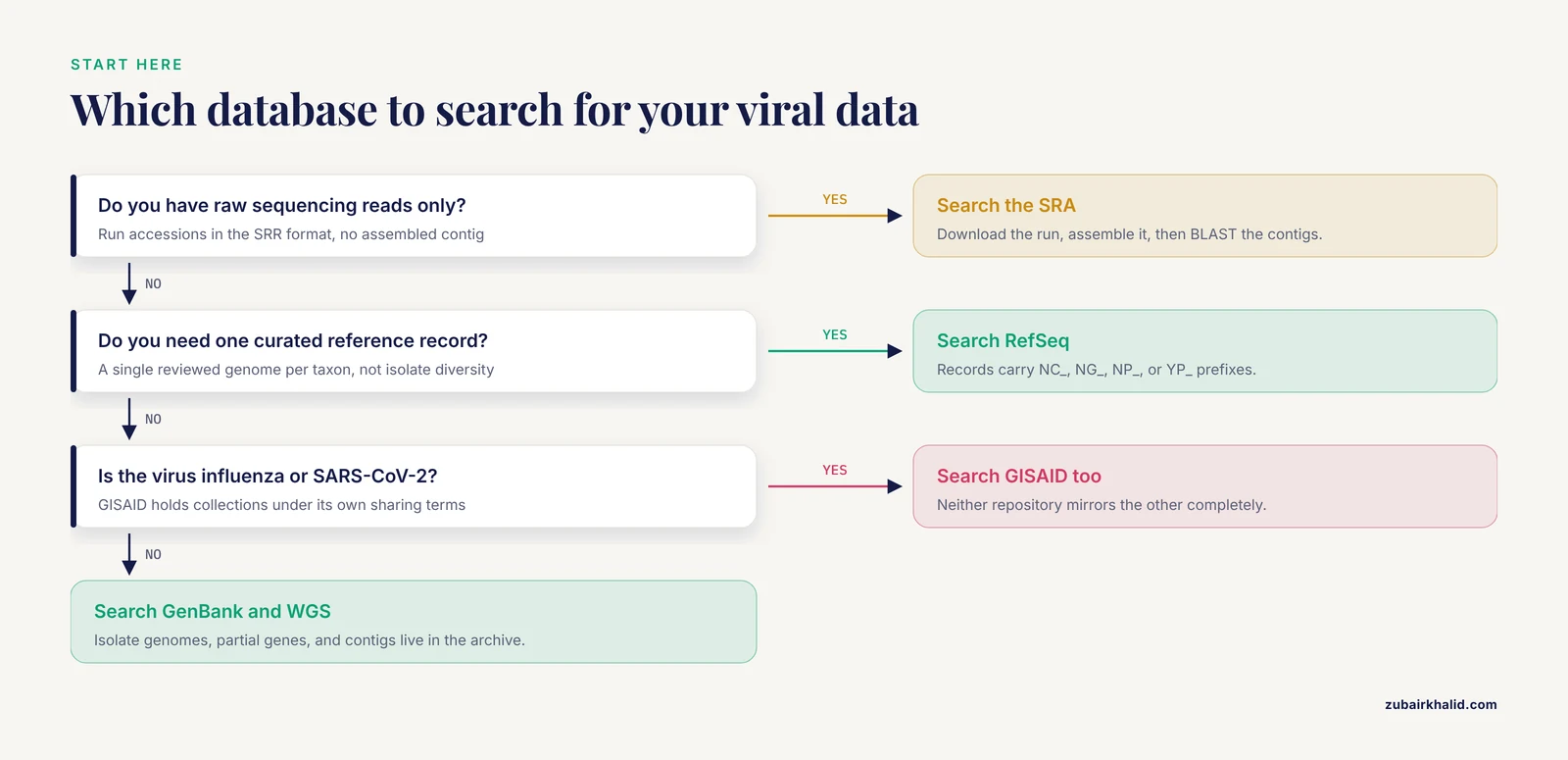
Eight causes account for nearly every case. They are listed here from most to least common, and each has its own section below.
- You are searching the wrong database for the data type.
- The sequence was never submitted, or it is still under a confidentiality hold.
- The taxonomy identifier or organism name changed.
- Your query defeats the search tool.
- The virus is genuinely novel or highly divergent.
- You expect the reference genome to match a real isolate, and it does not.
- The sequence lives in a repository outside NCBI.
- The sequence you are looking for is not the sequence you have.
Troubleshooting table
| Symptom | Likely cause | How to confirm | Fix |
|---|---|---|---|
| , - | , - | , - | , - |
| BLAST returns no hits at all | Wrong database, query too short, or heavy low-complexity masking | Rerun against nr/nt, use the short-query task for very short reads, check masking settings | Match the database to the data type and rerun with adjusted parameters |
| Name search in Nucleotide returns nothing | Record indexed under a different or outdated organism name | Look up the name in the Taxonomy Browser | Search by accession or BLAST the sequence instead of the name |
| A paper reports the genome but Nucleotide has no record | Data sit in SRA as raw reads, under embargo, or outside NCBI | Search SRA by the study accession, read the paper's data availability statement | Assemble the SRA reads locally, wait out the hold, or request data from the authors |
| A known accession does not resolve | Version suffix mismatch or a retired GI number | Drop the version and search the accession root | Use the current accession.version |
| A taxID-restricted search misses older records | The old taxon was merged into a new identifier | Check the Taxonomy Browser entry for merge history | Resolve to the current taxID or search the whole lineage |
| A pipeline reports a virus you cannot find in NCBI | The pipeline used a custom or filtered database | Read the pipeline documentation and database version | Rerun the contig against the NCBI total virus database or BLAST it directly |
| BLAST hits only part of your genome | Segmented virus stored as separate records | Split the query and search each segment | Search segments individually and collect all matching records |
| An odd insertion appears in a host genome alignment | Soft-clipped reads from a co-sequenced pathogen | Extract soft-clipped and unmapped reads and BLAST them | Treat it as a pathogen signal and confirm with an independent assay |
Cause 1: You are searching the wrong database
Raw reads never appear in BLAST
BLAST databases contain assembled sequences. The nucleotide collection includes GenBank records, RefSeq records, and WGS contigs for many organisms. It does not contain raw SRA reads. If a virus was sequenced and deposited only as reads, the only public trace is an SRR run that no BLAST search will ever touch.
Confirm by searching the SRA directly, by study, sample, or run accession, or by organism. To turn reads into something searchable, download the run with fasterq-dump from the sra-tools suite, assemble it with a metagenomic assembler such as MEGAHIT or SPAdes, and BLAST the resulting contigs. This extra step is the price of working with raw data, and it is the single most common reason a sequence that is "on NCBI" cannot be found with a sequence search.
RefSeq is a curated subset
RefSeq holds one reference record, occasionally a few, per taxon. Isolate surveys, outbreak datasets, strain collections, and partial sequences live in GenBank, WGS, and SRA. A RefSeq-restricted search shows you a thin slice of the archive, and if your isolate differs from the reference, a RefSeq-restricted BLAST can look empty even when dozens of near-identical GenBank records exist. Search the nucleotide collection instead, or use NCBI Virus to enumerate every aggregated record for the taxon.
WGS, TSA, and assembly-only records
Many modern submissions never produce a classic GenBank flat file. WGS contigs carry their own accessions and are indexed in the Nucleotide database. TSA contigs do the same for transcripts. If a paper cites a WGS master accession and you search it expecting a sequence, you will find a project page, not a record. Search the contig accessions, or download the whole assembly from the Assembly database.
Pipeline databases are not NCBI
If a metagenomics pipeline (bulk sequencing of all genetic material in a sample) or its virus-focused variant, metaviromics, reported the virus and you cannot find it afterward, check which database the pipeline actually searched. Pipeline databases differ in scope and version. A metavirome study of Aedes aegypti in Grenada mapped reads to the mosquito assembly first, then searched the remaining reads with FastViromeExplorer against three distinct NCBI-derived references, the total virus, RNA virus, and eukaryotic virus databases [4]. A DNA virus would be invisible to an RNA-virus-only search, and vice versa. Pipeline choice also changes results. A comparison of three pipelines (CZ ID, Genome Detective, and Galaxy) on Aedes mosquito shotgun data, validated against a mock database of 11 known viruses and public SRA datasets, found clear differences in detection accuracy between them [5]. When a pipeline calls a virus, export the contig and BLAST it yourself against nr/nt to anchor the call to a record you can cite.
Cause 2: The sequence was never submitted, or is still confidential
Submitters control release. NCBI permits a confidentiality hold that runs until publication, with a maximum of four years, during which the record is invisible to public search, to BLAST, and to programmatic access. Separately, a newly published paper can precede the public appearance of its records by days to weeks while GenBank staff process the submission and while the BLAST indexes refresh.
Confirm by reading the paper's data availability statement, which should list accessions or state where the data reside. Search the SRA for linked runs even when the paper cites only genome accessions. If nothing appears, contact the corresponding author and request the accession list. Absence from NCBI at this stage means not yet public, not never sequenced.
Cause 3: Taxonomy identifiers and names changed
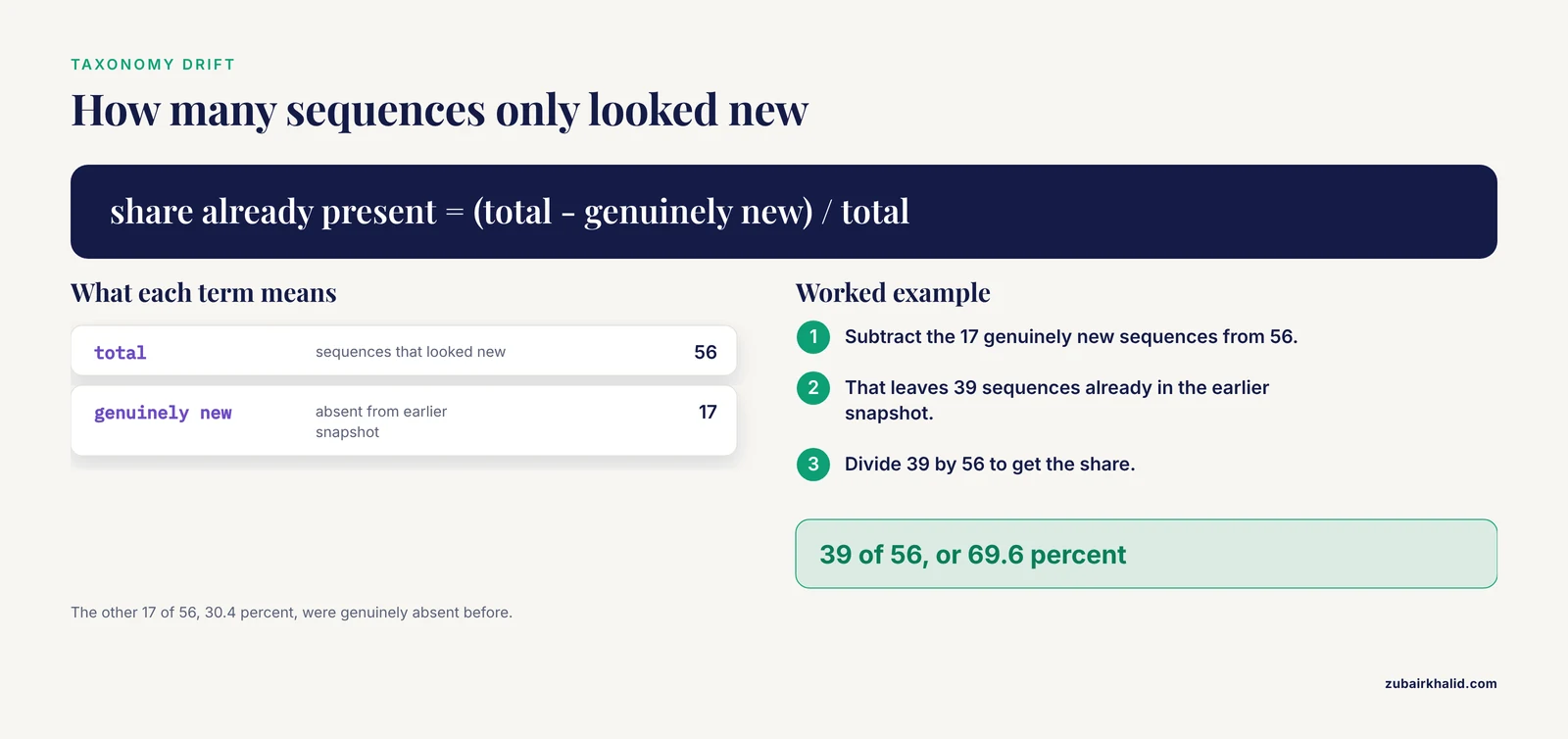
NCBI taxonomy is a living database. Taxa are renamed, split, and merged, and when a taxon is merged its numeric identifier is retired and replaced. Any search pinned to a stale TaxID silently loses records, and any analysis that resolves historical sequences to current identifiers can distort the past.
The scale of this artifact was quantified for viruses directly. Between two NCBI taxonomy snapshots taken one year apart, 56 viral sequences appeared to have been newly created. Only 17 of the 56 (30.4 percent) were genuinely absent from the earlier snapshot. The remaining 39 (69.6 percent) already existed there under a predecessor identifier that was later merged into the current one [6]. Across a library-wide population of 14,607 identifiers and 13 dated snapshots spanning 2014 to 2022, the same mechanism recovered 222 to 272 identifiers per snapshot in 10 of the 13 snapshots [6]. The authors showed that retagging the artifact sequences with their period-valid identifiers restored correct classification, and that the correction relies on identifier merge history alone [6].
Practical fixes follow from the mechanism. Open the Taxonomy Browser, confirm the name resolves to a live taxon, note the current TaxID, and read the merge history for predecessors. Search by lineage rather than by a single taxID when you need historical completeness. For long-term datasets, keep accession-based bookkeeping and resolve taxonomy at analysis time. As a concrete example, HSV-1 is Human alphaherpesvirus 1 with TaxID 10298, so txid10298[Organism] in a Nucleotide query restricts results to that taxon.
Cause 4: Your query defeats the search tool
Short queries
Default BLAST settings assume queries long enough to seed a full-length alignment. A 20-base read will not hit reliably under default megablast settings, which are tuned for long, near-identical matches. Use the short-query task, which shortens the word size and adjusts the expect value (e-value, the number of hits of similar quality you would expect by chance). In the web BLAST interface, choose the option optimized for short queries. On the command line, run blastn -task blastn-short -query q.fasta -db nt -remote.
Low-complexity masking and repeats
BLAST masks low-complexity sequence before searching, with DUST for nucleotides and SEG for proteins. Masking prevents spurious hits, but it can also hide real ones when the informative part of your query is repetitive. Viral genomes can be repeat-rich. A survey of 156 Rhabdoviridae genomes retrieved from NCBI extracted 10,058 simple sequence repeats and 536 compound repeats, with mono-nucleotide "A" repeats alone accounting for about 21 percent of the total (2,095 of 10,058) [3]. If your query is dominated by repeats, rerun with masking adjusted and compare the hit lists.
Strand, orientation, and translated searches
Command-line runs with an explicit strand restriction, and pipelines that search only one orientation, miss reverse-complement matches. More often the problem is molecule type. Rapidly evolving viruses diverge at the nucleotide level faster than at the protein level, so a nucleotide search can fail where a translated search succeeds. Use blastx (translated nucleotide query against a protein database) or tblastn when nucleotide hits are weak. Protein BLAST is also the standard tool for identity filtering, a step used, for example, to select predicted SARS-CoV-2 epitope peptides with the lowest sequence identity to human proteins and other human pathogens before assay design [7].
Cause 5: The virus is genuinely novel or highly divergent
Rapid evolution and heterogeneous genome structure complicate reliable assignment, and newly discovered viruses from underrepresented ecosystems keep expanding known diversity, which strains methods that depend on similarity to existing references [8]. If your sequence comes from an underexplored host, vector, or environment, weak or absent BLAST hits can be a real biological signal rather than a search failure.
Work down the ladder of conservation. Search conserved protein domains such as polymerase and capsid genes rather than whole genomes. Use profile hidden Markov model (HMM) searches against curated viral domain families. Place your contig phylogenetically among its nearest neighbors. The dengue virus work in Jeddah shows the standard confirmation path for a known virus: Nanopore sequencing of the isolate, a close-strain search with the BLAST NCBI tool, then phylogenetic analysis on the NGPhylogeny server [9]. For lineages too divergent for similarity-based tools, classification frameworks built to generalize beyond their training references are an emerging option, evaluated on NCBI benchmarks and on newly released genomes [8].
Cause 6: The reference genome is not a single real isolate
Reference genomes are often treated as faithful representations of experimentally validated viral genomes, and the assumption is rarely tested. The MS2 RNA phage case tested it. Investigators reconstructed the canonical MS2 genome from cDNA and compared the current NCBI RefSeq with closely related published isolate sequences. Isolate-derived constructs reproducibly yielded infectious phage. The RefSeq-derived construct did not, showing that the present reference does not represent a single experimentally validated infectious genome but reflects curation across multiple studies [10]. Even among closely related corrected reference-derived constructs, phage output differed by roughly 4 logs, associated with an apparent replicase frameshift [10].
Two consequences matter for searches. If you expect your isolate to match the reference base for base, it may not, and a failed identity check against RefSeq is not evidence that your sequence is wrong or absent. And if you search RefSeq alone, you are sampling a curated composite, not the diversity of the archive. Search GenBank and WGS alongside RefSeq whenever isolate-level detail matters.
Cause 7: The sequence lives outside NCBI
Some viral data are deposited under sharing terms that keep them out of NCBI. GISAID maintains large influenza and SARS-CoV-2 collections under its own terms, and surveillance studies routinely query both sources because neither mirrors the other completely, as the Hong Kong SARS-CoV-2 surveillance work did [1]. If your virus is one of those, search GISAID under its access terms before concluding the sequence is unavailable.
Within NCBI's own sphere, absence is more meaningful. GenBank, ENA, and DDBJ exchange records daily under INSDC, so a sequence present in one partner archive normally appears in all of them. A sequence absent from GenBank, WGS, TSA, SRA, and NCBI Virus, and absent from GISAID where relevant, was most likely never publicly released. Check NCBI Virus last, since its aggregation and filters sometimes surface records that a plain Nucleotide query hides.
Cause 8: The sequence you are looking for is not the sequence you have
A viral sequence produced by your own pipeline can be an artifact, and searching NCBI for it fails because nothing like it exists. The clearest worked example comes from neonatal intensive care. A 7-day-old infant underwent trio human genome sequencing for a suspected genetic disease, and variant calling reported an apparent de novo insertion in the NRROS gene. Manual inspection of the BAM file (the alignment file produced by the read aligner) in IGV (Integrative Genomics Viewer) showed that the reads flanking the insertion carried soft-clipped segments, portions of reads left unaligned at the junction, and a BLAST homology search aligned those segments to the HSV-1 UL47 gene rather than to anything human. Retrospective PCR confirmed HSV-1 in blood and nasopharyngeal samples, and the infant died at 14 days from disseminated infection [11].
The mechanism is general. A pathogen present in the sample co-sequences with the host, its reads fail to map to the host reference, the aligner soft-clips or leaves them unmapped, and downstream calling or assembly misreads the junction as an insertion or a novel contig. Related failure modes include vector and adapter contamination, chimeric assembly contigs, and index hopping on patterned flow cells. If your sequence came from a host-genome run, extract the soft-clipped and unmapped reads, BLAST them against nr/nt, and inspect the alignment in a genome viewer before you conclude that you have found something new. Confirm any consequential finding with an independent assay.
Safety note. Workflows that start from clinical or environmental material handle potentially infectious specimens, so follow institutional biosafety procedures and local regulations. Nucleic acid extraction buffers commonly contain guanidinium salts, which are toxic and must never be mixed with bleach. Handle and dispose of them according to the manufacturer's documentation.
A diagnostic sequence you can follow
Run these steps in order. Most failures die at step 2 or 3.
- Clean the query. Plain FASTA (the standard text format, a header line followed by the sequence), one sequence, IUPAC codes only, no pasted headers or notes.
- BLAST it against the nucleotide collection (nr/nt) on the BLAST web interface. Record the database build shown in the results header.
- If the query is under about 30 bases, rerun with the short-query task.
- Open the Taxonomy Browser. Confirm the virus name resolves, note the current TaxID, and read the merge history.
- Search Nucleotide by the accession root without the version, then by name with wildcards, then with a taxID-restricted query such as txid10298[Organism].
- Search the SRA by the study, sample, and run accessions listed in the source paper, and by organism name.
- Search NCBI Virus with the taxon filter to enumerate every aggregated record.
- If the source paper names GISAID, search there under its access terms.
- If BLAST returns only distant hits, rerun at the protein level with blastx, then try HMM searches against conserved viral domains.
- If everything above fails, write to the corresponding author with the data availability statement in hand and ask for the accession list.
For scripted work, the same first pass looks like this:
blastn -task blastn-short -query q.fasta -db nt -remote -outfmt "6 stitle pident length evalue"Practical retrieval habits: how to use NCBI well
Entrez queries accept Boolean operators and field tags. txid10298[Organism] restricts to a taxon, quotation marks force exact phrase matching, and AND, OR, and NOT combine clauses. Versioned accessions belong in notebooks and scripts exactly as cited, NC_045512.2 rather than NC_045512, together with the date and the database build you queried.
Use NCBI Virus when you need every record for a taxon rather than one reference. Use the Assembly database for bulk downloads and the FTP or Datasets interfaces for scripted retrieval. When you need a specific gene from many full genomes, extract it in a controlled, reproducible way rather than by hand, as the Lassa and Ebola comparative study did when it pulled Ebola virus glycoprotein sequences from full-genome assemblies through reference-guided MAFFT alignment [2]. Keep the provenance of every downloaded record, because the question of why something is not on NCBI is answerable only when you know exactly what you searched, when, and with which build.
Common Mistakes and Limitations
- Searching RefSeq only and concluding the sequence is absent from NCBI. RefSeq is a curated subset, and isolate data live in GenBank, WGS, and SRA.
- Trusting a single pipeline's negative call without checking which database and version it searched [5].
- Pinning a longitudinal dataset to taxIDs that later merge, which silently drops records and can make existing taxa look new [6].
- Reading weak BLAST hits as identification for a novel lineage instead of running translated, domain, and phylogenetic checks.
- Treating the RefSeq genome as a real isolate sequence when it can be a curated composite [10].
- BLASTing raw reads against assembled databases and expecting hits.
- Ignoring accession version suffixes and then wondering why an old link fails.
- Interpreting absence of a public record as evidence that a virus was absent from a sample. Confidential holds and non-NCBI repositories both produce true absence from search results.
- Treating a sequence hit as a clinical diagnosis. A sequencing signal that affects patient care needs confirmation in a clinical virology laboratory before it guides treatment, and individual cases need professional clinical judgment.
Prevention practices
- Record provenance for every sequence you use or store: database, accession.version, build date, and search parameters.
- Validate metagenomic pipelines against a mock database of known viruses and public SRA datasets before surveillance use, and document which pipeline and version produced each call [5].
- Document database scope in your methods, including host-filtering steps, so readers know what your search could and could not see.
- Snapshot taxonomy identifiers with dates for longitudinal work, and resolve historical records through identifier merge history rather than current-day identifiers alone [6].
- Deposit assemblies alongside raw reads when you submit, and cite accession.version in publications so your own data never become unfindable.
- Keep a local, dated copy of the reference sets your work depends on.
Frequently Asked Questions
Why does BLAST find my sequence but the Nucleotide search does not?
BLAST searches sequence content, while the Nucleotide search matches text and metadata. A record indexed under a different or outdated organism name still appears in BLAST. When naming is uncertain, search by accession or by the sequence itself.
Can I BLAST against raw SRA reads?
No. Standard BLAST databases contain assembled sequences, not raw reads. Search the SRA directly for the run, download it, assemble the reads locally, and BLAST the resulting contigs.
How long does a GenBank submission take to appear?
Processing varies from days to weeks with submission volume and complexity. Submitters can also request a confidentiality hold until publication, capped at four years, during which the record is invisible to public search and BLAST.
Why are some influenza and SARS-CoV-2 sequences in GISAID but not on NCBI?
GISAID uses its own sharing terms, and many sequences appear there without a mirrored NCBI record. Surveillance studies routinely query both repositories for this reason.
What does an accession like AAEX01000001 mean?
It is a WGS contig accession, a project prefix plus a version plus a contig number. The project's master record is not itself a sequence, so search or download the contig accessions.
Why does the RefSeq genome differ from the GenBank entries for the same virus?
RefSeq records are curated by NCBI and can combine input from several studies, so they can differ from any individual isolate. If you need isolate-level sequences, search GenBank and WGS rather than RefSeq alone.
How do I search NCBI when the virus taxonomy changed?
Open the Taxonomy Browser, resolve the current TaxID, and read the merge history for predecessor identifiers. Search by lineage or by accession rather than by a single stale identifier.
Why does my 20-base query return no BLAST hits?
Default BLAST settings assume longer queries. Use the short-query task with a shorter word size and an adjusted expect threshold, and check that low-complexity masking is not hiding the match.
Sources
- Genomic surveillance of COVID-19 in Hong Kong (2020-2023): Analysing SARS-CoV-2 variants, mutations, and their impact on viral entry.
- ESM-embedR: a protein language model framework for comparative mutation analysis and computational atypicality scoring of Lassa and Ebola virus sequences.
- Systems Biology of the Microsatellite Signature in 156 Genomes of the Viral Family Rhabdoviridae.
- High prevalence of Phasi Charoen-like virus from wild-caught Aedes aegypti in Grenada, W.I. as revealed by metagenomic analysis.
- Exploration of viral diversity in Aedes mosquitoes employing different shotgun metagenomic data analysis pipelines.
- When current taxids make historical taxa look new.
- Peptide microarray analysis of in-silico predicted B-cell epitopes in SARS-CoV-2 sero-positive healthcare workers in Bulawayo, Zimbabwe.
- FPCN: Fragment Path Complex Networks for Viral Genome Classification.
- Epidemiological and genomic analysis of the dengue virus isolate from Jeddah, Saudi Arabia: Implications for future therapeutic development.
- A reference genome without a virus: cDNA reconstruction reveals the provenance and function of the MS2 phage sequence.
- From genetic investigation to viral diagnosis: HSV-1 detection through genome sequencing analysis in neonatal intensive care.