NCBI Taxonomy for Metagenomics
By Dr. Zubair Khalid, DVM, MS, PhD ·

NCBI Taxonomy is the National Center for Biotechnology Information's curated classification of every organism with sequence data in its databases, organized as a single tree with a stable numeric identifier (a taxid) for each node. In metagenomics, this tree serves as the shared coordinate system that sequence classifiers use to convert raw reads into named organisms at defined ranks such as genus and species. When you read a report saying a sample contains 12% Escherichia coli, that percentage is only meaningful because the classifier, the reference genomes, and the report all point at the same node in this tree.
This matters because metagenomics produces millions of fragments from a mixture of organisms, and no fragment carries a label. Every classifier, from BLAST-based similarity searches to k-mer indexes like Kraken2, must decide which branch of a reference tree each read belongs to. If two tools or two reference databases use different trees, or if the tree itself changes between runs, the same dataset can produce different organism lists. Understanding how the NCBI tree is built, where it is stored, how tools consume it, and where its names can mislead you is therefore not optional background knowledge. It is a core skill for anyone who needs to interpret a metagenomic profile honestly, whether that profile comes from a soil sample, a clinical specimen, or a food batch.
What NCBI Taxonomy for Metagenomics Means
If you have searched for "what does ncbi taxonomy metagenomics mean", the plain answer is this. It is the practice of anchoring metagenomic classification, reporting, and downstream statistics to the NCBI Taxonomy database rather than to any other naming scheme. The phrase covers three distinct things that often get blurred together.
First, it is a data resource. The NCBI Taxonomy database is a curated tree containing roughly several hundred thousand taxa, from root down to individual strains, each identified by a taxid (a plain integer such as 562 for Escherichia coli or 9606 for Homo sapiens). The tree is available as plain-text dump files and through web and API interfaces.
Second, it is a convention. Most metagenomic classifiers, profilers, and reporting tools (Kraken2, Bracken, Centrifuge, Kaiju, MEGAN, and many amplicon pipelines) either consume the NCBI dump files directly or publish results keyed to NCBI taxids. Choosing NCBI Taxonomy means your species counts can be joined against genome metadata, filtered by host, and compared across tools.
Third, it is an interpretation framework. The tree defines what "genus level" or "family level" means for a given read. A read assigned by a lowest common ancestor (LCA) algorithm to node 562 says something specific, namely that the sequence resembles E. coli and its close relatives better than anything else in the reference set. NCBI taxonomy metagenomics interpretation is the skill of reading those assignments for what they actually claim, which is rarely the same thing as a confident species identification.
Why a Single Reference Tree Matters
Metagenomics would be impractical if every tool invented its own naming. The value of a shared tree shows up in four concrete places.
Classifier construction. Kraken2, Centrifuge, and Kaiju all build their indexes from reference genomes annotated with taxids. When you download bacterial genomes from NCBI RefSeq, each assembly record carries a taxid, and the classifier inherits the entire lineage attached to that taxid. A k-mer or minimizer does not store "E. coli", it stores a node in the NCBI tree.
Lowest common ancestor resolution. When a read matches k-mers from several species, the classifier walks up the tree until all matches share a single ancestor. The output node is a taxid, and its rank (species, genus, family) reflects how much ambiguity the classifier had to absorb. This is why some reads report to species and others stop at phylum.
Cross-tool comparability. A genus node like taxid 1358 (Bifidobacterium) means the same thing to Kraken2, MEGAN, and your downstream R or Python scripts. Without a shared tree, abundance tables from different profilers cannot be merged.
Metadata joins. NCBI's genome, SRA, and assembly databases are all indexed by taxid. If your results are keyed to taxids, you can pull host information, assembly quality, isolation source, and biosample metadata directly, which is what makes NCBI taxonomy for metagenomics more than a labeling convenience.
The alternative taxonomies that circulate in the field (SILVA and Greengenes for 16S rRNA amplicons, GTDB for genome-based prokaryotic classification) are useful, but they are not the same namespace. A 2023 analysis of Streptomyces compared full-length 16S rRNA sequences pooled from SILVA, Greengenes, the Ribosomal Database Project, and NCBI, totaling 48,981 sequences, against 2,276 publicly available genome assemblies, and found that existing classifications were inconsistent with the inferred 16S tree and that 16S and whole-genome classifications frequently disagreed [1]. Any multi-database metagenomics project will eventually face exactly this kind of collision, which is why knowing which taxonomy your numbers refer to is part of the result itself.
The Structure of the NCBI Taxonomy Database
Taxids, nodes, and lineages
Every node in the tree has a taxid, a scientific name, a rank, and a parent taxid. The root is taxid 1. Lineages are the ordered chain of ancestors from a node up to the root, for example:
species Escherichia coli (562), genus Escherichia (561), family Enterobacteriaceae (543), order Enterobacterales (91347), class Gammaproteobacteria (1236), phylum Pseudomonadota (1224), domain Bacteria (2), root (1).
Two properties make taxids usable as database keys. They are stable integers that persist even when names change, and every sequence record in GenBank and RefSeq carries the taxid of the organism it came from in its source feature. When a submission gets reclassified, the taxid attached to the sequence record is updated, which is how classifier databases built from GenBank absorb taxonomy changes.
Names, synonyms, merges, and dead taxids
The tree carries several kinds of names beyond the scientific name: synonyms, common names, and merged former names. When two taxa are judged to be one, for example when two species names turn out to describe the same organism, NCBI does not silently delete one node. The old taxid is recorded in a merge file so that software referencing it can be redirected. Newer dumps also flag "dead" taxids with the reason they were retired. This machinery exists because taxonomy is a moving target. A study of the diatom genus Anaulus illustrates the depth of the problem, describing how a search for a specimen that adequately defined the generitype Anaulus scalaris failed, and how molecular data revealed that morphologically similar genera with internal costae were in fact unrelated, prompting new genera and formal transfers of species between genera [2]. If the defining specimen of a genus cannot be located and the genus turns out to be polyphyletic, the names attached to sequences of those organisms will keep moving, and the merge records are what keep old analyses traceable.
Ranks and the problem of nonstandard ranks
NCBI nodes have ranks (species, genus, family, and so on), but the tree is not rank-uniform. Many environmental and uncultured lineages are represented by placeholder nodes such as "environmental samples" or candidate phyla with "Candidatus" prefixes, and these may sit at ranks that do not match classical Linnaean categories. Some nodes have no rank at all. Metagenomic reports therefore often show intermediate rank codes (for example R1 through R7 in a Kraken2 report) for clades that have no clean genus or family rank on their path to the root. Interpreting a report correctly requires accepting that a genus-level line may simply not exist for some branches of the tree.
How the Tree Gets Built and Updated
The taxonomy is maintained by NCBI staff taxonomists who integrate three streams of information. Sequence submissions to GenBank arrive with an organism name and are matched to existing nodes or, when genuinely new, added as new nodes, often tentatively under names flagged as unpublished or provisional. Nomenclature governed by the formal codes (the International Code of Nomenclature for prokaryotes, plants, and zoology, plus the Candidatus category for uncultured prokaryotes) provides ratified names from the taxonomic literature. Phylogenetic publications drive larger rearrangements, especially splits of polyphyletic groups.
The scale of these rearrangements is easy to underestimate. The fungal kingdom, long one of the most turbulent areas of eukaryotic taxonomy, has only recently stabilized enough for reviewers to describe nine well-supported phylum-level clades (Opisthosporidia, Chytridiomycota, Neocallimastigomycota, Blastocladiomycota, Zoopagomycota, Mucoromycota, Glomeromycota, Basidiomycota, and Ascomycota), and even that framework coexists with groups of uncertain placement [3]. At finer scales, revisions arrive constantly. A multigene study of the reef fish genus Plectranthias confirmed that the genus, suspected of non-monophyly for over 40 years, actually comprises seven distinct clades, resurrected four genera, established two new ones, and restricted Plectranthias sensu stricto to 20 species. A study of the Apiaceae genera Meeboldia and Sinodielsia concluded that Sinodielsia should be merged into Meeboldia and formally renamed two species [4]. In the plant genus Saussurea, a nuclear phylogeny built from hybrid-capture data supported a revised infrageneric classification with four subgenera and 13 sections, while also showing that deep cytoplasmic-nuclear conflict made a chloroplast-based classification unreliable [5].
Each of these papers changes what a name means. When names change, taxids get created or merged, and reference genomes get retagged. A metagenomic classifier database built in January and one built in December can disagree about a node for reasons that have nothing to do with your sample. The correct response is not to distrust the taxonomy but to version it: record which taxonomy release your classifier database used, and rebuild deliberately rather than incidentally.
How to Use NCBI for Metagenomics: A Practical Databases Guide
Readers searching for "how to use ncbi" in a metagenomics context usually need three access routes: the browser for exploration, the dump files for building tools, and the programmatic APIs for automation.
The Taxonomy Browser and Entrez
The Taxonomy Browser (at ncbi.nlm.nih.gov/Taxonomy) is the fastest way to answer questions like "what is in this lineage" or "how many genomes exist for this genus". Searching a name returns the node page, which shows the full lineage, immediate children, the number of linked nucleotide and protein records, and the number of genome assemblies. From any Entrez database (Assembly, Genome, SRA, Nucleotide), you can filter searches by taxonomy using the txid syntax, for example txid562[Organism] to restrict Assembly results to E. coli. Combining taxonomy filters with other Entrez fields (txid562[Organism] AND complete[title]) is the standard way to curate a reference set before you build anything.
The dump files
For programmatic work, download the taxonomy dump from the NCBI FTP server (ftp.ncbi.nlm.nih.gov under pub/taxonomy). The core files are:
nodes.dmp: taxid, parent taxid, rank, and other flags for every nodenames.dmp: all names (scientific, synonyms, common names) keyed to taxidsmerged.dmp: old taxids mapped to their replacements after mergesnew_taxdump/: an archive refreshed more frequently, with additional files such as division and type-material information
Tools such as taxonkit and the ETE toolkit parse these files to extract lineages, expand nodes, or convert between ranks and taxids. Keeping a dated copy of the dump alongside your classifier database is the single highest-value reproducibility habit in this area.
E-utilities and NCBI Datasets
E-utilities expose Entrez over HTTP. To fetch the full lineage of a taxid in XML:
curl "https://eutils.ncbi.nlm.nih.gov/entrez/eutils/efetch.fcgi?db=taxonomy&id=562&mode=xml"Unauthenticated requests are rate-limited, and NCBI provides an API key for higher throughput. Batch taxid lookups by supplying comma-separated id values rather than issuing one request per taxid.
The NCBI Datasets command-line tools are often easier for genome-level work:
datasets summary genome taxon "Escherichia coli" --reference
datasets download genome taxon "Bifidobacterium" --exclude-atypical
These commands respect the taxonomy tree, so a genus-level query returns assemblies for all child species automatically.
Building a classifier database from NCBI genomes
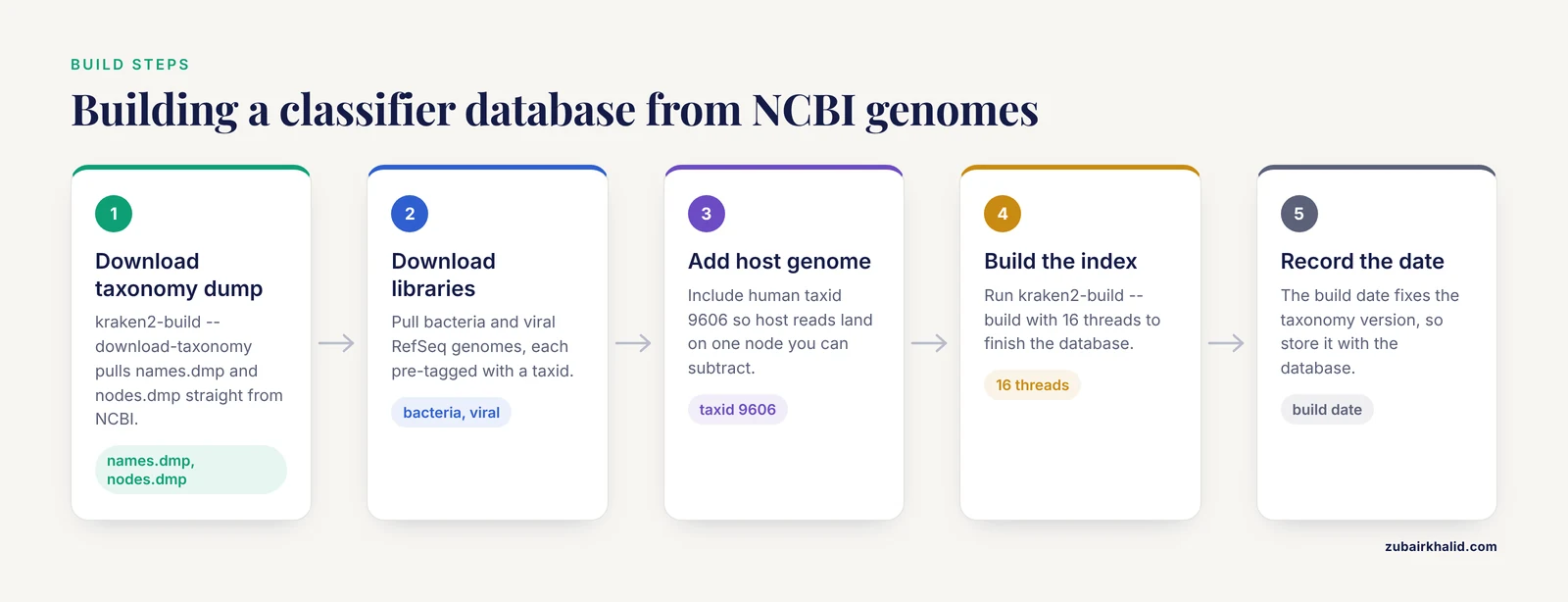
A typical Kraken2 build looks like this:
kraken2-build --download-taxonomy --db $DB
kraken2-build --download-library bacteria --db $DB
kraken2-build --download-library viral --db $DB
kraken2-build --build --db $DB --threads 16
The first command pulls names.dmp and nodes.dmp directly from NCBI, which makes the taxonomy version implicit in the build date. The library downloads pull RefSeq genomes, each pre-tagged with a taxid. Adding a host genome (commonly human, taxid 9606) lets the classifier absorb host reads into a node you can subtract afterward instead of letting them scatter across bacterial branches.
A Metagenomic Classification Workflow, Step by Step
- Define the reference scope. Decide which branches of the NCBI tree your question needs. A clinical respiratory sample needs bacteria, viruses, fungi, and the human genome for subtraction. A soil eukaryote survey needs a different slice entirely. Restricting the database improves sensitivity and reduces false positives from irrelevant matches.
- Acquire and version the inputs. Download RefSeq (curated) or GenBank (broader but noisier) assemblies for the chosen taxa, plus the taxonomy dump, and record the download date. RefSeq genomes are more consistently annotated and less likely to carry mislabeling, which matters for interpretation later.
- Preprocess reads. Adapter and quality trimming, and explicit host depletion by aligning against the host genome, are standard. Removing host reads before classification avoids wasting LCA resolution on contaminant branches.
- Classify. Run the classifier against the built database:
kraken2 --db $DB --threads 16 --report sample.kreport --paired R1.fq R2.fq > sample.krakenEach read receives a taxid. The -report file aggregates counts per node.
- Re-estimate abundances. Tools like Bracken redistribute reads among species and genera within a classified subtree to produce better abundance estimates, correcting for the fact that a k-mer assigned to a genus node could belong to any descendant.
- Convert taxids to analysis-ready tables. Map taxids to lineages and ranks using your taxonomy dump copy, then generate per-rank count matrices for diversity analysis, differential abundance testing, and visualization.
The same skeleton applies to amplicon (16S/ITS) workflows with one substitution. Amplicon pipelines such as DADA2 usually assign taxonomy with a trained naive Bayes classifier against SILVA or a similar marker-gene reference, whose label hierarchy is not the NCBI tree. For reporting and cross-study comparability, many groups then map those labels back to NCBI taxids. The mapping is where disagreements surface. The Streptomyces work cited above showed that 16S-derived zero-radius operational taxonomic units and whole-genome classifications of the same strains frequently conflict [1], so expect amplicon-based and shotgun-based taxonomies of the same sample to disagree at species level even when both are technically correct within their own frameworks.
Interpreting the Output: Reading a Report Correctly
A Kraken2 report has one row per node: percentage of reads, cumulative reads, reads assigned directly to the node, a rank code, the taxid, and the name. The rank codes deserve explicit attention because they are where misinterpretation begins.
- U reads are unclassified, meaning nothing in the database matched them well enough. A high unclassified fraction is a database problem as often as a sample property.
- R (and numbered variants like R1, R2) mark intermediate nodes without a standard rank.
- D, K, P, C, O, F, G, S correspond to domain (or superkingdom), kingdom, phylum, class, order, family, genus, and species.
Three interpretation rules carry most of the weight in practice.
Rule one: an LCA node is not an organism. A read assigned to genus Escherichia was placed there because the classifier could not distinguish among the species below that node. It does not mean Escherichia coli is present. Reads stop at higher nodes either because the sequence is conserved (many 16S-like or housekeeping fragments) or because the true organism is missing from the reference database and its nearest relatives absorb the read. Reporting genus presence when species presence was never established is the most common over-claim in published metagenomic results.
Rule two: relative abundance is compositional. Percentages in a report sum to one by construction. An organism at 30% of classified bacterial reads is not necessarily 30% of the community by cell count, because genome size, genome copy number, marker gene copy number, and database representation all distort read proportions. Read-based percentages are indices of relative representation, not biomass.
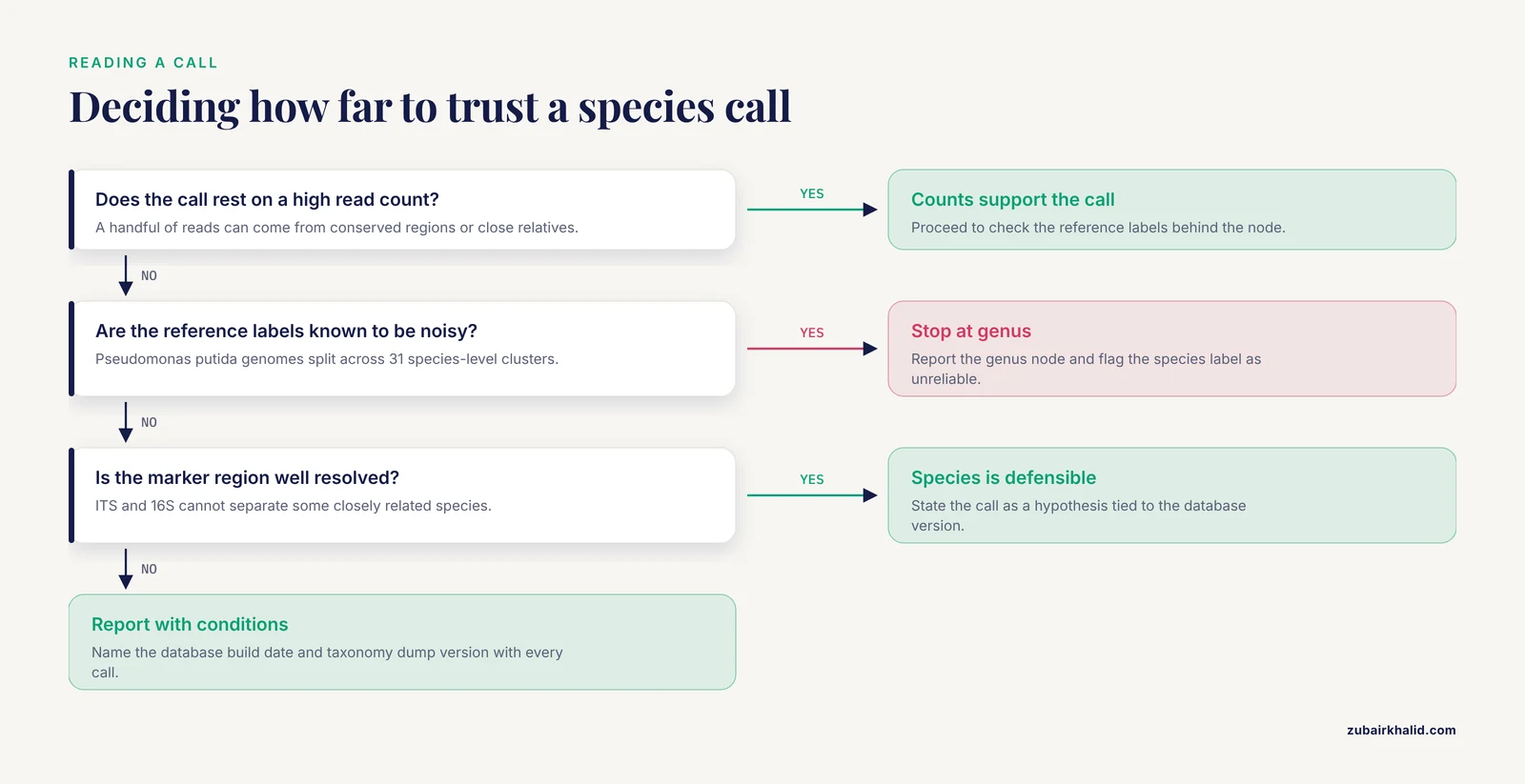
Rule three: species-level calls are conditional on the reference set. Within Pseudomonas, a genomic survey of 26,363 GenBank-labeled genomes delineated 435 distinct species-level clusters and found that 224 strains deposited under the name "Pseudomonas putida" were distributed across 31 of those clusters, with in-depth analysis of nine clusters including the P. alloputida and P. putida cliques [6]. When a fifth of the genomes carrying a species label belong to genomic species other than the one the label names, a classifier that reports "P. putida" is reporting the reference label, not a genomic fact. Similar tension exists in Streptomyces, where the authors document substantial species-level misclassification and show that resolving it has direct consequences for applied searches such as antimicrobial discovery programs [1]. Neither result means NCBI taxonomy is broken. It means that a species-level metagenomic call is a hypothesis conditioned on whatever the reference database currently says, and the phrase "ncbi taxonomy metagenomics interpretation" is best understood as the discipline of stating those conditions out loud.
Practical checks during interpretation. Look at the unclassified fraction before believing any abundance ranking. Check whether species-level percentages are supported by direct counts or just cumulative percentages at a genus node. Cross-check flagship findings with a second classifier or a read-mapping step against the specific species' genomes. Filter taxids with known label problems (contaminated assemblies, mislabeled type strains) when high-stakes calls matter.
When Reference Names and Biology Disagree
Every metagenomicist should internalize the fact that the names in the tree are scientific hypotheses, not fixed coordinates. The taxonomic literature provides a steady supply of demonstrations, and several of them map directly onto metagenomic pain points.
Marker genes reach their resolution limit. Internal transcribed spacer (ITS) sequences are the workhorse fungal and plant barcodes. A study of birch (Betula) used ITS1 and ITS2 sequences, even adding secondary structure reconstructions to the analysis, and found that the resolving power of these markers remained insufficient to discriminate some closely related species reliably, concluding that modern genomic approaches are needed [7]. In a metagenomic ITS profile, two species that share an ITS barcode will inevitably be reported as one taxon at species level or split arbitrarily at genus level.
Delimitation methods themselves disagree. In the land snail genus Rumina, researchers applied five different species delimitation approaches to mitochondrial sequence data (barcode gap analysis, Automatic Barcode Gap Discovery, a Geneious-based delimitation plugin, the Genealogical Sorting Index, and the General Mixed Yule Coalescent model) and obtained a variety of species hypotheses, with the data suggesting at least seven species where only three nominal species were recognized [8]. If taxonomists with full specimens cannot agree on species boundaries, a read classifier working with 150-base fragments has no chance of resolving them, and honest reporting requires stopping at the rank where the evidence actually supports the call.
Morphology and molecules can conflict systematically. In mushrooms of Conocybe section Pilosellae, morphological classification and molecular phylogenetics were in disagreement, and integrating both approaches revealed seven species new to science plus one new record for China [9]. An integrated approach combining fresh-specimen morphology, DNA-based species delimitation, and geography resolved 15 species in the deep-sea fish genus Chelidoperca (six of them new) where previous morphology-only work recognized 11 [10]. Metagenomics sees only molecules, which is a strength for detecting cryptic diversity but a weakness when the reference database's labels encode morphology-based groupings that molecules split or merge.
Revisions reshape whole clades. Beyond the Plectranthias, Meeboldia, and Saussurea examples above, a plastid phylogenomic study of the Himalayan genus Acronema showed the genus to be non-monophyletic, split into two clades, with problematic generic boundaries against Sinocarum and relatives [11]. A study of Cyclorhiza (also Apiaceae) found that a species sitting in Seseli morphologically resembled Cyclorhiza and needed re-evaluation, using newly sequenced plastomes, ITS, and chloroplast markers across 27 populations [12]. In rodents, molecular phylogenetics of the rare climbing mouse genus Vernaya described two new species and elevated a former subspecies to species rank [13]. In ciliates, an integrative redescription of Paradileptus species using 18S, 5.8S, and ITS rDNA sequences combined with living morphology produced a new identification key for the genus [14]. Even within a single genus of flowering plants, nuclear versus chloroplast genomes can support different classifications, as the Saussurea hybrid-capture study demonstrated [5]. Each of these is a concrete case where yesterday's reference labels and tomorrow's reference labels differ.
Visualization inherits the problem. Because phylogeny-based taxonomies are updated as genomes accumulate, researchers have built tools to keep visualization consistent with evolutionary reality. The Context-Aware Phylogenetic Trees (CAPT) web tool, for example, links an interactive phylogenetic tree with a taxonomic icicle view covering seven rankings (domain through species) to support validation of phylogeny-based taxonomies [15]. The same principle applies to your metagenomic reports. A taxonomy bar plot is a claim about a version of a tree, and the version should be recorded.
The unifying lesson for "ncbi taxonomy metagenomics explained" at the interpretation stage is this. The tree is a curated, professionally maintained consensus that is good enough to be the standard coordinate system, and simultaneously a living document whose genus and species nodes are periodically redrawn. Plan for both facts.
Comparing NCBI Taxonomy With Other Reference Taxonomies
| Entity | What it actually is | Typical role in metagenomics |
|---|---|---|
| NCBI Taxonomy tree | A curated organism classification keyed by taxids, spanning all sequenced life | The backbone namespace for most classifiers, genome downloads, and reporting |
| A taxid | One integer node in that tree | The database key that joins reads, genomes, and metadata |
| RefSeq | A curated subset of GenBank assemblies with known taxids | The usual source of classifier reference genomes |
| GenBank | The full archival sequence database, broader and less curated | Extends reference scope at the cost of label noise |
| SILVA | A curated 16S/18S rRNA reference database | Amplicon taxonomy assignment, labels mapped back to NCBI names for reporting [1] |
| Greengenes | A 16S rRNA taxonomy and tree widely used in microbiome analysis | Amplicon labels, historically divergent from NCBI at species level [1] |
| GTDB | A genome-based prokaryotic taxonomy derived from genome phylogeny | Alternative species concept, increasingly used for isolate and MAG classification |
| A classifier database (Kraken2, Centrifuge) | A frozen snapshot of genomes plus a taxonomy dump | What your actual results are conditioned on |
None of these is wrong. They answer different questions. The recurring mistake is mixing them silently, for example joining GTDB species names against an NCBI-keyed abundance table and treating mismatches as absence of the organism.
Common Mistakes and Limitations
Hardcoding taxids in scripts. Taxids for merged or retired nodes change meaning. Store names plus a taxonomy version, and resolve names to current taxids at runtime.
Assuming the classifier database taxonomy matches your annotation taxonomy. If your Kraken2 database was built against a 2023 taxonomy dump and you annotate results against a 2026 dump, merged nodes will break joins. Build, store, and annotate against one dated snapshot.
Reading genus-level cumulative percentages as species-level evidence. Cumulative percentages include all descendant reads. Only the "reads assigned directly" column belongs to the node itself.
Treating "Candidatus" and environmental-sample nodes as ordinary species. These nodes frequently lack standard ranks and may aggregate diverse uncultured lineages. A species-level label under a Candidatus node is much weaker evidence than a species-level label on a cultured, type-material-backed taxon.
Ignoring the unclassified fraction. Database bias is the dominant explanation for surprising absences. Before concluding an organism is absent, check whether anything related to it is represented in the database.
Expecting marker-gene and genome-based classifications to agree. The Streptomyces analysis quantified the scale of 16S versus whole-genome disagreement in one of the most studied bacterial genera [1]. Disagreement between an amplicon profile and a shotgun profile of the same sample is usually a taxonomy-resolution issue, not a laboratory error.
Forgetting that labels in the reference databases carry noise. The Pseudomonas putida example, where genomes deposited under one species name split across 31 species-level genomic clusters, is documented directly from NCBI GenBank records [6]. Reference mislabeling propagates into classifier output verbatim.
Over-interpreting low-abundance species calls. A handful of reads assigned to a species can arise from conserved regions, index hopping, or close relatives. Treat low-count species calls as candidates requiring targeted confirmation, not findings.
Not versioning anything. Reproducibility in this space is a three-part record: database build date, taxonomy dump version, and tool version. Missing any one makes the result effectively unreproducible.
One broader limitation applies to all biological interpretation. Taxonomic profiles describe populations in a sample, and any action based on them, whether clinical, environmental, or industrial, requires confirmation by methods appropriate to the individual case rather than inference from a classifier report alone.
Quick Review
- NCBI Taxonomy is the curated tree of taxids that metagenomic classifiers use as their shared coordinate system, and a taxid is a stable integer node, not a name.
- Classifiers built from NCBI genomes inherit the tree through
nodes.dmpandnames.dmp, so the taxonomy version is frozen at database build time. - A read assigned by lowest common ancestor to a node means the classifier could not distinguish below that node, which is weaker than a species identification.
- Report percentages are compositional and reflect read representation, not cell counts or biomass.
- Species labels in reference databases contain real noise, documented at scale in Pseudomonas and Streptomyces.
- Marker genes such as ITS and 16S have finite resolution, and delimitation methods can disagree even on full specimen datasets [7].
- Reproducibility requires recording the database build date, taxonomy dump version, and tool version together.
Frequently Asked Questions
What does NCBI taxonomy metagenomics mean?
It means performing metagenomic classification and interpretation against the NCBI Taxonomy tree, so that every read assignment, abundance estimate, and report line refers to a specific taxid and lineage. It covers the data resource, the convention of keying results to taxids, and the interpretive rules for reading classifier output.
How do I find the taxid for an organism and get its full lineage?
Search the organism name in the NCBI Taxonomy Browser to reach its node page, which displays the taxid and complete lineage. Programmatically, fetch it with E-utilities, for example efetch.fcgi?db=taxonomy&id=562&mode=xml, or parse the nodes.dmp and names.dmp files from the NCBI taxonomy FTP directory with tools like taxonkit.
Why do Kraken2 and other profilers disagree on my sample?
Different tools use different databases, different k-mer or alignment strategies, and different LCA thresholds, so borderline reads land at different nodes. Add taxonomy version differences and abundance re-estimation choices, and disagreement at species level is expected. Agreement at family or genus level across tools is a much stronger signal than agreement at species level.
Does the NCBI taxonomy change, and does that affect old results?
Yes. Curators merge names, create nodes for newly described species, and reclassify branches as phylogenetic evidence accumulates. Old taxids are preserved in merge files, but a classifier database built against an older dump may place a genome on a node that no longer matches current naming, so record the taxonomy version with every result set.
Can I trust species-level identifications in a metagenomic report?
Treat them as hypotheses conditioned on the reference database. They are strong when the species has well-separated genomes in the database and the read count is high, and weak when the reference labels are known to be noisy, the marker region is too conserved, or the call rests on a few reads. Genus-level calls are usually the more defensible claim.
How do I build a custom classifier database from NCBI genomes?
Download the taxonomy dump, select your taxa in Entrez Assembly using txid filters or the NCBI Datasets tool, fetch the assemblies with their taxids, load both into the classifier builder (for example kraken2-build with library downloads), build the index, and record the taxonomy dump date with the database. Add the host genome if you need subtraction.
Sources
- 16S rRNA phylogeny and clustering is not a reliable proxy for genome-based taxonomy in Streptomyces
- Exploring Diversity, Taxonomy and Phylogeny of Diatoms (Bacillariophyta) from Marine Habitats. Novel Taxa with Internal Costae.
- Fungal evolution: diversity, taxonomy and phylogeny of the Fungi
- Phylogeny and taxonomy of Meeboldia, Sinodielsia and their relatives (Apiaceae: Apioideae) inferred from nrDNA ITS, plastid DNA intron (rpl16 and rps16) sequences and morphological characters
- New insights into the phylogeny and infrageneric taxonomy of Saussurea based on hybrid capture phylogenomics (Hyb-Seq)
- Unraveling the genomic diversity of the Pseudomonas putida group: exploring taxonomy, core pangenome, and antibiotic resistance mechanisms
- ITS secondary structure reconstruction to resolve taxonomy and phylogeny of the Betula L. genus
- Exploring Species Level Taxonomy and Species Delimitation Methods in the Facultatively Self-Fertilizing Land Snail Genus Rumina (Gastropoda: Pulmonata)
- Conocybe Section Pilosellae in China: Reconciliation of Taxonomy and Phylogeny Reveals Seven New Species and a New Record
- Exploring the Phylogeny and Species Diversity of Chelidoperca (Teleostei: Serranidae) From the Western Pacific Ocean by an Integrated Approach in Systematics, With Descriptions of Three New Species and a Redescription of C. lecromi Fourmanoir, 1982
- Phylogeny, adaptive evolution, and taxonomy of Acronema (Apiaceae): evidence from plastid phylogenomics and morphological data
- Morphology, phylogeography, phylogeny, and taxonomy of Cyclorhiza (Apiaceae)
- Molecular phylogeny and taxonomy of the genus Vernaya (Mammalia: Rodentia: Muridae) with the description of two new species
- Taxonomy and Phylogeny of the Dileptid Ciliate Genus Paradileptus (Protista: Ciliophora), With a Brief Review and Redescriptions of Two Species Isolated From a Wetland in Northern China
- Context-Aware Phylogenetic Trees for Phylogeny-Based Taxonomy Visualization