How to Choose a Multiple Sequence Alignment Tool for Protein Sequences
By Dr. Zubair Khalid, DVM, MS, PhD ·

A multiple sequence alignment (MSA) is a table of homologous protein sequences arranged so that residues that descended from the same ancestral residue sit in the same column, and the differences between tools come down to how they estimate those residue-to-residue correspondences. The rule of thumb is simple: start with a fast progressive or iterative aligner such as MAFFT, MUSCLE, or Clustal Omega, and move to a slower consistency-based method such as T-Coffee or ProbCons only when your downstream analysis depends on alignment accuracy in hard-to-align regions. No single aligner wins on every dataset, because multiple sequence alignment is an NP-hard problem, meaning no known algorithm guarantees the mathematically optimal alignment in reasonable time, so every practical tool is a heuristic that trades accuracy against speed in a different way [1].
This guide walks through the main protein MSA options, explains how their algorithms differ, compares them on the criteria that actually decide real projects, and shows how to match the tool to your downstream application, whether that is phylogenetics, structure prediction, variant interpretation, or protein engineering.
What a Protein MSA Does and Why Tool Choice Matters
A multiple sequence alignment takes a set of related protein sequences and inserts gaps so that homologous positions line up. Columns of the alignment then become the substrate for almost every comparative analysis downstream: conserved catalytic residues, coevolving positions, domain boundaries, phylogenetic trees, profile Hidden Markov Models (HMMs), and the sequence inputs to deep-learning structure predictors.
Because the MSA is an input layer, errors propagate. A misaligned active-site residue can shift the apparent position of a conserved motif, alter a phylogenetic tree's branch lengths, or dilute the evolutionary signal that a machine learning model learns from. This is why benchmarking studies of alignment methods matter to far more than alignment specialists. A comprehensive benchmark of popular MSA methods found that modern aligners can identify most of the shared sequence features that determine a protein family's broad molecular function, even for divergent sequences, but that locally conserved regions reflecting functional specificity, motifs in natively disordered regions, and fragmentary or mispredicted protein sequences remain systematically problematic [2].
The field's own recent assessment is candid about the situation. A 2025 framework paper notes that no single approach consistently outperforms all others, that this creates genuine difficulty for users trying to pick a tool, and that growing data volumes make deployment itself a bottleneck, which motivated the development of a standardized nf-core pipeline for deploying and comparing MSA tools on high-performance computing (HPC) systems [1]. In other words, the professional consensus is not that one tool is best, but that the right tool depends on the dataset and the question.
How Protein Alignment Algorithms Differ
Understanding four algorithm families makes most tool descriptions readable and most marketing claims predictable.
Progressive alignment
Progressive methods first build a guide tree from pairwise distances, then align sequences or subalignments following that tree, from the closest pairs outward. This is fast because each step only aligns two profiles rather than solving the full problem. The weakness is the classic "once a gap, always a gap" problem, since errors made early in the tree, usually among distant sequences, are never revisited. Clustal-family tools are the historical archetypes of this approach, and Clustal V was still being used recently to derive a consensus sequence from multiple viral isolates for recombinant antigen design [3].
Consistency-based alignment
Consistency methods use information from pairwise alignments of every sequence pair to guide the final multiple alignment. ProbCons introduced probabilistic consistency, a scoring function that asks whether the residue assignments implied by the pairwise alignments agree with each other, and showed statistically significant improvement over leading methods on the BAliBASE, SABmark, and PREFAB benchmark databases while remaining practical in speed [4]. T-Coffee uses a related idea, building a library of pairwise alignments, including from different sources, and optimizing the multiple alignment for consistency with that library. The cost is compute time, which grows quickly with sequence count.
Iterative refinement
Iterative methods produce an initial alignment and then repeatedly reestimate the guide tree and realign groups of sequences until scores stop improving. MUSCLE is the classic example, and refinement stages let it correct some of the early-step errors that pure progressive methods lock in. MAFFT combines fast approximations for large datasets with iterative refinement options for smaller, harder ones, which is why it appears in so many pipelines.
Objective-function optimization and newer approaches
Some methods optimize a sum-of-pairs or similar objective directly, and the newest generation sidesteps alignment partially or entirely. Protein language models (pLMs) produce per-residue embeddings that capture evolutionary information without building an explicit alignment. The pLM-Repeat pipeline, built on pLM-BLAST, achieves repeat-detection sensitivity comparable to the MSA-based method HHrepID while running faster and resolving more repeat units, showing that embeddings can replace MSAs in some sensitivity-critical applications [5]. This matters for tool choice because it changes the question from "which aligner" to "do I need an explicit alignment at all for this step."
There is also a family of alignment-free and local-alignment tools that deliberately avoid a single global MSA. Local alignment approaches preserve rearrangements and mosaicism that a global alignment would smear across columns, a property exploited in genomic comparison tools such as Mulan, which uses the TBA multi-aligner to represent short- and large-scale rearrangements among distant organisms [6]. The same logic applies to proteins with domain shuffling or large insertions, where a single global MSA is the wrong model.
The Main Multiple Sequence Alignment Tool Protein Options
The table below summarizes the tools most biologists actually choose between. Treat the strengths and weaknesses as typical patterns reported across benchmark studies, not guarantees for your dataset.
| Tool | Algorithm family | Typical strengths | Typical weaknesses | Good fit |
|---|---|---|---|---|
| Clustal Omega | Progressive with profile-HMM guidance | Very fast, low memory, ubiquitous, simple interfaces | Weaker on difficult, divergent families than consistency methods | Quick first look at a family, thousands of sequences, teaching |
| MUSCLE | Progressive plus iterative refinement | Fast with better refinement than plain progressive | Slower than Clustal Omega at scale in practice | Medium datasets where you want refinement without heavy compute |
| MAFFT | Progressive (FFT-NS family) and iterative refinement (L-INS-i family) | Wide accuracy-to-speed range in one package, strong on long gaps and divergent sets | Many modes confuse beginners, parameter choice affects results | General-purpose default for protein families of almost any size |
| T-Coffee | Consistency-based library method | High accuracy on hard families, can combine evidence from other aligners | Slow and memory-hungry as sequence count grows | Small to medium, difficult alignments feeding phylogeny or modeling |
| ProbCons | Probabilistic consistency-based progressive | Statistically significant benchmark improvements over leading methods at practical speed [4] | Less actively maintained than MAFFT or Clustal in common distributions | Accuracy-sensitive small and medium protein sets |
| Dialign | Segment-based local alignment | Aligns conserved blocks without forcing global correspondence | Weak global ordering signal in very divergent sets | Motif-blocked families, modular proteins |
| pLM embedding methods (for example pLM-BLAST and pLM-Repeat) | Language model representations | MSA-free speed, sensitivity approaching MSA-based methods in repeat and similarity search [5] | No explicit columnar alignment to inspect, needs GPU or large models for best results | Massive-scale scans, repeat detection, similarity search where an MSA is a means not an end |
Historical note worth knowing when you read older papers: ClustalW and the earlier Clustal V appear constantly in the literature, and evaluation studies still include them. One assessment using permutation similarity, a method that compares the relative ordering of evolutionary distances rather than raw scores to get more robust evaluations, assessed Dialign, T-Coffee, ClustalW, and MUSCLE among the widely used algorithms of its era [7]. Older tools are not wrong, they are just tuned to problems and hardware that have moved on.
Clustal Omega
Clustal Omega is the modern member of the Clustal family and the tool most people meet first, often through a web form. Its core loop is progressive alignment guided by profile-HMM representations of growing subalignments. In practice you reach for it when you have hundreds to tens of thousands of sequences and want a usable alignment in minutes on a laptop or a web server. For a small set, the command is one line on any system with the binary installed:
clustalo -i kinases.fasta -o kinases.aln.fasta --outfmt fastaThe output writes an aligned FASTA file that downstream tools accept directly. The trade-off is accuracy on divergent families, where progressive heuristics inherit guide-tree errors.
MUSCLE
MUSCLE earned its reputation by adding iterative refinement to the progressive framework, realigning partitions and reestimating the tree until improvement stops. Version 5 rewrote the implementation for modern speed, and the current interface is straightforward:
muscle -align kinases.fasta -output kinases_muscle.aln.fastaMUSCLE sits in a useful middle position in any bioinformatics tools comparison, faster to accept than consistency methods and more self-correcting than plain progressive tools. The permutation-similarity evaluation that included MUSCLE alongside ClustalW, T-Coffee, and Dialign reflects how routinely these four were compared head to head [7].
MAFFT
MAFFT offers a deliberately wide menu of modes, from extremely fast approximate progressive strategies suitable for tens of thousands of sequences to accurate iterative-refinement strategies with local pairwise alignment information for smaller, harder sets. The -auto mode inspects the dataset and chooses for you, which is the right starting point for most users:
mafft --auto kinases.fasta > kinases_mafft.aln.fastaIf you want the accurate mode on a modest dataset, the L-INS-i family of strategies handles sequences with large terminal extensions or internal insertions better than the fast modes. The honest caveat is that MAFFT's mode menu is a decision surface, and the choices change results. Benchmark work on alignment under error conditions found that the most effective method varies with data characteristics such as depth and error patterns, which is a reminder that auto modes encode assumptions that may not match your data [8].
T-Coffee
T-Coffee builds a library of pairwise alignments, optionally drawing on several source aligners, then finds the multiple alignment most consistent with that library. This consistency formulation is what makes it accurate on difficult families, and it is also what makes it slow. T-Coffee shines when you have tens to a few hundred sequences, the family is divergent, and the alignment will feed something accuracy-critical such as phylogeny reconstruction or residue-level functional annotation. Consistency-based scoring is a proven design, as ProbCons demonstrated on standard protein benchmarks [4], and T-Coffee's library approach extends it by letting you mix in structural or template-derived information when available.
ProbCons
ProbCons formalized the consistency idea probabilistically and, on the BAliBASE, SABmark, and PREFAB benchmark alignment databases, achieved statistically significant improvement over other leading methods while maintaining practical speed [4]. Its main practical drawback today is maintenance pace relative to MAFFT and Clustal Omega in standard package managers, so check what your distribution ships before building a pipeline around it.
When the explicit alignment is the wrong tool
Two modern developments deserve a place in any current discussion of MSA choice. First, for very large-scale similarity and repeat detection, protein language model embeddings now match some MSA-based workflows at a fraction of the runtime, as pLM-Repeat demonstrated against HHrepID [5]. Second, alignment quality itself can be quantified before you commit downstream compute. The Leff framework recasts a spectral measure of information into an interpretable quantity for MSAs, the number of fully independent alignment positions that reproduce observed sequence diversity, and Leff correlates with protein structure prediction accuracy, letting you anticipate cases with insufficient evolutionary signal before modeling [9]. Both developments argue for treating the MSA as one component in a pipeline rather than an end in itself.
Choosing a Multiple Sequence Alignment Tool for Protein Sequences: The Criteria That Decide
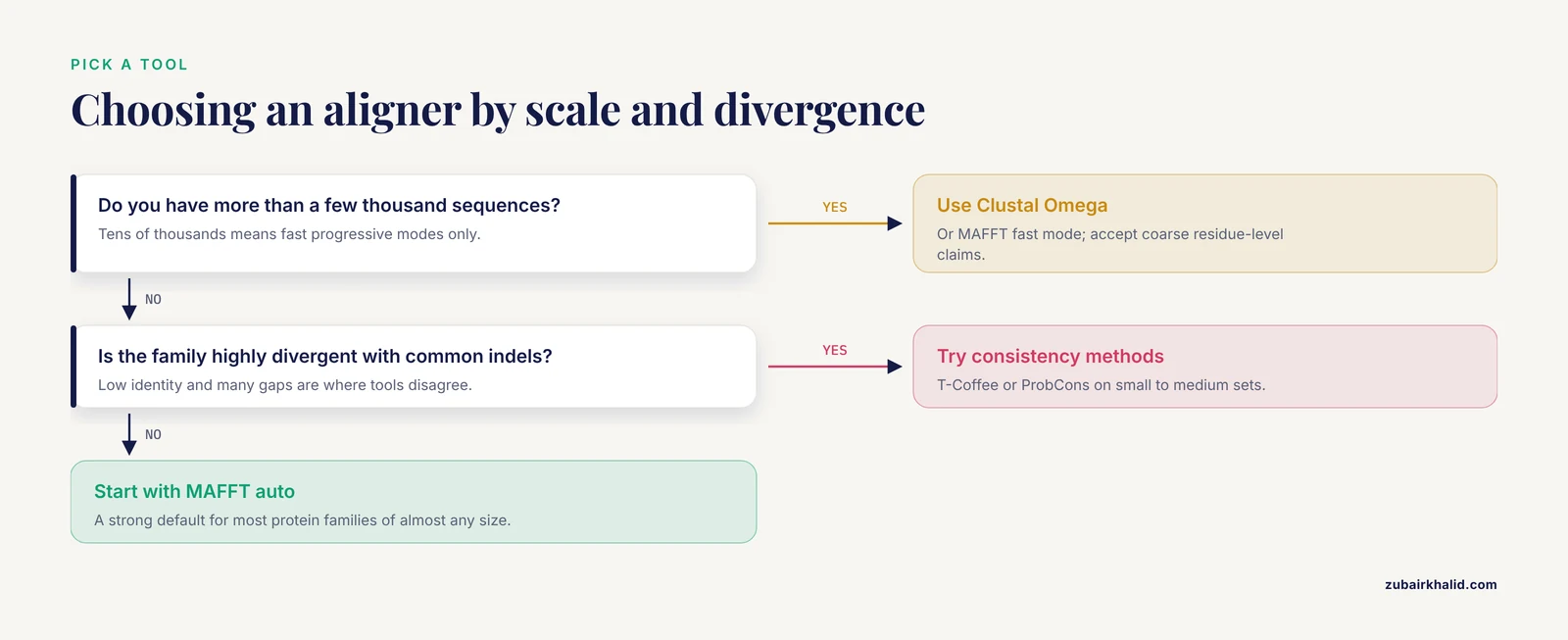
Tool features only matter in relation to your data and your question. These six criteria resolve most real decisions.
1. Number and length of sequences
Scale is the first filter. Roughly speaking, under about a hundred sequences, every modern tool is computationally feasible and you can afford the accurate, slower options such as T-Coffee or MAFFT's refinement modes. From a hundred to a few thousand, MAFFT's auto mode and MUSCLE handle the load comfortably. Into the tens of thousands, you are realistically in Clustal Omega or MAFFT fast-mode territory, and the nf-core framework for MSA tool deployment exists precisely because running alternative aligners at scale on HPC systems had become a serious engineering problem in its own right [1].
2. Divergence of the family
Closely related sequences align themselves, and almost any tool returns essentially the same result. The differences appear in the twilight zone, where sequence identity is low and indels are common. Consistency-based methods earn their compute cost here. Benchmark evidence supports this pattern, with consistency methods like ProbCons showing significant gains on the harder benchmark sets [4], and the comprehensive benchmark study showing that even the best current methods struggle most with locally conserved regions and disordered-region motifs, exactly the features that distinguish subfamilies [2]. For a highly divergent family, plan to try at least two methods and compare.
3. The downstream analysis
This criterion outranks the others. Match the aligner to what consumes the alignment:
- Phylogeny. Tree inference is sensitive to alignment error in variable regions. Accuracy-oriented aligners and manual inspection of ambiguous columns repay themselves. Pipelines for genome-scale positive selection detection such as POTION build in sequence and group quality filters precisely because error-prone alignments and sequence data inflate false positives in downstream tests [10].
- Structure and conformational modeling. Deep-learning structure predictors consume MSAs directly, and the composition of the MSA changes their output. Work on AlphaFold3 sampling showed that perturbing the MSA, through stochastic subsampling, clustering, or column masking, significantly improved sampling of alternative conformational states, lifting the top 1 percent TM-score by at least 0.05 in roughly 20 percent of cases per method across 107 multi-state proteins [11]. That result reframes tool choice: the question is not only which aligner produced the MSA but how you manipulate and subsample it for the model.
- Residue-level annotation and variation analysis. Tools that read alignments, such as ProteoMapper for mapping regular-expression motifs and Pfam domains onto aligned sequences [12], or PyTEA-O for Two-Entropies Analysis of sequence variation, which is explicitly designed to work with small MSAs and to identify residues accounting for functional specificity [13], inherit whatever column structure you give them. Columns are their coordinates, so alignment errors become annotation errors.
- Machine learning on families. Diversity measures such as Leff tell you whether your MSA contains enough independent evolutionary information for the model you plan to train, and can flag insufficient signal before you spend GPU time [9].
- Consensus and antigen design. When the goal is simply a consensus sequence from related isolates, as in deriving a consensus envelope protein domain for immunization studies [3], a fast progressive tool is entirely adequate, and speed and reproducibility matter more than marginal alignment accuracy.
4. Compute budget and infrastructure
Consistency methods scale poorly with sequence count, roughly with the square of the number of sequences for the pairwise library stage and worse with refinement. If your compute is a laptop, that constraint decides for you at a few hundred sequences. If you have HPC access, the calculus changes, and frameworks that containerize and standardize tool deployment reduce the operational cost of trying multiple aligners on the same dataset [1]. Memory, not just CPU time, is often the binding constraint for large consistency runs.
5. Error characteristics of the input data
Sequences from third-generation long-read platforms carry distinctive error patterns, and an automated evaluation pipeline called MSA Limit was built specifically to run and evaluate MSA methods across conditions representative of such reads, measuring alignment accuracy, time, and memory. Its experiments with real and simulated data found that popular methods do not consistently show optimal efficiency and that the best choice depends on sequencing depth, genome characteristics, and error patterns [8]. For routine curated protein sets from reference databases this is less pressing, but if your sequences come from noisy assemblies or predicted genes, the aligner's robustness to error becomes a selection criterion in its own right.
6. Reproducibility and version control
An MSA is a result, not just an intermediate. Record the tool, exact version, mode, and parameters for every alignment you publish or build on. The move toward workflow frameworks reflects this need, since a standardized pipeline makes tool versions and parameters explicit and rerunnable [1]. A result you cannot regenerate is a liability in review and in your own follow-up work.
Worked Scenarios
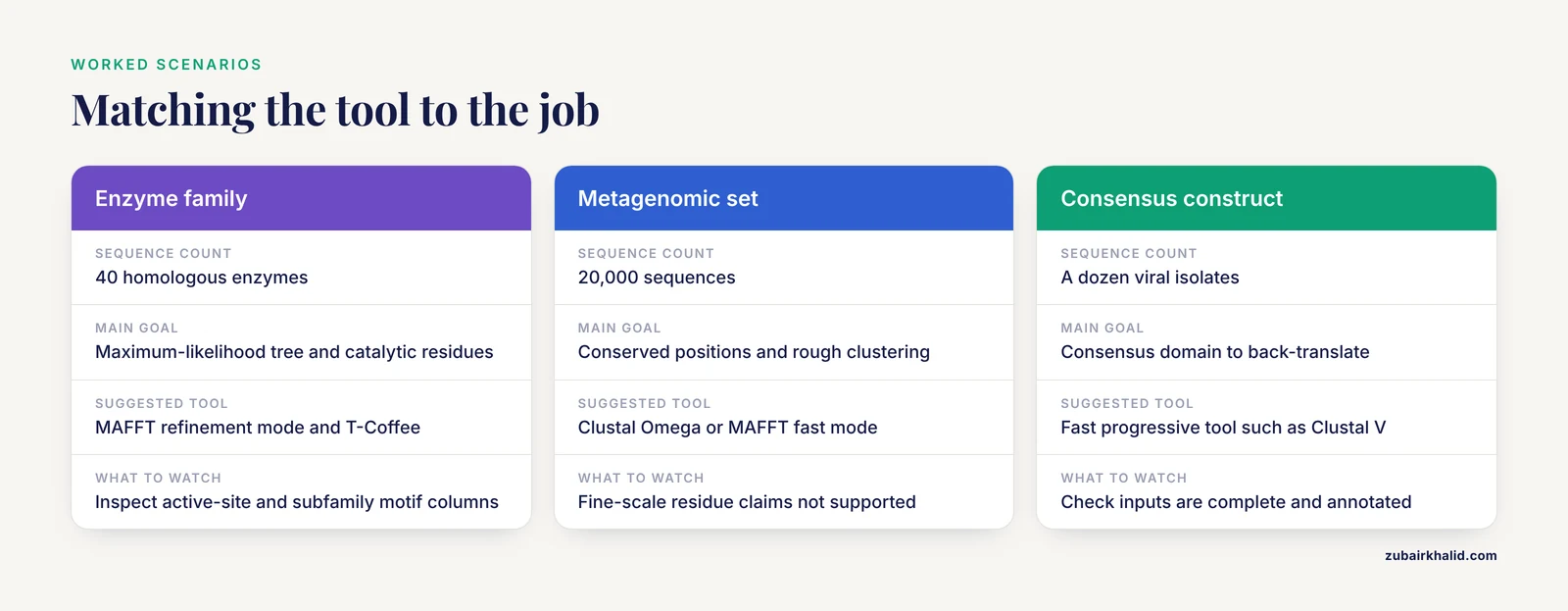
Scenario 1: A 40-sequence enzyme family for phylogenetic analysis
You have 40 homologous enzymes, moderate divergence, and you intend to build a maximum-likelihood tree and map known catalytic residues. Scale is trivial, so spend compute on accuracy. Run MAFFT in an accurate iterative-refinement mode and T-Coffee, compare the alignments around the active site and any subfamily-specific motif regions, and expect the consistency-based method to do better on exactly those locally conserved, functionally specific regions that benchmarks show are hardest to align [2]. Inspect columns feeding the tree, remove poorly aligned ambiguous blocks or mask them, and record versions and parameters. The downstream annotation tools you may use next, whether motif and domain mapping or variation analysis, will treat your columns as ground truth [12][13].
Scenario 2: 20,000 sequences from a metagenomic expedition
You have a huge expansion of a protein family and want a quick picture of conserved positions and rough clustering. Accuracy in every column is impossible and unnecessary at this scale. Clustal Omega or MAFFT in a fast mode will produce the alignment in reasonable time and memory. Accept that fine-scale residue-level claims are not supported by an alignment this coarse, and consider whether an embedding-based similarity search answers your actual question faster than any explicit MSA would [5].
Scenario 3: Building MSA inputs for structure prediction
You are predicting structure and conformational diversity for a signaling protein with known alternative states. Here the MSA is a control knob, not just an input. Beyond choosing a solid base aligner, plan to generate perturbed MSA variants through subsampling, clustering, or column masking, because these perturbations measurably increase the diversity of predicted states in AlphaFold3, improving top-1-percent TM-scores by at least 0.05 in about a fifth of multi-state test cases [11]. Also check the effective information content of your MSA with a diversity measure before committing expensive model runs, since low effective diversity predicts poor model performance [9].
Scenario 4: Genome-scale positive selection screen
You are scanning thousands of orthologous coding genes for sites under positive selection. At this scale you need automation, filters, and speed more than per-family perfection, which is why dedicated pipelines embed their own quality controls. POTION handles the end-to-end flow from predicted coding sequences and homology relationships to filtered groups of positively selected genes, applying numeric, phylogenetic, quality, and conservation filters to reduce false positives from error-prone sequence and alignment data [10]. The lesson generalizes: at scale, the alignment tool is one parameter inside a pipeline whose filters do much of the quality work.
Scenario 5: Quick consensus for construct design
You have a dozen viral isolate sequences for one domain and need a consensus to back-translate and order as a synthetic gene. This is the classic use case where a fast, standard, well-understood progressive tool is the right answer, and the published example of deriving a consensus envelope protein domain sequence with Clustal V before codon optimization and expression shows the workflow end to end [3]. Do not overthink tool choice here. Do check that your input sequences are complete and correctly annotated, since fragmentary or mispredicted sequences degrade any alignment [2].
Running Your Own Comparison Instead of Trusting Benchmarks
Published benchmarks are useful priors, but they were run on test sets that may not resemble your proteins. Two developments make self-comparison practical.
The nf-core/multiplesequencealign pipeline provides a standardized framework for deploying multiple MSA tools and evaluating their performance in a reproducible HPC setting, designed so that users can compare alternatives on their own data rather than extrapolating from other people's benchmarks [1]. If your institution has a compute cluster and you expect to run alignments repeatedly, adopting a workflow framework pays off in both comparability and reproducibility.
The MSA Limit pipeline takes a different slice of the same problem, automating the execution and evaluation of MSA methods under varied data conditions and reporting accuracy alongside time and memory [8]. Its central finding generalizes beyond sequencing errors: the most effective method depends on the properties of your specific data, so empirical comparison on your inputs beats generic rankings [8].
A minimal do-it-yourself protocol that requires no new infrastructure:
- Concatenate your sequences into one FASTA file with unique, meaningful identifiers.
- Run two or three candidate tools with their default or auto modes, for example
mafft, auto,clustalo, andmuscle -align. - Compare the outputs where it matters. If you care about an active site, look at the active-site columns. If you care about a tree, build quick neighbor-joining trees from each alignment and check whether topology-level conclusions agree.
- If the analyses that matter agree across alignments, tool choice is not your bottleneck, pick the fastest. If they disagree, invest in the accuracy-oriented options and in manual curation of the contested regions.
Common Mistakes and Limitations
Trusting one aligner blindly on divergent families. Benchmarks agree that hard, locally conserved, and disordered regions are where current methods fail, even while overall family-level features align well [2]. Divergence is precisely where aligners disagree, so a single unexamined run on a divergent family is the highest-risk usage pattern.
Ignoring sequence quality before alignment. Fragmentary sequences and mispredicted proteins degrade alignments, and their abundance in modern databases was flagged as a major remaining challenge in comprehensive benchmarking [2]. Trim, quality-filter, and check for frameshifts or fragments before blaming the aligner.
Assuming the default mode is neutral. Auto and default modes encode assumptions about sequence count, length, and divergence. The finding that optimal method choice shifts with data characteristics, including error patterns and depth, applies to mode selection within a tool as well as between tools [8]. Check which mode your tool selected and whether its assumptions match your dataset.
Feeding an alignment to a downstream tool without thinking about columns. Annotation and variation tools treat alignment columns as coordinates. ProteoMapper maps motifs and Pfam domains onto aligned positions [12], and PyTEA-O scores alignment positions for functional specificity [13]. Gaps, misaligned motifs, or inconsistent column numbering across alignment versions silently change their output.
Confusing an MSA with evolutionary truth. An MSA is a hypothesis about residue homology. Tree-building, positive-selection testing, and coevolution analyses all condition on that hypothesis. Pipelines that filter aggressively before testing, as POTION does with numeric, phylogenetic, quality, and conservation criteria plus multiple-hypothesis correction, exist because unfiltered downstream testing on weak alignments produces false positives [10].
Overlooking the possibility that you do not need a full MSA. For some questions, embedding-based methods or local alignment answer faster and as well. The pLM-Repeat result, matching an MSA-based gold standard's sensitivity while running faster, is the clearest current demonstration [5].
Letting tool choice obscure data sufficiency. Sometimes the problem is not the aligner but the evolutionary information in the sequences. Diversity measures such as Leff quantify effective information in an MSA and correlate with downstream prediction accuracy, so a poorly performing model may indicate insufficient signal rather than a poor alignment [9].
Skipping parameter logging. Unrecorded versions and modes make alignments irreproducible. This is the operational problem that standardized workflow frameworks were built to solve [1], and it costs one line in your methods section to fix.
A final scope note. Tool choice is one decision in a chain of biological and computational decisions, and alignment results should be interpreted by someone who understands both the sequences and the downstream method, in collaboration with domain experts where the biological stakes are real.
Frequently Asked Questions
What is the best multiple sequence alignment tool for protein sequences?
There is no single best tool, because alignment is an NP-hard problem and every practical tool is a heuristic with different trade-offs [1]. For most protein work, MAFFT with auto mode is a strong default, Clustal Omega wins at very large scale, and T-Coffee or ProbCons reward their extra compute on small, divergent, accuracy-critical sets [4].
How many sequences do I need in a protein MSA?
There is no universal threshold, because the requirement depends on the diversity of the family and the downstream method. What can be measured is whether your alignment carries enough effective information for its purpose, and diversity frameworks such as Leff quantify that and correlate with structure prediction accuracy [9].
Can I use the same tool for DNA, RNA, and protein sequences?
Many aligners handle all three, but scoring matrices and gap behavior differ, so always run the tool in the correct sequence-type mode. The decision criteria in this article, scale, divergence, downstream use, and compute, apply to nucleotide alignment too, though the tools cited here for specialized error conditions were evaluated on sequencing-read data [8].
Does my choice of aligner matter for structure prediction with AlphaFold?
Yes, both for the base alignment and for how you use it. Perturbing MSAs through subsampling, clustering, or column masking significantly improves AlphaFold3 sampling of alternative conformational states, improving top 1 percent TM-scores in roughly 20 percent of multi-state test cases [11].
How do I know if my alignment is good enough?
Compare outputs from two independent methods and inspect the regions your analysis depends on. Benchmark evidence says globally shared features align well with modern tools while locally conserved and disordered regions often do not [2], so focus your inspection there, and consider measuring effective alignment information before expensive downstream modeling [9].
Web server or command line, which should I use?
Web servers are fine for small one-off alignments and match how tools like ProbCons were originally offered as web resources [4]. For anything you will repeat, publish, or scale up, install the command-line version inside a workflow so versions and parameters are recorded and rerunnable.
Sources
- An nf-core framework for the systematic comparison of alternative modeling tools: the multiple sequence alignment case study.
- A comprehensive benchmark study of multiple sequence alignment methods: current challenges and future perspectives.
- Dengue virus type-3 envelope protein domain III; expression and immunogenicity.
- ProbCons: Probabilistic consistency-based multiple sequence alignment.
- pLM-Repeat: Exploiting the sequence representations of protein language models for sensitive repeat detection.
- Mulan: multiple-sequence local alignment and visualization for studying function and evolution.
- Performance assessment of protein multiple sequence alignment algorithms based on permutation similarity measurement.
- Automated evaluation of multiple sequence alignment methods to handle third generation sequencing errors.
- A spectral framework for measuring diversity in multiple sequence alignments.
- POTION: an end-to-end pipeline for positive Darwinian selection detection in genome-scale data through phylogenetic comparison of protein-coding genes.
- Several multiple sequence alignment-perturbing methods enhance AlphaFold3 sampling of alternative protein states.
- ProteoMapper: Alignment-aware identification and quantitative analysis of contextual motif-domain patterns in protein families.
- PyTEA-O: a Python implementation of Two-Entropies Analysis for protein sequence variation analysis.