HIPAA vs. GDPR for Genomic Data in the Cloud
By Dr. Zubair Khalid, DVM, MS, PhD ·

HIPAA is a US healthcare privacy and security law that binds specific covered entities and their vendors, while GDPR is a European Union data protection law that follows the personal data of EU residents almost anywhere it is processed. For genomic data in the cloud, the practical rule of thumb is this: if the data come from US clinical care or a HIPAA-covered research program, you build around HIPAA and a business associate agreement. If the data include any identifiable material from people in the EU, or your cloud processing occurs in the EU, GDPR applies as well, and it applies on top of HIPAA rather than instead of it.
Most teams do not get to pick one law. They inherit obligations from where the samples came from, where the sequencer ran, where the bucket lives, and where the collaborators sit. This article explains each framework on its own terms, puts them side by side on the criteria that decide real cloud bioinformatics designs, and walks through worked scenarios for aws genomics and multi-region projects.
Why genomic data in the cloud is a special compliance problem
Genomic data occupy an unusual position among data types. A genome is simultaneously a clinical record, a biometric identifier, and a family-level dataset, because variants reveal information about relatives who never consented to anything. Whole-genome sequence data are also effectively identifying on their own, which makes the usual de-identification arguments weaker than they are for, say, a lipid panel.
The migration of federally funded genomic datasets into commercial cloud repositories has accelerated because the alternative, on-premise storage and compute, cannot keep pace with sequencing output. Next-generation sequencing produces data volumes that routinely exceed what many laboratories can store and analyze locally, and this data management pressure is a major reason laboratories turn to cloud services in the first place [1]. Cloud environments also allow data to be stored, accessed, and analyzed within shared computing environments that can be more secure than a departmental server rack, which is why government-funded genomic data have undergone mass migration to the cloud [2].
That migration changes the compliance problem in three ways:
- Jurisdiction becomes decoupled from geography. A bucket replicated across regions, or an analysis job that runs in a region you did not choose, can put data under laws that no one on the team anticipated.
- Responsibility is split. The cloud service provider secures the infrastructure, but the customer remains responsible for how data are configured, encrypted, accessed, and shared. Regulators increasingly mandate specific access patterns and security protocols for genomic data, and although cloud providers supply compliance tools, building the required controls is not trivial [3].
- Stewardship becomes an explicit duty. A scoping review of the genomic data sharing literature identified responsible data stewardship, meaning the ethical and secure management, use, and protection of data throughout its lifecycle, as a core expectation for cloud-based repositories, alongside aligning authorized access with ethical use [2].
A systematic review of cybersecurity risks in healthcare cloud computing identified ten recurring challenges, and two of them are directly relevant here: compliance with regulations such as HIPAA and GDPR, and data sovereignty and jurisdictional issues [4]. Those two challenges are exactly what the rest of this article addresses.
HIPAA explained for genomic data
What HIPAA is and who it binds
HIPAA, the Health Insurance Portability and Accountability Act of 1996, is a US federal law. Its privacy and security rules apply to covered entities, meaning health plans, healthcare clearinghouses, and healthcare providers that transmit health information electronically, and to business associates, meaning vendors and contractors that handle protected health information (PHI) on a covered entity's behalf. A clinical sequencing laboratory reporting results to patients is a covered entity. A cloud platform processing that laboratory's data is a business associate. A university research lab working only with de-identified data may not be a covered entity at all, although its funding terms and institutional policy can impose HIPAA-equitable requirements anyway.
PHI is individually identifiable health information held or transmitted by a covered entity or business associate. Sequence files with linked identifiers, a VCF keyed to a medical record number, or even dates of service attached to a BAM file are all PHI. The Security Rule requires administrative, physical, and technical safeguards for electronic PHI, including access controls, audit controls, encryption at rest and in transit addressed through risk analysis, and workforce training.
The business associate agreement
The single most important HIPAA document for cloud bioinformatics is the business associate agreement (BAA). A BAA is a contract in which the vendor agrees to safeguard PHI, limit its uses, report breaches, and flow those duties down to subcontractors. Major cloud providers, including AWS, offer BAAs and designate particular services as HIPAA-eligible when used under that agreement. Running a genomics pipeline on HIPAA-eligible services under an executed BAA is the baseline architecture for US clinical genomic workloads in the cloud. Running the same pipeline on services outside the BAA, or under an account with no BAA in place, puts PHI outside the contractual shield even if the encryption is identical.
The regulatory environment for genetic information in US clinical care differs from the research and public database context, and compliance strategies have to be chosen accordingly, a distinction the clinical laboratory literature treats as central to cloud adoption [1].
De-identification under HIPAA
HIPAA offers two routes to de-identification. The Safe Harbor method requires removal of eighteen specified identifier categories, including names, geographic subdivisions smaller than a state, all elements of dates except year, and any other unique identifying number or code. The Expert Determination method requires a qualified statistician to document that the risk of re-identification is very small given the data and the context.
Here is the uncomfortable part for genomics: a genome is itself a unique identifier, and summary-level genomic data deposited in public repositories can be populated through crowdsourced submissions from laboratories [1]. Safe Harbor was not designed with whole genomes in mind. In practice, clinical pipelines under HIPAA tend to keep sequence-level data inside the BAA boundary and treat any release, even of variants, as a governed decision rather than a de-identification formality. Honest teams state this plainly rather than claiming a raw CRAM file is de-identified because the header was scrubbed.
GDPR explained for genomic data
What GDPR is and who it binds
The General Data Protection Regulation (GDPR) is the European Union's data protection law, in force since May 2018. It applies to organizations established in the EU and, critically for cloud bioinformatics, to organizations outside the EU that offer services to people in the EU or monitor their behavior. This extraterritorial reach means a US startup analyzing the exome of a single participant recruited in Germany can be within GDPR scope even if every server sits in Virginia.
GDPR protects personal data, any information relating to an identified or identifiable natural person. Genomic data are personal data, and because they reveal health and other intrinsic characteristics, they fall within special category data under Article 9, which requires a specific lawful basis for processing such as explicit consent or substantial public interest conditions under member-state law. There is no GDPR equivalent of Safe Harbor de-identification that removes data from scope. Pseudonymized data, where identifiers are replaced by codes held separately, remain personal data under GDPR. Only truly anonymized data, which for whole genomes is a very high bar, fall outside it.
Core obligations that shape cloud architecture
Several GDPR mechanisms map directly onto cloud genomics decisions:
- Lawful basis and consent. Every processing activity needs a documented basis. For research genomics, explicit consent or a national-law research provision is typical, and consent scope must cover the processing you actually perform, including secondary use.
- Data subject rights. Individuals can request access, rectification, erasure (the right to be forgotten, subject to research exemptions), and portability. Erasure of a genome replicated across buckets, snapshots, and backups is an architectural problem, not a paperwork problem, and it argues for disciplined data layout from day one.
- Data protection by design and default. Privacy safeguards must be built into processing, which in practice means encryption, access logging, purpose-limited data copies, and minimization before the first pipeline runs.
- Data Protection Impact Assessment (DPIA). Large-scale processing of special category data, which genomic datasets certainly are, requires a DPIA documenting risks and mitigations.
- Processors and contracts. A cloud provider processing personal data for you is a processor and must operate under a data processing agreement (often called the DPA or data processing addendum), the GDPR counterpart to the BAA.
- Cross-border transfers. Personal data may only leave the EU, or be accessed from outside it, under a transfer mechanism such as Standard Contractual Clauses or an adequacy decision. This is the provision that most often surprises US-based teams, because remote access by a US collaborator counts as a transfer.
The EU has treated this infrastructure problem strategically. The proposed European Health Research and Innovation Cloud (HRIC) is explicitly designed to enable data sharing and analysis across the EU in compliance with data protection legislation while preserving participant trust, built on an open, decentralized infrastructure certified to high standards of interoperability and data security [5]. The takeaway for any team is that European genomic data governance assumes GDPR compliance is an infrastructure property, not a policy binder.
GDPR versus GINA and US genetic privacy law
Genetic-specific US protections, such as the Genetic Information Nondiscrimination Act (GINA) restricting use of genetic information in health insurance and employment, sit alongside HIPAA rather than replacing it. They address downstream discrimination, not cloud processing controls. They matter to your consent language and your institutional policies, but they do not change bucket permissions.
Side-by-side comparison
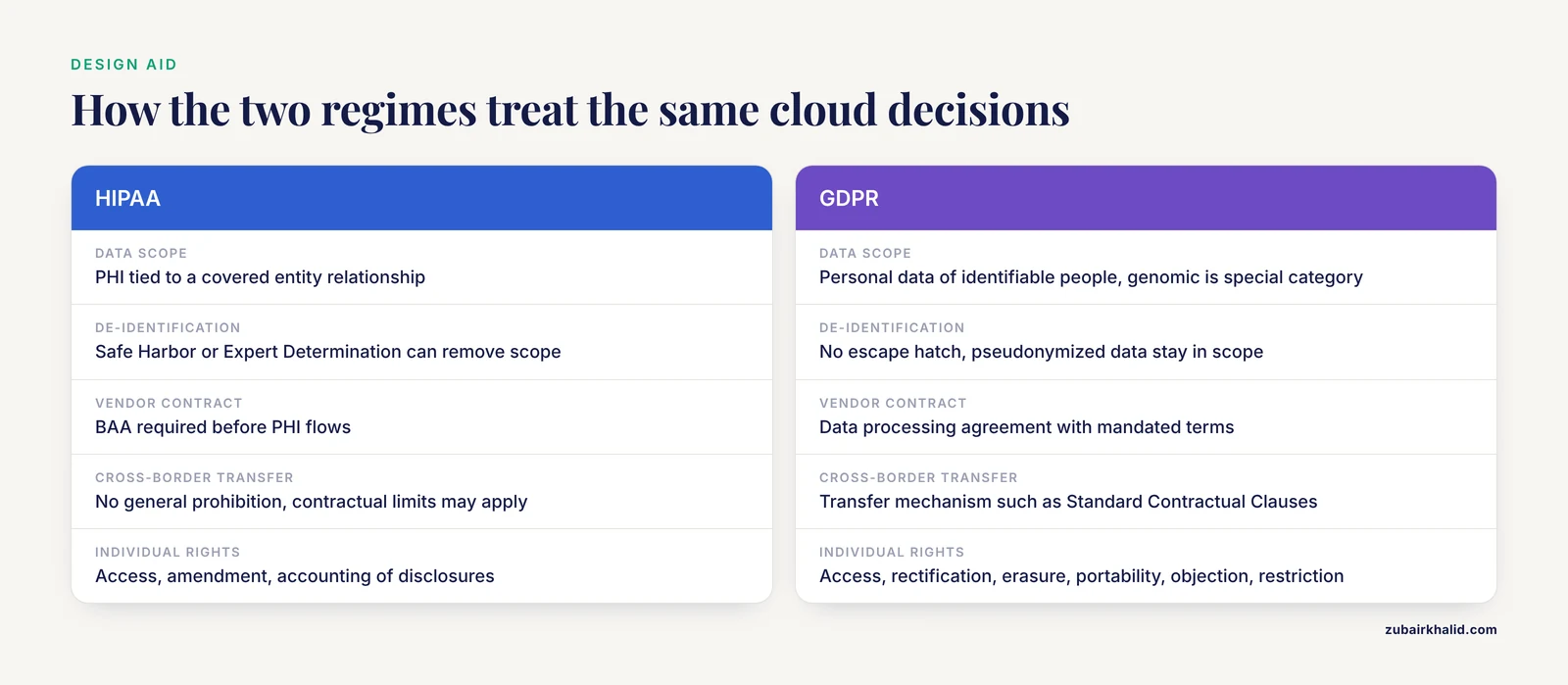
The table below is the core of the hipaa vs. gdpr for genomic data in the cloud comparison. Read it as a design aid: each row is a decision you will actually make in a cloud deployment.
| Criterion | HIPAA | GDPR | What it means for cloud genomics |
|---|---|---|---|
| Geographic trigger | US covered entities and their business associates | EU establishment, or processing data of EU residents, anywhere in the world | A US lab analyzing EU-recruited samples can hit GDPR with zero EU servers |
| Who is regulated | Covered entities, business associates | Controllers, processors, joint controllers | Your cloud provider is a business associate under HIPAA and a processor under GDPR, with different contracts (BAA versus DPA) |
| Data scope | Protected health information tied to a covered entity relationship | Personal data of identifiable people, genomic data treated as special category | GDPR scope attaches to the data subject, not to a healthcare relationship |
| De-identification escape hatch | Safe Harbor (18 identifiers) or Expert Determination can take data out of scope | No de-identification escape hatch, pseudonymized data stay in scope, true anonymization is a high bar for genomes | You cannot anonymize your way out of GDPR for sequence data in any realistic pipeline |
| Consent model | Notice and authorization for uses beyond treatment, payment, operations, with waivers for research | Lawful basis required, special category data needs explicit consent or national-law research conditions | GDPR consent must map to actual secondary uses, which constrains data reuse plans |
| Individual rights | Access and amendment rights, accounting of disclosures | Access, rectification, erasure, portability, objection, restriction | Erasure obligations shape bucket layout, backup strategy, and copy inventory |
| Security requirements | Security Rule safeguards, risk analysis, encryption addressed through documented decisions | Data protection by design, appropriate technical and organizational measures, breach notification within 72 hours | Both demand encryption, logging, and access control, so a well-built cloud control layer can serve both |
| Contracts with vendors | BAA required before PHI flows | Data processing agreement with mandated terms | One vendor can sign both, but the account and services must be configured to stay inside both agreements |
| Cross-border transfer | No general prohibition, state-level and contractual restrictions may apply | Transfers outside the EU require a legal mechanism such as Standard Contractual Clauses | Replication policies and collaborator access lists are compliance controls under GDPR |
| Penalties | Tiered civil monetary penalties per violation category, plus criminal exposure for knowing misuse | Administrative fines up to 20 million euros or 4 percent of global annual turnover, whichever is higher | The incentive structures differ, but both make silent misconfiguration expensive |
| Enforcement | US Office for Civil Rights, state attorneys general | National data protection authorities coordinated through the European Data Protection Board | Multi-country projects may face several supervisory authorities at once |
The honest summary of the difference between HIPAA and GDPR genomic data cloud obligations is that HIPAA is an entity-and-contract regime you can often scope out of, while GDPR is a data-and-person regime you mostly scope into. That asymmetry drives nearly everything in the sections below.
How the frameworks land on real cloud bioinformatics infrastructure
The shared responsibility model in practice
Every major cloud provider operates a shared responsibility model: the provider secures the cloud (hardware, physical sites, the hypervisor), and the customer secures what they put in the cloud (data, accounts, bucket policies, network exposure, application code). Neither HIPAA nor GDPR changes that split. What both laws do is make the customer's half legally accountable, so a misconfigured S3 bucket policy is simultaneously an operational failure and a compliance breach.
A risk-focused framework for healthcare cloud and AI deployments places data breaches and unauthorized access, shared infrastructure vulnerabilities, insider threats, limited visibility and control, and the complexity of cloud security management among the ten key challenges organizations must mitigate with robust security practices and continuous monitoring [4]. In a genomics context, the highest-yield controls are concrete:
- Account-level isolation of clinical or regulated workloads from general research buckets.
- Encryption at rest with customer-managed keys and encryption in transit on every data path.
- Identity-based access with least privilege, multi-factor authentication, and no long-lived static credentials.
- Audit logging of every read and write on raw sequence data, retained long enough to satisfy accounting-of-disclosures and GDPR accountability duties.
- Replication and region pinning, so EU-derived data do not silently replicate to regions outside the approved transfer mechanism.
Containers, pipelines, and validation
Most modern genomics pipelines run in containers. Containers bundle a pipeline and its dependencies into a consistent computational environment, which improves reproducibility, scalability, and security, and simplifies the validation, version control, and documentation that clinical laboratory regulatory compliance requires [6]. Under HIPAA, that validation trail doubles as your Security Rule documentation. Under GDPR, pinned, reviewed container images support the data protection by design obligation, because you can demonstrate exactly what software touched special category data. Two cautions from the same literature: container usage varies widely across laboratories in ways that can compromise the security and privacy of protected health information, so an unscanned, unpinned container pulled from a public registry is a real attack surface, not a convenience [6].
Governance frameworks that satisfy both laws at once
Teams operating across jurisdictions increasingly adopt a single governance framework designed to satisfy the stricter of the applicable requirements. The five safes framework, which governs data along five dimensions (safe people, safe projects, safe settings, safe data, safe outputs), has been implemented in a cloud-native genomics repository and analytics platform that leverages a commercial cloud provider to share and analyze genomic datasets without security breaches or running afoul of regulations [3]. Because the five safes framework encodes access control, purpose limitation, environment control, data transformation, and output review, it maps cleanly onto GDPR purpose limitation and onto HIPAA minimum necessary access, which is why it has become a common template for multinational repositories.
Federated analysis as a compliance strategy
An alternative to moving data across borders is to move the analysis. Federated platforms keep data at its source and distribute computation. The FEAST platform, developed under the ARPA-H Biomedical Data Fabric initiative, enables secure federated analysis of real-world biomedical data across institutions, and its design process surfaced infrastructure gaps and compliance requirements around security and interoperability standards [7]. For a consortium spanning the EU and the US, federated design can reduce the number of cross-border transfers to near zero, since only aggregate or model outputs move. It does not eliminate GDPR, because remote queries still process personal data, but it shrinks the transfer surface dramatically and simplifies the DPIA.
A cross-institutional survey of data-driven biomedical research priorities similarly found that authorized-access data use cases depend on backend data requirements and compliance with security and interoperability standards being designed into the platform from the start, not bolted on afterward [7].
Cost and scale realities
Cloud adoption in biomedical research offers scalable, on-demand storage and compute, collaboration support, and security and compliance features that can exceed what a small institution can build itself, but moving to the cloud is not trivial, carries real cost, and may not be the right choice in every scenario [8]. Compliance costs are part of that calculation. A BAA-scoped account with dedicated encryption keys, private networking, and audit retention costs more in engineering time than a casual research bucket, and that engineering time is the price of a defensible posture under either law. Teams should budget for it explicitly rather than discover it during an audit.
HIPAA or GDPR genomic data cloud: deciding which law governs your workload
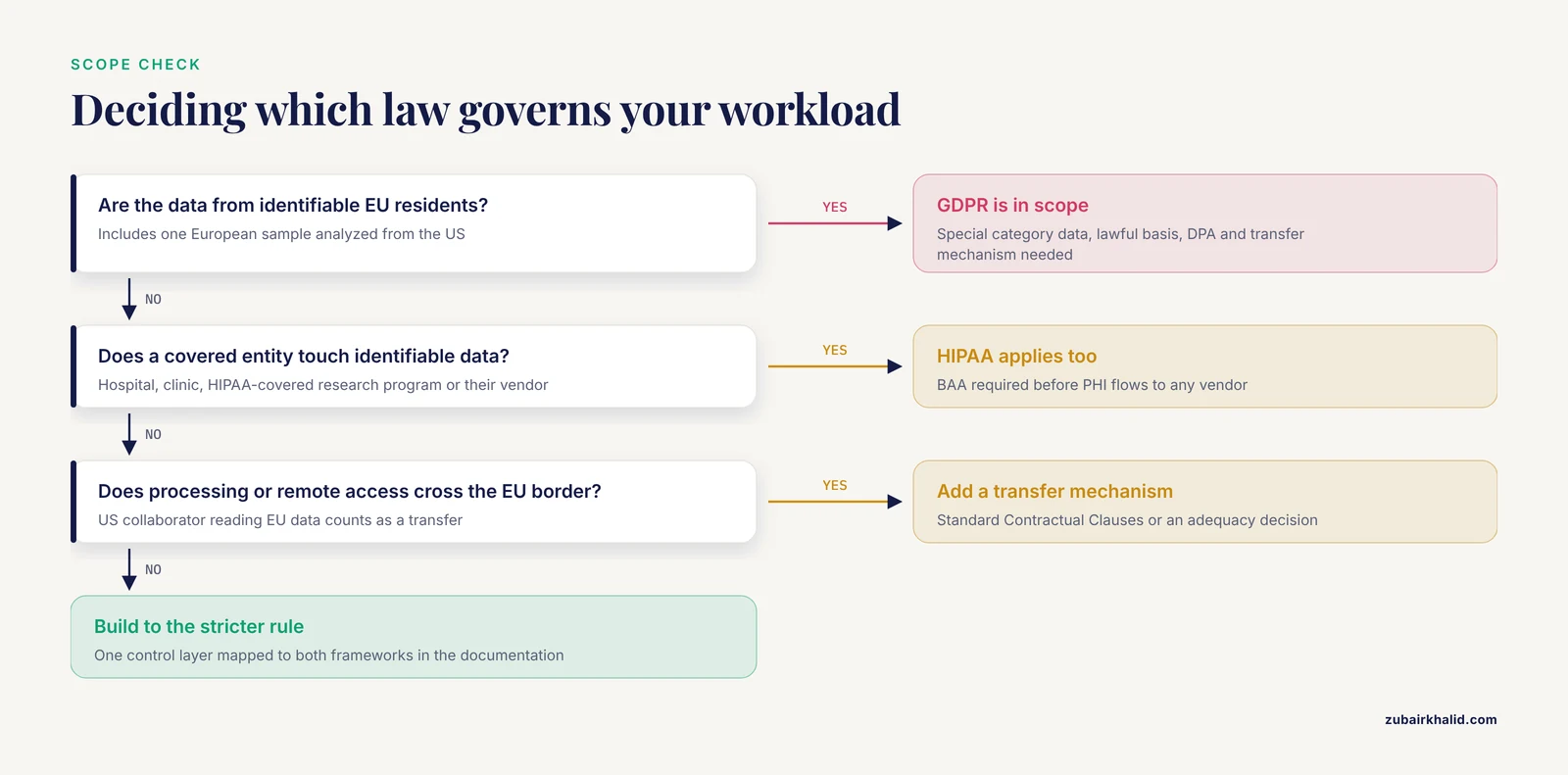
Use this sequence when someone asks which framework applies:
- Where did the data subjects live? Identifiable data from EU residents pulls GDPR in, regardless of your location. Data from US clinical care pulls HIPAA in if a covered entity relationship exists.
- Is a covered entity involved? If a hospital, clinic, HIPAA-covered research program, or their vendor touches the identifiable data, HIPAA applies. If the data were always de-identified under Safe Harbor or Expert Determination before reaching you, HIPAA may not.
- Where does processing physically occur? Processing in the EU triggers GDPR for the data processed there. Remote access to EU data from the US counts as a transfer requiring a mechanism.
- What do your grants and contracts say? Government-funded datasets frequently carry data use terms that impose obligations beyond statute, and the stewardship literature treats honoring those terms as part of responsible cloud governance [2].
- Which law is stricter on each control? Build to the stricter requirement per control. In practice, GDPR tends to be stricter on consent, transfers, and individual rights, while HIPAA is stricter on contract specificity and audit documentation for covered entities. A control layer built to the union of both requirements usually satisfies each one.
The answer to "when to use HIPAA" as a design target is: whenever identifiable clinical data from US covered entity contexts enter your pipeline, and whenever a payer, hospital, or clinical trial sponsor contract requires it, even for data you believe are de-identified. When in doubt about scope, the safe architectural choice is to build as if the strictest plausible regime applies and relax controls only after a documented determination.
Worked scenarios
Scenario 1: US clinical exome sequencing on AWS
A hospital molecular diagnostics laboratory validates an exome pipeline and runs it in an AWS account covered by a BAA, using HIPAA-eligible services, a private VPC, encrypted S3 buckets with customer-managed keys, and CloudTrail audit logging. Sequence data and variant calls keyed to medical record numbers never leave the BAA boundary. A separate, de-identified aggregate of variants is submitted to a public variation repository after a documented review, reflecting the distinction between clinical patient care data and research or public database submissions in the US regulatory environment [1]. No EU subjects are involved, so GDPR never enters. HIPAA alone governs, and the pipeline containers are versioned and validated to support the laboratory's compliance documentation [6].
Scenario 2: European cohort study analyzed by a US partner
A university hospital in the Netherlands recruits 5,000 participants, sequences their genomes, and stores the data in an EU region. A US-based collaborator wants to run association analyses. GDPR governs throughout, since the data are special category personal data of EU residents. The parties execute Standard Contractual Clauses, the DPIA is updated to cover the remote access as a cross-border transfer, and the US partner is designated a processor under a data processing agreement. HIPAA does not apply because there is no covered entity relationship. If the collaborator instead runs the analysis inside the EU region or through a federated query that never moves raw genotypes, the transfer problem mostly dissolves, which is the pattern federated platforms were designed to support [7].
Scenario 3: A multinational consortium with both regimes in scope
A consortium spans US clinical sites and EU research sites, with raw data in region-pinned buckets on both continents and a central metadata catalog. The governance layer implements the five safes framework, controlling who may access data, for which approved projects, in which environments, with which transformations, and what outputs may leave [3]. US clinical legs operate under BAAs and the Security Rule. EU legs operate under DPIAs, explicit consent, and transfer mechanisms for any US access. The shared control layer, encryption, logging, least privilege, region pinning, is built once to satisfy the stricter requirement for each dimension, then mapped to both frameworks in the documentation. This is the architecture pattern that globalized oversight is pushing repositories toward, and the stewardship literature treats such alignment of authorized access with ethical use as a core outcome for cloud-based genomic repositories [2].
Scenario 4: A startup with one EU sample in a research bucket
A small US company runs cloud bioinformatics on a mixed bucket containing one exome from a participant recruited at a European conference. GDPR applies to that file because it is special category personal data of an EU person, processed by an organization offering services into the EU. The fix is rarely heroic: segregate EU-derived identifiable data into their own account or bucket set with region pinning inside the EU, execute the provider's DPA, document a lawful basis, and treat remote US access as a transfer. The practical lesson is that jurisdiction follows the data subject, not the size of the dataset, and a single record can change your obligations [4].
Common mix-ups
- "We signed a BAA, so we are GDPR compliant." A BAA is a HIPAA instrument. It does nothing for EU data subjects. GDPR requires a DPA, lawful basis, DPIA, and transfer mechanisms.
- "De-identified means out of scope everywhere." True for HIPAA Safe Harbor data in many cases, false for GDPR pseudonymized data, and shaky for any whole genome, which is inherently a unique identifier.
- "The cloud provider is responsible for compliance." The provider secures infrastructure and signs contracts. Configuration, access, and lawful basis remain yours under both laws.
- "EU data in a US cloud is illegal." It is lawful with a proper transfer mechanism and DPA. What is unlawful is the transfer with no mechanism, which is a documentation failure more often than an architectural one.
- "Research data are exempt." GDPR contains research accommodations, but they modify conditions, they do not repeal Article 9, consent, or accountability duties.
- "Our pilot can ignore this until we scale." Obligations attach per data subject and per processing act, not per scale. A one-sample pilot can trigger the same duties as a cohort.
Common Mistakes and Limitations
The most expensive mistake is treating compliance as a paperwork layer above an already-built architecture. If region pinning, encryption with managed keys, and access logging are retrofits, the erasure and transfer obligations of GDPR become archaeology projects. Build the control layer first and let pipelines land inside it.
The second mistake is assuming one contract covers the vendor chain. BAAs and DPAs must flow down to subcontractors, and a third-party annotation service, a secondary analysis platform, or a spot-instance image pipeline outside the agreement is an unaccounted processor. Inventory every service that touches identifiable data.
The third mistake is over-claiming de-identification. For genomic data, modest claims are defensible and strong claims rarely are. Scrubbing headers does not make a CRAM file anonymous, and the expert determination route exists precisely because naive removal of identifiers is insufficient for genomes.
The fourth mistake is ignoring secondary uses. Consent obtained for a primary study does not authorize every later analysis, and GDPR makes the mismatch between consent scope and actual use a direct violation rather than an ethical gray area.
Finally, the limits of any written framework: this article explains how HIPAA and GDPR structure cloud genomic data decisions, but it is not legal advice. Individual determinations about a specific dataset, contract, or transfer depend on facts, institutional counsel, and the current text of the regulations, and those determinations belong with your legal and compliance office.
Frequently Asked Questions
Does HIPAA apply to genomic data stored in the cloud?
Yes, when the data are protected health information held by a covered entity or processed by a business associate, regardless of where the storage physically sits. Cloud storage under an executed BAA on HIPAA-eligible services is the standard compliant pattern.
Does GDPR apply if I am a US-based lab analyzing one European sample?
Very likely yes, because GDPR reaches organizations outside the EU that process personal data of people in the EU, and genomic data are special category personal data. One sample is enough to trigger lawful basis, DPA, and transfer requirements.
Can I store HIPAA-regulated genomic data in Amazon S3?
Yes. AWS offers a BAA and designates HIPAA-eligible services, S3 among them, when configured under that agreement with encryption, access controls, and audit logging that satisfy the Security Rule.
Is de-identified genomic data still regulated?
Under HIPAA, data properly de-identified by Safe Harbor or expert determination generally fall outside the rules. Under GDPR, pseudonymized genomic data remain regulated, and true anonymization of sequence data is a very high bar, so plan as if GDPR continues to apply.
Do I need both HIPAA and GDPR compliance for a multinational project?
If identifiable clinical data from US covered entity contexts and identifiable data from EU participants are both in scope, then yes, both apply simultaneously, typically as a shared control layer mapped to each framework with separate contracts and documentation per jurisdiction.
What is a BAA and when do I need one?
A business associate agreement is a HIPAA contract in which a vendor handling your protected health information agrees to safeguard it, limit its use, and report breaches. You need one executed before any PHI flows to the vendor, including cloud storage and compute services.
Sources
- Considerations for Genomic Data Privacy and Security when Working in the Cloud.
- Characterizing core outcomes of responsible stewardship for human genomic data in the cloud.
- A five-safes approach to a secure and scalable genomics data repository.
- The Challenges of Data Privacy and Cybersecurity in Cloud Computing and Artificial Intelligence (AI) Applications for EQA Organizations.
- Towards a European health research and innovation cloud (HRIC).
- Containers in Bioinformatics: Applications, Practical Considerations, and Best Practices in Molecular Pathology.
- From use cases to infrastructure: a cross-institutional survey of priorities in data-driven biomedical research.
- Biomedical research in the Cloud: considerations for researchers and organizations moving to (or adding) cloud computing resources.