Implementing a Tiered Storage Strategy for Genomics Data
By Dr. Zubair Khalid, DVM, MS, PhD ·

By the end of this guide you will be able to design and operate a three-tier storage system for sequencing data: a fast hot tier for active alignment and variant calling, a warm tier for recent completed projects, and a cold tier for long-term archive. You will know how to inventory your current data, define movement rules between tiers, compress files before migration, keep a checksum-verified metadata catalog, automate lifecycle policies on-premise and in the cloud, and run restore drills that prove your archive actually works.
You will need the following on hand before you start:
- Root or administrator access to your primary analysis storage (an NFS mount, a parallel filesystem such as Lustre or BeeGFS, or a SAN volume)
- A second storage target for the warm tier, such as a large-capacity HDD pool, a MinIO or Ceph object store, or a cloud bucket
- A cold-tier target: an archival object storage service, a tape library, or a dedicated nearline appliance
- Command-line tools:
samtools1.15 or newer,rcloneor the AWS CLI,sha256sum,sqlite3, anddu/findfrom coreutils - A written record of your retention obligations, since clinical and research genomic data carry consent and regulatory constraints that dictate how long each file must survive
Why Genomics Data Needs Storage Tiers
Sequencing facilities produce data with an unusual access profile. An account of storage integration at a national-scale omics data center supporting one of the largest population genomics programs in its region describes the workload as write-heavy, append-dominant, and latency-sensitive during active processing, all under stringent healthcare data governance requirements. In plain terms, files arrive in large sequential bursts, they are read intensely for a few weeks while pipelines run, and then they sit untouched for years while remaining legally required to exist.
A single 30x whole-human-genome sequence produces roughly 100 GB of FASTQ before alignment, and a population program generating hundreds or thousands of genomes per year turns that into petabyte-scale growth. Buying fast NVMe storage for all of it is wasteful, because the access pattern does not justify it. Buying only cheap archival storage is worse, because active pipelines need low-latency reads and writes. The standard resolution is a tiered architecture. The national data center cited above settled on exactly this shape: distinct tiers for active processing, warm archive, and cold archive, each balancing performance, capacity, and cost.
There is a second reason tiers matter that has nothing to do with performance. Central public repositories are not a guaranteed long-term home for your data. In 2011, budget constraints led NCBI to announce it would stop accepting new submissions to the Sequence Read Archive and phase out support for the database, an episode that forced the genomics community to confront what happens when a shared repository disappears and who bears responsibility for preserving raw reads [1]. The repository was ultimately preserved through other funding arrangements, but the lesson stands: your institution needs its own durable copy policy, and tiers are how you make that policy affordable.
The Tier Model: Hot, Warm, and Cold
The vocabulary used across the storage literature and in commercial cloud services is consistent. A predictive tiering study frames the same three buckets as hot, warm, and cold, classified by access frequency. The genomics-specific account frames them as active processing, warm archive, and cold archive. They are the same idea.
What Belongs in Each Tier
| Tier | Typical media | Access latency | What lives here | Move out when |
|---|---|---|---|---|
| Hot (active processing) | NVMe SSD, parallel filesystem, DRAM caches | Milliseconds | Incoming BCL/FASTQ during demultiplexing, BAM/CRAM and VCF mid-pipeline, scratch space for aligners and callers | Pipeline complete and outputs validated |
| Warm archive | High-capacity HDD, object storage standard or infrequent-access class | Seconds to minutes | Final FASTQ, CRAM, VCF, and reports for recent projects that may still be reopened | No access for a defined interval, typically 6 to 12 months |
| Cold archive | Tape, deep-archive object class, erasure-coded HDD | Minutes to hours | Everything retained for compliance, publication, or future reanalysis | Rarely or never, subject to retention schedule |
Two design rules hold across all three tiers. First, raw sequencing data and final validated outputs are the two asset classes you must never lose, so they need at least two independent copies, one of which should live in the cold tier. Second, intermediate files (sorted but unmarked BAMs, per-chunk intermediates, tmp directories) can usually be deleted rather than migrated, which is often the single largest storage saving available to a genomics group.
Implementing Genomics Data Storage Tiers Step by Step
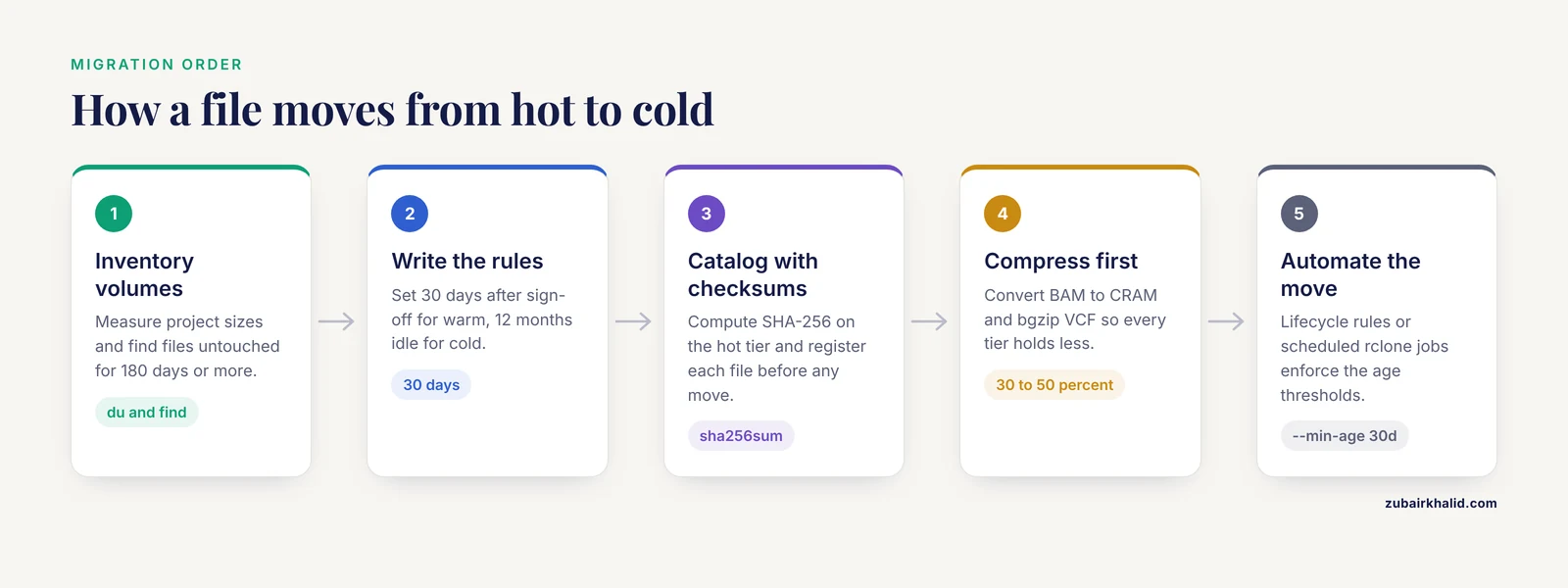
The walkthrough below assumes a mid-sized setup: one analysis cluster, an NFS or parallel filesystem for the hot tier, an S3-compatible object store for warm storage, and a deep-archive cloud class or tape for cold storage. The same logic applies if all three tiers are cloud buckets.
Step 1: Inventory What You Have and Who Touches It
You cannot tier data you have not measured. Start with volume by project directory:
sudo du -sh /data/seq/* 2>/dev/null | sort -rh | head -20Expected output looks like this:
42.7T   /data/seq/proj_cardio_2024
31.2T   /data/seq/proj_popgen_phase2
18.9T   /data/seq/clinical_onco
6.4T    /data/seq/pilot_rnaseq
Next, find the largest individual files, since these are your migration candidates:
find /data/seq -type f -name "*.bam" -printf "%s\t%p\n" 2>/dev/null \
  | sort -rn | head -10 \
  | awk -F'\t' '{printf "%.1f GB\t%s\n", $1/1e9, $2}'
Expected output:
182.3 GB  /data/seq/proj_cardio_2024/samples/S0041/aligned/S0041.sorted.bam
177.8 GB  /data/seq/proj_cardio_2024/samples/S0042/aligned/S0042.sorted.bam
Then measure actual access. Files untouched for 180 days or more are your warm and cold tier population:
find /data/seq -type f -atime +180 | wc -l
find /data/seq -type f -atime +180 -printf "%s\n" | awk '{s+=$1} END {printf "%.1f TB\n", s/1e12}'
A word of caution on this measurement: atime is only reliable if your mount uses relatime (the default on most modern Linux systems) and if no backup or indexing jobs are reading the tree. Cross-check the access counts against your pipeline logs and your LIMS records before trusting them.
Step 2: Define Tier Boundaries and Promotion Rules
Write the rules down before building anything, and make them auditable. A serviceable starting policy for a genomics group:
- Raw FASTQ and final CRAM, VCF, and QC reports are permanent assets. They always keep two copies in distinct failure domains.
- Intermediates (unsorted BAMs, split files, scratch) are deleted 30 days after pipeline completion, not archived.
- Completed project directories move from hot to warm storage 30 days after the final deliverable is signed off.
- Warm objects with no read access for 12 months move to cold storage.
- Restores from cold storage are requested through the metadata catalog, logged, and verified by checksum on arrival.
These thresholds are starting points, not regulations. Adjust them to your reanalysis rate. A group that frequently reprocesses cohorts with updated pipelines will keep more in warm storage than one that delivers reports and rarely looks back.
Step 3: Provision the Tiers
For the warm tier, an S3-compatible object store gives you versioning, lifecycle hooks, and cheap capacity. With MinIO, create the bucket and enable versioning:
mc alias set myminio http://warm-store.internal:9000 ACCESS_KEY SECRET_KEY
mc mb myminio/genomics-warm
mc version enable myminio/genomics-warm
For a cloud warm tier, the same shape applies with a versioned bucket:
aws s3api create-bucket --bucket genomics-warm --region us-east-1
aws s3api put-bucket-versioning --bucket genomics-warm \
  --versioning-configuration Status=Enabled
The cold tier is usually a separate bucket or storage class rather than separate hardware. Keep the cold target logically distinct regardless of what it runs on, because you will attach different lifecycle, access, and audit rules to it.
Step 4: Build the Metadata Catalog Before Moving Anything
The failure mode that destroys archives is not disk failure. It is data that exists but can no longer be found, identified, or trusted. A metadata-coordinated tiering framework in recent literature makes this point structurally: every placement decision should propagate through a verifiable, auditable metadata path, coordinated through an ordered write, verify, commit, redirect, and retire sequence so that migrations remain consistent and recoverable even when individual components fail [3].
You do not need blockchain machinery to get the benefit. A small relational catalog is enough to start:
CREATE TABLE objects (
  id INTEGER PRIMARY KEY,
  path TEXT NOT NULL,
  bucket TEXT,
  object_key TEXT,
  sha256 TEXT NOT NULL,
  bytes INTEGER NOT NULL,
  data_class TEXT NOT NULL,      -- raw_fastq, final_cram, vcf, report, intermediate
  project TEXT NOT NULL,
  tier TEXT NOT NULL,            -- hot, warm, cold
  consent_restricted INTEGER DEFAULT 0,
  created_at TEXT NOT NULL,
  migrated_at TEXT,
  last_accessed_at TEXT
);
Populate it with checksums as you go. Compute them once, on the hot tier, while the data is still fast to read:
find /data/seq/proj_cardio_2024 -type f \( -name "*.fastq.gz" -o -name "*.cram" -o -name "*.vcf.gz" \) \
  -print0 | xargs -0 -P 8 sha256sum > proj_cardio_2024.sha256
Then register each file in the catalog before its first migration. From this point forward, the rule is simple: nothing moves between tiers without a catalog entry, and every move updates the tier and object_key fields.
Step 5: Compress Before You Migrate
Compression belongs in the pipeline, not in the archive job. Compressed files shrink every tier and cut migration time, and genomics has mature format-specific tools that outperform generic compression.
For alignments, prefer CRAM over BAM. CRAM stores reads by reference to a supplied genome and typically lands 30 to 50 percent smaller than an equivalent BAM, with the exact ratio depending on the reference and the data:
samtools view -C -T GRCh38.fa S0041.sorted.bam -o S0041.cram
samtools quickcheck -v S0041.cram && echo "CRAM OK"
Keep the reference genome used for each CRAM in your catalog, because a CRAM without its reference is not readable.
For text formats such as VCF and FASTQ, bgzip plus tabix gives you block compression and indexed random access:
bgzip -@ 8 S0041.variants.vcf
tabix -p vcf S0041.variants.vcf.gz
Specialized tools push further. Deploying purpose-built FASTA and FASTQ compressors inside Hadoop environments yields better space savings and even better execution times over compressed data than the generic compressors bundled with those frameworks, particularly for FASTQ [4]. On the research frontier, learning-based compressors are beginning to automate this: one agent-based genomics compressor evaluated against 14 baselines on 9 datasets reported average compression ratio gains of roughly 16 to 17 percent and throughput gains of up to about 9 times over existing methods. For derived single-cell matrices, format choice inside your analysis code also matters. A value-compressed sparse column format for single-cell omics achieved up to 1.9-fold compression over the standard compressed sparse column format, and a variant that also compresses index arrays reduced memory use by up to 4.4-fold on real data [5].
Match the compression mode to the tier. Maximum-ratio compressors with slow codecs belong in the cold tier. Throughput-priority compression, or plain bgzip, belongs wherever pipelines still read the files.
Step 6: Automate Migration With Lifecycle Rules
Manual migration fails within a year. Automate it with two mechanisms: storage-native lifecycle rules for cloud tiers, and scheduled rclone or mc jobs for on-premise tiers.
For a cloud warm bucket, a lifecycle policy handles transitions without any code running on your side:
{
  "Rules": [
    {
      "ID": "warm-to-cold",
      "Filter": { "Prefix": "final/" },
      "Status": "Enabled",
      "Transitions": [
        { "Days": 365, "StorageClass": "GLACIER" },
        { "Days": 730, "StorageClass": "DEEP_ARCHIVE" }
      ]
    }
  ]
}
aws s3api put-lifecycle-configuration \
--bucket genomics-warm \
--lifecycle-configuration file://lifecycle.jsonFor on-premise or cross-target moves, schedule rclone:
rclone move /data/seq/complete myminio:genomics-warm/ \
  --min-age 30d --transfers 8 --checkers 16 --log-file /var/log/rclone-warm.log
The -min-age 30d flag enforces the 30-day quiescence rule at the tool level, so a file cannot leave the hot tier while a pipeline might still be writing to it.
How should the system decide what to move? Three policy styles exist, and the literature on each is converging on the same conclusion: static rules are a baseline, not an end state.
| Policy style | How it decides | Strengths | Watch out for |
|---|---|---|---|
| Rule-based (age, prefix) | Fixed thresholds such as "30 days idle" | Transparent, auditable, trivial to reason about | Ignores real access patterns, over- or under-migrates |
| Heat-driven and learned policies | Observed access frequency, device read/write asymmetry | Adapts to workload, fewer wasted migrations | Needs monitoring data and tuning |
| Predictive, ML-assisted | Forecasts future access from historical I/O traces | Acts before load arrives, balances latency, throughput, and cost | Model drift, harder to audit |
A reinforcement-learning page-level migration policy evaluated against industry benchmarks and real traces achieved up to 6 times lower runtime and 48 times fewer migrations than state-of-the-art baseline policies, illustrating how much waste naive rules can leave on the table [6]. A related proactive framework combines predictive models of future access with a multi-objective optimization agent that weighs latency, throughput, and cost together, rather than reacting after the fact [7]. And at the cloud level, a machine-learning model trained on historical usage patterns that automatically classifies data into hot, warm, or cold tiers demonstrated significant cost savings and latency improvements compared with manual tier distribution [2]. A practical adoption path: start with age-based rules, log access continuously, and introduce learned or predictive placement only after you have months of real traces to validate against.
Step 7: Encrypt and Gate Access by Tier
Genomic data is identifiable human data, and every tier must protect it. Encryption at rest is the baseline. A framework published for high-performance healthcare storage combines Argon2-based key generation, AES-256 encryption, and Keccak (SHA-3) hashing, and evaluates it against HIPAA and GDPR compliance requirements, reporting reduced encryption time and throughput rising from 84.3 MB/s to 96.7 MB/s versus a conventional AES-256 with SHA-256 configuration [8]. The practical takeaway for an archive architect is that strong cryptography no longer imposes the throughput penalty it once did, so there is no performance excuse for leaving the warm and cold tiers in plaintext.
Access control should also be tier-shaped. A landscape analysis of five NIH-supported genomic cloud platforms (the All of Us Research Hub, NHGRI AnVIL, NHLBI BioData Cursor, NCI Genomic Data Commons, and the Kids First Data Resource Center, reviewed alongside dbGaP) found consistent governance patterns across them: a formal data ingestion process, multiple tiers of data access with escalating authentication and authorization requirements, security controls, and auditing for inappropriate data use [9]. Mirror that shape on your own archive. Cold tier restores should require an explicit request and approval step, not just a credential. Where consent restricts reuse, carry that restriction as a field in the metadata catalog (consent_restricted in the schema above) rather than as tribal knowledge, and keep the audit trail of who restored what and when. Consent and governance obligations around biobanked genomic material are substantive and jurisdiction-specific, and they should be settled with your institutional compliance office before the first migration, not after [10].
Step 8: Test Restores and Verify Integrity
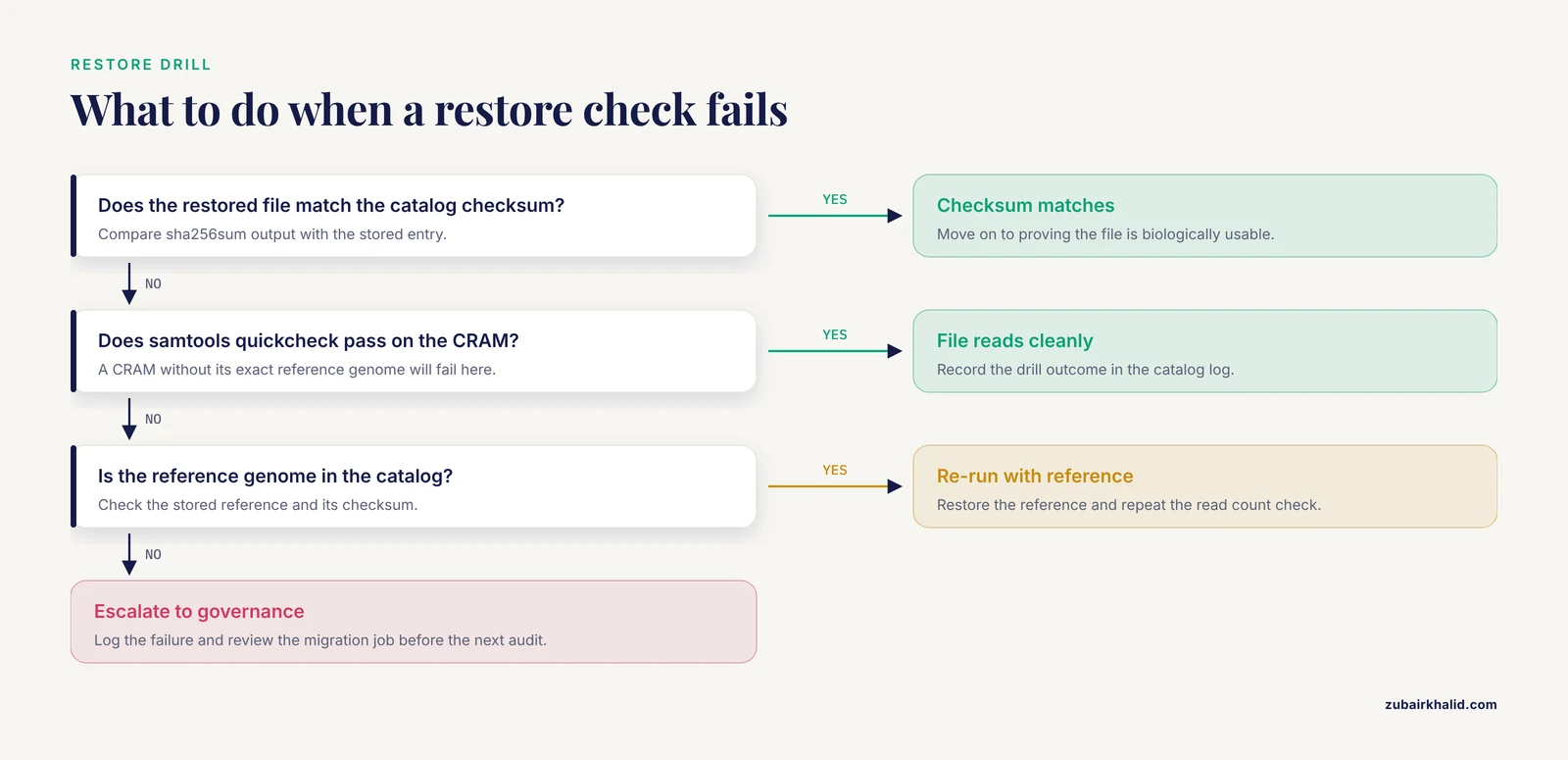
An archive you have never restored from is a hypothesis, not an archive. Schedule a quarterly restore drill:
- Pick one object at random from the cold tier catalog.
- Restore it to a scratch area:
aws s3 cp s3://genomics-cold/final/proj_cardio_2024/S0041.cram ./restore/- Verify the checksum against the catalog entry:
sha256sum ./restore/S0041.cram
grep S0041.cram proj_cardio_2024.sha256- Prove the file is biologically usable, not just byte-identical:
samtools quickcheck -v ./restore/S0041.cram
samtools view -c ./restore/S0041.cram chr1
Expected output from the last command is an integer read count for chromosome 1. If any step fails, you have learned this in a drill rather than during a regulatory audit or an urgent reanalysis.
Record drill outcomes in the catalog or an adjacent log. A tiered system with audited restores and audited access is far easier to defend to a data governance committee than one whose policies live in someone's head.
Step 9: Review Costs and Access Patterns Quarterly
Tiering is a cycle, not a project. Each quarter, rerun the access audit from Step 1 against the warm tier, reconcile it with the catalog's last_accessed_at field, and adjust thresholds. If your cloud bill shows more egress from the cold tier than expected, your thresholds are too aggressive. If the warm tier keeps growing while its access statistics flatline, your promotion rule is too conservative. Groups with stable workloads and good traces can graduate to the predictive placement approaches described in Step 6, while smaller groups may find that two or three well-tuned age rules capture most of the available savings.
A Worked Example: Sizing a Clinical Genomics Data Lake
A cancer center deploying a hybrid cloud data lake for clinical and research genomics illustrates what a finished system looks like at production scale. The architecture uses a zone model with four layers: ingestion, storage, transformation, and interaction, with genomic data stored in the cloud and synchronized with vendor storage, and access controlled through a data governance committee [11]. That implementation serves 149 clinicians across 31 disease groups and holds 240 TB of data covering 5,800 patients at a monthly cost of approximately 350 dollars [11]. The cost figure is striking precisely because of the tiering and zone logic: raw and derived genomic data sit in cheap cloud object storage, only working data gets premium treatment, and rich metadata enables patient-level queries without duplicating the underlying files.
The numbers translate to smaller groups. At roughly 48 GB per patient across clinical and research artifacts in that deployment, a lab holding data for 500 patients should expect its total governed footprint, hot plus warm plus cold, to land in the tens of terabytes, which is well within reach of a single warm-tier object store plus a deep-archive bucket. The architecture, not the hardware budget, is what makes the economics work.
For groups whose challenge is query speed over huge reference datasets rather than archival capacity, note that fast searchable indexes can also be treated as a hot-tier asset. A bloom-filter-based index was used to stream and index 170 TB of whole-genome data for rapid sequence search, with cheap storage of the index itself and support for parallel construction. Keeping such indexes on the hot tier while the underlying data lives in warm storage is a common and effective split.
Common Mistakes and Limitations
These are the errors that show up repeatedly in real genomics storage deployments.
- Archiving intermediates. Teams that migrate every sorted-unmarked BAM and scratch file double or triple their archive footprint for zero scientific value. Delete intermediates on a fixed schedule instead, and state the deletion rule in your data management plan.
- No checksum before the first move. If you cannot prove the copy in warm storage matches the original, the migration is not a migration, it is a hope. Compute SHA-256 on the hot tier, verify after every hop, and re-verify during quarterly drills.
- CRAM without a reference. A CRAM file is unreadable without the exact reference genome used to encode it. Store the reference, its checksum, and its provenance alongside every CRAM in the catalog.
- Trusting
atimeblindly. Backup agents, antivirus scans, and indexing jobs refresh access times. Cross-check filesystem access data against pipeline logs before promoting a file to cold storage, or you will bury actively used data. - Lifecycle rules with no restore path. Configuring automatic transition to deep archive is easy. Paying for and planning early deletions, retrieval delays of hours, and bulk restore operations is the part teams forget. Model restore behavior before enabling aggressive transitions.
- Metadata drift. When the catalog says an object is in the warm bucket and it is actually in cold storage, confidence in the whole system erodes. Update the catalog atomically as part of the migration job itself, in the verify-then-commit order, so a failed migration never leaves a half-updated record [3].
- Storing the only copy in a public repository. The 2011 SRA funding episode showed that even flagship repositories can be threatened by budget cycles. Treat public deposition as a dissemination and citation mechanism, not as your archive.
- Encrypting without key management. AES-256 on every object is worthless if the keys live in the same failure domain as the data, or in one person's shell history. Use a managed key service or a dedicated key server, and document recovery procedures.
- Tiering without governance sign-off. Consent terms, retention schedules, and data use agreements determine what may be moved, compressed, and deleted. Route the tiering policy through your governance committee before implementation, exactly as the clinical data lake deployments do [11].
- One policy forever. Workloads change. A threshold set during a sequencing-heavy year will misfire during an analysis-heavy one. Revisit thresholds on a quarterly cadence.
A final limitation applies to any storage architecture: tiers protect files, not scientific validity. They cannot rescue a sample swap, a contaminated run, or an analysis bug. Tiered storage is one component of bioinformatics data management, sitting alongside laboratory quality systems and provenance tracking, and it works only when those are sound.
Frequently Asked Questions
What are genomics data storage tiers?
Storage tiers are distinct layers of storage hardware and service classes, typically hot, warm, and cold, each matched to a different access pattern. Genomics pipelines read and write intensively for weeks, then the data sits for years, so matching each lifecycle stage to appropriately priced media cuts cost without slowing active analysis.
How do I decide when to move a file from hot to cold storage?
Start with a simple rule, such as 30 days after project sign-off for the move to warm storage and 12 months without access for the move to cold storage. Then validate the thresholds against your real access logs each quarter and tighten or loosen them based on actual reanalysis behavior.
Should I archive BAM or CRAM files?
Archive CRAM. It encodes reads against a reference genome and typically saves 30 to 50 percent of the space a BAM would use, with full fidelity. Always archive the reference genome alongside the CRAM and record it in your metadata catalog.
Can I rely on public repositories like the SRA for long-term storage?
No. The 2011 episode in which NCBI announced it would phase out SRA submissions over budget constraints demonstrated that even major repositories face funding risk [1]. Deposit data publicly for discovery and citation, but maintain your own tiered, checksum-verified archive as the authoritative copy.
How much storage does one whole human genome need?
A 30x whole-genome sequence produces roughly 100 GB of FASTQ. With CRAM alignment files, variant calls, and QC artifacts, budget on the order of a few hundred GB per genome across all tiers if you keep the full pipeline outputs, or far less if intermediates are deleted on schedule.
Do storage tiers apply to cloud object storage or only to on-premise hardware?
Both. Cloud object stores expose the same tier concept through storage classes with lifecycle transitions, and on-premise deployments implement it with SSD pools, HDD pools, and tape. Many production systems, including the clinical data lake described above, are hybrid, with cloud storage synchronized against vendor and local systems [11].
How do I keep metadata consistent when files move between tiers?
Make the catalog update part of the migration transaction itself, using an ordered write, verify, commit, redirect, and retire sequence so that a failed migration never leaves a stale record [3]. Every object should have exactly one authoritative location recorded at all times, and every move should be checksum-verified at the destination before the old copy is retired.
What encryption is appropriate for archived genomic data?
AES-256 encryption at rest on every tier, with modern key derivation such as Argon2 and SHA-3 class hashing for integrity, is the current standard practice for high-performance healthcare storage, and published evaluations show it meets HIPAA and GDPR expectations with modest overhead [8]. The keys themselves require managed custody, separate from the data they protect.
Sources
- Closure of the NCBI SRA and implications for the long-term future of genomics data storage
- Intelligent Tier-Based Data Management: A Predictive Approach to Cloud Storage Cost Optimization
- Scalable and Trusted Metadata-Coordinated Tiered Off-Chain Storage with Dynamic On-Chain Mapping for Recovery-Safe and Low-Latency IoT Data Management
- FASTA/Q data compressors for MapReduce-Hadoop genomics: space and time savings made easy
- Value-Compressed Sparse Column (VCSC): Sparse Matrix Storage for Single-cell Omics Data
- ReStore-in-Action: Adaptive Multi-Tier Storage Management via Intelligent Data Migration Policy
- Proactive Data Placement in Heterogeneous Storage Systems via Predictive Multi-Objective Reinforcement Learning
- Enhancing Security and Privacy in High-Performance Healthcare Data Storage using Advanced Cryptographic Framework
- Cloud-based biomedical data storage and analysis for genomic research: Landscape analysis of data governance in emerging NIH-supported platforms.
- Ethical considerations for biobanking and use of genomics data in Africa: a narrative review
- A hybrid cloud data lake architecture supporting the integration of clinical and genomics data