The True Cost of Data Loss in Genomics: Why Prevention Pays
By Dr. Zubair Khalid, DVM, MS, PhD ·

The difference between a lost dataset and a lost server is that hardware can be replaced in days while data can be regenerated only if the sample still exists, and in genomics the sample often does not. A lost FASTQ file is not a filing problem. It is the permanent disappearance of a measurement taken from biological material that may have been consumed, degraded, or exhausted during the original experiment. The genomics data loss cost, in the worst case, is the full price of a second experiment on a cohort you can never reassemble.
The rule of thumb is simple. Keep at least three copies of raw data, on at least two different types of media, with at least one copy offsite, and spend money on redundancy and verification before you spend it on capacity. Storage is cheap relative to regeneration, and every dollar of prevention buys protection that no amount of post-hoc recovery can match.
This article covers what data loss means in a sequencing lab, why genomic data is unusually expensive to replace, the main genomics data storage options compared side by side, worked scenarios showing how losses actually happen, and the bioinformatics data management practices that prevent them.
What Data Loss Actually Means in a Genomics Lab
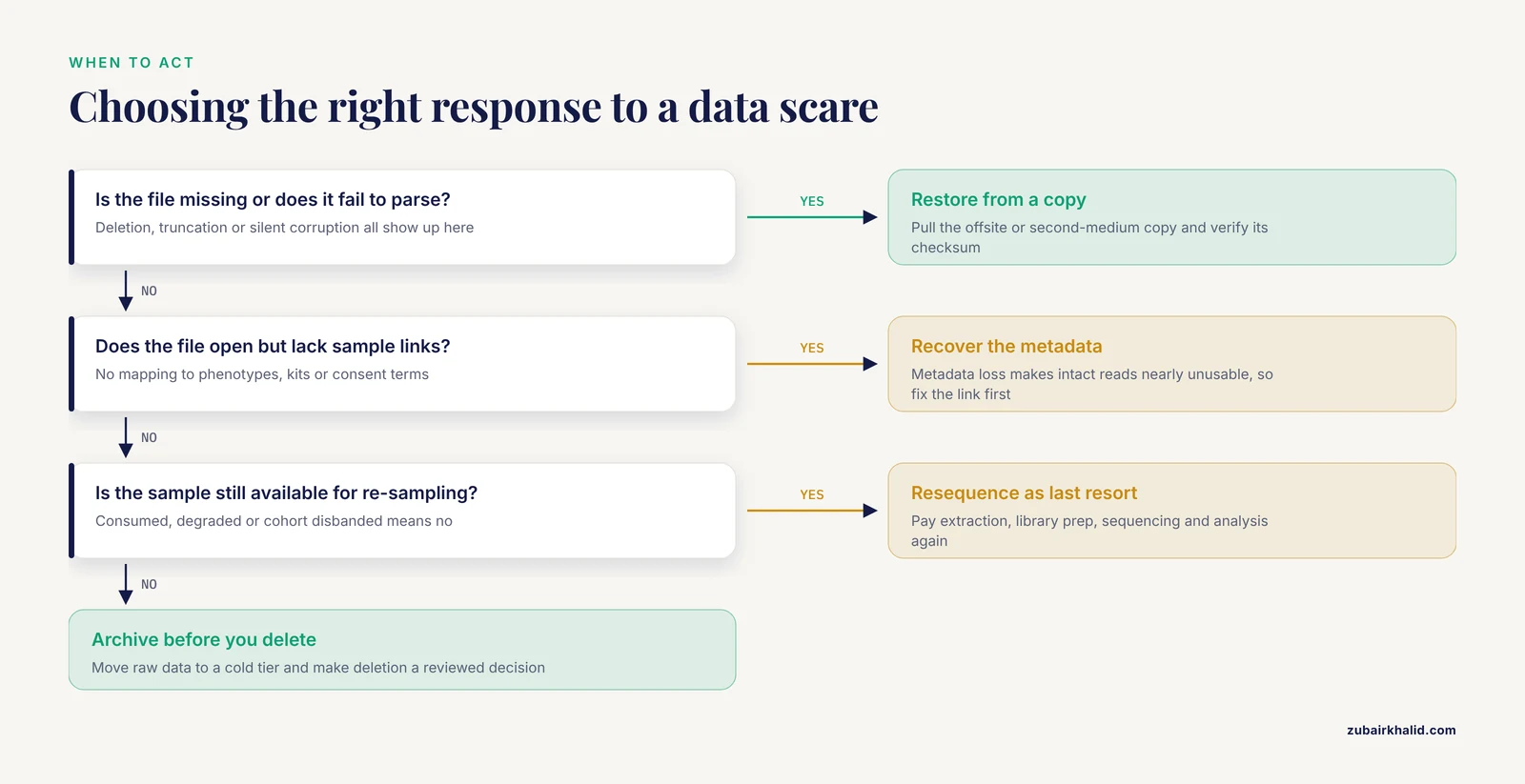
Data loss is broader than deletion. In practice, a genomics lab can lose data in at least five distinct ways, and each has a different cost profile.
Physical deletion. Files are removed intentionally during a cleanup, accidentally by a user or script, or systematically by a retention policy nobody reviewed. A classic pattern is a lab cleaning a shared drive after a paper is published, only to discover two years later that a reviewer or collaborator needs the raw reads.
Silent corruption. Bits rot. A hard drive can return corrupted sectors without reporting an error, a filesystem can propagate a bad write across a RAID array, and a truncated file can look complete until a parser fails years later. Without checksums and periodic verification, corruption is invisible until the moment you need the file.
Metadata loss. The reads survive but the mapping between files and samples does not. A directory of BAM files with no link to phenotypes, library preparation details, capture kits, or consent terms is a fraction as useful as the original data, and in clinical or regulated contexts it may be unusable. Provenance, the recorded history of how a file was produced and from which sample, is part of the data. Losing it is losing data.
Loss of reproducibility. The data files survive but the exact pipeline that produced the published results does not. Versions of tools, reference genomes, parameters, and containers vanish from a student's laptop or an unversioned directory. Results become impossible to reproduce or defend, which is a form of loss even when every byte is intact.
Third-party loss. A sequencing vendor holds the only copy, the contract ends, and the account is purged. A cloud bucket is misconfigured and a lifecycle rule deletes objects earlier than anyone expected. Ransomware encrypts a shared filesystem that everyone assumed someone else was backing up.
Each of these modes has appeared in real labs, and each is preventable with standard bioinformatics data management practices described later in this article.
Why Genomic Data Is Uniquely Expensive to Replace
Most digital assets can be regenerated. A lost spreadsheet can be rebuilt from a database export. Genomic data usually cannot, for reasons rooted in the wet laboratory and in the biology of the sample.
The sample is the bottleneck, not the compute
Raw reads are a measurement of a physical sample at a moment in time. Regenerating them requires the sample. In many workflows the sample is consumed or damaged during preparation. Enzymatic and bisulfite-based methylation assays illustrate the point clearly, because bisulfite conversion can damage DNA, producing DNA loss and sequencing biases that are baked into whatever data you generated [1]. If the archive DNA is gone and the patient or research subject cannot be sampled again, the data is gone with it. No budget recreates it.
Cohorts compound the problem. A longitudinal study with five years of follow-up, a rare disease family with three affected siblings, or a biobank of scat samples from a fragmented koala population represents sampling opportunities that cannot be repeated on demand [2]. Conservation genetics makes the point in its sharpest form, because population isolation and habitat loss mean some populations will never contribute new samples, making the sequences already in hand permanently irreplaceable [2].
Regeneration means paying the full experimental cost again
Even when the sample exists, resequencing means paying again for extraction, library preparation, sequencing, and analysis. Library preparation and sequencing costs have fallen substantially over the past decade, yet applying these technologies at scale remains expensive enough to constrain entire research programs, which is why cost-reduction strategies such as miniaturized protocols and reduced-representation assays attract so much effort [1], [3]. A method like targeted methylation sequencing was optimized specifically to profile a defined set of CpG sites affordably rather than paying for whole-genome depth [1]. If you must regenerate lost data, you pay today's price for that assay, plus staff time, plus the coordination cost of sample retrieval.
Higher-cost modalities raise the stakes further. Spatial transcriptomic data costs more per sample than conventional single-cell data, which is precisely why methods that squeeze more value from existing measurements, such as denoising and imputation frameworks, are an active research area [4]. When the data is expensive to begin with, the cost of losing it scales up accordingly. Similarly, whole-exome sequencing is used as the cost-effective alternative to whole-genome sequencing for many tumor analyses [5], so losing an exome dataset means paying for an exome again, and losing a whole-genome dataset means paying for something considerably larger.
Downstream value depends on the data existing
The value of genomic data is realized downstream in diagnoses, treatment decisions, and publications. Exome sequencing for infants with congenital hearing loss, for example, is cost-effective because it raises the diagnostic rate and improves the care pathway [6]. That value exists only while the data is available. A lost dataset also stalls projects that depend on it, delays trainees whose theses are built on it, and breaks the chain from sample to result that grant funders and journals expect you to demonstrate.
The Storage Cost Curve and the False Economy of Deleting
A decade ago, genome researchers already identified the core tension that labs still manage today. Data storage costs had become an appreciable proportion of the total cost of creating and analyzing DNA sequence data, and the rate of increase in DNA sequencing output was significantly outstripping the rate of increase in disk storage capacity [7]. Falling sequencing prices, have not resolved this tension. They have inverted it. When bases became cheap, the binding constraint moved from generating data to keeping it, moving it, and finding it again years later.
This economics produces a predictable failure mode. A lab under storage pressure deletes raw data to save space, keeps only processed outputs, and discovers later that the processed outputs cannot answer the new question. This is a false economy for three reasons.
First, storage is the cheap part. Compression, tiering, and archival formats reduce the storage burden without forcing deletion, as the next section explains.
Second, analysis questions change. A BAM file with variant calls answers the question the original analyst asked. The FASTQ files answer every future question, including questions nobody has posed yet. Deleting raw data converts a flexible asset into a frozen one.
Third, regeneration is not guaranteed. Given the sample constraints described above, deletion is often irreversible, which makes it the most expensive action a genomics lab can take with its data.
Compression deserves careful treatment here because it sits at the boundary between storage savings and data loss. The reference-based compression approach demonstrated by Fritz and colleagues aligns new sequencing reads to a reference genome and stores only the differences between the reads and the reference, achieving large savings that grow exponentially as read lengths increase [7]. The same principle underlies the CRAM format that is now standard tooling for aligned reads. The key design feature is that the method is tunable: researchers can adjust how much quality-score information and unaligned sequence data is retained, trading a small, controlled, documented loss of information for substantial storage savings [7]. That is the correct model for handling storage pressure. Make a deliberate, documented decision about what to discard, rather than discovering decades later that a cleanup script made the decision for you.
Genomics Data Storage Options Compared
The following table compares the storage options that decide real outcomes in a sequencing lab. Cost is described qualitatively because actual prices vary by vendor, institution, volume, and contract, and no single figure is honest across all of them.
| Storage option | What it holds best | Retrieval speed | Cost profile | Main failure mode |
|---|---|---|---|---|
| Local RAID or NAS | Active project data, fast reanalysis | Immediate | Moderate per terabyte, plus hardware and administration | Single-site risk, silent corruption without checksums, fire or flood |
| On-premises tape (LTO) | Deep archive of raw data | Hours to a day | Low per terabyte at scale, plus drive and library cost | Slow recall, media and drive generations must be managed |
| Hot cloud object storage | Primary or secondary copies of active and recent data | Immediate | Higher per terabyte, plus egress fees | Cost creep, bucket misconfiguration, accidental deletion without versioning |
| Cold or deep archive cloud tiers | Compliance copies, finished-project raw data | Hours to half a day or more, retrieval fees may apply | Lowest per terabyte among cloud tiers | Retrieval cost and latency surprise, lifecycle rules that delete early |
| Sequencer or vendor storage | Convenience copy after delivery | Immediate while the account is live | Often bundled initially, recurring fees after | Purged at contract end, not a real backup |
| HPC scratch filesystem | Temporary intermediates during pipeline runs | Immediate | Cheapest fast storage, often quota-limited and purged automatically | Never a home for anything you need tomorrow |
The Options on Their Own Terms
Local disk and NAS
A RAID array or network-attached storage server is where most day-to-day analysis happens. It is fast, cheap to access, and fully under lab control. Its weaknesses are physical and procedural. All drives live in one building, so fire, flood, theft, or a building power event can take out every copy at once. RAID protects against drive failure, not against deletion, corruption, or ransomware, and many admins learn too late that a RAID rebuild propagates whatever corruption already exists. Local storage works only as one leg of a multi-copy strategy, never the whole strategy.
Hot cloud object storage
Cloud object storage holds files as objects in buckets with durability engineered across multiple facilities. For a genomics lab, hot object storage is a natural home for the primary or secondary copy of raw and processed data for active projects. The pros are immediate access, programmatic access from pipeline code, and strong durability when configured with versioning enabled. The cons are recurring cost that grows with data volume, egress charges when moving data out, and the fact that a misconfigured bucket is a new class of human error that did not exist on a local drive. Treat cloud storage as a real copy with its own access controls, not as an automatic backup, and enable versioning and object-lock features so deletion by a user or script is recoverable.
Cold archive and deep archive tiers
Cloud vendors offer progressively colder tiers with lower per-terabyte costs and slower, sometimes fee-bearing retrieval. These tiers fit finished-project raw data that must be retained but rarely read, for example compliance copies or the FASTQ files behind a published paper. The pros are the lowest cloud storage prices and durability comparable to hot tiers. The cons are retrieval latency measured in hours or longer, retrieval charges that can surprise you if you archive carelessly, and lifecycle policies that, if configured wrong, can transition or delete objects earlier than intended. Cold tiers reward labs that think clearly about which files will genuinely never be touched and which might.
Tape libraries
Linear tape-open (LTO) tape remains the workhorse of large-scale archival in genome centers. The pros are a very low cost per terabyte at scale, long archival life, and an air gap, meaning data on a shelf cannot be encrypted by ransomware on your network. The cons are slow recall, the need to manage media generations and drive compatibility across decades, and the up-front investment in drives and a library. Tape is best understood as the second media type in a 3-2-1 scheme, holding the deep archive copy that you verify on a schedule and hope never to touch.
Sequencer and vendor storage
Instrument manufacturers and sequencing providers typically keep your data available on their systems for a window after delivery. This is a convenience feature, not a backup. The pros are simplicity and immediate re-download while the window is open. The cons are that the retention window is defined by the vendor and the contract, not by your needs, and that account closure or contract end can remove the only offsite copy a lab ever had. Download, checksum, and archive deliverables as if the vendor copy does not exist, because eventually it will not.
Compression and format choices as a storage decision
Format choice is a storage cost decision with data-loss consequences, and it deserves the same deliberateness as tier selection. Storing aligned reads as CRAM rather than BAM exploits reference-based compression, storing differences from the reference rather than full sequences, and the savings grow with read length [7]. The tunable part matters: you choose how much quality-score and unaligned-read information to keep, and that choice is a controlled, purposeful data reduction rather than an accident [7]. Two rules keep this safe. First, always retain the reference sequence used for compression, because CRAM files are not self-sufficient without it. Second, document what was trimmed or reduced and why, so future users know exactly what the archive contains. A reduced-representation mindset applied consciously, in the same spirit as cost-targeted assays that profile a defined slice of the genome rather than everything [1], keeps storage affordable without leaving anyone guessing.
Comparing on the Criteria That Decide Real Choices
When labs weigh genomics data loss cost options, five criteria do the deciding. The pros and cons of each option, laid out above, matter only in relation to these.
Retrieval latency. How quickly can you get the file back when a reviewer, collaborator, or regulator asks? Hot storage and local disk answer in seconds. Deep archive answers in hours. Tape answers in hours to a day. Match latency to how often you genuinely revisit old data, and archive the rest.
Durability against real threats. The threats are drive failure, site disaster, human deletion, ransomware, and vendor or institutional policy change. No single option covers all five. Local disk fails the site-disaster test, tape fails the latency test, hot cloud fails the cost-creep test, and vendor storage fails the retention test. Durability comes from combining options, not from choosing one perfect one.
Total cost over the retention period. The relevant number is not the price per terabyte today but the cost of holding the data for its entire required lifetime, including retrieval fees, egress, hardware refresh, and staff time. Reference-based compression directly attacks this number by shrinking the stored footprint while keeping the analysis-relevant content, with a tunable tradeoff on quality information [7]. Cost-efficiency strategies on the generation side, such as sample pooling designs that balance statistical power against data-generating cost [8] or miniaturized screening protocols that preserve data quality at high sample counts [3], reduce how much storage you must buy in the first place. Cost-aware design at generation time and storage tiering after the fact are the same discipline applied at two points.
Reproducibility and provenance. Storage that preserves bytes but not context fails this criterion. The best setups store the workflow definition, container versions, reference genome identifiers, and metadata alongside the data, so the archive answers not just what was measured but how.
Access control and compliance. Human genomic data carries consent terms and, in clinical contexts, regulatory obligations. Options differ in how finely they support access control, audit logging, and immutability. Object storage with object-lock and detailed access policies generally outperforms a shared drive with folder permissions, but institutional context decides what is required.
Worked Scenarios
These scenarios are composites of common failure patterns. They show how the true cost of data loss in genomics accumulates.
Scenario 1, the exhausted cohort. A lab completes a population epigenomics study. Two years later, a collaborator asks for the raw reads to apply a new analytical method. The lab had deleted the FASTQ files during a storage cleanup, keeping only processed methylation calls. Regeneration would require re-sampling every subject, but the original wet-lab protocol involved bisulfite-based conversion, a chemistry known to damage DNA and cause DNA loss and bias [1], and the archived DNA aliquots are long gone. The dataset is unrecoverable at any price. The prevention cost would have been a few cold-tier archive buckets and a written retention policy. The genomics data loss cost here is an entire study.
Scenario 2, the silent rot. A lab keeps five years of BAM files on a large RAID array with no checksums and no verification schedule. A reanalysis for a grant renewal hits a file that parsers reject. Investigation shows a corrupted region that predates the current backup system, meaning every backup generation faithfully copied the corruption. The analysis is delayed by months while the team negotiates with the original sequencing provider, whose retention window has closed. Standard practice would have caught this: checksum every file at creation, verify checksums on a schedule, and keep one copy on a different medium where independent corruption is unlikely.
Scenario 3, the ransomware blast radius. A shared HPC environment is encrypted by ransomware. The lab loses processed results, workflow outputs, and the local copies of raw data for one project. Restorable copies exist for everything that followed the 3-2-1 rule, but one junior analyst had moved the only copy of a pilot dataset onto scratch space, which is automatically purged and was never backed up. The pilot must be redone from residual sample. The lesson is procedural. Scratch is scratch, data has a designated home, and every home has a backup copy on a second medium with one copy offsite.
Scenario 4, the vendor purge. A core facility outsources sequencing. The contract ends, the vendor account is closed, and nobody had downloaded the deliverables beyond the first quality check. The samples were blood draws from a now-disbanded cohort. Nothing on the vendor's system replaces a local, verified, checksummed archive that was made the week the data arrived.
Bioinformatics Data Management Practices That Pay for Themselves
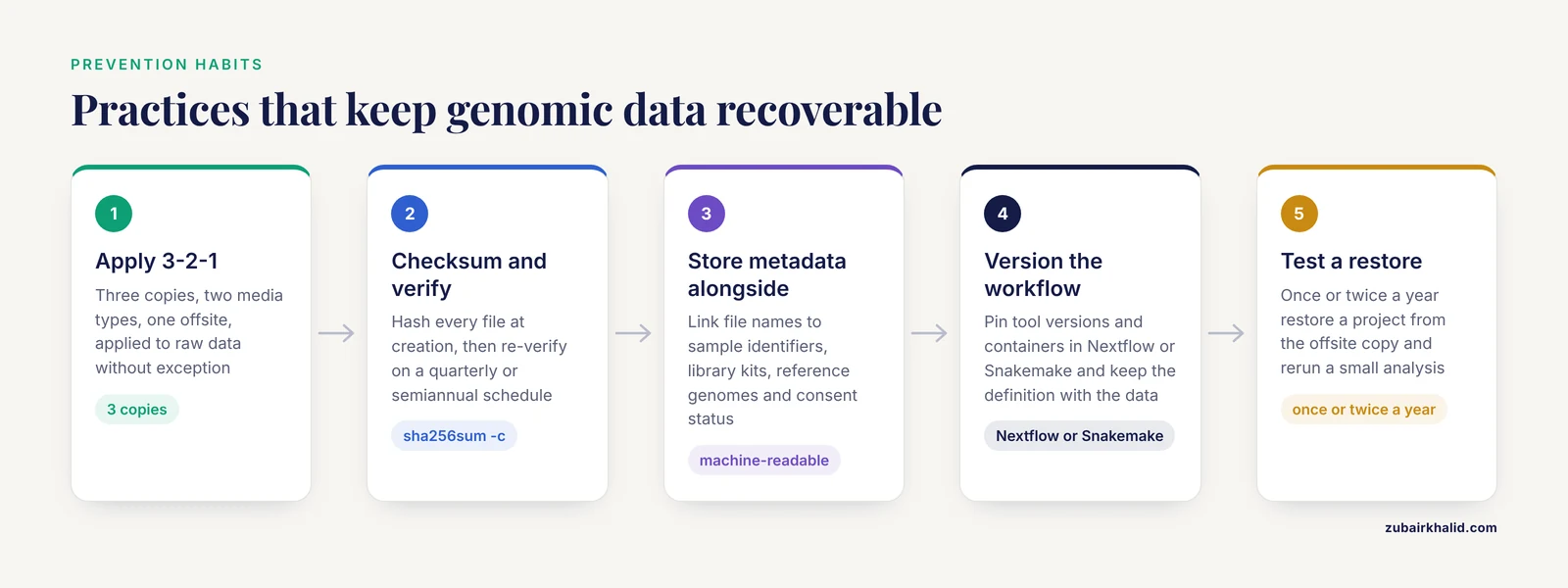
Prevention is not a product you buy. It is a short list of practices, most of which cost staff time rather than capital.
1. Apply the 3-2-1 rule to raw data, always. Three copies, two media types, one offsite. Raw sequencing data gets this treatment without exception. Processed results get it whenever regeneration would be expensive or impossible.
2. Checksum at creation and verify on a schedule. The cheapest prevention measure in this entire article is a checksum habit. At file creation:
sha256sum sampleA_R1.fastq.gz > sampleA_R1.fastq.gz.sha256and on a quarterly or semiannual schedule, re-verify:
sha256sum -c sampleA_R1.fastq.gz.sha256A checksum that is never verified is a receipt nobody reads. Schedule fixity checks and record the results. For aligned files, add a quick structural check with samtools quickcheck before deeper verification.
3. Store data and metadata together, in machine-readable form. Every dataset gets a metadata record linking file names to sample identifiers, library kits, instrument runs, reference genomes, and consent status. A spreadsheet on someone's laptop is not a metadata store. A versioned, backed-up metadata file next to the data is.
4. Version your workflows. Use a workflow engine such as Nextflow or Snakemake with pinned tool versions and containers, and store the workflow definition alongside the data it produced. This preserves reproducibility, which is half of what data loss destroys in practice.
5. Adopt compression with documented decisions. Convert long-term aligned archives from BAM to CRAM, keep the reference genome files that CRAM requires, and write down what quality-score or unaligned-read reductions were applied, mirroring the tunable, controlled-loss design that reference-based compression was built around [7].
6. Make deletion a decision, not a default. Lifecycle rules, quota pressure, and cleanup scripts delete data every day in genomics. Require that raw data deletion be a reviewed, documented decision with a named approver. The asymmetry justifies the friction: over-archiving costs storage fees, under-archiving can cost an experiment [1], [3].
7. Test recovery before you need it. Once or twice a year, actually restore a project from the offsite copy and rerun a small analysis. A backup that has never been restored is a hypothesis, not a backup.
8. Budget prevention like the investment it is. The framing that genomics has long used for other decisions applies here. Decision-analytic modeling, which formalizes the tradeoffs between costs, risks, and benefits under uncertainty, is an established tool in genomic decision making [9]. A lab can run the same logic on storage: the cost of redundancy and verification versus the probability-weighted cost of regeneration and loss. In every realistic version of that model, prevention wins, because regeneration costs are high [1], [4], [3] and the probability of eventual loss without prevention is effectively certain over long time horizons.
Common Mistakes and Limitations
Storing only processed results. Variant call files cannot be re-analyzed for a new question. Raw reads can. Keep raw data as the protected core of the archive.
Treating one copy as a backup. A file that exists once, in any location, on any platform, is not backed up. Backups mean independent copies on independent media, at least one offsite.
Confusing vendor storage with a backup. Sequencer-side retention and provider accounts are convenience copies with vendor-controlled lifetimes [20 describes the general storage pressure, and retention windows are contractual]. Download and archive deliverables immediately.
Writing checksums but never checking them. Unverified checksums detect nothing. Fixity verification on a schedule is the practice that matters.
Compressing without documenting. The reference-based compression tradeoff on quality scores and unaligned reads is legitimate and tunable [7], but only if the choices are recorded. Undocumented reduction is indistinguishable from loss to whoever opens the archive in five years.
Ignoring metadata as data. The most common irreversible loss in a functioning lab is not a FASTQ file. It is the link between that file and the sample it came from.
Assuming institutional or grant-funded storage solves everything. Institutional systems help enormously, but they also have retention policies, quota limits, and decommissioning cycles of their own. Verify what your institution actually guarantees.
Skipping recovery tests. Untested backups fail at the worst moment, usually because of a detail that only a real restore would have surfaced, such as an expired credential or a missing encryption key.
A note on limits. The cost of data loss varies enormously by lab, modality, funding model, and sample availability, and the right storage mix depends on your institution's contracts and infrastructure. This article gives the framework and the standard practices, not a universal price tag. Individual labs and clinical settings should work through their own numbers with their own compliance and IT stakeholders, and clinical decisions involving patient data need qualified professional oversight.
Frequently Asked Questions
What does data loss actually cost a genomics lab?
At minimum, the cost of regenerating the lost data, including library preparation, sequencing, and analysis, plus staff time and project delay. At worst, when samples are consumed or unavailable, the cost is the entire study, because no amount of money recreates the measurement. Storage and backup costs are small by comparison.
Is cloud storage safer than local servers for genomic data?
Cloud storage is safer against site-level disasters and offers strong durability, but it introduces its own risks such as misconfiguration, cost creep, and egress fees. Local storage is fast but vulnerable to fire, flood, and ransomware. Neither alone is safe. The durable answer is copies across both, following the 3-2-1 rule.
Can I delete raw FASTQ files after running my pipeline?
No, not if the samples are hard to obtain or the data may need future reanalysis. Processed outputs answer only the questions already asked. Raw reads answer future questions. If storage pressure is the concern, move raw files to compressed or cold-archive tiers rather than deleting them, and make deletion a reviewed decision with a documented rationale.
How does CRAM compression relate to data loss risk?
CRAM uses reference-based compression, storing differences from a reference genome instead of full sequences, which shrinks aligned-read archives substantially [7]. The reduction of quality-score and unaligned-read information is tunable and should be a documented choice [7]. Always retain the reference genome files the CRAM archive depends on, since a CRAM file without its reference is not self-sufficient.
How often should I verify backup integrity?
Verify checksums on a fixed schedule, commonly quarterly to semiannually for archived data, and run a full test restore of one project at least once a year. Verification frequency should scale with the value of the data. Irreplaceable cohorts justify more frequent checks than disposable intermediates.
What is the single cheapest prevention measure?
Checksum every file at creation and verify those checksums on a schedule. It requires only standard command-line tools and a calendar entry, and it converts silent corruption from a catastrophic late discovery into a routine early fix.
Sources
- Cost-effective solutions for high-throughput enzymatic DNA methylation sequencing.
- Development and Validation of a Standardised Genomic Tool for Conservation Management of the Koala (Phascolarctos cinereus).
- Cost-Efficient Transcriptomic-Based Drug Screening.
- spRefine denoises and imputes spatial transcriptomic data with a reference-free framework powered by genomic language model.
- Inferring copy number and genotype in tumour exome data.
- Exome Sequencing for Isolated Congenital Hearing Loss: A Cost-Effectiveness Analysis.
- Efficient storage of high throughput DNA sequencing data using reference-based compression.
- On the utility of RNA sample pooling to optimize cost and statistical power in RNA sequencing experiments.
- A risk-benefit analysis of factor V Leiden testing to improve pregnancy outcomes: a case study of the capabilities of decision modeling in genomics.