Genomics Data Lifecycle Management: Template and Examples
By Dr. Zubair Khalid, DVM, MS, PhD ·

By the end of this article you will be able to write a genomics data lifecycle management plan for your own project, set up a directory structure that survives personnel changes, verify incoming sequencing files with checksums, attach provenance to every processed artifact, choose the right genomics data storage format for each stage of analysis, and decide when to archive or delete data. You need a Linux or macOS shell, access to roughly three storage locations (a fast working disk, a slower project store, and an archive), and the standard tools shown in the walkthrough: sha256sum, rsync, samtools, bcftools, and git.
Genomics projects generate data that outlives grants, servers, and often the people who produced it. Sequencing costs keep falling, biodiversity and population-scale datasets keep growing, and researchers consistently report uncertainty about what counts as best practice for managing these datasets [1]. This article gives you a single coherent template plus concrete genomics data lifecycle management examples you can adapt in an afternoon.
What the Genomics Data Lifecycle Covers
A data lifecycle is the set of stages a dataset passes through from creation to disposal. Reviews of ICT-supported data management in precision agriculture formalized this as a staged model used to categorize solutions by the lifecycle phase they support [2], and research data management work in data-intensive disciplines extends the same idea, describing planning, collection, processing, analysis, preservation, sharing, and reuse as connected activities supported by infrastructure and services [3]. Applied to genomics, the stages look like this.
- Plan. Write the data management plan before the sequencer runs. Define identifiers, formats, storage locations, retention, and sharing.
- Acquire. Generate or receive raw data, usually FASTQ files from an Illumina, PacBio, or ONT instrument, plus the metadata that makes those files meaningful.
- Verify and ingest. Check file integrity, register samples in a sample sheet, and move data into managed storage.
- Process. Run alignment, variant calling, assembly, or quantification pipelines. Capture provenance for every output.
- Analyze and curate. Apply quality gates, keep derived results organized, and record which raw inputs produced which results.
- Preserve. Move stable data to long-term storage with fixity checks and documented formats.
- Share and reuse. Deposit in repositories, publish under a license, and make the data findable and reusable.
- Dispose. Delete or anonymize data when the retention period ends, and record that the deletion happened.
Two principles should anchor every stage. FAIR means data are Findable, Accessible, Interoperable, and Reusable. CARE means collective benefit, authority to control, responsibility, and ethics, and it matters for genomic data collected from or about Indigenous communities and other groups with governance rights over their data. Best-practice guidance for biodiversity genomics treats FAIR and CARE together as the baseline for a management plan, alongside practical steps that minimize the risk of data loss and enable reuse [1]. Both frameworks apply equally to human, animal, plant, and microbial genomics.
Why Genomics Data Breaks Ad Hoc Management
Most labs manage genomics data as loose files on shared drives, and this file-based approach fails in predictable ways. A recent population genomics system describes the problem directly: fragmented file-based workflows lose provenance and require full reprocessing when new samples arrive [4]. Anyone who has rerun a 500-sample variant calling pipeline because three samples arrived late understands the cost.
The failure modes are consistent across projects:
- Metadata drift. The sample sheet lives in a spreadsheet on one person's laptop while the FASTQ files live on the cluster. Nothing links them.
- Provenance loss. Six months later, nobody can say which parameter set produced
cohort_final_FINAL2.vcf.gz. - Reprocessing cost. Adding a sample triggers a full cohort rerun because the intermediate state was never stored in a queryable form [4].
- Silos. Sequencing data, phenotype data, and analysis code live in separate systems with no shared identifier, a pattern documented well beyond genomics in museum collection management, where data silos and collection silos block strategic management [5].
- Fixity gaps. Silent bit rot corrupts archived BAM files, and nobody notices until the retrieval that matters.
Research data management interviews across a European university alliance found that researchers' data practices directly affect their ability to collaborate, that sharing data within teams is impeded by technical obstacles, and that doubts about data quality hinder reuse of other researchers' data [6]. A lifecycle template is the cheapest fix for all of these.
The Genomics Data Lifecycle Management Template
Copy this template into your project documentation and fill in every field before data acquisition begins. A data management plan written after the data arrive is a postmortem, not a plan.
# Genomics Data Lifecycle Management Plan (fill in every bracket)

PROJECT_ID: [short unique code, e.g. GQ-2026-014]
TITLE: [one sentence]
PI / DATA STEWARD: [name, email] / [name, email]

1. DATA DESCRIPTION
   Data types: [e.g. paired-end Illumina WGS, RNA-seq, phenotype CSV]
   Estimated raw volume: [e.g. ~4 TB FASTQ, 320 samples x 30x coverage]
   Sensitive?: [yes/no, consent category, controlled-access requirement]

2. IDENTIFIERS
   Sample ID scheme: [e.g. {species}-{pop}-{site}-{NNN}, never reuse IDs]
   Sample sheet location: [path or database URI]
   Sample sheet owner: [name]

3. STORAGE AND FORMATS
   Working storage: [path/mount, quota, backup schedule]
   Project storage: [path or object store bucket]
   Archive: [location, media, retention period]
   Raw format: [FASTQ.gz, uBAM]  ->  keep original checksums
   Analysis formats: [CRAM, gVCF, VCF.bgz, HDF5/Zarr]
   Metadata format: [CSV with data dictionary at meta/DATA_DICTIONARY.md]

4. PIPELINE AND PROVENANCE
   Pipeline: [name and version, e.g. nf-core/XYZ 1.2.3 or Snakemake repo]
   Reference: [URL, build, checksum]
   Code repository: [URL]   Config history: [git repo path]
   Container images: [registry URIs and digests]

5. QUALITY GATES
   Acceptance criteria: [e.g. >90% mapped reads, per-sample coverage >=20x]
   Data quality state recorded in: [QC log path or database]

6. SHARING AND REUSE
   Repository: [e.g. SRA/ENA/DDBJ, Zenodo, institutional repository]
   Access terms: [open, controlled, embargo until YYYY-MM-DD]
   License: [e.g. CC-BY 4.0 for metadata, DB-specific terms for sequence]
   Community standards: [FAIR and CARE commitments [1]]

7. RETENTION AND DISPOSAL
   Retention period: [per funder/institutional policy]
   Disposal action: [delete raw reads / destroy re-identifiable links]
   Disposal record: [log entry with date, approver, what was deleted]
Fill this out once per project, not once per dataset. Field 3 is where the genomics data lifecycle management format decisions live, and section 5 borrows its logic from formal data quality lifecycle models discussed below.
Lifecycle Stages in Practice: A Numbered Walkthrough
This walkthrough uses a small WGS project, 24 human samples, as the running example. Every command is standard, and each step states what to check before moving on.
Step 1: Create the project skeleton
mkdir -p GQ-2026-014/{raw,meta,ref,work,results,archive}
cd GQ-2026-014
The directory contract is simple. raw/ is write-once, nothing ever modifies files in place. meta/ holds sample sheets, checksums, and documentation. ref/ holds reference genomes with their checksums. work/ is disposable scratch. results/ holds pipeline outputs. archive/ is a staging area for migration to long-term storage.
Step 2: Register samples in a sample sheet
Create meta/sample_sheet.csv. One row per library, not per sample, because a sample can have multiple libraries and lanes.
sample_id,library_id,lane,fastq_r1,fastq_r2,tissue,collection_date,consent_group
GQ-HUM-ALB-001,LIB001,L001,raw/run1/GQ-HUM-ALB-001_L001_R1.fastq.gz,raw/run1/GQ-HUM-ALB-001_L001_R1.fastq.gz,blood,2026-09-14,open
GQ-HUM-ALB-002,LIB002,L001,raw/run1/GQ-HUM-ALB-002_L001_R1.fastq.gz,raw/run1/GQ-HUM-ALB-002_L001_R2.fastq.gz,blood,2026-09-14,open
Master data discipline pays off here. Work on master data across commercial lifecycles emphasizes unique identifier strategies, deduplication, and a structured new item request process for adding entities, because clean identifiers drive everything downstream [7]. In genomics the equivalent rule is: one canonical sample ID, minted once, never renamed, with every file and row keyed to it.
Validate the sheet before any pipeline touches it:
awk -F, 'NR>1 && ($1=="" || $4=="" || $5=="") \
  {print "ERROR: missing field on line " NR; bad=1} END{exit bad}' meta/sample_sheet.csv
Expected output on success is silence and exit code 0. On failure you get ERROR: missing field on line 7, which tells you exactly where the problem is.
Step 3: Verify incoming data with checksums
Sequencing providers should supply MD5 or SHA-256 checksums. Verify on arrival, then generate your own manifest as the authoritative record.
sha256sum raw/run1/*.fastq.gz > meta/checksums_run1.sha256
sha256sum -c meta/checksums_run1.sha256
Expected output:
raw/run1/GQ-HUM-ALB-001_L001_R1.fastq.gz: OK
raw/run1/GQ-HUM-ALB-001_L001_R2.fastq.gz: OK
...
If a line reads FAILED, the transfer corrupted the file. Re-transfer before doing anything else. Store checksums for the raw reads and the reference genome. A mismatched reference checksum invalidates every downstream alignment, and it costs one command to catch.
Step 4: Capture provenance from the first command
Put your pipeline code, configuration, and reference URLs in a git repository inside meta/:
git init meta && cd meta
git add pipeline.smk config.yaml DATA_DICTIONARY.md
git commit -m "pipeline v1.0: bwa-mem2 alignment, GATK HaplotypeCaller, depth filter 10"
git tag v1.0
cd ..
Every result directory should then carry a pointer to the exact commit. Most workflow engines do this automatically in their report output. The habit that matters is simple: if you cannot reconstruct which code version, which parameters, and which input checksums produced a file, that file is not a result, it is decoration.
Step 5: Process and gate the outputs
Run your pipeline (the exact engine is a project choice). Then verify outputs before analysis:
samtools quickcheck -v results/bam/*.bam && echo "BAM headers OK"
samtools flagstat results/bam/GQ-HUM-ALB-001.bam
Expected flagstat output looks like:
98243677 + 0 in total (QC-passed reads + QC-failed reads)
94822011 + 0 mapped (96.51% : N/A)
0 + 0 secondary
...
Your plan in field 5 of the template set acceptance criteria such as a mapped percentage threshold. Formal data quality work supports treating these gates as lifecycle states rather than one-time checks. The FSM-DQA framework models a dataset as moving through states such as Unassessed, Under Assessment, Dormant, Assessed Acceptable Bugs, Assessed Blocker Bugs, and Good-To-Go, with structured reassessment triggers and time-dependent validity, plus key performance indicators like cycle time and a freshness index [8]. In practice that means: mark each BAM as assessed or unassessed, record the assessment date, and define what forces a reassessment, for example a reference version change. A dataset "assessed" two reference versions ago is stale, and a state column in your sample sheet makes that visible instead of anecdotal.
For variant outputs:
bcftools stats results/vcf/cohort.vcf.gz | grep -E "^SN"Record the SNP and indel counts per sample in results/qc/variant_summary.tsv with the pipeline tag alongside.
Step 6: Preserve and archive
When a milestone finishes, move immutable outputs to project storage and then to archive. A checksum-verified copy is the tool for this:
rsync -a -c results/vcf/ archive/GQ-2026-014/vcf_v1.0/
rsync -a -c raw/ archive/GQ-2026-014/raw/
sha256sum archive/GQ-2026-014/raw/*.fastq.gz | \
  diff - meta/checksums_run1.sha256 && echo "archive fixity OK"
Store CRAM rather than BAM for aligned data where the reference is available at read time. CRAM uses reference-based compression and typically saves substantial space, which matters at population scale. For matrices of genotype data, packed binary formats such as HDF5 or Zarr beat plain text by orders of magnitude for read speed and size. Document in meta/DATA_DICTIONARY.md which format versions you used, because format obsolescence is a preservation risk, and a format nobody can open is indistinguishable from data loss.
Step 7: Share and reuse
Deposit raw reads and metadata in a recognized archive, cite the accession in publications, and publish derived summary data with a license. Reuse depends on documentation more than on generosity: interviews across the research data lifecycle show that doubts toward existing data hinder researchers from reusing it, and that international teams struggle with sharing inside the team before open sharing is even reached [6]. The practical antidotes are a complete data dictionary, per-sample consent records, and quality state labels that let a stranger decide quickly whether your data fit their question.
Step 8: Retention and disposal
Retention length follows your funder and institutional policy, not personal preference. Disposal is a lifecycle stage, not an omission. When the retention period ends, delete the raw re-identifiable data or destroy the linkage keys, and write a disposal log entry in meta/ with the date, what was deleted, and who approved it. Privacy researchers treat the full big data lifecycle, collection through disposal, as the correct scope for privacy controls, and note that protection obligations do not end at the analysis stage [9].
Choosing Formats Across the Lifecycle
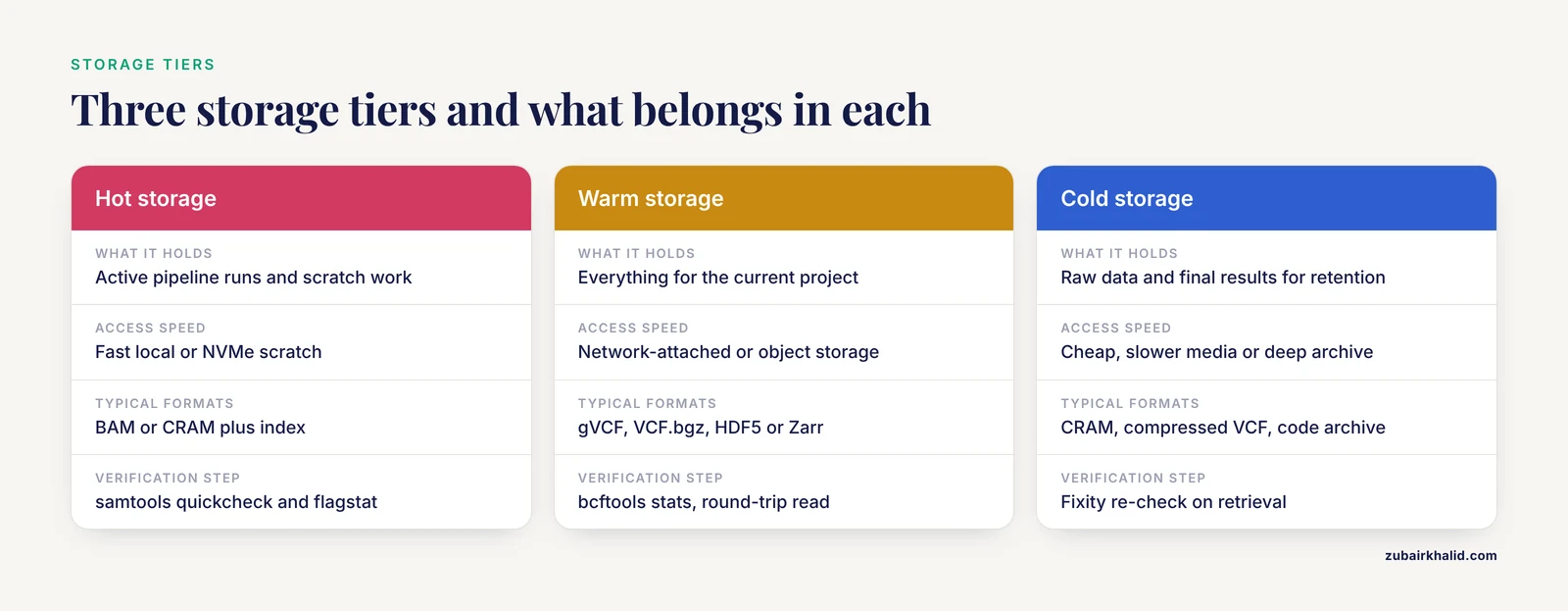
Format choice is the most consequential genomics data lifecycle management format decision you make, because formats determine what stays computable. The table below summarizes the standard choices.
| Lifecycle stage | Typical formats | Storage tier | Verification step |
|---|---|---|---|
| Acquisition | FASTQ.gz, uBAM | Project storage, write-once | sha256sum against vendor manifest |
| Alignment | BAM or CRAM + index (BAI/CRAI) | Working storage | samtools quickcheck, flagstat |
| Variant calling | gVCF per sample, joint VCF.bgz or BCF | Project storage | bcftools stats, per-sample call rate |
| Matrix analysis | HDF5, Zarr, packed genotype arrays | Working or project | round-trip read, shape and checksum |
| Metadata | CSV or TSV with data dictionary, or a relational/graph database | Project storage, backed up | field-level validation, referential checks |
| Preservation | CRAM, compressed VCF, checksums, code archive | Archive storage | fixity re-check on retrieval |
| Sharing | FASTQ/CRAM via repository, VCF, summary statistics | Repository | repository validation reports |
Three notes on this table. First, keep raw data in its original compressed form and never re-gzip it, since recompression breaks the vendor checksum relationship. Second, indexes are data, not accessories, an alignment file without its index is not queryable, and many pipeline failures trace to a stale or missing index. Third, matrix formats exist because text formats do not scale. On human data at the scale of 3,202 samples and roughly 70 million variants, reading and transforming per-sample genotype text becomes the bottleneck, which is why modern systems store genotype data as packed arrays [4].
Storage tiers follow access frequency. Hot storage is fast local or NVMe scratch for active pipeline runs. Warm storage is network-attached or object storage holding everything for the current project. Cold storage is cheap, slower media or deep archive tiers holding raw data and final results for the retention period. Keep at least two independent copies of raw data, on different systems, with fixity checks scheduled at intervals you actually calendar.
A Worked Example: Population-Scale Cohort Management
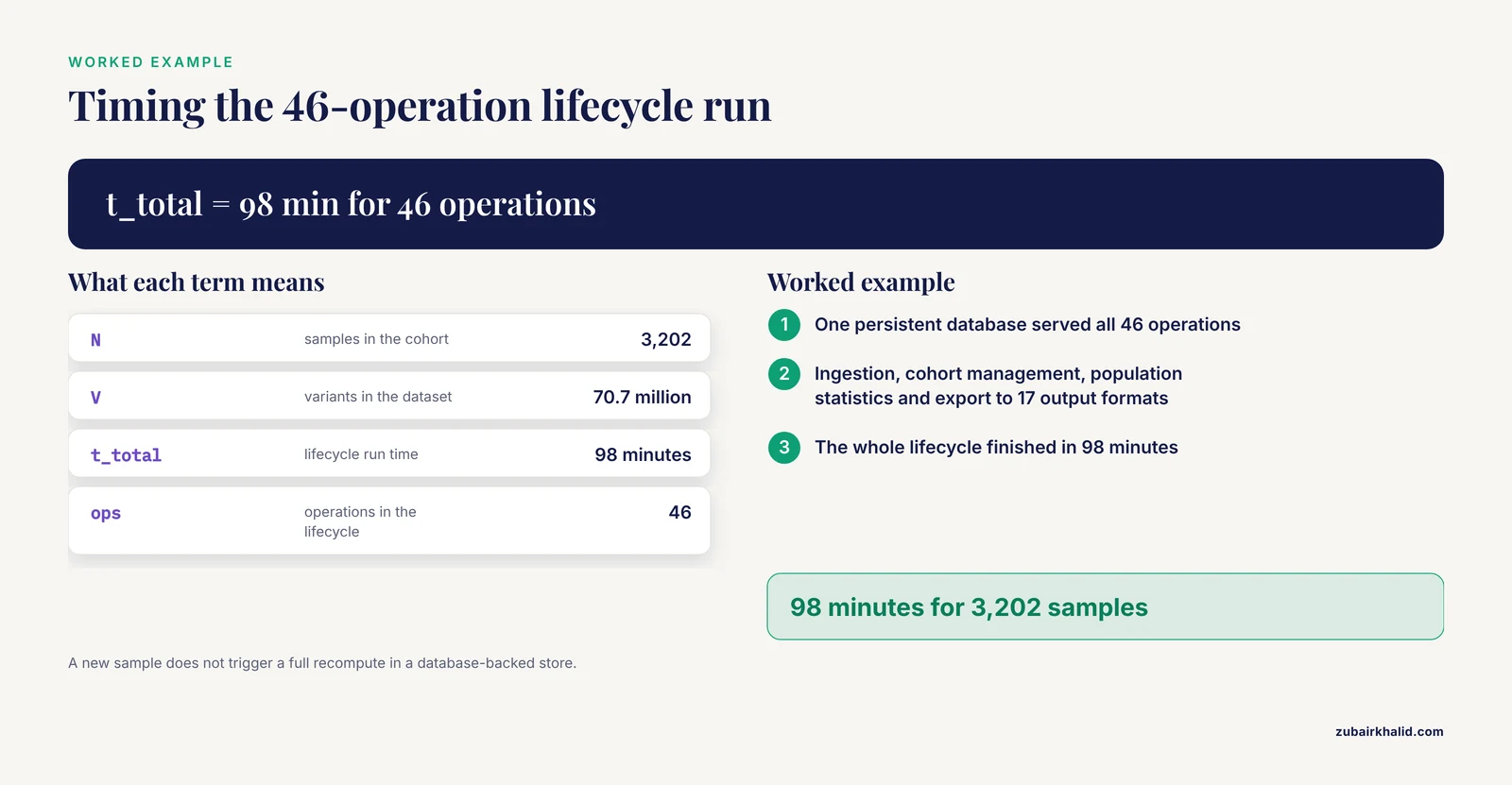
The clearest modern illustration of what lifecycle-aware infrastructure buys you is GraphMana, a graph-native data management system for population genomics projects [4]. It addresses exactly the failures listed earlier.
The design stores variant data in a graph database as packed genotype arrays with pre-computed population statistics, rather than as loose VCF files. Two access paths serve different questions: a FAST PATH reads population-level arrays in O(K) time, where K is the number of populations, and a FULL PATH unpacks per-sample genotypes in O(N) time, where N is the number of samples [4].
The benchmark is worth internalizing because it is a real genomics data lifecycle management example with numbers. On human 1000 Genomes data covering 3,202 samples and 70.7 million variants, GraphMana completed a 46-operation lifecycle, spanning ingestion, cohort management, population statistics, and export to 17 output formats, in 98 minutes from a single persistent database [4]. The lifecycle lesson generalizes even if you never adopt a graph database: pre-compute the statistics your project reuses, keep provenance in the data store rather than in tribal memory, and design for incremental sample addition so a new cohort member does not trigger a full recompute.
For smaller projects, you get a meaningful fraction of this benefit from disciplined file management: a validated sample sheet, checksums, per-stage summary files, and a stated convention for incremental additions, such as running joint genotyping per chromosome so a new sample only reprocesses one chromosome shard at a time.
Governance, Identifiers, and Data Evolution
Lifecycle management is as much governance as it is storage. Three governance threads deserve explicit attention.
Schema evolution. Genomics projects change. New phenotype fields appear, ontology terms get refined, and consent scopes shift. Work on ontology-based digital twin lifecycle management proposes governing data evolution explicitly, with layered architectures and defined evolution models so that data reusability survives schema change [10]. Your lightweight version of this is a versioned data dictionary: when the sample sheet gains a column, bump the dictionary version, record the change in git, and state whether old rows are still valid.
Regulated and high-stakes contexts. Evaluations of data models for vaccine lifecycle management conclude that generic product data models such as STEP, CPM, and IPPOP provide useful frameworks but require adaptation to the heavily regulated environment of vaccine development and distribution [11], a finding reinforced by a follow-up evaluation of product data modeling criteria for that domain [12]. Genomics in clinical and public health settings faces the same pattern: the lifecycle template must carry regulatory metadata, batch and lot tracking, and audit trails that a research-only project can skip.
Security risk across the whole pipeline. For AI models embedded in medical device software, a dedicated risk management framework maps assets, threats, vulnerabilities, and controls across the entire model lifecycle, from ingestion to maintenance, because existing standards such as ISO 14971, AAMI TIR57, ISO/IEC 27005, and NIST frameworks provide high-level guidance but do not operationalize data security across that lifecycle [13]. Genomics pipelines feeding clinical models inherit the same requirement: name the sensitive assets at each stage, name the controls, and record the risk decisions.
Privacy by stage. Privacy integration into the big data lifecycle requires different mechanisms at different stages, with frameworks covering collection, storage, processing, and analysis, and with emerging technologies such as differential privacy and blockchain entering the toolkit [9]. For genomics, the stage-appropriate translation is straightforward. At collection, capture consent terms per sample. At storage, restrict access by role and encrypt at rest. At processing, work with controlled-access datasets inside approved environments. At analysis and sharing, aggregate or perturb where individual genotypes could identify a person, since a genome is an identifier that cannot be rotated the way a password can.
Common Mistakes and Limitations
- Writing the plan after the data arrive. The plan's main value is forcing format, identifier, and consent decisions while they are still cheap. Retrofitting a sample sheet for 800 samples from filenames is where most bioinformatics data management projects actually die.
- One canonical ID, or chaos. If sequencing center IDs, patient IDs, and analysis IDs all float independently, every merge becomes an archaeology project. Mint one ID at registration and derive the others as recorded aliases.
- Skipping the checksum on the reference genome. A wrong reference silently produces wrong coordinates. Checksum the FASTA and its index, and record the version in provenance.
- Treating quality checks as one-time events. A point-in-time validation tells you nothing about how the asset evolved. The FSM-DQA approach exists precisely because datasets drift back into question, and it formalizes reassessment triggers and expiry states for that reason [8].
- Designing for the final cohort instead of the growing cohort. File-based cohort workflows that require full reprocessing on sample addition are the default failure mode at population scale [4]. Shard outputs, pre-compute reused statistics, or adopt a database-backed store if your cohort grows continuously.
- Confusing backup with preservation. A backup protects against hardware loss. Preservation keeps data usable, which requires documented formats, readable metadata, fixity checks, and a software environment note. A backed-up file nobody can interpret is not preserved.
- Assuming consent travels with the file. It does not. Consent scope lives in metadata and must be enforced at every stage, including derived data, because privacy obligations span the entire lifecycle from collection onward [9].
- Ignoring organizational silos. Data integration failures are structural, not just technical. Museum collection research documents how data silos and collection silos limit integrated management even in well-funded institutions [5], and genomics collaborations face the same pattern when sequencing, phenotype, and analysis groups use separate systems with no shared identifier.
- Limitation of this template. The template and walkthrough cover research-scale projects and standard small-molecule-free workflows. Clinical diagnostics, regulated manufacturing, and Indigenous data governance under CARE add legal and community requirements that a research template cannot satisfy on its own, and individual projects need review by their institution's data governance and compliance staff.
Frequently Asked Questions
What is genomics data lifecycle management?
Genomics data lifecycle management is the practice of planning, verifying, storing, processing, preserving, sharing, and disposing of genomic datasets as one connected system rather than as disconnected files. It exists to keep data findable, intact, traceable to their provenance, and reusable across years and personnel changes.
Where can I find a usable genomics data lifecycle management template?
Use the fill-in template in this article, which covers identifiers, storage tiers, formats, provenance, quality gates, sharing terms, and disposal. Adapt it per project, and anchor it to FAIR and CARE principles as recommended in biodiversity genomics best-practice guidance [1].
What format should raw and processed genomics data use?
Keep raw reads as FASTQ.gz exactly as delivered, store aligned reads as CRAM where a reference is available, store variants as bgzip-compressed VCF or BCF with indexes, and use HDF5 or Zarr for large genotype matrices. Each choice balances compression, queryability, and long-term readability.
How much storage does a genomics project need?
Plan for raw data plus one working copy of intermediates plus two archived copies, with CRAM and packed matrix formats reducing the processed footprint substantially relative to text and uncompressed BAM. Budget cold storage for the full retention period and fast scratch only for active runs, and check your instrument's output rate against quota before the first run rather than after.
How do I keep provenance for every result?
Version your pipeline code and configuration in git, tag each analysis release, record input checksums, and save the workflow engine's execution report with each result directory. If you cannot reconstruct code version, parameters, and input checksums for a file, treat that file as unverified.
How do I handle privacy for human genomic data?
Assign consent category per sample at collection, encrypt at rest, restrict processing of controlled-access data to approved environments, and aggregate or perturb results before sharing. Privacy controls belong at every lifecycle stage from collection through disposal, not only at the analysis step [9].
Can I add new samples to a cohort without reprocessing everything?
Yes, if the lifecycle design supports it. Database-backed population genomics systems store packed genotype arrays with pre-computed statistics so new samples can be added incrementally, avoiding the full-reprocessing cost of fragmented file-based workflows [4]. With plain files, shard joint genotyping by chromosome or region so additions touch only one shard.
When should I delete or dispose of genomic data?
When the retention period defined in your data management plan ends, following funder and institutional policy. Record the disposal with a date, an approver, and a description of what was deleted, and destroy re-identifiable linkage keys when raw reads are removed, since privacy obligations continue through disposal.
Sources
- Journeying towards best practice data management in biodiversity genomics.
- Data Lifecycle Management in Precision Agriculture Supported by Information and Communication Technology
- From data lifecycle to research activity model: research data management in data-intensive social sciences and humanities research
- GraphMana: graph-native data management for population genomics projects
- A Study on a Data-Driven Intelligent Integrated Management Model for Museum Collections: Establishing a Framework for Collection Preservation, Risk Management, Environmental Control, and Lifecycle Management in the Era of Digital Transformation
- Research Data Management Practices Across the Research Data Lifecycle and Their Potential for Collaboration in an International Higher Education Alliance
- Orchestrating Clean Data: Master Data Management Across the Lead-to-Cash Lifecycle
- Formalizing Data Quality Lifecycle Management with FSM-DQA: A Framework for Traceability and Governance in Modern Data Ecosystems
- INTEGRATING PRIVACY MANAGEMENT INTO BIG DATA LIFECYCLE: CHALLENGES AND APPROACHES
- Data Evolution Governance for Ontology-Based Digital Twin Product Lifecycle Management
- Data Modeling Review: The case of Vaccine Lifecycle Management
- Evaluating Product Data Modeling for Vaccine Lifecycle Management
- A Data Security Risk Management Framework for Medical Device Software AI Model Lifecycle: Alpha Version