Error Tracking in Genomics Data Management
By Dr. Zubair Khalid, DVM, MS, PhD ·

By the end of this article you will be able to design and operate a genomics data error tracking system for a sequencing lab or bioinformatics core: assign stable sample identifiers, capture checksums at ingest, run automated quality control gates, verify sample identity computationally, log every deviation in a queryable database, and wire validation into your pipeline so errors surface within hours instead of months. You will also learn how to detect a sample swap with a genotype concordance calculation, which mistakes most commonly undermine bioinformatics data management efforts, and how to triage errors once they are logged.
You will need on hand:
- A Linux or macOS workstation or server with Python 3.10 or later, R 4.2 or later, and Git
- Command line tools:
md5sumorshasum, FastQC, MultiQC, samtools, and bcftools - A workflow engine you already use (Nextflow, Snakemake, or CWL-based tooling)
- SQLite for the worked examples below. Any relational database works, and production systems often use PostgreSQL or MySQL, the same class of database used by the CoreFlow platform for tracking tasks and interdependencies in large-scale biology projects [1]
- A sample manifest spreadsheet or, ideally, a laboratory information management system (LIMS)
The guiding idea is simple. Quality control (QC) tells you whether a dataset is good. Error tracking tells you what went wrong, where, when, for which sample, and whether anyone fixed it. A lab that runs QC without an error log re-discovers the same problems every quarter. A lab that logs errors builds institutional memory, and the log itself becomes evidence of data integrity for collaborators, journals, and auditors.
Why Errors Happen in Genomics Data Pipelines
Modern genomics generates vast, complex datasets, and reviews of data stewardship in AI-based genomics consistently identify the same pressure points: data governance, quality management, traceability, access control, curation, and storage systems [2]. Errors cluster into a small number of classes, and knowing the classes tells you where to place detection gates.
Identity Errors
The most damaging class is the sample swap. Whole exome sequencing (WES) reviews describe how challenges in sample processing, experimental manipulation, and data management can produce misidentification that harms research integrity and, in clinical settings, patient outcomes [3]. A swap means every downstream call, from variant interpretation to differential expression, is attached to the wrong donor. These errors are invisible to standard read-level QC because the data itself is often technically excellent.
Pre-Analytical Integrity Errors
Errors also begin before sequencing. Biobanking standardization work documents that sample collection, processing, and storage conditions must be documented and validated to establish data integrity and the context for interpreting results, with fully automated workflows processing thousands of clinical samples in high-density 384-well tube systems under explicit validation criteria [4]. If a lab cannot show that a sample was handled under validated conditions, an anomalous result later cannot be distinguished from a handling problem.
Metadata and Harmonization Errors
A third class lives in the data model itself. When projects pool data across sites, terminology must be mapped between classification systems, and mappings drift. The AACR GENIE project built the Linked Entity Attribute Pair (LEAP) framework to manage term mappings between its OncoTree cancer ontology and the ICD-O-3 system used by the National Cancer Institute's Genomic Data Commons. After populating LEAP, the team identified 195 mappings requiring remediation and measured a 28 percent reduction in effort to resolve them, along with a reduction in inadvertent errors [5]. Large national programs face the same issue at the data model level, which is why the All Of Us Research Program invested in transforming i2b2 data into the OMOP common data model to achieve interoperability across sites [6].
Technical and Analytical Errors
Sequence data carries technology-specific error profiles, and analytical choices interact with those profiles. A comprehensive benchmark of variant calling on Oxford Nanopore bacterial genomes found that deep learning callers, particularly Clair3 and DeepVariant, significantly outperformed traditional methods, and that choosing the right caller and basecalling model changed results materially [7]. Meanwhile, RNA-seq pipelines treat quality control as the foundational step that determines the integrity of everything downstream, from alignment to differential expression [8]. Genotyping pipelines show the same pattern, with QC of genotypes described as essential to avoid spurious results and to maintain long-term data integrity in settings with ongoing sample accrual [9] [10].
Errors in Data You Did Not Generate
Finally, errors arrive embedded in external resources. A biosurveillance review notes that errors in pathogen genomic records, narrow database scope, and inconsistent standards undermine confidence in analyses built on public data [11]. Error tracking therefore has to extend to reference data and imported annotations, not just in-house runs.
Anatomy of a Genomics Data Error Tracking System
A working system has four layers. Skip any layer and errors leak through.
- Identity layer. Every physical sample, extract, library, sequencing run, and data file carries a stable, unique, machine-readable identifier. High-throughput structural proteomics faced this decades ago: the SPINE database was built for the Northeast Structural Genomics Consortium not merely as an information repository but as an active vehicle to standardize data across cloning, expression, purification, and structure determination for 985 constructs, so that the information could support systematic retrospective analysis [12].
- Integrity layer. Cryptographic checksums on every file at ingest, verified on a schedule, plus storage governance covering retention, access control, and traceability [2].
- Validation layer. Automated QC gates that compute metrics, compare them against thresholds, and emit pass, warn, or fail verdicts per sample and per run.
- Incident layer. A queryable error log, typically a relational database, that records every failed gate with the sample, stage, rule, severity, timestamp, and resolution status.
Two historical implementations illustrate how the layers work together. PACLIMS, a component LIMS built for a high-throughput functional genomics pipeline targeting roughly 11,000 predicted genes in the rice blast fungus and 50,000 insertion mutants, simplified data entry through barcodes and scanners specifically to reduce human error, time, and labor, and led researchers step by step through the protocol [13]. CoreFlow organized analysis scripts into project-specific pipelines, tracked interdependencies between related tasks, and generated summary reports so that errors in one task propagated visibly to dependent tasks [1]. Your system does not need their scale, but it needs their structure.
Building a Genomics Data Error Tracking System Step by Step
The following walkthrough uses a small RNA-seq or exome project as the example. Each step produces an artifact you can audit later.
Step 1: Assign Stable, Machine-Readable Identifiers
Create a canonical sample ID scheme before the first tube arrives. A practical pattern combines a project prefix, a plate or batch code, and a well position:
Project: EXOME2026
Sample ID: EXOME2026-P01-A01
Print this ID as a barcode (Code 128 is common) on every tube and plate. Barcode scanning at every handoff is the single cheapest error-prevention measure available, and the PACLIMS experience showed that barcodes and scanners at data entry measurably reduce human error in a high-throughput pipeline [13]. Keep the mapping between sample IDs, patient or donor codes, and plate positions in one controlled access registry, never in free-text spreadsheets that circulate by email.
Step 2: Capture Checksums at Ingest
The moment data lands on your storage, compute and store a checksum. MD5 is traditional and fast, SHA-256 is preferable for new systems.
cd /data/genomics/EXOME2026
md5sum raw/SampleA_R1.fastq.gz > raw/SampleA_R1.fastq.gz.md5
cat raw/SampleA_R1.fastq.gz.md5
Expected output looks like this (your hash will differ):
9f86d081884c7d659a2feaa0c55ad015 raw/SampleA_R1.fastq.gzVerify on every copy and on a schedule. A weekly cron job catches silent corruption from failing disks:
# crontab entry, runs every Sunday at 02:00
0 2 * * 0 cd /data/genomics && find raw -name '*.md5' -exec md5sum -c {} + >> /var/log/genomics/md5_weekly.log 2>&1
A failed line in that log, such as raw/SampleA_R1.fastq.gz: FAILED, is your first tracked error event. Checksum failure almost always means storage or transfer corruption, which matters because data stewardship reviews identify storage systems and integrity verification as core responsibilities of genomics programs, not optional extras [2].
Step 3: Run QC Gates and Record Their Output
Run per-sample QC immediately after ingest and again after every pipeline change. For sequencing data, FastQC plus MultiQC is the standard first gate, and RNA-seq protocols treat this QC as the step that establishes data integrity before alignment and differential expression [8].
fastqc -o qc/ raw/*.fastq.gz
multiqc qc/ -o qc/reports/
Expected console output:
Started analysis of SampleA_R1.fastq.gz
Approx 5% complete for SampleA_R1.fastq.gz
Analysis complete for SampleA_R1.fastq.gz
MultiQC v1.21 | multiqc_report.html
For genotyping arrays, established automated pipelines apply a wide range of quality metrics with user-defined thresholds and produce a comprehensive report plus a filtered dataset. SNPQC additionally builds a database that stores genotypic, phenotypic, and quality metrics so that data integrity is maintained across subsequent runs [9]. The GTQC R package automates most genotyping QC steps and emits a detailed HTML report with tables and figures for rapid inspection before GWAS analyses [14]. Adopting this pattern for your own data is straightforward: every gate writes a metrics file, and every metrics file gets parsed into your error database in Step 6.
Step 4: Verify Sample Identity Computationally
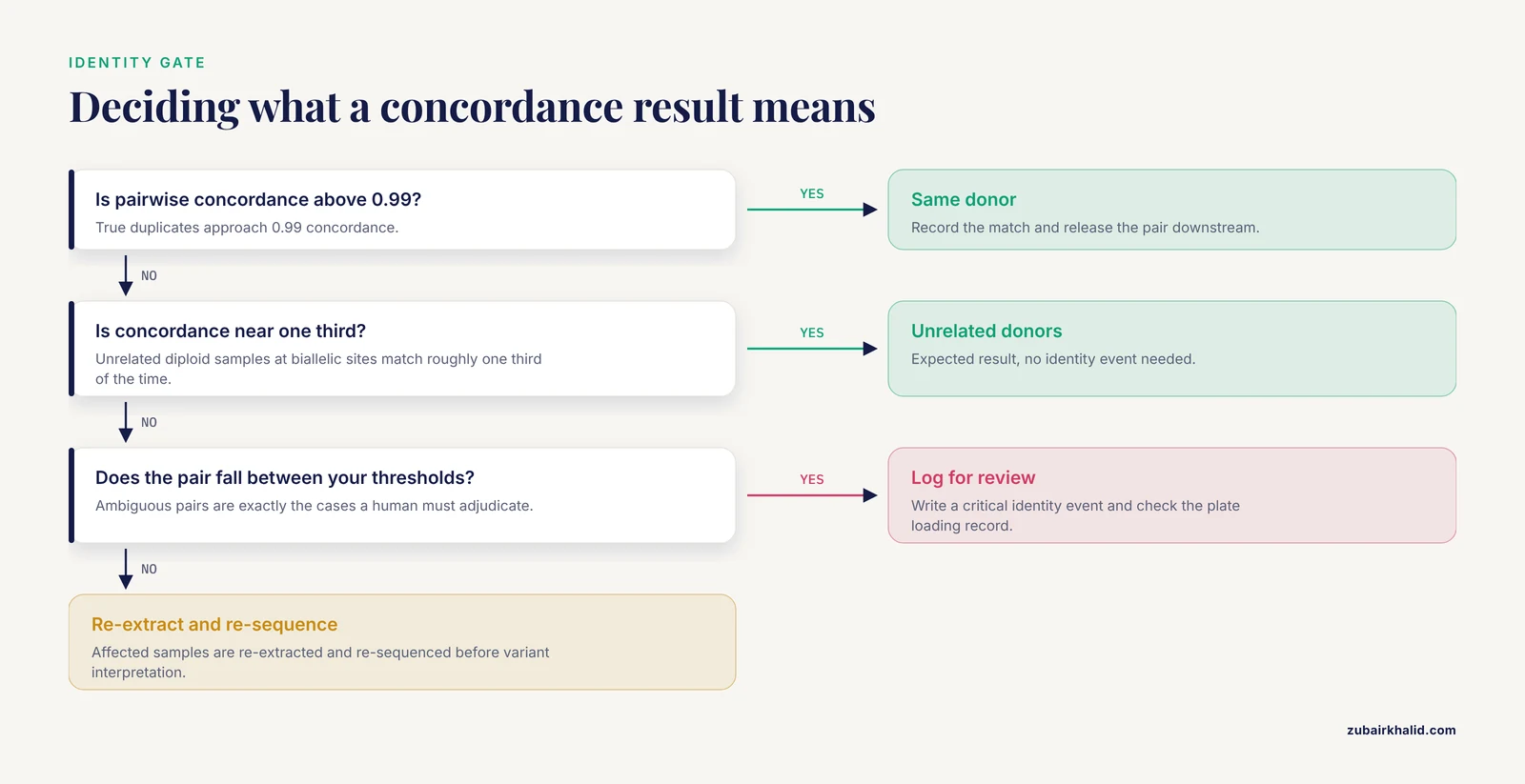
This is the gate that catches swaps. The Personal Genome Project-UK resource implemented genotype-validated QC and validation procedures explicitly to ensure data integrity and exclude sample mix-ups across its ten-sample multi-omics reference panel [15]. The WES literature likewise identifies bioinformatics approaches and genetic methods, alongside unified quality control systems advocated by bodies such as the American College of Medical Genetics and Genomics, as the defense against sample mix-ups in clinical sequencing [3].
A practical implementation compares a panel of common SNPs between pairs of samples. Concordance above 0.99 confirms a match, while unrelated diploid samples at biallelic sites match roughly one third of the time by chance.
# identity_check.py
def load_genotypes(path):
    snps = {}
    with open(path) as fh:
        for line in fh:
            if line.startswith("#"):
                continue
            f = line.rstrip().split("\t")
            snps[(f, f[12])] = f[16].split(":")
    return snps

def concordance(a, b):
    shared = set(a) & set(b)
    if not shared:
        return 0.0
    matches = sum(1 for k in shared if a[k] == b[k])
    return matches / len(shared)

s1 = load_genotypes("EXOME2026-P01-A01.vcf.gz")
s2 = load_genotypes("EXOME2026-P01-A02.vcf.gz")
print(f"A01 vs A02 concordance: {concordance(s1, s2):.4f}")
Expected output for two samples from the same donor:
A01 vs A02 concordance: 0.9981Expected output for two unrelated donors:
A01 vs A02 concordance: 0.3312Compute the full pairwise matrix for every plate and log any pair that falls between your thresholds. Those ambiguous pairs are exactly the cases a human must adjudicate, and they belong in the error log, not in an email thread.
Step 5: Track Pipeline Runs as First-Class Events
Every pipeline execution should emit a machine-readable record of what ran, with which inputs, which software versions, and which exit codes. Nextflow produces this with a trace file:
nextflow run rnaseq.nf -with-trace trace-2026-11-11.csv -resumeAn excerpt of the trace file:
task_id status  exit    process          tag          hash
2       OK      0       FASTQC           SampleA_R1   1a/7b3c9d
3       FAILED  1       STAR_ALIGN       SampleB      8c/21ffaa
4       CACHED  0       MULTIQC          -            9d/55e201
A FAILED row is a trackable event: task, sample tag, exit code, timestamp, and the exact command line recoverable from the work directory. CoreFlow demonstrated the value of this pattern by tracking interdependencies between related tasks in a relational database, so that a correction upstream could be traced to everything it affected downstream [1]. Without run-level tracking, a failed alignment step is a mystery buried in shell history.
Step 6: Write Every Deviation to an Error Log
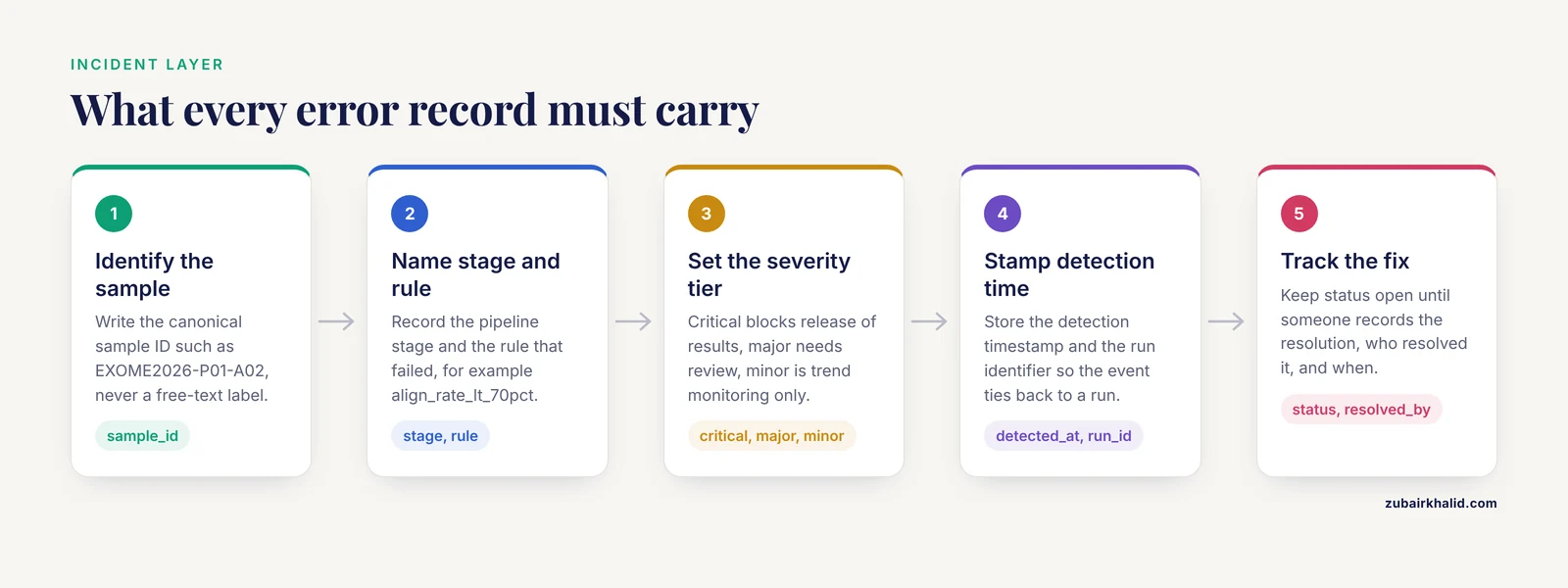
Create a single table where every gate, script, and human reviewer writes failures. SQLite is sufficient to start:
import sqlite3

conn = sqlite3.connect("errors.db")
conn.execute("""
CREATE TABLE IF NOT EXISTS error_events (
    event_id    INTEGER PRIMARY KEY AUTOINCREMENT,
    sample_id   TEXT NOT NULL,
    stage       TEXT NOT NULL,
    rule        TEXT NOT NULL,
    severity    TEXT NOT NULL,
    detected_at TEXT NOT NULL,
    run_id      TEXT,
    detail      TEXT,
    status      TEXT DEFAULT 'open',
    resolved_at TEXT,
    resolved_by TEXT
)
""")
conn.execute("""
INSERT INTO error_events
    (sample_id, stage, rule, severity, detected_at, run_id, detail)
VALUES (?, ?, ?, ?, ?, ?, ?)
""", (
    "EXOME2026-P01-A02",
    "star_align",
    "align_rate_lt_70pct",
    "major",
    "2026-11-11T09:14:00Z",
    "run-2026-11-11",
    "uniquely mapped reads 58.2 percent, threshold 70 percent"
))
conn.commit()
Query the log the way a lab manager would:
SELECT rule, COUNT(*) AS n, severity
FROM error_events
WHERE status = 'open'
GROUP BY rule, severity
ORDER BY n DESC
Expected output:
rule                    n   severity
align_rate_lt_70pct     3   major
contamination_est_gt5   1   critical
low_yield_ng            7   minor
This one view answers the questions that matter: which failure is most frequent, which is most severe, and which samples are repeat offenders. Severity tiers are a policy decision. A practical default is critical (blocks release of results), major (requires review before downstream analysis), and minor (trend monitoring only).
Step 7: Validate Continuously, Like Software
Treat your data files and reference assets like code. The mmCIF Validator project for structural biology data ships both a real-time editor extension and a standalone Python script explicitly designed for command line use, batch processing, and integration into automated CI/CD pipelines, so that errors are caught before deposition rather than during it [16]. The same pattern applies to FASTQ, VCF, and metadata tables.
A minimal nightly validation script:
#!/bin/bash
set -u
FAIL=0
for vcf in released/*.vcf.gz
do
    if ! bcftools index -s "$vcf" > /dev/null 2>&1
    then
        echo "VALIDATION FAIL: $vcf is missing or has a broken index"
        FAIL=1
    fi
done
exit $FAIL
Run this in a scheduled job or a continuous integration system and let a nonzero exit code open an error event automatically. Continuous validation converts slow, discovered-by-embarrassment errors into fast, discovered-by-dashboard errors.
Step 8: Review, Triage, and Close the Loop
Schedule a weekly review of the error log. For each open event, decide one of three outcomes: fix and re-run, accept with documented justification, or escalate. A closed event records what was done and by whom, which is the traceability and accountability that data stewardship frameworks for AI-based genomics identify as foundational [2]. The review cadence matters as much as the tooling. An error log nobody reads is a graveyard, not a system.
A Worked Example: Catching a Sample Swap
Suppose plate P01 of EXOME2026 was loaded into the sequencer out of order. Read-level QC looks perfect for every sample. The pairwise concordance matrix from Step 4 tells a different story.
         A01     A02     A03     A04
A01    1.000   0.334   0.338   0.997
A02    0.334   1.000   0.998   0.329
A03    0.338   0.998   1.000   0.335
A04    0.997   0.329   0.335   1.000
A01 and A04 are the same donor, and A02 and A03 are the same donor. The physical plate map said they were four donors. The system flags two critical identity events, the wet lab checks the plate loading record, and the affected samples are re-extracted and re-sequenced. This is precisely the failure mode that genotype validation procedures were implemented to exclude in multi-omics reference resources [15] and that reviews of clinical WES identify as a persistent risk requiring layered controls [3]. Catching it before variant interpretation costs one re-run. Catching it after publication costs a correction, or worse.
Quick Reference: Error Classes, Detection Signals, and Tooling
| Error class | Typical origin | Detection signal | Typical tooling | Default severity |
|---|---|---|---|---|
| Sample swap | Plate loading, pipetting, relabeling | Genotype concordance below 0.99 between paired aliquots | SNP concordance scripts, identity QC | Critical |
| File corruption | Disk fault, incomplete transfer | Checksum verification failure | md5sum, shasum, scheduled cron checks | Critical |
| Low sequencing quality | Library or instrument problems | Per-base quality, adapter content, duplication metrics | FastQC, MultiQC [8] | Major |
| Genotyping QC failure | Poor call rate, heterozygosity outliers | Sample and SNP-level QC metrics against thresholds | SNPQC, GTQC, manual GWAS QC [9] [14] [10] | Major |
| Metadata or term mapping error | Cross-site harmonization, ontology drift | Mapping audit, harmonization diff | LEAP-style mapping database [5], OMOP transformations [6] | Major |
| Pipeline failure or silent drift | Tool version changes, parameter edits | Trace file exit codes, provenance diff | Nextflow trace, CoreFlow-style task tracking [1] | Major |
| Reference data error | Public record errors, annotation staleness | Cross-checks against multiple sources | Release validation of references [11] | Major |
| Pre-analytical integrity | Unvalidated handling or storage conditions | Missing or failed validation documentation | Biobanking SOPs and validation records [4] | Major |
Genomics Data Error Tracking System Tips
- Make the error log the single destination. Every script, gate, and human writes to one table. Splitting errors across spreadsheets, email, and tickets guarantees that the critical event is in the file nobody opens.
- Automate QC from day one. The genotyping literature is explicit that manual QC protocols are a bottleneck and that automated pipelines with comprehensive reports, stored metrics, and support for subsequent runs protect long-term data integrity [9] [14] [10]. Automation also enforces consistency, since a human will eventually apply thresholds unevenly.
- Tie error tracking to data governance policy. A system only works when it is backed by policy on ownership, access control, accountability, and traceability. Reviews of AI-based genomics stewardship emphasize that these governance elements determine whether integrity measures actually hold under pressure [2].
- Know the error profile of your technology. Benchmark before you trust. The bacterial Nanopore benchmark showed that caller choice and basecalling model changed variant calling accuracy enough to exceed Illumina in some comparisons, which means an unexamined default caller is itself a tracked risk [7].
- Validate reference and imported data with the same rigor as in-house data. Use format validators in your CI system the way structural biology does with the mmCIF Validator, which was designed specifically for batch processing and automated pipelines [16], and treat errors in public genomic records as a real, documented phenomenon rather than a hypothetical [11].
- Use barcodes at every physical handoff. The reduction in human error from barcode-driven data entry in a 50,000-sample pipeline is one of the best-documented cheap wins in laboratory informatics [13].
- Track the fix, not just the fault. The 28 percent reduction in remediation effort achieved by the LEAP mapping framework came from storing and managing mappings so errors could be resolved iteratively rather than rediscovered [5]. Your error log should do the same for every error class you hit repeatedly.
- Keep thresholds versioned. When you change a QC threshold, record it as a tracked change with a date and a reason. Otherwise the log becomes unreadable, because identical metric values will have passed last month and failed this month.
Common Mistakes and Limitations
Treating QC as the finish line. QC reports measure quality at one moment. Without an incident log, repeat failures, resolution status, and accountability all vanish. The distinction between QC metrics and tracked error events is the core design decision in this article.
Building identity checks last. Labs often add genotype concordance after their first scare. Sample misidentification in clinical WES is documented as an ongoing risk affecting research integrity and clinical outcomes, and the recommended defenses, including bioinformatics identity checks and unified QC systems, should be in place before a misidentification happens, not after [3].
Free-text metadata. Sample IDs typed into spreadsheets with inconsistent spelling defeat every downstream check. Structured identifiers and controlled vocabularies are prerequisites, a lesson visible from the earliest high-throughput tracking databases, which were designed to standardize information so it could support retrospective analysis at all [12].
Assuming external data is clean. Reference genomes, annotations, and pathogen records obtained from public sources carry their own error burden, and analyses built on them inherit that burden silently [11]. Import gates belong in the error tracking system.
Ignoring pre-analytical context. If sample handling and storage lack documented, validated procedures, later anomalies cannot be attributed to sequencing or analysis. Biobanking standardization work is explicit that QC and sample suitability must be documented and validated for data integrity to be interpretable [4].
No severity model. If every failure is a red alert, operators stop reading the alerts. If every failure is a warning, critical events are missed. Define critical, major, and minor tiers in writing and wire them into notification routing.
No closing loop. An error event without a resolution field and a review cadence accumulates until the database is worthless. Accountability and traceability are named pillars of data stewardship for a reason [2].
A note on limitations. The exact thresholds, SNP panel sizes, and gate designs in this article are starting points, not validated clinical specifications. Clinical sequencing laboratories operate under formal regulatory and professional quality systems, and research settings planning clinical translation should align with the appropriate medical genetics oversight bodies [3]. Individual deployments need a qualified informatician or laboratory director to validate thresholds against their own platforms and disease contexts before results are acted upon.
Frequently Asked Questions
What is a genomics data error tracking system?
It is the combination of automated quality gates, integrity checks such as checksums and genotype concordance tests, and a queryable incident database that records every detected deviation with its sample, stage, severity, and resolution status.
How does error tracking differ from quality control?
Quality control computes metrics and verdicts at a point in time, while error tracking records what failed, when, for which sample, whether it was resolved, and by whom, turning one-off QC output into institutional memory.
What are the most common error types in genomics data management?
Sample swaps, metadata and term mapping errors, file corruption during storage or transfer, technical QC failures such as low alignment rates or poor call rates, pipeline failures, and errors embedded in imported reference data.
How do I detect a sample swap computationally?
Compare a panel of shared SNPs between every pair of samples on a plate and flag pairs with genotype concordance far below the expected match value, since true duplicates approach 0.99 concordance while unrelated pairs sit near one third.
Do I need a commercial LIMS to do this?
No. A barcode system, checksums, scripted QC gates, and a relational database reproduce the essential layers, as demonstrated by open academic systems like PACLIMS and CoreFlow, though commercial LIMS reduce engineering burden at scale.
How often should validation and QC gates run?
Run ingest QC on every new batch, checksum verification on a weekly schedule, identity concordance on every plate, and continuous validation of released files in a scheduled or CI-triggered job so failures surface within a day.
What fields should an error record contain?
At minimum the sample identifier, pipeline stage, rule or metric that failed, severity tier, detection timestamp, run identifier, free-text detail, resolution status, and who resolved it and when.
How do I start with a small budget?
Begin with three artifacts in the first week: a sample ID and barcode scheme, checksum capture with a weekly verification cron job, and a single SQLite error table that every existing QC script appends to, then add identity concordance and run tracing as volume grows.
Sources
- CoreFlow: a computational platform for integration, analysis and modeling of complex biological data.
- Data stewardship and curation practices in AI-based genomics and automated microscopy image analysis for high-throughput screening studies: promoting robust and ethical AI applications.
- Sample tracking in whole exome sequencing.
- Developments in biobanking workflow standardization providing sample integrity and stability.
- Linked Entity Attribute Pair (LEAP): A Harmonization Framework for Data Pooling.
- Data model harmonization for the All Of Us Research Program: Transforming i2b2 data into the OMOP common data model.
- Benchmarking reveals superiority of deep learning variant callers on bacterial nanopore sequence data.
- RNA-Seq Data Analysis.
- SNPQC--an R pipeline for quality control of Illumina SNP genotyping array data.
- Quality control for genome-wide association studies.
- Biosurveillance enterprise for operational awareness, a genomic-based approach for tracking pathogen virulence.
- SPINE: an integrated tracking database and data mining approach for identifying feasible targets in high-throughput structural proteomics.
- 'PACLIMS': a component LIM system for high-throughput functional genomic analysis.
- GTQC: Automated Genotyping Array Quality Control and Report.
- The Personal Genome Project-UK, an open access resource of human multi-omics data.
- mmCIF Validator: a comprehensive validation tool for structural biology data files.