Archival Strategies for Genomics Data
By Dr. Zubair Khalid, DVM, MS, PhD ·

Backup and archiving solve different problems. A backup exists to restore recent working files after an accident, while an archive exists to keep genomic data findable, verifiable, and reinterpretable for years, which means raw reads, metadata, provenance, and checksums rather than a bare copy of whatever sits on the lab drive. The rule of thumb for choosing among genomics data archival strategies is this: if a dataset could support a publication, a regulatory submission, or a reanalysis against a better reference genome five years from now, it belongs in a real archive with structured metadata and fixed integrity checks, not only on a backup drive.
What Archival Means in Bioinformatics Data Management
In bioinformatics data management, an archive is a system that preserves data together with the context needed to reuse them. A backup is a copy. An archive is a copy plus metadata plus provenance plus integrity guarantees plus a policy stating how long everything survives and who may retrieve it.
Several terms recur throughout this article, so they are defined here once.
Raw data for most sequencing projects means FASTQ files, the per-read base calls and quality scores produced directly by the instrument. Processed data usually means alignment files in BAM format, where reads have been positioned against a reference genome, and variant calls in VCF format, where differences between a sample and the reference have been enumerated. Metadata describes the sample, tissue, protocol, instrument, library preparation, and consent conditions. Provenance records the software versions, parameters, and reference build used to turn raw data into processed results. A checksum is a fixed-length fingerprint of a file, computed with standard tools such as md5sum or sha256sum, and a file whose recomputed checksum still matches its archived value has not changed.
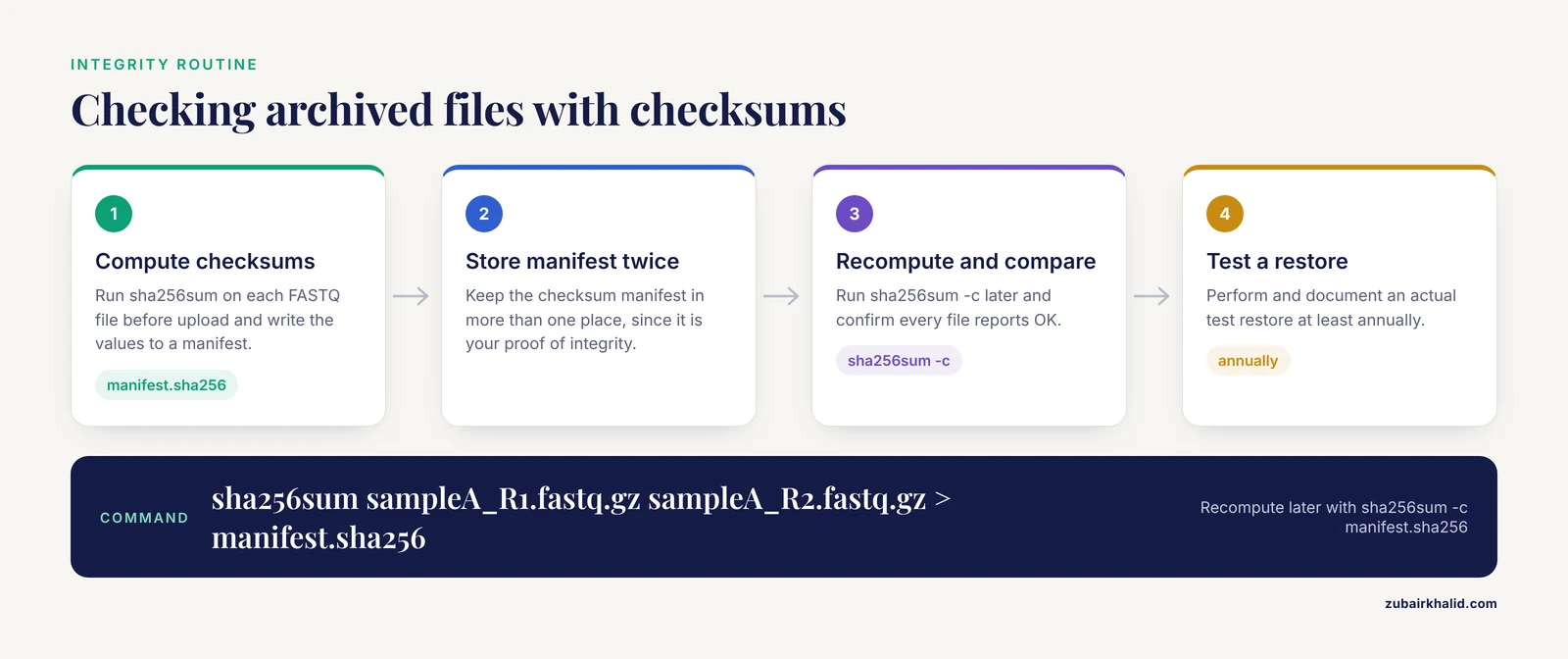
A useful one-line example of integrity checking that any lab can adopt today:
sha256sum sampleA_R1.fastq.gz sampleA_R2.fastq.gz > manifest.sha256Recompute later with sha256sum -c manifest.sha256. If the output reports OK for every file, the bits are unchanged. This pair of commands costs nothing and catches silent corruption that no amount of replication alone will catch, because replication faithfully copies corrupted bytes too.
The established practice baseline for durable storage is the 3-2-1 rule: keep at least three copies of the data, on at least two different types of storage media, with at least one copy off-site. On top of durability, the research community has converged on the FAIR principles, which state that data should be findable, accessible, interoperable, and reusable. Those four words are a compact specification for what separates an archive from a pile of files. A pile of files on a retired workstation is backed up at best. A directory of FASTQ files with sample metadata, a checksum manifest, the workflow used to process them, and a stable accession at a repository is archived.
Genomic data also move through a lifecycle. Data are hot during active analysis, warm after publication when reviewers and collaborators may request them, and cold during long-term retention when the main value is future reuse. Different archival strategies map onto different parts of that lifecycle, and most mature programs use several strategies at once.
Why Archival Strategies Earn Their Keep
Archives are not clerical overhead. They are scientific instruments, and the clearest evidence comes from studies that could not have been done without them.
A citrus genomics team faced exactly this situation with huanglongbing, a devastating disease caused by the bacterium "Candidatus Liberibacter asiaticus", which is transmitted by the Asian citrus psyllid, Diaphorina citri. Earlier transcriptome analyses of the insect had been hampered by incomplete versions of the D. citri genome, inadequate host plant controls, and a lack of a uniform analysis approach. Because the underlying sequencing data had been archived, the team could run a quantitative transcriptome analysis of excised heads, salivary glands, midguts, and bacteriomes from CLas-positive and CLas-negative psyllids using a new chromosomal-length genome assembly, and each organ showed a unique response to infection. When they reanalyzed the archived midgut dataset against both the older Diaci_v1.1 assembly and the newer Diaci_v3.0 assembly, the improved reference genome produced significant and quantifiable differences in how the RNA-sequencing data were interpreted [1]. No new insects were collected and no new libraries were sequenced. The archive turned an old dataset into new biology, and it demonstrated that the choice of reference genome version is part of the scientific result, not a detail to be forgotten after publication.
Archived public data also let single research groups operate at multi-institution scale. A recent study of CT-based deep learning radiomics and transcriptomics for predicting the staging of epithelial ovarian cancer built and validated its models on 201 patients from three hospitals, split 160 to 41 between training and internal validation, and then drew an external validation set of 84 patients from The Cancer Genome Atlas, with RNA sequencing data from The Cancer Imaging Archive used to investigate radiogenomics-related immune infiltration patterns [2]. The external cohort existed as reusable archived data, which is what made independent validation of a 201-patient model practical.
The longest archival horizon belongs to natural history collections. A comparison of whole-genome sequence data from contemporary steelhead populations against museum samples collected from the same California locations before most hatchery stocking found minimal introgression despite a century of stocking, and showed that migration-associated haplotypes had become less frequent over time, a result the authors describe as a rare example of shifting baseline syndrome validated with historical data [3]. A review of museum genomics notes that the hundreds of millions of specimens held in natural history collections can now yield genome-scale data, and that traditional collector motivations, such as studies of geographic variation and community inventories, create exactly the broad temporal and spatial sampling that conservation genomics needs [4]. Physical specimen archives are, in effect, sequencer-ready storage media with a shelf life measured in a century.
Clinical archives play the same role in medicine. Formalin fixed paraffin embedded (FFPE) samples, tissue preserved in formalin and embedded in paraffin wax for pathology, are valuable because they retain clinically relevant morphology and can be used to study genetic changes, although their DNA quality and quantity are often suboptimal and NGS-based variant detection from them is prone to false positives [5]. A well-run FFPE block archive is a longitudinal genomic record of a patient population that no prospective study could afford to recreate.
The Main Genomics Data Archival Strategies
Seven strategies cover essentially every genomics data storage situation. The table compares them side by side, and each is then explained on its own terms.
| Strategy | What it holds | Typical retrieval latency | Main strengths | Main drawbacks | Best suited to |
|---|---|---|---|---|---|
| Domain-specific public repositories | Raw reads and curated processed datasets | Minutes for processed data, hours to days for request-based raw data | Permanence, accessions, discoverability, community standards | Upload effort, format constraints | Published sequencing data |
| Generalist study repositories | Heterogeneous study data with rich metadata | Hours to days | Flexible formats, project-level packaging, legacy migration support | Less domain-specific indexing, more curation burden on the depositor | Mixed data types that do not fit sequence archives |
| Controlled-access archives | Human genomic data under consent | Days, because access review intervenes | Consent management, compliance, tiered access | Approval friction, slower reuse | Identifiable human genomic and clinical data |
| Cold-tier cloud object storage | Any file, any size | Minutes for warm tiers, hours for deep archive tiers | High durability, low at-rest cost, automated lifecycle rules | Retrieval and egress fees, weak built-in data semantics | Institutional bulk retention of raw data |
| On-premises disk and tape archives | Any file | Minutes for disk, manual handling for tape | One-time hardware cost, offline air gap, no egress fees | Media refresh cycles, physical logistics, no built-in indexing | Labs with large, stable holdings |
| Physical specimen archives | Tissue, extracted DNA, historical specimens | Weeks to months | The biological source itself, time series spanning decades | Degraded biomolecules, extraction variability, artifacts | Retrospective, temporal, and conservation studies |
| Provenance and pipeline archives | Workflows, containers, parameters, reference versions | Minutes | Reproducibility, cheap to maintain | Requires engineering discipline | Any project a third party will want to rerun |
Domain-Specific Public Repositories
Domain-specific repositories are the canonical destination for published sequencing data. Sequence read archives accept raw reads plus standardized sample metadata, assign a stable accession, and hold the data indefinitely, which is what makes it possible for a 2022 reanalysis to pull data that were generated years earlier. Subject-matter archives go a step further by curating and harmonizing processed data around a theme. The Cancer Genome Atlas and The Cancer Imaging Archive, for example, pair tumor molecular profiles with imaging, which is precisely the combination the ovarian cancer staging study needed for external validation and radiogenomics analysis [2].
The strengths of this strategy are permanence, discoverability through repository search, and citation value through accessions, all of which directly serve the FAIR principles. The drawbacks are the effort of deposition, which involves metadata preparation and validation, and format constraints, since sequence archives are built around sequencing data types and handle unusual outputs poorly. Deposition effort is also front-loaded and one-time, which makes this the best cost-benefit profile of any archival option for data destined for publication.
Generalist Study Repositories
Not every dataset is a pile of FASTQ files. Interaction tables, image-derived features, phenotype spreadsheets, and assay outputs from niche platforms often have no specialized archive. The BioStudies database, an EMBL-EBI resource, serves as a repository for descriptions of biological studies, provides links to associated data in both internal databases and external resources, and accommodates data that do not fit into specialized archives. It offers mechanisms for defining metadata guidelines tailored to specific data sources, projects, or communities, organizes datasets into collections, and supports data sharing across the whole lifecycle, from collaborative projects through deposition at manuscript submission to post-publication data packages. It has also helped projects transition away from legacy data infrastructures by offering sustainable archival and access services [6].
The strength of a generalist repository is flexibility with structure. You can wrap a whole study, its heterogeneous files, and its metadata into one retrievable package. The drawbacks are that generalist repositories carry less domain-specific indexing than sequence archives, and the depositor supplies more of the descriptive structure, which means the quality of the archive depends on the quality of the metadata you write.
Controlled-Access Archives for Sensitive Human Data
Human genomic sequence is inherently identifiable, so open repositories are not appropriate for most clinical and many research datasets. Controlled-access archives gate downloads behind data use certifications, institutional sign-off, and data use agreements that enforce the consent terms under which the samples were collected. Retrieval latency is measured in days rather than minutes because an access review intervenes, and secondary users must usually return to the repository for re-approval when their analysis purpose changes.
The strength of this strategy is that it reconciles two goals that otherwise conflict, long-term preservation and protection of research participants. The drawbacks are approval friction, slower reuse, and the fact that consent scope, once fixed, limits what future analyses the archive can legally support. Plan consent language with the archive in mind, because data frozen today under narrow consent may be unusable for the methods of ten years from now.
Cold-Tier Cloud Object Storage
Cloud object storage vendors sell capacity in tiers. Hot tiers serve files instantly and cost the most per terabyte. Cool tiers cost less and add modest retrieval latency. Archive tiers cost the least at rest and trade that for retrieval delays measured in hours plus per-gigabyte retrieval charges, and most deep archive tiers impose minimum storage durations and charge for early deletion. Because no source-verified price schedule is cited here, treat exact costs as vendor-specific and check current published rates before committing.
The strengths of cloud cold tiers are durability through redundant storage, low marginal at-rest cost, and lifecycle policies that move objects between tiers automatically based on age or access patterns. The drawbacks are retrieval and egress fees, which can turn a cheap archive into an expensive one the day you restore everything, and the fact that object storage has no inherent understanding of what a FASTQ file or a patient cohort means. Semantics must come from your metadata layer.
Two habits make cloud archival work. First, compute checksums before upload and store the manifest in more than one place, since the manifest is your proof of integrity. Second, perform and document an actual test restore at least annually, because an untested restore path is a hypothesis, not a capability.
On-Premises Disk and Tape Archives
Tape remains standard infrastructure for bulk scientific archiving, and the practical reasons are unchanged from any standard data management reference. Modern tape cartridges store many terabytes, last decades on the shelf when stored properly, consume no power while sitting, and because they sit offline they are immune to network-borne attacks such as ransomware, which is the air gap property. Disk-based on-premises archives trade some of that durability for retrieval in minutes.
The strengths of on-premises archiving are a one-time hardware cost, no recurring egress fees, and complete physical control. The drawbacks are media and hardware refresh cycles, since formats and drives change roughly every generation, the physical logistics of off-site copy rotation, and the absence of built-in indexing, which leaves metadata entirely to your own systems. Tape is the right answer for a large, stable, rarely-read corpus. It is the wrong answer for data that collaborators expect to query next week.
Physical Specimen Archives
Physical archives store the biological material itself, which is the only archival medium that can generate new data types as technology advances. Natural history collections hold hundreds of millions of specimens, and reviews of museum genomics describe the methods now available for generating genome-scale data from historical specimens and the conservation questions those data answer, from measuring population responses to past anthropogenic change to refining projections of future responses [4]. The steelhead study shows the payoff directly, since pre-stocking museum samples provided the temporal baseline that revealed haplotype frequency shifts invisible in contemporary data alone [3].
Clinical tissue archives work on shorter timescales but the same principle. FFPE blocks preserve both morphology and DNA, and a study designed to isolate FFPE-specific artifacts compared DNA from paired FFPE and fresh frozen breast tissues within subjects, testing two extraction methods, the QIAGEN QIAamp DNA Mini Kit and the QIAGEN GeneRead DNA FFPE Kit, with negative and positive control samples, sequencing on a HiSeq 4000 under a targeted breast cancer panel, and found that both wet-lab and bioinformatics choices measurably affect variant concordance and FFPE artifact profiles [5]. The lesson for archive managers is that the specimen, the extraction method, and the analysis pipeline are one system, and decisions in all three should be recorded together.
The strengths of physical archives are irreplaceable. The drawbacks are degraded and chemically damaged biomolecules, extraction variability, slow retrieval, and the fact that a specimen without a georeferenced, dated record is nearly worthless, which is why curators treat cataloging metadata as inseparable from the specimen itself.
Provenance and Pipeline Archives
The cheapest archival strategy, and the one most often skipped, is archiving the analysis itself. This means version-pinned workflows, container images, parameter files, and the exact reference genome build and annotation release used. The citrus reanalysis shows why the reference build matters, since the same midgut dataset produced quantifiably different results on Diaci_v1.1 versus Diaci_v3.0 [1]. A pipeline archive is what allows someone in 2032 to reproduce your 2026 result, or to explain an inconsistency that turns out to be a reference assembly difference rather than a biological one.
Pathogen surveillance shows the operational pattern. The Castanet pipeline, built for targeted multi-pathogen enrichment sequencing, works on short-read data but can be deployed on any BAM file from another methodology, and beyond consensus generation it reports method-specific metrics that quantify capture efficiency, estimate pathogen load, differentiate low-level positives from contamination, and assess sequencing quality [7]. An archive that holds the BAM files plus the pinned pipeline preserves not only the consensus sequences but the ability to regenerate them and to reinterpret capture metrics under changed outbreak conditions.
The strength of provenance archiving is that it multiplies the value of every other strategy on this list, at the cost of a few gigabytes and some engineering discipline. The drawback is that it requires the discipline to pin versions at the time of analysis, which no tool can retroactively do for you.
How to Choose Between the Options
Every organization weighs the genomics data archival strategies options against six criteria, and the pros and cons of each strategy only matter relative to these criteria.
Durability and integrity. Ask how many independent copies exist, on how many media, in how many locations, and whether checksum verification is automated. Public repositories and cloud object storage score highest on durability per dollar. Tape scores highest on air-gapped durability. A single lab server scores lowest, regardless of how expensive the server was.
Retrieval latency and cost shape. Distinguish what you pay at rest from what you pay to get data back. Deep archive tiers and tape have the lowest at-rest costs and the highest retrieval friction. Public repositories have near-zero retrieval cost but deposition effort up front. Match the cost shape to the access pattern. Data read monthly do not belong in deep archive, and data untouched for a decade do not belong on hot storage.
Metadata depth and standards fit. Sequence archives enforce community metadata standards but constrain formats [6] discusses the complementary problem for data outside those standards. Generalist repositories let you define project-specific metadata guidelines, which is valuable exactly when your data do not fit. The deciding question is whether a stranger, five years from now, could interpret your metadata without emailing you.
Access control and consent. Identifiable human data require controlled-access archives, full stop. Nonhuman and de-identified data gain nothing from access controls except friction, so open deposition is usually the better choice where consent and policy allow.
Reanalysis readiness. Raw reads plus provenance beat processed files, because the reanalysis that matters, like the reference assembly comparison that changed RNA-seq interpretation in the citrus study [1], almost always starts from raw data. Archive raw reads whenever scale permits, archive the pipeline alongside, and record the reference build in the same metadata record as the data.
Effort and expertise. Public deposition, containerized pipelines, and managed cloud tiers all demand skills that small labs may not keep on staff. A defensible, if less elegant, fallback is structured on-premises storage with rigorous checksum manifests and an off-site copy, upgraded when the program grows. Perfection delivered late is worse than adequacy delivered this quarter.
A compact way to summarize the pros and cons decision: public repositories maximize reuse and discoverability, generalist repositories maximize format flexibility, controlled-access archives maximize compliance, cloud cold tiers minimize at-rest cost, tape maximizes offline durability, physical specimen archives maximize temporal reach, and provenance archives maximize reproducibility. Most mature programs combine four or more of these rather than electing a single winner.
Worked Scenarios
An academic RNA-seq lab. A lab studying vector-borne pathogen interactions sequences psyllid organs across an infection time course. During the project, FASTQ files live on a fast shared filesystem. On publication, raw reads and metadata go to a sequence read archive with accessions cited in the paper, and a full copy with checksum manifests moves to cloud cold storage. The workflow, container versions, and the exact reference assembly build are archived alongside, in the knowledge that a future chromosomal-length assembly may change the interpretation, as happened when archived midgut data were reanalyzed against Diaci_v1.1 and v3.0 [1]. Total incremental cost beyond the cold storage bill is a few days of a student's time.
A multi-hospital model development group. A team predicting ovarian cancer stage from CT radiomics, deep learning features, and transcriptomics trains on 160 patients and validates internally on 41 from its own three-hospital consortium, then needs external validation that no consortium of 201 patients can provide. Archived TCGA imaging and molecular data supply an 84-patient external cohort and immune infiltration analysis [2]. The internal data sit in controlled-access institutional storage because they are identifiable, while the published model artifacts and de-identified feature tables go to a generalist repository.
A conservation genomics program. A state fisheries agency monitoring steelhead archives voucher specimens from every survey year in a natural history collection, which costs little more than the labeling discipline, because collections are the resource that turns future sequencing technology into time travel [4]. When whole-genome sequencing becomes affordable, the program compares contemporary samples against pre-stocking museum samples and can quantify a century of change, including the haplotype frequency shifts that contemporary-only sampling would have missed [3].
A clinical molecular laboratory. A hospital lab sequences targeted panels from FFPE blocks. It archives blocks under standard pathology retention, records the extraction method used, since kit choice affects artifact profiles [5], and archives raw reads, BAM files, variant calls, the pipeline container, and the manifest of positive and negative controls with every run. When a new variant caller or a revised panel appears, retrospective batches can be reprocessed under known conditions rather than confounded ones.
A pathogen surveillance network. A public health network runs targeted enrichment sequencing across multiple pathogens per sample. It archives BAM files with the pinned Castanet pipeline, so that consensus regeneration and capture efficiency metrics remain reproducible as reference sequences and outbreak priorities change [7]. Weekly dashboards can be regenerated from the archive without re-sequencing anything.
Common Mistakes and Limitations
The most expensive mistakes in genomics data archiving are silent ones, discovered the day the data are needed.
Treating a backup as an archive is the most common error. A backup restores files. It does not answer what sample a file came from, under what consent, processed with which genome build. Every failure downstream of that confusion, from failed manuscript revisions to unusable historical cohorts, traces back to it.
Deleting raw reads after publishing processed results is the second. Variant calls and expression matrices are snapshots of one pipeline against one reference. The citrus reanalysis demonstrates that a newer reference assembly alone can change quantitative interpretation [1], so an archive holding only processed results forecloses the reanalyses that matter most.
Leaving reference builds and software versions unstated is a close relative. Record the genome assembly, annotation release, aligner version, and parameters in the same metadata record as the data, not in a lab member's memory.
Writing metadata after the fact fails predictably. Metadata reconstructed from memory years later is wrong in the details that matter, such as tissue provenance and library type. Capture metadata at collection time, ideally machine-generated, and follow the specimen archive principle that the record and the object are inseparable [4].
Untested restores are another quiet failure. Replication protects against hardware loss but not against silent corruption, which only checksum verification catches, and a restore path never exercised will fail on the day it is needed. Run and document test restores annually, and verify against the checksum manifest.
Ignoring archived-sample artifacts produces confident wrong answers. FFPE DNA carries characteristic damage, and both extraction method and analysis choices shift variant concordance, which is why the paired FFPE and fresh frozen comparison design with controls exists as a template [5]. Apply equivalent validation whenever sequencing archived clinical material.
Finally, one scope limitation applies throughout. Retention periods, deposit mandates, consent requirements, and controlled-access rules are set by funders, journals, and institutions, and they differ, so the specific obligations for any dataset must be confirmed against the policies that govern it rather than inferred from general practice.
Frequently Asked Questions
What is the difference between backing up and archiving genomics data?
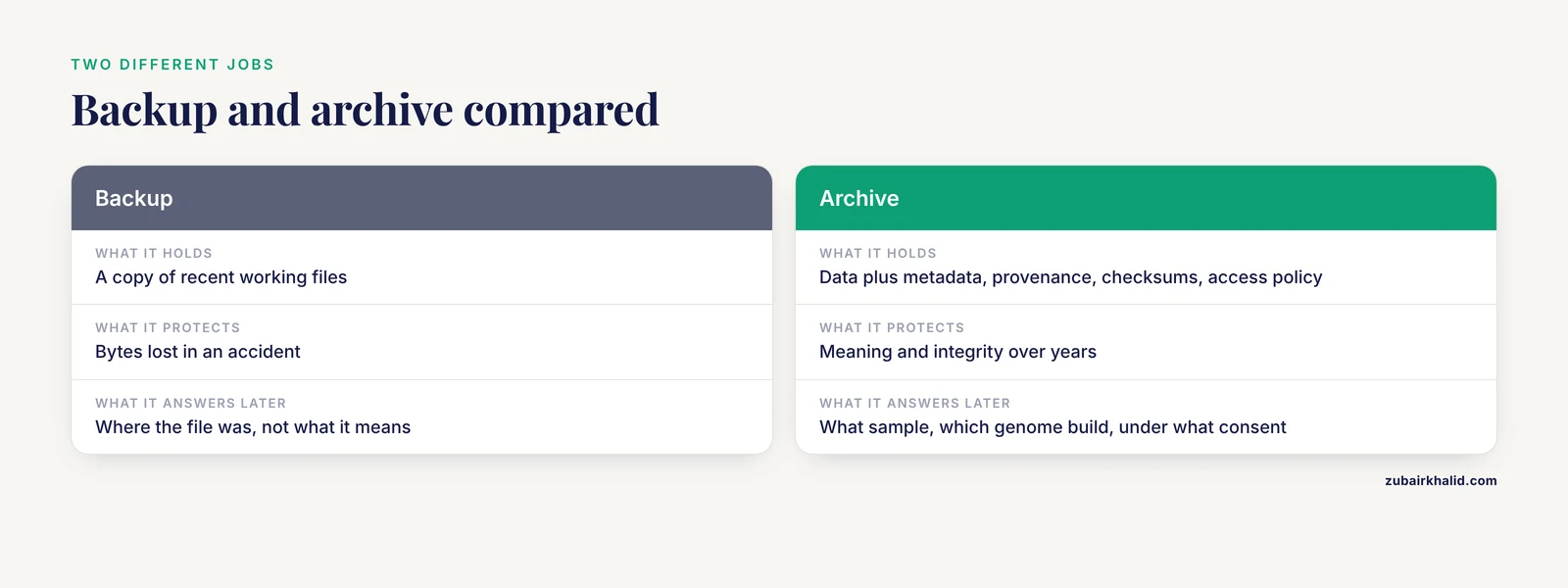
A backup is a copy made to survive accidents, and an archive is data preserved with the metadata, provenance, checksums, and access policy needed to find, trust, and reuse them years later. Backups protect bytes. Archives protect meaning.
Should we archive raw reads or only processed files?
Archive raw reads whenever storage permits, because reanalysis against improved reference genomes and new methods starts from raw data. Processed files are worth keeping too, but they are snapshots of one pipeline and one reference version.
How long should genomic data be kept after publication?
Funders and journals set the binding requirements, so confirm the specific mandates that apply to your grant and manuscript. As a practical floor, keep raw data and provenance for at least as long as the findings remain citable and reproducible, which in practice means many years.
What metadata should be captured before deposit?
Record sample identity and provenance, tissue and organism, collection date and location where applicable, library preparation, instrument, consent or access conditions, the reference genome build, and the software versions and parameters used. Capture these at data creation time, not retrospectively.
Can FFPE tissue blocks still be used for sequencing years later?
Yes, archived FFPE samples are valuable clinical resources for studying genetic changes, although their DNA quality is often suboptimal and variant calling is prone to FFPE-specific artifacts. Extraction method and bioinformatics filtering choices measurably affect results, so validate the pipeline for archived material specifically.
How do natural history collections fit into genomic data archiving?
They are physical genomic archives. Collections hold hundreds of millions of dated, georeferenced specimens from which genome-scale data can now be generated, enabling direct measurement of population change across decades, which contemporary-only sampling cannot provide.
Sources
- Lessons learned about the biology and genomics of Diaphorina citri infection with "Candidatus Liberibacter asiaticus" by integrating new and archived organ-specific transcriptome data.
- CT deep learning radiomics and genomics for predicting staging of epithelial ovarian cancer.
- Recent Adaptation in a Threatened Salmonid Revealed by Museum Genomics.
- Natural history collections as a resource for conservation genomics: Understanding the past to preserve the future.
- Bioinformatics and DNA-extraction strategies to reliably detect genetic variants from FFPE breast tissue samples.
- BioStudies Database: A Platform for Life Sciences Study Data Dissemination.
- Castanet: a pipeline for rapid analysis of targeted multi-pathogen genomic data.