Ensembl vs. UCSC Genome Browser for Gene Expression and Regulation
By Dr. Zubair Khalid, DVM, MS, PhD ·

Ensembl is a genome database and annotation project that also ships a browser, while the UCSC Genome Browser is a visualization engine that displays annotations from many sources, Ensembl included. That single sentence explains most of the practical differences between them. The rule of thumb that follows: when your deliverable is a table of read counts, a GTF file, or a set of stable gene identifiers, use Ensembl. When your deliverable is a figure, a regulatory interpretation, or a visual check that your quantification landed where you think it did, use UCSC. Most published expression workflows end up using both, and the studies that compare annotations directly show why [1].
This guide walks through what each browser actually is, where the choice changes your numbers, how to use Ensembl step by step, how to get the most out of UCSC, and worked scenarios drawn from real expression and regulation studies.
Why the Choice Is Not Cosmetic
Gene expression measurements are always relative to a definition of the gene. Before you can say a transcript is upregulated, something has to decide where the gene starts, where it ends, which exons belong to it, and how many isoforms it has. Ensembl genes, RefSeq genes, and UCSC Known Genes answer those questions differently, and the differences propagate straight into your quantification.
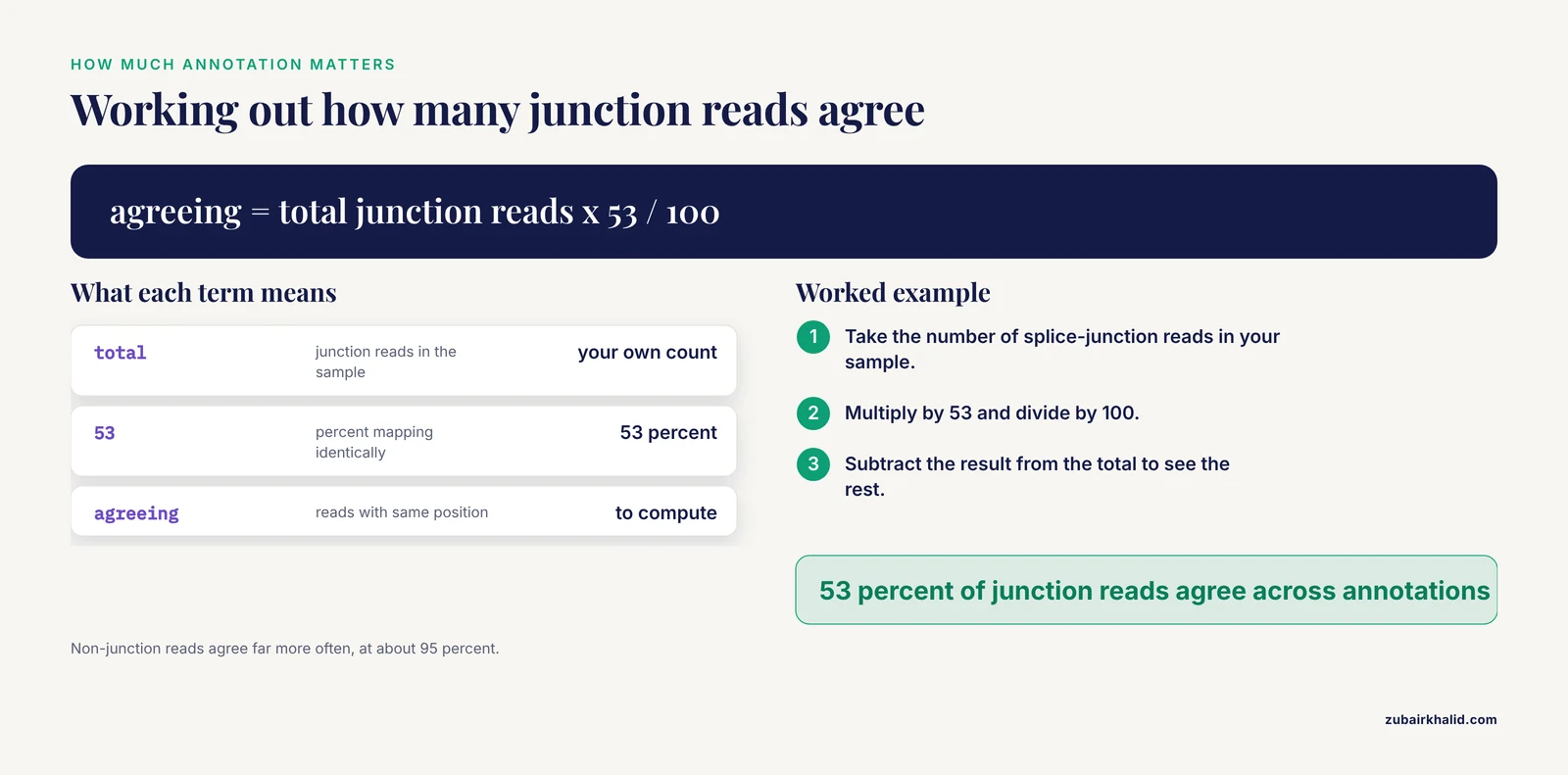
The evidence for this is quantitative. In a systematic comparison of the RefGene, Ensembl, and UCSC annotations on the Human Body Map 2.0 RNA-seq dataset, about 95 percent of non-junction reads mapped to exactly the same genomic position regardless of which gene model was used. For splice-junction reads, that agreement collapsed to 53 percent. Roughly 30 percent of junction reads failed to align at all without the help of a gene model, and 10 to 15 percent mapped to alternative locations depending on the annotation supplied [1]. Only 21,958 genes were common to all three annotations [1]. A separate evaluation of six human annotations, including AceView, Ensembl, H-InvDB, RefSeq, UCSC Known Genes, and Vega, found that the least complex annotation (RefSeq) gave the highest percentage of successfully mapped reads, and concluded that annotation choice should be guided by the research question, particularly the balance between gene-level and isoform-level analysis [2]. A follow-up chapter from the same group summarized the stakes plainly: gene model choice has a dramatic effect on both gene quantification and differential expression analysis [3].
The takeaway is that the difference between Ensembl and UCSC for expression data is not primarily about interface taste. It is about which gene definition, which coordinates, and which transcript catalog your counts are silently being measured against.
What Ensembl Is
Ensembl is a genome annotation and browser project that maintains its own gene builds for hundreds of species. Its annotations are versioned in numbered releases, which matters enormously for reproducibility. Ensembl version 109, published in 2023, annotated approximately 252,798 distinct RNA isoforms across 62,710 human gene bodies [4]. Older releases are preserved, so a paper can state exactly which annotation it used. One heart failure RNA-seq study, for example, classified its noncoding transcripts by cross-referencing Ensembl release 73 on the GRCh37 genome build [5].
Ensembl identifiers are stable and hierarchical. A gene carries an ENSG identifier, each transcript an ENST identifier, and each exon, protein, and variant its own stable accession. Those identifiers are what your counting software, your VEP runs, and your downstream databases talk to each other through. Several expression studies lean on this directly. An osteoarthritis cartilage study performed differential expression on lncRNAs annotated in the GENCODE and Ensembl databases, identified 5,053 robustly expressed lncRNAs, of which 191 were significantly differentially expressed between lesioned and preserved tissue, and then correlated those lncRNAs with flanking sense genes to nominate regulatory candidates [6]. A nasopharyngeal carcinoma lncRNA study built its microarray probes from RefSeq, UCSC Known Genes, Ensembl, and the literature, generating 33,045 lncRNA probes and finding 8,088 lncRNAs differentially expressed at twofold or better [7].
When to Use Ensembl
Use Ensembl when the task involves gene definitions rather than gene pictures:
- You need a GTF or GFF3 file to count RNA-seq reads with tools such as featureCounts, HTSeq, or a transcriptome-aware aligner.
- You need stable transcript-level identifiers, for example when reporting which specific isoform of a gene changed, a need that grows sharply as long-read data matures [4].
- You need versioned, citable annotation. Pinning Ensembl release 73 with GRCh37, as one study did, is a reproducibility guarantee that a browser screenshot is not [5].
- You are working outside the standard model organisms. Ensembl Plants supplied the genome context for identifying 35 members of the maize Snf2 chromatin-remodeling family, mapping them across all ten maize chromosomes, and linking exon-intron structure and cis-regulatory elements to stress-responsive expression validated by qRT-PCR under drought [8]. Ensembl Genomes underpins WormBase ParaSite, which provides consistent functional annotation and gene expression analysis for more than 100 helminth species and offers a choice of genome browsers for exploration [9].
- You need comparative sequence data. A study of chicken LECT2 retrieved amino acid sequences for the gene from multiple vertebrate species through the Ensembl database before running motif, signal peptide, and expression analyses [10].
- You want variant effect prediction in the same ecosystem. Ensembl VEP assigns functional consequences to variants, and two separate studies used it as the annotation engine for expressed variants in cystic fibrosis single-cell data and for FKBP5 polymorphisms associated with insomnia in stress-related bipolar disorder [11] [12].
How to Use Ensembl for an Expression Project
A practical Ensembl genome browser tutorial for expression work comes down to five steps.
Step 1: Find and verify the gene. Type the gene symbol or Ensembl gene ID into the search box at ensembl.org. On the gene page, confirm three things before anything else: the species, the assembly (GRCh38 for current human work, GRCh37 if you must match older data), and the release number displayed on the page. If a collaborator sent you coordinates from 2019 and you are looking at the 2026 release, some of those coordinates may no longer match.
Step 2: Pull the annotation you will compute against. For RNA-seq quantification, download the GTF directly from the Ensembl FTP site. For release 109, the human file is:
wget https://ftp.ensembl.org/pub/release-109/gtf/homo_sapiens/Homo_sapiens.GRCh38.109.gtf.gzCheck the current release number on the Ensembl FTP index before downloading, because releases update several times a year. Then count reads against it, keeping the release number in your lab notebook and your methods section:
featureCounts -a Homo_sapiens.GRCh38.109.gtf.gz -g gene_id -t exon -p -o counts.txt sorted.bamStep 3: Retrieve gene sets with BioMart. When you need a list of all protein-coding genes on chromosome 1, all transcripts for a gene family, or orthologs between species, BioMart filters and exports the identifiers without any scripting.
Step 4: Inspect the gene model. The Location tab shows exon-intron structure, transcript variants, and supporting evidence. For isoform-heavy genes this view is essential context. With 256 human gene bodies carrying at least 50 annotated isoforms, 30 carrying at least 100, and MAPK10 annotated with 192 distinct isoforms, glancing at the transcript panel before quantifying at isoform resolution is not optional [4].
Step 5: Check the DNA, not just the gene model. The Ensembl DNA sequence views are also used for primer-oriented checks. In a workflow for validating RT-qPCR primer specificity, the authors combined NCBI Primer BLAST, in silico PCR in the UCSC genome browser, and the Ensembl DNA database to catch primer problems before they contaminated published datasets [13].
What the UCSC Genome Browser Is
The UCSC Genome Browser is a visualization and data-integration platform. Its default gene set (UCSC Known Genes) is only one of many annotation tracks it displays. It happily shows RefSeq, GenBank, Ensembl, and GENCODE transcripts side by side on the same coordinates, which makes it the fastest place to see how differently the same gene can be defined. One microarray study exploited exactly that: it downloaded RefSeq, GenBank, and Ensembl transcript data through the UCSC genome browser, integrated them into a combined zebrafish annotation, and remapped Affymetrix probes against it. Compared to remapping against a single database, the integrated annotation retained up to 20 percent more probes and detected roughly 1,000 additional genes [14].
UCSC is also where regulatory context lives in one scrollable view. Conservation tracks, repetitive elements, CpG islands, transcription factor binding data, and expression tracks from projects such as ENCODE can be layered under your own data. A chicken study illustrates the pattern: gene sequences came from Ensembl, while CpG islands were identified using the hgTables interface of the UCSC Genome Browser, and the analysis linked GC content in the 5' UTR to expression breadth and maximum expression level [15].
When to Use UCSC
Use UCSC when the task involves seeing, checking, or contextualizing:
- You want to view your own RNA-seq coverage as a bigWig track on top of gene models, conservation, and regulatory marks, the standard move after a differential expression analysis produces a shortlist of genes.
- You need bulk genomic intervals, for example all CpG islands or all conserved elements in a region, through the Table Browser (the hgTables interface) [15].
- You want to test whether a primer pair would amplify something unexpected. The UCSC in silico PCR tool, used alongside NCBI Primer BLAST and Ensembl in one published primer-audit workflow, is a fast sanity check for cross-amplification [13].
- You need to show a reviewer where a variant sits relative to exons, promoters, and known regulatory elements. A cystic fibrosis single-cell study identified variants with FreeBayes, annotated them with Ensembl VEP, then visualized them in the UCSC Genome Browser to assign context and rsIDs [11].
- You are auditing regulation around a candidate gene. A study of ACE2 expression in the renin-angiotensin system used the Ensembl Genome Browser and the UCSC Genome Browser, together with IGV, BioXpress, and UniProt, to profile ACE2 expression across tissues and to characterize 99 variations in the gene, several of which had not been previously described [16].
Side-by-Side Comparison
| Criterion | Ensembl | UCSC Genome Browser |
|---|---|---|
| Core identity | Genome annotation and database project with its own browser | Visualization platform integrating many annotation sources |
| Default gene set | Ensembl genes, computed and maintained per release | UCSC Known Genes, with RefSeq, Ensembl, and GENCODE as parallel tracks |
| Gene identifiers | Stable ENSG and ENST accessions with versioned releases | Tracks reference external accession systems such as RefSeq and Ensembl |
| Versioning | Explicit numbered releases tied to genome assemblies, for example release 109 in 2023 [4] | Genome assembly versions (hg38, hg19) with tracks updated continuously |
| Expression visualization | Gene and transcript views, Expression Atlas links, VEP integration | Superior custom track display, bigWig coverage, public expression tracks |
| Regulatory content | Variant effect prediction, regulatory features in the annotation | Conservation, CpG islands, ENCODE regulation, Table Browser intersections [15] |
| Bulk data access | FTP downloads of GTF, GFF3, FASTA, VCF per release | Table Browser, Track Hubs, downloads gateway |
| Species coverage | Broad, including plants and pathogens through Ensembl Genomes and Ensembl Plants [8] [9] | Deep for vertebrates, strong for model organisms, hosts hubs for many others |
| Standout tools | BioMart, VEP, REST API, comparative genomics | In silico PCR [13], Blat, liftOver, custom track sessions |
| Typical role in an expression workflow | Source of truth for what a gene is and where it is | Place where results, annotation, and regulation meet visually |
Reading the table by column: Ensembl is the database you compute against. UCSC is the stage you interpret on.
Ensembl or UCSC for Expression Data: The Deciding Criteria
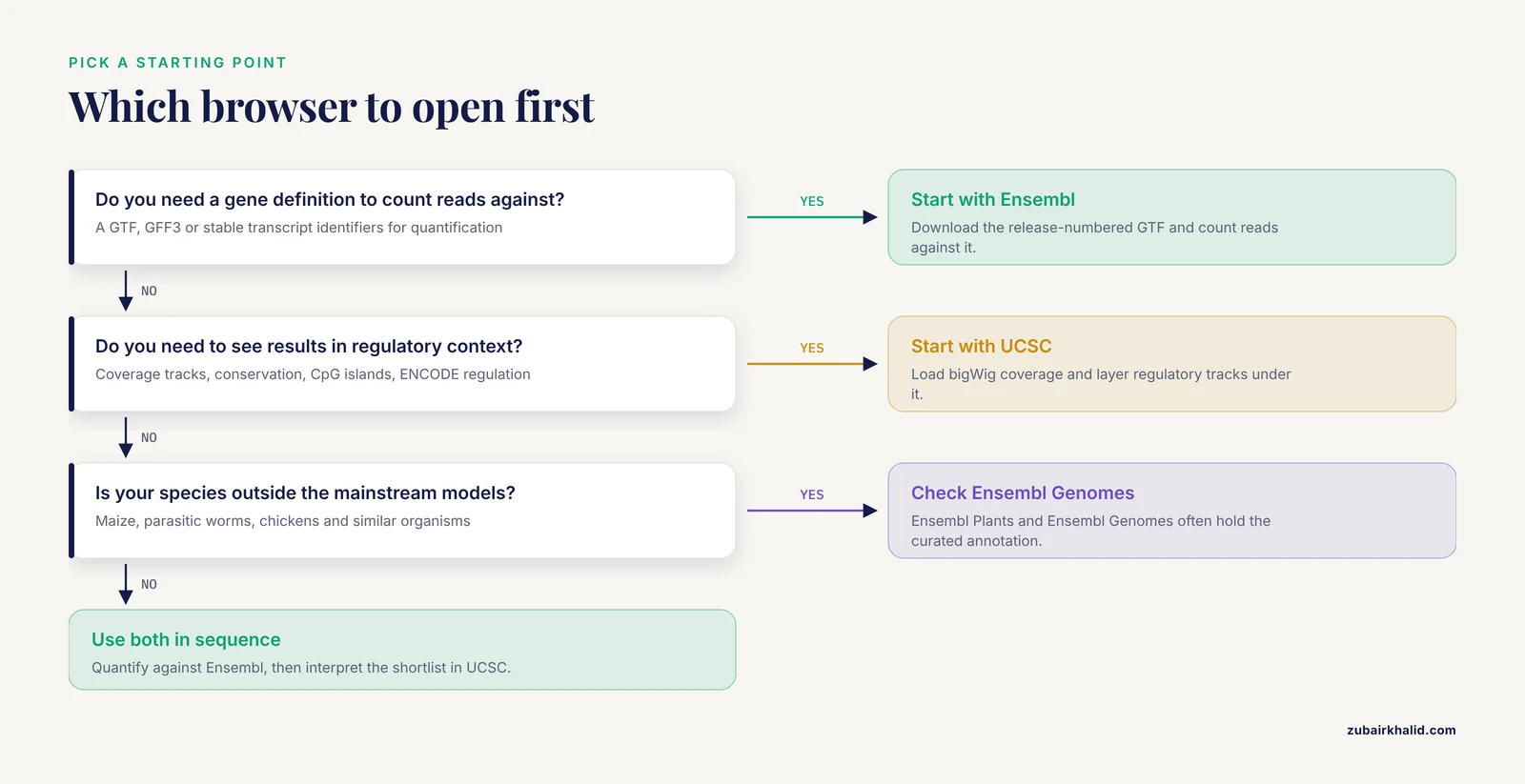
Four questions resolve nearly every real choice.
First, are you quantifying or interpreting? Quantification needs one gene definition applied consistently to every sample. That is an Ensembl GTF job. Interpretation, meaning explaining why a gene changed and what regulatory logic sits upstream, needs the layered context UCSC excels at.
Second, do you care about isoforms? Isoform-level work is where annotation differences bite hardest. Because only 53 percent of junction reads map identically across three major annotations [1], a transcript-level analysis is only as good as the transcript catalog behind it. Ensembl's release-annotated isoform set, with its explicit versioning [4] [5], is the usual foundation, while UCSC is where you inspect whether the isoforms your pipeline called actually look plausible against full-length transcript evidence.
Third, which genome build is your data on? Ensembl and UCSC both serve GRCh38 for human, but UCSC names builds hg38 and hg19 while Ensembl uses GRCh38 and GRCh37. Coordinates are the same genome, different labels, and mixing builds silently breaks interval intersections. Confirm the build before comparing anything across the two sites.
Fourth, is your species a mainstream model organism? For maize, parasitic worms, or chickens, Ensembl Plants and Ensembl Genomes are often the primary annotation source [8] [9] [10], while UCSC may host the assembly with fewer curated gene tracks. For human and mouse, both are first-class and the choice is about workflow rather than coverage.
Worked Scenarios
Scenario 1: RNA-seq differential expression in human tissue
You have twelve paired-end libraries from patient and control tissue. Download the Ensembl GRCh38 GTF, align with a splice-aware aligner supplying that GTF as the junction reference, and count with featureCounts at gene level. Record the release number. Once differential expression gives you a shortlist, export per-sample bigWig coverage files, load them into UCSC as a custom track hub, and inspect each candidate gene against the Ensembl and RefSeq tracks simultaneously. Junction reads sit at the heart of the disagreement between annotations [1], so checking that your top hits have consistent exon structure across tracks catches quantification artifacts before they become figures. If the project extends to isoform resolution, remember how crowded the human isoform catalog is: Ensembl v109 lists about 252,798 isoforms [4], and long-read data is currently the most reliable way to determine which of those are actually used in a given tissue [4].
Scenario 2: RT-qPCR validation of RNA-seq hits
Your differential expression table gives you five genes to validate by RT-qPCR. The trap here is primer quality, and the trap is well documented. In a survey of 504 primer sets from 70 rat toxicological studies, systematic in silico evaluation found potential mismatches in 9 percent of sets, cross-matches amplifying unintended targets in 13.5 percent, co-amplification of multiple splice variants in 9 percent, and suboptimal amplicon sizes in 25 percent. The same study showed that genomic DNA contamination disproportionately corrupted measurements of lowly expressed genes, which are precisely the genes most qPCR validation is asked to confirm [13]. The published defense is a three-tool workflow: NCBI Primer BLAST for specificity, in silico PCR in the UCSC genome browser for rapid genomic cross-checks, and the Ensembl DNA database for verifying exon boundaries and splice variants against the current annotation [13]. Run that workflow before ordering oligos, and include a no-reverse-transcriptase control in your assay design to detect genomic DNA carryover.
Scenario 3: Gene family and regulatory analysis in a non-model crop
You are cataloging stress-responsive genes in maize. Ensembl Plants provides the gene models, protein sequences, and chromosomal coordinates. From there, a published pipeline identified 35 Snf2 family members, mapped them across all ten chromosomes, analyzed exon-intron structure and 20 conserved motifs, ran collinearity analysis for duplication history, scanned upstream regions for cis-regulatory elements linked to abiotic stress, and confirmed tissue-specific and drought-responsive expression by qRT-PCR [8]. The Ensembl database also supplies the cross-species ortholog sequences you need for phylogeny, as a chicken LECT2 study demonstrated by retrieving the gene across fowl, fish, and mammals before functional expression work [10]. UCSC plays a smaller role for most crop species, which is itself a deciding criterion: when a curated annotation exists in Ensembl Genomes but not in UCSC, the question "ensembl or ucsc for expression data" answers itself.
Scenario 4: Regulatory interpretation of a candidate variant
A genome-wide association hit or a patient variant needs a functional story. A published analysis of FKBP5 polymorphisms in stress-related bipolar disorder ran functional annotation of associated variants through Ensembl VEP, RegulomeDB, HaploReg, and SNPnexus, connecting a candidate polymorphism to predicted effects on transcription factor binding and gene expression [12]. The expression side then moves to UCSC: overlay the variant position on the gene model, conservation, DNase hypersensitivity, and any available eQTL or enhancer tracks. For disease-focused projects that need scale, platforms such as GVViZ integrate gene-disease databases with RNA-seq expression analysis and heatmap visualization in a FAIR-compliant framework, reducing the manual browser hopping for large gene sets [17]. Reviews of public multi-omics resources place Ensembl and the UCSC Genome Browser together in the genomics layer that supports sequence retrieval, annotation, and clinical variant interpretation, with transcriptomics resources such as GTEx, TCGA, and the Single Cell Expression Atlas supplying the expression layer [18].
Common Mistakes and Limitations
- Mixing assemblies. hg19 is GRCh37 and hg38 is GRCh38, but patches and chromosome naming conventions differ. A 10 percent coordinate offset is not subtle. Always run liftOver or re-download annotation in the correct build before intersecting intervals from Ensembl with tracks from UCSC.
- Ignoring the annotation release. Ensembl's value is versioning, and failing to use it is self-defeating. Pin the release in your methods. A study that pinned Ensembl release 73 on GRCh37 can be reproduced against that exact catalog years later [5]. "I used Ensembl" is not a methods statement.
- Assuming one annotation is the truth. With only 21,958 genes shared across RefGene, Ensembl, and UCSC annotations [1], any single catalog is a subset of consensus plus a set of unique calls. If a gene disappears between annotations, that is information, not noise. Integrating multiple databases is not cheating, it is how one microarray remapping study retained 20 percent more probes and found roughly 1,000 additional genes [14].
- Confusing browser views with quantification. A UCSC screenshot of a bigWig track is evidence, not a measurement. Values for a paper should come from your count matrix and statistical model, with the browser figure as visual confirmation.
- Skipping primer and probe audits. The qPCR literature shows the cost of skipping the in silico checks: roughly a quarter of published primer sets had suboptimal amplicon sizes and more than one in ten could amplify the wrong target [13]. The same discipline applies to microarray probes, which is why the lncRNA arrays cited above were built by explicit, documented selection from RefSeq, UCSC Known Genes, and Ensembl [7].
- Treating "expressed" as "annotated." Long-read sequencing keeps revealing isoform use that short-read pipelines against a fixed catalog miss [4]. When isoform biology is the question, expect the annotation to be a floor rather than a ceiling.
- Forgetting that genomic DNA contamination skews low-abundance measurements. qPCR results for lowly expressed genes are the most susceptible to gDNA carryover [13], and the same principle warns against over-trusting near-background calls in any platform.
Individual experimental cases, especially clinical ones, need review by a qualified specialist and appropriate statistical support, and the browsers are decision-support tools rather than diagnostic instruments.
Frequently Asked Questions
Which browser should I use first for a gene expression question?
Start with Ensembl if you need gene definitions, identifiers, or annotation files to compute against, and start with UCSC if you need to visualize your data in regulatory context. Most expression projects touch both, typically Ensembl for quantification and UCSC for interpretation.
What is the difference between Ensembl and UCSC for expression data?
Ensembl is an annotation database that defines genes and transcripts in numbered releases, while UCSC is primarily a browser that displays many annotation sources, including Ensembl, on a shared genome. The difference matters because annotation choice measurably changes RNA-seq mapping and quantification.
Do Ensembl and UCSC use the same genome coordinates?
Both serve the same underlying genome assemblies for human, but they use different naming, with UCSC labels such as hg38 corresponding to Ensembl's GRCh38. Coordinates agree between matched builds, so always verify the build label before transferring intervals.
Does my choice of annotation change my RNA-seq results?
Yes. Comparisons across RefGene, Ensembl, and UCSC annotations found that 95 percent of non-junction reads mapped identically but only 53 percent of junction reads did, and roughly 30 percent of junction reads failed to align without a gene model at all.
How do I download an annotation file to count reads?
Download the GTF for your organism and assembly from the Ensembl FTP site, note the release number, and supply the file to your counting tool with the gene identifier as the grouping attribute. Keep the exact file name and release in your methods section for reproducibility.
Can I follow an Ensembl genome browser tutorial without any programming?
Yes. Searching a gene, checking the assembly and release, inspecting transcripts, and exporting data through BioMart all happen in the web interface. Command-line work only becomes necessary when you download annotation files for read counting or use the REST API for bulk queries.
Sources
- A comprehensive evaluation of ensembl, RefSeq, and UCSC annotations in the context of RNA-seq read mapping and gene quantification
- Assessing the impact of human genome annotation choice on RNA-seq expression estimates
- Impact of Gene Annotation on RNA-seq Data Analysis
- A bioinformatic survey of RNA isoform diversity and expression across 9 GTEx tissues using long-read sequencing data.
- Right ventricular long noncoding RNA expression in human heart failure.
- Elucidating Epigenetic Regulation by Identifying Functional cis-Acting Long Noncoding RNAs and Their Targets in Osteoarthritic Articular Cartilage.
- Long Noncoding RNA Expression Signatures of Metastatic Nasopharyngeal Carcinoma and Their Prognostic Value
- Exploring the Roles of the Swi2/Snf2 Gene Family in Maize Abiotic Stress Responses.
- Using WormBase ParaSite: An Integrated Platform for Exploring Helminth Genomic Data.
- Transcriptional regulation of chicken leukocyte cell-derived chemotaxin 2 in response to toll-like receptor 3 stimulation.
- Identification and Functional Annotation of Expressed Variants in Cystic Fibrosis Using Single-Cell Transcriptomic Data
- Association of FKBP5 gene polymorphism with insomnia symptoms in the depressive episodes of stress-related bipolar disorder.
- A bioinformatics workflow for the evaluation of RT-qPCR primer specificity: Application for the assessment of gene expression data reliability in toxicological studies.
- Integrating multiple genome annotation databases improves the interpretation of microarray gene expression data
- Impact of GC content on gene expression pattern in chicken
- Role of ACE2 Gene Expression in Renin Angiotensin System and Its Importance in Covid-19: In Silico Approach
- Advancing clinical genomics and precision medicine with GVViZ: FAIR bioinformatics platform for variable gene-disease annotation, visualization, and expression analysis.
- Public Multi-Omics Databases for In Silico Cancer Research