Ensembl Regulatory Build Explained: What It Is and How to Access
By Dr. Zubair Khalid, DVM, MS, PhD ·

The Ensembl regulatory build is a genome-wide catalog of predicted regulatory regions, including promoters, enhancers, CTCF binding sites, transcription factor binding sites, and open chromatin regions, that Ensembl assembles from public epigenetic and transcription factor binding data and summarizes across the cell types studied. It is a computational summary rather than an experimental assay, meaning each entry tells you where regulatory activity has been observed in public data and how Ensembl classified that region, not that the region was functionally validated one feature at a time.
This matters because the majority of variants associated with disease and phenotypic traits do not fall inside protein-coding sequence. They fall in regulatory regions, which makes their interpretation far harder than interpreting a variant that disrupts a codon. The Ensembl regulatory build was created precisely to give researchers a single, intuitive map of candidate regulatory sequence for the human genome, verified against independent assays for sensitivity and progressively enriched as more public data becomes available [1]. This article explains what the build contains, how it is constructed, how to pull it down through the browser, MySQL, REST, and the Variant Effect Predictor, and how to interpret it correctly in real analyses.
What Does the Ensembl Regulatory Build Mean
When researchers ask what the Ensembl regulatory build means, they are usually asking two different questions at once. The first is what the resource is. The second is what a particular feature class inside it means when they see it in a browser track or a VEP output file.
At the resource level, the regulatory build is Ensembl's consolidated regulatory annotation layer. Ensembl collects public datasets on histone modifications, DNA accessibility, and transcription factor (TF) binding in human cell types, and uses them to construct a summary of regulatory regions [1]. The build sits alongside Ensembl's gene, variation, and comparative annotation on the same coordinate system, so a region flagged as a candidate enhancer can be viewed next to the transcripts, SNPs, and conservation scores at that same locus.
At the feature level, each entry in the build is called a regulatory feature. A regulatory feature carries three things you will use constantly in interpretation:
- A genomic span on a specific assembly, currently GRCh38 for human, with GRCh37 still supported through a dedicated legacy site [2].
- A feature class, such as promoter or enhancer, that describes what kind of regulatory element the evidence supports.
- An activity profile across cell types, recording in which assayed cell types the feature showed evidence of activity.
The third point deserves emphasis because it is the part beginners miss. The build is not a list of " enhancers that are always on." It is a compendium of regions where regulatory activity was detected somewhere, annotated with where, so that you can ask whether a candidate enhancer near your gene of interest was active in the tissue you actually care about.
A short history of the build
The regulatory build appeared in the late 2000s as part of Ensembl's expansion into functional genomics. Ensembl added a specialized functional genomics database and the regulatory build alongside genome-wide maps of protein-DNA interactions around its release 47 era [3]. The underlying infrastructure is the funcgen schema, Ensembl's framework for storing functional genomics and regulatory data.
The build was substantially revamped around 2015, when Ensembl reorganized it to identify regulatory regions of interest more effectively and to highlight their activity across disparate epigenetic datasets efficiently [2]. That same era brought the REST server to full service, an updated Variant Effect Predictor, and the WiggleTools package for summarizing large collections of functional genomics datasets into single browser tracks [2].
More recently, coverage has broadened beyond human. Ensembl released its first regulatory builds for farmed animals in 2024 [4], and continued work on improved regulatory annotation for human, mouse, and agricultural species into 2025 [5].
Key facts at a glance
- Scope: genome-wide catalogs of candidate regulatory regions, deepest for human, now expanding to mouse and agricultural species [1][5][4].
- Input: public epigenetic marks, DNA accessibility, and transcription factor binding data across many cell types [1].
- Output: regulatory features with a class label and a per-cell-type activity profile [2].
- Validation: assessed against independent assays for sensitivity during development [1].
- Access: the Ensembl browser, the Ensembl Regulation MySQL database server, a dedicated track hub, REST, and VEP integration [1][2].
- Versioning: regulatory builds are tied to Ensembl releases, so a paper may cite, for example, Ensembl Regulatory build 89 [6].
Terms the build gets confused with
| Term | What it is | Relationship to the regulatory build |
|---|---|---|
| Ensembl regulatory build | Ensembl's consolidated catalog of predicted regulatory features with cell-type activity profiles [1] | The subject of this article |
| Ensembl funcgen | The Ensembl database schema and API for functional genomics data | The regulatory build is stored and served through funcgen, which third parties have extended for their own purposes [7][3] |
| ENCODE | A public consortium producing epigenomic and TF binding datasets | A major source of the raw input data from which the build is summarized [7] |
| GENCODE | Reference gene and transcript annotation, including noncoding RNAs | A different annotation layer. Gene models, not regulatory features. Studies routinely use both together [8] |
| VEP regulatory annotation | Variant Effect Predictor output that overlaps variants against regulatory features | A downstream interpretation tool that consumes the build [2][9] |
How the Ensembl Regulatory Build Is Constructed
Understanding the construction pipeline is the foundation of sound Ensembl regulatory build interpretation, because every limitation of the build traces back to a step in this process. The steps below follow the logic described in the original methodology paper and subsequent Ensembl release reports.
Step 1: Collect public epigenetic data
Ensembl collects publicly available data on epigenetic marks and transcription factor binding across human cell types [1]. In practice this means datasets of the kinds produced by large functional genomics consortia, including ChIP-seq assays for histone modifications, ChIP-seq for transcription factors and insulator proteins such as CTCF, and DNA accessibility assays [1][7]. Each dataset has an associated cell type or tissue, and that metadata is preserved because the entire point of the build is to know in which cellular context each signal was observed.
Step 2: Summarize evidence into feature classes
Raw signal tracks are not directly usable by most researchers. A ChIP-seq track for H3K27ac plus a DNase track plus dozens of TF tracks would bury an interpretation under hundreds of overlapping peaks. The build's job is to collapse this into "an intuitive summary of regulatory regions" [1]. The pipeline integrates the signals across datasets and calls discrete regulatory features, assigning each to a class based on the pattern of marks it displays. For example, a region with promoter-characteristic histone marks near a transcription start site is called as a promoter-class feature, while a distal region with enhancer-characteristic marks is called as an enhancer-class feature.
The 2015 revamp was specifically aimed at making this step identify regulatory regions of interest more effectively and represent their activity across heterogeneous datasets efficiently [2]. Ensembl has also invested in tooling for handling input data at scale, notably WiggleTools, which lets users summarize large collections of datasets and view them as single tracks [2].
Step 3: Attach the cell-type activity profile
Every feature carries an activity record across the cell types in the input data. Concretely, if a candidate enhancer on chromosome 7 shows enhancer-characteristic signal in datasets from activated T cells but no signal in liver datasets, the feature will reflect activity in the T-cell context and absence of activity in the liver context. This is what turns the build from a flat list of regions into an interpretable matrix of region by cell type activity, and it is the attribute that makes cell-type-specific hypothesis generation possible.
Step 4: Verify sensitivity against independent assays
The developers verified the build against independent assays for sensitivity [1]. This is a meaningful quality statement. It means the build was tested for how often it recovers regulatory signal when assessed with data it was not built from, which is the property you care about when you use it as a filter. Sensitivity rather than specificity is the design target, because a catalog intended for prioritization would rather retain a somewhat larger set of candidate regions than silently discard true regulatory elements.
Step 5: Maintain and progressively enrich
The build is designed to be progressively enriched as more public data becomes available [1]. This has two practical consequences. First, the build improves over time, with recent releases extending regulatory annotation to human, mouse, and agricultural species [5][4]. Second, any analysis that uses the build must record the Ensembl release number, because a feature set downloaded today will not be identical to the one downloaded two years ago. Published studies make this explicit, for example by mapping methylation probes to Ensembl Regulatory build 89 [6].
Feature Types in the Regulatory Build
The build summarizes heterogeneous chromatin evidence into a small set of feature classes. Knowing what each class does and does not assert is the core skill in Ensembl regulatory build interpretation.
Promoter-class features
Promoters sit at the 5' ends of genes and are marked in the input data by histone modifications characteristic of transcription start sites plus accessibility signal. A promoter-class feature near your gene gives you a defined candidate span for the region controlling transcription initiation. When a methylation study wants to ask which genes show aberrant promoter methylation, mapping probes onto regulatory build promoter features is a natural strategy, which is exactly how a colorectal cancer methylation study framed its analysis of 253 genes with aberrant promoter methylation across methylation subtypes [6].
Enhancer-class features
Enhancers are distal elements that boost transcription and are identified by their characteristic histone mark patterns and accessibility in the input cell types. Two cautions apply. First, the build reports that enhancer-characteristic marks were observed in the assayed cell types, not that the element was cloned and shown to drive expression in a reporter assay. Second, the target gene of an enhancer is not annotated by proximity alone in any rigorous sense, so a candidate enhancer 80 kilobases from a gene may act on a different gene entirely. The activity profile tells you where the element is active, not what it regulates.
CTCF binding sites
CTCF is an insulator and architectural protein. CTCF-class features mark candidate boundaries of topologically associated domains, which matters when you are trying to reason about which promoter an enhancer can physically contact. A variant that disrupts a CTCF motif inside a CTCF-class feature is a candidate for altering chromatin architecture, and tools used alongside the build will flag it as such.
Transcription factor binding sites
The build includes transcription factor binding site evidence derived from TF ChIP-seq input data [1]. Separate from the build itself, third-party extensions have added genome-wide occurrences of TF binding site motifs from major motif libraries such as JASPAR and TRANSFAC on top of funcgen-derived regulatory data, which is how extended resources like the Nencki Genomics Database enrich the core build [7].
Open chromatin regions
Open chromatin features summarize DNA accessibility evidence. These are the least specific class in the biological sense, because accessible sequence could serve several regulatory roles, but they are extremely useful as a first-pass filter for noncoding variants. A variant in closed, inaccessible chromatin with no TF binding evidence is a much weaker regulatory candidate than one inside an open region with an active TF binding site profile in your tissue of interest.
How to Access the Ensembl Regulatory Build
The build is freely available through several access routes, each suited to a different workflow [1]. This section doubles as a compact Ensembl genome browser tutorial for the regulation tracks and a guide to programmatic access.
Route 1: The Ensembl genome browser
For a single locus, the browser is the fastest route, and learning it is the best way to learn how to use Ensembl more generally. Practical guides to the Ensembl browser emphasize exactly this strength, the integration of gene, comparative, and functional genomics data into one coherent picture of a locus [10].
A working sequence for inspecting regulatory annotation at a gene:
- Go to the Ensembl website and type your gene symbol into the search box, then select the human gene result for the current assembly.
- Open the Location view for a genomic region. The region in detail page draws stacked tracks for the assembly.
- Open the "Configure this image" menu and enable the regulatory feature tracks in the Regulation section. You will see regulatory features drawn as colored blocks by class, with activity information available in the feature's detail page.
- Click any regulatory feature to open its page. There you can see the evidence, the class, and the cell types in which the feature was called active.
- Use the export links on the region view to pull the visible regulatory features out as text for downstream work.
The regulatory tracks are also the place to overlay your own data. Ensembl supports attaching user data and large-scale comparisons of user datasets against Ensembl annotations [2], so you can view your own ChIP-seq or accessibility peaks directly above the build's features.
Route 2: Bulk download from the Ensembl FTP site
For genome-scale work, download the regulatory annotation files from the Ensembl FTP site, which distributes regulatory features in standard formats such as GTF and BED for each release. This is the route you want for intersecting the build with your own interval files using tools like bedtools. Always download the file matching your Ensembl release and assembly, and record both in your analysis notes.
Route 3: The Ensembl Regulation MySQL database server
For direct database queries, the build is served from a dedicated Ensembl Regulation MySQL database server [1]. Public read access to Ensembl MySQL servers is a long-standing feature of the project, and third groups have built directly on this pattern. The Nencki Genomics Database, for example, extends Ensembl funcgen data for human, mouse, and rat and offers anonymous client access with a single command, mysql -h database.nencki-genomics.org -u public, requiring registration only for adding private data [7]. The same client-based workflow applies to querying Ensembl's own regulation server. Typical queries join the feature, class, and activity tables to pull all enhancer-class features active in a given cell type within a coordinate range.
The database route matters for a specific reason. Pre-computed intersections and gene mappings, the kind of heavy queries that are slow to run ad hoc, can be stored and reused when the schema supports it, which is precisely the enhancement third-party funcgen extensions built in [7].
Route 4: The Ensembl REST API
The REST server at rest.ensembl.org allows programs written in any language to query Ensembl databases, and it moved to full production service alongside Ensembl's upgraded website tools in 2015 [2]. For regulatory queries, REST is the right tool when you need feature lookup or region overlap checks inside a script without installing a database client. Requests return JSON, so Python, R, and shell pipelines all consume the results with equal ease.
Route 5: Track hubs
The build is also distributed as a dedicated track hub [1]. Track hubs are a standard mechanism for displaying remote annotation in compatible genome browsers, which means you can display Ensembl regulatory features alongside data hosted elsewhere, including in third-party browsers, without downloading files locally.
Route 6: The Variant Effect Predictor
The Ensembl Variant Effect Predictor (VEP) annotates variants and has been developed to process more variants and calculate summary statistics [2]. Because VEP integrates regulatory feature annotation, it is the natural route for regulatory interpretation of a variant list. A practical illustration comes from a study of FKBP5 polymorphisms in stress-related bipolar disorder, which used Ensembl VEP alongside RegulomeDB, HaploReg, and SNPnexus to annotate associated variants, finding that rs755658 showed a genotype association with insomnia symptoms in individuals with stressors (p = 0.03, adjusted p = 0.22) and was predicted to affect gene expression and transcription factor binding [9]. That workflow, variant list in, regulatory annotation plus TF binding predictions out, is the single most common way the regulatory build enters clinical genetics pipelines.
Route 7: BioMart and biomaRt
For table-based queries of Ensembl annotation, the BioMart web interface and its R package biomaRt are standard. Researchers use biomaRt to pull structured Ensembl data directly into R, for example to acquire orthologous gene mappings across species in comparative transcriptomics work [11]. Regulatory attribute queries through BioMart are subject to release availability, so check which regulatory attributes your current Ensembl release exposes before building a pipeline around them.
Choosing between access routes
- One gene, one variant, quick visual check: browser [10].
- Genome-scale interval arithmetic on your own machine: FTP download in GTF or BED.
- Repeated structured queries or joins with other Ensembl tables: MySQL [1][7].
- Scripted lookups inside any language: REST [2].
- Displaying the build alongside external data in another browser: track hub [1].
- Interpreting a variant call set: VEP [2][9].
- Pulling annotation into R for statistical pipelines: biomaRt.
Ensembl Regulatory Build Interpretation in Practice
Concrete examples make the interpretation rules stick, so this section walks through three published workflows that used the build or its ecosystem in different ways.
Example 1: Mapping methylation probes to promoter and bound regions
A colorectal cancer study began with genome-wide methylation data and unsupervised hierarchical clustering, which separated tumor samples into four subtypes with distinct methylation levels [6]. To move from clustering to biology, the authors mapped significant methylation probes onto Ensembl Regulatory build 89, focusing on probes located in promoter regions or bound regions. Intersecting methylated promoter and bound regions across all four subtypes yielded 253 genes with aberrant promoter methylation across every subtype, with BMP4 emerging as the most prominent candidate [6].
Three interpretation lessons come out of this example. First, the build version was named explicitly, build 89, because regulatory annotation changes between releases. Second, the study used the build as a coordinate filter, asking which of their measured signals fell inside annotated regulatory space, which is the build's most defensible use. Third, the build narrowed a genome-wide result to a shortlist, but the biological claim about BMP4 still rested on the methylation data and subsequent tools, not on the build alone.
Example 2: Regulatory interpretation of a disease-associated variant
The FKBP5 study described earlier shows the variant-first direction of travel. After association testing in 347 individuals with stress-related bipolar disorder, the authors ran functional annotation of significantly associated variants through Ensembl VEP and complementary resources, and the annotation predicted that rs755658 affects gene expression and transcription factor binding [9]. This is Ensembl regulatory build interpretation in its most common modern form. The association points at a locus, and the build, consumed through VEP, supplies the hypothesis about mechanism, in this case altered TF binding near a stress-response regulator gene.
Notice the honest statistical posture in that study as well. The headline genotype association reached p = 0.03 but only p = 0.22 after multiple-testing adjustment, and the authors said so [9]. Regulatory annotation strengthens a mechanistic story, it does not rescue a marginal statistical result.
Example 3: Building on funcgen for cross-species and motif-aware queries
Third parties have treated the regulatory build and its funcgen schema as a foundation rather than a finished product. The Nencki Genomics Database extended Ensembl funcgen for human, mouse, and rat, adding conserved non-coding candidate regulatory sequences, genome-wide TF binding site motifs from JASPAR and TRANSFAC, pre-computed intersections between regulatory features, mapping of features to genes, and support for users to add and analyze private data alongside public data [7]. It even provided the first regulatory feature database for rat, because the Ensembl funcgen schema for rat was not populated at the time [7].
For a working bioinformatician, the lesson is that the build plugs into a wider ecosystem. If your question needs motif-level detail or pre-computed feature-to-gene mappings at scale, it is worth checking whether an extension resource already provides it before writing your own pipeline from the raw build.
Where the build fits alongside gene annotation
Regulatory interpretation never happens in isolation from gene models. Studies of noncoding RNA, for example, anchor their transcript discovery to Ensembl gene annotation, as in the heart failure RNA-seq study that cross-referenced its transcripts against a specific Ensembl release on GRCh37 [12], and the osteoarthritis cartilage study that restricted differential expression analysis to lncRNAs annotated in GENCODE and Ensembl databases [8]. The regulatory build supplies the where regulatory control might act, and the gene annotation supplies the what is being regulated. Keeping both pinned to the same release is a recurring discipline in every one of these workflows. The scale of modern Ensembl gene annotation, with over 250,000 annotated human RNA isoforms from over 62,000 gene bodies in a recent release [13], is itself a reason to be deliberate about which release you standardize on.
Species Coverage and Assembly Considerations
The regulatory build began as a human resource, built from human cell-type data [1], and human remains where it is deepest. Ensembl expanded regulatory annotation work to human, mouse, and agricultural species in recent release cycles, including the first regulatory builds for farmed animals [5][4]. For non-vertebrate research organisms, Ensembl serves annotation through sister resources such as Ensembl Genomes and Ensembl Plants, and researchers routinely pull gene-level annotation from them, as in a survey of the maize Snf2 chromatin remodeling gene family that identified 35 members using the Ensembl Plants database [14]. Do not assume a regulatory build exists for your species. Check the current release documentation for the species before designing an analysis around regulatory features.
Assembly choice interacts with regulatory interpretation in a specific way. Because most disease-associated variants are noncoding, regulatory evidence is often the strongest functional clue available, and Ensembl maintains parallel support for current and legacy human assemblies, with GRCh37 accessible at a dedicated site alongside GRCh38 [2]. If your variant coordinates come from an older pipeline, lifting them to the assembly your regulatory annotation uses, or fetching annotation from the matching legacy site, is a mandatory step, not an optional refinement.
Common Mistakes and Limitations
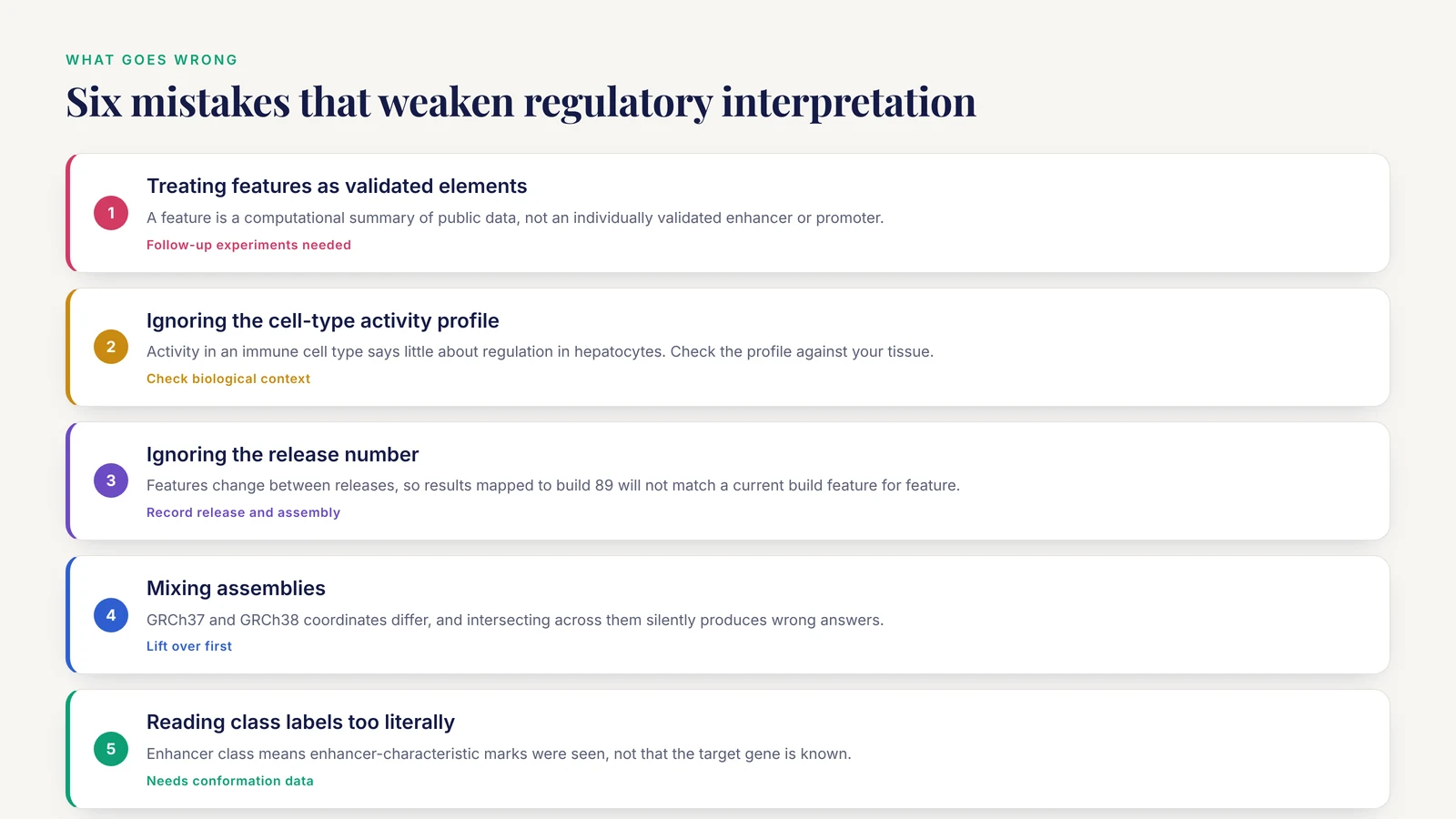
These are the errors that most often invalidate an analysis or mislead a reader, drawn from the structure of the build itself and the way published studies use it.
- Treating features as experimentally validated elements. A build feature is a computational summary of public data, verified for sensitivity against independent assays at the level of the overall method [1]. It is not a individually validated enhancer or promoter. Follow-up experiments are still required for causal claims.
- Ignoring the cell-type activity profile. A feature that is active in an immune cell type tells you little about regulation in hepatocytes. Always check the activity profile against your biological context.
- Ignoring the release number. Regulatory features change between releases. Results mapped to build 89 [6] will not match a current build feature-for-feature, and reproducibility requires recording release, assembly, and download date.
- Mixing assemblies. Coordinates on GRCh37 and GRCh38 differ, and Ensembl supports both through separate sites [2]. Intersecting regulatory features from one assembly with variants on the other silently produces wrong answers.
- Reading class labels too literally. The enhancer class means enhancer-characteristic epigenetic marks were observed, not that target gene relationships are known. Enhancer-to-gene assignment requires additional evidence such as chromatin conformation data or perturbation experiments.
- Overinterpreting overlap. A variant inside a regulatory feature is a candidate, not a cause. The FKBP5 study layered VEP annotation on top of an association test and still reported an adjusted p-value that did not cross conventional significance thresholds [9]. Annotation is one line of evidence among several.
- Assuming the build exists for your species. Coverage is deepest for human and expanding for other vertebrates [5][4], but many species, particularly outside vertebrates, have no regulatory build, and gene-level Ensembl annotation [14] is not a substitute for one.
- Forgetting that the build improves over time. The design intent is progressive enrichment as more data becomes available [1], so absence of a feature in an old build does not mean the region is unimportant. Recheck against the current release before declaring a region unannotated.
Quick Review
- The Ensembl regulatory build is a computational summary of public epigenetic and TF binding data, converted into regulatory features with class labels and cell-type activity profiles [1].
- It was created because most trait-associated variants are noncoding, and its sensitivity was verified against independent assays [1].
- Feature classes include promoter, enhancer, CTCF binding site, TF binding site, and open chromatin categories.
- Every feature carries an activity profile across assayed cell types, which is central to interpretation [2].
- Access routes are the browser, FTP, the Regulation MySQL server, REST, track hubs, VEP, and BioMart [1][2][11].
- The build is release-versioned, and published analyses name the build they used, such as build 89 [6].
- Human coverage is deepest, with regulatory builds now extending to mouse and farmed animals [5][4].
Frequently Asked Questions
What does the Ensembl regulatory build mean in plain language?
It means a genome-wide, cell-type-aware catalog of predicted regulatory regions that Ensembl assembled from public epigenetic and transcription factor binding data. Think of it as a map of where regulatory activity has been observed in public experiments, organized into interpretable classes like promoter and enhancer, rather than a list of experimentally proven functional elements [1].
Is every regulatory feature in the build a verified enhancer or promoter?
No. Each feature is a computational summary of epigenetic evidence, and the build as a whole was verified against independent assays for sensitivity [1]. A feature is a strong candidate, not a functional proof. Claims that a specific element controls a specific gene require additional experimental support.
How do I download the Ensembl regulatory build for GRCh38?
Use the Ensembl FTP site to download the regulatory feature files in GTF or BED format for the release and assembly you need, or query the Ensembl Regulation MySQL server directly [1]. Record the release number with your download, because features change between releases and reproducibility depends on version pinning.
Can I use the Ensembl regulatory build for species other than human?
Human has the deepest coverage, and Ensembl has more recently released regulatory builds for farmed animals and improved regulatory annotation for human, mouse, and agricultural species [5][4]. For many other species, including plants and parasites, Ensembl provides gene-level annotation but you should not assume regulatory build data exists without checking the current release documentation [14][15].
How does the regulatory build relate to VEP variant annotation?
The Variant Effect Predictor consumes Ensembl regulatory features and reports when an input variant overlaps a regulatory feature or predicted transcription factor binding site [2]. This is the standard route for regulatory interpretation of variant lists, and published studies commonly combine VEP with tools like RegulomeDB and HaploReg for the same variants [9].
Why does the Ensembl release number matter so much for regulatory analyses?
Regulatory features are progressively enriched as new data becomes available and the build has been revamped between releases [1][2]. A feature set from one release will not match another feature-for-feature, so any analysis must name its release and assembly, and comparing results across papers requires checking which builds each paper used.
Sources
- The ensembl regulatory build.
- Ensembl 2015.
- Ensembl 2008.
- Ensembl 2024.
- Ensembl 2025.
- In Silico Gene Prioritization Highlights the Significance of Bone Morphogenetic Protein 4 (BMP4) Promoter Methylation across All Methylation Clusters in Colorectal Cancer.
- Nencki Genomics Database--Ensembl funcgen enhanced with intersections, user data and genome-wide TFBS motifs.
- Elucidating Epigenetic Regulation by Identifying Functional cis-Acting Long Noncoding RNAs and Their Targets in Osteoarthritic Articular Cartilage.
- Association of FKBP5 gene polymorphism with insomnia symptoms in the depressive episodes of stress-related bipolar disorder.
- Touring Ensembl: a practical guide to genome browsing.
- Human-specific protein-coding and lncRNA genes cast sex-biased genes in the brain and their relationships with brain diseases.
- Right ventricular long noncoding RNA expression in human heart failure.
- A bioinformatic survey of RNA isoform diversity and expression across 9 GTEx tissues using long-read sequencing data.
- Exploring the Roles of the Swi2/Snf2 Gene Family in Maize Abiotic Stress Responses.
- Using WormBase ParaSite: An Integrated Platform for Exploring Helminth Genomic Data.