Ensembl Sequence Retrieval for Non-Model Organisms
By Dr. Zubair Khalid, DVM, MS, PhD ·

The single most common cause of failed Ensembl sequence retrieval for non-model organisms is looking in the wrong portal. A researcher who types a rice, fungal, or bacterial gene name into the search box at ensembl.org will often get nothing, because almost all non-vertebrate species live in the parallel Ensembl Genomes service rather than the main vertebrate database [1]. The first thing to check is therefore simple: identify which portal holds your species (Ensembl for vertebrates, Ensembl Genomes for plants, fungi, metazoa, protists, and bacteria), confirm the assembly version, and only then pick a retrieval method. Most "Ensembl is broken" reports resolve in under five minutes once those two facts are pinned down.
This article is a troubleshooting workflow. It walks from the most common failure to the rarest, explains the mechanism behind each one, gives you a diagnostic sequence you can follow, and closes with prevention practices that keep your sequence retrieval reproducible. It assumes you know what a FASTA file is and can run a command line, but it does not assume prior experience with the Ensembl project.
How Ensembl Organizes Species, and Why That Causes Failures
Ensembl is not a single database. It is a family of services built on shared software, and the split matters immediately for anyone working outside human, mouse, rat, and the other well-supported vertebrates. The Ensembl project describes its Core database and API as the stable infrastructure that stores and serves genome assemblies and annotations for all species it supports, with cross-references to identifiers such as UniProt and RefSeq [2]. On top of that Core layer, the project runs two front doors.
Ensembl (ensembl.org) handles vertebrate genomes. Ensembl Genomes (ensemblgenomes.org) handles non-vertebrate species through five division portals: Plants, Fungi, Metazoa, Bacteria, and Protists. Together the two resources expose genome sequence, gene models, transcript sequences, variation, and comparative analyses through a consistent set of interactive and programmatic interfaces, so the tools you learn in one portal transfer to the others [1]. Ensembl Genomes has grown aggressively. By 2017 the resource had incorporated close to 20,000 additional genome sequences and over 35,000 RNA-seq tracks aligned to genomic sequence [1], and later updates added extensive new plant, metazoan, and fungal genomes, pangenome analysis efforts, AlphaFold visualization, and the Ensembl Rapid Release service for newly deposited genomes that have not yet gone through full comparative annotation [3].
The Rapid Release service deserves special attention for non-model work. Newly sequenced species often appear there first, with a minimal set of annotations, before they receive full gene trees and variation data in the main portals [3]. If you cannot find your species in the Plants or Metazoa portal, checking Rapid Release is a standard early step.
The key consequence for troubleshooting: a sequence that "does not exist in Ensembl" usually exists in one of these services, just not in the one you queried.
A Five-Minute Diagnostic Sequence
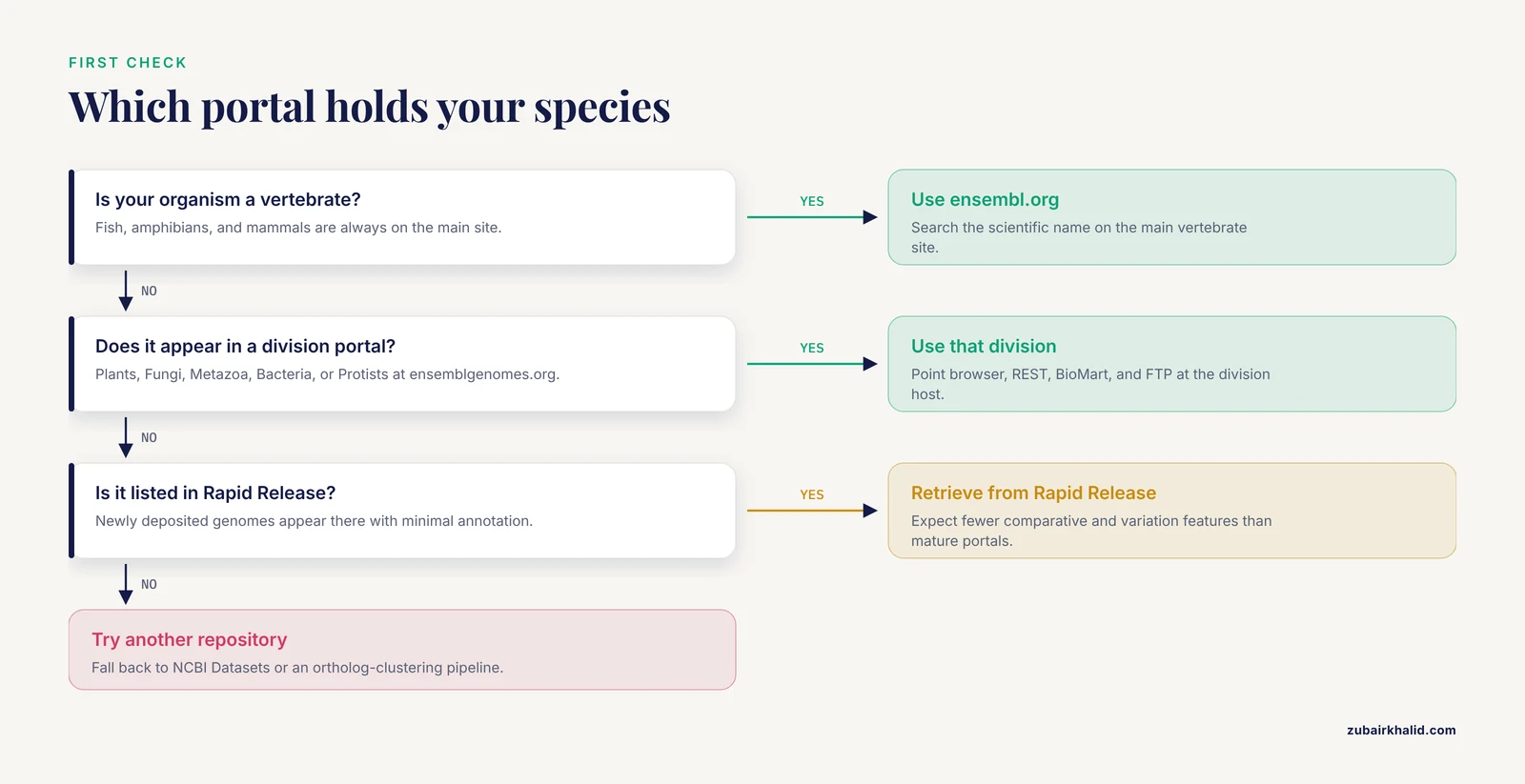
Before touching any of the fixes below, run this checklist in order. Each step eliminates a whole class of causes.
- Confirm the division. Determine whether your organism is a vertebrate (ensembl.org) or one of the non-vertebrate divisions (ensemblgenomes.org, then Plants, Fungi, Metazoa, Bacteria, or Protists). Fish, amphibians, and mammals are always on the main site. Insects are Metazoa, not the main site. Wheat, maize, and Arabidopsis are Plants [4].
- Confirm the species page exists. Search the scientific name in the correct portal. If it appears only in Rapid Release, note that the annotation there is minimal [3].
- Confirm the assembly. Note the assembly name and accession shown on the species home page and on any gene page. Every later coordinate check depends on this string.
- Confirm the identifier type. Decide whether your input is a gene symbol, an Ensembl stable ID (format ENS + three-letter division code + a number, for example a gene, transcript, or protein ID), or an external cross-reference. These are not interchangeable.
- Test a single known gene. Pick one gene you trust, retrieve its sequence through the browser, and confirm it looks right. Only then scale up to bulk retrieval.
- Check the release number. Write down the Ensembl release number of every file or API response you get. This is the metadata that makes results reproducible.
If step 1 through step 3 all pass and retrieval still fails, move to the troubleshooting table and match your symptom.
Troubleshooting Table
| Symptom | Likely cause | How to confirm | Fix |
|---|---|---|---|
| Search for the species or gene on ensembl.org returns nothing | Species lives in an Ensembl Genomes division, not the main site | Search the same name at ensemblgenomes.org and check the division portal | Query the correct portal, for example plants.ensembl.org [1] |
| Species appears nowhere in the full portals | Newly deposited genome, present only in Rapid Release | Check the Rapid Release service directly | Retrieve from Rapid Release and note that comparative and variation data may be absent [3] |
| REST lookup or sequence endpoint returns 404 for an ID that looks valid | ID is from a different release or assembly, or you queried the wrong division endpoint | Run the lookup endpoint with the species specified | Use the archive site for the original release, or re-map to the current release |
| Retrieved sequence does not match your alignment or PCR design | Assembly version mismatch between your data and Ensembl | Compare the assembly accession on the Ensembl page with the one in your project | Re-retrieve from the matching assembly or re-run your mapping against the current one [6] |
| Gene symbol search returns nothing, or returns several unrelated genes | Symbols are ambiguous across species and often map to more than one gene | Count the hits, check the species filter | Use Ensembl stable IDs instead of symbols [7] |
| Sequence length is far from the expected gene size | You retrieved CDS when you wanted cDNA, or peptide when you wanted genomic, or the gene sits on a short scaffold | Inspect the FASTA header and the gene structure view | Request the correct sequence type, and confirm the gene is fully contained in one assembly region [4] |
| Bulk FTP download stops partway or yields corrupt files | Interrupted transfer, or a very large polyploid genome FASTA | Compare file sizes against the listed sizes, verify checksums | Resume with wget -c, split large files, or download per-chromosome files |
| REST requests return HTTP 429 or hang | API rate limit exceeded by a loop of thousands of single-gene calls | Check request frequency and response headers | Switch to BioMart, FTP, or the MySQL servers for bulk work, and throttle what remains |
| A gene present last year cannot be found this year | Annotation drift between Ensembl releases | Compare the two release GTFs for the same region | Pin your analyses to a release number and use archive sites [5] |
Cause 1: The Species Sits in the Wrong Portal (Most Common)
Mechanism
The Ensembl project deliberately split its species portfolio. The main Ensembl service carries vertebrate genomes, while Ensembl Genomes carries the rest of the tree of life, unified so that interfaces stay consistent across both [1]. The division split is not cosmetic. It determines the URL, the REST endpoint behavior, the BioMart host, and the FTP root. A URL or API call written for the vertebrate server will frequently fail silently or return empty results when pointed at a non-vertebrate species, because the species dataset simply is not registered there.
How to confirm
Open the species page. The URL itself tells you the division. A URL beginning with plants.ensembl.org is the Plants division. If your browser history shows ensembl.org for an insect query, that is the bug. Programmatic confirmation is even faster: call the Ensembl REST lookup endpoint with the species name specified, and note whether the response indicates the species was found.
Fix
Point every retrieval step at the correct division host. In the browser, use the division subdomain directly. In the REST API, pass the species name so the service routes the query to the right division. In BioMart, select the corresponding Mart host, for example plants.ensembl.org for the Plants Mart. In the Perl API, connect to the database for the correct division rather than the default vertebrate host [2]. Once the portal is correct, the remaining causes in this article become much easier to distinguish.
Cause 2: Assembly and Release Mismatch
Mechanism
Every Ensembl release couples a genome assembly with an annotation set, and the two evolve independently of your local data. For human genomes this problem is well documented: the archived GRCh37 Ensembl annotations have not been updated since 2013, yet they remain the default gene models in many projects, and hundreds of genes show discrepant protein-coding annotation between GRCh37 and GRCh38 [6]. Non-model organisms suffer the same class of problem more often, because assemblies are updated and replaced more frequently and the community is smaller, so stale coordinate frames persist longer.
The annotation side also moves. A longitudinal characterization of Ensembl human annotations from 2014 to 2023 found the gene count rising from 58,812 to 62,710, with some intervening years that dipped, and clear year-to-year shifts in how many genes were labeled protein-coding [5]. Any pipeline that retrieves sequence and annotation without recording the release number will produce results that cannot be reproduced six months later.
How to confirm
Compare three strings: the assembly accession on the Ensembl gene or species page, the assembly stated in your read-alignment or variant files, and the Ensembl release number of the file you downloaded. If any two disagree, you have found your cause.
Fix
Three options, in order of preference. First, retrieve everything from a single pinned release: use the archive site for that release, which Ensembl maintains so old assemblies and annotations remain accessible [6]. Second, if your data are on an old assembly and the gene you need was re-annotated in a newer release, re-run your mapping against the current assembly rather than trying to translate coordinates by hand. Third, if you must work across assemblies, retrieve the sequence from the assembly your data are actually on and treat any cross-assembly comparison as a separate, validated step. The lessons from the human GRCh37 case apply directly: genes present in one assembly's annotation set but absent from the archived one will be invisible to any tool built on the stale set [6].
Cause 3: Identifier Type Mismatch
Mechanism
Ensembl stable IDs are the primary keys. Gene symbols are labels, and labels collide. A systematic retrieval of protein-coding gene identifiers from the Ensembl genome browser for human, mouse, rat, and pig found that the pool of official symbols plus synonyms ranges from 16,600 in pig to 64,580 in mouse, and that large numbers of symbols map to more than one gene, complicating the identification of roughly 10 percent of rat and mouse protein-coding genes and about 18 percent of human protein-coding genes [7]. The same study emphasizes that the robust solution is to use stable gene IDs assigned by scientific institutions, provided the associated genomic information is retrieved directly from the authoritative database [7].
A second layer of the same cause is cross-reference drift. Resources such as SIFTS maintain residue-level mappings between PDB structures and UniProt sequences and incorporate cross-references from sources including Ensembl, precisely because no single identifier namespace covers every question [8]. If you input a UniProt accession or a RefSeq transcript where Ensembl expects its own stable ID, retrieval may fail or return a different feature.
How to confirm
Take one failing input and run it through the REST lookup endpoint. If the endpoint returns no feature, but the browser finds the gene by symbol search, your input is a symbol or external ID rather than a stable ID. If the endpoint returns a different species or a different gene than you expected, you have a synonym collision of the kind quantified above [7].
Fix
Use stable IDs for all programmatic retrieval. Resolve symbols once, at the start of the project, through the browser search or the ID-mapping endpoints, record the stable IDs, and store them in your project metadata. Where you must work with transcript-level identifiers, note that dedicated tools have been built around this exact gap: TransAT was developed because common annotation tools could not accept a transcript ID and return genomic positions, and it maps user-provided transcript IDs to SNP identifiers, genomic positions, and population allele frequencies [9]. The pattern generalizes: convert your identifiers to the ones the target interface expects before retrieval, not after failure.
Cause 4: Using the Wrong Retrieval Interface for the Job
Mechanism
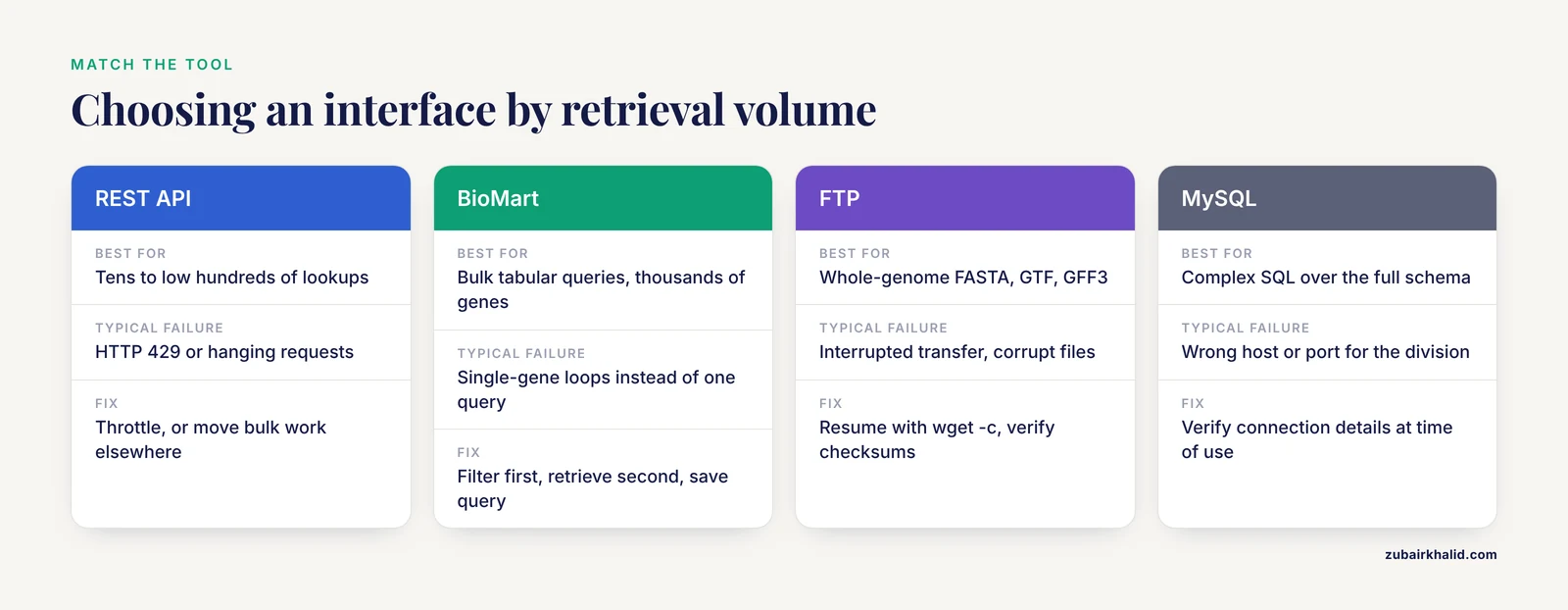
Ensembl offers four main programmatic access routes, and each is designed for a different volume. Choosing the wrong one produces either rate-limit failures or enormous wasted effort.
- REST API (rest.ensembl.org): best for tens to low hundreds of individual lookups and sequence fetches. Enforced rate limits make it unsuitable for whole-genome enumeration.
- BioMart or biomaRt: best for bulk tabular queries, such as retrieving sequences for thousands of genes with filters.
- FTP downloads: best for whole-genome FASTA, GTF, and GFF3 files. Download once, query locally.
- MySQL servers: best for complex SQL over the full schema. Ensembl exposes anonymous-access MySQL servers for both the vertebrate and the Ensembl Genomes databases, and the underlying Perl API wraps the same Core schema [2].
A common failure loop looks like this: a script iterates over 40,000 gene IDs and calls the REST sequence endpoint once per gene. After a few hundred calls the service throttles the client, requests begin failing intermittently, and the resulting sequence set is silently incomplete. The interface was never designed for that load.
How to confirm
Check whether your failing retrieval is per-feature and small (REST territory), filter-and-export shaped (BioMart territory), or whole-file (FTP territory). Check the HTTP status of REST failures. A 429 response is a rate-limit signal, not a missing-sequence signal.
Fix
Match volume to interface. For single sequences, the REST call is the right tool:
curl -H "Content-Type: text/x-fasta" \
  "https://rest.ensembl.org/sequence/id/<STABLE_ID>?type=cdna" \
  -o <STABLE_ID>.fa
For bulk work across thousands of features, move to BioMart. In R:
library(biomaRt)
mart <- useMart("plants_mart", host = "https://plants.ensembl.org")
listDatasets(mart)   # find your species dataset
then use getSequence() with your gene filter of choice. For whole genomes, download from FTP and work locally, which also insulates you from rate limits entirely. For established whole-genome FASTA conventions, note that Ensembl distinguishes unmasked, soft-masked, and hard-masked variants of the genomic sequence in its file naming, so pick the variant appropriate for your downstream aligner.
For multi-genome projects, purpose-built tooling exists. The retrieve-ensembl-seq tool was written specifically for user-friendly, large-scale retrieval of single or multi-genome sequences from Ensembl [10], and it remains a useful reference point for how to structure batch retrieval. Where heavy SQL is needed, connect to the public MySQL servers with the anonymous user account, and consult the current connection documentation for the host and port of your division. Expect to verify connection details at the time of use, since service endpoints change across the years.
Cause 5: Annotation Drift Between Releases
Mechanism
Even with the right portal, identifier, and interface, the annotation attached to a stable ID changes over time. Genes are added, merged, split, and re-biotyped between releases. The Ensembl release-to-release variability is not marginal: in the human annotation survey, the count of genes annotated as protein-coding moved up and down across the decade, and the majority of newly added isoforms in recent years proved to be expressed in surveyed tissues, meaning that old annotation releases are genuinely missing real biology, not just noise [5].
For non-model organisms the effect is amplified, because automatic annotation pipelines re-run whenever an assembly is updated, and gene models can shift wholesale.
How to confirm
Retrieve the same gene from two different releases via the archive sites and diff the cDNA or the CDS. If the sequences differ, you have annotation drift, not retrieval failure.
Fix
Pin every analysis to a stated release number, record it in your methods section and your code repository, and use the archive URLs for retrieval when reproducing old results. When you deliberately upgrade, re-retrieve the full annotation set rather than patching individual genes, and re-run downstream steps. The core API exists precisely to make this kind of versioned storage and programmatic access stable across the whole species portfolio [2].
Cause 6: Polyploid and Highly Fragmented Assemblies
Mechanism
Some of the most economically important non-model genomes are the hardest to retrieve from. The Triticeae resources in Ensembl Plants document the challenge directly: bread wheat and barley genomes are large and, in wheat's case, polyploid, and Ensembl built specific extensions to its analysis pipelines and web interface to support polyploid genomes [4]. In a polyploid assembly, a "gene" often resolves to multiple homeologous copies on different subgenomes, and in a fragmented assembly a gene can be split across two scaffolds, so a naive retrieval of the genomic sequence for a gene ID returns something shorter than the true locus.
How to confirm
Open the gene view in the browser and check the location. If the location string lists a short scaffold rather than a named chromosome, or if multiple genes with near-identical symbols appear, you are dealing with fragmentation or polyploidy respectively.
Fix
Retrieve per-transcript sequences (cDNA, CDS, or peptide) rather than full genomic sequence when a gene may span scaffolds, because transcript sequences are assembled from the annotation and are complete even when the underlying genomic region is not. For polyploid species, retrieve with explicit subgenome awareness, and treat the homeologs as separate sequences in downstream analysis. The Ensembl Plants interface displays variant loci, gene models, and comparative alignments for these crop genomes, which helps you disambiguate copies before retrieval [4].
Cause 7: Variation and Transcript-Level Edge Cases
Retrieving variant-flanked sequence, or transcript-specific sequence, exercises different parts of the Ensembl stack and fails in different ways. The Ensembl variation resources aggregate large, heterogeneous variation datasets and expose them in standard formats with annotation pipelines that compare variants against genomic annotation sets [11]. Two pitfalls recur.
First, population-frequency retrieval tied to a transcript rather than a genomic position is a known gap in general-purpose tools, which is why TransAT was built to take a transcript ID as input and return the corresponding SNP IDs, genomic positions, and global allele frequencies [9]. If your workflow needs allele frequency context per transcript, plan for a dedicated mapping step rather than assuming the sequence endpoint will carry it.
Second, coordinate-to-protein mapping is complicated by alternative splicing and transcript evidence, as the VarMap tool documents. VarMap maps chromosome coordinates to canonical UniProt sequences and protein structures with validation checks, and its authors are explicit that this mapping is non-trivial [12]. When a retrieved coordinate does not fall where you expect in the protein, suspect transcript structure before suspecting the retrieval itself.
Cause 8: The Species Is Not in Ensembl at All (Rarest)
Mechanism
Ensembl Genomes and Rapid Release have dramatically expanded coverage, adding tens of thousands of genome sequences across the divisions [1][3], but coverage is not universal. Very recent deposits, sequencing projects that have not released an assembly to the public archives, and some taxa outside the divisions' scope will simply be absent.
How to confirm
Search the correct division portal and Rapid Release by scientific name, including synonyms. Search the assembly name, not just the species name, since a species may have several assemblies and only one registered.
Fix
Fall back to complementary repositories. NCBI Datasets provides programmatic and web access to genome sequences, annotations, and metadata across the tree of life, structured to follow FAIR data principles and delivered as packages of sequences with metadata [13]. For phylogenetic sampling where orthology matters more than a single reference genome, pipelines such as phylotaR harvest clusters of orthologous sequences from GenBank and are built specifically to avoid the mislabeling and paralogy problems that plague manual sequence collection [14]. When you switch repositories, record it, because sequence versions and naming conventions differ between sources.
Ensembl Non-Model Organism Sequence Retrieval Solutions: Three Worked Walkthroughs
These walkthroughs show the fix side of the table in practice, from smallest to largest scale. Together they cover most real requests for Ensembl sequence retrieval for non-model organisms.
Walkthrough 1: One Gene, Through the Browser
For a single gene, the browser is the fastest route and doubles as a tutorial in how to use Ensembl. The Ensembl genome browser provides integrated automatic annotation alongside experimental evidence, and the standard unit-of-work approach is to search for your gene or protein, land on the location or gene tab, and use the export buttons to pull out genomic sequence, cDNA, CDS, or peptide in FASTA [15]. On a gene page, open the sequence view, choose the sequence type you need, and set the flanking distance if you want upstream or downstream context. The displayed assembly and release are shown on the page, so record them in your notebook before you close the tab. For crop genomes with polyploid structure, the same browser interface supports the extended displays built for those genomes [4].
Walkthrough 2: One Species, Whole Genome, From FTP
For a whole genome, do not enumerate features through any API. Download once:
wget -c "ftp://ftp.ensemblgenomes.org/pub/release-<NN>/plants/fasta/<genus_species>/{dna,pep}/*"Then verify the transfer with the checksum files provided in the same directory, and work locally. The release number NN should be the one you pinned in your project plan. Download the soft-masked DNA variant if your downstream aligner benefits from repeat masking already applied, or the unmasked variant if you handle masking yourself. This single download, plus the matching GTF or GFF3 annotation file from the same release directory, replaces tens of thousands of individual API calls and removes rate-limit failures from your workflow entirely.
Walkthrough 3: Thousands of Genes, Through biomaRt
For a filtered set of genes, BioMart in R is the right interface:
library(biomaRt)
mart <- useMart("plants_mart", host = "https://plants.ensembl.org")
ds <- listDatasets(mart)                 # locate your species row
mart <- useDataset("<species_dataset>", mart)
seqs <- getSequence(id = my_stable_ids,
                    type = "cdna",
                    seqType = "cdna",
                    mart = mart)
This respects Ensembl's infrastructure because it runs a single bulk query rather than thousands of single requests. Filter first, retrieve second, and save the query with the results so the retrieval is reproducible. If your needs grow to dozens of species, examine retrieve-ensembl-seq, which was designed for exactly this large-scale, multi-genome pattern [10].
A short operational note. Genome-scale FASTA files for large plant genomes reach into the tens of gigabytes, and polyploid crop genomes are larger still. Run bulk downloads in a working directory with adequate disk quota, keep checksum verification in your script, and avoid filling a shared compute node's home volume, which can disrupt other users on the system. This workflow involves no biological reagents or hazards beyond ordinary compute resource management.
Common Mistakes and Limitations
These are the specific, repeated errors seen in real projects, and the honest limits of what Ensembl retrieval can do.
- Treating symbols as identifiers. The symbol-to-gene ambiguity is quantified and severe, affecting about a tenth of rodent genes and nearly a fifth of human protein-coding genes [7]. Retrieval by symbol is a convenience for browsing, never a pipeline input.
- Not recording the release number. Every sequence you retrieve has an implicit release stamp. If you omit it, your results cannot be reproduced, and the annotation you used may no longer exist, since annotation content shifts measurably between releases.
- Confusing sequence types. Genomic sequence, cDNA (spliced transcript), CDS (coding sequence), and peptide differ by introns and untranslated regions. A "missing 1,500 bases" complaint is usually a CDS-versus-cDNA confusion, not a truncated retrieval.
- Assuming complete annotation. Gene nomenclature itself is incomplete even in well-studied species, with many genes carrying no assigned symbol at all [7]. Absence of a symbol does not mean absence of a gene or a sequence.
- Trusting annotation without biological checks. Genome annotation remains error-prone, and documented cases exist where experimentally characterized enzymes were systematically misannotated in sequence databases, resolvable only through conserved motifs and comparative gene context [16]. Retrieved sequence is only as good as the gene model behind it. Spot-check a few retrieved proteins against known domains before committing a whole analysis.
- Harvesting sequence from general repositories without orthology control. Phylogenetic-scale collection from open repositories is prone to species misidentification, ambiguous annotation, and paralog inclusion, which is why automated pipelines that use alignment search were developed to bypass manual curation [14]. Apply the same skepticism to your own bulk downloads.
- Assuming cross-assembly compatibility. Genes annotated as protein-coding in one assembly can be absent from an archived older annotation set, and such discrepant genes are dropped by tools built on the stale annotations [6]. Cross-assembly inference needs explicit validation.
- Overloading the REST service. Per-feature endpoints are rate-limited by design. Bulk-scale work belongs in BioMart, FTP, or MySQL.
Prevention Practices
A few habits prevent nearly every failure documented above from recurring.
- Pin the tuple: species, division, assembly, release. Write all four into your project README and into the header comment of every retrieval script. Any one of them changing invalidates cached sequences.
- Resolve symbols once, centrally. Build a mapping table from every symbol you encounter to an Ensembl stable ID, using the browser or ID-mapping endpoints, and store it in version control [7].
- Cache aggressively. Retrieve whole genomes and full annotation sets once per release, store them locally with checksums, and treat all subsequent work as local queries. This eliminates rate limits and makes old releases reproducible from your own archive.
- Prefer stable IDs in all scripts and logs. Symbols are for human reading only.
- Validate a sample after every bulk retrieval. Pick ten sequences at random, check their lengths against the annotation, BLAST one or two against a trusted database, and confirm the biotypes match expectation before the dataset touches downstream analysis.
- Record provenance for cross-database work. If a sequence came via a cross-reference through UniProt or PDB mappings [8], or from an alternative repository [13], note the source and date alongside the sequence itself.
- Re-verify after upgrades. When you move to a new Ensembl release, re-run your validation sample. Do not assume continuity, because release-to-release annotation gains and losses are real and measurable [5].
Frequently Asked Questions
What is Ensembl sequence retrieval for non-model organisms?
It is the process of obtaining DNA, cDNA, CDS, or peptide sequence for species outside the standard laboratory vertebrates from Ensembl or Ensembl Genomes, through the browser, the REST API, BioMart, FTP, or the MySQL servers. The main practical skill is knowing which portal and interface fit your species and volume [1][2].
Why is my species missing from the main Ensembl site?
Almost certainly because it is a non-vertebrate and lives in one of the five Ensembl Genomes divisions: Plants, Fungi, Metazoa, Bacteria, or Protists, which together complement the vertebrate resource and share the same interfaces [1]. If it is absent there too, check the Rapid Release service, which carries newly deposited genomes with minimal annotation [3].
Which Ensembl interface should I use for bulk sequence downloads?
Use FTP for whole-genome files, BioMart for filtered bulk sets of thousands of genes, the REST API for tens to low hundreds of individual fetches, and the public MySQL servers or Perl API for complex queries over the full schema [2]. Matching volume to interface prevents most rate-limit failures.
How do I fix retrieval failures caused by assembly version mismatch?
Compare the assembly accession on the Ensembl page with the assembly used in your own data, then either re-retrieve from the matching assembly using the archive site or re-run your analysis against the current assembly. Archived Ensembl annotations are frozen, so relying on a stale annotation set can silently omit genes that newer assemblies annotate [6].
Why does my gene symbol not return a sequence?
Symbols are ambiguous labels, not stable identifiers. Large fractions of genes share ambiguous symbols across and within species, which is why the recommended practice is to resolve symbols to Ensembl stable IDs once and retrieve by stable ID thereafter [7]. Cross-references to UniProt and RefSeq also exist and can be used to bridge identifier systems [2].
Can I use the Ensembl REST API for plants, fungi, and bacteria?
Yes. The REST endpoints serve species across the divisions alongside the vertebrates, so the same API style works once you specify the correct species. Keep individual REST calls to modest volumes and shift bulk work to BioMart or FTP.
What is Ensembl Rapid Release and when should I use it?
Rapid Release is the service that presents newly produced genome annotations quickly, ahead of full integration into the division portals. Use it when your species is brand new to Ensembl, and expect fewer comparative and variation features there than in the mature portals [3].
What should I do if the species is not in Ensembl at all?
Retrieve from a complementary repository instead. NCBI Datasets offers sequence and metadata packages across a wide taxonomic range through web interfaces, command-line tools, and documented APIs [13]. For phylogenetic projects spanning many species, an automated ortholog-clustering pipeline can assemble the sequences with fewer labeling errors than manual collection [14].
Sources
- Ensembl Genomes 2018: an integrated omics infrastructure for non-vertebrate species
- Ensembl core software resources: storage and programmatic access for DNA sequence and genome annotation
- Ensembl Genomes 2022: an expanding genome resource for non-vertebrates
- Triticeae resources in Ensembl Plants.
- Genome annotations matter: characterizing Ensembl hg38 annotations from 2014 to 2023
- Lost in translation: the pitfalls of Ensembl Gene annotations between human genome assemblies and their impact on diagnostics
- Protein-coding genes in humans and model mammals (mouse, rat and pig): gene identifiers and disambiguation of gene nomenclature retrieved from the Ensembl genome browser
- SIFTS: updated Structure Integration with Function, Taxonomy and Sequences resource allows 40-fold increase in coverage of structure-based annotations for proteins
- Transcript annotation tool (TransAT): an R package for retrieving annotations for transcript-specific genetic variants
- Retrieve-ensembl-seq: user-friendly and large-scale retrieval of single or multi-genome sequences from Ensembl
- Ensembl variation resources
- VarMap: a web tool for mapping genomic coordinates to protein sequence and structure and retrieving protein structural annotations
- Exploring and retrieving sequence and metadata for species across the tree of life with NCBI Datasets
- phylotaR: An Automated Pipeline for Retrieving Orthologous DNA Sequences from GenBank in R
- Using the Ensembl genome server to browse genomic sequence data.
- Retrieving sequences of enzymes experimentally characterized but erroneously annotated : the case of the putrescine carbamoyltransferase