Ensembl Gene Tree Orthologs: How to Interpret It
By Dr. Zubair Khalid, DVM, MS, PhD ·

Ensembl gene tree orthologs are pairs of genes in different species that Ensembl Compara predicts descend from a single gene in the last common ancestor of those species, based on an inferred evolutionary tree of the gene family. The label sits on the tree itself, so the orthology call is only as good as the tree, and every orthology assignment in Ensembl comes with a homology type, a confidence flag, and a phylogenetic context that you are expected to check.
This matters because orthology is the backbone of comparative annotation. When you transfer a functional annotation from a well-studied gene to a newly sequenced genome, pick a gene model for a pan-genome analysis, or build a cross-species expression comparison, you are making an orthology claim. Benchmarks that compare Ensembl Compara against eggNOG, HOGENOM, InParanoid, OMA, OrthoDB, and Panther show that orthology assignments across databases are generally highly specific for well-conserved families but never complete or perfectly correct, and that differences between databases come as much from underlying design choices as from the algorithms themselves [1]. That means you should read an Ensembl gene tree as evidence, not as ground truth. This article explains what the labels mean, how the trees are built, how to pull them down in the browser and over the API, and where the method breaks.
Key Terms at a Glance
The words around orthology are used loosely in everyday papers but precisely in Ensembl. The table below is the vocabulary you need before touching a gene tree.
| Term | Precise meaning | Common confusion |
|---|---|---|
| Homology | Shared ancestry of two genes through speciation or duplication | Often misused to mean similarity. Similarity is the evidence, homology is the conclusion. Homologous genes are either orthologs or paralogs, never both |
| Ortholog | Genes separated by a speciation event | Often assumed to imply functional equivalence. Orthology is an evolutionary statement, function usually follows but does not always |
| Paralog | Genes separated by a duplication event | People assume paralogs are only within one genome. Paralogs can be between species if the duplication predates the speciation that separates them |
| Inparalog | A paralog that duplicated after a given speciation event, so both copies are equally related to the other species' gene | Confused with outparalogs, which duplicated before the speciation and are therefore more distantly related across species |
| Outparalog | A paralog that duplicated before the speciation being considered | Often mislabeled as an ortholog when only sequence similarity is used |
| Gene tree | A phylogenetic tree of genes from multiple species, reconciled against the species tree | Confused with a species tree. Branch order in a gene tree reflects gene history, which includes duplications and losses |
| Homoeolog | A gene pair derived from a whole-genome duplication, especially in an allopolyploid genome | Often called paralogs in casual usage, which hides the fact that they descend from different ancestral genomes |
What Ensembl Gene Tree Orthologs Mean
Every pair of genes with detectable common ancestry is homologous. Fitch's classic framing, which is the consensus position in standard textbooks, splits homology into two mutually exclusive categories. If the genes were separated by a speciation event, they are orthologs. If they were separated by a duplication event, they are paralogs. Ensembl Compara, the comparative genomics division of Ensembl, operationalizes this by building an explicit tree for every gene family and labeling each internal node as a speciation or a duplication [1]. An orthology assignment in Ensembl is therefore a claim about a specific path through a specific tree, not a pairwise similarity score.
That framing has a consequence that surprises newcomers. "Ortholog" and "paralog" are relative to the event you care about. Consider two genes A1 and A2 in mouse that arose from a duplication, and their single orthologous copy A in human. Relative to the human-mouse split, A1 and A2 are inparalogs, and each of them can be called co-orthologous to human A. Relative to an older duplication that happened before the human and mouse lineages split, A1 and A2 are outparalogs with respect to each other. Automated pipelines that collapse families into similarity clusters lose this resolution. Gene trees preserve it, which is the central reason Ensembl uses trees rather than best-reciprocal-hit tables alone [2].
The distinction is not academic. Orthologs are widely treated as functional counterparts across species, and methods for ortholog assignment exist precisely because researchers need that transfer of function to be defensible [3]. When the assignment is wrong, downstream conclusions about conserved function, synteny, or gene loss inherit the error. Large-scale studies of whole-genome duplication (WGD), where entire genomes were duplicated and then repeatedly thinned by gene loss, show exactly how costly this can be. In teleost fishes, which descend from a WGD roughly 320 million years ago, nearly one in four teleost gene phylogenies in the Ensembl database was found to be inconsistent with the syntenic context of the genes, and synteny-aware correction improved 2,387 of the 3,394 affected families, about 70 percent [4]. A synteny-blind reading of the Ensembl tree would have propagated those errors.
How Ensembl Builds Gene Trees
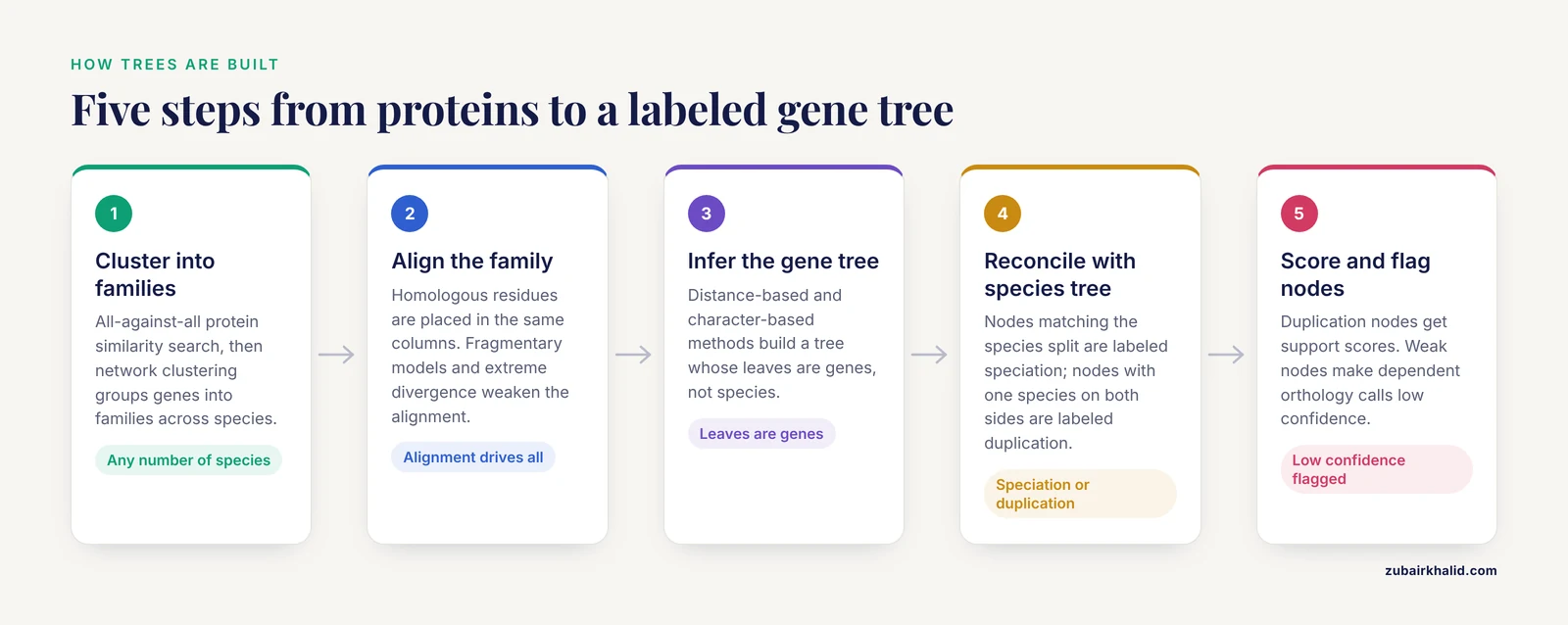
Ensembl Compara builds gene trees in a multi-step pipeline on each release. Knowing the steps tells you what the tree can and cannot represent.
- Family clustering. Compara runs an all-against-all similarity search over the protein set of every species in the release. Genes are grouped into families by network clustering of the similarity graph, so a family can span any number of species and can contain multiple paralogs.
- Multiple sequence alignment. Each protein family is aligned so that homologous residues sit in the same columns. The quality of this alignment drives everything downstream. Fragmentary gene models, poor annotations, and extreme sequence divergence all weaken it.
- Tree inference. For each family, Compara infers a gene phylogeny from the alignment. The method combines distance-based and character-based approaches and produces a tree whose leaves are genes, not species.
- Reconciliation with the species tree. The gene tree is then reconciled against the known species phylogeny. Every node where the tree implies a split matching the species tree is labeled speciation. Every node where genes from the same species fall on both sides is labeled duplication. This reconciliation step is where a generic clustering approach differs from a tree-based one, and it is what allows Ensembl to report both orthologs and paralogs from a single analysis.
- Node scoring and confidence. Duplication nodes receive a support score reflecting how strongly the data support the duplication interpretation. Nodes with weak support are flagged, and orthology relationships that depend on them are marked as low confidence. Special cases, such as a gene model that appears to sit in the wrong place on the tree because of a genome assembly or annotation error, are flagged as well.
Two properties of this design follow directly from the literature on phylogenomic databases. First, completeness varies by database concept rather than by method alone. A benchmark across seven orthology databases found that differences in coverage of gene relationships were mostly attributable to what each database chose to represent, not to errors in the algorithms [1]. Second, using a single representative protein per gene means alternative splice isoforms are not modeled in the tree. Methods research on reconciliation with protein trees shows that ignoring isoforms can misplace genes and that isoform-aware reconstructions can change the resulting gene tree [5]. In practice, if your gene of interest has an isoform problem, treat the tree with extra caution.
How to Use Ensembl to Find Gene Tree Orthologs
This section is a compact Ensembl genome browser tutorial for the orthology workflow. Suppose you start from a human gene, BRCA2, and want its orthologs and its evolutionary context.
- Search for the gene. On the Ensembl front page, type the gene symbol or identifier into the search box and pick the correct entry from the suggestions. BRCA2 resolves to ENSG00000139618 in the human assembly. Always land on the Gene tab, not the Transcript tab, because trees are built at the gene level.
- Open the Gene tab. The left-hand menu lists every comparative view for that gene. The two you want are "Gene tree" and "Orthologues" (and "Paralogues" for within-species copies).
- View the orthologue table. Clicking "Orthologues" groups predicted orthologs by species. Each row lists the partner gene, its stable identifier, the homology type, a confidence flag, and per-gene measures of identity and divergence relative to the reference. Sorting by species makes it easy to see whether a species has one ortholog, several co-orthologs, or none.
- Open the gene tree image. The tree view draws the full family with internal nodes labeled. You can expand and collapse clades, restrict the display to particular taxonomic groups, and zoom to your gene of interest. Hovering over a node shows whether it is a speciation or duplication node and how well supported it is.
- Read the surrounding evidence. From the Gene tab you can also open region views showing neighboring genes, which matters enormously when you suspect a duplication history, as discussed below.
The same workflow exists outside the browser. Ensembl provides a REST interface that returns homology data as JSON, which is how most pipelines consume orthology calls:
curl -X GET "https://rest.ensembl.org/homology/id/human/ENSG00000139618?type=orthologues" \
  -H "Content-Type: application/json"
The response lists each ortholog with its Ensembl stable ID, species, homology type, and confidence. Variants of this endpoint accept a target species, so you can restrict the query to a single comparison, for example human against mouse. For bulk export, BioMart lets you select a gene list and retrieve every orthology relationship with its type and confidence in one table, which is the standard route for building a cross-species mapping file for hundreds or thousands of genes.
Reading the Tree: Ensembl Gene Tree Orthologs Interpretation
Homology types
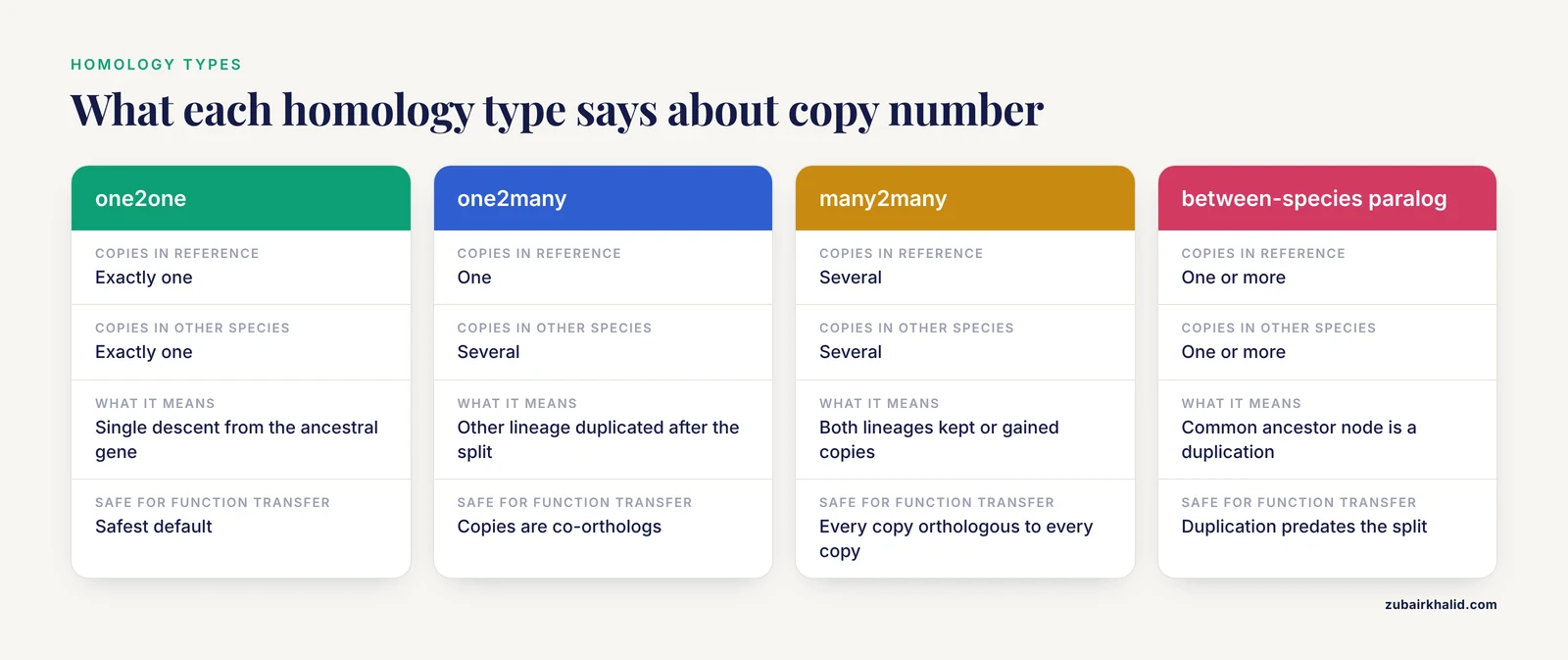
Ensembl reports orthology as one of a small set of types, and the type encodes the copy-number history:
- ortholog_one2one. Exactly one gene in each species descends from the ancestral gene at the relevant speciation node. This is the cleanest case and the safest default for functional transfer.
- ortholog_one2many. One gene in the reference species relates to several in the other species. Typically this means duplications occurred in the other lineage after the split, making those copies co-orthologs (inparalogs) of the reference gene.
- ortholog_many2many. Both lineages have retained or duplicated copies since the split. Every copy in one species is orthologous to every copy in the other relative to that speciation event.
- within_species_paralog. Copies within the same species, separated by a duplication.
- between_species_paralog. Genes in different species whose common ancestor node is a duplication rather than a speciation, meaning the duplication happened before the species split.
- Special flags. Relationships affected by annotation or assembly issues are marked with labels such as gene split or possible contamination. Treat these as warnings, not as biology.
The key interpretation habit is to ask which speciation node a label is relative to. A one2many orthology call is not a lower-quality one2one call. It is a different biological statement, namely that the other lineage kept or generated extra copies.
Confidence flags
Each relationship carries a confidence value. High confidence means the tree nodes supporting the relationship are well supported and the call is consistent with the species tree. Low confidence means the relevant node is weakly supported or the relationship depends on an uncertain duplication. When you build a pipeline, decide explicitly how you will treat low-confidence calls. Common strategies are to exclude them, to keep them but track them as a separate tier, or to resolve them manually with synteny or extra sequence data.
Nodes, branch lengths, and duplication signals
In the tree image, speciation nodes and duplication nodes are drawn differently, and branch lengths reflect evolutionary distance. A duplication node with weak support and a topology that contradicts what you would expect from neighboring genes deserves scrutiny. The strongest independent check available to you is synteny, the conserved order of genes on chromosomes. Whole-genome duplications produce large duplicated syntenic blocks, and methods that exploit this signal can substantially outperform sequence-only tree reconstruction. For the teleost WGD, a synteny-guided method corrected nearly a quarter of teleost gene trees in Ensembl and improved the majority of them [4]. You do not need the full method to benefit from the idea. When a tree call looks wrong, open the region view for your gene in each species and check whether the neighbors are also duplicated and arranged in matching blocks.
Gene names as an orthology cross-check
Standardized nomenclature is itself an orthology-informed resource. The Vertebrate Gene Nomenclature Committee (VGNC), a sister project of the HUGO Gene Nomenclature Committee, assigns official gene symbols to vertebrate species that lack a dedicated nomenclature committee, and it assigns orthologs the same symbol as their human counterparts wherever possible. VGNC-approved names are displayed in Ensembl, NCBI, and UniProt [6]. If two genes across species carry the same approved symbol, that is an independent, curated vote for orthology, though it is not a substitute for checking the tree, because nomenclature follows evidence with a lag and occasionally needs revision.
A Worked Example
Consider a researcher who wants to compare expression of the BRCA2 gene between human and zebrafish. In the Ensembl browser, the BRCA2 gene page shows predicted orthologs across vertebrates, most at high confidence in well-annotated vertebrate genomes. The gene tree for the family shows the vertebrate speciation nodes resolved cleanly. The researcher selects the zebrafish ortholog from the orthologue table, records its stable identifier and the homology type, and confirms in the tree view that the human and zebrafish genes sit on opposite sides of a speciation node rather than a duplication node.
Now contrast a harder case. A researcher studying a duplicated gene family in Xenopus opens the gene tree and finds multiple copies. Xenopus laevis is an allotetraploid, so many loci exist in two homeologous copies, and the model organism database Xenbase maintains genome resources and gene-specific pages for both X. laevis and X. tropicalis, linking out to Ensembl and other sources [7]. Here the correct question is not "which gene is the ortholog" but "which duplication event am I relative to." Reading the tree at the right node, and cross-checking with the curated model organism database, is what turns an ambiguous homology table into a defensible analysis.
How Ensembl Gene Trees Fit Among Other Resources
Ensembl Compara is one of several orthology databases, and knowing the alternatives sharpens your interpretation.
- Clustering-based homology databases. HOVERGEN, HOGENOM, and HOMOLENS were built from an automated pipeline of massive similarity searches, gene clustering, multiple alignment, and phylogenetic tree construction and reconciliation, with tree-pattern searches to retrieve sets of orthologs [2]. Their architecture shows how long the field has combined clusters with trees, and why reconciled trees remain the reference standard for defining orthology sets.
- Alternative assignment methods. Some methods infer orthology from genome rearrangement history rather than sequence trees alone. MSOAR 2.0, for example, models tandem duplications explicitly when assigning one-to-one orthologs between closely related species [3]. When sequence-based and rearrangement-based approaches agree, your confidence rises.
- Isoform-aware reconstructions. Because gene trees use one protein per gene, methods that reconcile gene trees with protein trees and account for alternative isoforms address a known blind spot in tree construction [5]. If your study hinges on a specific isoform, remember that the tree was not built from that isoform.
- Gene age resources. Databases such as GenOrigin date the origin of over nine million protein-coding genes across hundreds of species in Ensembl and Ensembl Genomes using protein-family-based analysis and parsimony over a species tree, and they distribute orthology and paralogy information alongside gene age estimates [8]. Gene age calls depend on the same orthology machinery, so they inherit the same caveats.
- Model organism and clinical portals. Xenbase compiles gene pages with GO, disease associations, and links to Ensembl, NCBI, and UniProt [7]. In the clinical sphere, the DECIPHER database uses the Ensembl genome browser as part of its toolset for interpreting copy number variants, including prioritizing affected genes for dosage sensitivity [9]. Those portals demonstrate how downstream curation sits on top of, and sometimes corrects, automated orthology calls.
Common Mistakes and Limitations
- Treating the ortholog label as proof of conserved function. Orthology describes ancestry. Most orthologs share function, but divergence, subfunctionalization, and neofunctionalization are real, and the faster the genes evolve, the weaker the inference.
- Reading the tree at the wrong node. A many2many relationship relative to one speciation event can look like a clean one2one relationship relative to a different, older event. Always identify the node in question before comparing your result to another paper.
- Ignoring low-confidence flags in pipelines. Downloading every ortholog without filtering by confidence mixes well-supported calls with calls resting on weakly supported duplication nodes. Decide your policy before the analysis, not after.
- Assuming teleost and other WGD-descended gene trees are correct. The teleost genome duplication produced enormous paralog complexity, and the Ensembl trees for these families have measurable error rates that synteny-aware correction substantially reduces [4]. For WGD lineages, always check duplicated syntenic blocks.
- Expecting isoform-awareness. Trees use one representative protein per gene, so splice-variant biology is invisible to the orthology call [5].
- Comparing databases without checking their definitions. Benchmarking shows databases differ in what they attempt to represent, so an orthology call in one resource is not automatically comparable to one in another [1]. If a database calls a gene an ortholog and Ensembl calls it a between-species paralog, the disagreement is often definitional rather than factual.
- Confusing similarity with homology. A reciprocal best hit is evidence, not a conclusion. Two-paralog situations, where each species retained multiple copies, routinely defeat similarity heuristics, which is a central reason tree-based assignment exists [2][3].
- Forgetting genome and annotation quality. A gene model sitting in the wrong place on a chromosome, a missing exon, or a fragmented assembly can mislead clustering and alignment, and Ensembl flags some but not all such cases.
Quick Review
- Ensembl gene tree orthologs are genes separated by speciation events on an inferred, species-tree-reconciled gene family tree built by Ensembl Compara [1].
- Homology is binary and mutual. Orthology and paralogy depend on the event, so inparalogs and outparalogs are defined relative to the speciation you care about.
- Homology types (one2one, one2many, many2many, within-species paralog, between-species paralog) encode copy-number history, not data quality.
- High and low confidence flags reflect tree node support. Set a pipeline policy for low-confidence calls before analysis.
- The pipeline uses one protein per gene, so splice isoforms are not represented in the tree [5].
- For WGD lineages such as teleosts, a large fraction of Ensembl gene trees conflict with syntenic evidence, so check conserved gene neighborhoods [4].
- Access orthology through the Gene tab, the Compara REST homology endpoint, or BioMart, and cross-check gene symbols against VGNC-standardized nomenclature displayed in Ensembl [6].
Frequently Asked Questions
What does Ensembl gene tree orthologs mean?
It refers to pairs of genes in different species that Ensembl Compara predicts descend from a single ancestral gene at a speciation node of an inferred gene family tree. Each call carries a homology type and a confidence flag that you should read alongside the tree itself.
How accurate are Ensembl orthology predictions?
Benchmarks show orthology assignments are generally highly specific for well-conserved families, but no orthology database is fully correct and comprehensive [1]. Accuracy is weakest in large duplicated families and in lineages with whole-genome duplications, where sequence-only reconstruction struggles [4].
What is the difference between high and low confidence orthologs in Ensembl?
High confidence means the tree nodes supporting the relationship are well supported and consistent with the species tree. Low confidence means the relationship depends on a weakly supported node or on a flagged annotation issue, so treat it as provisional.
How do I download all orthologs for a gene from Ensembl?
Use the Gene tab's Orthologues view for browsing, the Compara REST homology endpoint for a single gene query, or BioMart for bulk export of a gene list with homology types and confidence values into a tabular file.
Why does Ensembl call two genes paralogs when another database calls them orthologs?
Databases differ in their underlying concepts and in whether they resolve relationships at the level of individual duplication events [1]. A between-species paralog label in Ensembl means the genes last shared an ancestor at a duplication node, which some similarity-based methods classify differently.
Do Ensembl gene trees account for whole-genome duplication events?
The trees are reconciled against the species tree, so WGD-descended copies appear as duplication nodes, but sequence-only reconstruction frequently misplaces genes in these families. Synteny-guided correction improved about 70 percent of the inconsistent teleost gene families identified in Ensembl [4], so verify WGD cases against conserved syntenic blocks.
Sources
- Conceptual framework and pilot study to benchmark phylogenomic databases based on reference gene trees.
- Databases of homologous gene families for comparative genomics.
- MSOAR 2.0: Incorporating tandem duplications into ortholog assignment based on genome rearrangement.
- Synteny-Guided Resolution of Gene Trees Clarifies the Functional Impact of Whole-Genome Duplications.
- Reconstructing protein and gene phylogenies using reconciliation and soft-clustering.
- The VGNC: expanding standardized vertebrate gene nomenclature.
- Navigating Xenbase: An Integrated Xenopus Genomics and Gene Expression Database.
- GenOrigin: A comprehensive protein-coding gene origination database on the evolutionary timescale of life.
- Interpretation of genomic copy number variants using DECIPHER.