Encryption Key Management for Genomic Data: Best Practices
By Dr. Zubair Khalid, DVM, MS, PhD ·

By the end of this guide you will be able to classify your genomics data storage estate, encrypt sequence files with the GA4GH Crypt4GH container format, wrap every data encryption key under a managed key service such as HashiCorp Vault or AWS KMS, rotate keys on a schedule without breaking pipeline access, tie decryption rights to authorization decisions, produce tamper-evident access logs, and delete data permanently by destroying keys. You will also know which mistakes sink most first deployments and how modern privacy-preserving computation methods change what you must protect.
To follow the walkthrough you need a Linux or macOS host with Python 3.8 or newer, the crypt4gh package, access to a HashiCorp Vault server (a dev server is fine for practice) or an AWS account with KMS permissions, and a small test file such as a 5 MB VCF. Every command below runs as a non-root user with no special hardware.
Why Genomic Data Demands Stronger Key Discipline
A genome is a permanent biometric identifier. Unlike a leaked password, a leaked genome cannot be rotated, and it exposes relatives as well as the donor. That asymmetry drives the unusual severity of key management requirements in bioinformatics data management. Three forces make the problem acute today.
First, the volume and location of data have shifted. Cloud computing offers the low cost, elastic storage, and rapid processing that massive sequencing programs need, and research groups routinely move variant files, alignments, and raw reads into shared cloud platforms [1]. Once data leaves your rack, your controls, not the provider's physical security, become the effective boundary, and those controls are almost entirely cryptographic.
Second, privacy expectations are rising faster than legacy pipelines can adapt. Cryptography-based privacy-preserving techniques are widely seen as the most promising answer to the privacy barriers that limit genomic research and data sharing, yet existing designs have struggled with interoperability, scalability, and multiparty analysis [2]. Key management is the substrate under all of those techniques. If the keys are mishandled, the fanciest homomorphic scheme in the world still ships plaintext to anyone who finds a stale .pem file in a pipeline repo.
Third, trust is the currency of participation. A comprehensive review of genomic information management concluded that storage, encryption, consent, and authorization mechanisms must work together to build participant trust, and highlighted the GA4GH Passports framework and the Crypt4GH file container standard as key community developments alongside quantum-resistant encryption research [3]. Participants consent to sharing because they believe professional handling is real, not nominal.
Key management is the practice that makes those three forces tractable. The rest of this guide is a working policy you can adapt.
Core Concepts: Keys, Envelopes, and Who Holds What
Before touching a terminal, fix your vocabulary. Sloppy key vocabulary produces sloppy key handling.
Data encryption key (DEK). The symmetric key (typically AES-256, meaning a 256-bit key for the AES cipher, which offers a keyspace of 2 to the power 256, far beyond brute-force reach) that directly encrypts a file or object. Brute-forcing AES-256 is not the threat model. Human mishandling of the DEK is.
Key encryption key (KEK). A key that encrypts other keys. In envelope encryption, you generate a fresh DEK per file or per dataset, encrypt the data with it, then encrypt (wrap) the DEK with a KEK held by a key management service. The plaintext DEK exists in memory only for the duration of the encryption operation.
KMS and HSM. A key management service is a service that creates, stores, wraps, and controls use of KEKs without exposing them. A hardware security module (HSM) is tamper-resistant hardware that performs the same job with keys that never exist outside the device. Managed cloud KMS offerings and Vault-style software KMSs both sit in front of HSMs or hardened key stores.
Rotation and versioning. Rotation means retiring a key for new encryption while keeping the ability to decrypt old data. A well-designed KMS keeps every key version and tracks which version encrypted which ciphertext.
Crypto-shredding. Deleting data by destroying its DEK. The ciphertext remains on disk but is unrecoverable. For immutable archives, this is often the only practical deletion path.
Homomorphic encryption. A family of schemes that allow computation directly on ciphertext, so a server can compute a result without seeing plaintext. Multiparty variants let each participating institution hold its own key, and threshold variants split a single decryption key across institutions so that no single entity can unilaterally decrypt [4][5].
Attribute-based encryption. A scheme where ciphertexts are encrypted to a policy over attributes, and only holders of keys with matching attributes can decrypt. This supports fine-grained access control over encrypted genomic data, including unbounded attribute sets, directly on the ciphertext [1].
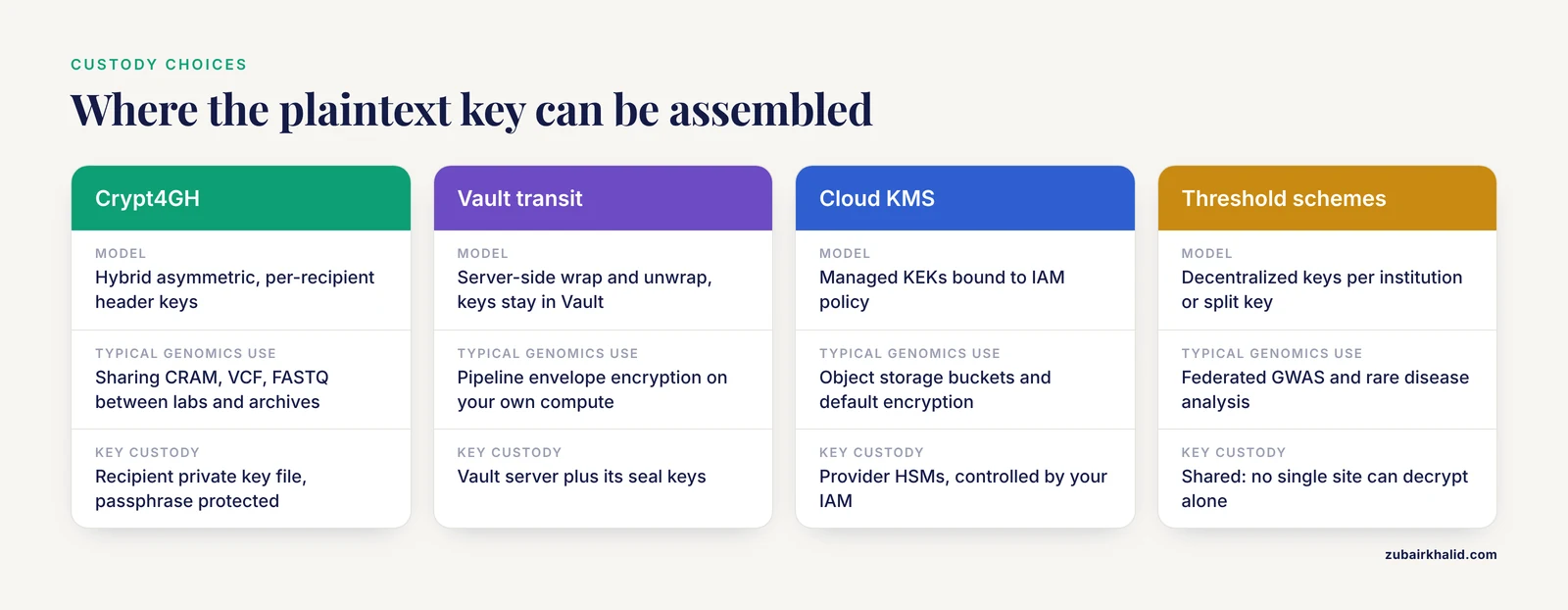
The central design decision in encryption key management for genomic data is custody. Whoever can assemble the plaintext DEK can read the genome. Every choice below is a choice about who that is and under what conditions.
| Approach | Model | Typical use in genomics | Key custody |
|---|---|---|---|
| , - | , - | , - | , - |
| Crypt4GH container | Hybrid asymmetric, per-recipient header keys | Sharing sequence files (CRAM, VCF, FASTQ) between laboratories and archives | Recipient private key file, passphrase protected |
| GPG | OpenPGP asymmetric plus symmetric | Ad hoc secure transfer, staff-to-staff exchange | Local keyring |
| HashiCorp Vault transit | Server-side wrap and unwrap, keys never leave Vault | Pipeline-integrated envelope encryption on your own compute | Vault server plus its seal keys |
| Cloud KMS (AWS KMS, GCP KMS, Azure Key Vault) | Managed KEKs with IAM policy binding | Object storage buckets, EBS volumes, S3 default encryption | Provider HSMs, controlled by your IAM |
| Multiparty or threshold homomorphic schemes | Decentralized keys per institution or split key | Federated GWAS, rare disease analysis, cross-institution testing | Shared: no single site can decrypt alone |
Step-by-Step: Encryption Key Management for Genomic Data
The walkthrough below builds a minimal but production-shaped system: file-level encryption with the community standard container, envelope wrapping with a KMS, rotation, authorization, logging, recovery, and deletion. Adapt names and paths to your environment.
Step 1. Inventory and classify what you hold
You cannot manage keys for data you have not inventoried. Walk your storage tiers, including object storage buckets, NFS mounts, HDFS, workflow scratch directories, and laptops. For each location, record the data class (identifiable genomic sequence, coded genomic data, derived summaries, phenotype tables), the current encryption state, and the pipeline that writes there.
Classify in three tiers:
- Tier 1, raw and re-identifiable genomic data. FASTQ, BAM, CRAM, VCF with identifying metadata. Always encrypted at rest with keys you or your institution control.
- Tier 2, coded genomic data. Variant matrices linked by pseudonymized IDs. Encrypt at rest and control decryption rights tightly, because re-identification risk persists.
- Tier 3, derived aggregates. Summary statistics, allele frequencies. Lower sensitivity, but encrypt if they derive from small strata.
A large population study that captured roughly five terabytes of participant data over a year and a half organized this problem with a central data management layer that combined capturing, integration, storage, and transfer under a multi-layered role and right system for access control, alongside de-identification of identifying fields and a defined backup process [6]. That structural pattern, one authoritative inventory with role-based access layered on top, is where key management begins.
Step 2. Encrypt files with Crypt4GH
Crypt4GH is the file container standard adopted within the genomics community for secure sharing of sequence data [3]. It encrypts the payload with a symmetric data encryption key and wraps that key for each recipient in an encrypted header block, which is textbook envelope encryption in a portable format.
Install and generate a key pair:
python3 -m pip install crypt4gh
crypt4gh-keygen --sk chris.sec --pk chris.pub
Expected interaction:
Passphrase for chris.sec:
Confirm passphrase:
Generating public/private key pair. Done.
Two files appear: chris.sec (the private signing key, passphrase protected) and chris.pub. Set restrictive permissions immediately:
chmod 600 chris.secEncrypt a file for a collaborator:
crypt4gh encrypt --recipient_pk collaborator.pub --in sample_42.cram --out sample_42.cram.c4ghExpected result: a new file sample_42.cram.c4gh roughly the size of the input plus a small header. Verify integrity by decrypting and comparing checksums:
crypt4gh decrypt --sk chris.sec --in sample_42.cram.c4gh --out roundtrip.cram
md5sum sample_42.cram roundtrip.cram
Expected output:
9d5f2a...  sample_42.cram
9d5f2a...  roundtrip.cram
Matching hashes confirm the container round-trips correctly. The private key file chris.sec is now a Tier 1 asset. It should never live in the same directory as the data it unlocks, never be emailed, and ideally should be referenced from an encrypted home or a secrets manager rather than sitting in a shared scratch filesystem.
Step 3. Wrap pipeline keys with a KMS (Vault transit)
Crypt4GH handles file exchange. For automated pipelines that encrypt objects at rest, the pattern is envelope encryption with a KMS. Vault's transit engine is a clean example because keys never leave the server.
Start a dev server for practice (production Vault runs sealed with HSM-backed auto-unseal in real deployments):
vault server -devExport the root token printed in the output, then enable transit and create a key:
export VAULT_ADDR='http://127.0.0.1:8200'
export VAULT_TOKEN='<root token from dev output>'
vault secrets enable transit
vault write -f transit/keys/genomics-dek
Expected output:
Success! Data written to: transit/keys/genomics-dekGenerate a wrapped data key and use it to encrypt a VCF with OpenSSL:
KEYJSON=$(vault write -f -format=json transit/datakey/plaintext/genomics-dek)
echo "$KEYJSON" | jq -r .data.plaintext | base64 -d > /dev/shm/dek.bin
openssl enc -aes-256-ctr -pbkdf2 -in calls/plain.vcf.gz \
  -out objects/calls/plain.vcf.gz.enc -pass file:/dev/shm/dek.bin
rm /dev/shm/dek.bin
echo "$KEYJSON" | jq -r .data.ciphertext > objects/calls/plain.vcf.gz.key
The DEK existed in plaintext only in /dev/shm/dek.bin for a few seconds. What persists next to the ciphertext is the wrapped key, a vault:v1: prefixed string that is useless without Vault. Decrypt later by asking Vault to unwrap:
CT=$(cat objects/calls/plain.vcf.gz.key)
vault write -format=json transit/decrypt/genomics-dek ciphertext="$CT" \
  | jq -r .data.plaintext | base64 -d > /dev/shm/dek.bin
openssl enc -d -aes-256-ctr -pbkdf2 -in objects/calls/plain.vcf.gz.enc \
  -out restored.vcf.gz -pass file:/dev/shm/dek.bin
shred -u /dev/shm/dek.bin
Expected output is a byte-identical restored.vcf.gz. Confirm with md5sum calls/plain.vcf.gz restored.vcf.gz.
The equivalent on a cloud KMS uses the same envelope shape:
aws kms generate-data-key --key-id alias/genomics-dek --key-spec AES_256The response contains Plaintext (base64 DEK) and CiphertextBlob (the wrapped key). Write the ciphertext blob alongside your object, use the plaintext key for the encryption pass, then discard it from memory.
Step 4. Rotate keys on a schedule
Rotation limits the blast radius of a compromised key. In Vault:
vault write -f transit/keys/genomics-dek/rotate
vault read transit/keys/genomics-dek
Expected output shows latest_version: 2. Vault now encrypts new data under version 2 and can still decrypt anything written under version 1. Optionally cap which versions may decrypt to retire old material gradually:
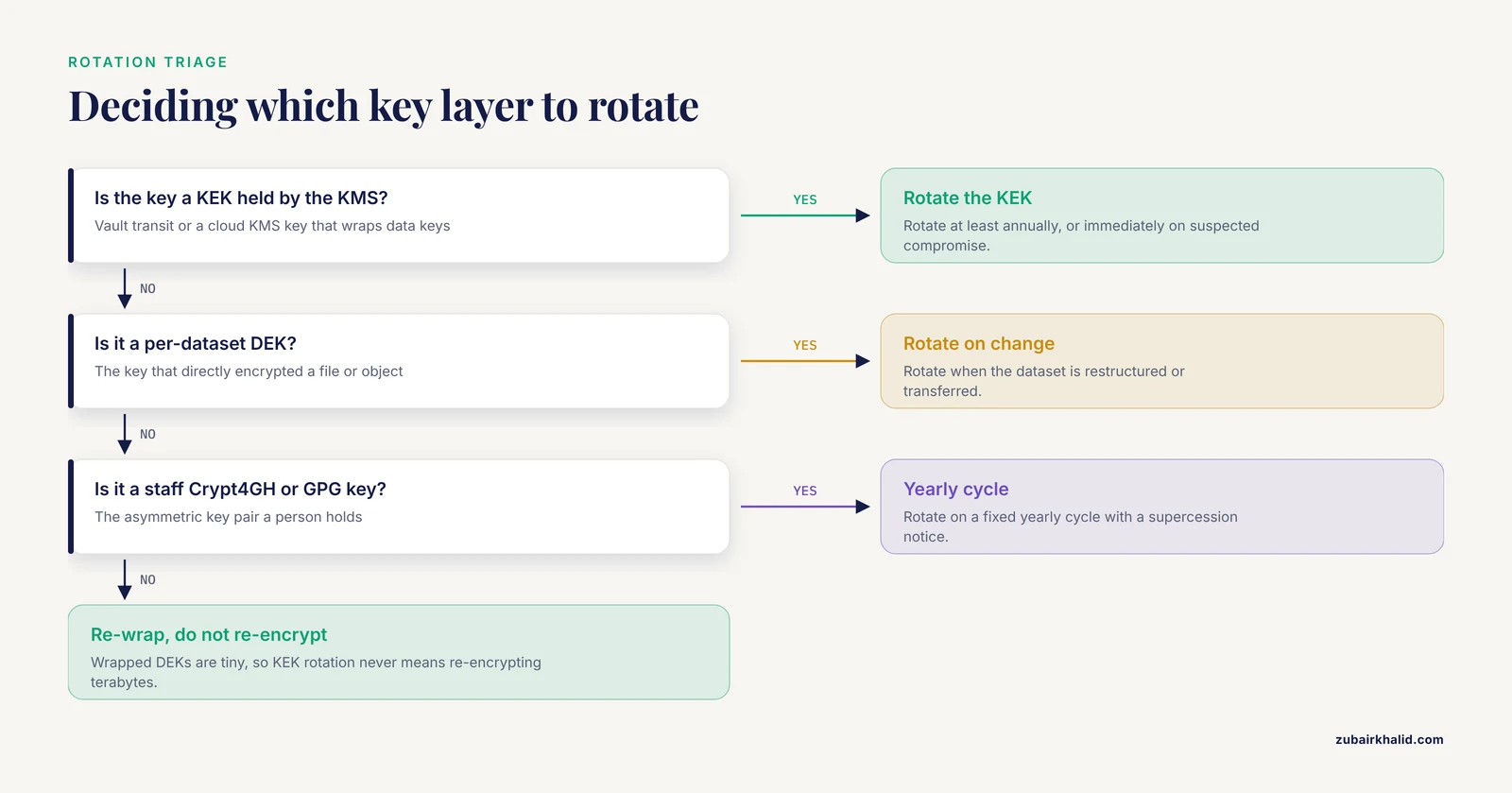
vault write transit/keys/genomics-dek/min_decryption_version=1A practical schedule: rotate KEKs at least annually and immediately on any suspicion of compromise, rotate per-dataset DEKs when a dataset is restructured or transferred, and rotate staff-facing asymmetric keys (your Crypt4GH and GPG keys) on a fixed yearly cycle with a documented supercession notice. Cloud KMS offerings support automated KEK rotation, typically annual, which you enable once and audit periodically.
Critically, rotation of a KEK does not require re-encrypting terabytes of data. That is the entire point of envelope encryption. The wrapped DEKs are tiny, so re-wrapping them under the new KEK version is cheap.
Step 5. Tie decryption to authorization
Encryption without authorization plumbing is just a locked door with the key under the mat. The genomics community has converged on structures you should mirror.
GA4GH Passports provide a standard way to carry verified claims about a researcher, such as dataset entitlements, alongside the Crypt4GH container standard for the files themselves [3]. In practice, your pipeline should not decrypt based on filesystem reachability. It should request decryption from a service that first evaluates an access policy.
Two implementation patterns appear repeatedly. Centralized decision, distributed enforcement: the DS-PACK middleware assembly centralizes access control management while distributing enforcement across federation nodes, supporting cloud-based application access and operating in production at a national data hosting platform with legal facilitation and data stewardship [7]. Attribute-based cryptography: schemes such as P2GT use key-policy attribute-based encryption so that access policy is enforced by the cryptography itself, allowing authorized testing directly on ciphertext in cloud settings [1].
For most institutional deployments, the pragmatic translation is:
- Store wrapped DEKs in a metadata database keyed by dataset ID.
- Gate the unwrap endpoint behind an authorization service that checks the requester's entitlements, ideally GA4GH Passport visas or your institutional equivalent.
- Log every unwrap call. Deny-by-default.
Step 6. Produce tamper-evident access logs
An access log tells you who decrypted what and when, which is essential for misuse investigation and for demonstrating controlled access to data providers. The weakness of ordinary logs is that an attacker with database access can edit them. Blockchain-based ledgering addresses exactly that single point of failure. A winning solution to the iDASH Secure Genome Analysis Competition stored genomic dataset access logs in MultiChain data streams, exploiting stream keys to build an efficiently queryable data frame over the chain [8]. You do not need a blockchain to get the benefit, but you do need the properties: append-only storage, hash-chained entries or external notarization, and query support for audit questions such as which user accessed dataset X in a date range.
At minimum, log these events with timestamps, user identity, dataset ID, and outcome: key creation, key rotation, unwrap success, unwrap failure, policy change, and key destruction.
Step 7. Plan recovery before you need it
The most feared failure in key management is not a breach. It is the permanent loss of the only KEK that can unwrap the DEKs for an entire cohort. Recovery planning has three parts.
First, distribute trust. Vault uses a split seal process where multiple key shares are required to unseal, so no single administrator can reconstruct the root of trust alone. Apply the same dual-control principle to any break-glass credentials.
Second, test restores. Once per quarter, take a wrapped dataset from cold storage, perform the unwrap and decrypt path on a clean host, and verify checksums. An untested recovery plan is a hypothesis, not a plan. Large research infrastructures treat backup and recovery as part of the core data management contract rather than an afterthought [6].
Third, document key provenance. For every dataset, record which key version encrypted it, where the wrapped DEK lives, and which policy governs unwrapping. When the person who set it up leaves, this record is the difference between an afternoon and a quarter of archaeology.
Step 8. Delete by destroying keys
For many genomics data storage backends, especially immutable object storage and tape archives, true file deletion is slow and unverifiable. Crypto-shredding is cleaner: destroy the wrapped DEK, and the ciphertext becomes noise.
In Vault, destroy the specific key version backing the dataset:
vault kv metadata delete secret/genomics/erase-meIn a metadata-database design, issue a soft delete first, honor a grace window for consent disputes, then hard delete the wrapped DEK row and log the destruction event. For cloud object stores, customer-managed KMS keys let you retire a key version that rendered a bucket's contents readable, which is often the only reliable erasure path for replicated objects.
Deleting the ciphertext copy while a wrapped DEK survives elsewhere is a classic audit finding. Deletion means deleting the ability to decrypt, everywhere, including backups.
Step 9. Compute on encrypted data when data must move
Sometimes the analysis itself must happen without decrypting, for example across institutions that cannot pool genotypes. Homomorphic encryption makes this possible, and it changes your key management topology.
Early clinical proof came from a privacy-preserving genomic testing model in HIV care, where thousands of genetic markers were processed under homomorphic encryption and a multimarker test on encrypted data averaged 865 milliseconds on a standard computer, with reports delivered to clinicians without exposing the underlying sequence [9]. Physicians in the Swiss HIV Cohort Study who evaluated a related privacy-preserving delivery model largely endorsed the approach, with two thirds identifying genetic privacy as a key aspect to protect and 90 percent satisfied with the tool's usability [10].
Current systems scale this idea. TrustGWAS is a full-process encrypted GWAS workflow using multi-key homomorphic encryption, in which each participating institution holds its own key, and it evaluated 100,000 individuals with one million variants through quality control, LD pruning, PCA, and regression in about 50 hours, recapitulating gold standard PLINK results [11]. FAMHE applies multiparty homomorphic encryption to federated biomedical analytics, reproducing centralized Kaplan-Meier and GWAS studies accurately across distributed datasets without revealing intermediate data [5]. For rare disease analysis across multiple institutions, PRISM builds on threshold fully homomorphic encryption specifically to decentralize key management, ensuring that no single entity can unilaterally decrypt sensitive data, with algorithmic choices delivering up to 17-fold runtime improvement for recessive and dominant filtering and 22-fold for de novo filtering [4]. Multi-key designs also underpin newer genomic computation frameworks aiming at interoperability and multiparty support [2].
What this means for your key inventory is concrete: in federated projects, your institution holds a key share, and the joint analysis protocol defines how key shares combine. Your local key governance, custody, rotation, and logging, still applies to your share.
Emerging Storage Media and Their Key Models
Two research directions extend encryption key management into unusual territory and are worth tracking even if you never deploy them.
Digital data storage in synthetic DNA can be encrypted with keys derived from a person's own genome. Researchers demonstrated that human short tandem repeats contain enough entropy to generate strong keys, experimentally producing 80-bit-strength keys from human DNA and using them to encrypt 17 kB of digital information stored in synthetic DNA, with perfect recovery from a single sequencing run [12]. The key and the data are read by the same instrument, which is elegant and also a reminder that key derivation from biological material raises its own governance questions. Related in vivo work proposes encoding schemes built from gene regulatory networks and complete genomes that expand the key space by more than 100 orders of magnitude relative to earlier methods, demonstrating encrypted storage and 100 percent recovery after 100 generations of microbial replication [13]. Comparative analyses of DNA-based ciphers combined with DNA steganography, including playfair, vigenere, RSA, and AES variants, document wide performance differences in security, speed, and capacity across these techniques [14]. Treat all of these as research systems. For operational genomics data storage today, AES-256 under a managed KMS with envelope encryption remains the defensible standard.
On the sharing side, note that encryption is one tool among several. For dual-use pathogen data, pooling reads from multiple samples before sharing can prevent reconstruction of any individual sample while preserving most genomic information, a data-format-level control that complements rather than replaces encryption [15]. Individual-level sharing initiatives outside formal archives carry their own governance challenges around consent and participant awareness of the risks of balancing data sharing decisions alone [16].
Common Mistakes and Limitations
These are the failures seen most often when teams first implement encryption key management for genomic data.
- Keys in version control. A private key committed to a Git repository, even briefly, is exposed forever if the repo was ever pushed. Scan histories with a secrets scanner, rotate immediately after any exposure, and add pre-commit hooks that block key-shaped files.
- Confusing encryption with de-identification. Encrypting a VCF does not de-identify it, and de-identifying it does not encrypt it. They are complementary controls. Encrypted token-based linkage, as used to join genomic classifier results with claims and EHR data across payers, shows how coded identifiers and encryption work together in practice [17].
- Hardcoding keys in workflow files. Keys pasted into Nextflow, Snakemake, or CWL configs end up in logs, in workflow registration services, and in the hands of anyone with read access to the pipeline repo. Pass keys at runtime from a KMS through short-lived environment variables or secret mounts.
- No key escrow or break-glass path. If the only holder of a KEK leaves the institution, the data is gone. Distribute custody with dual control and document the recovery ceremony.
- Single-administrator root keys. One person who can both create and unwrap keys defeats every downstream control. Split responsibilities so the person who authorizes access is not the person who performs the unwrap.
- Rotating carelessly. Rotating a KEK is cheap. Re-encrypting petabytes unnecessarily is expensive and risky. Know which layer you are rotating. Conversely, failing to track key versions means old ciphertext becomes unreadable after cleanup.
- Unencrypted derived files. Teams encrypt the VCF and forget the BAM index, the PCA cache, the genotype matrix in RDS format, and the scratch directory of the workflow engine. Your inventory from Step 1 must include every derivative.
- Assuming provider default encryption equals your control. Storage-side default encryption protects against disk loss, not against platform-level access under someone else's key. Use customer-managed keys when the data class demands it.
- Deploying experimental ciphers in production. DNA-based, chaos-based, and other exotic schemes are research contributions, not substitutes for vetted standards [14][18]. Use reviewed, widely analyzed primitives.
- Ignoring computation-layer keys. If you join a federated analysis, your multiparty key share is a live credential. Give it the same custody, rotation, and logging discipline as any KEK.
The main limitation of the whole field is practicality. Fully homomorphic and multiparty schemes impose real runtime and ciphertext-size costs, which is why algorithmic engineering such as addition-intensive variants exists to reduce multiplication-heavy operations [4], and why adoption in routine clinical care is still building through pilots and surveys rather than universal deployment [10]. Individual deployment decisions also depend on your institution's governance, data agreements, and local infrastructure, so treat this guide as a template to adapt rather than a compliance ruling.
Frequently Asked Questions
What is the difference between a data encryption key and a key encryption key?
A data encryption key (DEK) directly encrypts the genomic file, while a key encryption key (KEK) encrypts the DEK itself. Envelope encryption means the bulky ciphertext carries only the tiny wrapped DEK, and the KEK stays inside your KMS where it can be rotated, audited, and never exported.
How often should I rotate encryption keys for genomic data?
Rotate key encryption keys at least annually and immediately after any suspected compromise, and rotate per-dataset data encryption keys when a dataset is restructured or handed off. Because envelope encryption keeps wrapped DEKs small, KEK rotation does not require re-encrypting your data, only re-wrapping the keys.
Is Crypt4GH required for sharing genomic data?
Crypt4GH is not legally required anywhere, but it is the file container standard adopted by the genomics community for controlled sequence data sharing and is widely supported by archives and transfer tools. Using it means your wrapped keys travel inside the file header and your recipients decrypt with their own key pairs.
Can I run analysis directly on encrypted genomic data?
Yes, using homomorphic encryption, and multiparty and threshold variants support cross-institution analyses where each site holds its own key or a key share. Published workflows have executed GWAS pipelines, survival analysis, and clinical pharmacogenomic tests on encrypted data, with runtime costs that remain the main engineering constraint.
What happens if I lose the encryption key?
If you lose the only KEK that wraps a dataset's DEKs, the ciphertext is unrecoverable, permanently. That is why dual control, split seal keys, and quarterly restore tests exist. The same property, deliberately invoked, is crypto-shredding, the most reliable way to delete replicated genomic data.
Where should keys live, a cloud KMS or an on-premises HSM?
Put keys where your authorization enforcement lives, because the KMS is effectively your decryption oracle. A cloud KMS integrates tightly with object storage IAM, while an on-premises Vault or HSM gives you custody when data agreements require it. Either way, the KEK must never be exportable in plaintext to pipeline hosts.
Does encryption satisfy de-identification requirements?
No. Encryption protects data at rest and in transit, while de-identification and coding address the content's identifiability. Auditors and data providers expect both, and access logging on top. Encrypting an identifiable genome produces an encrypted identifiable genome.
How does key management work in a multi-institution federated project?
Each institution typically holds its own key or a share of a threshold key, and the federation protocol defines how ciphertexts are computed over jointly without any party reconstructing the plaintext. Your obligations do not change: you still control, rotate, log, and recover your own key share under your institution's policy.
Sources
- P2GT: Fine-Grained Genomic Data Access Control With Privacy-Preserving Testing in Cloud Computing.
- Privacy-preserving framework for genomic computations via multi-key homomorphic encryption.
- Future-proofing genomic data and consent management: a comprehensive review of technology innovations.
- PRISM: privacy-preserving rare disease analysis using fully homomorphic encryption.
- Truly privacy-preserving federated analytics for precision medicine with multiparty homomorphic encryption.
- Efficient data management in a large-scale epidemiology research project.
- DS-PACK: Tool assembly for the end-to-end support of controlled access human data sharing.
- Using blockchain to log genome dataset access: efficient storage and query.
- Privacy-preserving genomic testing in the clinic: a model using HIV treatment.
- Are privacy-enhancing technologies for genomic data ready for the clinic? A survey of medical experts of the Swiss HIV Cohort Study.
- TrustGWAS: A full-process workflow for encrypted GWAS using multi-key homomorphic encryption and pseudorandom number perturbation.
- Genomic Encryption of Digital Data Stored in Synthetic DNA.
- Highly Secure In Vivo DNA Data Storage Driven by Genomic Dynamics.
- DNA-based cryptographic methods for data hiding in DNA media.
- Methods for safely sharing dual-use genetic data.
- Challenges of web-based personal genomic data sharing.
- Development of a Longitudinal Prostate Cancer Transcriptomic and Clinical Data Linkage.
- An Efficient Chaos-Based Image Encryption Technique Using Bitplane Decay and Genetic Operators.