How to Conduct a DPIA for Cloud-Based Genomic Research
By Dr. Zubair Khalid, DVM, MS, PhD ·

Genomic sequencing produces files measured in tens of gigabytes per participant, and most laboratories cannot store and compute at that scale on premises. That pressure is one reason the field has moved toward cloud bioinformatics, where storage, compute, and shared analysis environments scale on demand [1][2]. A Data Protection Impact Assessment (DPIA) is the structured document that shows regulators, funders, and participants that this migration was done responsibly rather than by default.
By the end of this article you will be able to:
- Decide whether your cloud genomic project legally requires a DPIA and document that decision.
- Fill in a reusable DPIA template (the YAML skeleton in Step 8) with system descriptions, data flows, and processing purposes that survive audit.
- Run concrete discovery commands against an AWS account to verify that the system you described in the DPIA matches the system that actually exists.
- Build a scored risk register for genomic data in the cloud, assign mitigations, and compute residual risk.
- Record sign-off, consultation, and review triggers so the DPIA stays a living document instead of a shelf artifact.
To follow the walkthrough you need read access to the cloud account that hosts your genomic data, the AWS CLI v2 installed locally (aws, version to confirm), Python 3.8 or newer, a text editor, and copies of your data processing agreements with any SaaS or platform vendors. If you are the data controller, involve your privacy officer or data protection officer (DPO) before you start. If you are a processor acting for a hospital or university, get their written instructions first, because the controller owns the DPIA decision.
What a DPIA Covers When the Data Is Genomic
A DPIA is a documented assessment, required under Article 35 of the EU General Data Protection Regulation (GDPR) when processing is likely to result in a high risk to individuals, that describes the processing, evaluates its necessity and proportionality, assesses risks to data subjects, and specifies mitigations. The GDPR is not the only law in play, but it is the framework the DPIA concept comes from, and its Article 35 checklist is the de facto template format used by research institutions worldwide.
Three facts make genomic data a near-automatic DPIA trigger:
- Genetic data is special category data. Article 9 treats genetic data (and biometric data) as sensitive, so the threshold for "high risk" processing is met at much smaller scale than for ordinary health data.
- Genomic data is large scale by default. A single whole genome stored as a CRAM file is commonly on the order of 100 GB. A cohort study therefore involves large-scale processing of special category data almost by definition, which matches the mandatory DPIA criteria in Article 35(3)(b).
- Cloud processing is inherently multi-party. Your institution, the cloud provider, storage vendors, pipeline tools, and downstream repositories all touch the data. Each relationship changes the risk surface.
Reviewers of the genomic data sharing literature have converged on "responsible data stewardship" as the framing for this work, defined as the ethical and secure management, use, and protection of data to ensure its accuracy, privacy, integrity, and appropriate access throughout the data lifecycle [3]. A DPIA is where you demonstrate stewardship on paper. Separately, reviews of clinical and research laboratories that moved sequencing workloads to the cloud emphasize that the compliance burden does not disappear when you sign a cloud contract, it changes shape, and the laboratory remains accountable for how genetic information is handled in research and in shared public variant repositories [1].
Do not confuse a DPIA with a security risk assessment. A security assessment asks "can an adversary get in." A DPIA asks "if everything works as designed, is this processing justified, minimized, and fair to the data subjects, and what happens to them if it fails." You need both, and the DPIA should reference the security assessment rather than duplicate it.
Before You Start: Inputs to Assemble
Gather these before writing anything, because a DPIA drafted from memory is the most common failure mode:
- Data flow map. Which systems hold genomic files, metadata, and linked phenotypes, and which networks connect them.
- Cloud account inventory. Account IDs, regions, buckets, databases, and the identities (human and machine) that can read genomic data.
- Contracts. The data processing agreement with your cloud provider, any consent language covering cloud storage and international transfer, and repository submission agreements.
- Regulatory registrations. IRB or research ethics protocol number, any national registry entry, and your organization's GDPR records of processing (Article 30).
- Tooling. AWS CLI configured with a read-only or security-audit role,
jqfor parsing JSON output, and Python 3.
Step 1: Describe the Processing Precisely
Open your DPIA document and write a system description that a stranger could reconstruct the deployment from. Vague descriptions ("data is stored securely in the cloud") are the single biggest quality defect in real DPIAs. A concrete worked example, which I will carry through the whole article, looks like this:
The NIGHTINGALE Study conducts whole genome sequencing of 12,000 participants. Raw BCL files are transferred from the sequencing vendor directly into the S3 bucket
nightingale-genomes-rawin theus-east-1region. CRAM files, averaging roughly 100 GB per genome, are produced by a Nextflow variant calling pipeline executed on AWS Batch with spot instances inside a private VPC. Aligned files are encrypted with SSE-KMS using the customer-managed keyalias/genomics-data. Participant covariates (age, sex, ancestry, diagnosis codes) live in an encrypted RDS PostgreSQL instance. Variant call results (VCF) are copied to a controlled-access collaborator bucket. The study team of 9 analysts access the environment through federated IAM roles with multi-factor authentication (MFA). No genomic data leaves the AWS environment except summary statistics approved by the data access committee.
That paragraph answers most of Article 35(7)(a) on its own. Note what it contains: data categories, volumes, regions, encryption state, identities, purposes, and egress points. Note also what it omits: security theater phrases with no verifiable content.
Step 2: Inventory the Real Environment with Commands
The DPIA must describe the system as it is, not as the architecture diagram claims it is. Run discovery against the account and paste verified outputs into an appendix. This is where "how to conduct a DPIA for cloud-based genomic research" stops being paperwork and becomes cloud bioinformatics practice.
First, confirm which account and identity you are auditing:
aws sts get-caller-identityExpected output:
{
    "UserId": "AIDAUDITROLE123456789",
    "Account": "123456789012",
    "Arn": "arn:aws:sts::123456789012:assumed-role/SecurityAudit/audit-session"
}
List every storage location that could hold genomic data:
aws s3 lsExpected output:
2024-02-11 09:14:22 nightingale-genomes-raw
2024-02-11 09:15:03 nightingale-genomes-cram
2024-03-02 11:40:51 nightingale-variant-vcf
2024-03-02 11:41:07 nightingale-collab-shared
Now verify the three controls that dominate genomic cloud risk: encryption at rest, public access blocking, and external sharing.
Check default encryption on each bucket:
aws s3api get-bucket-encryption --bucket nightingale-genomes-cramExpected output:
{
    "ServerSideEncryptionConfiguration": {
        "Rules": [
            {
                "ApplyServerSideEncryptionByDefault": {
                    "SSEAlgorithm": "aws:kms",
                    "KMSMasterKeyID": "alias/genomics-data"
                },
                "BucketKeyEnabled": true
            }
        ]
    }
}
If a bucket is unconfigured, you get the error ServerSideEncryptionConfigurationNotFoundError and the bucket inherits no default encryption, which means an uploaded CRAM could land unencrypted. The fix appears in Step 5.
Check public access blocking:
aws s3api get-public-access-block --bucket nightingale-genomes-cramExpected output:
{
    "PublicAccessBlockConfiguration": {
        "BlockPublicAcls": true,
        "IgnorePublicAcls": true,
        "BlockPublicPolicy": true,
        "RestrictPublicBuckets": true
    }
}
All four values must be true for any bucket holding participant-derived data. A false anywhere is a DPIA finding.
Check whether the account exposes data outside your organization using IAM Access Analyzer, which identifies resources shareable with external principals:
aws accessanalyzer list-findings --analyzer-name org-analyzer --region us-east-1Expected output for a clean account:
{
    "findings": [],
    "findingsCount": 0
}
Each nonempty finding (for example, a bucket policy granting read to an external AWS account) is a data flow that must appear in your DPIA or be closed.
Finally, confirm that audit logging exists, because without it your DPIA cannot honestly claim accountability:
aws cloudtrail describe-trails --query 'trailList[].{name:Name,status:IsLogging}'Expected output:
[
    {
        "name": "org-audit-trail",
        "status": true
    }
]
Attach this section as the factual backbone of the DPIA. Any control you assert in the narrative that these commands cannot verify is a liability.
Step 3: Assess Necessity and Proportionality
Article 35(7)(b) requires you to justify that the processing is necessary and proportionate. For cloud genomics, this section of the template answers four questions in writing:
- Why the cloud at all. Reviews of biomedical cloud adoption are explicit that the cloud is not the right answer in every scenario, and that organizations should weigh scalability, collaboration, and security benefits against cost and management overhead [2]. State why your alternative (on-premise cluster, institutional HPC, or a national facility) is inadequate for the cohort size, turnaround, or collaboration model.
- Why raw data at this granularity. Could variant-level or summary-level data answer the research question? If collaborators only need association results, shipping them CRAM files is disproportionate. Federated designs, where analysis code moves to the data rather than data moving to analysts, directly reduce the exposure surface and are an active infrastructure pattern in biomedical cloud platforms [4].
- Why this jurisdiction and these regions. Data residency commitments, both contractual and consent-based, must match where you actually replicate data. Cross-border storage architecture is a recognized category of cloud privacy risk [5].
- Why this retention period. Write a number, tie it to the consent and the funder agreement, and describe the deletion mechanism (Step 5 covers the command-level check).
Step 4: Build the Risk Register with a Structured Catalog
Article 35(7)(c) requires an assessment of risks to the rights and freedoms of data subjects. Do not free-associate here. Start from a structured risk catalog and adapt it.
A systematic review of cybersecurity and privacy challenges in healthcare cloud computing, combined with expert consultation and analysis of real incidents, identified ten recurring challenge categories: data breaches and unauthorized access, compliance with regulations such as HIPAA and GDPR, data sovereignty and jurisdictional issues, shared infrastructure vulnerabilities, insider threats, data loss and availability concerns, inadequate security measures by cloud providers, application vulnerabilities, limited visibility and control, and the complexity of cloud security management [5]. This catalog maps cleanly onto genomic research and is a defensible basis for a DPIA risk register.
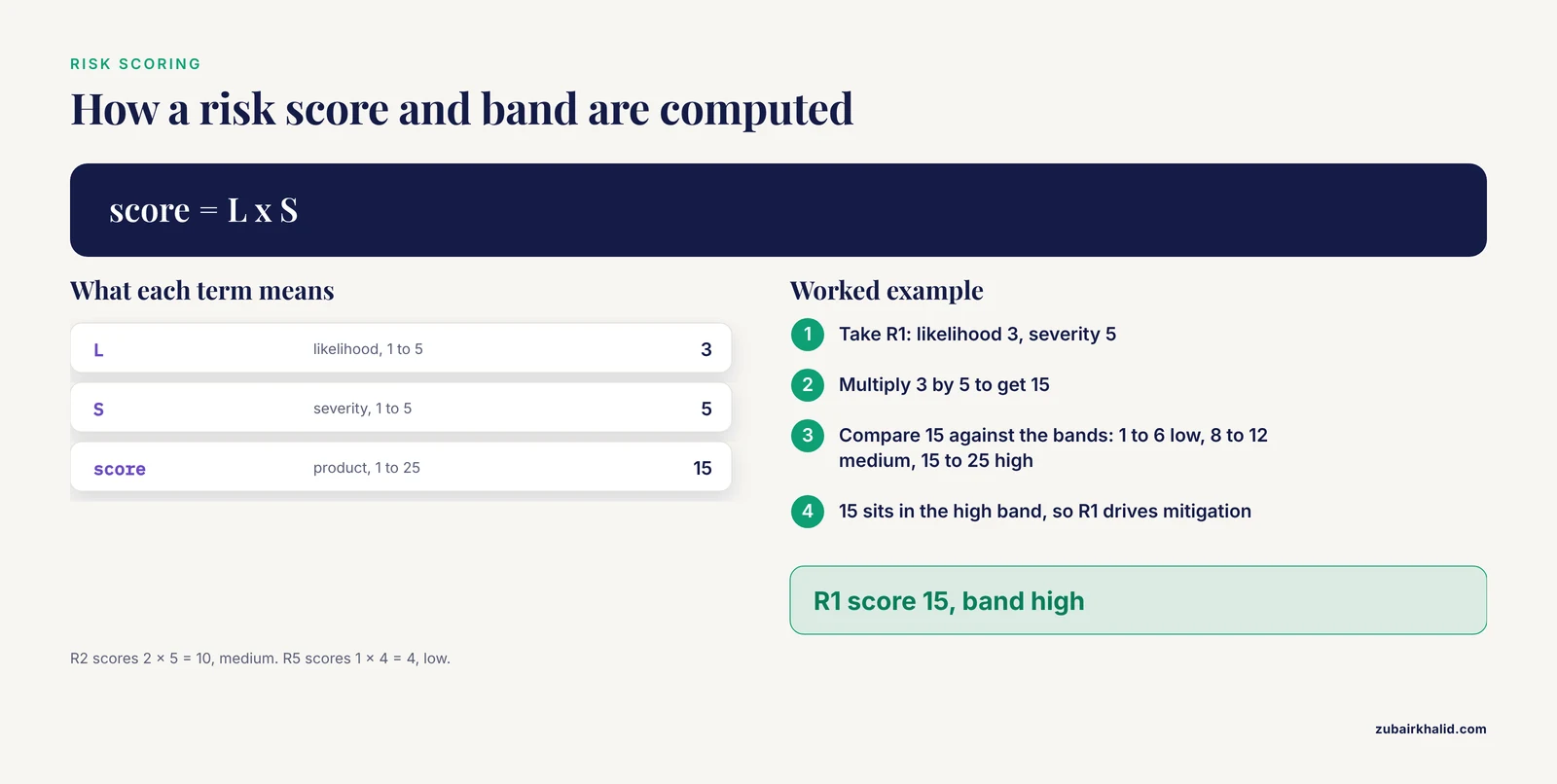
Score each risk on a 5-point likelihood (L) and 5-point severity (S) scale. The standard qualitative anchors are L1 = rare through L5 = almost certain, and S1 = negligible (no harm, administrative impact only) through S5 = severe (re-identification of participants, discrimination, loss of employability or insurability, major breach). Risk score = L × S, giving a 1 to 25 range. Bands: 1 to 6 low, 8 to 12 medium, 15 to 25 high. This scoring convention is standard practice in risk assessment and is not study-derived, so state your anchors in the template so scores are reproducible.
Here is the worked register for the NIGHTINGALE example, before mitigations:
| ID | Risk (source category) | L | S | Score | Primary mitigation |
|---|---|---|---|---|---|
| R1 | Public exposure of a genomic bucket through a misconfigured policy (breaches, unauthorized access) [5] | 3 | 5 | 15 | Block Public Access, deny-unencrypted-transport bucket policy, Access Analyzer |
| R2 | Insider or compromised credential exfiltrates CRAM files (insider threats) [5] | 2 | 5 | 10 | Least-privilege IAM, MFA, CloudTrail data events, alerting on bulk S3 reads |
| R3 | Re-identification of participants from nominally de-identified genomes plus linked metadata (breaches) [1][5] | 2 | 5 | 10 | Strict separation of identity keys, controlled egress of summary statistics only |
| R4 | Processing or storage in a region that violates consent or contract (sovereignty, jurisdiction) [5] | 2 | 4 | 8 | Region-pinned infrastructure, SCP denying replication to other regions |
| R5 | Cross-contamination or leakage through shared multi-tenant infrastructure (shared infrastructure) [5] | 1 | 4 | 4 | Private VPC endpoints, no shared scratch buckets between projects |
| R6 | Data loss, deletion, or unavailability destroying irreplaceable genomes (data loss and availability) [5] | 2 | 3 | 6 | Versioning, Object Lock, cross-region replication within approved regions |
| R7 | Pipeline or container dependency imports a vulnerable image into the protected environment (application vulnerabilities) [5][6] | 3 | 3 | 9 | Pinned image digests, vulnerability scanning, curated container registry |
| R8 | Noncompliance with HIPAA or GDPR obligations in workflows shared with clinical variant databases (compliance) [1] | 2 | 4 | 8 | Separate research and clinical processing tracks, documented DPA per vendor |
| R9 | Loss of visibility because data moved outside institutional monitoring (limited visibility) [5] | 3 | 3 | 9 | Centralized CloudTrail and GuardDuty, deny-egress without logging |
| R10 | Configuration drift as the environment evolves (complexity of cloud security management) [5] | 4 | 3 | 12 | Infrastructure as code, periodic re-run of the Step 2 discovery commands |
The pre-mitigation high risks (R1 at 15) drive the mitigation plan. To keep scores computable and auditable, encode the register in a small script rather than a spreadsheet:
import csv

rows = [
    ("R1", 3, 5, "Block Public Access, deny HTTP, Access Analyzer"),
    ("R2", 2, 5, "Least privilege IAM, MFA, CloudTrail data events"),
    ("R3", 2, 5, "Separate identity keys, summary-stats-only egress"),
    ("R4", 2, 4, "Region pinning with service control policy"),
    ("R5", 1, 4, "VPC endpoints, no shared scratch buckets"),
    ("R6", 2, 3, "Versioning, Object Lock, in-region replication"),
    ("R7", 3, 3, "Pinned digests, image scanning, curated registry"),
    ("R8", 2, 4, "Documented DPA per vendor, separated workflows"),
    ("R9", 3, 3, "Central logging, deny egress without logging"),
    ("R10", 4, 3, "Infrastructure as code, quarterly re-audit"),
]

def band(score):
    if score >= 15:
        return "high"
    if score >= 8:
        return "medium"
    return "low"

with open("risk_register.csv", "w", newline="") as f:
    w = csv.writer(f)
    w.writerow(["id", "L", "S", "score", "band", "mitigation"])
    for rid, l, s, mit in rows:
        w.writerow([rid, l, s, l * s, band(l * s), mit])
print("wrote risk_register.csv")
Run it and check the output:
python3 make_register.py
cat risk_register.csv | head -4
Expected output:
wrote risk_register.csv
id,L,S,score,band,mitigation
R1,3,5,15,high,Block Public Access deny HTTP Access Analyzer
R2,2,5,10,medium,Least privilege IAM MFA CloudTrail data events
R3,2,5,10,medium,Separate identity keys summary-stats-only egress
The highest scoring rows become mandatory mitigations. If any high risk remains high after mitigation, Article 35 requires consulting your supervisory authority before processing begins. Write that decision point into the template explicitly.
Step 5: Define Mitigations and Verify Them at the Command Line
Article 35(7)(d) requires measures to address the risks. For each row in the register, the mitigation column must name a control that can be verified. Vague mitigations ("we will strengthen access controls") fail audit for the same reason vague system descriptions do. Here is how the top risks in the example register get fixed and proven.
R1, public exposure. Enforce the full public access block and default KMS encryption:
aws s3api put-public-access-block \
  --bucket nightingale-genomes-cram \
  --public-access-block-configuration \
  BlockPublicAcls=true,IgnorePublicAcls=true,BlockPublicPolicy=true,RestrictPublicBuckets=true

aws s3api put-bucket-encryption \
  --bucket nightingale-genomes-cram \
  --server-side-encryption-configuration \
  '{"Rules":[{"ApplyServerSideEncryptionByDefault":{"SSEAlgorithm":"aws:kms","KMSMasterKeyID":"alias/genomics-data"},"BucketKeyEnabled":true}]}'
Then add a bucket policy that denies any request not made over TLS, so a CRAM file can never traverse the network in plaintext:
{
  "Version": "2012-10-17",
  "Statement": [
    {
      "Sid": "DenyInsecureTransport",
      "Effect": "Deny",
      "Principal": "*",
      "Action": "s3:*",
      "Resource": [
        "arn:aws:s3:::nightingale-genomes-cram",
        "arn:aws:s3:::nightingale-genomes-cram/*"
      ],
      "Condition": {
        "Bool": { "aws:SecureTransport": "false" }
      }
    }
  ]
}
Re-run the get-public-access-block and get-bucket-encryption commands from Step 2 and confirm the values changed. Verification is part of the mitigation, not an afterthought.
R2 and R9, insider access and visibility. Enable CloudTrail S3 data events for the genomic buckets and confirm identity hygiene:
aws iam get-account-summary --query 'SummaryMap.AccountMFAEnabled'Expected output for an MFA-enforced account:
[3]Review the IAM policy attached to analyst roles and confirm it scopes s3:GetObject to specific bucket prefixes rather than *. Least privilege is the control that most directly addresses the insider threat category in the risk catalog [5].
R7, pipeline vulnerabilities. Genomic pipelines increasingly run as containers, and the bioinformatics literature documents both the reproducibility and security benefits of that approach and the wide variability in practice that can compromise the security and privacy of protected information [6]. Pin images by digest, not tag, and scan them before they enter the protected environment:
docker pull quay.io/biocontainers/bwa@sha256:3f1a9c0e5d8b2c7f6e4a1d2b3c4d5e6f7a8b9c0d1e2f3a4b5c6d7e8f9a0b1c2d
trivy image --severity HIGH,CRITICAL quay.io/biocontainers/bwa@sha256:3f1a9c0e5d8b2c7f6e4a1d2b3c4d5e6f7a8b9c0d1e2f3a4b5c6d7e8f9a0b1c2d
Expected output (abridged):
bwa@sha256:3f1a... (quay.io/biocontainers/bwa)
=====================================================
Total: 0 (HIGH: 0, CRITICAL: 0)
Record the digest and scan date in the DPIA appendix. If the scan reports CRITICAL findings, the mitigation is documented remediation or a documented risk acceptance by the controller, never silent deployment.
R3, re-identification. The structural control matters more than any single setting here. Keep the identity key map in a separate account with separate keys and separate administrators, egress only summary statistics or variant-level data approved by the data access committee, and log every egress event. This is where responsible stewardship translates into architecture: appropriate access, integrity, and privacy are maintained across the data lifecycle rather than asserted once at upload [3].
R6, irreplaceable data loss. Enable versioning and Object Lock in compliance mode on raw data buckets:
aws s3api put-bucket-versioning \
  --bucket nightingale-genomes-raw \
  --versioning-configuration Status=Enabled

aws s3api put-object-lock-configuration \
  --bucket nightingale-genomes-raw \
  --object-lock-configuration '{"ObjectLockEnabled":"Enabled","Rule":{"DefaultRetention":{"Mode":"COMPLIANCE","Days":3650}}}'
The 10-year retention shown here must match the retention period you wrote in Step 3. A mismatch between the documented retention policy and the technical retention control is exactly the kind of inconsistency a DPIA reviewer looks for.
Step 6: Consult, Sign Off, and Record
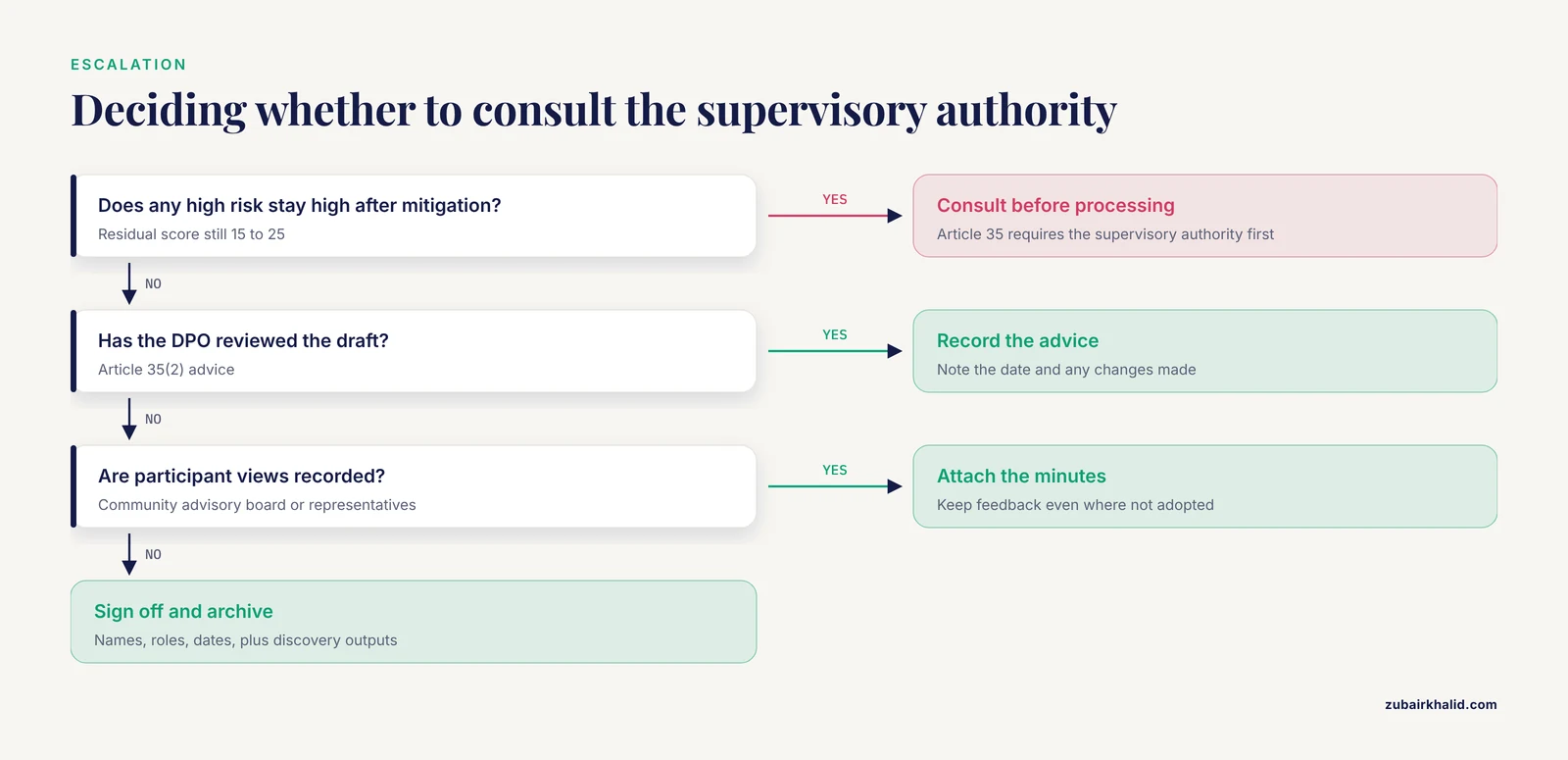
Article 35(2) requires seeking the advice of your DPO where one exists, and Article 35(9) requires seeking the views of data subjects or their representatives where appropriate. In practice for genomic research this means:
- Circulate the draft DPIA to the DPO and at least one independent bioinformatician or security engineer. Community work on cloud data stewardship has emphasized that trustworthiness is demonstrated through the data access and management practices repositories can show, not just claim [3], and peer review of the DPIA is the cheapest way to demonstrate it.
- Consult participant representatives or the study's community advisory board on the egress and sharing plan, and record their feedback even if you did not adopt it.
- Record sign-off with names, roles, and dates for the DPO, the principal investigator (as controller delegate), and the information security officer.
- Archive the discovery command outputs from Step 2 alongside the signed document, with a timestamp, so an auditor can re-run them and compare.
Large-scale European infrastructure planning for health research clouds reaches the same conclusion from a different direction: any shared genomic compute environment must be built and certified to standards stakeholders can trust, supported by an ethical and legal framework compliant with data protection law, and developed openly rather than as a black box [7]. A signed, evidence-attached DPIA is the per-project expression of exactly those principles.
Step 7: Define Re-Assessment Triggers
A DPIA is a snapshot. Write explicit triggers into the template so review is mechanical rather than aspirational:
- A new data type enters the environment (for example, transcriptomics or clinical images linked to genomes).
- Data moves to a new region or a new cloud account.
- A new external collaborator or repository receives data.
- The consent framework changes or a new funding agreement imposes different terms.
- Any security incident involving genomic data, regardless of confirmed impact.
- At minimum, annually.
When a trigger fires, re-run the Step 2 discovery commands, diff the outputs against the archived appendix, and write an addendum. The diff between snapshots is the most persuasive review artifact you can produce, because it shows the DPIA tracked reality rather than decorated it.
Step 8: The Reusable DPIA Template Format
Here is the full template in YAML, populated with the NIGHTINGALE example values. Save it as dpia.yaml, fill it per project, and keep it under version control next to your infrastructure code. This skeleton doubles as a free DPIA template for cloud genomic research that any team can adapt, and it maps one-to-one onto the Article 35(7) content requirements.
dpia:
  id: DPIA-2026-014
  version: 1.0
  date: 2026-11-11
  project: NIGHTINGALE Study whole genome sequencing
  controller:
    organization: University Center for Genomic Medicine
    dpo: [email protected]
  processors:
    - name: Cloud provider
      service: AWS (storage, compute, managed databases)
      dpa_reference: DPA-2024-008
    - name: Sequencing vendor
      service: BCL generation and transfer
      dpa_reference: DPA-2024-011
  processing_purposes:
    - Germline variant discovery for rare disease research
    - Deposition of variant-level results to a controlled-access repository
  data_categories:
    - type: genomic (CRAM, VCF)
      volume_estimate: 1200 TB
      identifiable: pseudonymized, identity key held separately
      special_category: true
    - type: clinical covariates
      volume_estimate: 12k rows
      identifiable: pseudonymized
      special_category: true
  data_subjects: 12000 research participants
  regions: [us-east-1]
  retention: 10 years from sample acquisition, then cryptographic erasure of keys
  necessity:
    cloud_rationale: Cohort scale exceeds institutional HPC capacity and requires
      collaborator access across four institutions
    granularity_rationale: Raw alignment required for [structural variant](/blog/guides/structural-variant) calling
    alternatives_rejected: Federated analysis insufficient for the joint
      genotyping stage, on-premise capacity documented in HPC-2025-003
  risks:
    - id: R1
      description: Public exposure of a genomic bucket
      likelihood: 3
      severity: 5
      score: 15
      band: high
      mitigation: Public access block, deny insecure transport, Access Analyzer
      residual_score: 3
      residual_band: low
  consultation:
    dpo_review: 2026-10-30
    participant_representatives: Community Advisory Board minutes 2026-10-18
  sign_off:
    - name: J. Okafor
      role: Data Protection Officer
      date: 2026-11-02
    - name: P. Sandoval
      role: Principal Investigator
      date: 2026-11-04
  review_triggers: [new data type, new region, new collaborator, incident, annual]
  evidence:
    discovery_outputs: appendix/2026-11-11-discovery/
    risk_register: risk_register.csv
The structure generalizes to Google Cloud or Azure deployments without changing a single key name, because the required content is defined by the DPIA framework, not the provider.
How to Check the Result Is Right
Before declaring the DPIA complete, run this closing checklist:
- Every bucket, database, and transfer named in the narrative appears in a discovery output. If a command cannot find it, either the narrative or the environment is wrong.
- Every mitigation names a verifiable control, and the verification command output is attached.
- Every high pre-mitigation risk has either a low or medium residual score with named controls, or a documented consultation decision with your supervisory authority.
- Retention numbers match across the narrative, the Object Lock configuration, and the consent documents.
- The processor list matches your signed DPAs, and no vendor appears in one and not the other.
- The review triggers have owner names and dates, not just categories.
Common Mistakes and Limitations
- Writing the DPIA from the architecture diagram instead of the account. Discovery commands exist because drift between the two is normal. The register score R10 in the worked example exists precisely because configuration drift scored highest likelihood of all ten risks [5].
- Treating the cloud contract as the compliance work. Reviews of laboratory cloud adoption consistently note that moving to the cloud does not discharge the laboratory's own compliance obligations for genetic information in research and shared repositories [1]. The provider is accountable for the infrastructure you do not configure. You remain accountable for everything you do configure.
- Assuming pseudonymized genomic data is anonymous. Genomes are inherently identifying over time as reference databases grow. Score re-identification risks accordingly, and restrict egress to the least re-identifiable data form that answers the question.
- Scoring severity from the IT perspective. A leaked CRAM is not just a data leak. Severity anchors should reflect harms to participants, including discrimination and loss of privacy over sensitive health traits, which is why genomic risk severity scores rarely sit below 4.
- One DPIA per platform instead of per processing purpose. A platform-level DPIA is a reasonable baseline, but a new purpose, new data category, or new sharing arrangement is a change requiring an addendum.
- Treating containers as security-free plumbing. The literature documents inconsistent container practice as a real source of privacy and security exposure in molecular pipelines [6]. Pin, scan, and record.
- Freezing the document. An unsigned template with no discovery evidence and no review triggers will not survive the first audit, and it provides no stewardship value in the meantime.
The methods here address the assessment and control of cloud genomic processing at the program level. Whether a specific project's design is ethically appropriate for a specific population is a judgment for your ethics board, your DPO, and your participant representatives, not a template.
Frequently Asked Questions
Is a DPIA legally required for cloud-based genomic research?
In most cases yes. Genomic data is special category data under GDPR Article 9, and large-scale processing of special category data is an explicit mandatory DPIA trigger under Article 35(3)(b). A multi-thousand-participant sequencing project in the cloud meets both conditions, and most institutional privacy offices treat it as mandatory regardless of cohort size.
What is the difference between a DPIA and a security risk assessment?
A security risk assessment evaluates whether technical adversaries can compromise your systems. A DPIA evaluates whether the processing itself is necessary, proportionate, and fair to the people the data describes, and what happens to them if it fails. You need both, and the DPIA should reference the security assessment rather than duplicate it.
Do I need a new DPIA for every project or one per platform?
Maintain a platform-level DPIA as your baseline, then write a project-level addendum whenever a new purpose, data category, region, or sharing arrangement appears. The addendum reuses the platform inventory and focuses on what changed.
How do cloud provider shared responsibility boundaries affect my DPIA?
The provider is responsible for the security of the cloud (physical facilities, hardware, managed service internals) and you are responsible for security in the cloud (bucket policies, IAM, encryption choices, logging). Your DPIA covers your half in verifiable detail and records the provider's DPA and certifications for the other half.
Can de-identified or pseudonymized genomic data skip the DPIA?
No. Pseudonymized genomic data is still special category personal data, and genomes are inherently re-identifiable over time as reference databases expand. De-identification reduces severity in specific risk rows but does not remove the DPIA obligation for large-scale genomic processing.
What belongs in the risk scoring table for a DPIA?
Each row needs a risk description drawn from a structured catalog, a likelihood score, a severity score with participant-harm anchors, their product, a named verifiable mitigation, and a residual score. Ten recurring healthcare cloud risk categories, from breaches to configuration complexity, make a defensible starting catalog.
How do containers and pipeline tools factor into the DPIA?
Containers improve reproducibility and isolation, but inconsistent container practice can compromise privacy and security. Record which images run against participant data, pin them by digest, scan them for critical vulnerabilities before deployment, and log the scan results in the DPIA evidence appendix.
How often should a DPIA for a cloud genomic project be reviewed?
Review at least annually, and immediately when a trigger fires: a new data type, a new region, a new collaborator, a change in consent terms, or any security incident. Re-run your discovery commands at each review and diff them against the archived evidence.
Sources
- Considerations for Genomic Data Privacy and Security when Working in the Cloud.
- Biomedical research in the Cloud: considerations for researchers and organizations moving to (or adding) cloud computing resources.
- Characterizing core outcomes of responsible stewardship for human genomic data in the cloud.
- From use cases to infrastructure: a cross-institutional survey of priorities in data-driven biomedical research.
- The Challenges of Data Privacy and Cybersecurity in Cloud Computing and Artificial Intelligence (AI) Applications for EQA Organizations.
- Containers in Bioinformatics: Applications, Practical Considerations, and Best Practices in Molecular Pathology.
- Towards a European health research and innovation cloud (HRIC).